"LambdaGrids--Earth and Planetary Sciences Driving High Performance Networks and  High Resolution Visualizations" Invited Talk to the NASA Jet Propulsion Laboratory Pasadena, CA February 4, 2005 Dr. Larry Smarr Director, California Institute for Telecommunications and Information Technology Harry E. Gruber Professor,  Dept. of Computer Science and Engineering Jacobs School of Engineering, UCSD Chair, NASA Earth System Science and Applications Advisory Committee
Abstract While the Internet and the World Wide Web have become ubiquitous, their shared nature severely limits the bandwidth available to an individual user. However, during the last few years, a radical restructuring of optical networks supporting e-Science projects is beginning to occur around the world. Amazingly, scientists are now able to acquire the technological capability for private 1-10 Gbps light pipes (termed  "lambdas"), which create deterministic network connections coming right into their laboratories.  Two of the largest research projects on LambdaGrids are the NSF- funded OptIPuter (www.optiputer.net) and its new companion LOOKING (http://lookingtosea.ucsd.edu/), which is prototyping an interactive ocean observatory. The OptIPuter has two regional cores, one in Southern California and one in Chicago, which has now been extended to Amsterdam. One aim of the OptIPuter project is to make interactive visualization of remote gigabyte data objects as easy as the Web makes manipulating megabyte-size data objects today As earth and planetary sciences move toward an interactive global observation capability, a new generation of cyberinfrastructure is required, based on LambdaGrids. LOOKING and OptIPuter are prototyping realtime control of remote instruments, remote visualization or large data objects, metadata searching of federated data repositories, and collaborative analysis of complex simulations and observations. Calit2 is currently expanding its OptIPuter collaboration partners to include the NASA Science centers, JPL, Ames, and Goddard -- coupling ocean and climate supercomputer simulations with global earth satellite repositories and interactive viewing tens of megapixels of Mars Rover scenes.
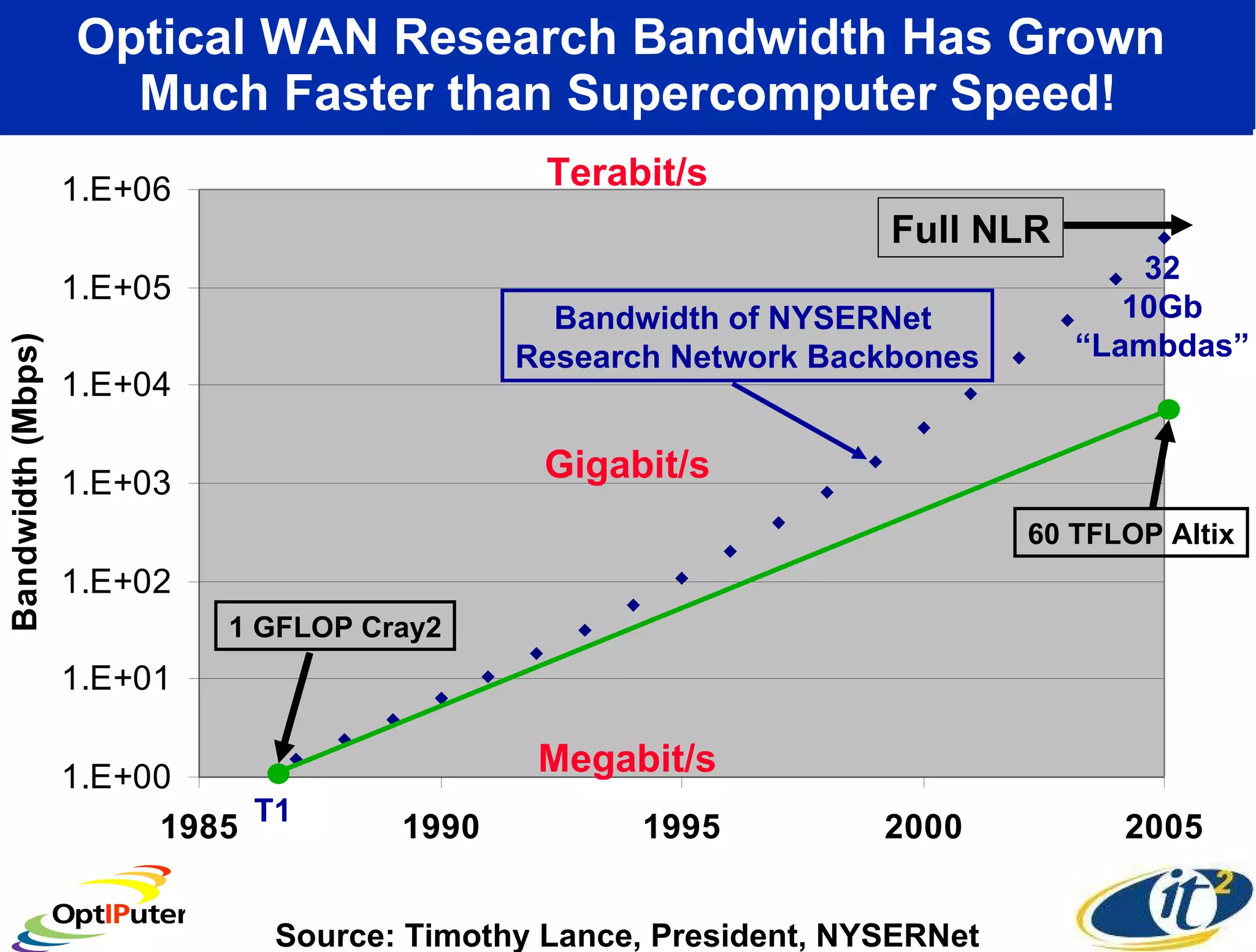
Optical WAN Research Bandwidth Has Grown  Much Faster than Supercomputer Speed! Megabit/s Gigabit/s Terabit/s Source: Timothy Lance, President, NYSERNet 1 GFLOP Cray2 60 TFLOP Altix Bandwidth of NYSERNet  Research Network Backbones T1 32 10Gb “ Lambdas” Full NLR
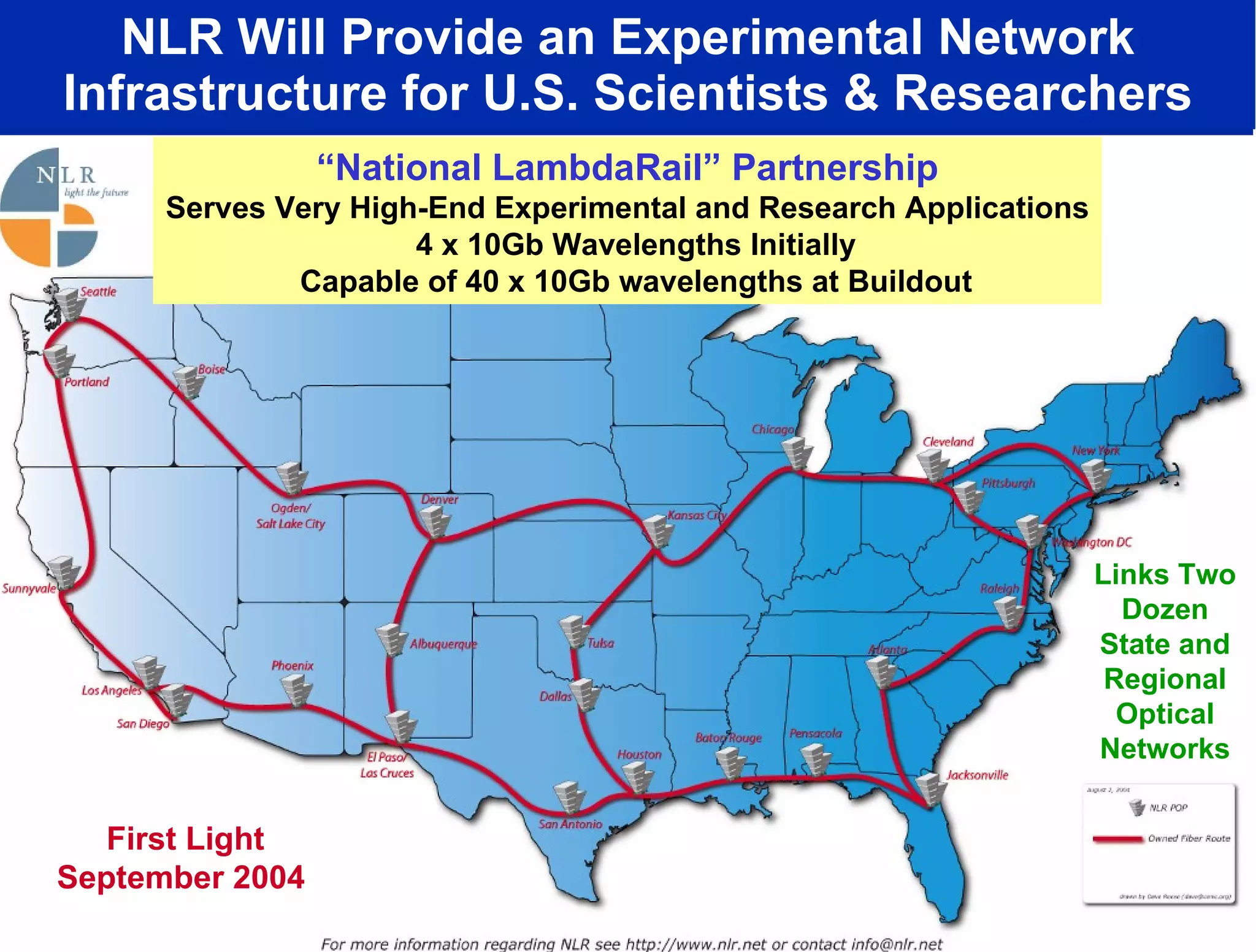
NLR Will Provide an Experimental Network Infrastructure for U.S. Scientists & Researchers First Light September 2004  “ National LambdaRail” Partnership Serves Very High-End Experimental and Research Applications 4 x 10Gb Wavelengths Initially Capable of 40 x 10Gb wavelengths at Buildout Links Two Dozen State and Regional Optical Networks
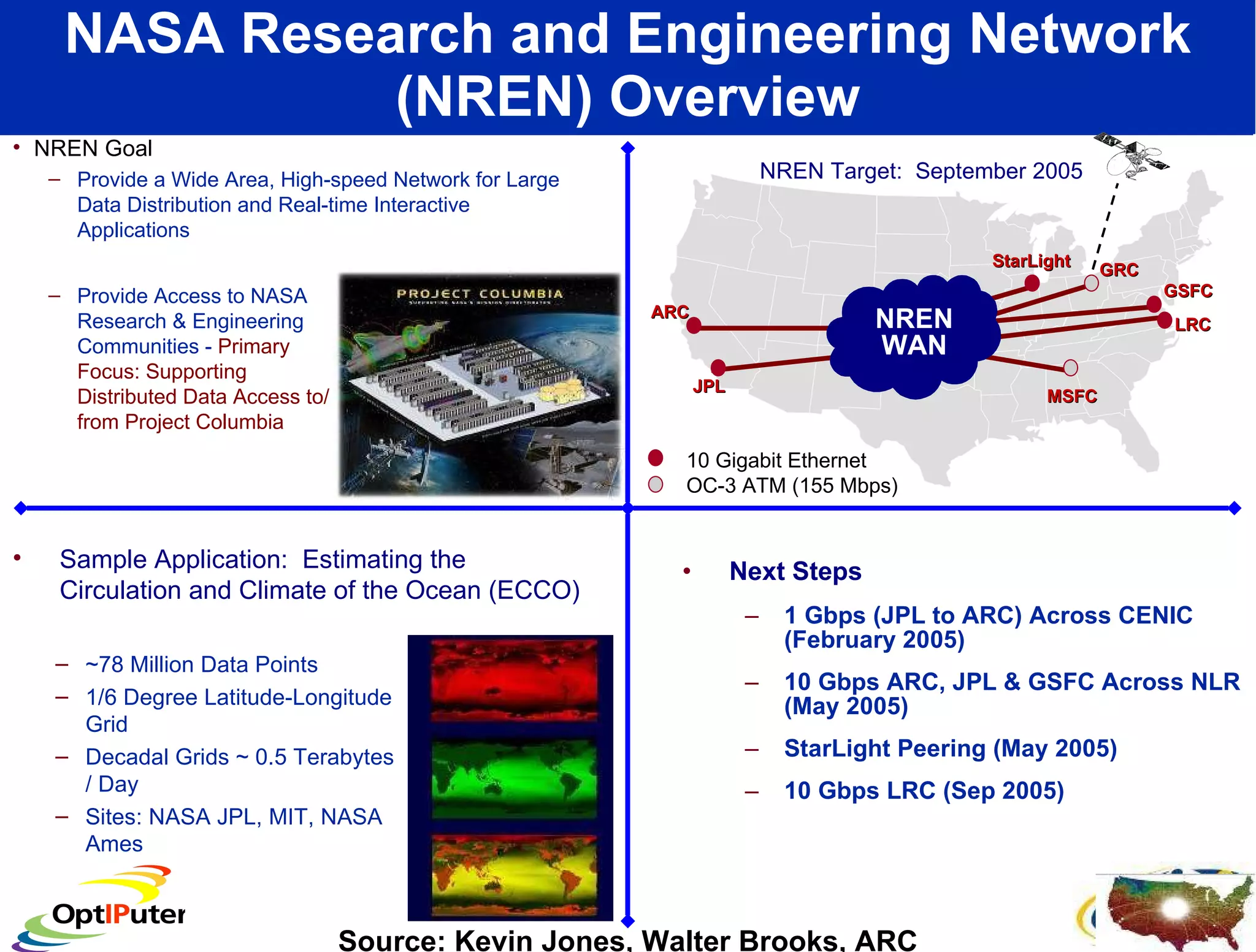
NASA Research and Engineering Network (NREN) Overview Next Steps 1 Gbps (JPL to ARC) Across CENIC (February 2005) 10 Gbps ARC, JPL & GSFC Across NLR (May 2005) StarLight Peering (May 2005) 10 Gbps LRC (Sep 2005) NREN Goal  Provide a Wide Area, High-speed Network for Large Data Distribution and Real-time Interactive Applications GSFC ARC StarLight LRC GRC MSFC JPL 10 Gigabit Ethernet OC-3 ATM (155 Mbps) NREN Target:  September 2005 Provide Access to NASA Research & Engineering Communities -  Primary Focus: Supporting Distributed Data Access to/from Project Columbia Sample Application:  Estimating the Circulation and Climate of the Ocean (ECCO) ~78 Million Data Points 1/6 Degree Latitude-Longitude Grid  Decadal Grids ~ 0.5 Terabytes / Day Sites: NASA JPL, MIT, NASA Ames Source: Kevin Jones, Walter Brooks, ARC NREN WAN
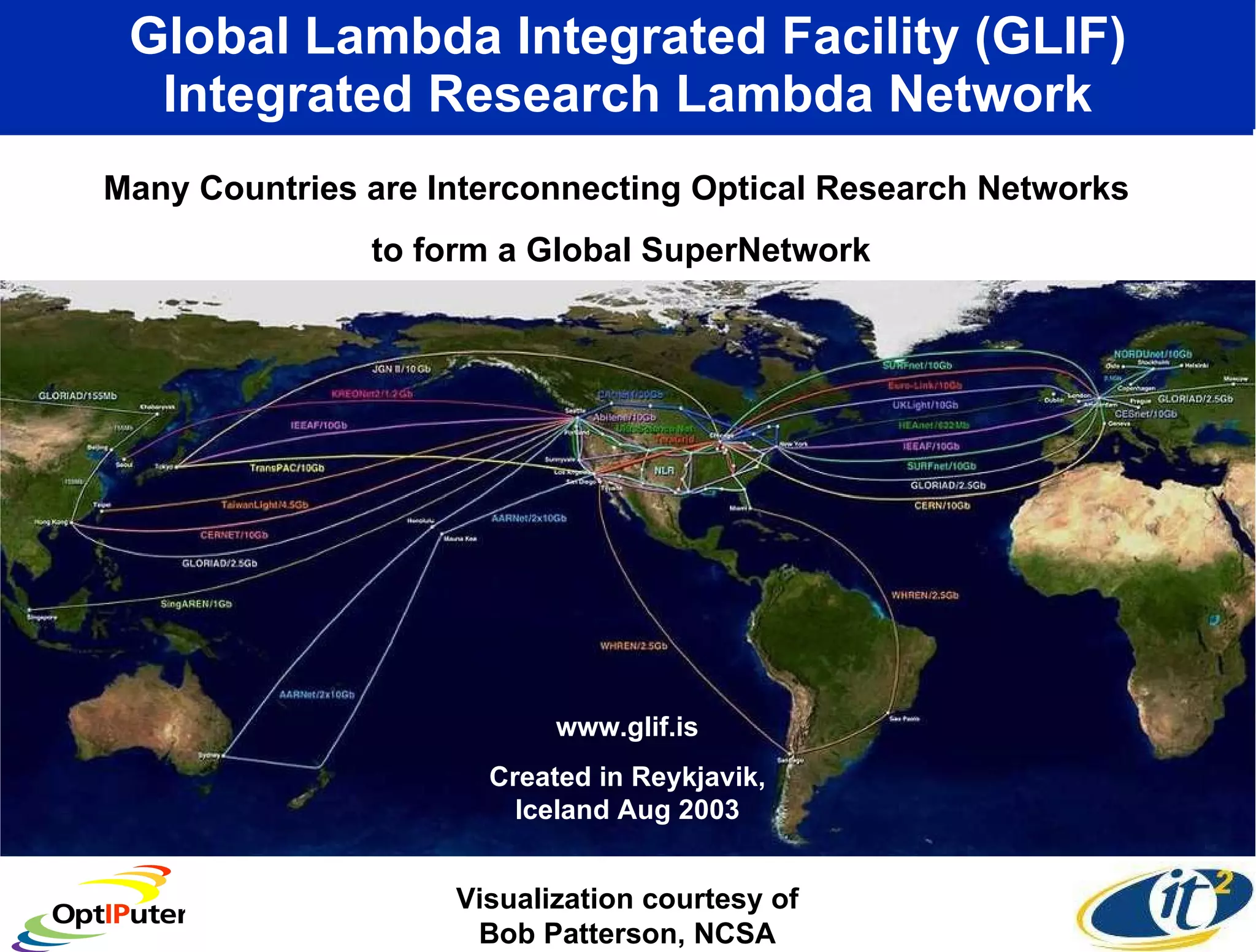
Global Lambda Integrated Facility (GLIF) Integrated Research Lambda Network Many Countries are Interconnecting Optical Research Networks  to form a Global SuperNetwork Visualization courtesy of Bob Patterson, NCSA www.glif.is Created in Reykjavik, Iceland Aug 2003
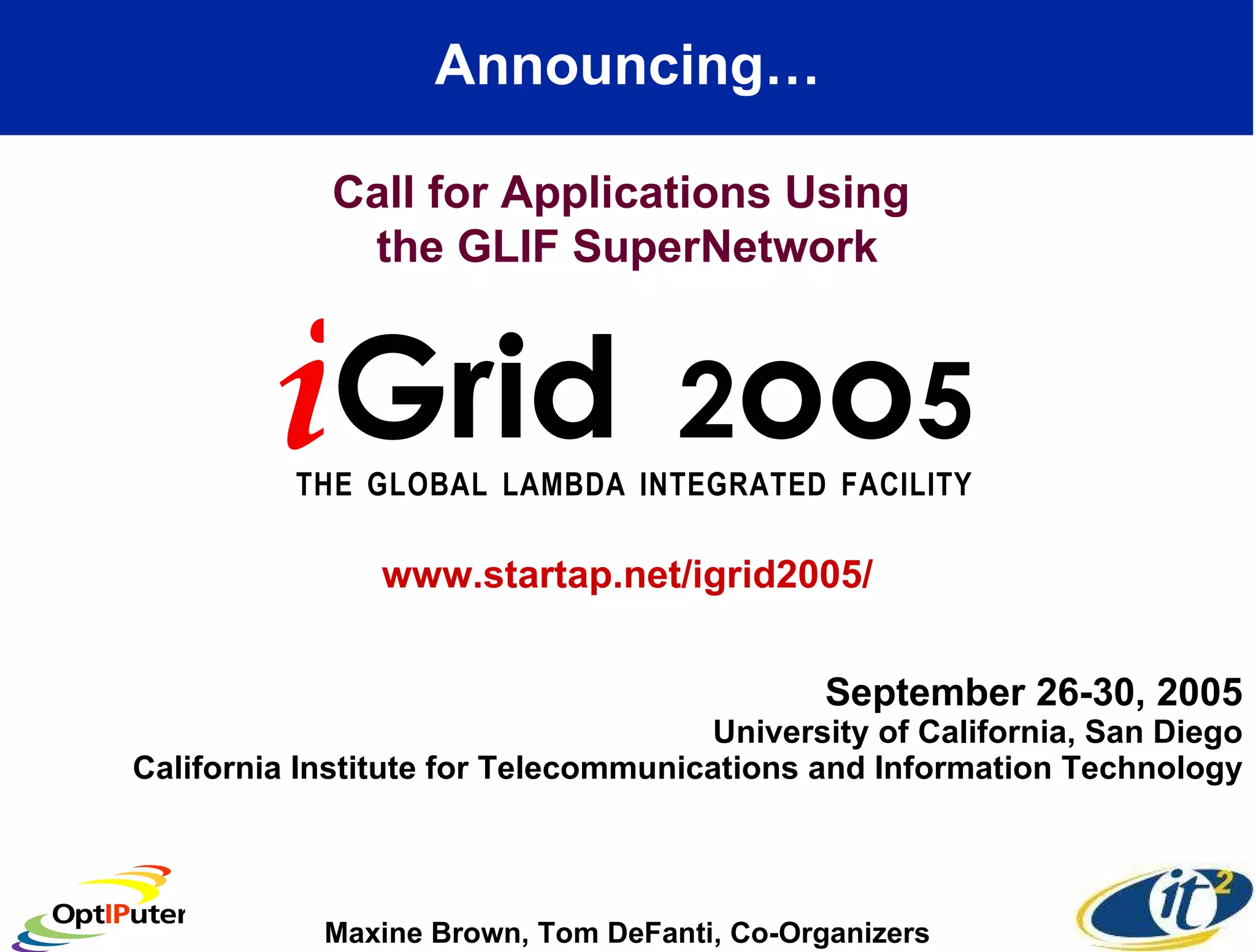
September 26-30, 2005 University of California, San Diego California Institute for Telecommunications and Information Technology Announcing… i Grid  2 oo 5 T   H   E  G   L   O   B   A   L  L   A   M   B   D   A  I   N   T   E   G   R   A   T   E   D  F   A   C   I   L   I   T   Y   Call for Applications Using  the GLIF SuperNetwork Maxine Brown, Tom DeFanti, Co-Organizers www.startap.net/igrid2005/
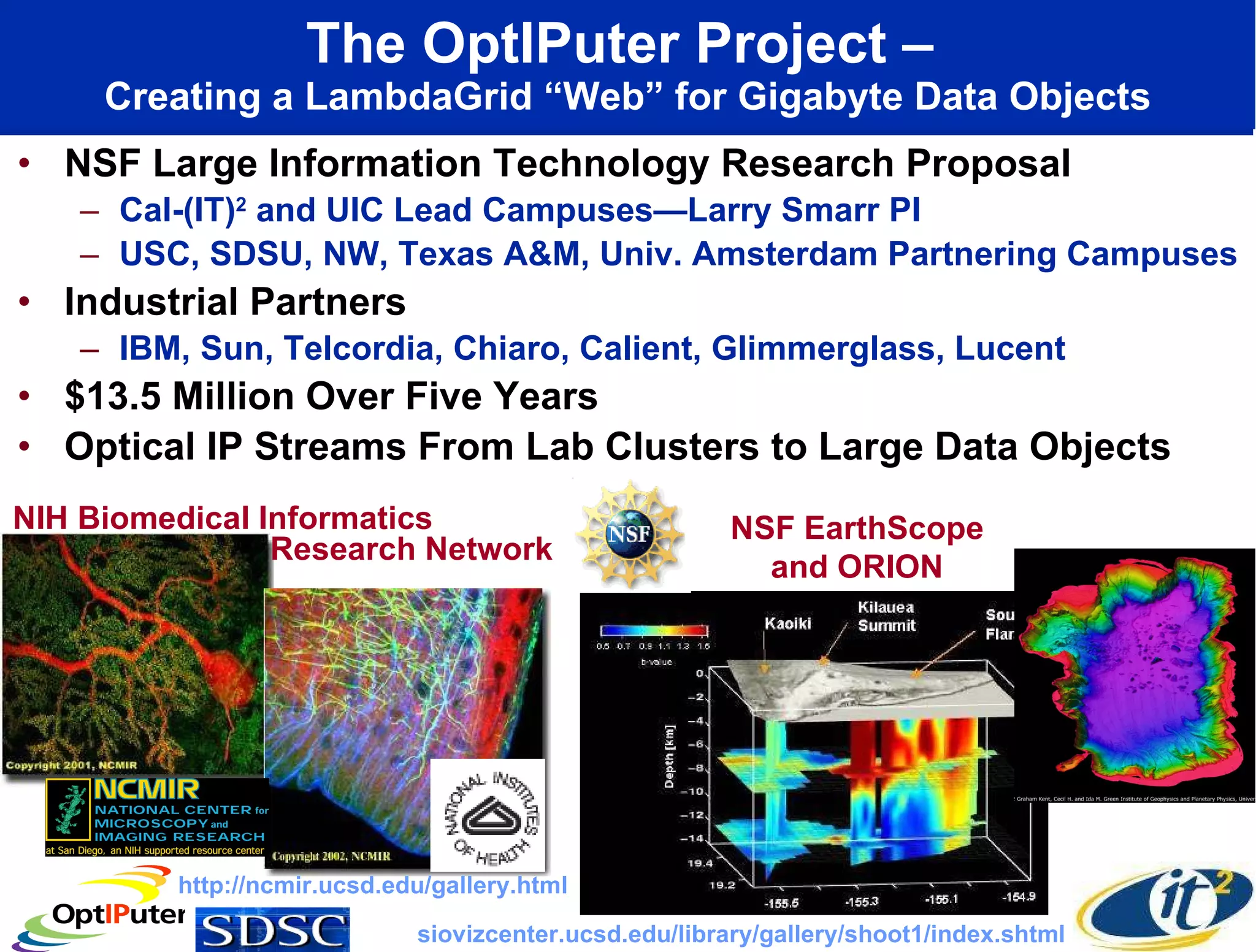
The OptIPuter Project –  Creating a LambdaGrid “Web” for Gigabyte Data Objects NSF Large Information Technology Research Proposal Cal-(IT) 2  and UIC Lead Campuses—Larry Smarr PI USC, SDSU, NW, Texas A&M, Univ. Amsterdam Partnering Campuses Industrial Partners IBM, Sun, Telcordia, Chiaro, Calient, Glimmerglass, Lucent $13.5 Million Over Five Years Optical IP Streams From Lab Clusters to Large Data Objects  NIH Biomedical Informatics NSF EarthScope and ORION http://ncmir.ucsd.edu/gallery.html siovizcenter.ucsd.edu/library/gallery/shoot1/index.shtml Research Network
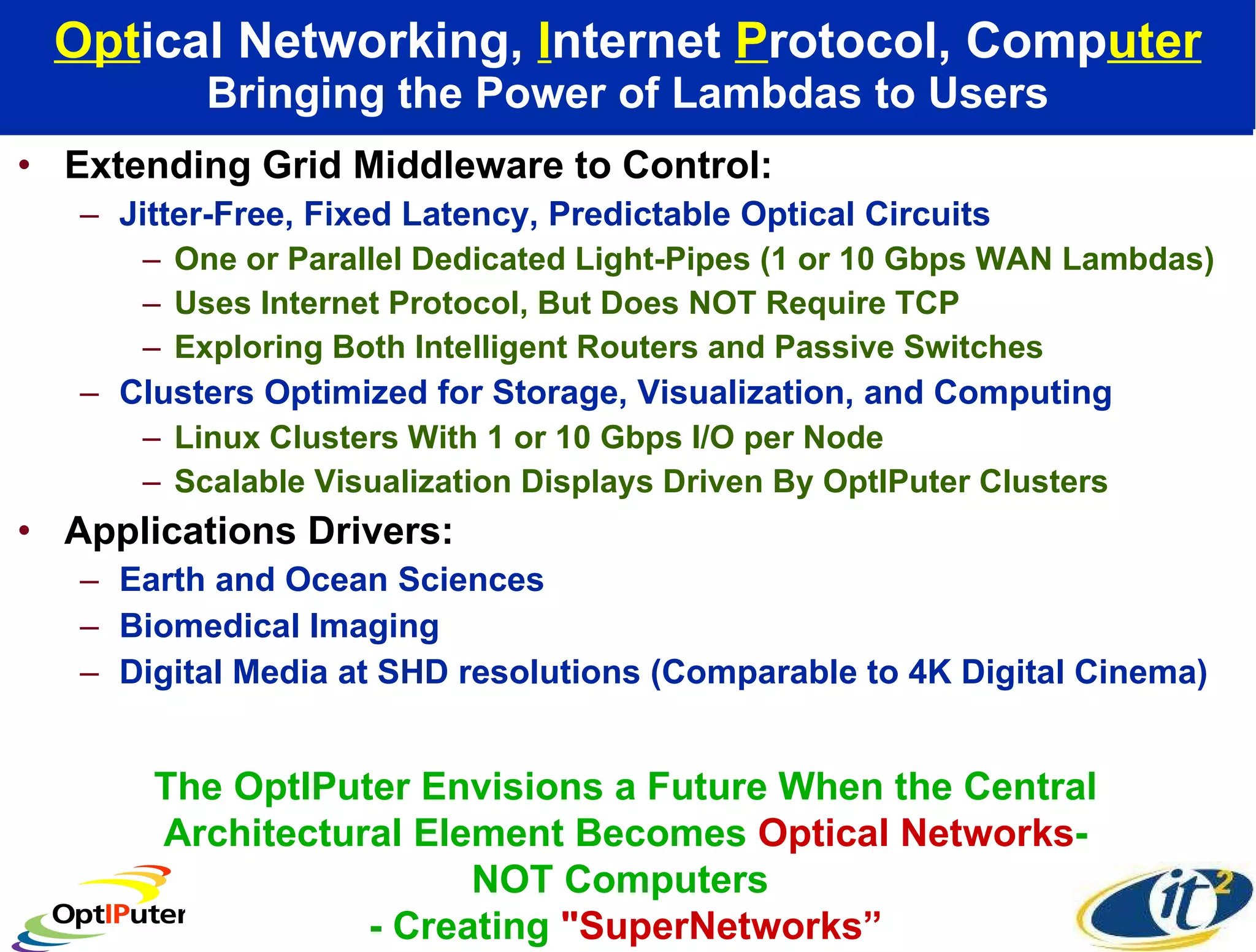
Opt ical Networking,  I nternet  P rotocol, Comp uter Bringing the Power of Lambdas to Users Extending Grid Middleware to Control: Jitter-Free, Fixed Latency, Predictable Optical Circuits One or Parallel Dedicated Light-Pipes (1 or 10 Gbps WAN Lambdas) Uses Internet Protocol, But Does NOT Require TCP  Exploring Both Intelligent Routers and Passive Switches Clusters Optimized for Storage, Visualization, and Computing Linux Clusters With 1 or 10 Gbps I/O per Node Scalable Visualization Displays Driven By OptIPuter Clusters Applications Drivers:  Earth and Ocean Sciences Biomedical Imaging Digital Media at SHD resolutions (Comparable to 4K Digital Cinema) The OptIPuter Envisions a Future When the Central Architectural Element Becomes  Optical Networks - NOT Computers  - Creating  "SuperNetworks”
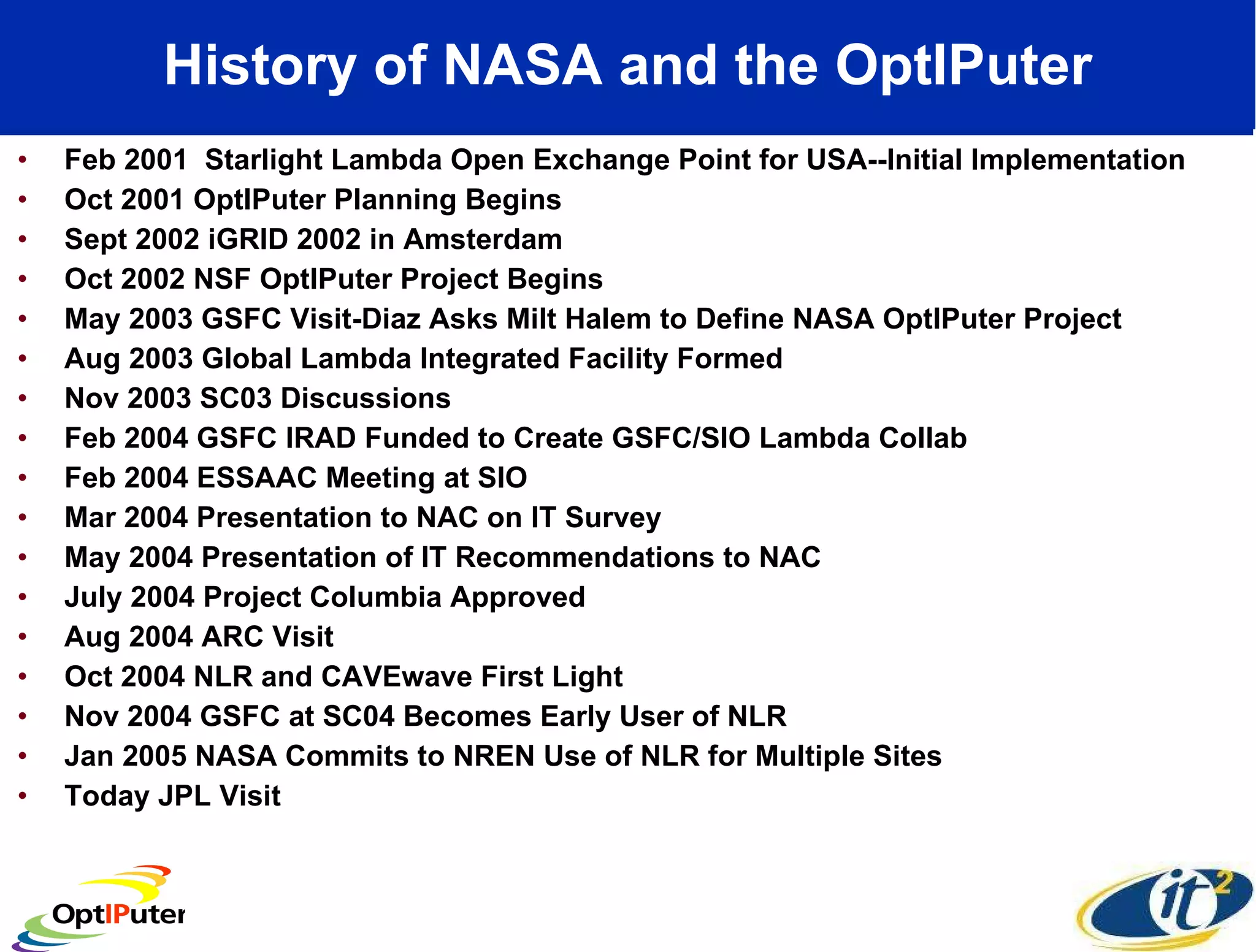
History of NASA and the OptIPuter Feb 2001  Starlight Lambda Open Exchange Point for USA--Initial Implementation Oct 2001 OptIPuter Planning Begins Sept 2002 iGRID 2002 in Amsterdam Oct 2002 NSF OptIPuter Project Begins May 2003 GSFC Visit-Diaz Asks Milt Halem to Define NASA OptIPuter Project Aug 2003 Global Lambda Integrated Facility Formed Nov 2003 SC03 Discussions Feb 2004 GSFC IRAD Funded to Create GSFC/SIO Lambda Collab Feb 2004 ESSAAC Meeting at SIO Mar 2004 Presentation to NAC on IT Survey May 2004 Presentation of IT Recommendations to NAC July 2004 Project Columbia Approved Aug 2004 ARC Visit Oct 2004 NLR and CAVEwave First Light Nov 2004 GSFC at SC04 Becomes Early User of NLR Jan 2005 NASA Commits to NREN Use of NLR for Multiple Sites Today JPL Visit
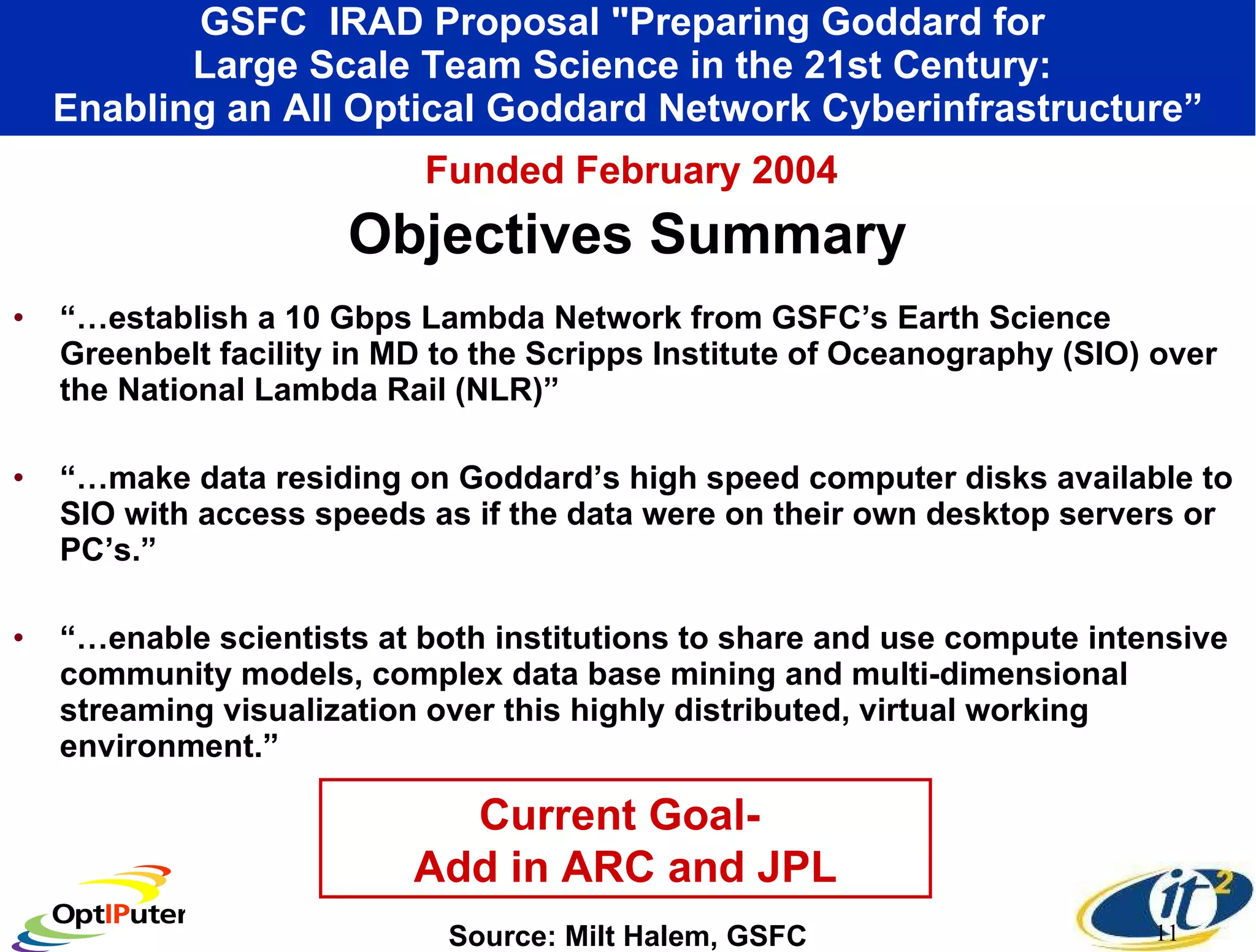
GSFC  IRAD Proposal "Preparing Goddard for  Large Scale Team Science in the 21st Century:  Enabling an All Optical Goddard Network Cyberinfrastructure” “… establish a 10 Gbps Lambda Network from GSFC’s Earth Science Greenbelt facility in MD to the Scripps Institute of Oceanography (SIO) over the National Lambda Rail (NLR)” “… make data residing on Goddard’s high speed computer disks available to SIO with access speeds as if the data were on their own desktop servers or PC’s.” “… enable scientists at both institutions to share and use compute intensive community models, complex data base mining and multi-dimensional streaming visualization over this highly distributed, virtual working environment.”  Source: Milt Halem, GSFC Objectives Summary Funded February 2004  Current Goal-  Add in ARC and JPL
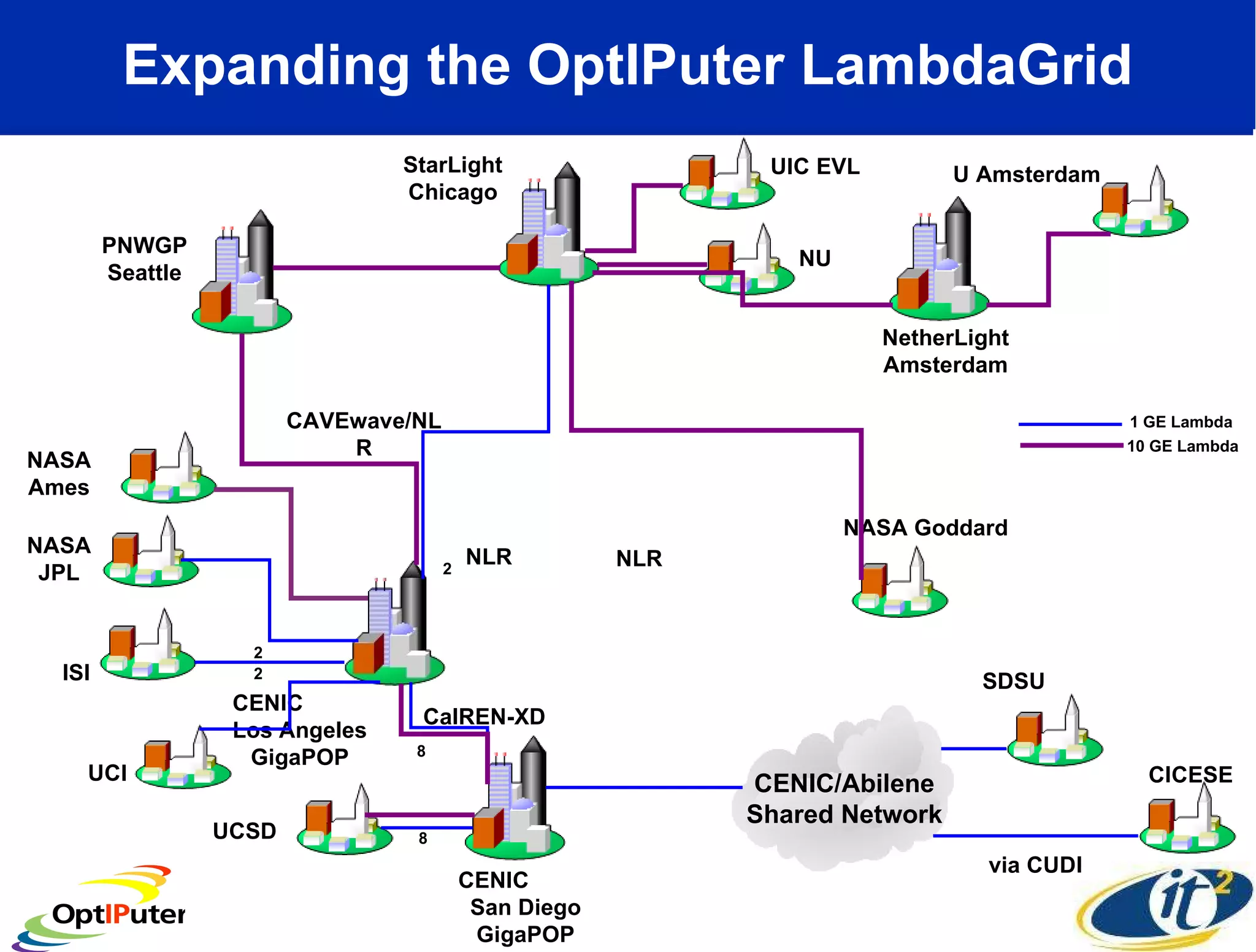
Expanding the OptIPuter LambdaGrid 1 GE Lambda 10 GE Lambda UCSD StarLight Chicago UIC EVL NU CENIC  San Diego GigaPOP CalREN-XD 8 8 NetherLight Amsterdam U Amsterdam NASA Ames NASA Goddard NLR NLR 2 SDSU CICESE via CUDI CENIC/Abilene Shared Network PNWGP Seattle CAVEwave/NLR NASA JPL ISI   UCI CENIC  Los Angeles GigaPOP 2 2
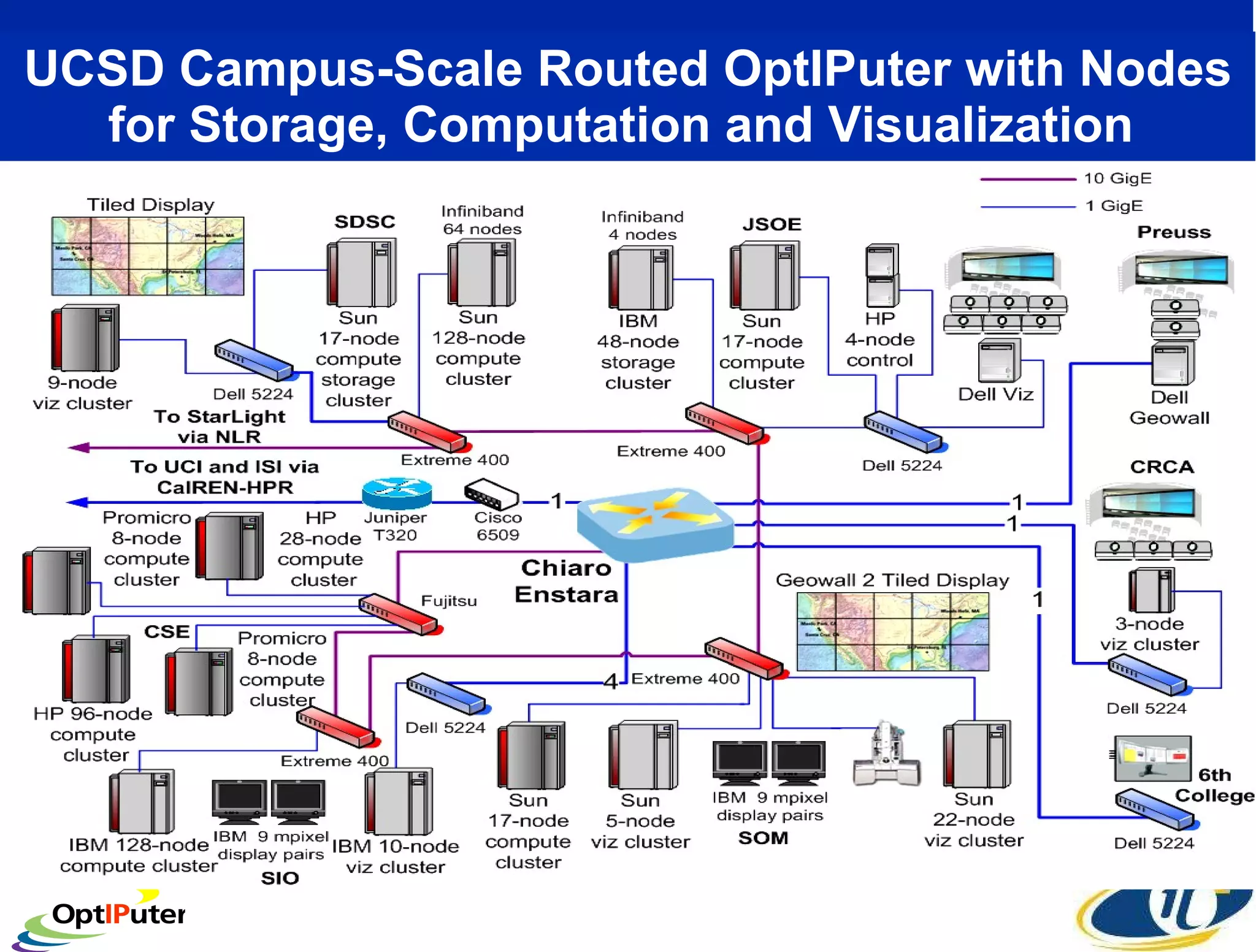
UCSD Campus-Scale Routed OptIPuter with Nodes for Storage, Computation and Visualization
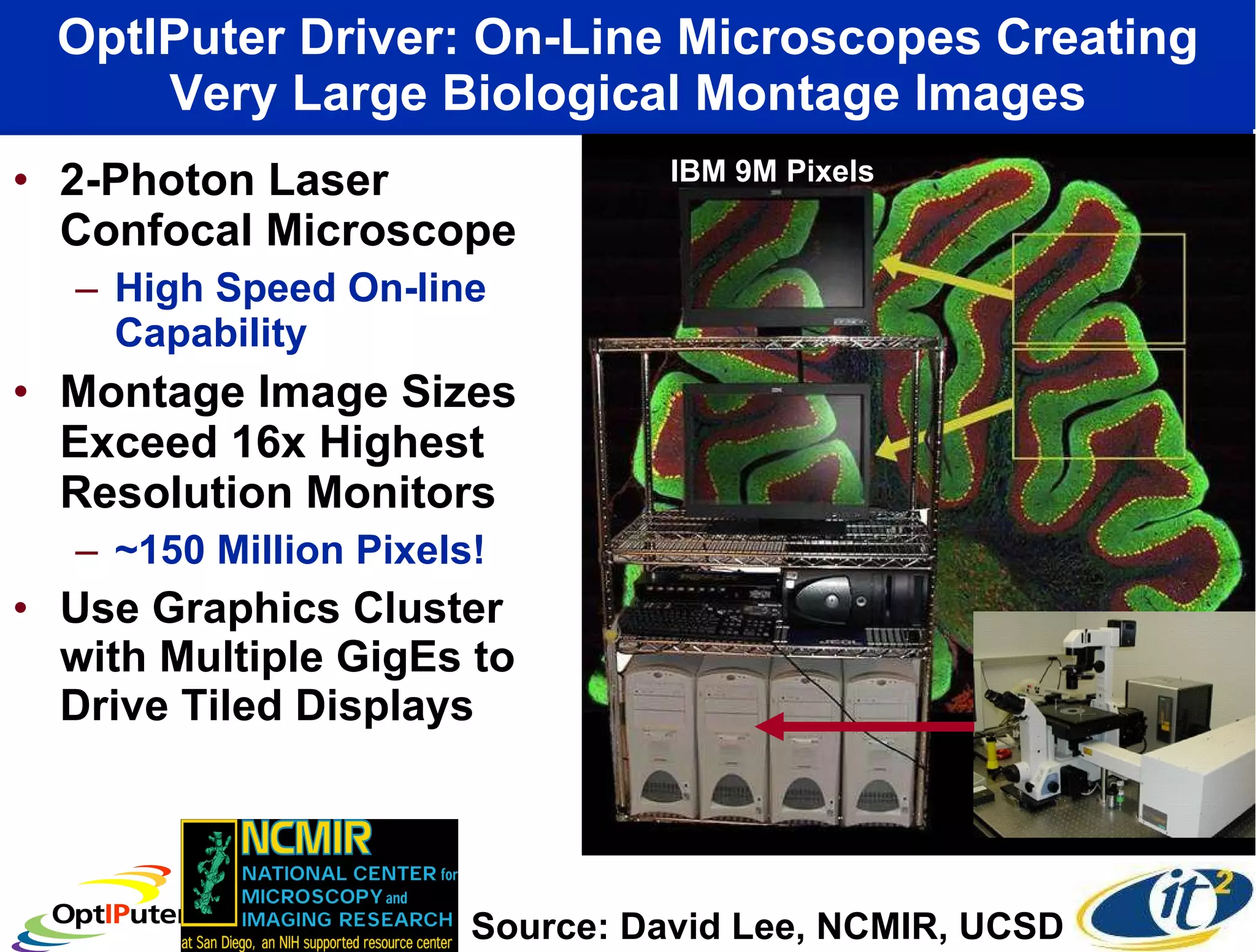
OptIPuter Driver: On-Line Microscopes Creating Very Large Biological Montage Images 2-Photon Laser Confocal Microscope High Speed On-line Capability Montage Image Sizes Exceed 16x Highest Resolution Monitors ~150 Million Pixels!  Use Graphics Cluster with Multiple GigEs to Drive Tiled Displays Source: David Lee, NCMIR, UCSD IBM 9M Pixels
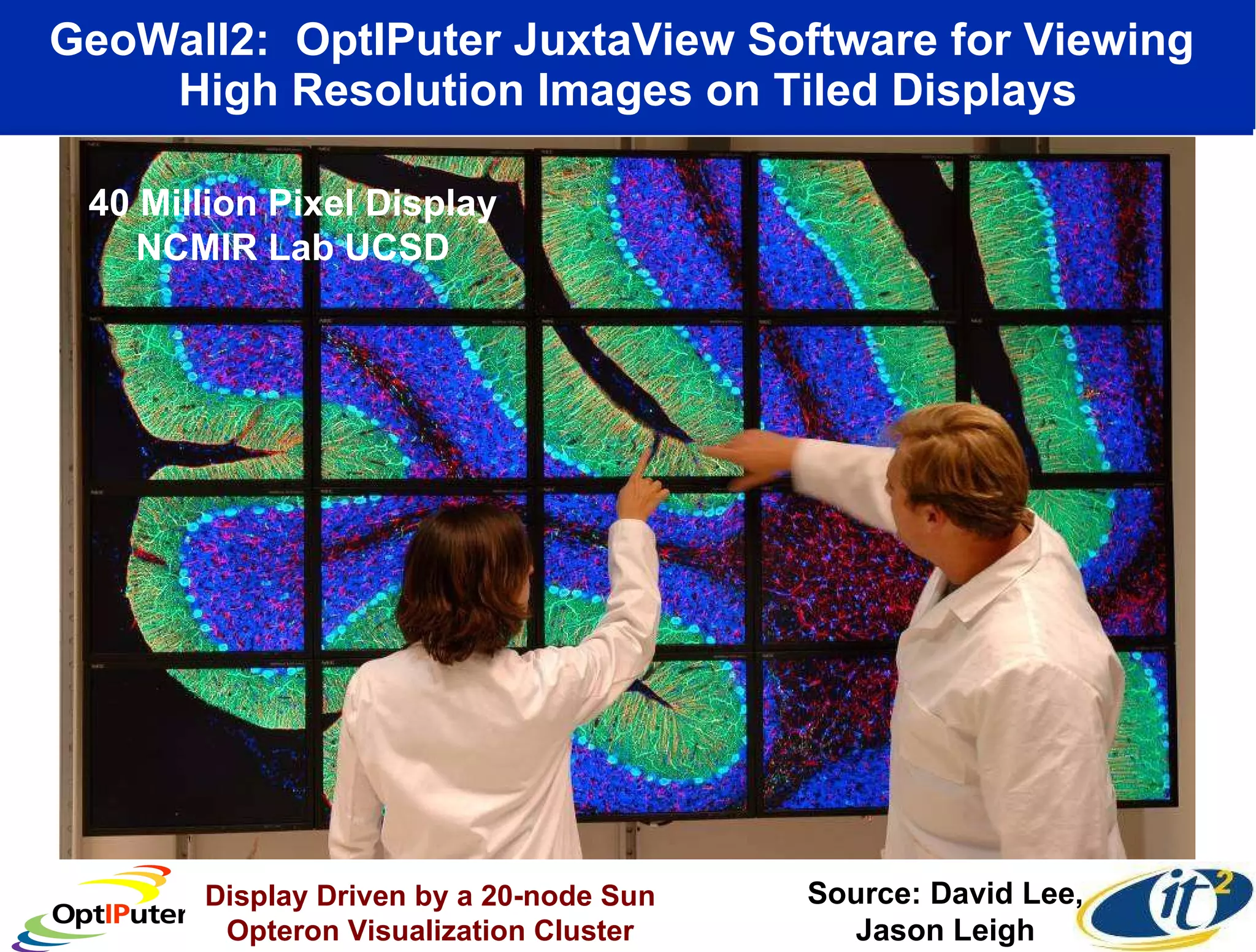
GeoWall2:  OptIPuter JuxtaView Software for Viewing  High Resolution Images on Tiled Displays 40 Million Pixel Display NCMIR Lab UCSD Source: David Lee, Jason Leigh Display Driven by a 20-node Sun Opteron Visualization Cluster
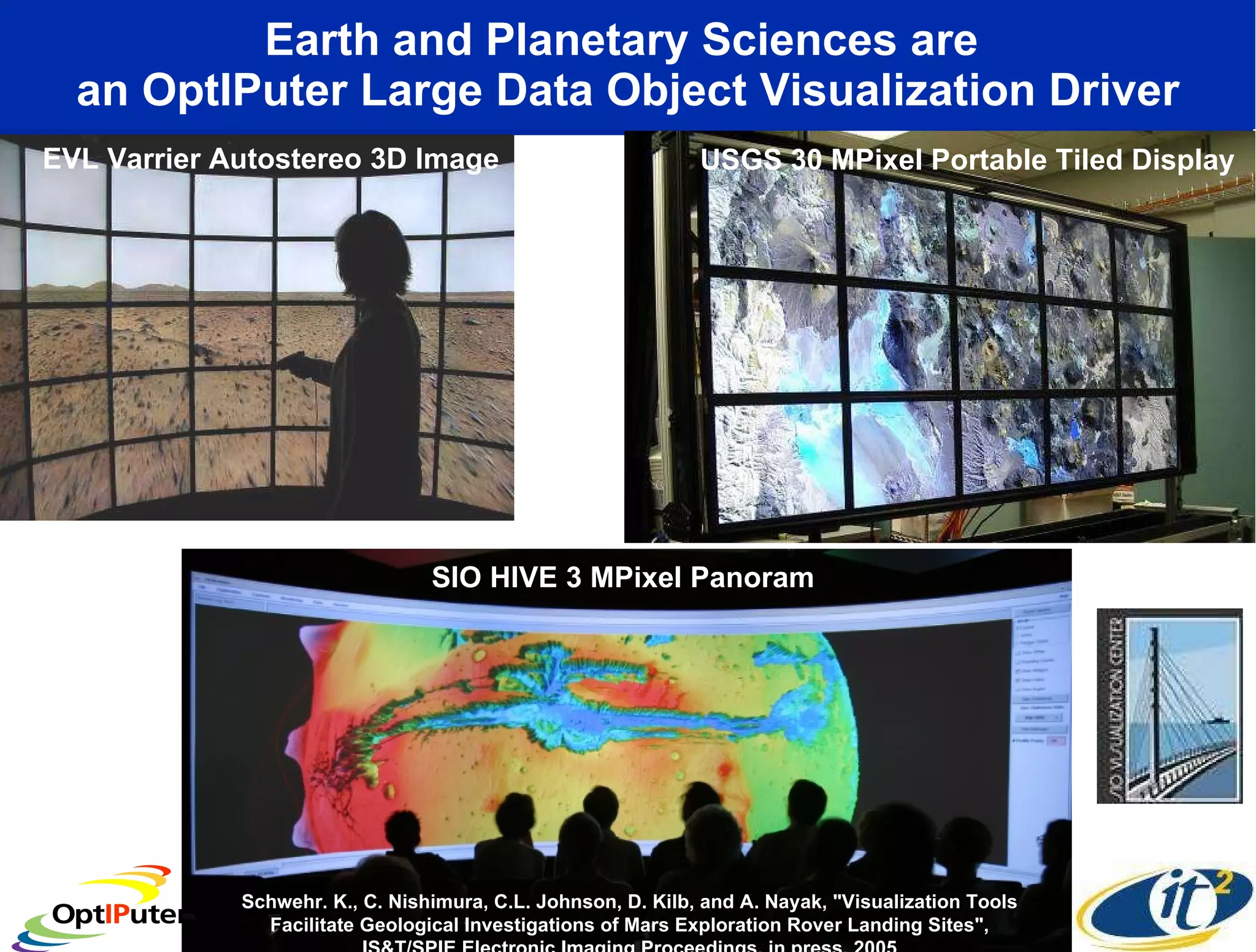
Earth and Planetary Sciences are  an OptIPuter Large Data Object Visualization Driver EVL Varrier Autostereo 3D Image  USGS 30 MPixel Portable Tiled Display  SIO HIVE 3 MPixel Panoram  Schwehr. K., C. Nishimura, C.L. Johnson, D. Kilb, and A. Nayak, "Visualization Tools Facilitate Geological Investigations of Mars Exploration Rover Landing Sites", IS&T/SPIE Electronic Imaging Proceedings, in press, 2005
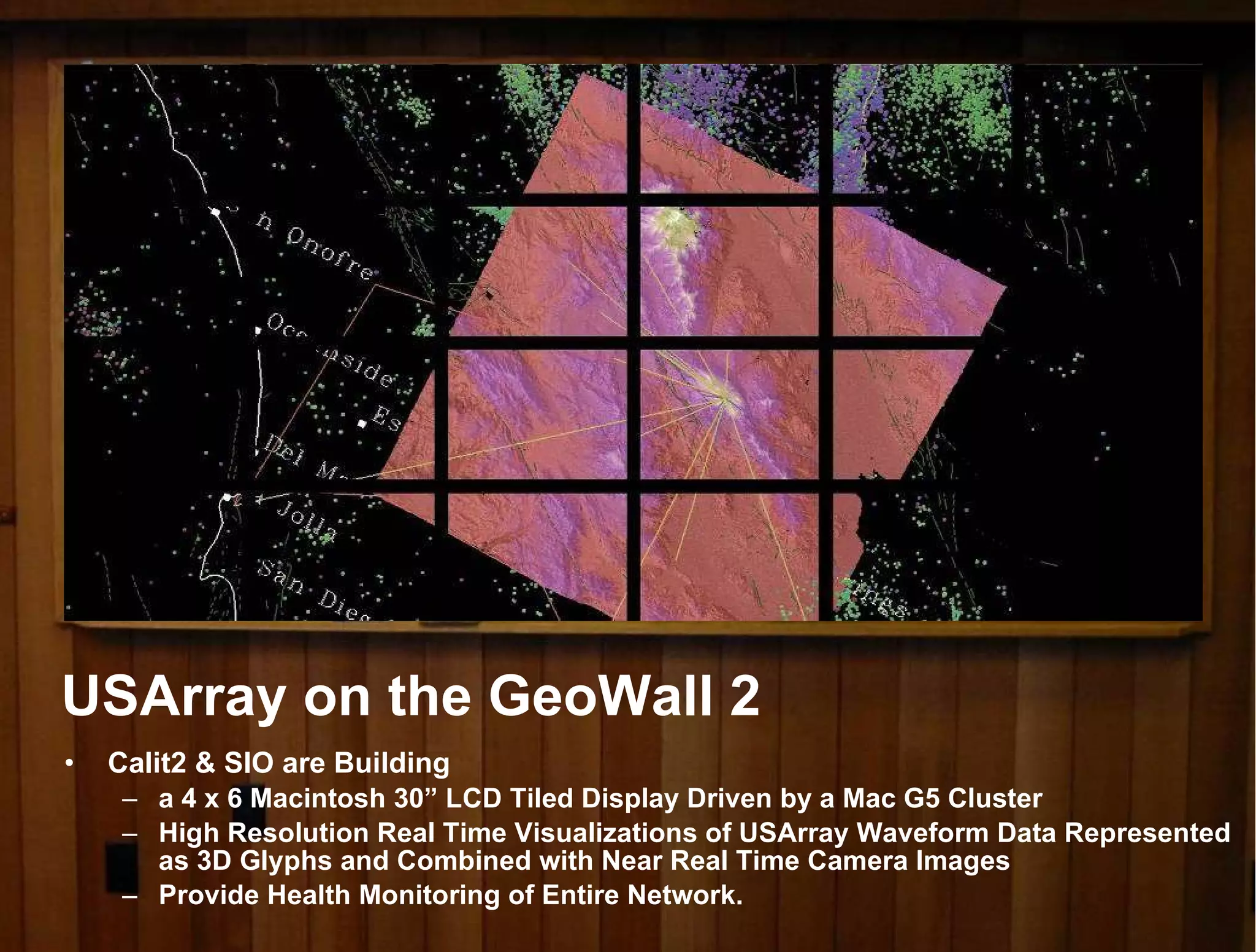
Calit2 & SIO are Building  a 4 x 6 Macintosh 30” LCD Tiled Display Driven by a Mac G5 Cluster High Resolution Real Time Visualizations of USArray Waveform Data Represented as 3D Glyphs and Combined with Near Real Time Camera Images Provide Health Monitoring of Entire Network. USArray on the GeoWall 2
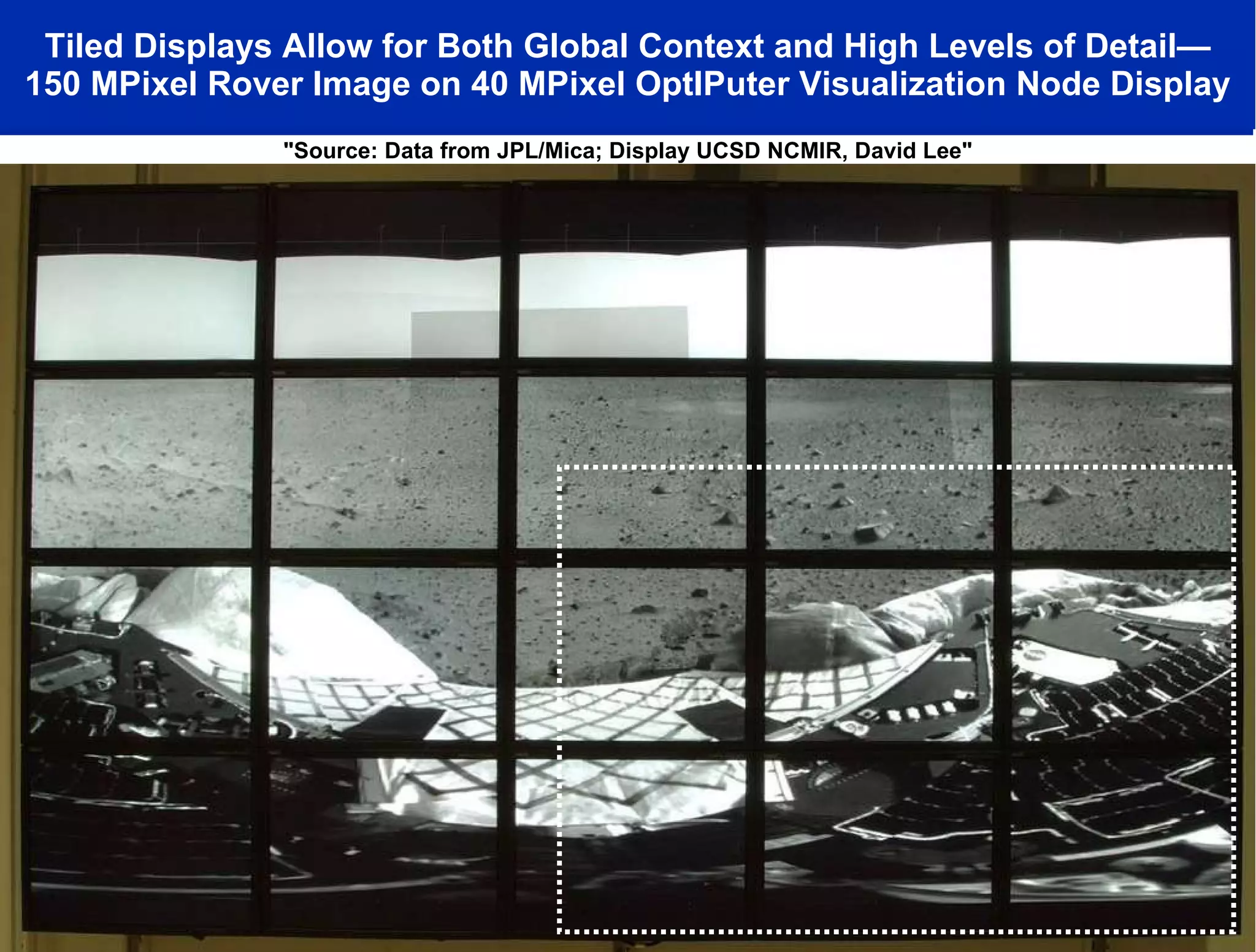
Tiled Displays Allow for Both Global Context and High Levels of Detail— 150 MPixel Rover Image on 40 MPixel OptIPuter Visualization Node Display "Source: Data from JPL/Mica; Display UCSD NCMIR, David Lee"
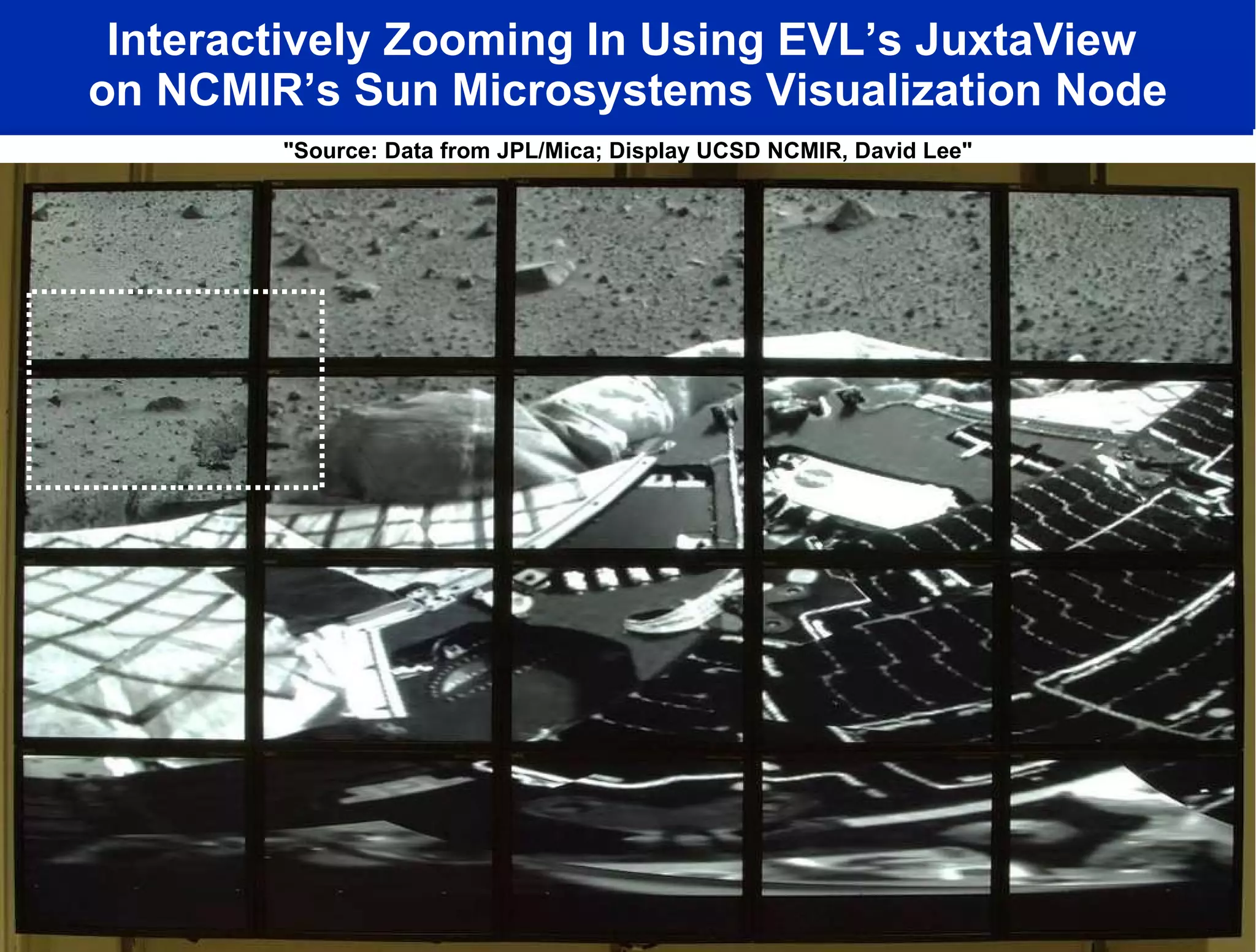
Interactively Zooming In Using EVL’s JuxtaView  on NCMIR’s Sun Microsystems Visualization Node "Source: Data from JPL/Mica; Display UCSD NCMIR, David Lee"
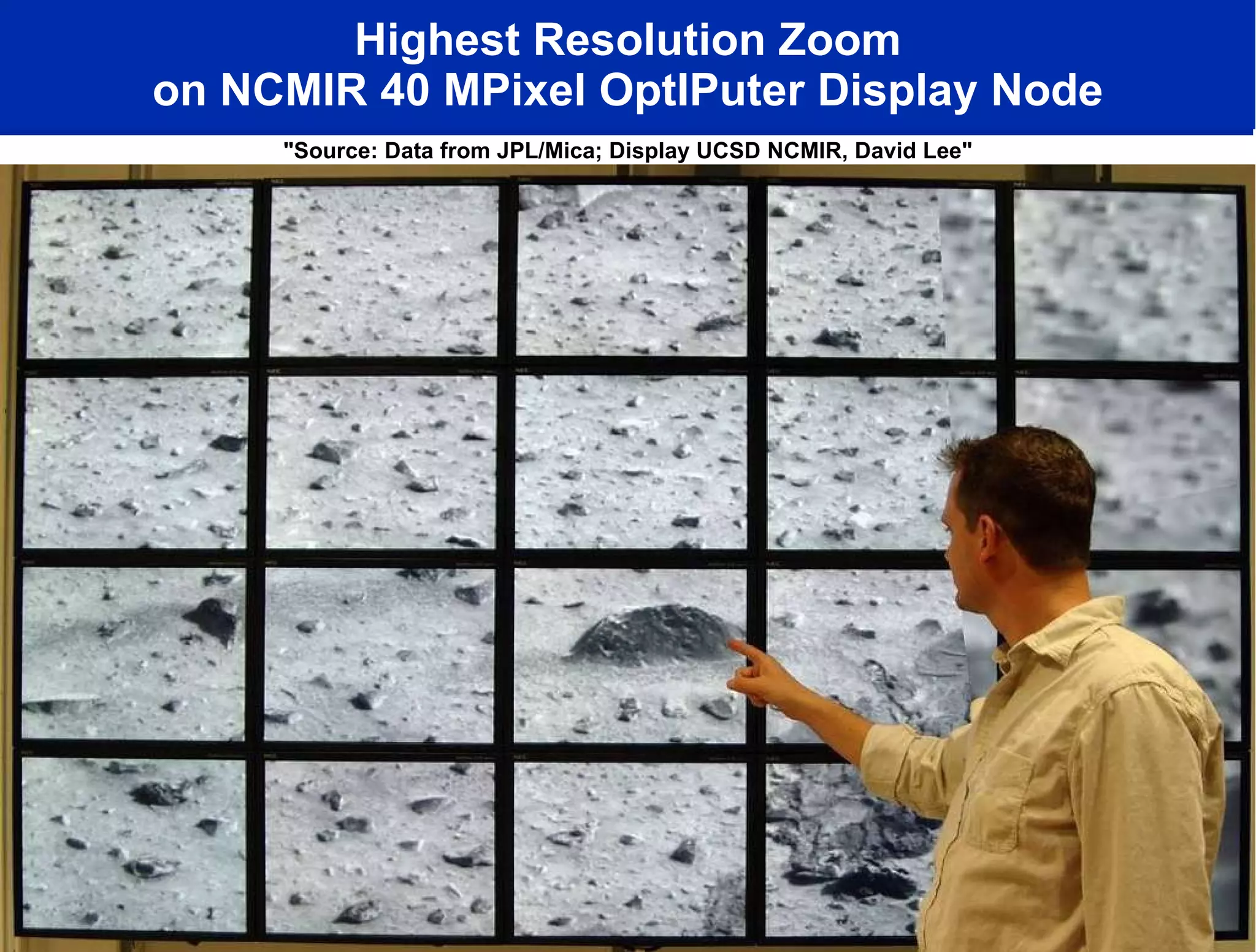
Highest Resolution Zoom on NCMIR 40 MPixel OptIPuter Display Node "Source: Data from JPL/Mica; Display UCSD NCMIR, David Lee"
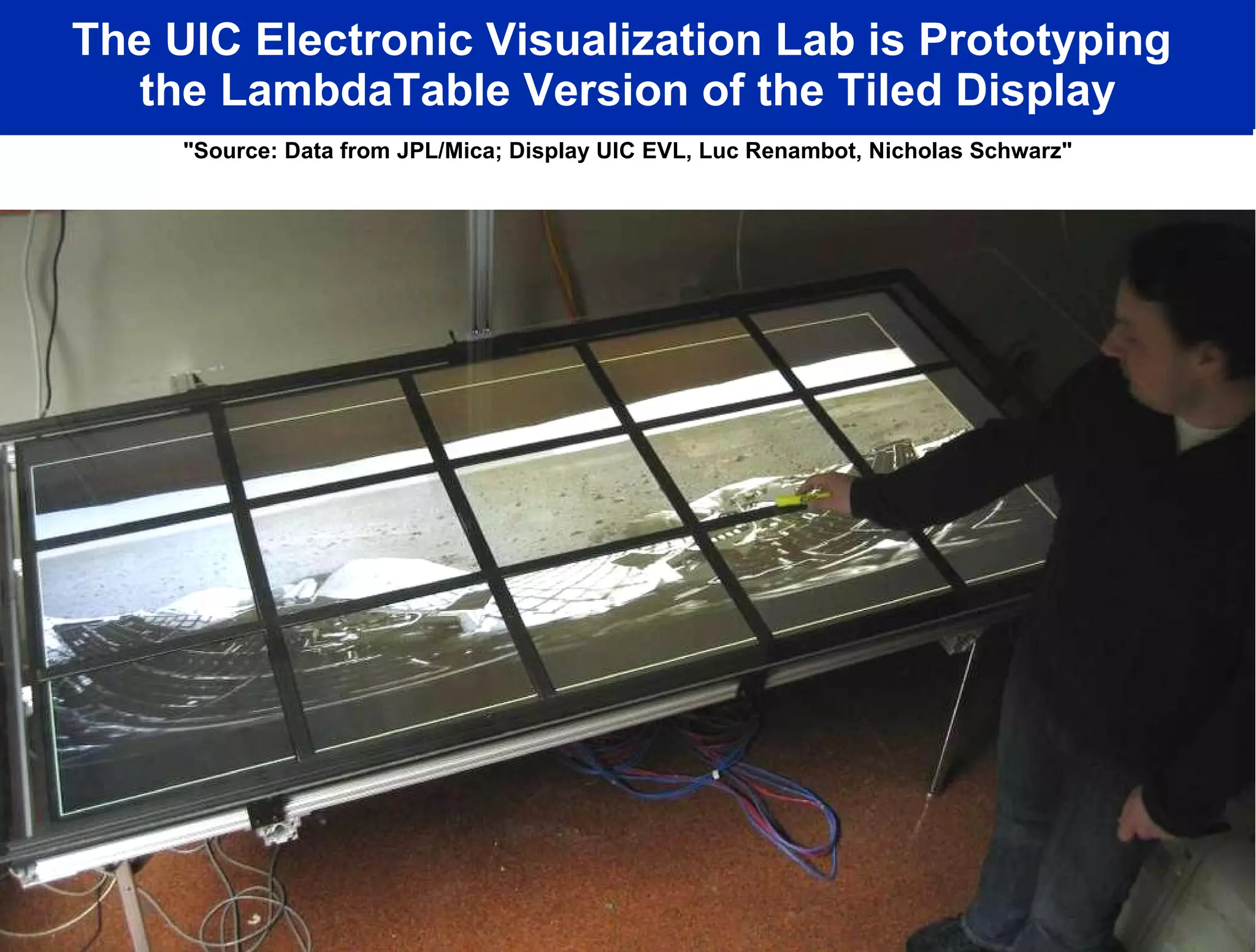
The UIC Electronic Visualization Lab is Prototyping  the LambdaTable Version of the Tiled Display "Source: Data from JPL/Mica; Display UIC EVL, Luc Renambot, Nicholas Schwarz"
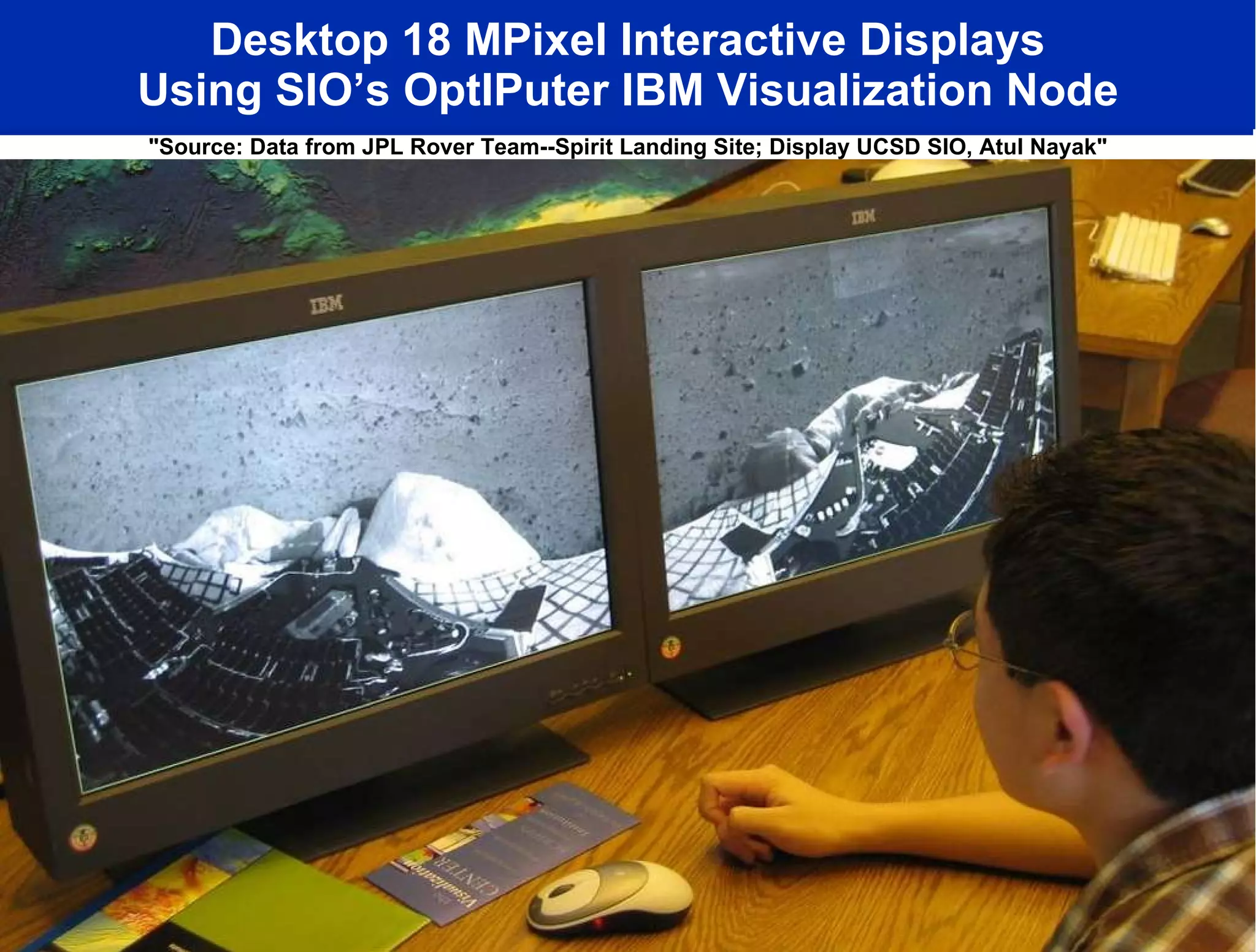
Desktop 18 MPixel Interactive Displays Using SIO’s OptIPuter IBM Visualization Node "Source: Data from JPL Rover Team--Spirit Landing Site; Display UCSD SIO, Atul Nayak"
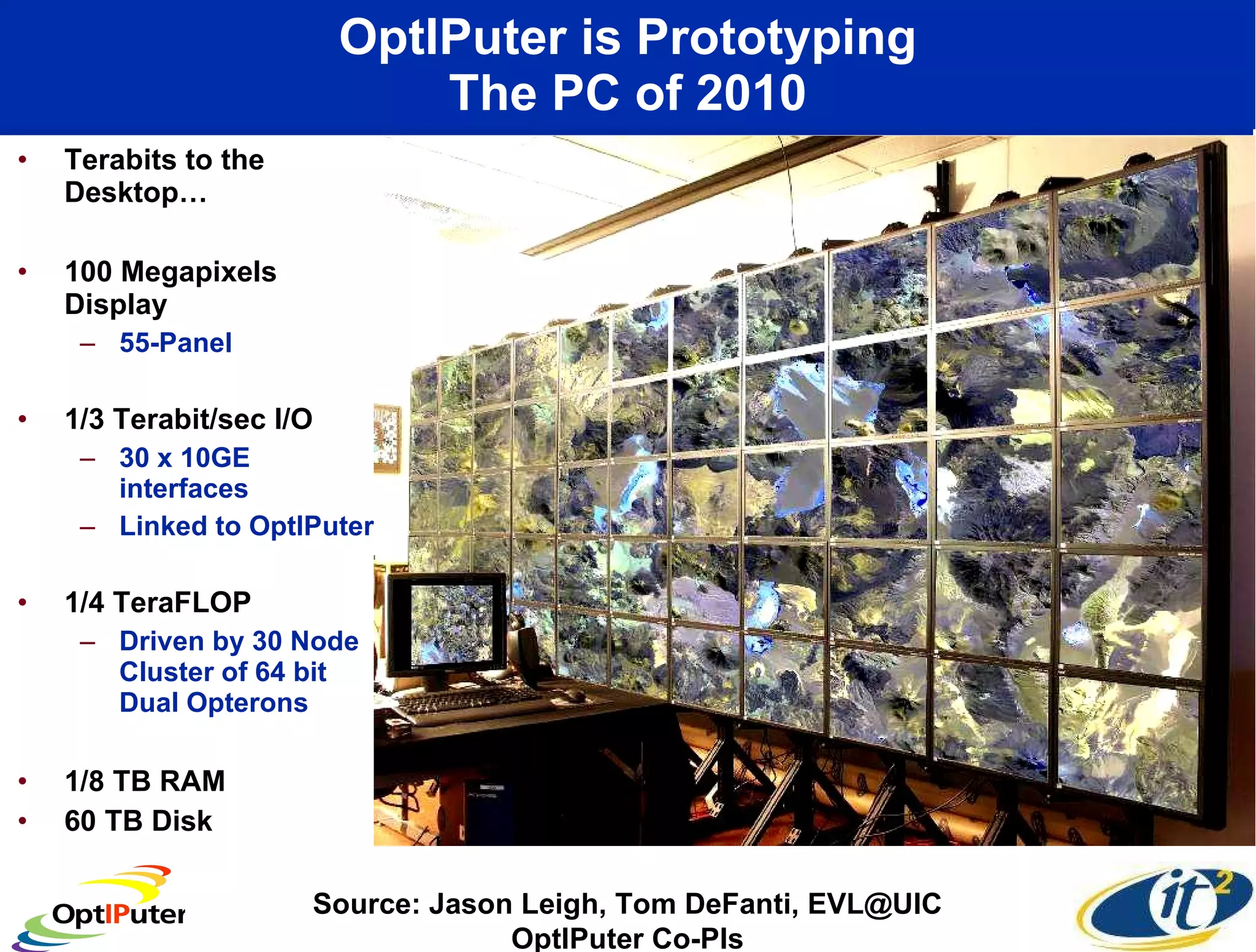
OptIPuter is Prototyping The PC of 2010 Terabits to the Desktop… 100 Megapixels Display  55-Panel 1/3 Terabit/sec I/O 30 x 10GE interfaces Linked to OptIPuter 1/4 TeraFLOP  Driven by 30 Node Cluster of 64 bit Dual Opterons 1/8 TB RAM 60 TB Disk Source: Jason Leigh, Tom DeFanti, EVL@UIC OptIPuter Co-PIs
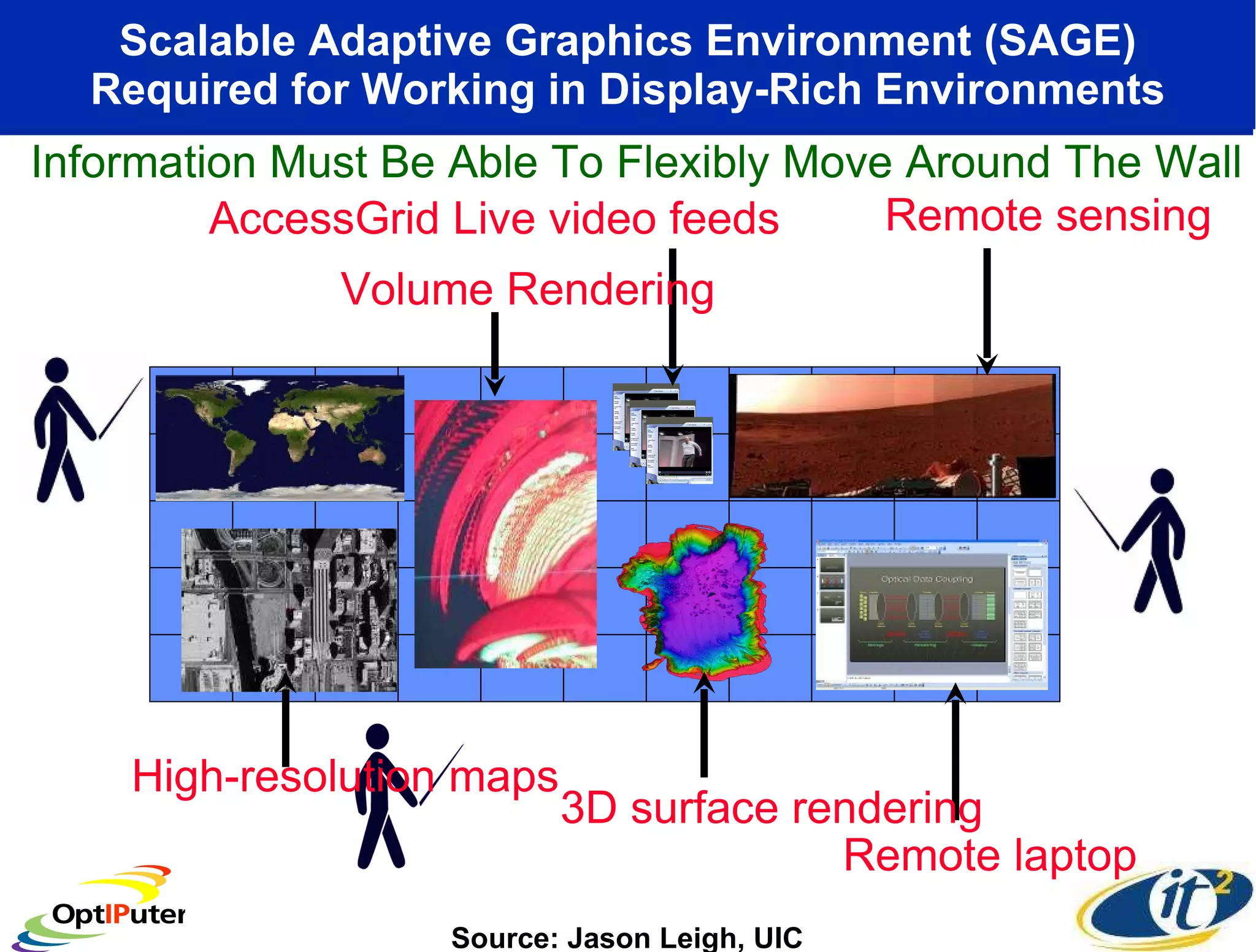
Scalable Adaptive Graphics Environment (SAGE) Required for Working in Display-Rich Environments AccessGrid Live video feeds Information Must Be Able To Flexibly Move Around The Wall Source: Jason Leigh, UIC Remote laptop High-resolution maps 3D surface rendering Volume Rendering Remote sensing
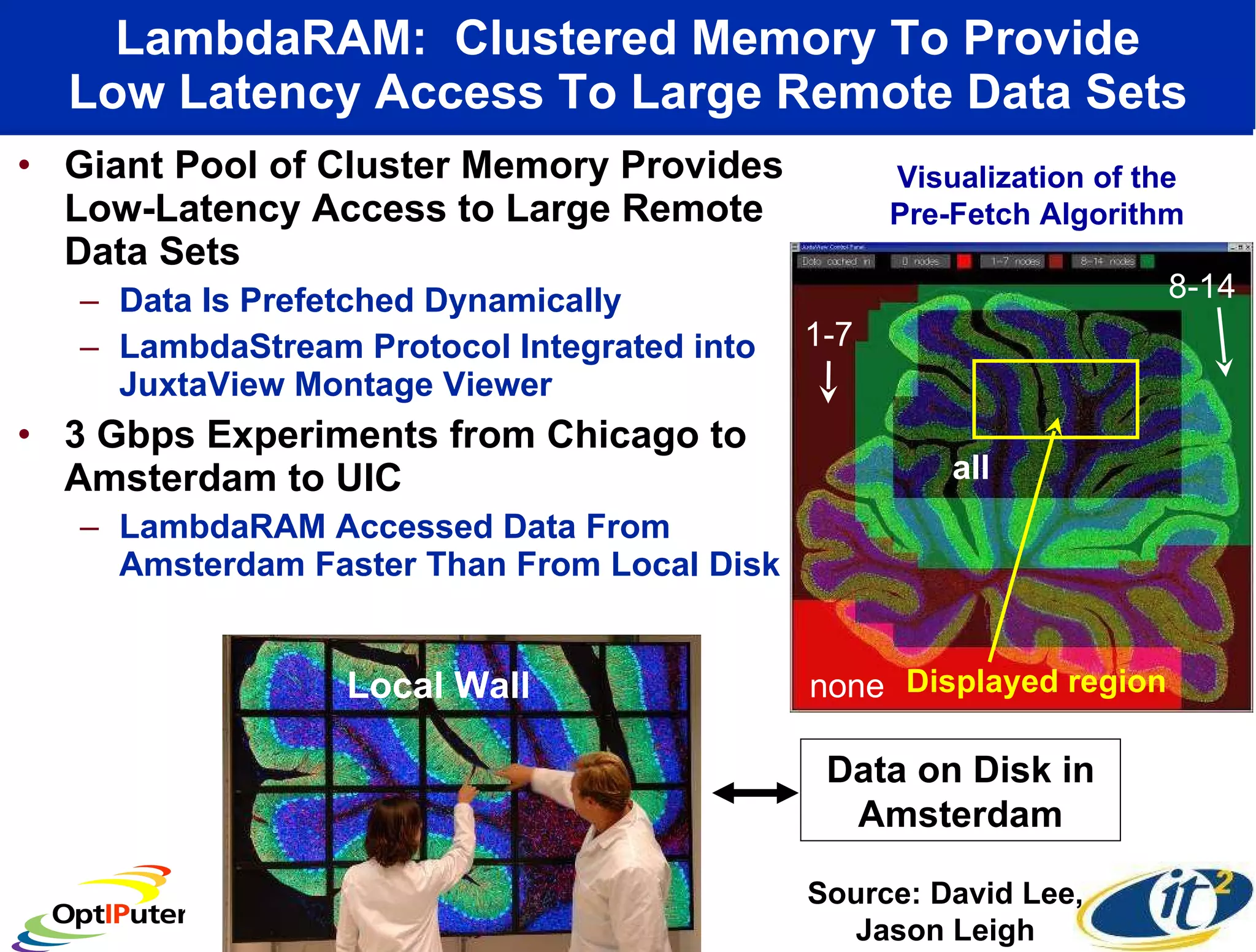
LambdaRAM:  Clustered Memory To Provide Low Latency Access To Large Remote Data Sets Giant Pool of Cluster Memory Provides Low-Latency Access to Large Remote Data Sets  Data Is Prefetched Dynamically LambdaStream Protocol Integrated into JuxtaView Montage Viewer 3 Gbps Experiments from Chicago to Amsterdam to UIC  LambdaRAM Accessed Data From Amsterdam Faster Than From Local Disk all 8-14 none all 8-14 1-7 Displayed region Visualization of the Pre-Fetch Algorithm none Data on Disk in Amsterdam Local Wall Source: David Lee, Jason Leigh
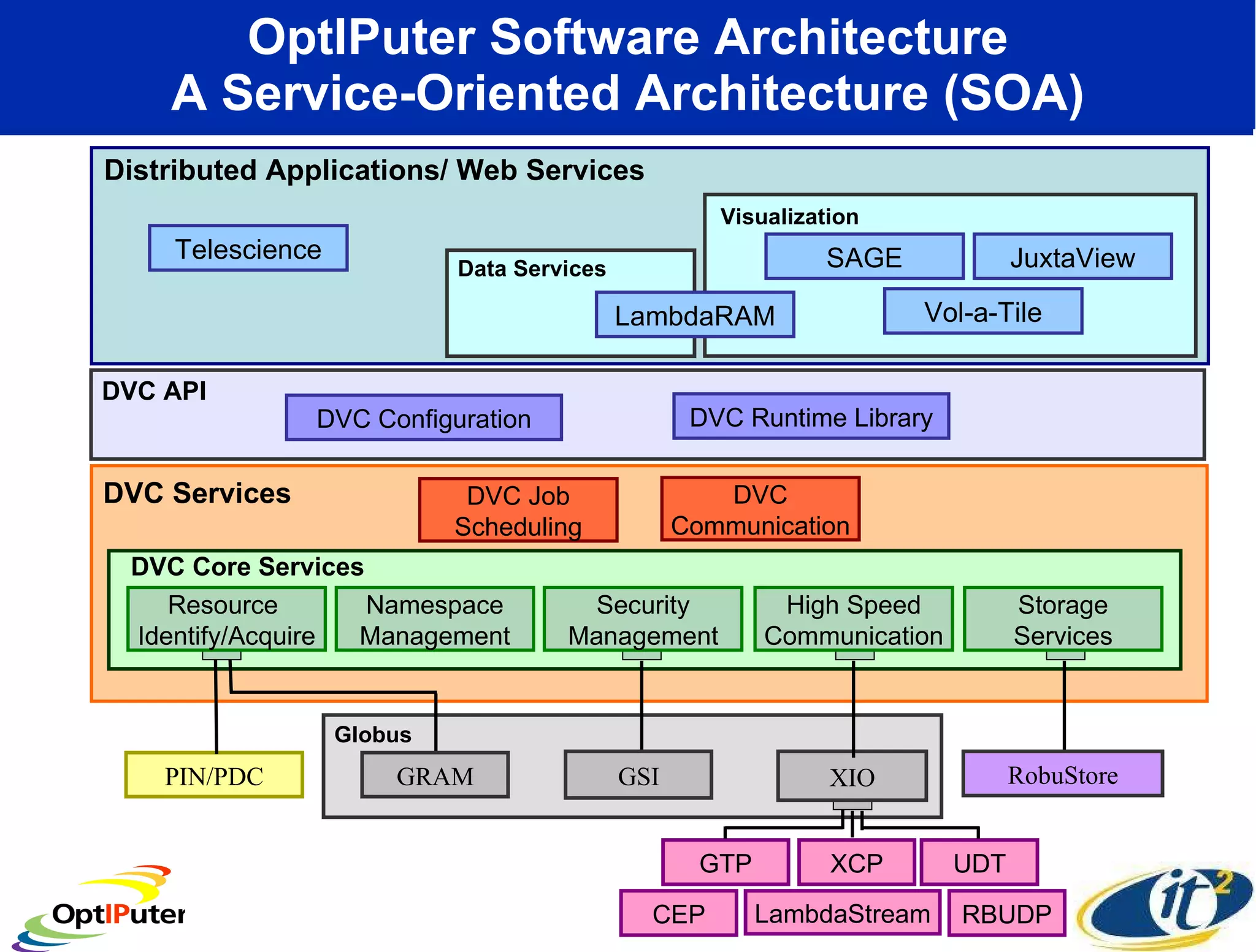
OptIPuter Software Architecture A Service-Oriented Architecture (SOA) Distributed Applications/ Web Services Telescience Vol-a-Tile SAGE JuxtaView Visualization  Data Services LambdaRAM PIN/PDC GTP XCP UDT LambdaStream CEP RBUDP DVC Configuration DVC API DVC Runtime Library Globus XIO DVC Services DVC Core Services DVC Job Scheduling DVC Communication Resource  Identify/Acquire Namespace Management Security Management High Speed Communication Storage Services GRAM GSI RobuStore
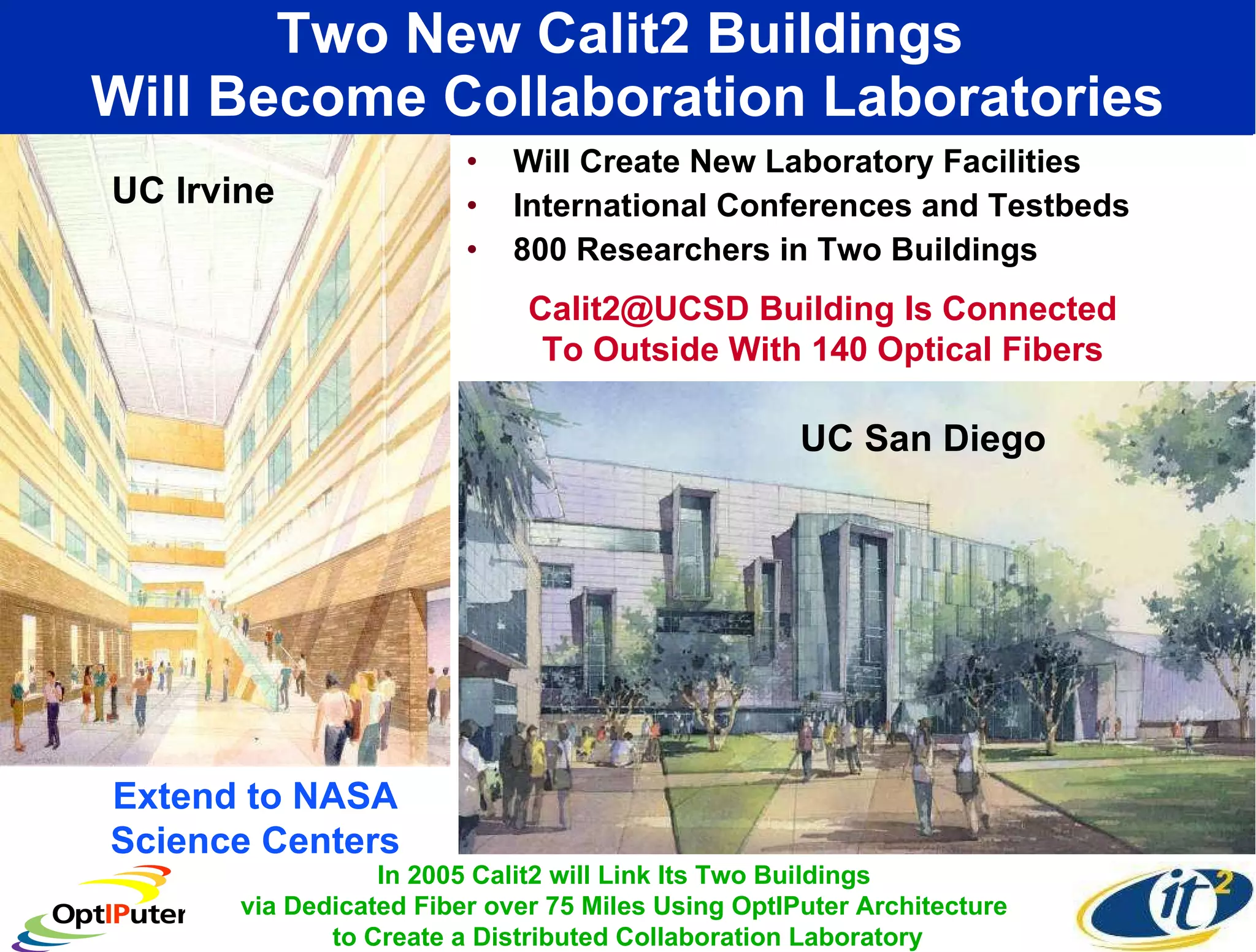
Two New Calit2 Buildings  Will Become Collaboration Laboratories Will Create New Laboratory Facilities International Conferences and Testbeds 800 Researchers in Two Buildings Bioengineering UC San Diego UC Irvine In 2005 Calit2 will Link Its Two Buildings  via Dedicated Fiber over 75 Miles Using OptIPuter Architecture  to Create a Distributed Collaboration Laboratory Calit2@UCSD Building Is Connected  To Outside With 140 Optical Fibers  Extend to NASA Science Centers
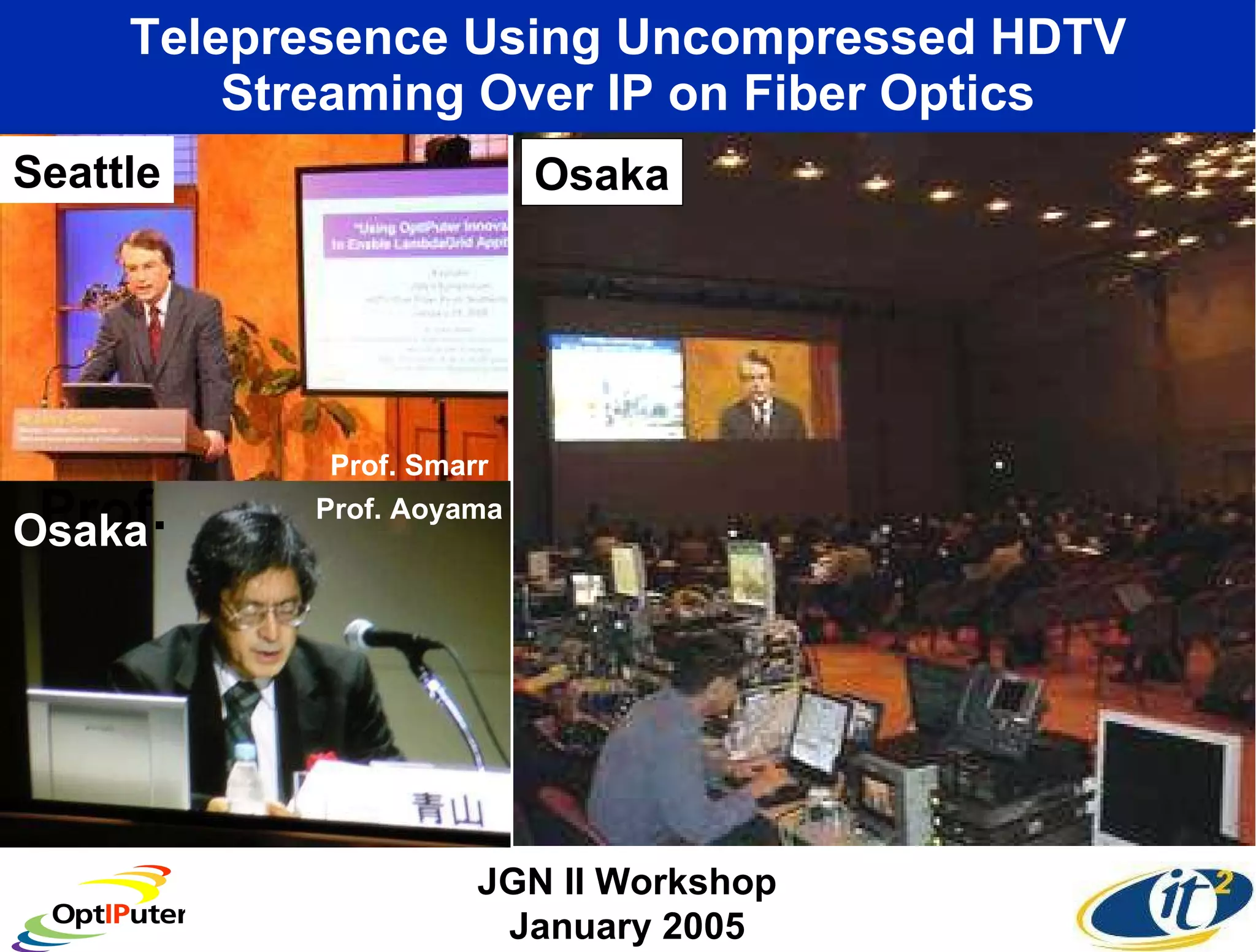
Telepresence Using Uncompressed HDTV Streaming Over IP on Fiber Optics Seattle JGN II Workshop January 2005 Osaka Prof.  Osaka Prof. Aoyama Prof. Smarr
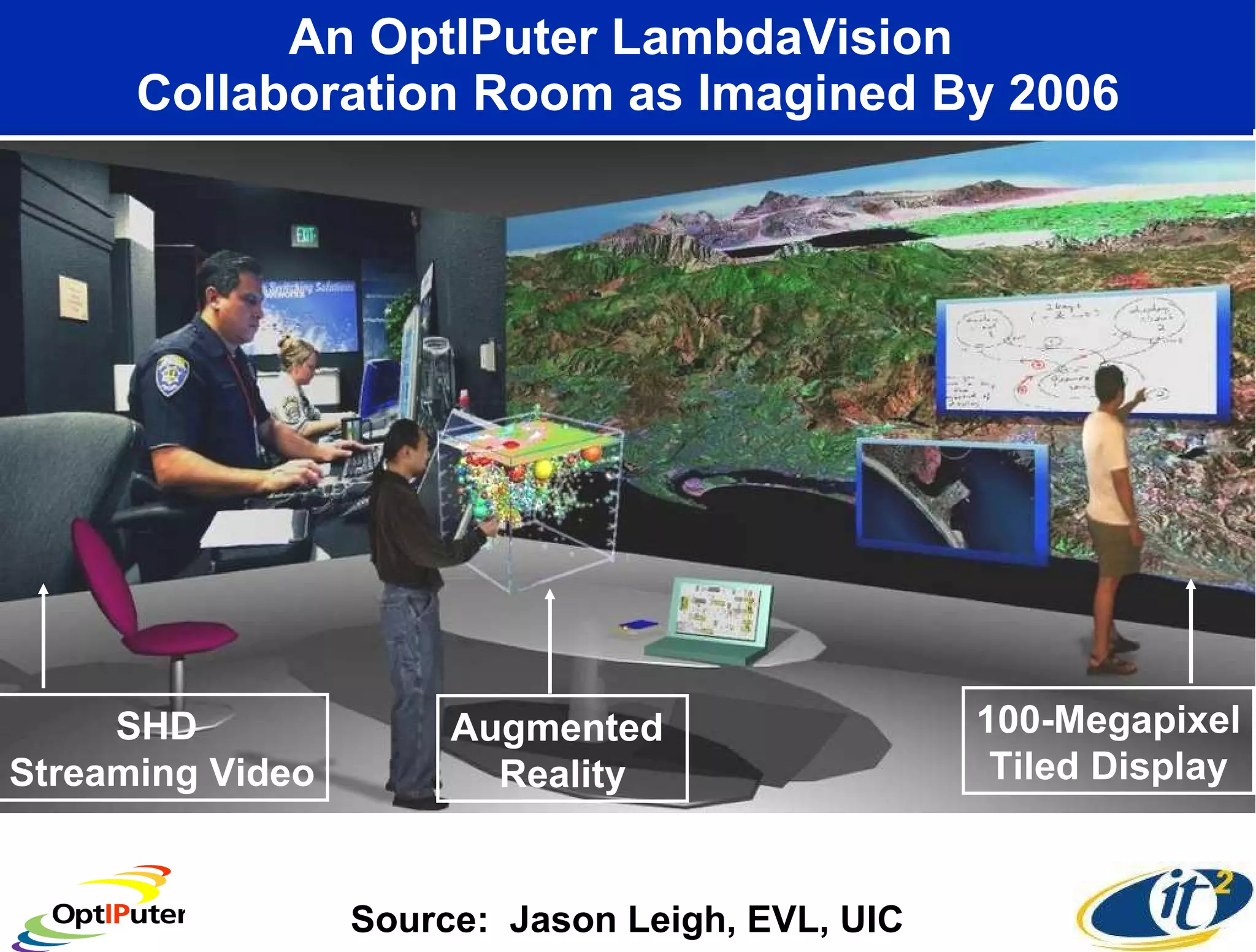
An OptIPuter LambdaVision  Collaboration Room as Imagined By 2006 Source:  Jason Leigh, EVL, UIC Augmented  Reality SHD  Streaming Video 100-Megapixel Tiled Display
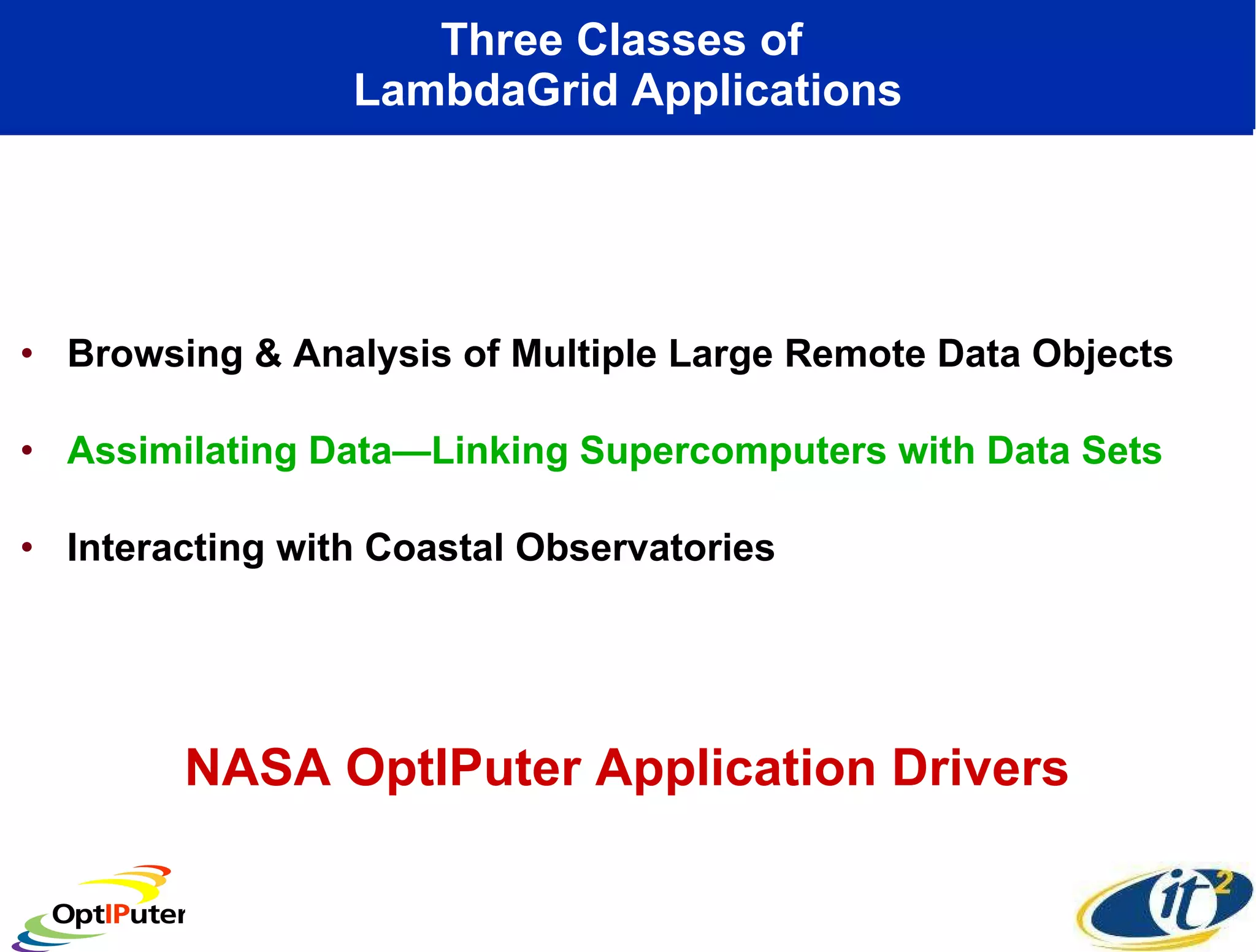
Three Classes of  LambdaGrid Applications Browsing & Analysis of Multiple Large Remote Data Objects Assimilating Data—Linking Supercomputers with Data Sets Interacting with Coastal Observatories NASA OptIPuter Application Drivers
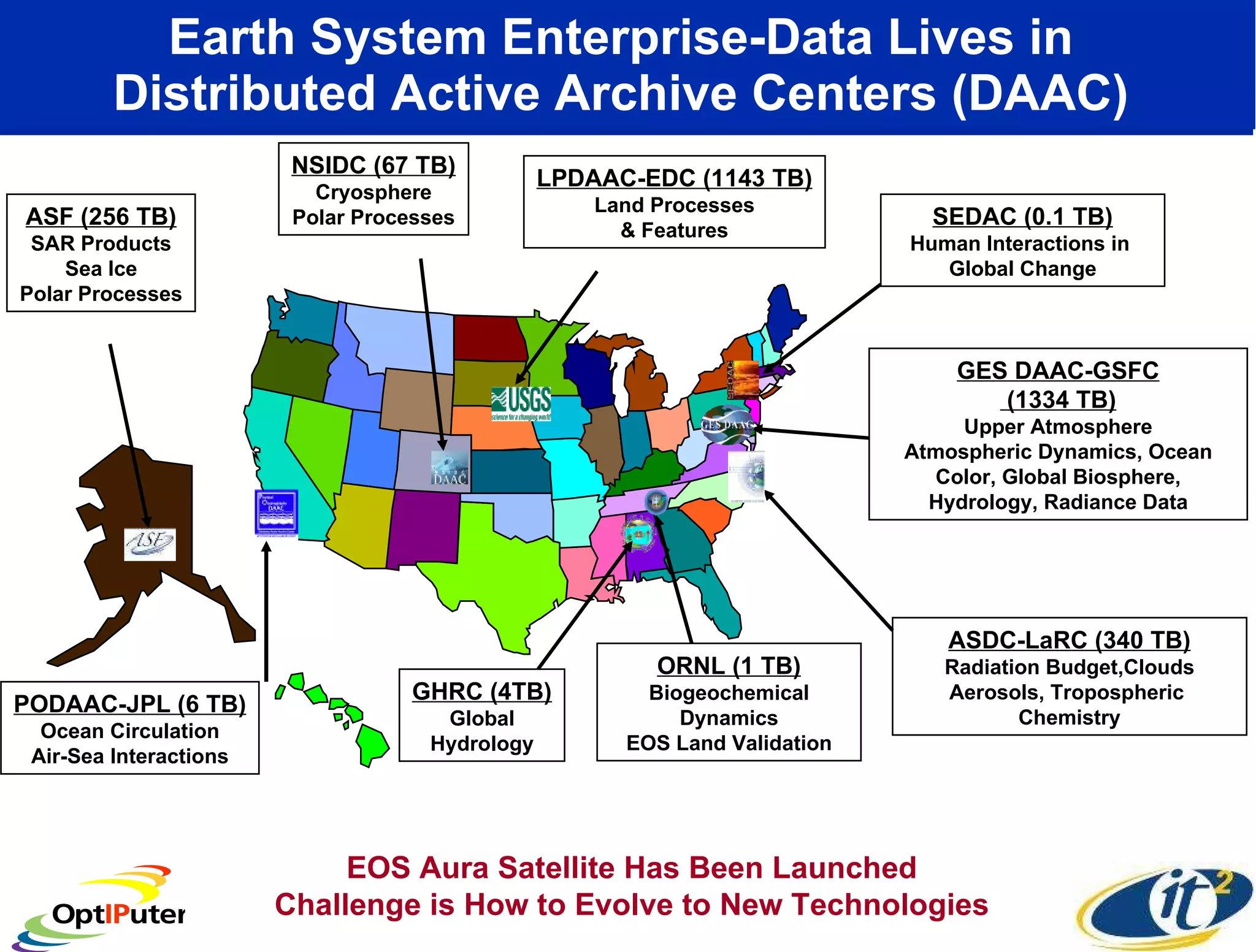
Earth System Enterprise-Data Lives in  Distributed Active Archive Centers (DAAC)  EOS Aura Satellite Has Been Launched Challenge is How to Evolve to New Technologies SEDAC (0.1 TB) Human Interactions in  Global Change GES DAAC-GSFC (1334 TB) Upper Atmosphere Atmospheric Dynamics, Ocean Color, Global Biosphere, Hydrology, Radiance Data ASDC-LaRC (340 TB) Radiation Budget,Clouds Aerosols, Tropospheric  Chemistry ORNL (1 TB) Biogeochemical Dynamics EOS Land Validation NSIDC (67 TB) Cryosphere Polar Processes LPDAAC-EDC (1143 TB) Land Processes & Features PODAAC-JPL (6 TB) Ocean Circulation Air-Sea Interactions ASF (256 TB) SAR Products Sea Ice Polar Processes GHRC (4TB) Global Hydrology
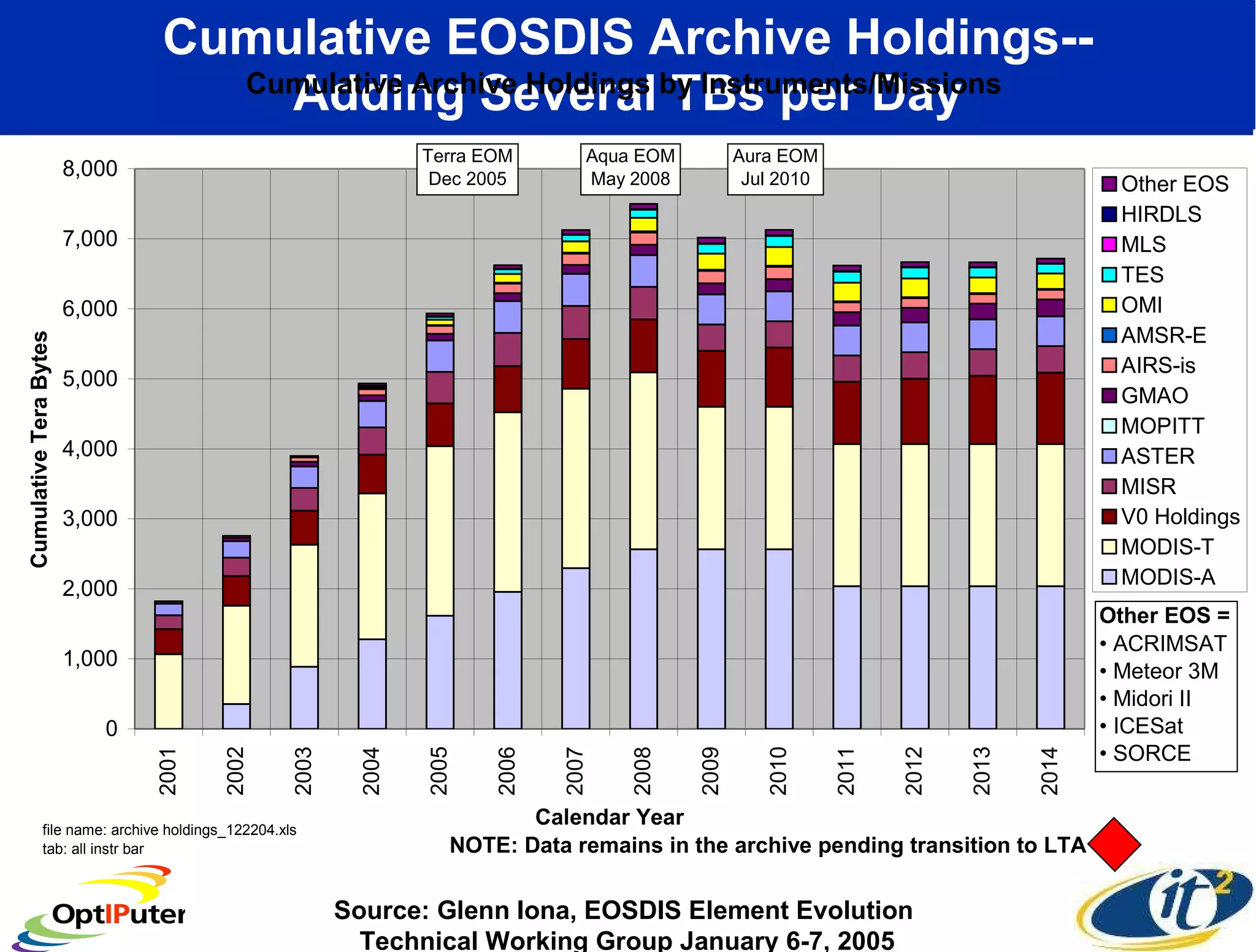
Cumulative EOSDIS Archive Holdings-- Adding Several TBs per Day Source: Glenn Iona, EOSDIS Element Evolution  Technical Working Group January 6-7, 2005
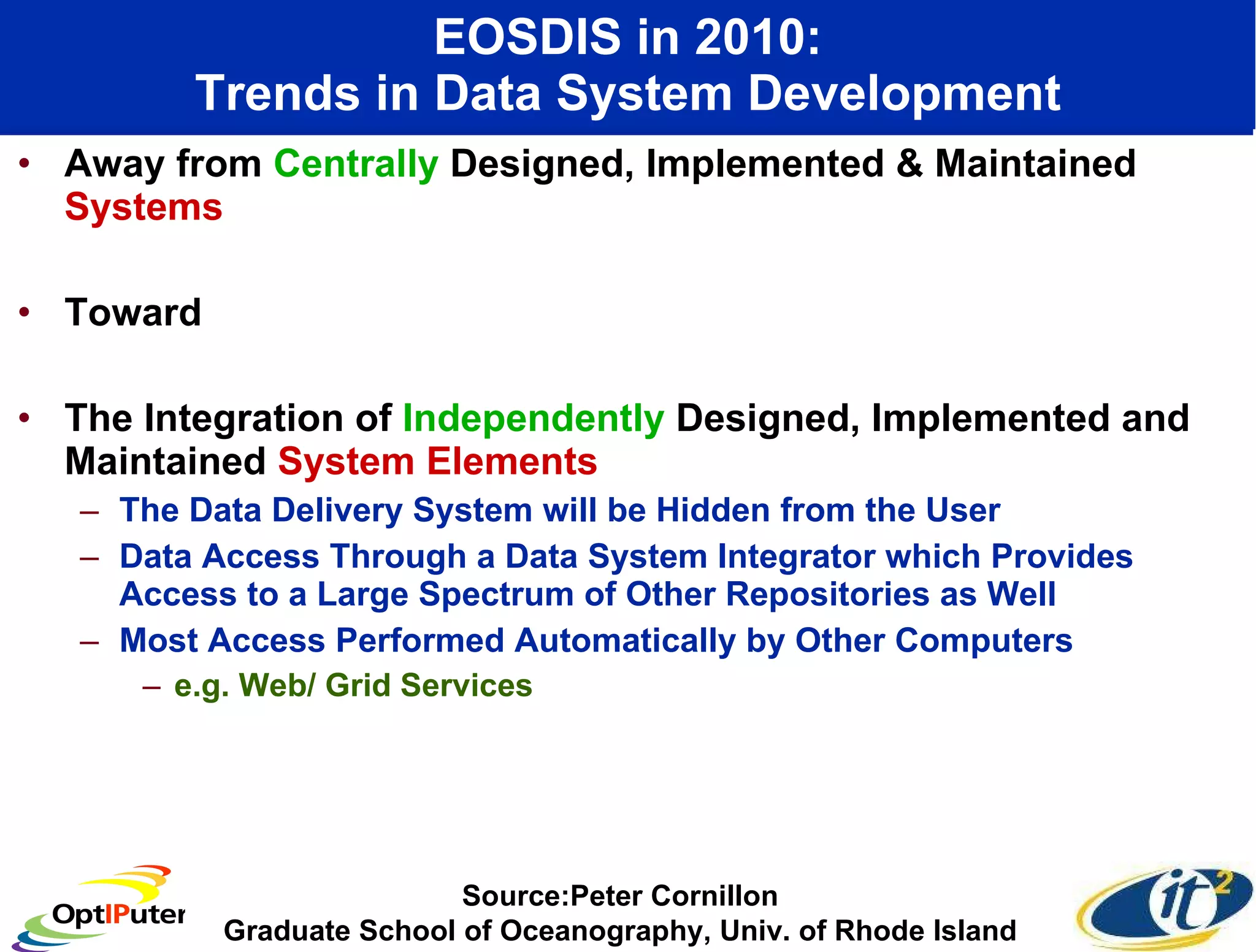
EOSDIS in 2010: Trends in Data System Development Away from  Centrally  Designed, Implemented & Maintained  Systems Toward  The Integration of  Independently  Designed, Implemented and Maintained  System Elements The Data Delivery System will be Hidden from the User Data Access Through a Data System Integrator which Provides Access to a Large Spectrum of Other Repositories as Well Most Access Performed Automatically by Other Computers e.g. Web/ Grid Services Source:Peter Cornillon Graduate School of Oceanography, Univ. of Rhode Island
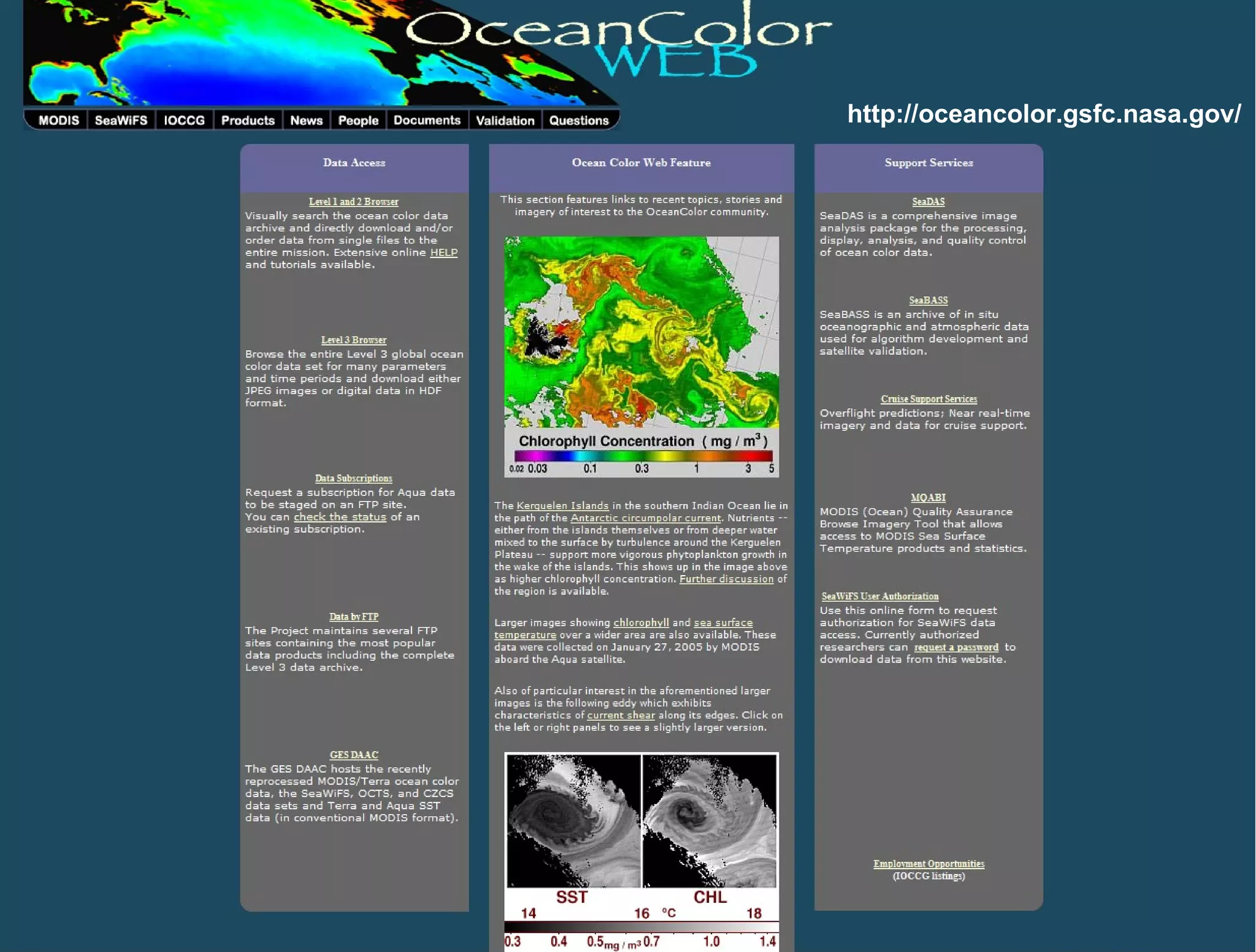
http://oceancolor.gsfc.nasa.gov/
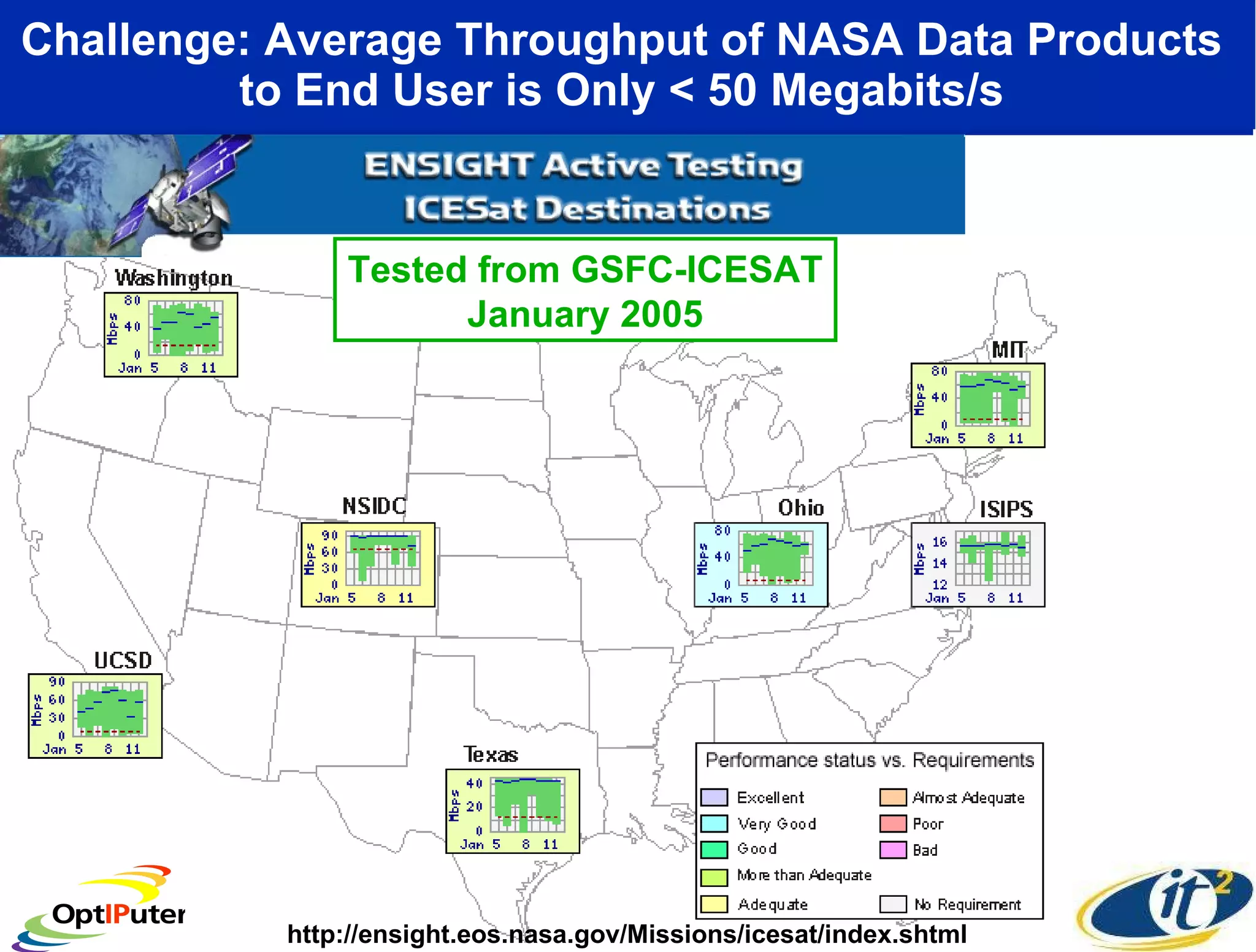
Challenge: Average Throughput of NASA Data Products  to End User is Only < 50 Megabits/s  Tested from GSFC-ICESAT January 2005 http://ensight.eos.nasa.gov/Missions/icesat/index.shtml
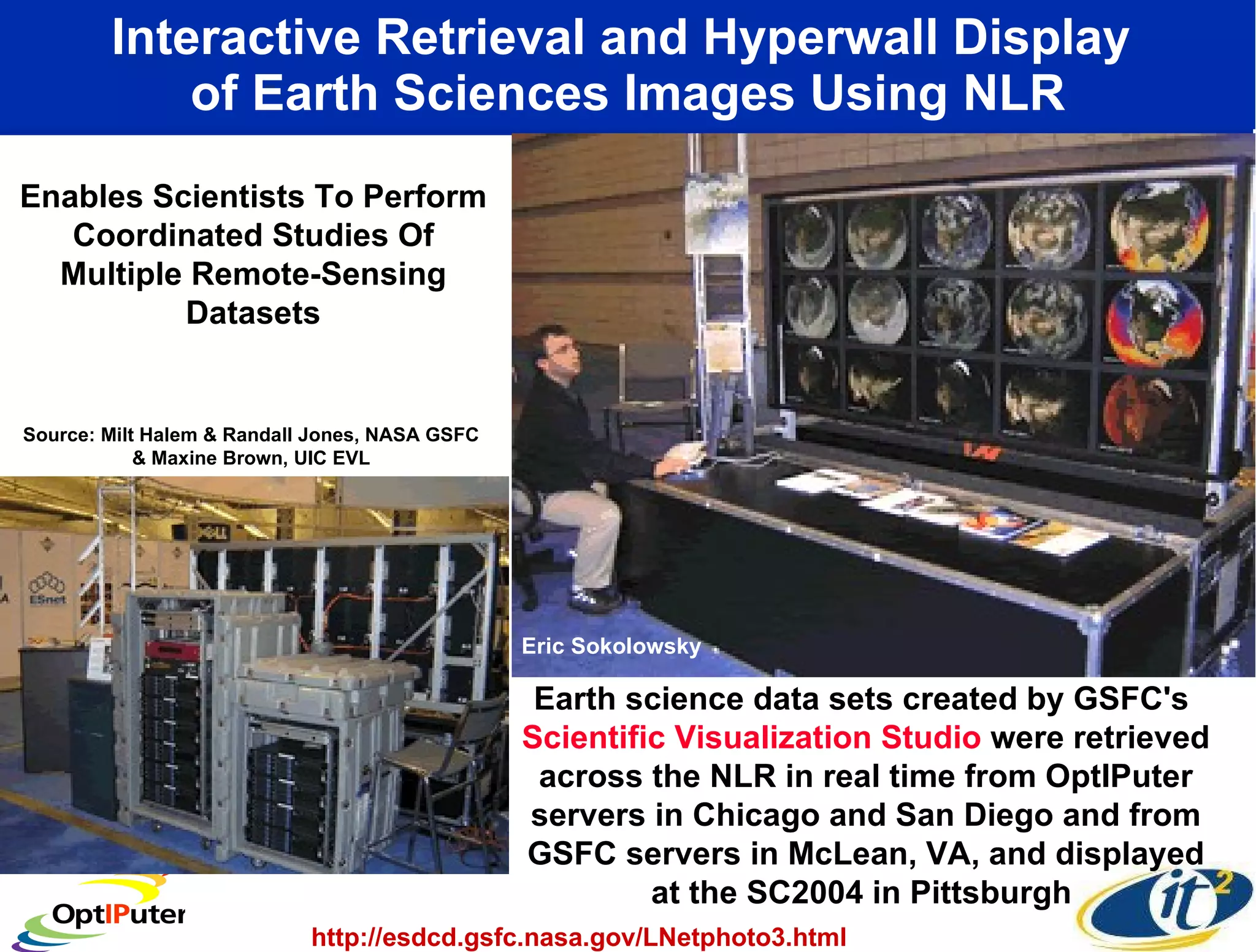
Interactive Retrieval and Hyperwall Display  of Earth Sciences Images Using NLR Earth science data sets created by GSFC's  Scientific Visualization Studio  were retrieved across the NLR in real time from OptIPuter servers in Chicago and San Diego and from GSFC servers in McLean, VA, and displayed at the SC2004 in Pittsburgh  Enables Scientists To Perform Coordinated Studies Of Multiple Remote-Sensing Datasets http://esdcd.gsfc.nasa.gov/LNetphoto3.html Source: Milt Halem & Randall Jones, NASA GSFC & Maxine Brown, UIC EVL Eric Sokolowsky
NASA is Moving Towards   a Service-Oriented Architecture for Earth Sciences Data ECHO is an Open Source Interoperability Middleware Solution Providing a Marketplace of Resource Offerings Metadata Clearinghouse & Order Broker with Open, XML-based APIs Being Built by NASA's Earth Science Data and Information System New Paradigm for Access to EOS Data  Service-Oriented Enterprise Net-Centric Computing Pushing Power to the Participants - Producers and Consumers GEOSS (Global Earth Observation System of Systems) Momentum Current Availability: Over 40 Million Data Granules  Over 6 Million Browse Images www.echo.eos.nasa.gov
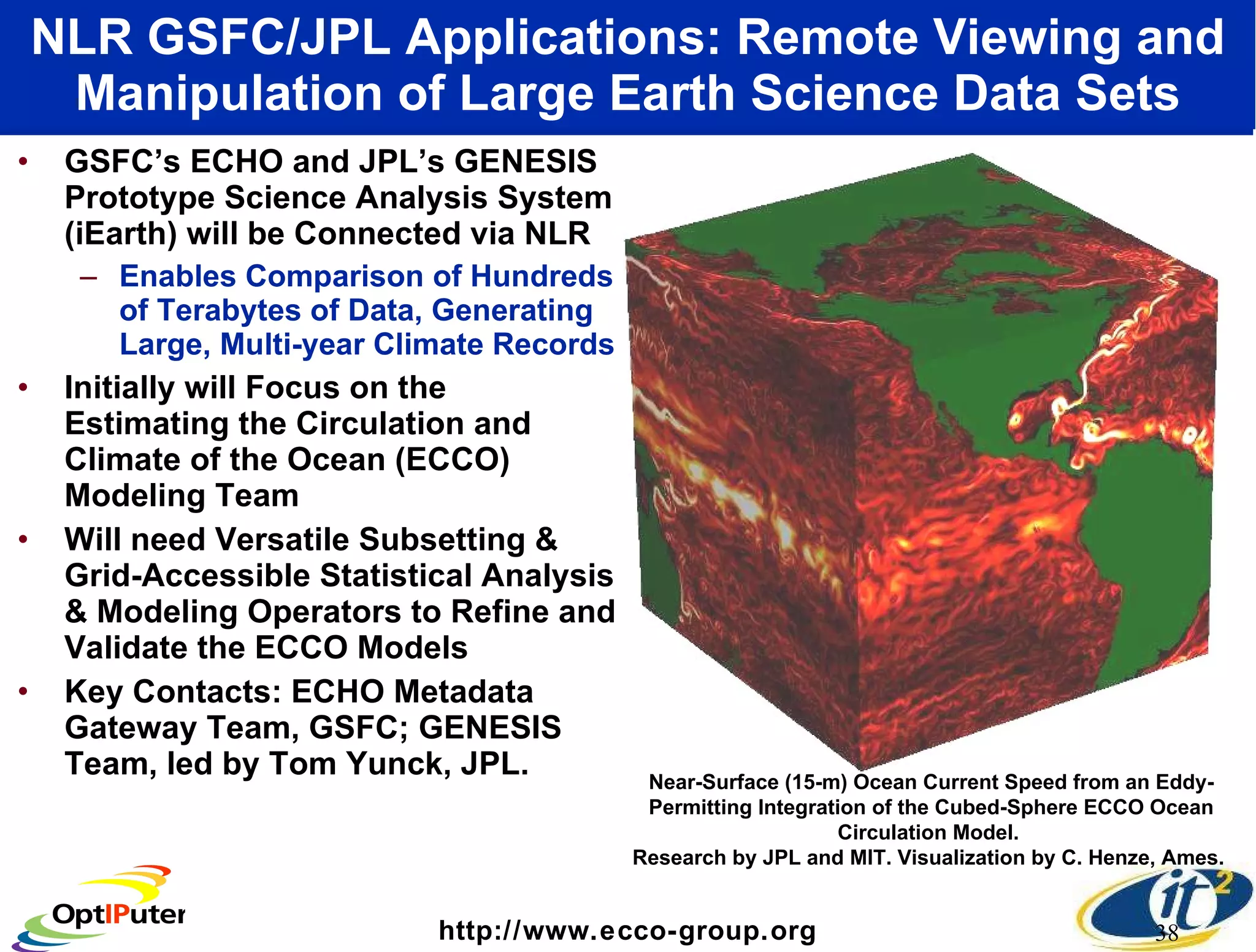
NLR GSFC/JPL Applications: Remote Viewing and Manipulation of Large Earth Science Data Sets GSFC’s ECHO and JPL’s GENESIS Prototype Science Analysis System (iEarth) will be Connected via NLR Enables Comparison of Hundreds of Terabytes of Data, Generating Large, Multi-year Climate Records Initially will Focus on the Estimating the Circulation and Climate of the Ocean (ECCO) Modeling Team Will need Versatile Subsetting & Grid-Accessible Statistical Analysis & Modeling Operators to Refine and Validate the ECCO Models Key Contacts: ECHO Metadata Gateway Team, GSFC; GENESIS Team, led by Tom Yunck, JPL. http://www.ecco-group.org Near-Surface (15-m) Ocean Current Speed from an Eddy-Permitting Integration of the Cubed-Sphere ECCO Ocean Circulation Model.  Research by JPL and MIT. Visualization by C. Henze, Ames.
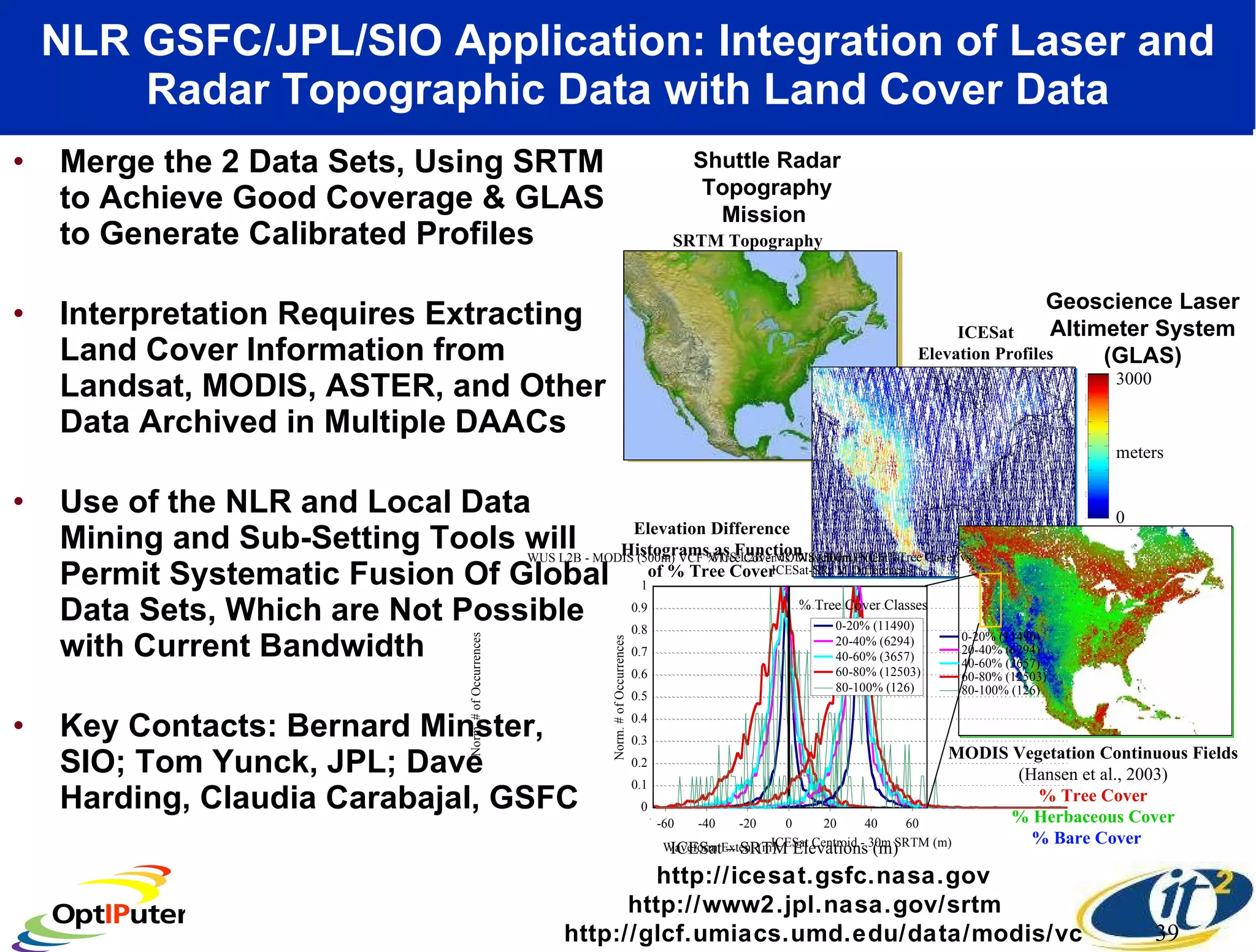
NLR GSFC/JPL/SIO Application: Integration of Laser and Radar Topographic Data with Land Cover Data Merge the 2 Data Sets, Using SRTM to Achieve Good Coverage & GLAS to Generate Calibrated Profiles Interpretation Requires Extracting Land Cover Information from Landsat, MODIS, ASTER, and Other Data Archived in Multiple DAACs Use of the NLR and Local Data Mining and Sub-Setting Tools will Permit Systematic Fusion Of Global Data Sets, Which are Not Possible with Current Bandwidth Key Contacts: Bernard Minster, SIO; Tom Yunck, JPL; Dave Harding, Claudia Carabajal, GSFC http://icesat.gsfc.nasa.gov http://www2.jpl.nasa.gov/srtm  http://glcf.umiacs.umd.edu/data/modis/vcf Geoscience Laser Altimeter System (GLAS) Shuttle Radar Topography Mission  SRTM Topography ICESat – SRTM Elevations (m)  % Tree Cover Classes MODIS Vegetation Continuous Fields  (Hansen et al., 2003) % Tree Cover % Herbaceous Cover % Bare Cover   ICESat Elevation Profiles 0 3000 meters Elevation Difference Histograms as Function of % Tree Cover
Three Classes of  LambdaGrid Applications Browsing & Analysis of Multiple Large Remote Data Objects Assimilating Data—Linking Supercomputers with Data Sets Interacting with Coastal Observatories NASA OptIPuter Application Drivers
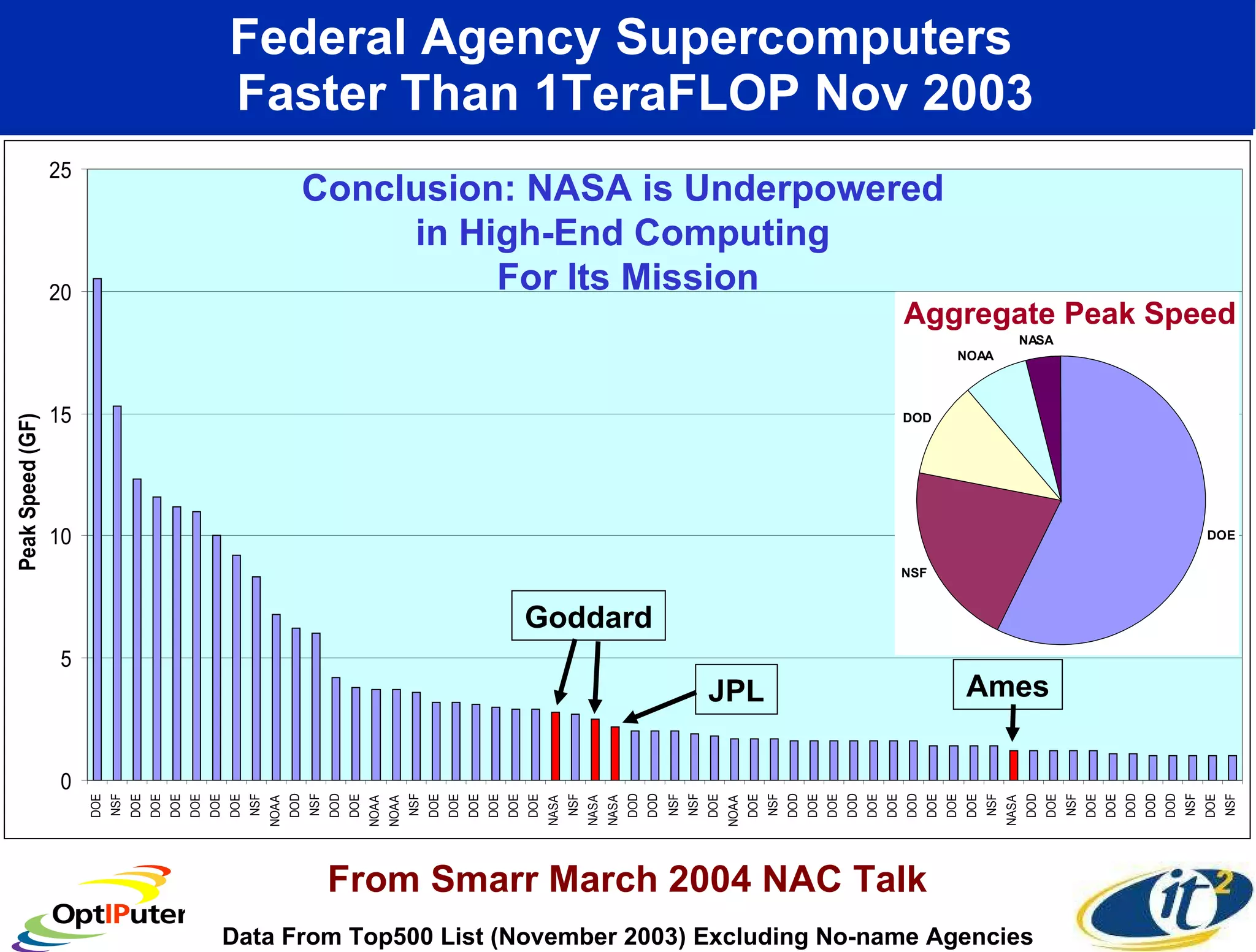
Federal Agency Supercomputers   Faster Than 1TeraFLOP Nov 2003 Conclusion: NASA is Underpowered  in High-End Computing  For Its Mission Goddard Ames JPL Data From Top500 List (November 2003) Excluding No-name Agencies From Smarr March 2004 NAC Talk Aggregate Peak Speed
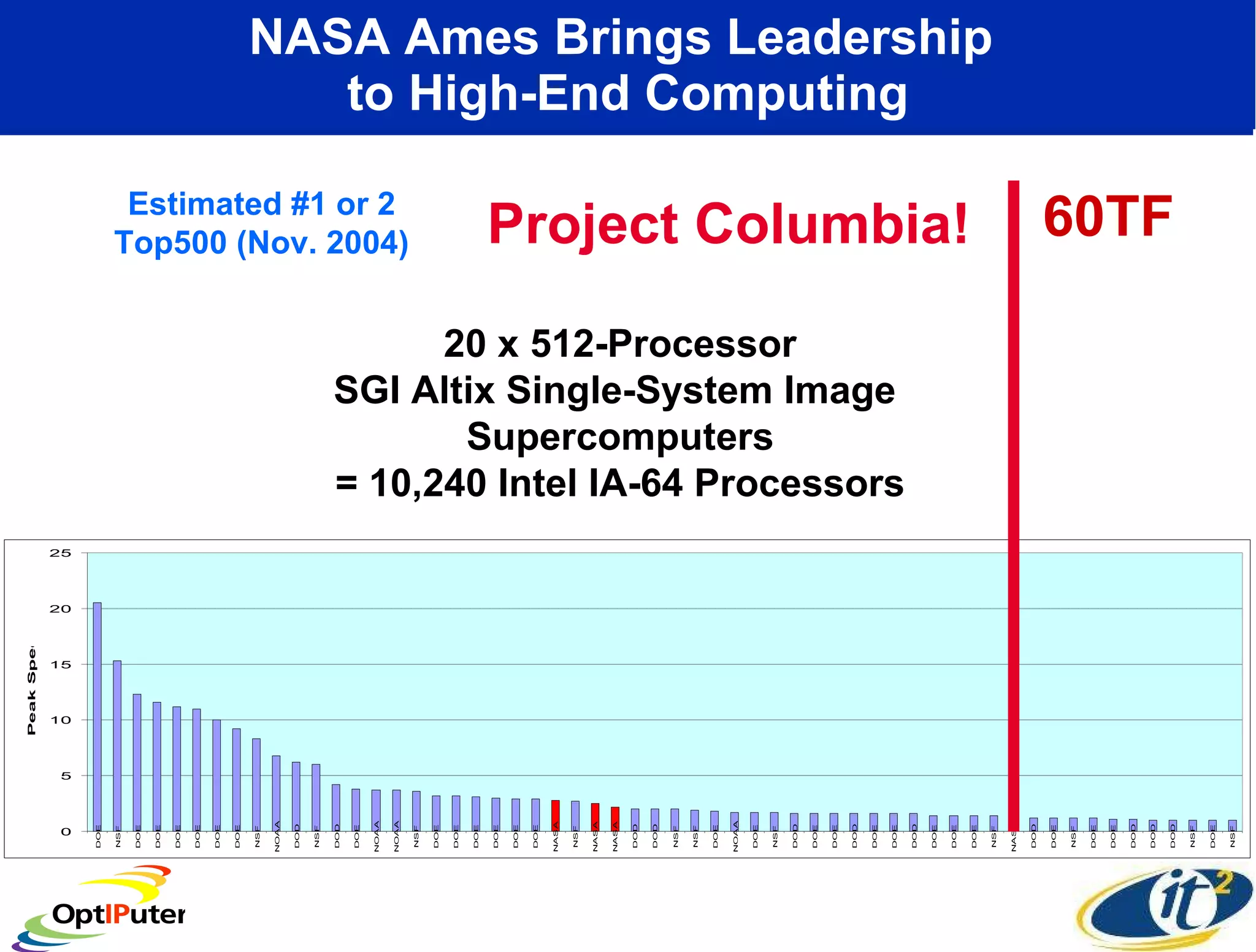
NASA Ames Brings Leadership  to High-End Computing 20 x 512-Processor SGI Altix Single-System Image  Supercomputers = 10,240 Intel IA-64 Processors Estimated #1 or 2 Top500 (Nov. 2004) Project Columbia! 60TF
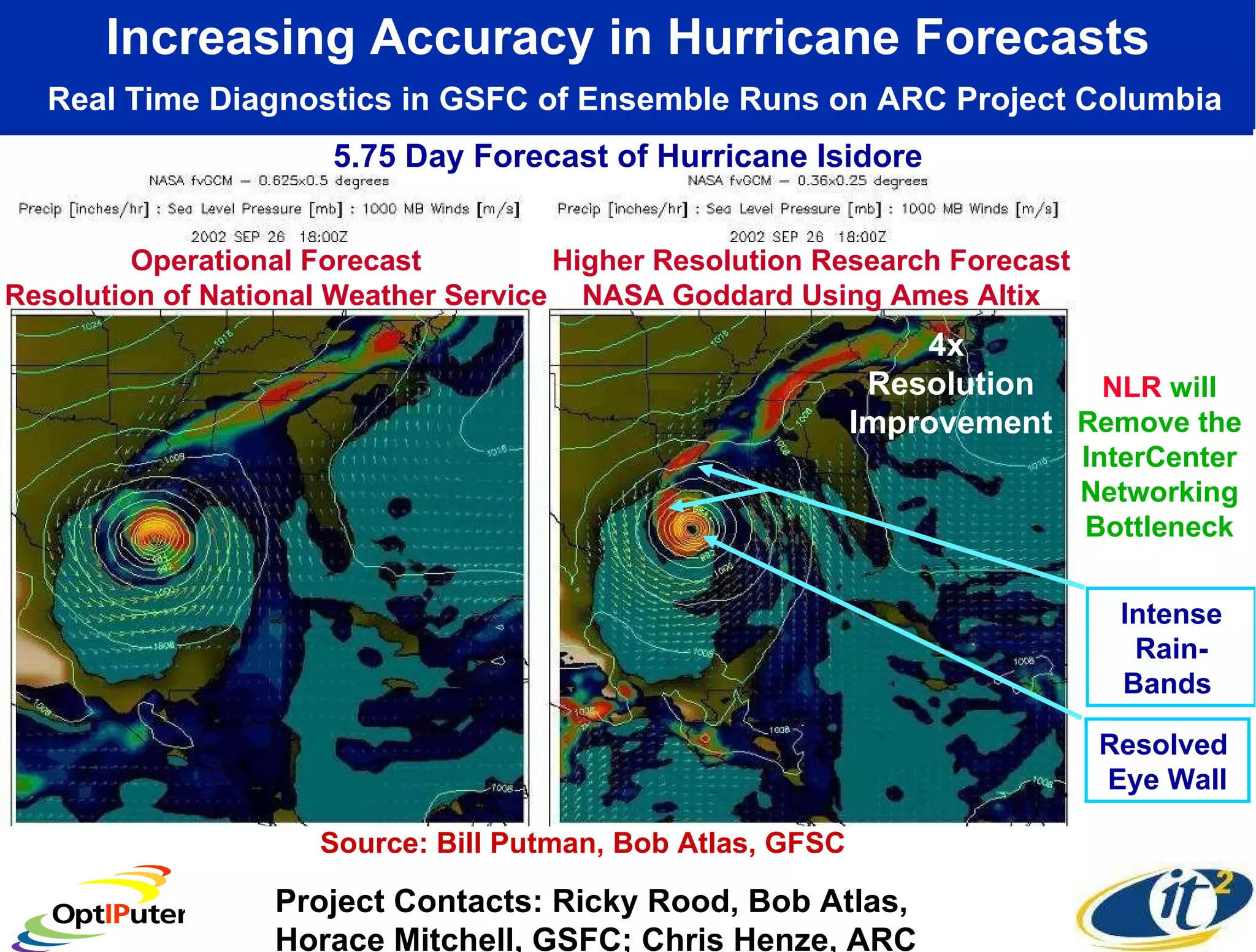
Increasing Accuracy in Hurricane Forecasts   Real Time Diagnostics in GSFC of Ensemble Runs on ARC Project Columbia Operational Forecast Resolution of National Weather Service Higher Resolution Research Forecast NASA Goddard Using Ames Altix 5.75 Day Forecast of Hurricane Isidore Intense Rain- Bands  4x  Resolution Improvement Source: Bill Putman, Bob Atlas, GFSC NLR   will Remove the InterCenter Networking Bottleneck Project Contacts: Ricky Rood, Bob Atlas, Horace Mitchell, GSFC; Chris Henze, ARC Resolved  Eye Wall
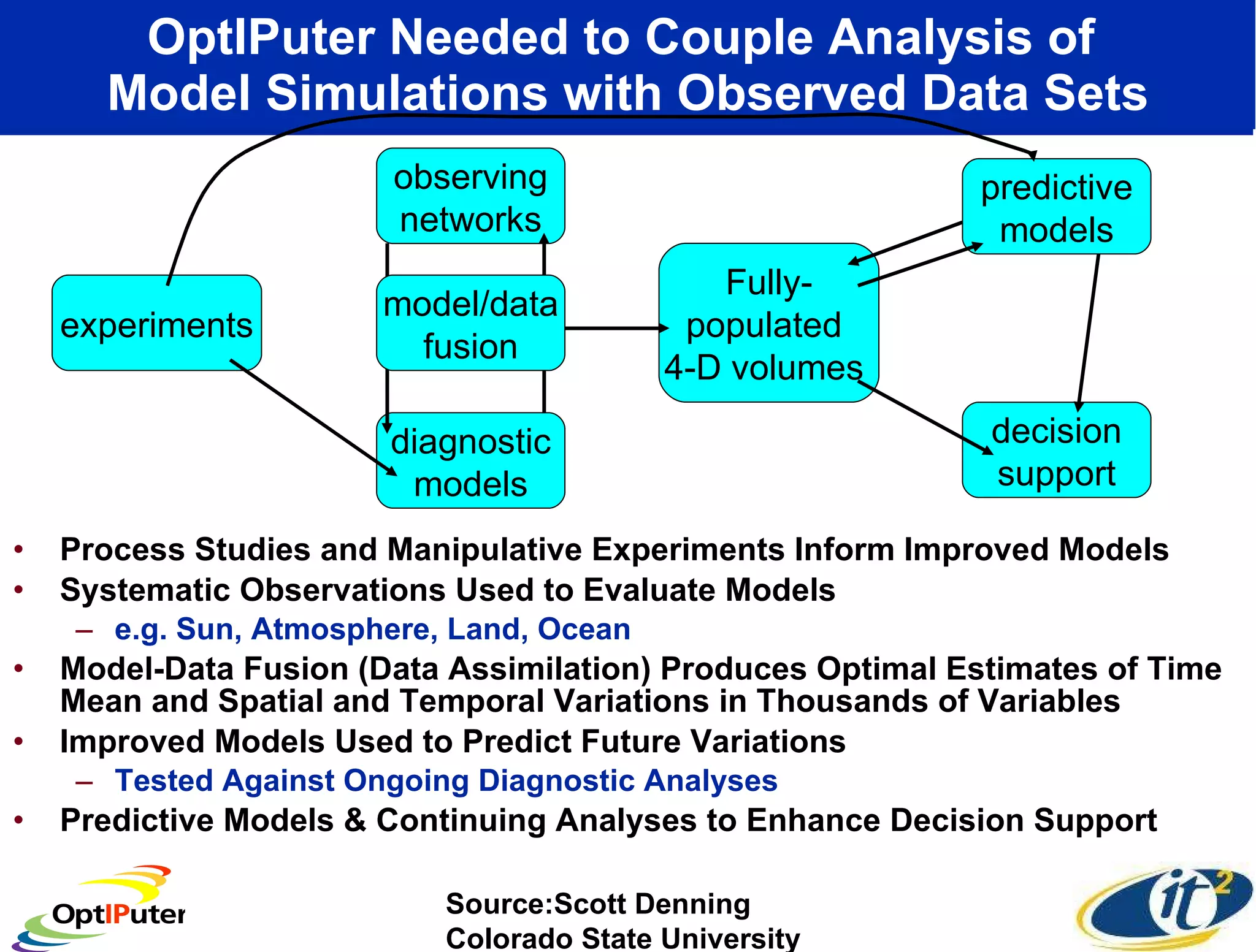
OptIPuter Needed to Couple Analysis of  Model Simulations with Observed Data Sets Process Studies and Manipulative Experiments Inform Improved Models Systematic Observations Used to Evaluate Models e.g. Sun, Atmosphere, Land, Ocean Model-Data Fusion (Data Assimilation) Produces Optimal Estimates of Time Mean and Spatial and Temporal Variations in Thousands of Variables Improved Models Used to Predict Future Variations Tested Against Ongoing Diagnostic Analyses Predictive Models & Continuing Analyses to Enhance Decision Support  Source:Scott Denning Colorado State University  experiments diagnostic models observing networks predictive models decision support Fully- populated  4-D volumes  model/data fusion
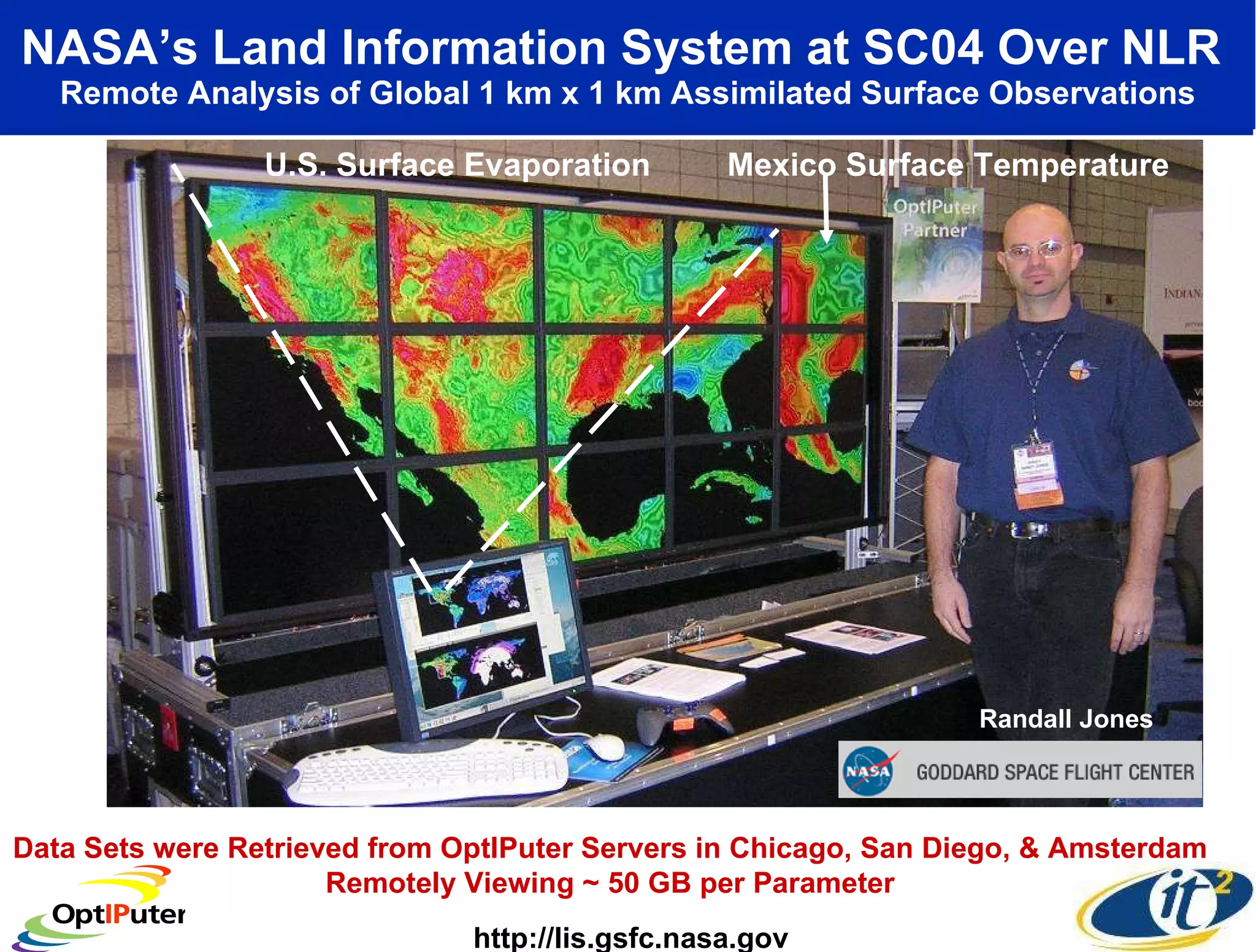
NASA’s Land Information System at SC04 Over NLR   Remote Analysis of Global 1 km x 1 km Assimilated Surface Observations Data Sets were Retrieved from OptIPuter Servers in Chicago, San Diego, & Amsterdam  Remotely Viewing ~ 50 GB per Parameter  Randall Jones http://lis.gsfc.nasa.gov U.S. Surface Evaporation Mexico   Surface Temperature
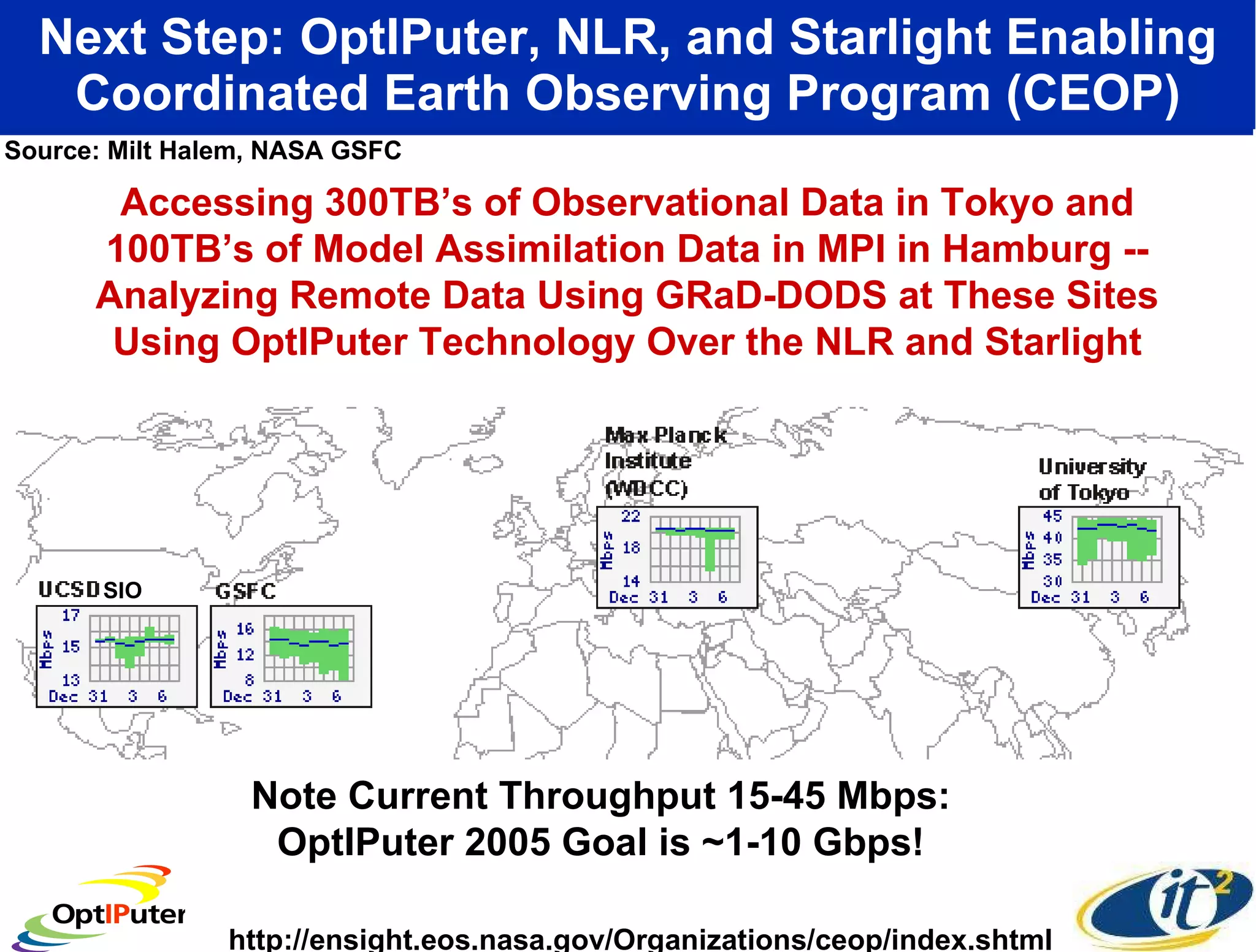
Next Step: OptIPuter, NLR, and Starlight Enabling Coordinated Earth Observing Program (CEOP) Note Current Throughput 15-45 Mbps: OptIPuter 2005 Goal is ~1-10 Gbps! http://ensight.eos.nasa.gov/Organizations/ceop/index.shtml Accessing 300TB’s of Observational Data in Tokyo and 100TB’s of Model Assimilation Data in MPI in Hamburg -- Analyzing Remote Data Using GRaD-DODS at These Sites Using OptIPuter Technology Over the NLR and Starlight Source: Milt Halem, NASA GSFC SIO
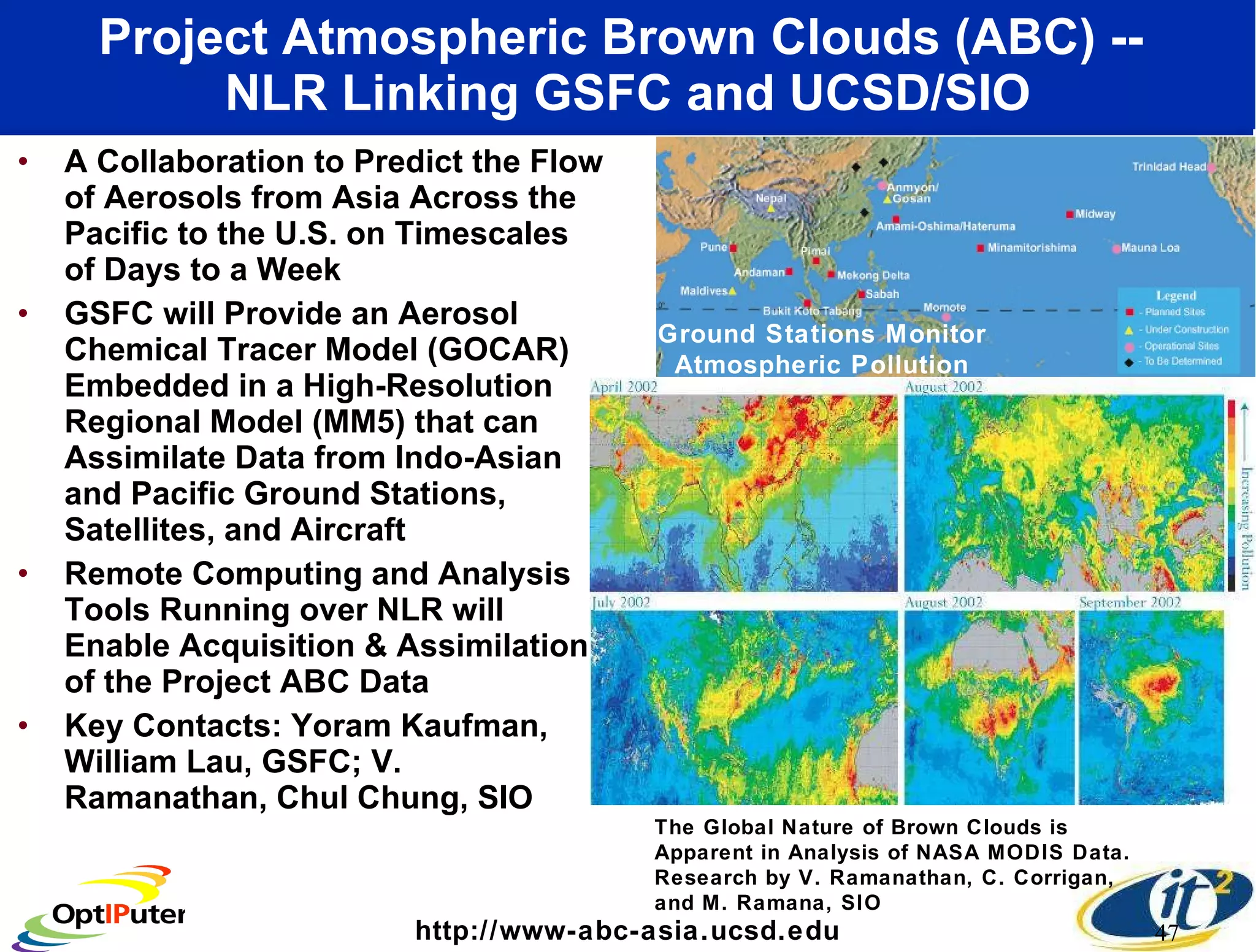
Project Atmospheric Brown Clouds (ABC) --  NLR Linking GSFC and UCSD/SIO A Collaboration to Predict the Flow of Aerosols from Asia Across the Pacific to the U.S. on Timescales of Days to a Week GSFC will Provide an Aerosol Chemical Tracer Model (GOCAR) Embedded in a High-Resolution Regional Model (MM5) that can Assimilate Data from Indo-Asian and Pacific Ground Stations, Satellites, and Aircraft Remote Computing and Analysis Tools Running over NLR will Enable Acquisition & Assimilation of the Project ABC Data Key Contacts: Yoram Kaufman, William Lau, GSFC; V. Ramanathan, Chul Chung, SIO http://www-abc-asia.ucsd.edu The Global Nature of Brown Clouds is Apparent in Analysis of NASA MODIS Data. Research by V. Ramanathan, C. Corrigan, and M. Ramana, SIO Ground Stations Monitor Atmospheric Pollution
Three Classes of  LambdaGrid Applications Browsing & Analysis of Multiple Large Remote Data Objects Assimilating Data—Linking Supercomputers with Data Sets Interacting with Coastal Observatories NASA OptIPuter Application Drivers
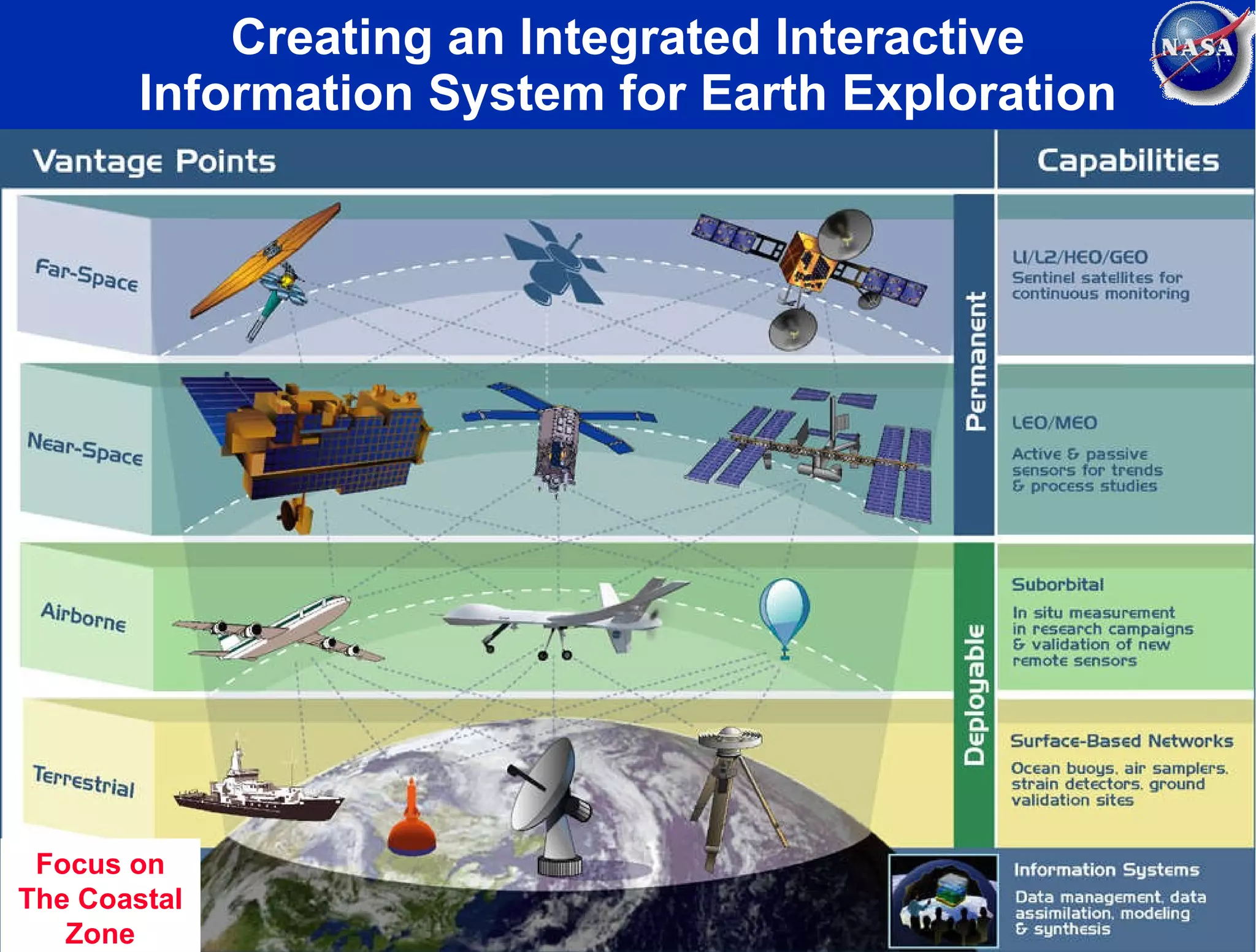
Creating an Integrated Interactive Information System for Earth Exploration Components of a Future Global System for Earth Observation (Sensor Web) Focus on The Coastal Zone
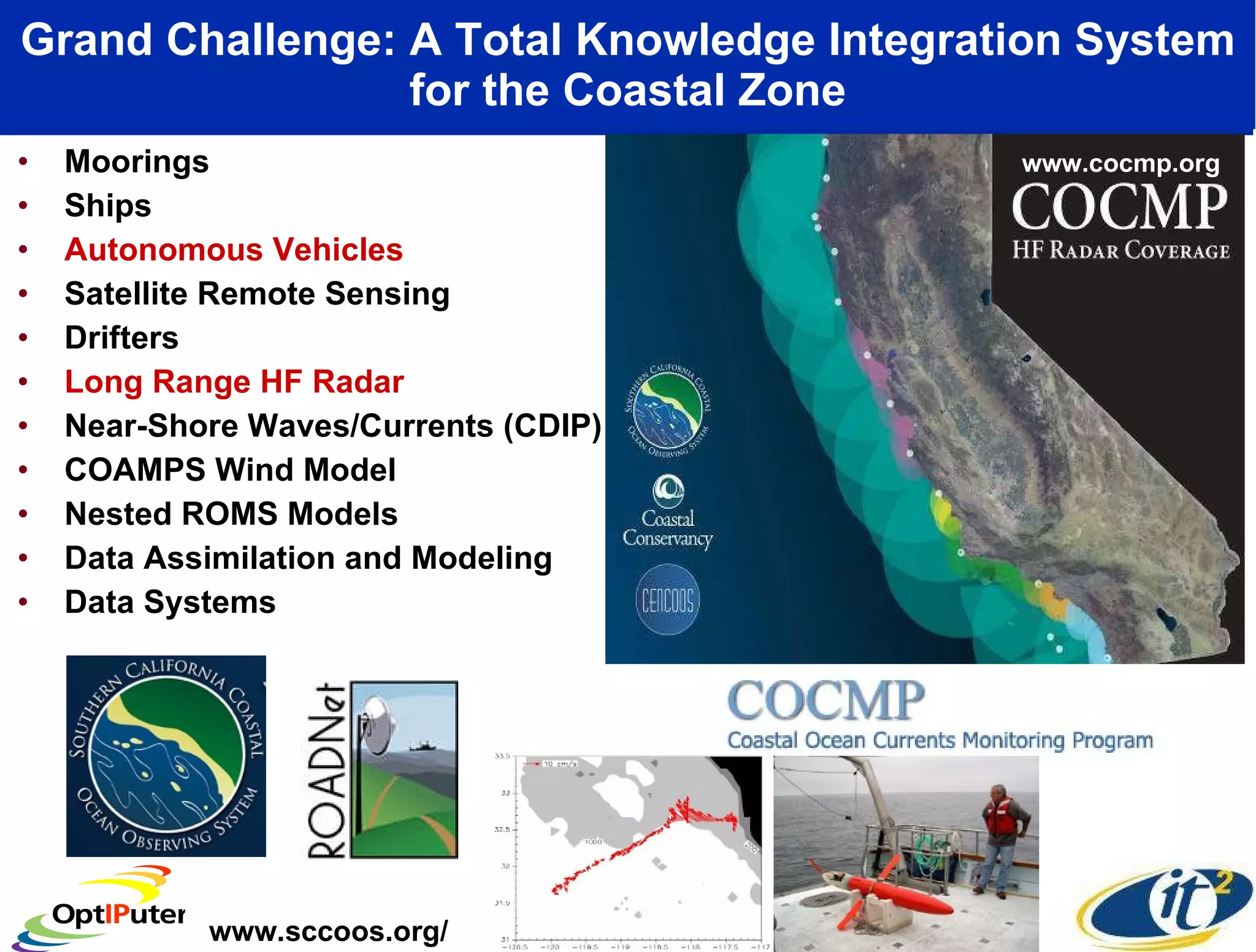
Grand Challenge: A Total Knowledge Integration System for the Coastal Zone Moorings Ships Autonomous Vehicles  Satellite Remote Sensing Drifters Long Range HF Radar   Near-Shore Waves/Currents (CDIP) COAMPS Wind Model Nested ROMS Models Data Assimilation and Modeling Data Systems Pilot Project Components www.sccoos.org/ www.cocmp.org
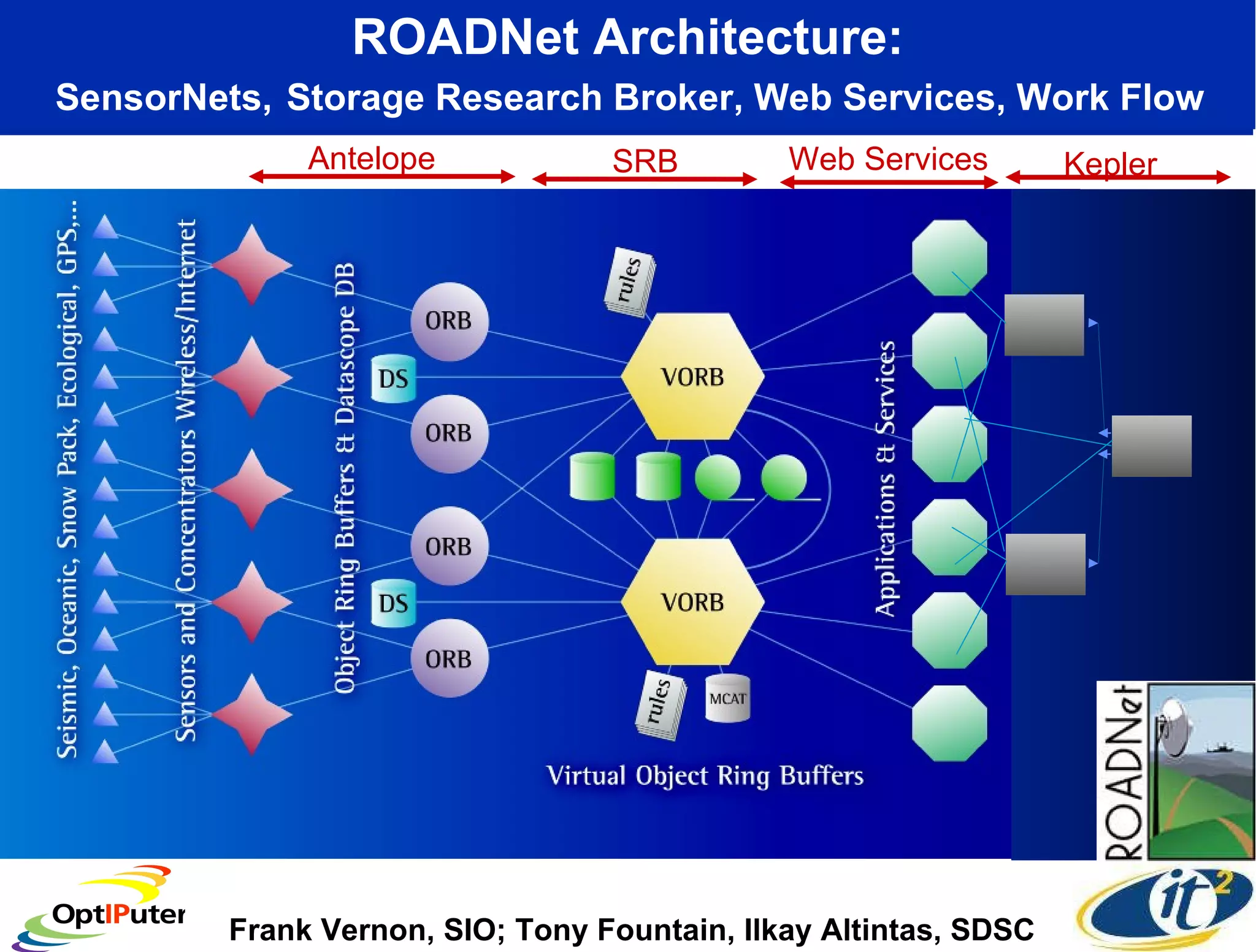
ROADNet Architecture:   SensorNets,   Storage Research Broker, Web Services, Work Flow  Kepler Web Services SRB Antelope Frank Vernon, SIO; Tony Fountain, Ilkay Altintas, SDSC
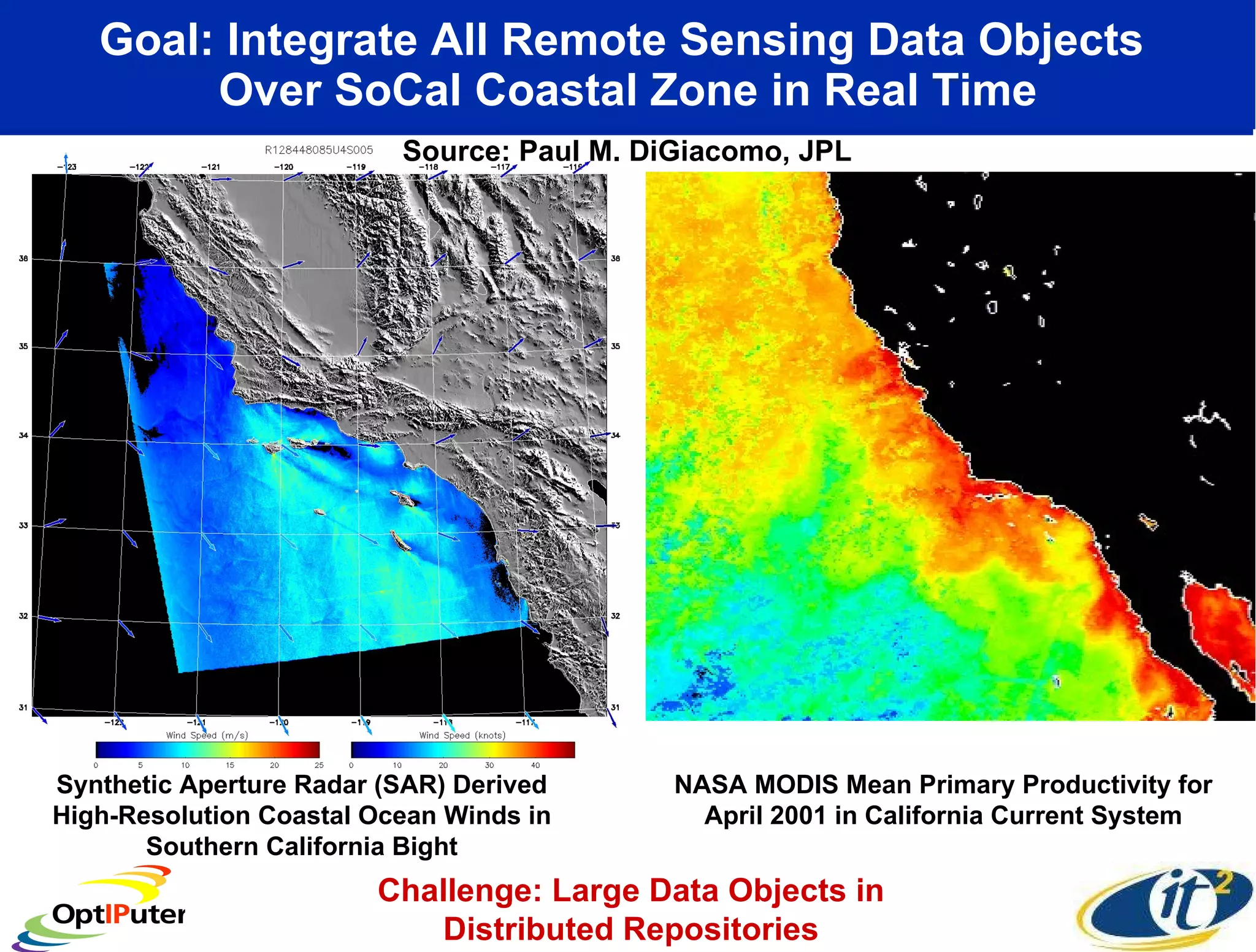
Goal: Integrate All Remote Sensing Data Objects  Over SoCal Coastal Zone in Real Time NASA MODIS Mean Primary Productivity for April 2001 in California Current System Source: Paul M. DiGiacomo, JPL Synthetic Aperture Radar (SAR) Derived High-Resolution Coastal Ocean Winds in Southern California Bight Challenge: Large Data Objects in Distributed Repositories
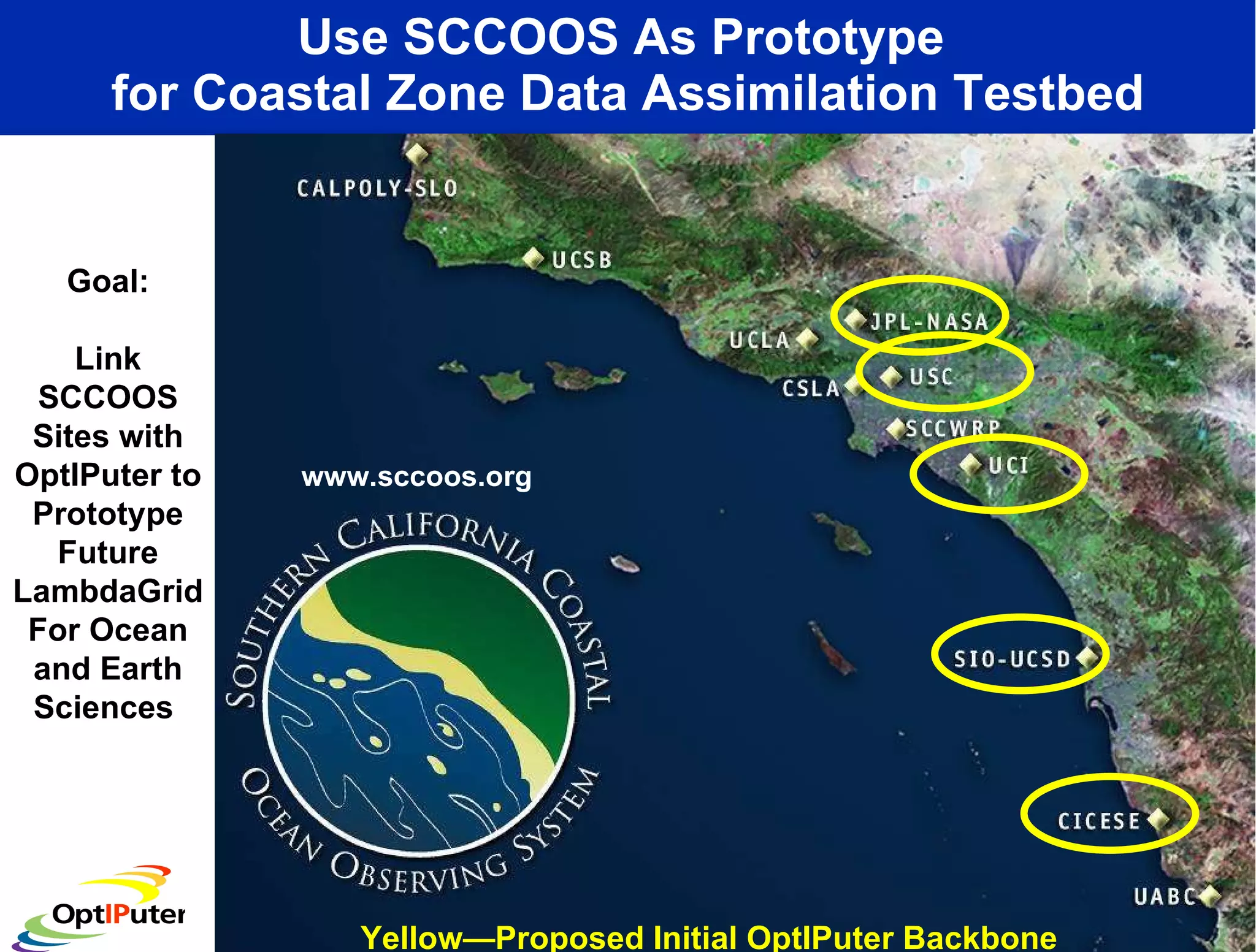
Use SCCOOS As Prototype  for Coastal Zone Data Assimilation Testbed www.sccoos.org Goal: Link SCCOOS Sites with OptIPuter to Prototype Future LambdaGrid For Ocean and Earth Sciences  Yellow—Proposed Initial OptIPuter Backbone
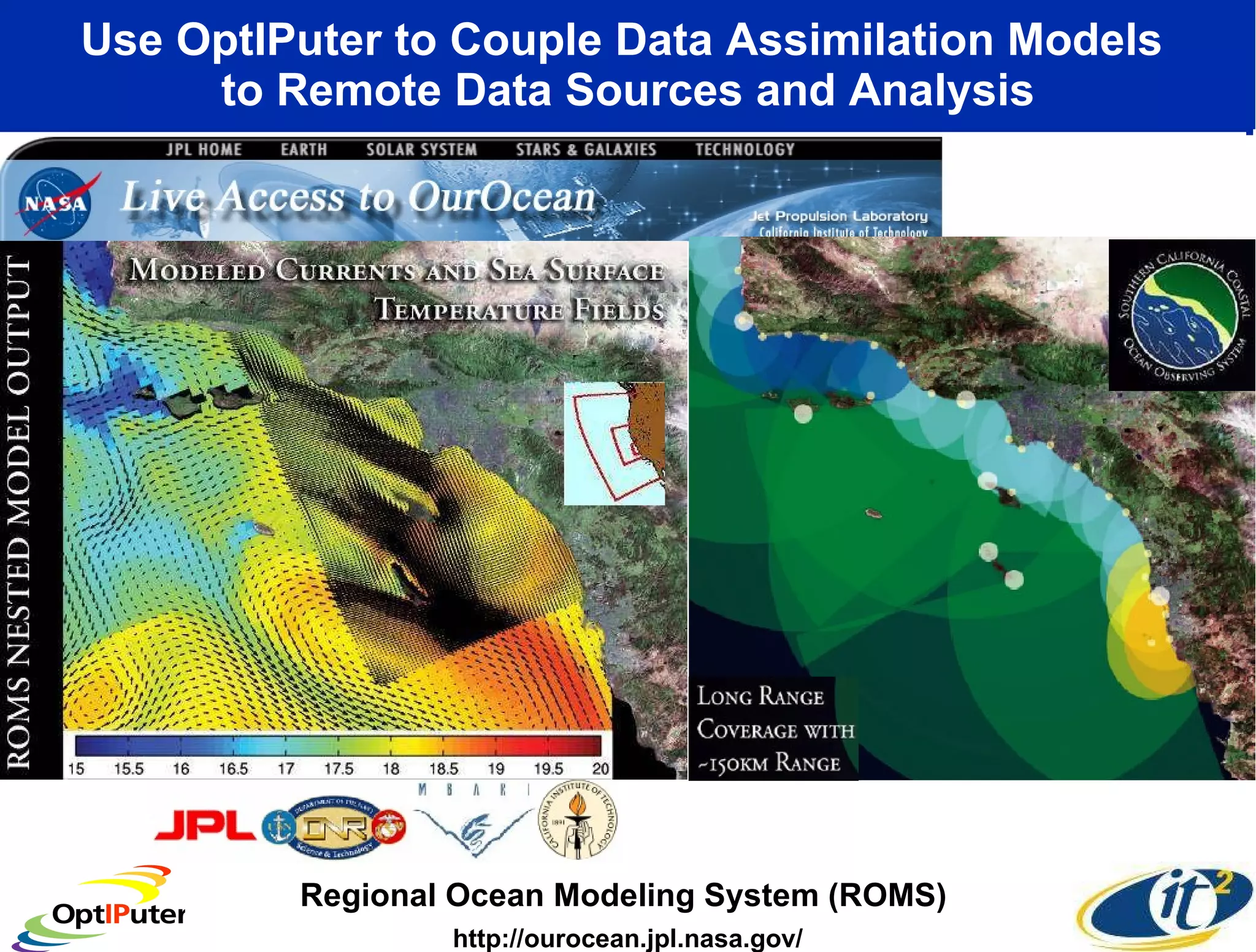
Use OptIPuter to Couple Data Assimilation Models  to Remote Data Sources and Analysis Regional Ocean Modeling System (ROMS)  http://ourocean.jpl.nasa.gov/
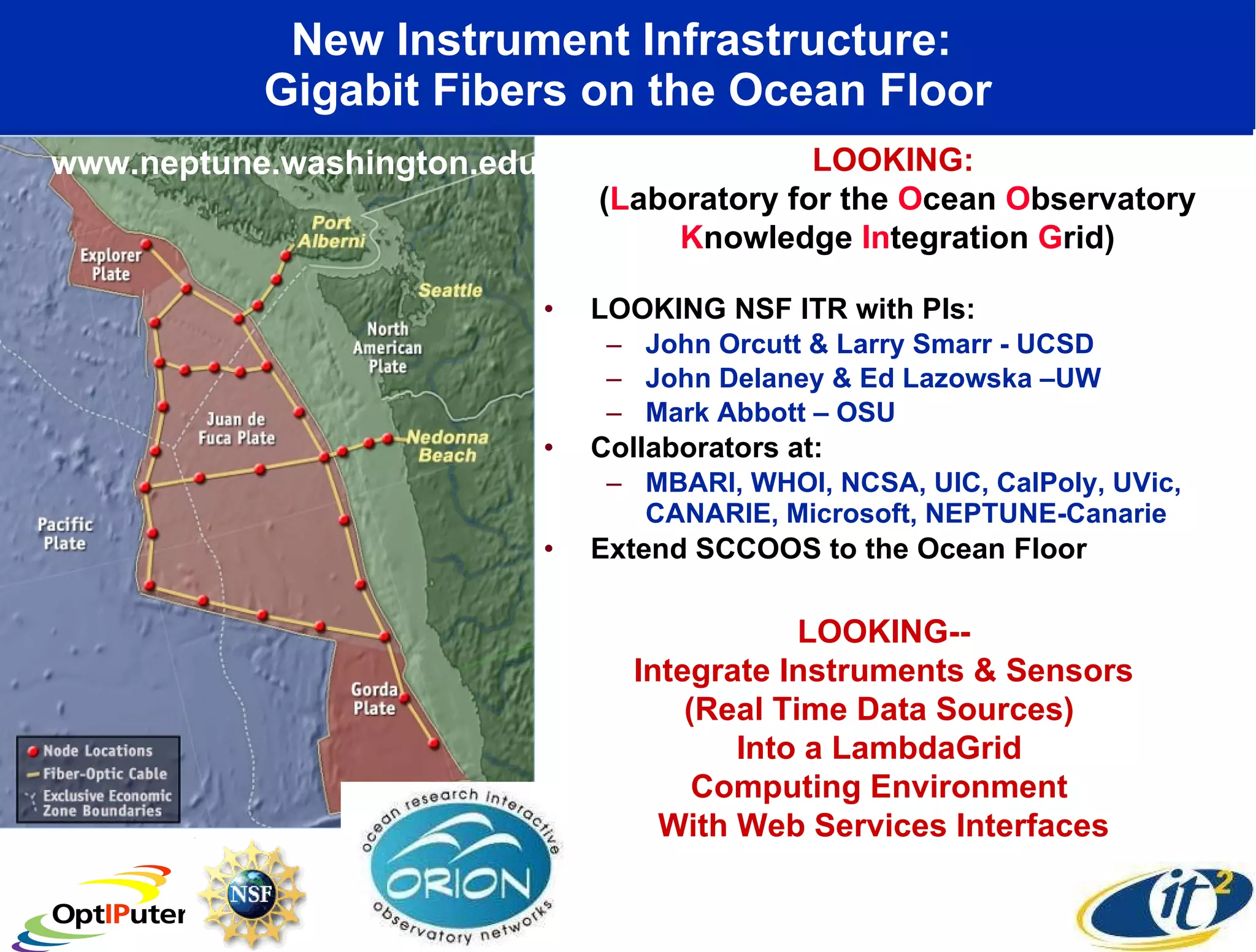
New Instrument Infrastructure:  Gigabit Fibers on the Ocean Floor LOOKING NSF ITR with PIs: John Orcutt & Larry Smarr - UCSD John Delaney & Ed Lazowska –UW Mark Abbott – OSU Collaborators at: MBARI, WHOI, NCSA, UIC, CalPoly, UVic, CANARIE, Microsoft, NEPTUNE-Canarie Extend SCCOOS to the Ocean Floor LOOKING:  ( L aboratory for the  O cean  O bservatory  K nowledge  In tegration  G rid) www.neptune.washington.edu LOOKING-- Integrate Instruments & Sensors (Real Time Data Sources)  Into a LambdaGrid  Computing Environment  With Web Services Interfaces
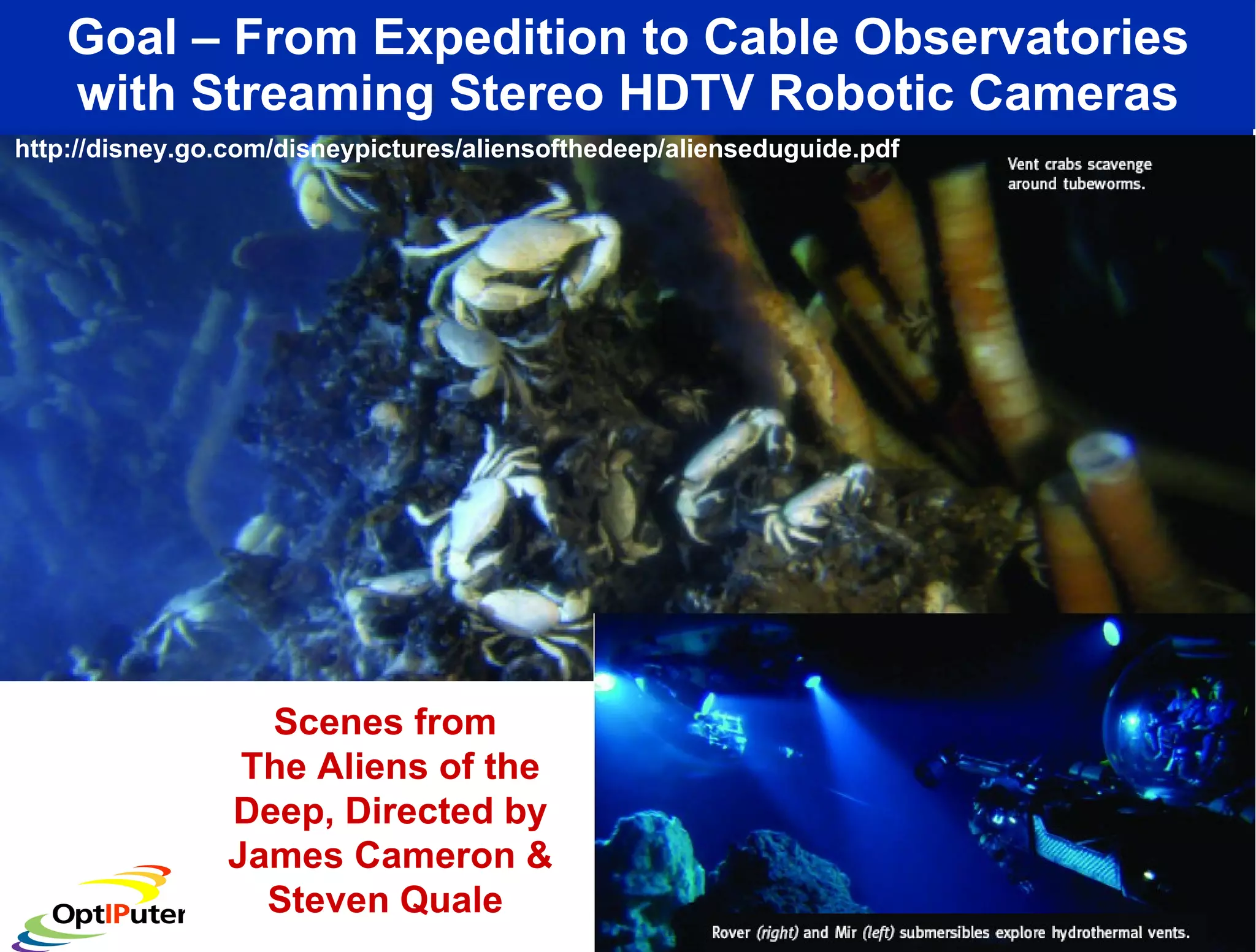
Goal – From Expedition to Cable Observatories with Streaming Stereo HDTV Robotic Cameras Scenes from  The Aliens of the Deep, Directed by James Cameron & Steven Quale  http://disney.go.com/disneypictures/aliensofthedeep/alienseduguide.pdf
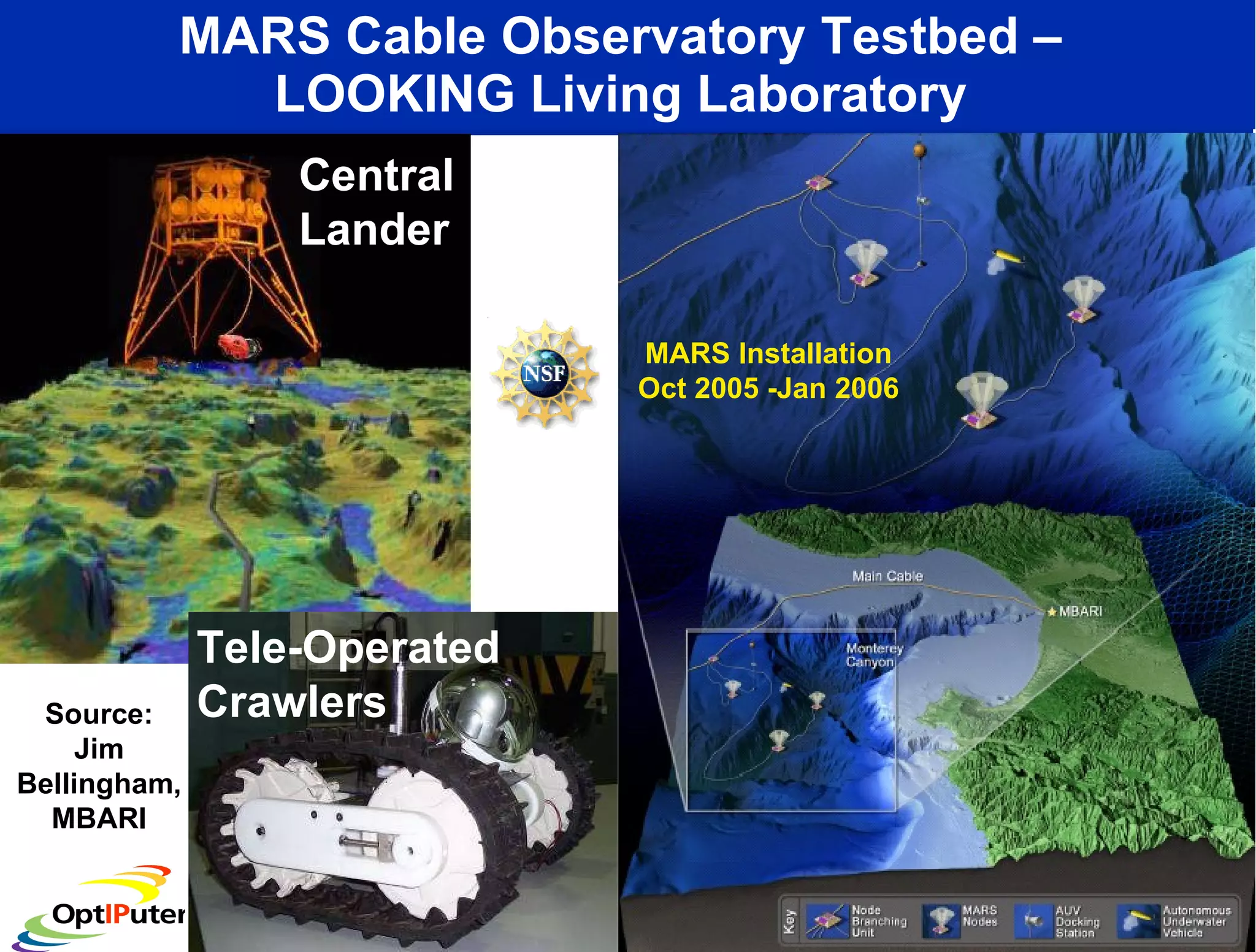
MARS Cable Observatory Testbed –  LOOKING Living Laboratory  Tele-Operated Crawlers Central Lander MARS Installation Oct 2005 -Jan 2006 Source: Jim Bellingham, MBARI
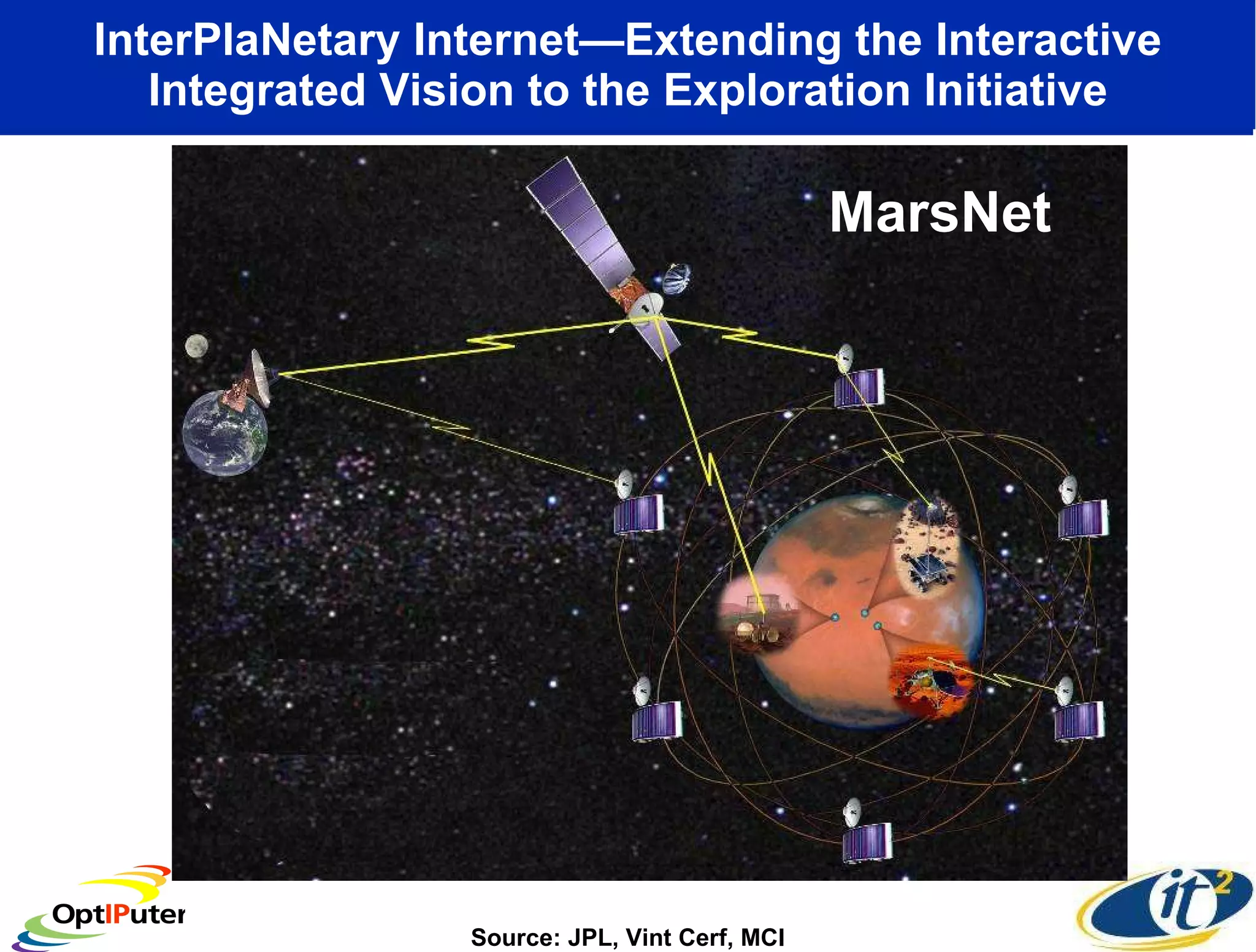
InterPlaNetary Internet—Extending the Interactive Integrated Vision to the Exploration Initiative Source: JPL, Vint Cerf, MCI MarsNet
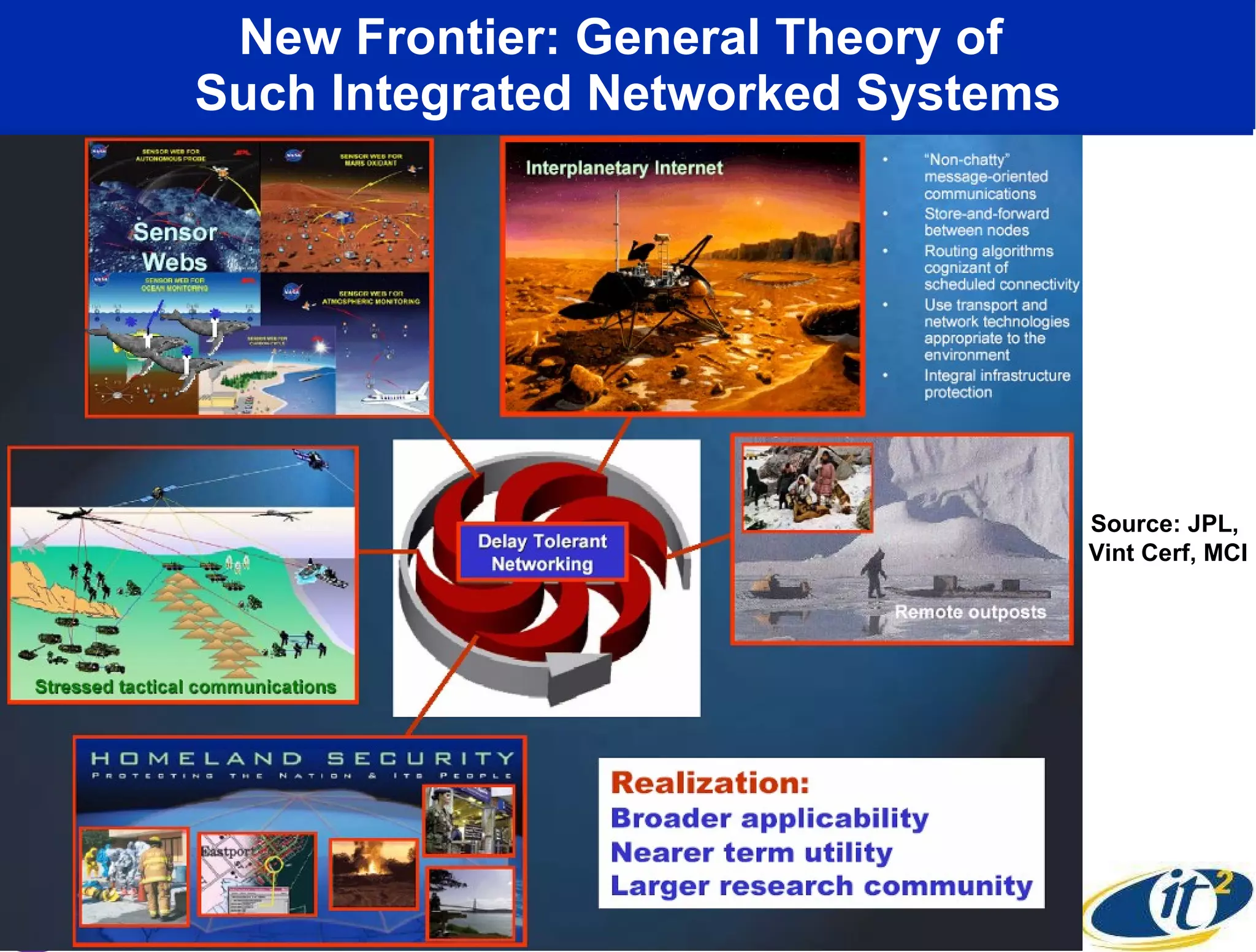
New Frontier: General Theory of  Such Integrated Networked Systems Source: JPL,  Vint Cerf, MCI

LambdaGrids--Earth and Planetary Sciences Driving High Performance Networks and High Resolution Visualizations

  • 1.
    &quot;LambdaGrids--Earth and PlanetarySciences Driving High Performance Networks and High Resolution Visualizations&quot; Invited Talk to the NASA Jet Propulsion Laboratory Pasadena, CA February 4, 2005 Dr. Larry Smarr Director, California Institute for Telecommunications and Information Technology Harry E. Gruber Professor, Dept. of Computer Science and Engineering Jacobs School of Engineering, UCSD Chair, NASA Earth System Science and Applications Advisory Committee
  • 2.
    Abstract While theInternet and the World Wide Web have become ubiquitous, their shared nature severely limits the bandwidth available to an individual user. However, during the last few years, a radical restructuring of optical networks supporting e-Science projects is beginning to occur around the world. Amazingly, scientists are now able to acquire the technological capability for private 1-10 Gbps light pipes (termed &quot;lambdas&quot;), which create deterministic network connections coming right into their laboratories. Two of the largest research projects on LambdaGrids are the NSF- funded OptIPuter (www.optiputer.net) and its new companion LOOKING (http://lookingtosea.ucsd.edu/), which is prototyping an interactive ocean observatory. The OptIPuter has two regional cores, one in Southern California and one in Chicago, which has now been extended to Amsterdam. One aim of the OptIPuter project is to make interactive visualization of remote gigabyte data objects as easy as the Web makes manipulating megabyte-size data objects today As earth and planetary sciences move toward an interactive global observation capability, a new generation of cyberinfrastructure is required, based on LambdaGrids. LOOKING and OptIPuter are prototyping realtime control of remote instruments, remote visualization or large data objects, metadata searching of federated data repositories, and collaborative analysis of complex simulations and observations. Calit2 is currently expanding its OptIPuter collaboration partners to include the NASA Science centers, JPL, Ames, and Goddard -- coupling ocean and climate supercomputer simulations with global earth satellite repositories and interactive viewing tens of megapixels of Mars Rover scenes.
  • 3.
    Optical WAN ResearchBandwidth Has Grown Much Faster than Supercomputer Speed! Megabit/s Gigabit/s Terabit/s Source: Timothy Lance, President, NYSERNet 1 GFLOP Cray2 60 TFLOP Altix Bandwidth of NYSERNet Research Network Backbones T1 32 10Gb “ Lambdas” Full NLR
  • 4.
    NLR Will Providean Experimental Network Infrastructure for U.S. Scientists & Researchers First Light September 2004 “ National LambdaRail” Partnership Serves Very High-End Experimental and Research Applications 4 x 10Gb Wavelengths Initially Capable of 40 x 10Gb wavelengths at Buildout Links Two Dozen State and Regional Optical Networks
  • 5.
    NASA Research andEngineering Network (NREN) Overview Next Steps 1 Gbps (JPL to ARC) Across CENIC (February 2005) 10 Gbps ARC, JPL & GSFC Across NLR (May 2005) StarLight Peering (May 2005) 10 Gbps LRC (Sep 2005) NREN Goal Provide a Wide Area, High-speed Network for Large Data Distribution and Real-time Interactive Applications GSFC ARC StarLight LRC GRC MSFC JPL 10 Gigabit Ethernet OC-3 ATM (155 Mbps) NREN Target: September 2005 Provide Access to NASA Research & Engineering Communities - Primary Focus: Supporting Distributed Data Access to/from Project Columbia Sample Application: Estimating the Circulation and Climate of the Ocean (ECCO) ~78 Million Data Points 1/6 Degree Latitude-Longitude Grid Decadal Grids ~ 0.5 Terabytes / Day Sites: NASA JPL, MIT, NASA Ames Source: Kevin Jones, Walter Brooks, ARC NREN WAN
  • 6.
    Global Lambda IntegratedFacility (GLIF) Integrated Research Lambda Network Many Countries are Interconnecting Optical Research Networks to form a Global SuperNetwork Visualization courtesy of Bob Patterson, NCSA www.glif.is Created in Reykjavik, Iceland Aug 2003
  • 7.
    September 26-30, 2005University of California, San Diego California Institute for Telecommunications and Information Technology Announcing… i Grid 2 oo 5 T H E G L O B A L L A M B D A I N T E G R A T E D F A C I L I T Y Call for Applications Using the GLIF SuperNetwork Maxine Brown, Tom DeFanti, Co-Organizers www.startap.net/igrid2005/
  • 8.
    The OptIPuter Project– Creating a LambdaGrid “Web” for Gigabyte Data Objects NSF Large Information Technology Research Proposal Cal-(IT) 2 and UIC Lead Campuses—Larry Smarr PI USC, SDSU, NW, Texas A&M, Univ. Amsterdam Partnering Campuses Industrial Partners IBM, Sun, Telcordia, Chiaro, Calient, Glimmerglass, Lucent $13.5 Million Over Five Years Optical IP Streams From Lab Clusters to Large Data Objects NIH Biomedical Informatics NSF EarthScope and ORION http://ncmir.ucsd.edu/gallery.html siovizcenter.ucsd.edu/library/gallery/shoot1/index.shtml Research Network
  • 9.
    Opt ical Networking, I nternet P rotocol, Comp uter Bringing the Power of Lambdas to Users Extending Grid Middleware to Control: Jitter-Free, Fixed Latency, Predictable Optical Circuits One or Parallel Dedicated Light-Pipes (1 or 10 Gbps WAN Lambdas) Uses Internet Protocol, But Does NOT Require TCP Exploring Both Intelligent Routers and Passive Switches Clusters Optimized for Storage, Visualization, and Computing Linux Clusters With 1 or 10 Gbps I/O per Node Scalable Visualization Displays Driven By OptIPuter Clusters Applications Drivers: Earth and Ocean Sciences Biomedical Imaging Digital Media at SHD resolutions (Comparable to 4K Digital Cinema) The OptIPuter Envisions a Future When the Central Architectural Element Becomes Optical Networks - NOT Computers - Creating &quot;SuperNetworks”
  • 10.
    History of NASAand the OptIPuter Feb 2001 Starlight Lambda Open Exchange Point for USA--Initial Implementation Oct 2001 OptIPuter Planning Begins Sept 2002 iGRID 2002 in Amsterdam Oct 2002 NSF OptIPuter Project Begins May 2003 GSFC Visit-Diaz Asks Milt Halem to Define NASA OptIPuter Project Aug 2003 Global Lambda Integrated Facility Formed Nov 2003 SC03 Discussions Feb 2004 GSFC IRAD Funded to Create GSFC/SIO Lambda Collab Feb 2004 ESSAAC Meeting at SIO Mar 2004 Presentation to NAC on IT Survey May 2004 Presentation of IT Recommendations to NAC July 2004 Project Columbia Approved Aug 2004 ARC Visit Oct 2004 NLR and CAVEwave First Light Nov 2004 GSFC at SC04 Becomes Early User of NLR Jan 2005 NASA Commits to NREN Use of NLR for Multiple Sites Today JPL Visit
  • 11.
    GSFC IRADProposal &quot;Preparing Goddard for Large Scale Team Science in the 21st Century: Enabling an All Optical Goddard Network Cyberinfrastructure” “… establish a 10 Gbps Lambda Network from GSFC’s Earth Science Greenbelt facility in MD to the Scripps Institute of Oceanography (SIO) over the National Lambda Rail (NLR)” “… make data residing on Goddard’s high speed computer disks available to SIO with access speeds as if the data were on their own desktop servers or PC’s.” “… enable scientists at both institutions to share and use compute intensive community models, complex data base mining and multi-dimensional streaming visualization over this highly distributed, virtual working environment.” Source: Milt Halem, GSFC Objectives Summary Funded February 2004 Current Goal- Add in ARC and JPL
  • 12.
    Expanding the OptIPuterLambdaGrid 1 GE Lambda 10 GE Lambda UCSD StarLight Chicago UIC EVL NU CENIC San Diego GigaPOP CalREN-XD 8 8 NetherLight Amsterdam U Amsterdam NASA Ames NASA Goddard NLR NLR 2 SDSU CICESE via CUDI CENIC/Abilene Shared Network PNWGP Seattle CAVEwave/NLR NASA JPL ISI UCI CENIC Los Angeles GigaPOP 2 2
  • 13.
    UCSD Campus-Scale RoutedOptIPuter with Nodes for Storage, Computation and Visualization
  • 14.
    OptIPuter Driver: On-LineMicroscopes Creating Very Large Biological Montage Images 2-Photon Laser Confocal Microscope High Speed On-line Capability Montage Image Sizes Exceed 16x Highest Resolution Monitors ~150 Million Pixels! Use Graphics Cluster with Multiple GigEs to Drive Tiled Displays Source: David Lee, NCMIR, UCSD IBM 9M Pixels
  • 15.
    GeoWall2: OptIPuterJuxtaView Software for Viewing High Resolution Images on Tiled Displays 40 Million Pixel Display NCMIR Lab UCSD Source: David Lee, Jason Leigh Display Driven by a 20-node Sun Opteron Visualization Cluster
  • 16.
    Earth and PlanetarySciences are an OptIPuter Large Data Object Visualization Driver EVL Varrier Autostereo 3D Image USGS 30 MPixel Portable Tiled Display SIO HIVE 3 MPixel Panoram Schwehr. K., C. Nishimura, C.L. Johnson, D. Kilb, and A. Nayak, &quot;Visualization Tools Facilitate Geological Investigations of Mars Exploration Rover Landing Sites&quot;, IS&T/SPIE Electronic Imaging Proceedings, in press, 2005
  • 17.
    Calit2 & SIOare Building a 4 x 6 Macintosh 30” LCD Tiled Display Driven by a Mac G5 Cluster High Resolution Real Time Visualizations of USArray Waveform Data Represented as 3D Glyphs and Combined with Near Real Time Camera Images Provide Health Monitoring of Entire Network. USArray on the GeoWall 2
  • 18.
    Tiled Displays Allowfor Both Global Context and High Levels of Detail— 150 MPixel Rover Image on 40 MPixel OptIPuter Visualization Node Display &quot;Source: Data from JPL/Mica; Display UCSD NCMIR, David Lee&quot;
  • 19.
    Interactively Zooming InUsing EVL’s JuxtaView on NCMIR’s Sun Microsystems Visualization Node &quot;Source: Data from JPL/Mica; Display UCSD NCMIR, David Lee&quot;
  • 20.
    Highest Resolution Zoomon NCMIR 40 MPixel OptIPuter Display Node &quot;Source: Data from JPL/Mica; Display UCSD NCMIR, David Lee&quot;
  • 21.
    The UIC ElectronicVisualization Lab is Prototyping the LambdaTable Version of the Tiled Display &quot;Source: Data from JPL/Mica; Display UIC EVL, Luc Renambot, Nicholas Schwarz&quot;
  • 22.
    Desktop 18 MPixelInteractive Displays Using SIO’s OptIPuter IBM Visualization Node &quot;Source: Data from JPL Rover Team--Spirit Landing Site; Display UCSD SIO, Atul Nayak&quot;
  • 23.
    OptIPuter is PrototypingThe PC of 2010 Terabits to the Desktop… 100 Megapixels Display 55-Panel 1/3 Terabit/sec I/O 30 x 10GE interfaces Linked to OptIPuter 1/4 TeraFLOP Driven by 30 Node Cluster of 64 bit Dual Opterons 1/8 TB RAM 60 TB Disk Source: Jason Leigh, Tom DeFanti, EVL@UIC OptIPuter Co-PIs
  • 24.
    Scalable Adaptive GraphicsEnvironment (SAGE) Required for Working in Display-Rich Environments AccessGrid Live video feeds Information Must Be Able To Flexibly Move Around The Wall Source: Jason Leigh, UIC Remote laptop High-resolution maps 3D surface rendering Volume Rendering Remote sensing
  • 25.
    LambdaRAM: ClusteredMemory To Provide Low Latency Access To Large Remote Data Sets Giant Pool of Cluster Memory Provides Low-Latency Access to Large Remote Data Sets Data Is Prefetched Dynamically LambdaStream Protocol Integrated into JuxtaView Montage Viewer 3 Gbps Experiments from Chicago to Amsterdam to UIC LambdaRAM Accessed Data From Amsterdam Faster Than From Local Disk all 8-14 none all 8-14 1-7 Displayed region Visualization of the Pre-Fetch Algorithm none Data on Disk in Amsterdam Local Wall Source: David Lee, Jason Leigh
  • 26.
    OptIPuter Software ArchitectureA Service-Oriented Architecture (SOA) Distributed Applications/ Web Services Telescience Vol-a-Tile SAGE JuxtaView Visualization Data Services LambdaRAM PIN/PDC GTP XCP UDT LambdaStream CEP RBUDP DVC Configuration DVC API DVC Runtime Library Globus XIO DVC Services DVC Core Services DVC Job Scheduling DVC Communication Resource Identify/Acquire Namespace Management Security Management High Speed Communication Storage Services GRAM GSI RobuStore
  • 27.
    Two New Calit2Buildings Will Become Collaboration Laboratories Will Create New Laboratory Facilities International Conferences and Testbeds 800 Researchers in Two Buildings Bioengineering UC San Diego UC Irvine In 2005 Calit2 will Link Its Two Buildings via Dedicated Fiber over 75 Miles Using OptIPuter Architecture to Create a Distributed Collaboration Laboratory Calit2@UCSD Building Is Connected To Outside With 140 Optical Fibers Extend to NASA Science Centers
  • 28.
    Telepresence Using UncompressedHDTV Streaming Over IP on Fiber Optics Seattle JGN II Workshop January 2005 Osaka Prof. Osaka Prof. Aoyama Prof. Smarr
  • 29.
    An OptIPuter LambdaVision Collaboration Room as Imagined By 2006 Source: Jason Leigh, EVL, UIC Augmented Reality SHD Streaming Video 100-Megapixel Tiled Display
  • 30.
    Three Classes of LambdaGrid Applications Browsing & Analysis of Multiple Large Remote Data Objects Assimilating Data—Linking Supercomputers with Data Sets Interacting with Coastal Observatories NASA OptIPuter Application Drivers
  • 31.
    Earth System Enterprise-DataLives in Distributed Active Archive Centers (DAAC) EOS Aura Satellite Has Been Launched Challenge is How to Evolve to New Technologies SEDAC (0.1 TB) Human Interactions in Global Change GES DAAC-GSFC (1334 TB) Upper Atmosphere Atmospheric Dynamics, Ocean Color, Global Biosphere, Hydrology, Radiance Data ASDC-LaRC (340 TB) Radiation Budget,Clouds Aerosols, Tropospheric Chemistry ORNL (1 TB) Biogeochemical Dynamics EOS Land Validation NSIDC (67 TB) Cryosphere Polar Processes LPDAAC-EDC (1143 TB) Land Processes & Features PODAAC-JPL (6 TB) Ocean Circulation Air-Sea Interactions ASF (256 TB) SAR Products Sea Ice Polar Processes GHRC (4TB) Global Hydrology
  • 32.
    Cumulative EOSDIS ArchiveHoldings-- Adding Several TBs per Day Source: Glenn Iona, EOSDIS Element Evolution Technical Working Group January 6-7, 2005
  • 33.
    EOSDIS in 2010:Trends in Data System Development Away from Centrally Designed, Implemented & Maintained Systems Toward The Integration of Independently Designed, Implemented and Maintained System Elements The Data Delivery System will be Hidden from the User Data Access Through a Data System Integrator which Provides Access to a Large Spectrum of Other Repositories as Well Most Access Performed Automatically by Other Computers e.g. Web/ Grid Services Source:Peter Cornillon Graduate School of Oceanography, Univ. of Rhode Island
  • 34.
  • 35.
    Challenge: Average Throughputof NASA Data Products to End User is Only < 50 Megabits/s Tested from GSFC-ICESAT January 2005 http://ensight.eos.nasa.gov/Missions/icesat/index.shtml
  • 36.
    Interactive Retrieval andHyperwall Display of Earth Sciences Images Using NLR Earth science data sets created by GSFC's Scientific Visualization Studio were retrieved across the NLR in real time from OptIPuter servers in Chicago and San Diego and from GSFC servers in McLean, VA, and displayed at the SC2004 in Pittsburgh Enables Scientists To Perform Coordinated Studies Of Multiple Remote-Sensing Datasets http://esdcd.gsfc.nasa.gov/LNetphoto3.html Source: Milt Halem & Randall Jones, NASA GSFC & Maxine Brown, UIC EVL Eric Sokolowsky
  • 37.
    NASA is MovingTowards a Service-Oriented Architecture for Earth Sciences Data ECHO is an Open Source Interoperability Middleware Solution Providing a Marketplace of Resource Offerings Metadata Clearinghouse & Order Broker with Open, XML-based APIs Being Built by NASA's Earth Science Data and Information System New Paradigm for Access to EOS Data Service-Oriented Enterprise Net-Centric Computing Pushing Power to the Participants - Producers and Consumers GEOSS (Global Earth Observation System of Systems) Momentum Current Availability: Over 40 Million Data Granules Over 6 Million Browse Images www.echo.eos.nasa.gov
  • 38.
    NLR GSFC/JPL Applications:Remote Viewing and Manipulation of Large Earth Science Data Sets GSFC’s ECHO and JPL’s GENESIS Prototype Science Analysis System (iEarth) will be Connected via NLR Enables Comparison of Hundreds of Terabytes of Data, Generating Large, Multi-year Climate Records Initially will Focus on the Estimating the Circulation and Climate of the Ocean (ECCO) Modeling Team Will need Versatile Subsetting & Grid-Accessible Statistical Analysis & Modeling Operators to Refine and Validate the ECCO Models Key Contacts: ECHO Metadata Gateway Team, GSFC; GENESIS Team, led by Tom Yunck, JPL. http://www.ecco-group.org Near-Surface (15-m) Ocean Current Speed from an Eddy-Permitting Integration of the Cubed-Sphere ECCO Ocean Circulation Model. Research by JPL and MIT. Visualization by C. Henze, Ames.
  • 39.
    NLR GSFC/JPL/SIO Application:Integration of Laser and Radar Topographic Data with Land Cover Data Merge the 2 Data Sets, Using SRTM to Achieve Good Coverage & GLAS to Generate Calibrated Profiles Interpretation Requires Extracting Land Cover Information from Landsat, MODIS, ASTER, and Other Data Archived in Multiple DAACs Use of the NLR and Local Data Mining and Sub-Setting Tools will Permit Systematic Fusion Of Global Data Sets, Which are Not Possible with Current Bandwidth Key Contacts: Bernard Minster, SIO; Tom Yunck, JPL; Dave Harding, Claudia Carabajal, GSFC http://icesat.gsfc.nasa.gov http://www2.jpl.nasa.gov/srtm http://glcf.umiacs.umd.edu/data/modis/vcf Geoscience Laser Altimeter System (GLAS) Shuttle Radar Topography Mission SRTM Topography ICESat – SRTM Elevations (m) % Tree Cover Classes MODIS Vegetation Continuous Fields (Hansen et al., 2003) % Tree Cover % Herbaceous Cover % Bare Cover ICESat Elevation Profiles 0 3000 meters Elevation Difference Histograms as Function of % Tree Cover
  • 40.
    Three Classes of LambdaGrid Applications Browsing & Analysis of Multiple Large Remote Data Objects Assimilating Data—Linking Supercomputers with Data Sets Interacting with Coastal Observatories NASA OptIPuter Application Drivers
  • 41.
    Federal Agency Supercomputers Faster Than 1TeraFLOP Nov 2003 Conclusion: NASA is Underpowered in High-End Computing For Its Mission Goddard Ames JPL Data From Top500 List (November 2003) Excluding No-name Agencies From Smarr March 2004 NAC Talk Aggregate Peak Speed
  • 42.
    NASA Ames BringsLeadership to High-End Computing 20 x 512-Processor SGI Altix Single-System Image Supercomputers = 10,240 Intel IA-64 Processors Estimated #1 or 2 Top500 (Nov. 2004) Project Columbia! 60TF
  • 43.
    Increasing Accuracy inHurricane Forecasts Real Time Diagnostics in GSFC of Ensemble Runs on ARC Project Columbia Operational Forecast Resolution of National Weather Service Higher Resolution Research Forecast NASA Goddard Using Ames Altix 5.75 Day Forecast of Hurricane Isidore Intense Rain- Bands 4x Resolution Improvement Source: Bill Putman, Bob Atlas, GFSC NLR will Remove the InterCenter Networking Bottleneck Project Contacts: Ricky Rood, Bob Atlas, Horace Mitchell, GSFC; Chris Henze, ARC Resolved Eye Wall
  • 44.
    OptIPuter Needed toCouple Analysis of Model Simulations with Observed Data Sets Process Studies and Manipulative Experiments Inform Improved Models Systematic Observations Used to Evaluate Models e.g. Sun, Atmosphere, Land, Ocean Model-Data Fusion (Data Assimilation) Produces Optimal Estimates of Time Mean and Spatial and Temporal Variations in Thousands of Variables Improved Models Used to Predict Future Variations Tested Against Ongoing Diagnostic Analyses Predictive Models & Continuing Analyses to Enhance Decision Support Source:Scott Denning Colorado State University experiments diagnostic models observing networks predictive models decision support Fully- populated 4-D volumes model/data fusion
  • 45.
    NASA’s Land InformationSystem at SC04 Over NLR Remote Analysis of Global 1 km x 1 km Assimilated Surface Observations Data Sets were Retrieved from OptIPuter Servers in Chicago, San Diego, & Amsterdam Remotely Viewing ~ 50 GB per Parameter Randall Jones http://lis.gsfc.nasa.gov U.S. Surface Evaporation Mexico Surface Temperature
  • 46.
    Next Step: OptIPuter,NLR, and Starlight Enabling Coordinated Earth Observing Program (CEOP) Note Current Throughput 15-45 Mbps: OptIPuter 2005 Goal is ~1-10 Gbps! http://ensight.eos.nasa.gov/Organizations/ceop/index.shtml Accessing 300TB’s of Observational Data in Tokyo and 100TB’s of Model Assimilation Data in MPI in Hamburg -- Analyzing Remote Data Using GRaD-DODS at These Sites Using OptIPuter Technology Over the NLR and Starlight Source: Milt Halem, NASA GSFC SIO
  • 47.
    Project Atmospheric BrownClouds (ABC) -- NLR Linking GSFC and UCSD/SIO A Collaboration to Predict the Flow of Aerosols from Asia Across the Pacific to the U.S. on Timescales of Days to a Week GSFC will Provide an Aerosol Chemical Tracer Model (GOCAR) Embedded in a High-Resolution Regional Model (MM5) that can Assimilate Data from Indo-Asian and Pacific Ground Stations, Satellites, and Aircraft Remote Computing and Analysis Tools Running over NLR will Enable Acquisition & Assimilation of the Project ABC Data Key Contacts: Yoram Kaufman, William Lau, GSFC; V. Ramanathan, Chul Chung, SIO http://www-abc-asia.ucsd.edu The Global Nature of Brown Clouds is Apparent in Analysis of NASA MODIS Data. Research by V. Ramanathan, C. Corrigan, and M. Ramana, SIO Ground Stations Monitor Atmospheric Pollution
  • 48.
    Three Classes of LambdaGrid Applications Browsing & Analysis of Multiple Large Remote Data Objects Assimilating Data—Linking Supercomputers with Data Sets Interacting with Coastal Observatories NASA OptIPuter Application Drivers
  • 49.
    Creating an IntegratedInteractive Information System for Earth Exploration Components of a Future Global System for Earth Observation (Sensor Web) Focus on The Coastal Zone
  • 50.
    Grand Challenge: ATotal Knowledge Integration System for the Coastal Zone Moorings Ships Autonomous Vehicles Satellite Remote Sensing Drifters Long Range HF Radar Near-Shore Waves/Currents (CDIP) COAMPS Wind Model Nested ROMS Models Data Assimilation and Modeling Data Systems Pilot Project Components www.sccoos.org/ www.cocmp.org
  • 51.
    ROADNet Architecture: SensorNets, Storage Research Broker, Web Services, Work Flow Kepler Web Services SRB Antelope Frank Vernon, SIO; Tony Fountain, Ilkay Altintas, SDSC
  • 52.
    Goal: Integrate AllRemote Sensing Data Objects Over SoCal Coastal Zone in Real Time NASA MODIS Mean Primary Productivity for April 2001 in California Current System Source: Paul M. DiGiacomo, JPL Synthetic Aperture Radar (SAR) Derived High-Resolution Coastal Ocean Winds in Southern California Bight Challenge: Large Data Objects in Distributed Repositories
  • 53.
    Use SCCOOS AsPrototype for Coastal Zone Data Assimilation Testbed www.sccoos.org Goal: Link SCCOOS Sites with OptIPuter to Prototype Future LambdaGrid For Ocean and Earth Sciences Yellow—Proposed Initial OptIPuter Backbone
  • 54.
    Use OptIPuter toCouple Data Assimilation Models to Remote Data Sources and Analysis Regional Ocean Modeling System (ROMS) http://ourocean.jpl.nasa.gov/
  • 55.
    New Instrument Infrastructure: Gigabit Fibers on the Ocean Floor LOOKING NSF ITR with PIs: John Orcutt & Larry Smarr - UCSD John Delaney & Ed Lazowska –UW Mark Abbott – OSU Collaborators at: MBARI, WHOI, NCSA, UIC, CalPoly, UVic, CANARIE, Microsoft, NEPTUNE-Canarie Extend SCCOOS to the Ocean Floor LOOKING: ( L aboratory for the O cean O bservatory K nowledge In tegration G rid) www.neptune.washington.edu LOOKING-- Integrate Instruments & Sensors (Real Time Data Sources) Into a LambdaGrid Computing Environment With Web Services Interfaces
  • 56.
    Goal – FromExpedition to Cable Observatories with Streaming Stereo HDTV Robotic Cameras Scenes from The Aliens of the Deep, Directed by James Cameron & Steven Quale http://disney.go.com/disneypictures/aliensofthedeep/alienseduguide.pdf
  • 57.
    MARS Cable ObservatoryTestbed – LOOKING Living Laboratory Tele-Operated Crawlers Central Lander MARS Installation Oct 2005 -Jan 2006 Source: Jim Bellingham, MBARI
  • 58.
    InterPlaNetary Internet—Extending theInteractive Integrated Vision to the Exploration Initiative Source: JPL, Vint Cerf, MCI MarsNet
  • 59.
    New Frontier: GeneralTheory of Such Integrated Networked Systems Source: JPL, Vint Cerf, MCI