MICRO,SMALL & MEDIUM
ENTERPRISES
AN OVERVIEW
CONTENTS
• Introduction
• What is MSMEs
• Role of MSMEs
• MSMEs in India
• Initiative taken
• Supporting organizations
• Problems of MSMEs
• Conclusion
INTRODUCTION
The Micro, Small and Medium enterprises (MSMEs) have been
accepted as the engine of economic growth and for promoting equitable
development in all over the world. Let there be any category of countries
(Developed, Developing and Under Developed), the existence of MSMEs
is inevitable. The major advantage of the sector is its pivotal role through
its contribution in Industrial output, Exports, and majorly in Employment
generation at low capital cost.
WHAT IS MSME ?
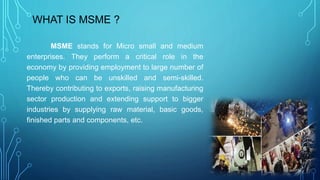
MSME stands for Micro small and medium
enterprises. They perform a critical role in the
economy by providing employment to large number of
people who can be unskilled and semi-skilled.
Thereby contributing to exports, raising manufacturing
sector production and extending support to bigger
industries by supplying raw material, basic goods,
finished parts and components, etc.
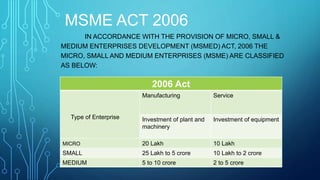
MSME ACT 2006
IN ACCORDANCE WITH THE PROVISION OF MICRO, SMALL &
MEDIUM ENTERPRISES DEVELOPMENT (MSMED) ACT, 2006 THE
MICRO, SMALL AND MEDIUM ENTERPRISES (MSME) ARE CLASSIFIED
AS BELOW:
2006 Act
Type of Enterprise
Manufacturing Service
Investment of plant and
machinery
Investment of equipment
MICRO 20 Lakh 10 Lakh
SMALL 25 Lakh to 5 crore 10 Lakh to 2 crore
MEDIUM 5 to 10 crore 2 to 5 crore
MSME AMENDMENT BILL, 2018
THE UNION GOVERNMENT HAS APPROVED CHANGE IN THE
BASIS OF CLASSIFYING MICRO, SMALL AND MEDIUM ENTERPRISES
FROM ‘INVESTMENT IN PLANT & MACHINERY/EQUIPMENT’ TO
‘ANNUAL TURNOVER’ IN FEBRUARY 2018.
BILL 2018
Types of Enterprises
Manufacturing/Service
Annual Turnover
MICRO 5 CRORES
SMALL 5 TO 75 CRORES
MEDIUM 75 TO 250 CRORES
ROLE OF MSME IN INDIA
•Contribution to GDP
•Employment Generation
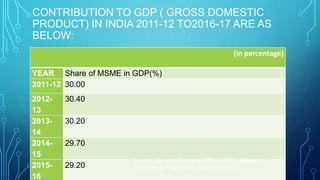
CONTRIBUTION TO GDP ( GROSS DOMESTIC
PRODUCT) IN INDIA 2011-12 TO2016-17 ARE AS
BELOW:
(in percentage)
YEAR Share of MSME in GDP(%)
2011-12 30.00
2012-
13
30.40
2013-
14
30.20
2014-
15
29.70
2015-
16
29.20
Source: Central Statistics Office (CSO), Ministry of
Statistics & Programme Implementation
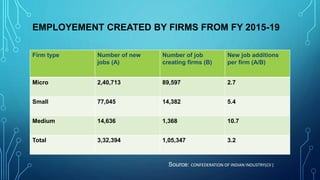
Firm type Number of new
jobs (A)
Number of job
creating firms (B)
New job additions
per firm (A/B)
Micro 2,40,713 89,597 2.7
Small 77,045 14,382 5.4
Medium 14,636 1,368 10.7
Total 3,32,394 1,05,347 3.2
EMPLOYEMENT CREATED BY FIRMS FROM FY 2015-19
Source: CONFEDERATION OF INDIAN INDUSTRY(CII )
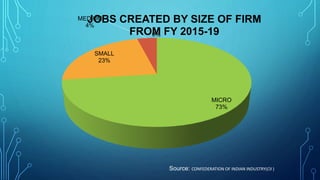
MICRO
73%
SMALL
23%
MEDIUM
4%
0%
JOBS CREATED BY SIZE OF FIRM
FROM FY 2015-19
Source: CONFEDERATION OF INDIAN INDUSTRY(CII )
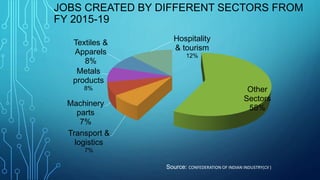
Other
Sectors
58%
Transport &
logistics
7%
Machinery
parts
7%
Metals
products
8%
Textiles &
Apparels
8%
Hospitality
& tourism
12%
JOBS CREATED BY DIFFERENT SECTORS FROM
FY 2015-19
Source: CONFEDERATION OF INDIAN INDUSTRY(CII )
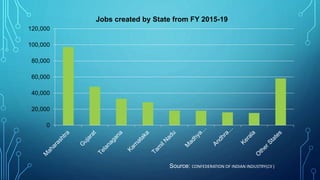
0
20,000
40,000
60,000
80,000
100,000
120,000
Jobs created by State from FY 2015-19
Source: CONFEDERATION OF INDIAN INDUSTRY(CII )
MSMEs IN INDIA (2019)
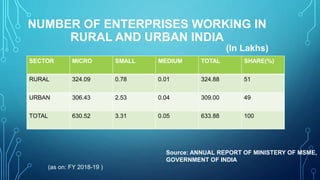
NUMBER OF ENTERPRISES WORKING IN
RURAL AND URBAN INDIA
SECTOR MICRO SMALL MEDIUM TOTAL SHARE(%)
RURAL 324.09 0.78 0.01 324.88 51
URBAN 306.43 2.53 0.04 309.00 49
TOTAL 630.52 3.31 0.05 633.88 100
(In Lakhs)
Source: ANNUAL REPORT OF MINISTERY OF MSME,
GOVERNMENT OF INDIA
(as on: FY 2018-19 )
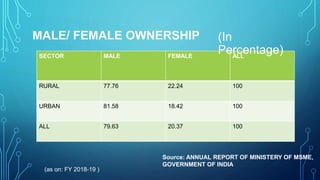
MALE/ FEMALE OWNERSHIP
SECTOR MALE FEMALE ALL
RURAL 77.76 22.24 100
URBAN 81.58 18.42 100
ALL 79.63 20.37 100
(In
Percentage)
Source: ANNUAL REPORT OF MINISTERY OF MSME,
GOVERNMENT OF INDIA
(as on: FY 2018-19 )
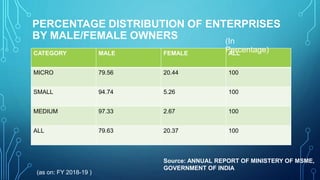
PERCENTAGE DISTRIBUTION OF ENTERPRISES
BY MALE/FEMALE OWNERS
CATEGORY MALE FEMALE ALL
MICRO 79.56 20.44 100
SMALL 94.74 5.26 100
MEDIUM 97.33 2.67 100
ALL 79.63 20.37 100
(In
Percentage)
Source: ANNUAL REPORT OF MINISTERY OF MSME,
GOVERNMENT OF INDIA
(as on: FY 2018-19 )
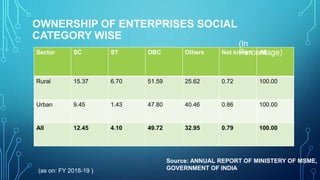
OWNERSHIP OF ENTERPRISES SOCIAL
CATEGORY WISE
Sector SC ST OBC Others Not known All
Rural 15.37 6.70 51.59 25.62 0.72 100.00
Urban 9.45 1.43 47.80 40.46 0.86 100.00
All 12.45 4.10 49.72 32.95 0.79 100.00
(In
Percentage)
Source: ANNUAL REPORT OF MINISTERY OF MSME,
GOVERNMENT OF INDIA(as on: FY 2018-19 )
1. Khadi and Village Industries Commission (KVIC)
2. COIR BOARD
3. The National Small Industries Corporation Limited (NSIC)
4. National Institute for Micro, Small and Medium Enterprises, (NI-
MSME)
5. Mahatma Gandhi Institute for Rural Industrialisation(MGIRI)
SUPPORTING ORGANISATIONS/STATUTORY
BODIES OF MSME:
Khadi and Village Industries Commission
(KVIC)
Khadi and Village Industries Commission (KVIC) established under the Khadi
and Village Industries Commission Act, 1956 (61 of 1956) is a Statutory Organization
under the aegis of the Ministry of MSME.
COIR BOARD
The Coir Board is a statutory body established under the Coir
Industry Act, 1953 for promoting the overall development of the coir
industry and improvement of the living conditions of the workers
engaged in this traditional industry.
The National Small Industries
Corporation Limited (NSIC)
The National Small Industries Corporation Ltd. (NSIC) is an ISO
9001-2015 certified Government of India Enterprise under Ministry of
Micro, Small and Medium Enterprises(MSME). NSIC has been working
to promote, aid and foster the growth of micro, small and medium
enterprises in the country. NSIC is a profit making dividend paying
company.
National Institute for Micro, Small and Medium Enterprises, (NI-
MSME)
NI-MSME was originally set up as Central Industrial Extension Training Institute
(CIETI) in New Delhi in 1960 under the then Ministry of Industry and Commerce,
Government of India. The Institute was shifted to Hyderabad in 1962 as a registered
Society in the name of Small Industry Extension Training Institute (SIET). After the
enactment of MSMED Act, 2006, the Institute expanded focus of its objectives and re-
designated its organization structure. Inline with the new Act, the Institute was rechristened
as National Institute for Micro, Small and Medium enterprises (NI-MSME). It is currently an
organization under the aegis of the Ministry of Micro, Small and Medium Enterprises
(formerly Ministry of SSI & ARI), Govt. ofIndia.
Mahatma Gandhi Institute for Rural
Industrialisation
The Jamnalal Bajaj Central Research Institute (JBCRI), Wardha was
revamped with the help of Indian Institute of Technology, Delhi as a national
level institute under the Ministry of MSME in October 2008 called Mahatma
Gandhi Institute for Rural Industrialization (MGIRI).
INITIATIVES BY
GOVT.
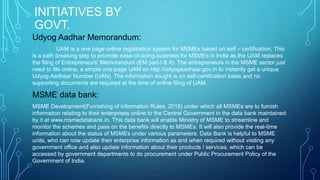
Udyog Aadhar Memorandum:
UAM is a one page online registration system for MSMEs based on self – certification. This
is a path breaking step to promote ease-of-doing-business for MSMEs in India as the UAM replaces
the filing of Entrepreneurs’ Memorandum (EM part-I & II). The entrepreneurs in the MSME sector just
need to file online, a simple one-page UAM on http://udyogaadhaar.gov.in to instantly get a unique
Udyog Aadhaar Number (UAN). The information sought is on self-certification basis and no
supporting documents are required at the time of online filing of UAM.
MSME data bank:
MSME Development(Furnishing of information Rules, 2016) under which all MSMEs are to furnish
information relating to their enterprises online to the Central Government in the data bank maintained
by it at www.msmedatabank.in. This data bank will enable Ministry of MSME to streamline and
monitor the schemes and pass on the benefits directly to MSMEs. It will also provide the real-time
information about the status of MSMEs under various parameters. Data Bank is helpful to MSME
units, who can now update their enterprise information as and when required without visiting any
government office and also update information about their products / services, which can be
accessed by government departments to do procurement under Public Procurement Policy of the
Government of India.
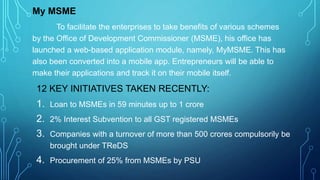
My MSME
To facilitate the enterprises to take benefits of various schemes
by the Office of Development Commissioner (MSME), his office has
launched a web-based application module, namely, MyMSME. This has
also been converted into a mobile app. Entrepreneurs will be able to
make their applications and track it on their mobile itself.
12 KEY INITIATIVES TAKEN RECENTLY:
1. Loan to MSMEs in 59 minutes up to 1 crore
2. 2% Interest Subvention to all GST registered MSMEs
3. Companies with a turnover of more than 500 crores compulsorily be
brought under TReDS
4. Procurement of 25% from MSMEs by PSU
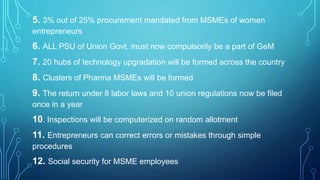
5. 3% out of 25% procurement mandated from MSMEs of women
entrepreneurs
6. ALL PSU of Union Govt. must now compulsorily be a part of GeM
7. 20 hubs of technology upgradation will be formed across the country
8. Clusters of Pharma MSMEs will be formed
9. The return under 8 labor laws and 10 union regulations now be filed
once in a year
10. Inspections will be computerized on random allotment
11. Entrepreneurs can correct errors or mistakes through simple
procedures
12. Social security for MSME employees
PROBLEMS OF MSME
• Lack of credit from banks
• Competition from multination companies
• Poor infrastructure
• Unavailability of raw material & other inputs
• Lack of advance technology
• Lack of distribution of market channel
• Lack of skill development training
• Complex labour laws & red-tape
• Market access
CONCLUSION
From the above explanation we can conclude that MSMEs are
crucial for the economy as it generates large number of employments
and contributes to GDP. But the growth of MSMEs are hindered by a lot
of problems. Hence, to reap the full potential of MSMEs in terms of their
contribution to economy, a holistic measure by the government is highly
desirable. At the same time the young masses of the country must be
motivated to venture into new business propositions so to act as a
catalyst in the economic growth of the country.
ASK ?
THANK YOU
• GUIDED BY PRESENTED
BY:
• DR. B VENKETESWAR RAO UMESH PATNAIK (17)
• MR. MAHESWAR SETHI KARAM CHAND NAIK
(06)
• MR. SAKTI RANJAN DASH BALAKRUSHNA RAIT (10)

MSMEs in India: An overview

  • 2.
  • 3.
    CONTENTS • Introduction • Whatis MSMEs • Role of MSMEs • MSMEs in India • Initiative taken • Supporting organizations • Problems of MSMEs • Conclusion
  • 4.
    INTRODUCTION The Micro, Smalland Medium enterprises (MSMEs) have been accepted as the engine of economic growth and for promoting equitable development in all over the world. Let there be any category of countries (Developed, Developing and Under Developed), the existence of MSMEs is inevitable. The major advantage of the sector is its pivotal role through its contribution in Industrial output, Exports, and majorly in Employment generation at low capital cost.
  • 5.
    WHAT IS MSME? MSME stands for Micro small and medium enterprises. They perform a critical role in the economy by providing employment to large number of people who can be unskilled and semi-skilled. Thereby contributing to exports, raising manufacturing sector production and extending support to bigger industries by supplying raw material, basic goods, finished parts and components, etc.
  • 6.
    MSME ACT 2006 INACCORDANCE WITH THE PROVISION OF MICRO, SMALL & MEDIUM ENTERPRISES DEVELOPMENT (MSMED) ACT, 2006 THE MICRO, SMALL AND MEDIUM ENTERPRISES (MSME) ARE CLASSIFIED AS BELOW: 2006 Act Type of Enterprise Manufacturing Service Investment of plant and machinery Investment of equipment MICRO 20 Lakh 10 Lakh SMALL 25 Lakh to 5 crore 10 Lakh to 2 crore MEDIUM 5 to 10 crore 2 to 5 crore
  • 7.
    MSME AMENDMENT BILL,2018 THE UNION GOVERNMENT HAS APPROVED CHANGE IN THE BASIS OF CLASSIFYING MICRO, SMALL AND MEDIUM ENTERPRISES FROM ‘INVESTMENT IN PLANT & MACHINERY/EQUIPMENT’ TO ‘ANNUAL TURNOVER’ IN FEBRUARY 2018. BILL 2018 Types of Enterprises Manufacturing/Service Annual Turnover MICRO 5 CRORES SMALL 5 TO 75 CRORES MEDIUM 75 TO 250 CRORES
  • 8.
    ROLE OF MSMEIN INDIA •Contribution to GDP •Employment Generation
  • 9.
    CONTRIBUTION TO GDP( GROSS DOMESTIC PRODUCT) IN INDIA 2011-12 TO2016-17 ARE AS BELOW: (in percentage) YEAR Share of MSME in GDP(%) 2011-12 30.00 2012- 13 30.40 2013- 14 30.20 2014- 15 29.70 2015- 16 29.20 Source: Central Statistics Office (CSO), Ministry of Statistics & Programme Implementation
  • 10.
    Firm type Numberof new jobs (A) Number of job creating firms (B) New job additions per firm (A/B) Micro 2,40,713 89,597 2.7 Small 77,045 14,382 5.4 Medium 14,636 1,368 10.7 Total 3,32,394 1,05,347 3.2 EMPLOYEMENT CREATED BY FIRMS FROM FY 2015-19 Source: CONFEDERATION OF INDIAN INDUSTRY(CII )
  • 11.
    MICRO 73% SMALL 23% MEDIUM 4% 0% JOBS CREATED BYSIZE OF FIRM FROM FY 2015-19 Source: CONFEDERATION OF INDIAN INDUSTRY(CII )
  • 12.
    Other Sectors 58% Transport & logistics 7% Machinery parts 7% Metals products 8% Textiles & Apparels 8% Hospitality &tourism 12% JOBS CREATED BY DIFFERENT SECTORS FROM FY 2015-19 Source: CONFEDERATION OF INDIAN INDUSTRY(CII )
  • 13.
    0 20,000 40,000 60,000 80,000 100,000 120,000 Jobs created byState from FY 2015-19 Source: CONFEDERATION OF INDIAN INDUSTRY(CII )
  • 14.
  • 15.
    NUMBER OF ENTERPRISESWORKING IN RURAL AND URBAN INDIA SECTOR MICRO SMALL MEDIUM TOTAL SHARE(%) RURAL 324.09 0.78 0.01 324.88 51 URBAN 306.43 2.53 0.04 309.00 49 TOTAL 630.52 3.31 0.05 633.88 100 (In Lakhs) Source: ANNUAL REPORT OF MINISTERY OF MSME, GOVERNMENT OF INDIA (as on: FY 2018-19 )
  • 16.
    MALE/ FEMALE OWNERSHIP SECTORMALE FEMALE ALL RURAL 77.76 22.24 100 URBAN 81.58 18.42 100 ALL 79.63 20.37 100 (In Percentage) Source: ANNUAL REPORT OF MINISTERY OF MSME, GOVERNMENT OF INDIA (as on: FY 2018-19 )
  • 17.
    PERCENTAGE DISTRIBUTION OFENTERPRISES BY MALE/FEMALE OWNERS CATEGORY MALE FEMALE ALL MICRO 79.56 20.44 100 SMALL 94.74 5.26 100 MEDIUM 97.33 2.67 100 ALL 79.63 20.37 100 (In Percentage) Source: ANNUAL REPORT OF MINISTERY OF MSME, GOVERNMENT OF INDIA (as on: FY 2018-19 )
  • 18.
    OWNERSHIP OF ENTERPRISESSOCIAL CATEGORY WISE Sector SC ST OBC Others Not known All Rural 15.37 6.70 51.59 25.62 0.72 100.00 Urban 9.45 1.43 47.80 40.46 0.86 100.00 All 12.45 4.10 49.72 32.95 0.79 100.00 (In Percentage) Source: ANNUAL REPORT OF MINISTERY OF MSME, GOVERNMENT OF INDIA(as on: FY 2018-19 )
  • 19.
    1. Khadi andVillage Industries Commission (KVIC) 2. COIR BOARD 3. The National Small Industries Corporation Limited (NSIC) 4. National Institute for Micro, Small and Medium Enterprises, (NI- MSME) 5. Mahatma Gandhi Institute for Rural Industrialisation(MGIRI) SUPPORTING ORGANISATIONS/STATUTORY BODIES OF MSME:
  • 20.
    Khadi and VillageIndustries Commission (KVIC) Khadi and Village Industries Commission (KVIC) established under the Khadi and Village Industries Commission Act, 1956 (61 of 1956) is a Statutory Organization under the aegis of the Ministry of MSME. COIR BOARD The Coir Board is a statutory body established under the Coir Industry Act, 1953 for promoting the overall development of the coir industry and improvement of the living conditions of the workers engaged in this traditional industry.
  • 21.
    The National SmallIndustries Corporation Limited (NSIC) The National Small Industries Corporation Ltd. (NSIC) is an ISO 9001-2015 certified Government of India Enterprise under Ministry of Micro, Small and Medium Enterprises(MSME). NSIC has been working to promote, aid and foster the growth of micro, small and medium enterprises in the country. NSIC is a profit making dividend paying company.
  • 22.
    National Institute forMicro, Small and Medium Enterprises, (NI- MSME) NI-MSME was originally set up as Central Industrial Extension Training Institute (CIETI) in New Delhi in 1960 under the then Ministry of Industry and Commerce, Government of India. The Institute was shifted to Hyderabad in 1962 as a registered Society in the name of Small Industry Extension Training Institute (SIET). After the enactment of MSMED Act, 2006, the Institute expanded focus of its objectives and re- designated its organization structure. Inline with the new Act, the Institute was rechristened as National Institute for Micro, Small and Medium enterprises (NI-MSME). It is currently an organization under the aegis of the Ministry of Micro, Small and Medium Enterprises (formerly Ministry of SSI & ARI), Govt. ofIndia. Mahatma Gandhi Institute for Rural Industrialisation The Jamnalal Bajaj Central Research Institute (JBCRI), Wardha was revamped with the help of Indian Institute of Technology, Delhi as a national level institute under the Ministry of MSME in October 2008 called Mahatma Gandhi Institute for Rural Industrialization (MGIRI).
  • 23.
    INITIATIVES BY GOVT. Udyog AadharMemorandum: UAM is a one page online registration system for MSMEs based on self – certification. This is a path breaking step to promote ease-of-doing-business for MSMEs in India as the UAM replaces the filing of Entrepreneurs’ Memorandum (EM part-I & II). The entrepreneurs in the MSME sector just need to file online, a simple one-page UAM on http://udyogaadhaar.gov.in to instantly get a unique Udyog Aadhaar Number (UAN). The information sought is on self-certification basis and no supporting documents are required at the time of online filing of UAM. MSME data bank: MSME Development(Furnishing of information Rules, 2016) under which all MSMEs are to furnish information relating to their enterprises online to the Central Government in the data bank maintained by it at www.msmedatabank.in. This data bank will enable Ministry of MSME to streamline and monitor the schemes and pass on the benefits directly to MSMEs. It will also provide the real-time information about the status of MSMEs under various parameters. Data Bank is helpful to MSME units, who can now update their enterprise information as and when required without visiting any government office and also update information about their products / services, which can be accessed by government departments to do procurement under Public Procurement Policy of the Government of India.
  • 24.
    My MSME To facilitatethe enterprises to take benefits of various schemes by the Office of Development Commissioner (MSME), his office has launched a web-based application module, namely, MyMSME. This has also been converted into a mobile app. Entrepreneurs will be able to make their applications and track it on their mobile itself. 12 KEY INITIATIVES TAKEN RECENTLY: 1. Loan to MSMEs in 59 minutes up to 1 crore 2. 2% Interest Subvention to all GST registered MSMEs 3. Companies with a turnover of more than 500 crores compulsorily be brought under TReDS 4. Procurement of 25% from MSMEs by PSU
  • 25.
    5. 3% outof 25% procurement mandated from MSMEs of women entrepreneurs 6. ALL PSU of Union Govt. must now compulsorily be a part of GeM 7. 20 hubs of technology upgradation will be formed across the country 8. Clusters of Pharma MSMEs will be formed 9. The return under 8 labor laws and 10 union regulations now be filed once in a year 10. Inspections will be computerized on random allotment 11. Entrepreneurs can correct errors or mistakes through simple procedures 12. Social security for MSME employees
  • 26.
    PROBLEMS OF MSME •Lack of credit from banks • Competition from multination companies • Poor infrastructure • Unavailability of raw material & other inputs • Lack of advance technology • Lack of distribution of market channel • Lack of skill development training • Complex labour laws & red-tape • Market access
  • 27.
    CONCLUSION From the aboveexplanation we can conclude that MSMEs are crucial for the economy as it generates large number of employments and contributes to GDP. But the growth of MSMEs are hindered by a lot of problems. Hence, to reap the full potential of MSMEs in terms of their contribution to economy, a holistic measure by the government is highly desirable. At the same time the young masses of the country must be motivated to venture into new business propositions so to act as a catalyst in the economic growth of the country.
  • 28.
  • 29.
    THANK YOU • GUIDEDBY PRESENTED BY: • DR. B VENKETESWAR RAO UMESH PATNAIK (17) • MR. MAHESWAR SETHI KARAM CHAND NAIK (06) • MR. SAKTI RANJAN DASH BALAKRUSHNA RAIT (10)