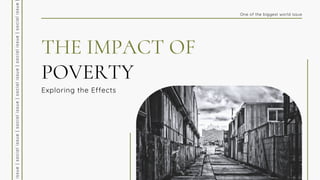
Poverty
Brief definition of
Povertyhas far-reaching consequences affecting
individuals, communities, and societies.
Poverty is a state where people or communities lack the
resources to meet a minimum standard of living.
This can include a lack of financial resources, basic healthcare
and education, clean drinking water, and infrastructure.
The Impact of Poverty
3.
Poverty is acondition where a person or community lacks the financial
resources and essentials to enjoy a minimum standard of living. This means
they may not have enough income to meet basic needs such as food, clean
water, shelter, clothing, healthcare, and education.
There are two common types:
Absolute poverty – when people cannot meet basic life needs (like food
or shelter).
Relative poverty – when people have much less income compared to
others in their society.
4.
Definition of PovertyAccording to NEDA Philippines
According to the National Economic and Development
Authority (NEDA), poverty is not just about low income—it is
a multidimensional issue that involves lack of access to:
• Basic needs (food, education, health services)
• Opportunities for productive employment
• Decent living conditions
• Social inclusion and participation
NEDA defines poverty as a condition wherein the income of
individuals or families is not sufficient to meet the basic
food and non-food requirements, measured by the poverty
threshold set by the Philippine Statistics Authority (PSA).
Beyond income, poverty also includes vulnerability, lack of
education, and limited access to essential services.
5.
"No Poverty" isthe first goal (Goal 1) of the United Nations Sustainable
Development Goals (SDGs).
Its aim is to end poverty in all its forms everywhere by 2030.
Relevance:
Poverty affects access to education, health, clean water, and job
opportunities.
Ending poverty helps people live with dignity, security, and hope for a
better future.
Without reducing poverty, other SDGs like good health (Goal 3), quality
education (Goal 4), and reduced inequalities (Goal 10) are harder to
achieve.
Reducing poverty builds more peaceful, fair, and resilient societies.
6.
The Impact ofPoverty
Physical Health
Higher rates of chronic
diseases
Lower life expectancy.
Mental Health
Increased rates of
depression
Anxiety
Substance abuse
Infant Mortality
Correlation between
poverty
Infant mortality rates
7.
Education
Impacts
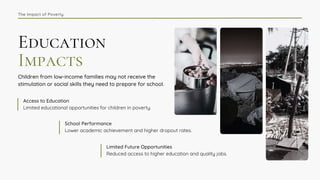
Children from low-incomefamilies may not receive the
stimulation or social skills they need to prepare for school.
Limited educational opportunities for children in poverty.
Access to Education
Lower academic achievement and higher dropout rates.
School Performance
Reduced access to higher education and quality jobs.
Limited Future Opportunities
The Impact of Poverty
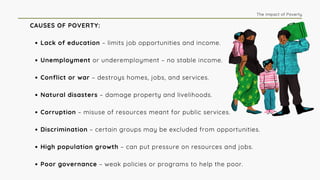
CAUSES OF POVERTY:
Lackof education – limits job opportunities and income.
Unemployment or underemployment – no stable income.
Conflict or war – destroys homes, jobs, and services.
Natural disasters – damage property and livelihoods.
Corruption – misuse of resources meant for public services.
Discrimination – certain groups may be excluded from opportunities.
High population growth – can put pressure on resources and jobs.
Poor governance – weak policies or programs to help the poor.
The Impact of Poverty
10.
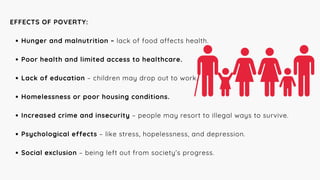
EFFECTS OF POVERTY:
Hungerand malnutrition – lack of food affects health.
Poor health and limited access to healthcare.
Lack of education – children may drop out to work.
Homelessness or poor housing conditions.
Increased crime and insecurity – people may resort to illegal ways to survive.
Psychological effects – like stress, hopelessness, and depression.
Social exclusion – being left out from society’s progress.