Welcome
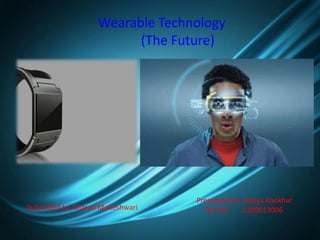
Wearable Technology
(The Future)
Presented by: Aditya Khokhar
Roll No :1109013006Submitted to: Sharad Maheshwari
Contents
• Introduction
• History
• Architecture
• Technologies
• Application
• Advantages and Disadvantages
• Conclusion
• References
• Wearable technology, wearable devices or fashion electronics are
clothing and accessories incorporating computer and advanced
electronic technologies.
• Wearable technology is related to both the field of ubiquitous
computing and the history and development of wearable
computers. With ubiquitous computing, wearable technology share
the vision of interweaving technology into the everyday life, of
making technology pervasive and interaction frictionless.
History
• Idea dates back to the 1960’s (Groen,2010)
• Early models not feasible because of large, bulky size
• 1966 Ivan Sutherland created first head mounted computer
• 1977- Vest and Headset developed to aid the blind
• 1980’s general purpose wearable computers developed
• In 1990’s wearable computing swiftly progressing
• Carnegie Melon University, Massachusetts Institute of Technology,
and Georgia Tech sponsored international symposium on
“Wearable Computing” in 1997
• Today, computer fibers being woven in clothing fibers
1960 1970 1980 1990 2000 2010
Implementation or Architecture
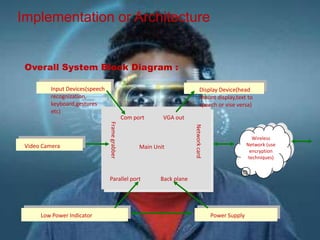
Overall System Block Diagram :
Wireless
Network (use
encryption
techniques)
Input Devices(speech
recognization,
keyboard,gestures
etc)
Display Device(head
mount display,text to
speech or vise versa)
Video Camera
Low Power Indicator Power Supply
Com port VGA out
Framegrabber
Networkcard
Parallel port Back plane
Main Unit
TECHNOLOGIES
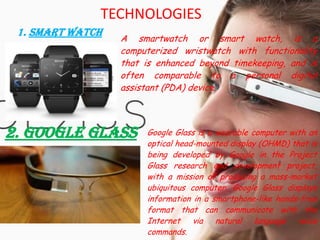
1. Smart Watch
A smartwatch or smart watch, is a
computerized wristwatch with functionality
that is enhanced beyond timekeeping, and is
often comparable to a personal digital
assistant (PDA) device.
2. Google Glass Google Glass is a wearable computer with an
optical head-mounted display (OHMD) that is
being developed by Google in the Project
Glass research and development project,
with a mission of producing a mass-market
ubiquitous computer. Google Glass displays
information in a smartphone-like hands-free
format that can communicate with the
Internet via natural language voice
commands.
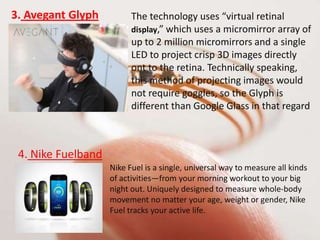
3. Avegant Glyph The technology uses “virtual retinal
display,” which uses a micromirror array of
up to 2 million micromirrors and a single
LED to project crisp 3D images directly
ont to the retina. Technically speaking,
this method of projecting images would
not require goggles, so the Glyph is
different than Google Glass in that regard
4. Nike Fuelband
Nike Fuel is a single, universal way to measure all kinds
of activities—from your morning workout to your big
night out. Uniquely designed to measure whole-body
movement no matter your age, weight or gender, Nike
Fuel tracks your active life.
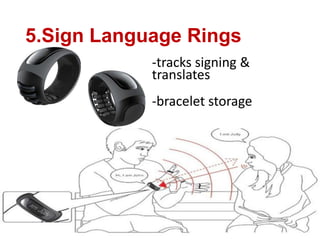
5.Sign Language Rings
-tracks signing &
translates
-bracelet storage
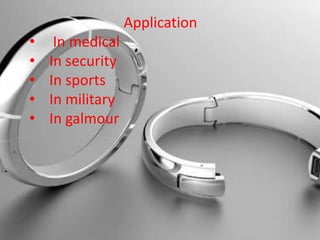
Application
• In medical
• In security
• In sports
• In military
• In galmour
Advantages
• User friendly, easy to learn
• Computer moves with you
• Patients data easily obtained
• Eliminates unnecessary charting
• New technology appeals to net generation
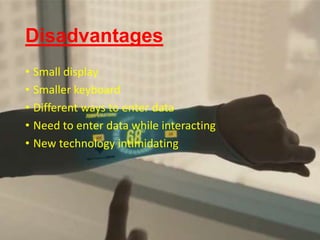
Disadvantages
• Small display
• Smaller keyboard
• Different ways to enter data
• Need to enter data while interacting
• New technology intimidating
CONCLUSION
• Wearable Computing is an upcoming technology.
• A Wearable Computer is not a belt-worn desktop
computer.
• It will become more important to work with
instead of work at the computer.
• IT-Support gets deeper into work processes.
• Wearable Computing will bring efficiency on site.
• A lot of work still to be done-looking forward to
newer advanced versions.
References
• Wikipedia
• Google
• Wearable-technology.com
• Imdb
Thank You

Wearable technology

  • 1.
  • 2.
    Wearable Technology (The Future) Presentedby: Aditya Khokhar Roll No :1109013006Submitted to: Sharad Maheshwari
  • 3.
    Contents • Introduction • History •Architecture • Technologies • Application • Advantages and Disadvantages • Conclusion • References
  • 4.
    • Wearable technology,wearable devices or fashion electronics are clothing and accessories incorporating computer and advanced electronic technologies. • Wearable technology is related to both the field of ubiquitous computing and the history and development of wearable computers. With ubiquitous computing, wearable technology share the vision of interweaving technology into the everyday life, of making technology pervasive and interaction frictionless.
  • 5.
    History • Idea datesback to the 1960’s (Groen,2010) • Early models not feasible because of large, bulky size • 1966 Ivan Sutherland created first head mounted computer • 1977- Vest and Headset developed to aid the blind • 1980’s general purpose wearable computers developed • In 1990’s wearable computing swiftly progressing • Carnegie Melon University, Massachusetts Institute of Technology, and Georgia Tech sponsored international symposium on “Wearable Computing” in 1997 • Today, computer fibers being woven in clothing fibers 1960 1970 1980 1990 2000 2010
  • 6.
    Implementation or Architecture OverallSystem Block Diagram : Wireless Network (use encryption techniques) Input Devices(speech recognization, keyboard,gestures etc) Display Device(head mount display,text to speech or vise versa) Video Camera Low Power Indicator Power Supply Com port VGA out Framegrabber Networkcard Parallel port Back plane Main Unit
  • 7.
    TECHNOLOGIES 1. Smart Watch Asmartwatch or smart watch, is a computerized wristwatch with functionality that is enhanced beyond timekeeping, and is often comparable to a personal digital assistant (PDA) device. 2. Google Glass Google Glass is a wearable computer with an optical head-mounted display (OHMD) that is being developed by Google in the Project Glass research and development project, with a mission of producing a mass-market ubiquitous computer. Google Glass displays information in a smartphone-like hands-free format that can communicate with the Internet via natural language voice commands.
  • 8.
    3. Avegant GlyphThe technology uses “virtual retinal display,” which uses a micromirror array of up to 2 million micromirrors and a single LED to project crisp 3D images directly ont to the retina. Technically speaking, this method of projecting images would not require goggles, so the Glyph is different than Google Glass in that regard 4. Nike Fuelband Nike Fuel is a single, universal way to measure all kinds of activities—from your morning workout to your big night out. Uniquely designed to measure whole-body movement no matter your age, weight or gender, Nike Fuel tracks your active life.
  • 9.
    5.Sign Language Rings -trackssigning & translates -bracelet storage
  • 10.
    Application • In medical •In security • In sports • In military • In galmour
  • 11.
    Advantages • User friendly,easy to learn • Computer moves with you • Patients data easily obtained • Eliminates unnecessary charting • New technology appeals to net generation
  • 12.
    Disadvantages • Small display •Smaller keyboard • Different ways to enter data • Need to enter data while interacting • New technology intimidating
  • 13.
    CONCLUSION • Wearable Computingis an upcoming technology. • A Wearable Computer is not a belt-worn desktop computer. • It will become more important to work with instead of work at the computer. • IT-Support gets deeper into work processes. • Wearable Computing will bring efficiency on site. • A lot of work still to be done-looking forward to newer advanced versions.
  • 14.
    References • Wikipedia • Google •Wearable-technology.com • Imdb
  • 15.