Future of Mobile Technology
ASHISH
Samsung Mobile
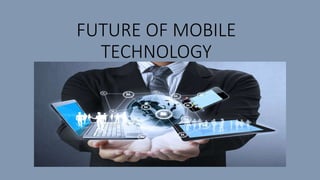
FUTURE OF MOBILE
TECHNOLOGY
Introduction
With our ever increasing demand of technology in our world, Mobile Technology seems to be at the fore-
front. It is very hard to believe that this technology didn’t even exist 100 years ago, now it is the most used
technology in our society today.
In the near future, there will be more mobile phones than there are people in the world. Almost the entire
population will have a mobile phone in their hands.
With this in mind, we will explore the future of Mobile Technology, with a brief history of the past, and the
possibilities that lie ahead. In terms of mobile technology:
THE FUTURE IS NOW
Definition
An electronic tele-communications device, often referred to as a cellular phone or cellphone. Mobile phones
connect to a wireless communications network through radio wave or satellite transmissions. Most mobile
phones provide voice communications, Short Message Service (SMS), Multimedia Message Service
(MMS), games, cameras, video players, navigational systems, video call and also provide Internet services
such as Web browsing and e-mail.
They can be used over a wide area without a physical connection to a network.
Mobile Technology
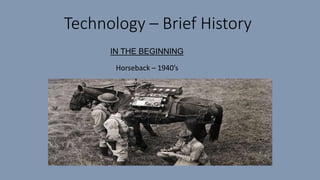
Technology – Brief History
IN THE BEGINNING
Horseback – 1940’s
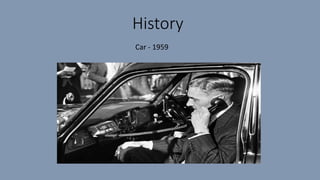
History
Car - 1959
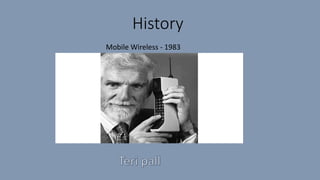
History
Mobile Wireless - 1983
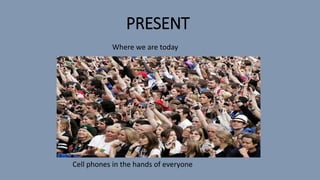
PRESENT
Where we are today
Cell phones in the hands of everyone
SURVEY
Silicon India recently reported, the number of active cell phones will
reach 7.3 billion by 2014.
AND
This simply means that by 2020 we have more phone in this world than
the number of people in this world according to the SILICON survey.
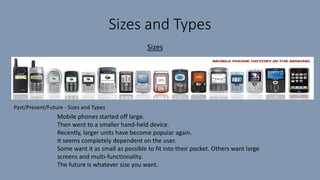
Sizes and Types
Sizes
Mobile phones started off large.
Then went to a smaller hand-held device.
Recently, larger units have become popular again.
It seems completely dependent on the user.
Some want it as small as possible to fit into their pocket. Others want large
screens and multi-functionality.
The future is whatever size you want.
Past/Present/Future - Sizes and Types
Sizes and Types
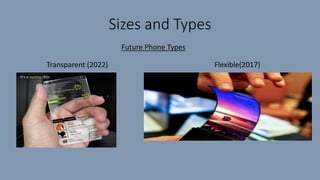
Future Phone Types
Transparent (2022) Flexible(2017)
Sizes and Types
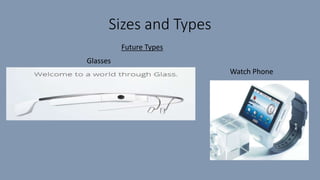
Future Types
Glasses
Watch Phone
Sizes and Types
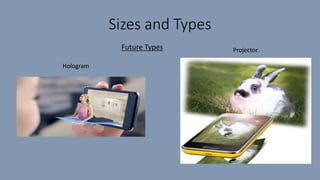
Future Types
Hologram
Projector
Generation Types
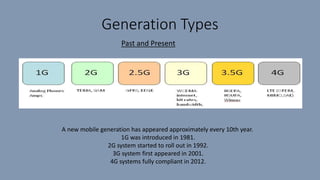
Past and Present
A new mobile generation has appeared approximately every 10th year.
1G was introduced in 1981.
2G system started to roll out in 1992.
3G system first appeared in 2001.
4G systems fully compliant in 2012.
Generation Types
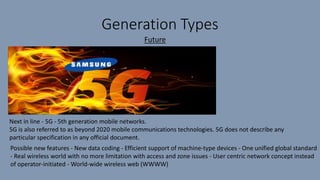
Future
Next in line - 5G - 5th generation mobile networks.
5G is also referred to as beyond 2020 mobile communications technologies. 5G does not describe any
particular specification in any official document.
Possible new features - New data coding - Efficient support of machine-type devices - One unified global standard
- Real wireless world with no more limitation with access and zone issues - User centric network concept instead
of operator-initiated - World-wide wireless web (WWWW)
Operating Systems
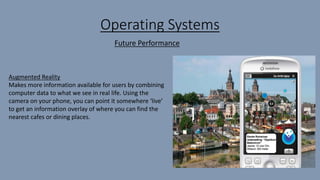
Augmented Reality
Makes more information available for users by combining
computer data to what we see in real life. Using the
camera on your phone, you can point it somewhere ‘live’
to get an information overlay of where you can find the
nearest cafes or dining places.
Future Performance
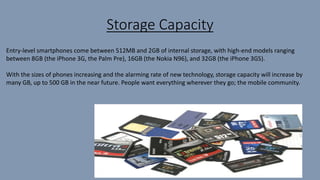
Storage Capacity
Entry-level smartphones come between 512MB and 2GB of internal storage, with high-end models ranging
between 8GB (the iPhone 3G, the Palm Pre), 16GB (the Nokia N96), and 32GB (the iPhone 3GS).
With the sizes of phones increasing and the alarming rate of new technology, storage capacity will increase by
many GB, up to 500 GB in the near future. People want everything wherever they go; the mobile community.
Mobile Input Technology Trends
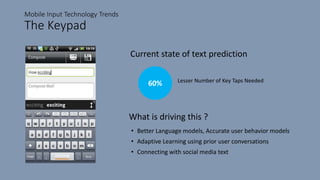
The Keypad
Current state of text prediction
60% Lesser Number of Key Taps Needed
What is driving this ?
• Better Language models, Accurate user behavior models
• Adaptive Learning using prior user conversations
• Connecting with social media text
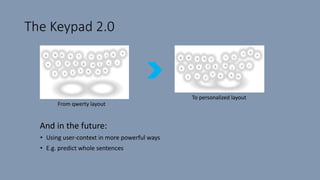
The Keypad 2.0
And in the future:
• Using user-context in more powerful ways
• E.g. predict whole sentences
From qwerty layout
To personalized layout
Mobile Input Technology Trends
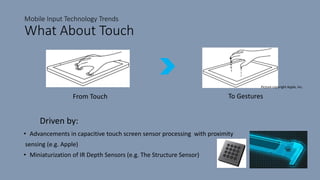
What About Touch
Driven by:
From Touch To Gestures
• Advancements in capacitive touch screen sensor processing with proximity
sensing (e.g. Apple)
• Miniaturization of IR Depth Sensors (e.g. The Structure Sensor)
Picture copyright Apple, Inc.
Mobile Input Technology Trends
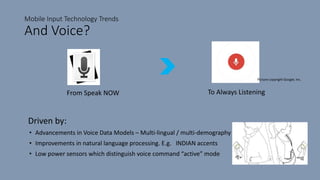
And Voice?
Driven by:
From Speak NOW To Always Listening
• Advancements in Voice Data Models – Multi-lingual / multi-demography
• Improvements in natural language processing. E.g. INDIAN accents
• Low power sensors which distinguish voice command “active” mode
Picture copyright Google, Inc.
Mobile Sensor Technology Trends
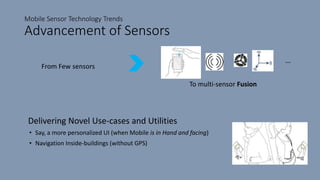
Advancement of Sensors
Delivering Novel Use-cases and Utilities
• Say, a more personalized UI (when Mobile is in Hand and facing)
• Navigation Inside-buildings (without GPS)
From Few sensors
To multi-sensor Fusion
---
Mobile Computing Technology Trends
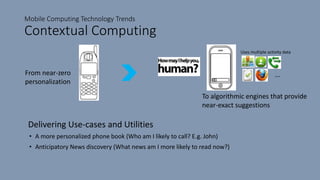
Contextual Computing
Delivering Use-cases and Utilities
• A more personalized phone book (Who am I likely to call? E.g. John)
• Anticipatory News discovery (What news am I more likely to read now?)
From near-zero
personalization
To algorithmic engines that provide
near-exact suggestions
---
Uses multiple activity data
Mobile Computing Technology Trends
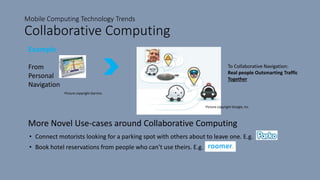
Collaborative Computing
More Novel Use-cases around Collaborative Computing
• Connect motorists looking for a parking spot with others about to leave one. E.g.
• Book hotel reservations from people who can’t use theirs. E.g.
From
Personal
Navigation
To Collaborative Navigation:
Real people Outsmarting Traffic
Together
Example
Picture copyright Google, Inc.
Picture copyright Garmin.
Thank You

Seminar (B-TECH)

  • 1.
    Future of MobileTechnology ASHISH Samsung Mobile
  • 2.
  • 3.
    Introduction With our everincreasing demand of technology in our world, Mobile Technology seems to be at the fore- front. It is very hard to believe that this technology didn’t even exist 100 years ago, now it is the most used technology in our society today. In the near future, there will be more mobile phones than there are people in the world. Almost the entire population will have a mobile phone in their hands. With this in mind, we will explore the future of Mobile Technology, with a brief history of the past, and the possibilities that lie ahead. In terms of mobile technology: THE FUTURE IS NOW
  • 4.
    Definition An electronic tele-communicationsdevice, often referred to as a cellular phone or cellphone. Mobile phones connect to a wireless communications network through radio wave or satellite transmissions. Most mobile phones provide voice communications, Short Message Service (SMS), Multimedia Message Service (MMS), games, cameras, video players, navigational systems, video call and also provide Internet services such as Web browsing and e-mail. They can be used over a wide area without a physical connection to a network. Mobile Technology
  • 5.
    Technology – BriefHistory IN THE BEGINNING Horseback – 1940’s
  • 6.
  • 7.
  • 8.
    PRESENT Where we aretoday Cell phones in the hands of everyone
  • 9.
    SURVEY Silicon India recentlyreported, the number of active cell phones will reach 7.3 billion by 2014. AND This simply means that by 2020 we have more phone in this world than the number of people in this world according to the SILICON survey.
  • 10.
    Sizes and Types Sizes Mobilephones started off large. Then went to a smaller hand-held device. Recently, larger units have become popular again. It seems completely dependent on the user. Some want it as small as possible to fit into their pocket. Others want large screens and multi-functionality. The future is whatever size you want. Past/Present/Future - Sizes and Types
  • 11.
    Sizes and Types FuturePhone Types Transparent (2022) Flexible(2017)
  • 12.
    Sizes and Types FutureTypes Glasses Watch Phone
  • 13.
    Sizes and Types FutureTypes Hologram Projector
  • 14.
    Generation Types Past andPresent A new mobile generation has appeared approximately every 10th year. 1G was introduced in 1981. 2G system started to roll out in 1992. 3G system first appeared in 2001. 4G systems fully compliant in 2012.
  • 15.
    Generation Types Future Next inline - 5G - 5th generation mobile networks. 5G is also referred to as beyond 2020 mobile communications technologies. 5G does not describe any particular specification in any official document. Possible new features - New data coding - Efficient support of machine-type devices - One unified global standard - Real wireless world with no more limitation with access and zone issues - User centric network concept instead of operator-initiated - World-wide wireless web (WWWW)
  • 16.
    Operating Systems Augmented Reality Makesmore information available for users by combining computer data to what we see in real life. Using the camera on your phone, you can point it somewhere ‘live’ to get an information overlay of where you can find the nearest cafes or dining places. Future Performance
  • 17.
    Storage Capacity Entry-level smartphonescome between 512MB and 2GB of internal storage, with high-end models ranging between 8GB (the iPhone 3G, the Palm Pre), 16GB (the Nokia N96), and 32GB (the iPhone 3GS). With the sizes of phones increasing and the alarming rate of new technology, storage capacity will increase by many GB, up to 500 GB in the near future. People want everything wherever they go; the mobile community.
  • 18.
    Mobile Input TechnologyTrends The Keypad Current state of text prediction 60% Lesser Number of Key Taps Needed What is driving this ? • Better Language models, Accurate user behavior models • Adaptive Learning using prior user conversations • Connecting with social media text
  • 19.
    The Keypad 2.0 Andin the future: • Using user-context in more powerful ways • E.g. predict whole sentences From qwerty layout To personalized layout
  • 20.
    Mobile Input TechnologyTrends What About Touch Driven by: From Touch To Gestures • Advancements in capacitive touch screen sensor processing with proximity sensing (e.g. Apple) • Miniaturization of IR Depth Sensors (e.g. The Structure Sensor) Picture copyright Apple, Inc.
  • 21.
    Mobile Input TechnologyTrends And Voice? Driven by: From Speak NOW To Always Listening • Advancements in Voice Data Models – Multi-lingual / multi-demography • Improvements in natural language processing. E.g. INDIAN accents • Low power sensors which distinguish voice command “active” mode Picture copyright Google, Inc.
  • 22.
    Mobile Sensor TechnologyTrends Advancement of Sensors Delivering Novel Use-cases and Utilities • Say, a more personalized UI (when Mobile is in Hand and facing) • Navigation Inside-buildings (without GPS) From Few sensors To multi-sensor Fusion ---
  • 23.
    Mobile Computing TechnologyTrends Contextual Computing Delivering Use-cases and Utilities • A more personalized phone book (Who am I likely to call? E.g. John) • Anticipatory News discovery (What news am I more likely to read now?) From near-zero personalization To algorithmic engines that provide near-exact suggestions --- Uses multiple activity data
  • 24.
    Mobile Computing TechnologyTrends Collaborative Computing More Novel Use-cases around Collaborative Computing • Connect motorists looking for a parking spot with others about to leave one. E.g. • Book hotel reservations from people who can’t use theirs. E.g. From Personal Navigation To Collaborative Navigation: Real people Outsmarting Traffic Together Example Picture copyright Google, Inc. Picture copyright Garmin.
  • 25.