AEROPLANE PROPULSION SYSTEM
PRESENTED BY:
1. Name: Saurav kumar(87)
2. Name: Sawan Kumar(88)
1. Department of Mechanical Engineering
2. Academy of Technology, West Bengal.
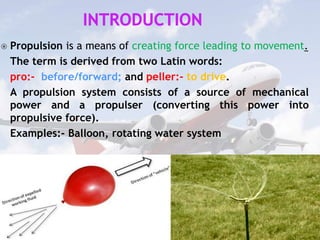
 Propulsion is a means of creating force leading to movement.
The term is derived from two Latin words:
pro:- before/forward; and peller:- to drive.
A propulsion system consists of a source of mechanical
power and a propulser (converting this power into
propulsive force).
Examples:- Balloon, rotating water system
 Aircraft
 Aeroplane
 Rocket
 Ballistic missiles
 Ship
 Submarine
 Vehicals
 Fan: Aluminum, titanium, or stainless steel
 Compressor: Nickel, cobalt, or iron-based alloys. Additive
are aluminum or titanium, chromium.
 Combustion chamber: Superalloys such as tungsten,
molybdenum, niobium, tantalum. Ceramics and ceramic-
metal mixes.
 Turbine: Nickel-based superalloy, iron-based superalloy or
even stainless steel.
 Exhaust nozzle: Nickel Iand stainless steel alloys.
 Casing: Aluminum or polymer matrix materials.
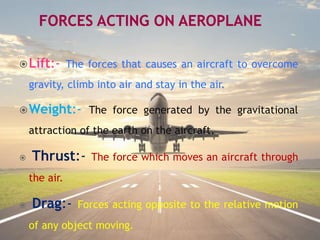
Lift:- The forces that causes an aircraft to overcome
gravity, climb into air and stay in the air.
Weight:- The force generated by the gravitational
attraction of the earth on the aircraft.
 Thrust:- The force which moves an aircraft through
the air.
 Drag:- Forces acting opposite to the relative motion
of any object moving.
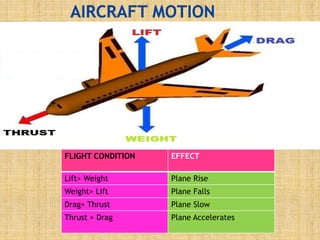
FLIGHT CONDITION EFFECT
Lift> Weight Plane Rise
Weight> Lift Plane Falls
Drag> Thrust Plane Slow
Thrust > Drag Plane Accelerates
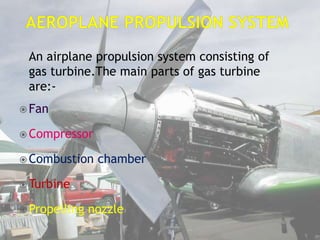
An airplane propulsion system consisting of
gas turbine.The main parts of gas turbine
are:-
 Fan
 Compressor
 Combustion chamber
 Turbine
 Propelling nozzle
 There are three types of propulsion :-
1.Propeller propulsion system
2.Rocket propulsion system
3.Jet propulsion system
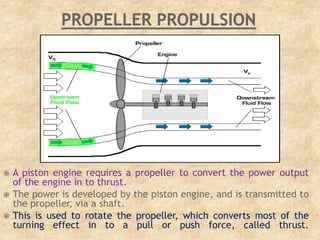
 A piston engine requires a propeller to convert the power output
of the engine in to thrust.
 The power is developed by the piston engine, and is transmitted to
the propeller, via a shaft.
 This is used to rotate the propeller, which converts most of the
turning effect in to a pull or push force, called thrust.
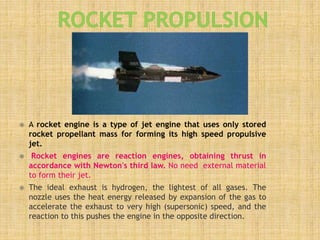
 A rocket engine is a type of jet engine that uses only stored
rocket propellant mass for forming its high speed propulsive
jet.
 Rocket engines are reaction engines, obtaining thrust in
accordance with Newton's third law. No need external material
to form their jet.
 The ideal exhaust is hydrogen, the lightest of all gases. The
nozzle uses the heat energy released by expansion of the gas to
accelerate the exhaust to very high (supersonic) speed, and the
reaction to this pushes the engine in the opposite direction.
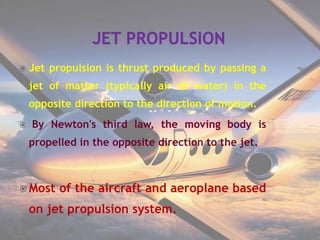
 Jet propulsion is thrust produced by passing a
jet of matter (typically air or water) in the
opposite direction to the direction of motion.
 By Newton's third law, the moving body is
propelled in the opposite direction to the jet.
 Most of the aircraft and aeroplane based
on jet propulsion system.
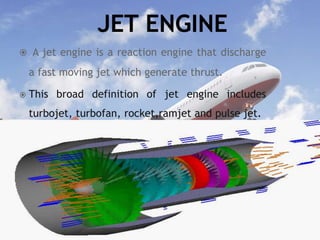
 A jet engine is a reaction engine that discharge
a fast moving jet which generate thrust.
 This broad definition of jet engine includes
turbojet, turbofan, rocket,ramjet and pulse jet.
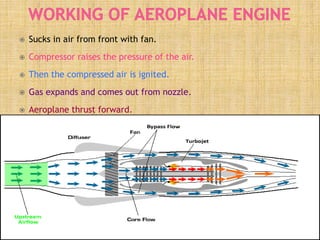
 Sucks in air from front with fan.
 Compressor raises the pressure of the air.
 Then the compressed air is ignited.
 Gas expands and comes out from nozzle.
 Aeroplane thrust forward.
 Principle of jet engine is based on Newton’s 2nd & 3rd
laws of motion.
 2nd law states that the rate of change of momentum
in any direction is proportional to the force acting in
that direction.
 3rd law states that for every action there is an equal
and opposite reaction.
 A propulsion system is a machine that
produces thrust to push an object forward.
 A gas, or working fluid, is accelerated by the
engine, and the reaction to this acceleration
produces a force on the engine.
 The four basic parts of a jet engine are the
compressor, combustion chamber, turbine,
and propelling nozzles.
Seminar

Seminar

  • 1.
    AEROPLANE PROPULSION SYSTEM PRESENTEDBY: 1. Name: Saurav kumar(87) 2. Name: Sawan Kumar(88) 1. Department of Mechanical Engineering 2. Academy of Technology, West Bengal.
  • 2.
     Propulsion isa means of creating force leading to movement. The term is derived from two Latin words: pro:- before/forward; and peller:- to drive. A propulsion system consists of a source of mechanical power and a propulser (converting this power into propulsive force). Examples:- Balloon, rotating water system
  • 3.
     Aircraft  Aeroplane Rocket  Ballistic missiles  Ship  Submarine  Vehicals
  • 4.
     Fan: Aluminum,titanium, or stainless steel  Compressor: Nickel, cobalt, or iron-based alloys. Additive are aluminum or titanium, chromium.  Combustion chamber: Superalloys such as tungsten, molybdenum, niobium, tantalum. Ceramics and ceramic- metal mixes.  Turbine: Nickel-based superalloy, iron-based superalloy or even stainless steel.  Exhaust nozzle: Nickel Iand stainless steel alloys.  Casing: Aluminum or polymer matrix materials.
  • 5.
    Lift:- The forcesthat causes an aircraft to overcome gravity, climb into air and stay in the air. Weight:- The force generated by the gravitational attraction of the earth on the aircraft.  Thrust:- The force which moves an aircraft through the air.  Drag:- Forces acting opposite to the relative motion of any object moving.
  • 6.
    FLIGHT CONDITION EFFECT Lift>Weight Plane Rise Weight> Lift Plane Falls Drag> Thrust Plane Slow Thrust > Drag Plane Accelerates
  • 7.
    An airplane propulsionsystem consisting of gas turbine.The main parts of gas turbine are:-  Fan  Compressor  Combustion chamber  Turbine  Propelling nozzle
  • 8.
     There arethree types of propulsion :- 1.Propeller propulsion system 2.Rocket propulsion system 3.Jet propulsion system
  • 9.
     A pistonengine requires a propeller to convert the power output of the engine in to thrust.  The power is developed by the piston engine, and is transmitted to the propeller, via a shaft.  This is used to rotate the propeller, which converts most of the turning effect in to a pull or push force, called thrust.
  • 10.
     A rocketengine is a type of jet engine that uses only stored rocket propellant mass for forming its high speed propulsive jet.  Rocket engines are reaction engines, obtaining thrust in accordance with Newton's third law. No need external material to form their jet.  The ideal exhaust is hydrogen, the lightest of all gases. The nozzle uses the heat energy released by expansion of the gas to accelerate the exhaust to very high (supersonic) speed, and the reaction to this pushes the engine in the opposite direction.
  • 11.
     Jet propulsionis thrust produced by passing a jet of matter (typically air or water) in the opposite direction to the direction of motion.  By Newton's third law, the moving body is propelled in the opposite direction to the jet.  Most of the aircraft and aeroplane based on jet propulsion system.
  • 12.
     A jetengine is a reaction engine that discharge a fast moving jet which generate thrust.  This broad definition of jet engine includes turbojet, turbofan, rocket,ramjet and pulse jet.
  • 13.
     Sucks inair from front with fan.  Compressor raises the pressure of the air.  Then the compressed air is ignited.  Gas expands and comes out from nozzle.  Aeroplane thrust forward.
  • 14.
     Principle ofjet engine is based on Newton’s 2nd & 3rd laws of motion.  2nd law states that the rate of change of momentum in any direction is proportional to the force acting in that direction.  3rd law states that for every action there is an equal and opposite reaction.
  • 15.
     A propulsionsystem is a machine that produces thrust to push an object forward.  A gas, or working fluid, is accelerated by the engine, and the reaction to this acceleration produces a force on the engine.  The four basic parts of a jet engine are the compressor, combustion chamber, turbine, and propelling nozzles.