Pasquale Lops 
Dept. of Computer Science 
University of Bari “Aldo Moro”, Italy 
Semantic 
Web 
Access and Personalization 
research group 
http://www.di.uniba.it/~swap 
Semantics-aware Content-based Recommender Systems 
the Big Picture 
1st Workshop on NEW TRENDS IN CONTENT-BASED RECOMMENDER SYSTEMS 
CBRecSys 2014 - Foster City, CA, US – October 6, 2014
2/74 
About me 
Semantic Web 
Access and Personalization 
research group 
http://www.di.uniba.it/~swap 
pasquale.lops@.uniba.it 
pasquale.lops 
pasqualelops
3/74
4/74
5/74
6/74 
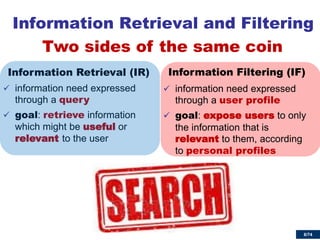
Information Retrieval (IR) 
information need expressed through a query 
goal: retrieve information which might be useful or relevant to the user 
Information Filtering (IF) 
information need expressed through a user profile 
goal: expose users to only the information that is relevant to them, according to personal profiles 
Information Retrieval and Filtering 
Two sides of the same coin
7/74 
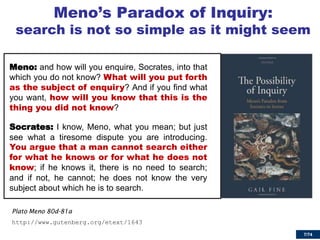
Meno’s Paradox of Inquiry: search is not so simple as it might seem 
Meno: and how will you enquire, Socrates, into that which you do not know? What will you put forth as the subject of enquiry? And if you find what you want, how will you know that this is the thing you did not know? 
Socrates: I know, Meno, what you mean; but just see what a tiresome dispute you are introducing. You argue that a man cannot search either for what he knows or for what he does not know; if he knows it, there is no need to search; and if not, he cannot; he does not know the very subject about which he is to search. 
Plato Meno 80d-81a 
http://www.gutenberg.org/etext/1643 
7
8/74 
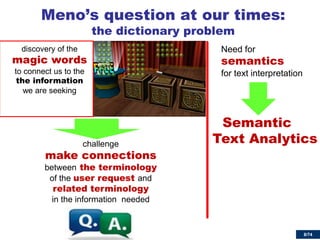
Meno’s question at our times: the dictionary problem 
discovery of the magic words to connect us to the the information we are seeking 
challenge make connections between the terminology of the user request and related terminology in the information needed 
Need for semantics for text interpretation 
8 
Semantic Text Analytics
9/74 
Beyond keywords 
Analytics Machine Learning & Data Mining–based Personalization “deep user profiles” 
9 
Semantic Text Analytics 
Semantic concept identification in text- based representations through advanced NLP techniques “beyond keywords”
10/74 
Part I: Content-based Recommender Systems (CBRS): basics 
Part II: Limited content analysis 
Beyond keywords: semantics into CBRS 
Part III: Overspecialization 
Serendipitous recommendations 
Outline
11/74 
Basics
12/74 
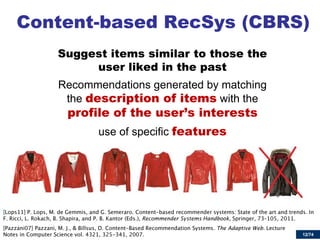
Content-based RecSys (CBRS) 
Suggest items similar to those the user liked in the past 
Recommendations generated by matching the description of items with the profile of the user’s interests 
use of specific features 
Recommender Systems Handbook, The Adaptive Web
13/74 
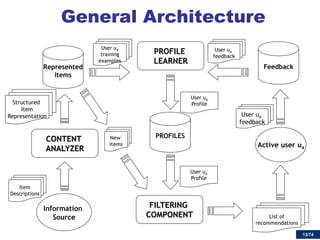
General Architecture 
CONTENT ANALYZER 
PROFILE 
LEARNER 
FILTERING COMPONENT 
Information 
Source 
Represented 
Items 
Feedback 
PROFILES 
Structured 
Item 
Representation 
Active user ua 
Item 
Descriptions 
User ua 
feedback 
User ua 
training 
examples 
User ua 
feedback 
List of 
recommendations 
User ua 
Profile 
New Items 
User ua 
Profile
14/74 
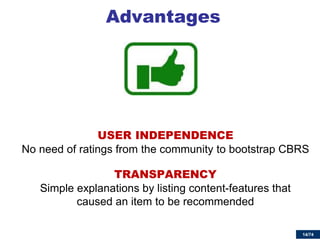
Advantages 
USER INDEPENDENCE No need of ratings from the community to bootstrap CBRS 
TRANSPARENCY Simple explanations by listing content-features that caused an item to be recommended
15/74 
Drawback 
LIMITED CONTENT ANALYSIS 
no suitable suggestions if no enough information in the content to discriminate items the user likes / does not like 
need of meaningful features 
keywords not appropriate for representing content multi-word concepts, synonymy, polysemy
16/74 
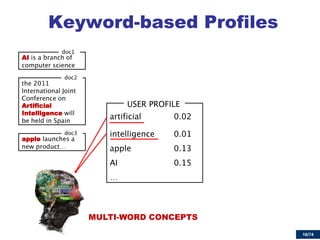
Keyword-based Profiles 
AIArtificialIntelligence 
apple 
MULTI-WORD CONCEPTS
17/74 
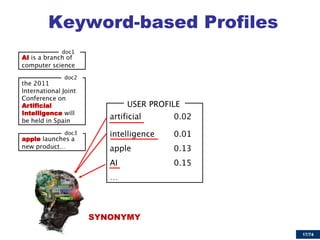
Keyword-based Profiles 
AIArtificialIntelligence 
apple 
SYNONYMY
18/74 
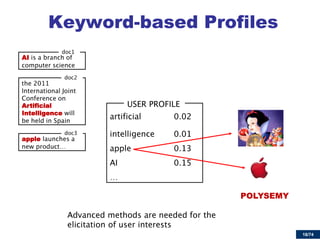
Keyword-based Profiles 
AIArtificialIntelligence 
apple 
POLYSEMY
19/74 
Drawback 
OVERSPECIALIZATION 
user is going to be recommended items similar to those already rated (OBVIOUSNESS) 
no inherent method for finding something unexpected 
SERENDIPITY PROBLEM Extended Abstracts of the 2006 ACM Conference on Human Factors in Computing Systems
20/74 
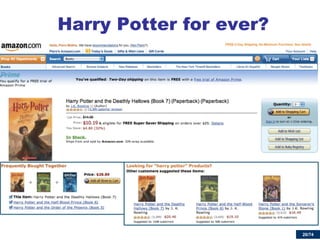
Harry Potter for ever?
21/74 
Part I: Content-based Recommender Systems (CBRS): basics 
Part II: Limited content analysis 
Beyond keywords: semantics into CBRS 
Part III: Overspecialization 
Serendipitous recommendations 
Outline
22/74 
From CBRSs to semantics-aware CBRSs through Semantic Text Analytics
23/74 
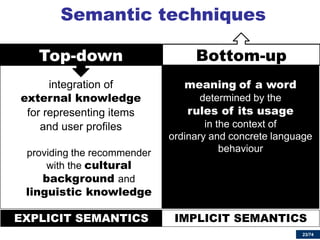
Top-down 
integration of 
external knowledge 
for representing items 
and user profiles 
providing the recommender with the cultural background and linguistic knowledge 
Semantic techniques 
23 
Bottom-up 
meaning of a word determined by the 
rules of its usage in the context of ordinary and concrete language behaviour 
Top-down 
Bottom-up 
EXPLICIT SEMANTICS 
IMPLICIT SEMANTICS
24/74 
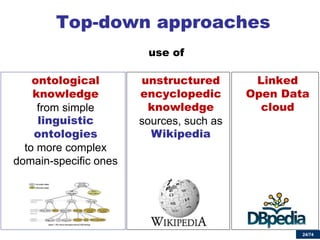
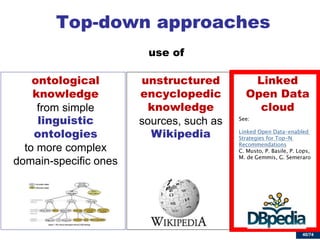
Linked Open Data cloud 
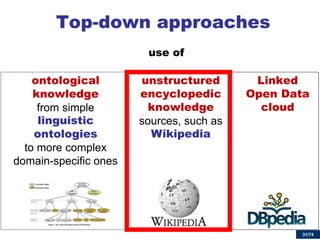
ontological knowledge from simple linguistic ontologies to more complex domain-specific ones 
Top-down approaches 
unstructured encyclopedic knowledge sources, such as Wikipedia 
use of
25/74 
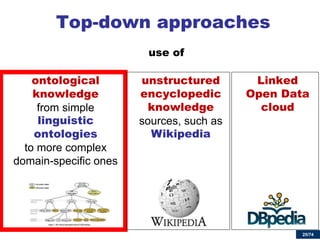
Linked Open Data cloud 
ontological knowledge from simple linguistic ontologies to more complex domain-specific ones 
Top-down approaches 
unstructured encyclopedic knowledge sources, such as Wikipedia 
use of
26/74 
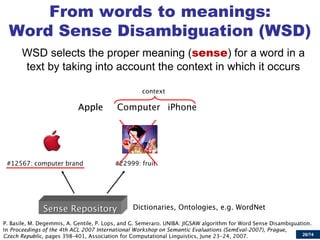
From words to meanings: Word Sense Disambiguation (WSD) 
WSD selects the proper meaning (sense) for a word in a text by taking into account the context in which it occurs Proceedings of the 4th ACL 2007 International Workshop on Semantic Evaluations (SemEval-2007), Prague, Czech Republic
27/74 
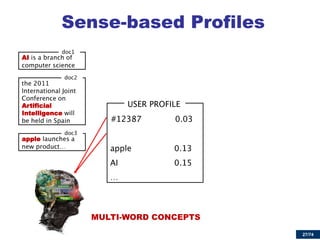
Sense-based Profiles 
AIArtificialIntelligence 
apple 
MULTI-WORD CONCEPTS
28/74 
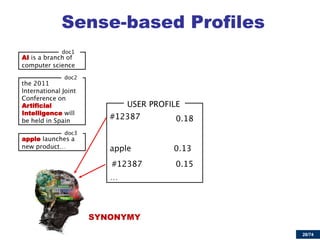
Sense-based Profiles 
AIArtificialIntelligence 
apple 
SYNONYMY
29/74 
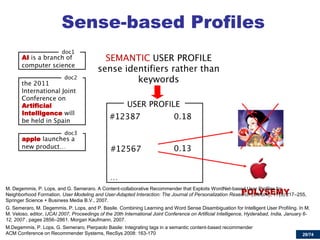
Sense-based Profiles 
AIArtificialIntelligence 
apple 
POLYSEMY 
M. Degemmis, P. Lops, and G. Semeraro. A Content-collaborative Recommender that Exploits WordNet-based User Profiles for Neighborhood Formation. User Modeling and User-Adapted Interaction: The Journal of Personalization Research (UMUAI), 17(3):217–255, Springer Science + Business Media B.V., 2007. 
G. Semeraro, M. Degemmis, P. Lops, and P. Basile. Combining Learning and Word Sense Disambiguation for Intelligent User Profiling. In M. M. Veloso, editor, IJCAI 2007, Proceedings of the 20th International Joint Conference on Artificial Intelligence, Hyderabad, India, January 6- 12, 2007 , pages 2856–2861. Morgan Kaufmann, 2007. 
M.Degemmis, P. Lops, G. Semeraro, Pierpaolo Basile: Integrating tags in a semantic content-based recommender ACM Conference on Recommender Systems, RecSys 2008: 163-170
30/74 
Leverage crowdsourcing for deep text analytics 
WordNet 
few named entities 
no events 
evolving vocabularies 
Wikipedia 
free and covers many domains 
under constant development 
highly accurate [Giles05] 
Nature
31/74 
Linked Open Data cloud 
ontological knowledge from simple linguistic ontologies to more complex domain-specific ones 
Top-down approaches 
unstructured encyclopedic knowledge sources, such as Wikipedia 
use of
32/74 
Explicit Semantic Analysis (ESA) 
fine-grained semantic representation of natural language texts in a high-dimensional space of comprehensible concepts derived from Wikipedia [Gabri06] 
[Gabri06] E. Gabrilovich and S. Markovitch. Overcoming the Brittleness Bottleneck using Wikipedia: Enhancing Text Categorization with Encyclopedic Knowledge. In Proceedings of the 21th National Conf. on Artificial Intelligence and the 18th Innovative Applications of Artificial Intelligence Conference, pages 1301–1306. AAAI Press, 2006. 
Panthera 
World War II 
Jane Fonda 
Island 
Wikipedia viewed as an ontology
33/74 
Explicit Semantic Analysis (ESA) 
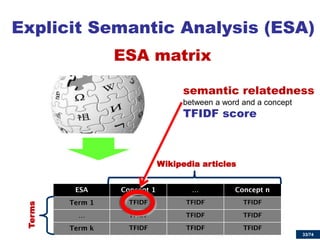
ESA matrix 
Wikipedia articles 
Terms 
33 
semantic relatedness between a word and a concept TFIDF score
34/74 
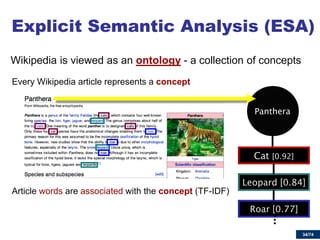
Wikipedia is viewed as an ontology - a collection of concepts 
Every Wikipedia article represents a concept 
Article words are associated with the concept (TF-IDF) 
Explicit Semantic Analysis (ESA)
35/74 
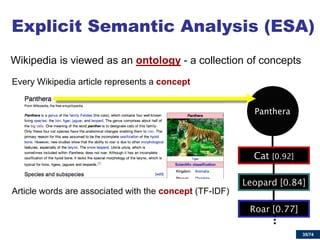
Wikipedia is viewed as an ontology - a collection of concepts 
Every Wikipedia article represents a concept 
Article words are associated with the concept (TF-IDF) 
Explicit Semantic Analysis (ESA)
36/74 
Explicit Semantic Analysis (ESA) 
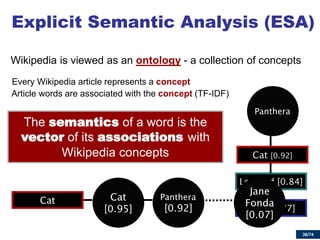
Wikipedia is viewed as an ontology - a collection of concepts 
Every Wikipedia article represents a concept 
Article words are associated with the concept (TF-IDF) 
The semantics of a word is the vector of its associations with Wikipedia concepts
37/74 
The semantics of a text fragment is the centroid of the semantics of its words 
Game Controller 
[0.32] 
Mickey Mouse [0.81] 
Game Controller 
[0.64] 
Explicit Semantic Analysis (ESA)
38/74 
Text Categorization [Gabri09] experiments on diverse datasets 
Semantic relatedness of words and texts [Gabri09] cosine similarity between vectors of ESA concepts 
Information Retrieval [Egozi08, Egozi11] ESA-based IR algorithm enriching documents and queries 
ESA effectively used for 
[Gabri09] E. Gabrilovich and S. Markovitch. Wikipedia-based Semantic Interpretation for Natural Language Processing. Journal of Artificial Intelligence Research 34:443-498, 2009. 
[Egozi08] Ofer Egozi, Evgeniy Gabrilovich, Shaul Markovitch: Concept-Based Feature Generation and Selection for Information Retrieval. AAAI 2008, 1132-1137, 2008. 
[Egozi11] Ofer Egozi, Shaul Markovitch, Evgeniy Gabrilovich. Concept-Based Information Retrieval using Explicit Semantic Analysis. ACM Transactions on Information Systems 29(2), April 2011. 
38 
What about ESA for Information Filtering?
39/74 
Information Filtering using ESA 
TV-domain::German Electronic Program Guides better precision [Musto12] 
Social data from Facebook and Twitter better serendipity [Narducci13] i.e. more unexpected and interesting recommendations 
Multimedia recommendation::TED lectures better results in a cold-start setting [Pappas14] 
[Musto12] C. Musto, F. Narducci, P. Lops, G. Semeraro, M. de Gemmis, M. Barbieri, J. H. M. Korst, V. Pronk, and R. Clout. Enhanced semantic tv-show representation for personalized electronic program guides. UMAP 2012, pp. 188–199. Springer, 2012 
[Narducci13] F. Narducci, C. Musto, G. Semeraro, P. Lops, and M. de Gemmis. Leveraging Encyclopedic Knowledge for Transparent and Serendipitous User Profiles. UMAP 2013, pp. 350-352. 
[Pappas14] N. Pappas and A. Popescu-Belis. Combining content with user preferences for non-fiction multimedia recommendation: A study on ted lectures. Multimedia Tools and Applications, 2014. 
39
40/74 
Linked Open Data cloud 
ontological knowledge from simple linguistic ontologies to more complex domain-specific ones 
Top-down approaches 
unstructured encyclopedic knowledge sources, such as Wikipedia 
use of
41/74 
Bottom-up approaches 
alternative representation based on distributional models 
insight 
the analysis of large corpora of textual data allows to infer information about the usage (meaning) of the terms
42/74 
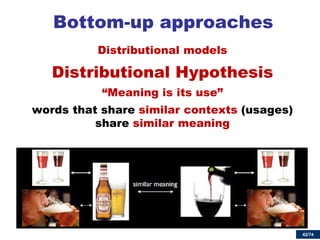
Bottom-up approaches 
Distributional models 
Distributional Hypothesis 
“Meaning is its use” 
words that share similar contexts (usages) share similar meaning
43/74 
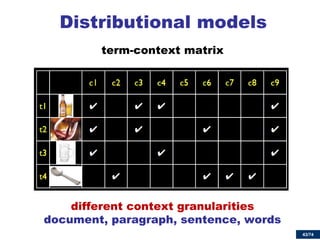
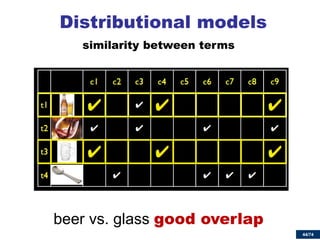
Distributional models 
term-context matrix 
different context granularities document, paragraph, sentence, words
44/74 
Distributional models 
similarity between terms 
beer vs. glass good overlap 
44
45/74 
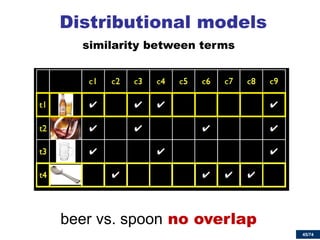
Distributional models 
similarity between terms 
beer vs. spoon no overlap 
45
46/74 
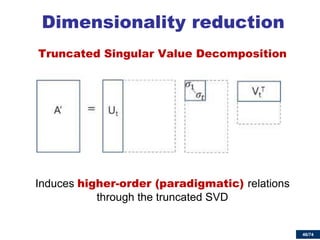
Dimensionality reduction 
Truncated Singular Value Decomposition 
Induces higher-order (paradigmatic) relations through the truncated SVD
47/74 
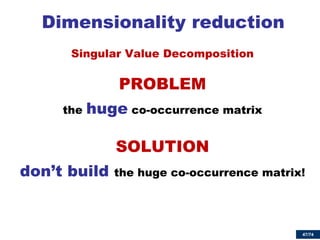
Dimensionality reduction 
Singular Value Decomposition 
PROBLEM 
the huge co-occurrence matrix 
SOLUTION 
don’t build the huge co-occurrence matrix!
48/74 
Dimensionality reduction 
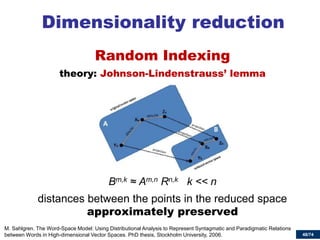
Random Indexing 
theory: Johnson-Lindenstrauss’ lemma 
Bm,k ≈ Am,n Rn,k k << n 
distances between the points in the reduced space approximately preserved 
M. Sahlgren. The Word-Space Model: Using Distributional Analysis to Represent Syntagmatic and Paradigmatic Relations between Words in High-dimensional Vector Spaces. PhD thesis, Stockholm University, 2006.
49/74 
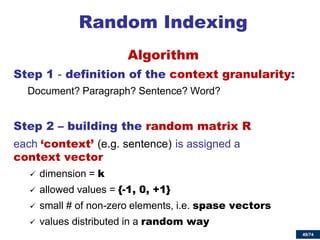
Random Indexing 
Algorithm 
Step 1 - definition of the context granularity: 
Document? Paragraph? Sentence? Word? 
Step 2 – building the random matrix R 
each ‘context’ (e.g. sentence) is assigned a context vector 
dimension = k 
allowed values = {-1, 0, +1} 
small # of non-zero elements, i.e. spase vectors 
values distributed in a random way
50/74 
Random Indexing 
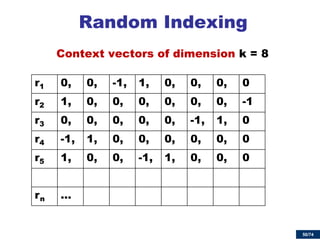
Context vectors of dimension k = 8 
r1 
0, 
0, 
-1, 
1, 
0, 
0, 
0, 
0 
r2 
1, 
0, 
0, 
0, 
0, 
0, 
0, 
-1 
r3 
0, 
0, 
0, 
0, 
0, 
-1, 
1, 
0 
r4 
-1, 
1, 
0, 
0, 
0, 
0, 
0, 
0 
r5 
1, 
0, 
0, 
-1, 
1, 
0, 
0, 
0 
rn 
…
51/74 
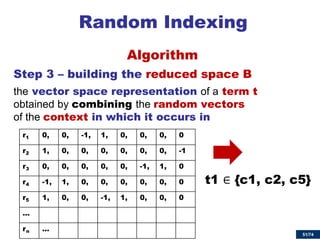
Random Indexing 
Algorithm 
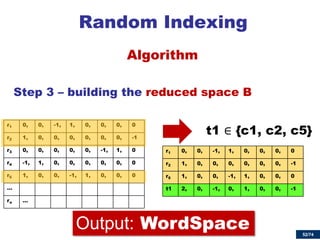
Step 3 – building the reduced space B 
the vector space representation of a term t obtained by combining the random vectors of the context in which it occurs in 
r1 
0, 
0, 
-1, 
1, 
0, 
0, 
0, 
0 
r2 
1, 
0, 
0, 
0, 
0, 
0, 
0, 
-1 
r3 
0, 
0, 
0, 
0, 
0, 
-1, 
1, 
0 
r4 
-1, 
1, 
0, 
0, 
0, 
0, 
0, 
0 
r5 
1, 
0, 
0, 
-1, 
1, 
0, 
0, 
0 
… 
rn 
… 
t1 ∈ {c1, c2, c5}
52/74 
Random Indexing 
Algorithm 
Step 3 – building the reduced space B 
r1 
0, 
0, 
-1, 
1, 
0, 
0, 
0, 
0 
r2 
1, 
0, 
0, 
0, 
0, 
0, 
0, 
-1 
r3 
0, 
0, 
0, 
0, 
0, 
-1, 
1, 
0 
r4 
-1, 
1, 
0, 
0, 
0, 
0, 
0, 
0 
r5 
1, 
0, 
0, 
-1, 
1, 
0, 
0, 
0 
… 
rn 
… 
t1 ∈ {c1, c2, c5} 
r1 
0, 
0, 
-1, 
1, 
0, 
0, 
0, 
0 
r2 
1, 
0, 
0, 
0, 
0, 
0, 
0, 
-1 
r5 
1, 
0, 
0, 
-1, 
1, 
0, 
0, 
0 
t1 
2, 
0, 
-1, 
0, 
1, 
0, 
0, 
-1 
Output: WordSpace
53/74 
Random Indexing 
Algorithm 
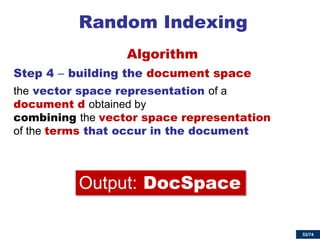
Step 4 – building the document space 
the vector space representation of a document d obtained by combining the vector space representation of the terms that occur in the document 
Output: DocSpace
54/74 
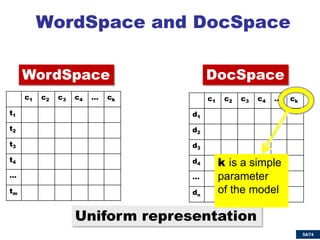
WordSpace and DocSpace 
c1 
c2 
c3 
c4 
… 
ck 
t1 
t2 
t3 
t4 
… 
tm 
c1 
c2 
c3 
c4 
… 
ck 
d1 
d2 
d3 
d4 
… 
dn 
DocSpace 
WordSpace 
Uniform representation 
k is a simple 
parameter 
of the model
55/74 
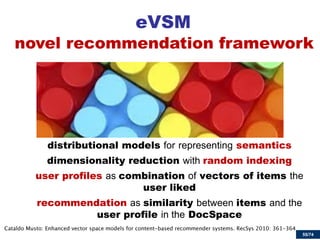
eVSM 
distributional models for representing semantics 
dimensionality reduction with random indexing 
user profiles as combination of vectors of items the user liked 
recommendation as similarity between items and the user profile in the DocSpace 
novel recommendation framework
56/74 
eVSM: some results 
Movie domain 
MovieLens::content crawled from Wikipedia better average precision than classical content-based algorithms [Musto11] 
IMDB::contextual eVSM better precision and recall than state-of-the-art approaches based on CF [Musto13] 
IMDB::contextual eVSM + entity linking better precision and recall than state-of-the-art approaches based on CF [Musto14] 
[Musto11] C. Musto, G. Semeraro, P. Lops, and M. de Gemmis. Random indexing and negative user preferences for enhancing content-based recommender systems. In EC-Web 2011, vol. 85 of LNBIP, pp. 270–281. 
[Musto13] C. Musto, G. Semeraro, P. Lops, and M. de Gemmis. Contextual evsm: A content-based context-aware recommendation framework based on distributional semantics. In EC-Web 2013, vol. 152 of LNBIP, pp. 125–136. 
[Musto14] C. Musto, G. Semeraro, P. Lops, and M. de Gemmis. Combining distributional semantics and entity linking for context-aware content-based recommendation. In UMAP 2014, vol. 8538 of LNCS, pp. 381–392. 
56
57/74 
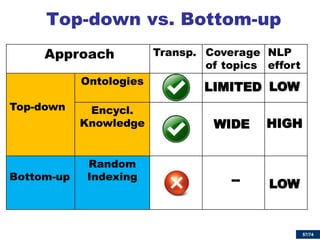
Top-down vs. Bottom-up 
57 
Approach 
Transp. 
Coverage of topics 
NLP effort 
Top-down 
Ontologies 
Encycl. Knowledge 
Bottom-up 
Random Indexing 
LIMITED 
WIDE 
LOW 
HIGH 
LOW 
--
58/74 
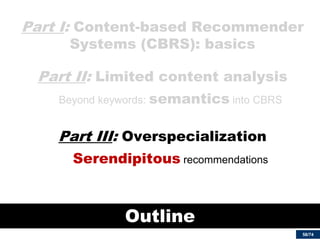
Part I: Content-based Recommender Systems (CBRS): basics 
Part II: Limited content analysis 
Beyond keywords: semantics into CBRS 
Part III: Overspecialization 
Serendipitous recommendations 
Outline
59/74 
Serendipitous recommendations 
response to the overspecialization problem 
accurate but obvious and actually not useful recommendations 
suggestions which help the user to find surprisingly interesting items she might not have discovered by herself [Her04] 
both attractive and unexpected
60/74 
“Reasoning by Analogy” 
applicability of an existing schema to a new situation 
Strategies to induce serendipity 
“Blind Luck” random 
[Toms00] Toms, E. Serendipitous Information Retrieval. In Proc. of the First DELOS Network of Excellence Workshop on Information Seeking, Searching and Querying in Digital Libraries, 2000. 
“Prepared Mind” 
Pasteur principle: “chance favors only the prepared mind” 
“Anomalies and Exceptions” 
searching for dissimilarity
61/74 
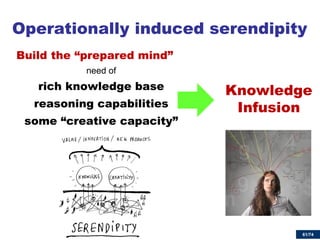
Operationally induced serendipity 
Build the “prepared mind” 
need of 
rich knowledge base 
reasoning capabilities 
some “creative capacity” 
61 
Knowledge Infusion
62/74 
knowledge-intensive process 
to find hidden associations between items instead of computing attribute similarity 
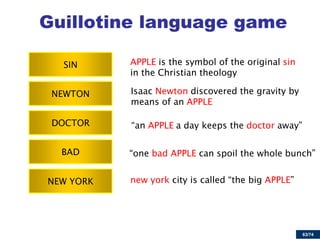
HOW? serendipitous discovery emerged while watching a TV show 
Knowledge Infusion (KI) 
62
63/74 
Guillotine language game 
63
64/74 
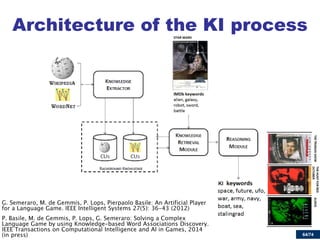
Architecture of the KI process
65/74 
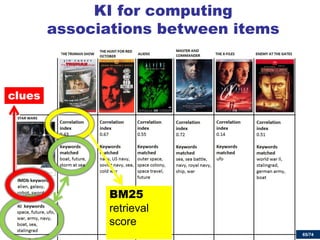
KI for computing 
associations between items 
BM25 
retrieval 
score 
clues
66/74 
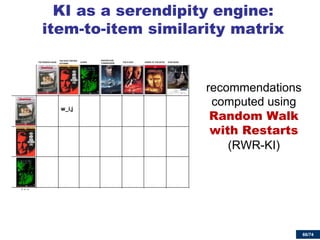
KI as a serendipity engine: item-to-item similarity matrix 
recommendations computed using Random Walk with Restarts (RWR-KI)
67/74 
Preliminary experiment 
questionnaires and analysis of users’ facial expressions Noldus FaceReaderTM 
FaceReader able to recognize 
anger, sadness, fear, disgust, happiness, surprise 
Between-subjects experiment 
20 users get RWR-KI recommendations 20 users get RANDOM recommendations
68/74 
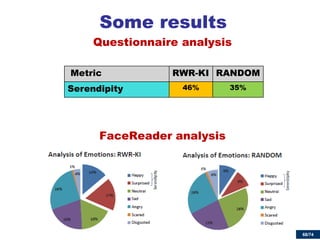
Some results 
Questionnaire analysis 
FaceReader analysis 
Metric 
RWR-KI 
RANDOM 
Serendipity 
46% 
35%
69/74 
Conclusions 
NLP methods to improve CBRSs 
semantics to capture the meaning of content/user needs 
overcoming limited content analysis 
overcoming overspecialization
70/74 
Ongoing work 
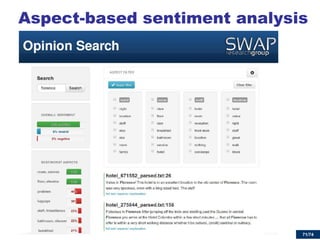
aspect-based sentiment analysis aspect term extraction and polarity using divergence of language models 
multi-criteria recommender system
71/74 
Aspect-based sentiment analysis
72/74 
Ongoing work 
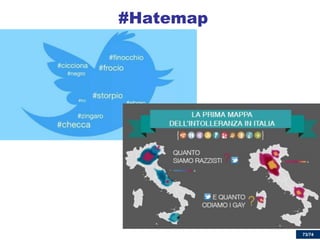
#Hatemap detection of homophobic tweets violence against women, antisemitism, racism definition of the map of intolerance 
recommendation of concrete actions by local governments
73/74 
#Hatemap
74/74 
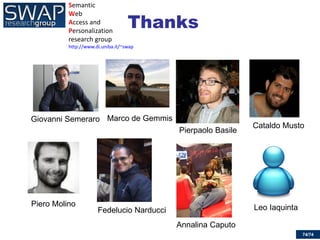
Thanks 
Giovanni Semeraro 
Marco de Gemmis 
Pierpaolo Basile 
Cataldo Musto 
Fedelucio Narducci 
Annalina Caputo 
Piero Molino 
Leo Iaquinta 
Semantic 
Web 
Access and Personalization 
research group 
http://www.di.uniba.it/~swap

Semantics-aware Content-based Recommender Systems

  • 1.
    Pasquale Lops Dept.of Computer Science University of Bari “Aldo Moro”, Italy Semantic Web Access and Personalization research group http://www.di.uniba.it/~swap Semantics-aware Content-based Recommender Systems the Big Picture 1st Workshop on NEW TRENDS IN CONTENT-BASED RECOMMENDER SYSTEMS CBRecSys 2014 - Foster City, CA, US – October 6, 2014
  • 2.
    2/74 About me Semantic Web Access and Personalization research group http://www.di.uniba.it/~swap pasquale.lops@.uniba.it pasquale.lops pasqualelops
  • 3.
  • 4.
  • 5.
  • 6.
    6/74 Information Retrieval(IR) information need expressed through a query goal: retrieve information which might be useful or relevant to the user Information Filtering (IF) information need expressed through a user profile goal: expose users to only the information that is relevant to them, according to personal profiles Information Retrieval and Filtering Two sides of the same coin
  • 7.
    7/74 Meno’s Paradoxof Inquiry: search is not so simple as it might seem Meno: and how will you enquire, Socrates, into that which you do not know? What will you put forth as the subject of enquiry? And if you find what you want, how will you know that this is the thing you did not know? Socrates: I know, Meno, what you mean; but just see what a tiresome dispute you are introducing. You argue that a man cannot search either for what he knows or for what he does not know; if he knows it, there is no need to search; and if not, he cannot; he does not know the very subject about which he is to search. Plato Meno 80d-81a http://www.gutenberg.org/etext/1643 7
  • 8.
    8/74 Meno’s questionat our times: the dictionary problem discovery of the magic words to connect us to the the information we are seeking challenge make connections between the terminology of the user request and related terminology in the information needed Need for semantics for text interpretation 8 Semantic Text Analytics
  • 9.
    9/74 Beyond keywords Analytics Machine Learning & Data Mining–based Personalization “deep user profiles” 9 Semantic Text Analytics Semantic concept identification in text- based representations through advanced NLP techniques “beyond keywords”
  • 10.
    10/74 Part I:Content-based Recommender Systems (CBRS): basics Part II: Limited content analysis Beyond keywords: semantics into CBRS Part III: Overspecialization Serendipitous recommendations Outline
  • 11.
  • 12.
    12/74 Content-based RecSys(CBRS) Suggest items similar to those the user liked in the past Recommendations generated by matching the description of items with the profile of the user’s interests use of specific features Recommender Systems Handbook, The Adaptive Web
  • 13.
    13/74 General Architecture CONTENT ANALYZER PROFILE LEARNER FILTERING COMPONENT Information Source Represented Items Feedback PROFILES Structured Item Representation Active user ua Item Descriptions User ua feedback User ua training examples User ua feedback List of recommendations User ua Profile New Items User ua Profile
  • 14.
    14/74 Advantages USERINDEPENDENCE No need of ratings from the community to bootstrap CBRS TRANSPARENCY Simple explanations by listing content-features that caused an item to be recommended
  • 15.
    15/74 Drawback LIMITEDCONTENT ANALYSIS no suitable suggestions if no enough information in the content to discriminate items the user likes / does not like need of meaningful features keywords not appropriate for representing content multi-word concepts, synonymy, polysemy
  • 16.
    16/74 Keyword-based Profiles AIArtificialIntelligence apple MULTI-WORD CONCEPTS
  • 17.
    17/74 Keyword-based Profiles AIArtificialIntelligence apple SYNONYMY
  • 18.
    18/74 Keyword-based Profiles AIArtificialIntelligence apple POLYSEMY
  • 19.
    19/74 Drawback OVERSPECIALIZATION user is going to be recommended items similar to those already rated (OBVIOUSNESS) no inherent method for finding something unexpected SERENDIPITY PROBLEM Extended Abstracts of the 2006 ACM Conference on Human Factors in Computing Systems
  • 20.
  • 21.
    21/74 Part I:Content-based Recommender Systems (CBRS): basics Part II: Limited content analysis Beyond keywords: semantics into CBRS Part III: Overspecialization Serendipitous recommendations Outline
  • 22.
    22/74 From CBRSsto semantics-aware CBRSs through Semantic Text Analytics
  • 23.
    23/74 Top-down integrationof external knowledge for representing items and user profiles providing the recommender with the cultural background and linguistic knowledge Semantic techniques 23 Bottom-up meaning of a word determined by the rules of its usage in the context of ordinary and concrete language behaviour Top-down Bottom-up EXPLICIT SEMANTICS IMPLICIT SEMANTICS
  • 24.
    24/74 Linked OpenData cloud ontological knowledge from simple linguistic ontologies to more complex domain-specific ones Top-down approaches unstructured encyclopedic knowledge sources, such as Wikipedia use of
  • 25.
    25/74 Linked OpenData cloud ontological knowledge from simple linguistic ontologies to more complex domain-specific ones Top-down approaches unstructured encyclopedic knowledge sources, such as Wikipedia use of
  • 26.
    26/74 From wordsto meanings: Word Sense Disambiguation (WSD) WSD selects the proper meaning (sense) for a word in a text by taking into account the context in which it occurs Proceedings of the 4th ACL 2007 International Workshop on Semantic Evaluations (SemEval-2007), Prague, Czech Republic
  • 27.
    27/74 Sense-based Profiles AIArtificialIntelligence apple MULTI-WORD CONCEPTS
  • 28.
    28/74 Sense-based Profiles AIArtificialIntelligence apple SYNONYMY
  • 29.
    29/74 Sense-based Profiles AIArtificialIntelligence apple POLYSEMY M. Degemmis, P. Lops, and G. Semeraro. A Content-collaborative Recommender that Exploits WordNet-based User Profiles for Neighborhood Formation. User Modeling and User-Adapted Interaction: The Journal of Personalization Research (UMUAI), 17(3):217–255, Springer Science + Business Media B.V., 2007. G. Semeraro, M. Degemmis, P. Lops, and P. Basile. Combining Learning and Word Sense Disambiguation for Intelligent User Profiling. In M. M. Veloso, editor, IJCAI 2007, Proceedings of the 20th International Joint Conference on Artificial Intelligence, Hyderabad, India, January 6- 12, 2007 , pages 2856–2861. Morgan Kaufmann, 2007. M.Degemmis, P. Lops, G. Semeraro, Pierpaolo Basile: Integrating tags in a semantic content-based recommender ACM Conference on Recommender Systems, RecSys 2008: 163-170
  • 30.
    30/74 Leverage crowdsourcingfor deep text analytics WordNet few named entities no events evolving vocabularies Wikipedia free and covers many domains under constant development highly accurate [Giles05] Nature
  • 31.
    31/74 Linked OpenData cloud ontological knowledge from simple linguistic ontologies to more complex domain-specific ones Top-down approaches unstructured encyclopedic knowledge sources, such as Wikipedia use of
  • 32.
    32/74 Explicit SemanticAnalysis (ESA) fine-grained semantic representation of natural language texts in a high-dimensional space of comprehensible concepts derived from Wikipedia [Gabri06] [Gabri06] E. Gabrilovich and S. Markovitch. Overcoming the Brittleness Bottleneck using Wikipedia: Enhancing Text Categorization with Encyclopedic Knowledge. In Proceedings of the 21th National Conf. on Artificial Intelligence and the 18th Innovative Applications of Artificial Intelligence Conference, pages 1301–1306. AAAI Press, 2006. Panthera World War II Jane Fonda Island Wikipedia viewed as an ontology
  • 33.
    33/74 Explicit SemanticAnalysis (ESA) ESA matrix Wikipedia articles Terms 33 semantic relatedness between a word and a concept TFIDF score
  • 34.
    34/74 Wikipedia isviewed as an ontology - a collection of concepts Every Wikipedia article represents a concept Article words are associated with the concept (TF-IDF) Explicit Semantic Analysis (ESA)
  • 35.
    35/74 Wikipedia isviewed as an ontology - a collection of concepts Every Wikipedia article represents a concept Article words are associated with the concept (TF-IDF) Explicit Semantic Analysis (ESA)
  • 36.
    36/74 Explicit SemanticAnalysis (ESA) Wikipedia is viewed as an ontology - a collection of concepts Every Wikipedia article represents a concept Article words are associated with the concept (TF-IDF) The semantics of a word is the vector of its associations with Wikipedia concepts
  • 37.
    37/74 The semanticsof a text fragment is the centroid of the semantics of its words Game Controller [0.32] Mickey Mouse [0.81] Game Controller [0.64] Explicit Semantic Analysis (ESA)
  • 38.
    38/74 Text Categorization[Gabri09] experiments on diverse datasets Semantic relatedness of words and texts [Gabri09] cosine similarity between vectors of ESA concepts Information Retrieval [Egozi08, Egozi11] ESA-based IR algorithm enriching documents and queries ESA effectively used for [Gabri09] E. Gabrilovich and S. Markovitch. Wikipedia-based Semantic Interpretation for Natural Language Processing. Journal of Artificial Intelligence Research 34:443-498, 2009. [Egozi08] Ofer Egozi, Evgeniy Gabrilovich, Shaul Markovitch: Concept-Based Feature Generation and Selection for Information Retrieval. AAAI 2008, 1132-1137, 2008. [Egozi11] Ofer Egozi, Shaul Markovitch, Evgeniy Gabrilovich. Concept-Based Information Retrieval using Explicit Semantic Analysis. ACM Transactions on Information Systems 29(2), April 2011. 38 What about ESA for Information Filtering?
  • 39.
    39/74 Information Filteringusing ESA TV-domain::German Electronic Program Guides better precision [Musto12] Social data from Facebook and Twitter better serendipity [Narducci13] i.e. more unexpected and interesting recommendations Multimedia recommendation::TED lectures better results in a cold-start setting [Pappas14] [Musto12] C. Musto, F. Narducci, P. Lops, G. Semeraro, M. de Gemmis, M. Barbieri, J. H. M. Korst, V. Pronk, and R. Clout. Enhanced semantic tv-show representation for personalized electronic program guides. UMAP 2012, pp. 188–199. Springer, 2012 [Narducci13] F. Narducci, C. Musto, G. Semeraro, P. Lops, and M. de Gemmis. Leveraging Encyclopedic Knowledge for Transparent and Serendipitous User Profiles. UMAP 2013, pp. 350-352. [Pappas14] N. Pappas and A. Popescu-Belis. Combining content with user preferences for non-fiction multimedia recommendation: A study on ted lectures. Multimedia Tools and Applications, 2014. 39
  • 40.
    40/74 Linked OpenData cloud ontological knowledge from simple linguistic ontologies to more complex domain-specific ones Top-down approaches unstructured encyclopedic knowledge sources, such as Wikipedia use of
  • 41.
    41/74 Bottom-up approaches alternative representation based on distributional models insight the analysis of large corpora of textual data allows to infer information about the usage (meaning) of the terms
  • 42.
    42/74 Bottom-up approaches Distributional models Distributional Hypothesis “Meaning is its use” words that share similar contexts (usages) share similar meaning
  • 43.
    43/74 Distributional models term-context matrix different context granularities document, paragraph, sentence, words
  • 44.
    44/74 Distributional models similarity between terms beer vs. glass good overlap 44
  • 45.
    45/74 Distributional models similarity between terms beer vs. spoon no overlap 45
  • 46.
    46/74 Dimensionality reduction Truncated Singular Value Decomposition Induces higher-order (paradigmatic) relations through the truncated SVD
  • 47.
    47/74 Dimensionality reduction Singular Value Decomposition PROBLEM the huge co-occurrence matrix SOLUTION don’t build the huge co-occurrence matrix!
  • 48.
    48/74 Dimensionality reduction Random Indexing theory: Johnson-Lindenstrauss’ lemma Bm,k ≈ Am,n Rn,k k << n distances between the points in the reduced space approximately preserved M. Sahlgren. The Word-Space Model: Using Distributional Analysis to Represent Syntagmatic and Paradigmatic Relations between Words in High-dimensional Vector Spaces. PhD thesis, Stockholm University, 2006.
  • 49.
    49/74 Random Indexing Algorithm Step 1 - definition of the context granularity: Document? Paragraph? Sentence? Word? Step 2 – building the random matrix R each ‘context’ (e.g. sentence) is assigned a context vector dimension = k allowed values = {-1, 0, +1} small # of non-zero elements, i.e. spase vectors values distributed in a random way
  • 50.
    50/74 Random Indexing Context vectors of dimension k = 8 r1 0, 0, -1, 1, 0, 0, 0, 0 r2 1, 0, 0, 0, 0, 0, 0, -1 r3 0, 0, 0, 0, 0, -1, 1, 0 r4 -1, 1, 0, 0, 0, 0, 0, 0 r5 1, 0, 0, -1, 1, 0, 0, 0 rn …
  • 51.
    51/74 Random Indexing Algorithm Step 3 – building the reduced space B the vector space representation of a term t obtained by combining the random vectors of the context in which it occurs in r1 0, 0, -1, 1, 0, 0, 0, 0 r2 1, 0, 0, 0, 0, 0, 0, -1 r3 0, 0, 0, 0, 0, -1, 1, 0 r4 -1, 1, 0, 0, 0, 0, 0, 0 r5 1, 0, 0, -1, 1, 0, 0, 0 … rn … t1 ∈ {c1, c2, c5}
  • 52.
    52/74 Random Indexing Algorithm Step 3 – building the reduced space B r1 0, 0, -1, 1, 0, 0, 0, 0 r2 1, 0, 0, 0, 0, 0, 0, -1 r3 0, 0, 0, 0, 0, -1, 1, 0 r4 -1, 1, 0, 0, 0, 0, 0, 0 r5 1, 0, 0, -1, 1, 0, 0, 0 … rn … t1 ∈ {c1, c2, c5} r1 0, 0, -1, 1, 0, 0, 0, 0 r2 1, 0, 0, 0, 0, 0, 0, -1 r5 1, 0, 0, -1, 1, 0, 0, 0 t1 2, 0, -1, 0, 1, 0, 0, -1 Output: WordSpace
  • 53.
    53/74 Random Indexing Algorithm Step 4 – building the document space the vector space representation of a document d obtained by combining the vector space representation of the terms that occur in the document Output: DocSpace
  • 54.
    54/74 WordSpace andDocSpace c1 c2 c3 c4 … ck t1 t2 t3 t4 … tm c1 c2 c3 c4 … ck d1 d2 d3 d4 … dn DocSpace WordSpace Uniform representation k is a simple parameter of the model
  • 55.
    55/74 eVSM distributionalmodels for representing semantics dimensionality reduction with random indexing user profiles as combination of vectors of items the user liked recommendation as similarity between items and the user profile in the DocSpace novel recommendation framework
  • 56.
    56/74 eVSM: someresults Movie domain MovieLens::content crawled from Wikipedia better average precision than classical content-based algorithms [Musto11] IMDB::contextual eVSM better precision and recall than state-of-the-art approaches based on CF [Musto13] IMDB::contextual eVSM + entity linking better precision and recall than state-of-the-art approaches based on CF [Musto14] [Musto11] C. Musto, G. Semeraro, P. Lops, and M. de Gemmis. Random indexing and negative user preferences for enhancing content-based recommender systems. In EC-Web 2011, vol. 85 of LNBIP, pp. 270–281. [Musto13] C. Musto, G. Semeraro, P. Lops, and M. de Gemmis. Contextual evsm: A content-based context-aware recommendation framework based on distributional semantics. In EC-Web 2013, vol. 152 of LNBIP, pp. 125–136. [Musto14] C. Musto, G. Semeraro, P. Lops, and M. de Gemmis. Combining distributional semantics and entity linking for context-aware content-based recommendation. In UMAP 2014, vol. 8538 of LNCS, pp. 381–392. 56
  • 57.
    57/74 Top-down vs.Bottom-up 57 Approach Transp. Coverage of topics NLP effort Top-down Ontologies Encycl. Knowledge Bottom-up Random Indexing LIMITED WIDE LOW HIGH LOW --
  • 58.
    58/74 Part I:Content-based Recommender Systems (CBRS): basics Part II: Limited content analysis Beyond keywords: semantics into CBRS Part III: Overspecialization Serendipitous recommendations Outline
  • 59.
    59/74 Serendipitous recommendations response to the overspecialization problem accurate but obvious and actually not useful recommendations suggestions which help the user to find surprisingly interesting items she might not have discovered by herself [Her04] both attractive and unexpected
  • 60.
    60/74 “Reasoning byAnalogy” applicability of an existing schema to a new situation Strategies to induce serendipity “Blind Luck” random [Toms00] Toms, E. Serendipitous Information Retrieval. In Proc. of the First DELOS Network of Excellence Workshop on Information Seeking, Searching and Querying in Digital Libraries, 2000. “Prepared Mind” Pasteur principle: “chance favors only the prepared mind” “Anomalies and Exceptions” searching for dissimilarity
  • 61.
    61/74 Operationally inducedserendipity Build the “prepared mind” need of rich knowledge base reasoning capabilities some “creative capacity” 61 Knowledge Infusion
  • 62.
    62/74 knowledge-intensive process to find hidden associations between items instead of computing attribute similarity HOW? serendipitous discovery emerged while watching a TV show Knowledge Infusion (KI) 62
  • 63.
  • 64.
    64/74 Architecture ofthe KI process
  • 65.
    65/74 KI forcomputing associations between items BM25 retrieval score clues
  • 66.
    66/74 KI asa serendipity engine: item-to-item similarity matrix recommendations computed using Random Walk with Restarts (RWR-KI)
  • 67.
    67/74 Preliminary experiment questionnaires and analysis of users’ facial expressions Noldus FaceReaderTM FaceReader able to recognize anger, sadness, fear, disgust, happiness, surprise Between-subjects experiment 20 users get RWR-KI recommendations 20 users get RANDOM recommendations
  • 68.
    68/74 Some results Questionnaire analysis FaceReader analysis Metric RWR-KI RANDOM Serendipity 46% 35%
  • 69.
    69/74 Conclusions NLPmethods to improve CBRSs semantics to capture the meaning of content/user needs overcoming limited content analysis overcoming overspecialization
  • 70.
    70/74 Ongoing work aspect-based sentiment analysis aspect term extraction and polarity using divergence of language models multi-criteria recommender system
  • 71.
  • 72.
    72/74 Ongoing work #Hatemap detection of homophobic tweets violence against women, antisemitism, racism definition of the map of intolerance recommendation of concrete actions by local governments
  • 73.
  • 74.
    74/74 Thanks GiovanniSemeraro Marco de Gemmis Pierpaolo Basile Cataldo Musto Fedelucio Narducci Annalina Caputo Piero Molino Leo Iaquinta Semantic Web Access and Personalization research group http://www.di.uniba.it/~swap