Europeana Creative.
EDM Endpoint. Custom Views.
Dr. Nikola Ikonomov
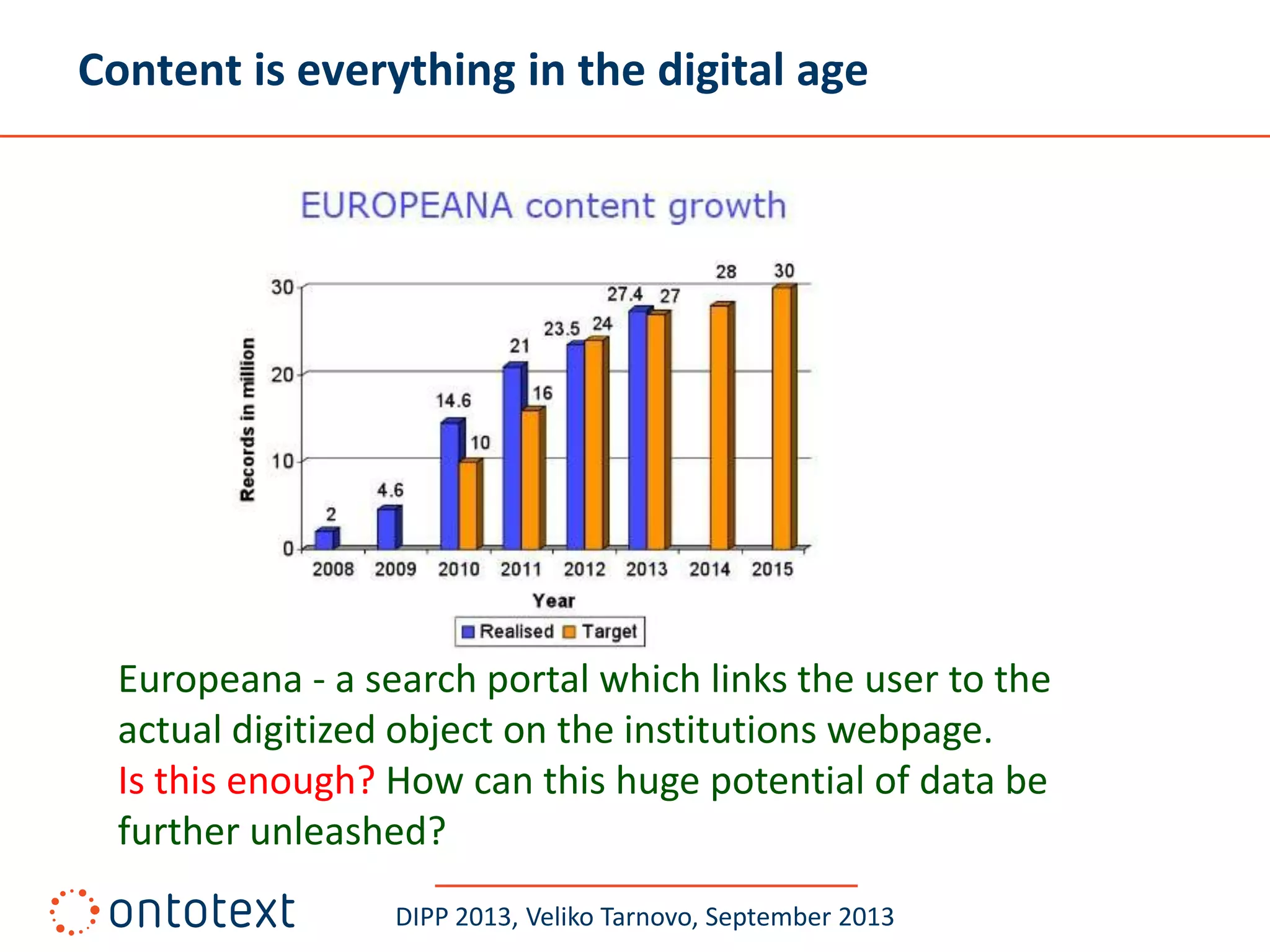
Content is everything in the digital age

Europeana - a search portal which links the user to the
actual digitized object on the institutions webpage.
Is this enough? How can this huge potential of data be
further unleashed?
DIPP 2013, Veliko Tarnovo, September 2013
Europeana – the next step
• Recently opened up its dataset of over 25 million cultural
objects to the public.
• the material can be used for any purpose – creative,
educational commercial….
• the free availability of this data offers a new boost to the
digital economy. The sector of cultural and creative
industries (particularly from the learning, tourism and
games sectors) represents 3.3% of EU GDP and is worth
over €150 billion in exports.
• new and exciting opportunities for app developers,
designers and other digital innovators have been
created.
DIPP 2013, Veliko Tarnovo, September 2013
Obstacles and challenges

• Organizational: lack of sustainable environment for
experimentation.
.
• Technical : Europeana API doesn’t retrieve content.
• Legal : Licensing framework doesn’t cover content but
only metadata.
• Cultural: no real-world case studies.

DIPP 2013, Veliko Tarnovo, September 2013
The Europeana Creative project
In September 2012, Europeana encouraged the
development of innovative applications by:
• publishing the metadata for 25 million cultural
heritage objects under the terms of
the Creative Commons Public Domain
Dedication 0 (CC0) license;
• providing free and open access to the
metadata through API and Linked Open Data.
• Europeana Creative will not only use this
metadata, but also many of the digital objects
themselves, which are available for re-use
together with the necessary licenses.
DIPP 2013, Veliko Tarnovo, September 2013
Project objectives 1
• Establish the Europeana Open Labs Network for experimentation
beginning with four Open Lab affiliates and a virtual space.
• Create the Europeana Content Re-use Framework which will
extend the Europeana Licensing Framework from metadata to
content.
• Implement the infrastructure and essential services needed to
support re-use of cultural resources, at the same time boosting
creativity and long-term business development.
• Create five pilot applications in the thematic areas of History
Education, Natural History Education, Tourism, Social Networks
and Design.

DIPP 2013, Veliko Tarnovo, September 2013
Project objectives 2
• Identify, incubate, and spin-off five viable projects into the
Creative Industry sector.

• Identify business models allowing key stakeholders within the
Europeana ecosystem to develop products and services based
on the Content Re-use Framework.
• Evaluate all work streams, while the delivery of pilots and
services supports best practice learning.
• Project results will be promoted via an extensive stakeholder
engagement campaign in the Creative Industries sector and the
Europeana Network.

DIPP 2013, Veliko Tarnovo, September 2013
The role of Ontotext
• Creation of Content Retrieval Services as part of the Content Re-use
Framework - a sophisticated platform for the retrieval of Europeana
metadata and related digital content objects.
• Deployment of OWLIM platform for metadata storage and search.
Europeana Creative will make use of this triple store as a central data
integration repository.
• Geographic mapping to be used for the creation and management of
cultural routes as required by the Tourism pilot.
• Linking to external web resources (e.g. Freebase, DBpedia, Wikipedia,
VIAF, Getty, Geonames).
• Creation of services for geo-referencing of data that are required by
the Social Networks Pilot. Geo-referenced cultural objects can also be
used for location-based services.

DIPP 2013, Veliko Tarnovo, September 2013
ESE schema
Each of the different
heritage sectors represented
in Europeana uses different
data standards, and ESE
reduces these to the lowest
common denominator.
•

• 15 original Dublin Core
(DC) metadata elements, a
subset of the DC terms
• a set of twelve elements
which were created to meet
Europeana’s specific needs.
DIPP 2013, Veliko Tarnovo, September 2013
How does one CH object looks like in Europeana?

DIPP 2013, Veliko Tarnovo, September 2013
EDM - the new data structure for Europeana

Classes introduced by EDM are in blue, classes in white are re-used from other schemas.

DIPP 2013, Veliko Tarnovo, September 2013
What makes EDM different?
• not built on any particular community standard.
• allows for richer and truly semantic representations of CHO.
• Integrates ontologies like SKOS, Dublin Core, and FOAF.

• uses RDFS as meta-model and URIs to identify information
about CHO.
• uses OAI-ORE as ontology framework thus making Europeana
compatible with the Semantic Web paradigm and enables it to
become part of the emerging LOD community.
• has 3 core classes of resources that result from the package of
data provided to Europeana: ProvidedCHO, WebResource and
Aggregation. Each of them can be subject to corresponding
metadata, leading to three core “metadata sections”.
DIPP 2013, Veliko Tarnovo, September 2013
Ontotext’s EDM Endpoint
• Endpoint - a specific location for accessing a web service using a
specific protocol and data format. EDM (SPARQL) endpoint - a
URI to which queries can be sent, and which returns answers to
the queries as a response.
• In December 2012 Ontotext launched the Europeana's EDM
Endpoint, which allows CH data from data.europeana.eu to be
accessed from applications and to be explored through the UI of
the Forest framework. One billion explicit statements have been
loaded in the OWLIM repository and with inference they stack
up to about 4 billion distinct retrievable statements.
• Ever since Ontotext launched the Endpoint, the positive
reactions from the community and the number of visitors
constantly increased.
DIPP 2013, Veliko Tarnovo, September 2013
OWLIM

• The backbone of the EDM Endpoint is OWLIM - a family
of semantic repositories, or RDF database management
systems, with the following characteristics:
– native RDF engines, implemented in Java;
– delivering full performance through both Sesame and Jena;
– best scalability, loading and query evaluation performance.
• OWLIM comes in 3 editions: OWLIM-Lite, OWLIM-SE
(Standard Edition) and OWLIM-Enterprise. All editions share
the same inference mechanisms and semantics.

DIPP 2013, Veliko Tarnovo, September 2013
Forest framework
• Forest - web interface that brings together tools for execution
of SPARQL queries, visual exploration of RDF triples, full text
search and integration of popular third-party data
visualization components.
• Forest is an optimal platform for exploring the data in an
OWLIM repository. It is the front end for linked data web
services offered by Ontotext.
• Forest is used in various client applications providing a
flexible architecture for development of custom
functionalities like user-friendly RDF views.

DIPP 2013, Veliko Tarnovo, September 2013
Visualization of a CH object

DIPP 2013, Veliko Tarnovo, September 2013
What is typical for custom views?

• All triples of all nodes comprising the CHO are shown.
Download can be done in JSON, RDF, Turtle, NTriples.
• A view from the Europeana portal is shown, including links to
the original (source).
• A CHO Graph and connections between the nodes are shown.
URLs are shortened. Data is compressed into the node.

DIPP 2013, Veliko Tarnovo, September 2013
Thank you for your attention!
Questions?

nikola.ikonomov@ontotext.com

DIPP 2013, Veliko Tarnovo, September 2013

Europeana Creative. EDM Endpoint. Custom Views

  • 1.
    Europeana Creative. EDM Endpoint.Custom Views. Dr. Nikola Ikonomov
  • 2.
    Content is everythingin the digital age Europeana - a search portal which links the user to the actual digitized object on the institutions webpage. Is this enough? How can this huge potential of data be further unleashed? DIPP 2013, Veliko Tarnovo, September 2013
  • 3.
    Europeana – thenext step • Recently opened up its dataset of over 25 million cultural objects to the public. • the material can be used for any purpose – creative, educational commercial…. • the free availability of this data offers a new boost to the digital economy. The sector of cultural and creative industries (particularly from the learning, tourism and games sectors) represents 3.3% of EU GDP and is worth over €150 billion in exports. • new and exciting opportunities for app developers, designers and other digital innovators have been created. DIPP 2013, Veliko Tarnovo, September 2013
  • 4.
    Obstacles and challenges •Organizational: lack of sustainable environment for experimentation. . • Technical : Europeana API doesn’t retrieve content. • Legal : Licensing framework doesn’t cover content but only metadata. • Cultural: no real-world case studies. DIPP 2013, Veliko Tarnovo, September 2013
  • 5.
    The Europeana Creativeproject In September 2012, Europeana encouraged the development of innovative applications by: • publishing the metadata for 25 million cultural heritage objects under the terms of the Creative Commons Public Domain Dedication 0 (CC0) license; • providing free and open access to the metadata through API and Linked Open Data. • Europeana Creative will not only use this metadata, but also many of the digital objects themselves, which are available for re-use together with the necessary licenses. DIPP 2013, Veliko Tarnovo, September 2013
  • 6.
    Project objectives 1 •Establish the Europeana Open Labs Network for experimentation beginning with four Open Lab affiliates and a virtual space. • Create the Europeana Content Re-use Framework which will extend the Europeana Licensing Framework from metadata to content. • Implement the infrastructure and essential services needed to support re-use of cultural resources, at the same time boosting creativity and long-term business development. • Create five pilot applications in the thematic areas of History Education, Natural History Education, Tourism, Social Networks and Design. DIPP 2013, Veliko Tarnovo, September 2013
  • 7.
    Project objectives 2 •Identify, incubate, and spin-off five viable projects into the Creative Industry sector. • Identify business models allowing key stakeholders within the Europeana ecosystem to develop products and services based on the Content Re-use Framework. • Evaluate all work streams, while the delivery of pilots and services supports best practice learning. • Project results will be promoted via an extensive stakeholder engagement campaign in the Creative Industries sector and the Europeana Network. DIPP 2013, Veliko Tarnovo, September 2013
  • 8.
    The role ofOntotext • Creation of Content Retrieval Services as part of the Content Re-use Framework - a sophisticated platform for the retrieval of Europeana metadata and related digital content objects. • Deployment of OWLIM platform for metadata storage and search. Europeana Creative will make use of this triple store as a central data integration repository. • Geographic mapping to be used for the creation and management of cultural routes as required by the Tourism pilot. • Linking to external web resources (e.g. Freebase, DBpedia, Wikipedia, VIAF, Getty, Geonames). • Creation of services for geo-referencing of data that are required by the Social Networks Pilot. Geo-referenced cultural objects can also be used for location-based services. DIPP 2013, Veliko Tarnovo, September 2013
  • 9.
    ESE schema Each ofthe different heritage sectors represented in Europeana uses different data standards, and ESE reduces these to the lowest common denominator. • • 15 original Dublin Core (DC) metadata elements, a subset of the DC terms • a set of twelve elements which were created to meet Europeana’s specific needs. DIPP 2013, Veliko Tarnovo, September 2013
  • 10.
    How does oneCH object looks like in Europeana? DIPP 2013, Veliko Tarnovo, September 2013
  • 11.
    EDM - thenew data structure for Europeana Classes introduced by EDM are in blue, classes in white are re-used from other schemas. DIPP 2013, Veliko Tarnovo, September 2013
  • 12.
    What makes EDMdifferent? • not built on any particular community standard. • allows for richer and truly semantic representations of CHO. • Integrates ontologies like SKOS, Dublin Core, and FOAF. • uses RDFS as meta-model and URIs to identify information about CHO. • uses OAI-ORE as ontology framework thus making Europeana compatible with the Semantic Web paradigm and enables it to become part of the emerging LOD community. • has 3 core classes of resources that result from the package of data provided to Europeana: ProvidedCHO, WebResource and Aggregation. Each of them can be subject to corresponding metadata, leading to three core “metadata sections”. DIPP 2013, Veliko Tarnovo, September 2013
  • 13.
    Ontotext’s EDM Endpoint •Endpoint - a specific location for accessing a web service using a specific protocol and data format. EDM (SPARQL) endpoint - a URI to which queries can be sent, and which returns answers to the queries as a response. • In December 2012 Ontotext launched the Europeana's EDM Endpoint, which allows CH data from data.europeana.eu to be accessed from applications and to be explored through the UI of the Forest framework. One billion explicit statements have been loaded in the OWLIM repository and with inference they stack up to about 4 billion distinct retrievable statements. • Ever since Ontotext launched the Endpoint, the positive reactions from the community and the number of visitors constantly increased. DIPP 2013, Veliko Tarnovo, September 2013
  • 14.
    OWLIM • The backboneof the EDM Endpoint is OWLIM - a family of semantic repositories, or RDF database management systems, with the following characteristics: – native RDF engines, implemented in Java; – delivering full performance through both Sesame and Jena; – best scalability, loading and query evaluation performance. • OWLIM comes in 3 editions: OWLIM-Lite, OWLIM-SE (Standard Edition) and OWLIM-Enterprise. All editions share the same inference mechanisms and semantics. DIPP 2013, Veliko Tarnovo, September 2013
  • 15.
    Forest framework • Forest- web interface that brings together tools for execution of SPARQL queries, visual exploration of RDF triples, full text search and integration of popular third-party data visualization components. • Forest is an optimal platform for exploring the data in an OWLIM repository. It is the front end for linked data web services offered by Ontotext. • Forest is used in various client applications providing a flexible architecture for development of custom functionalities like user-friendly RDF views. DIPP 2013, Veliko Tarnovo, September 2013
  • 16.
    Visualization of aCH object DIPP 2013, Veliko Tarnovo, September 2013
  • 17.
    What is typicalfor custom views? • All triples of all nodes comprising the CHO are shown. Download can be done in JSON, RDF, Turtle, NTriples. • A view from the Europeana portal is shown, including links to the original (source). • A CHO Graph and connections between the nodes are shown. URLs are shortened. Data is compressed into the node. DIPP 2013, Veliko Tarnovo, September 2013
  • 18.
    Thank you foryour attention! Questions? nikola.ikonomov@ontotext.com DIPP 2013, Veliko Tarnovo, September 2013

Editor's Notes

  • #19 # Parts of Museum Objects Made in China and Museum Objects discovered in China# links with DBpedia and GeonamesPREFIX rdfs: <http://www.w3.org/2000/01/rdf-schema#>PREFIX geo-ont: <http://www.geonames.org/ontology#>PREFIX crm: <http://crm.rkbexplorer.com/id/> PREFIX bmx: <http://crm.rkbexplorer.com/id/bm-extensions/> PREFIX dbpedia: <http://dbpedia.org/resource/>PREFIX rdf: <http://www.w3.org/1999/02/22-rdf-syntax-ns#>PREFIX geo-pos: <http://www.w3.org/2003/01/geo/wgs84_pos#>select ?part ?museumObjectMade ?museumObjectDiscovered ?placewhere { {?part crm:P46B.forms_part_of ?museumObjectMade . ?part crm:P108B.was_produced_by ?made . ?made bmx:PX.made_in ?place . ?place geo-ont:parentFeature <http://collection.britishmuseum.org/id/thesauri/x17274> . }UNION { ?museumObjectDiscoveredbmx:PX.was_discovered_by ?discovered . ?discovered crm:P7F.took_place_at ?place . ?place geo-ont:parentFeature <http://collection.britishmuseum.org/id/thesauri/x17274> . }}