Semantic Linked Data
Kouroupetroglou Praxitelis Nikolaos
Postgraduate Student
Department of Computer Science
Aristotle University, Thessaloniki, Greece
Master Studies – Web Data Mining
Instructor: Vakali Athena
What is about? – Origins?
 Web 1.0
◦ The Internet is a huge network of
computers that uses TCP/IP to
communicate, Lot of documents
interlinked via the internet
◦ Users have a passive role, they just
receive a page
 Web 2.0
◦ People started to interact with pages,
forums, social networks, blogs etc.
 Problem
◦ Web Pages are written in HTML,
describing the structure and not the
Tackle the Problem
 Semantic Web is about Things instead of
today’s Web is about Documents
 Solutions
◦ Top Down
 ◊ Need: Information Analysis, Web scraping,
natural language processing
 - Expensive! Human Intervention, hard to
maintain, legal issues
◦ Bottom Up
 ◊ Embedding sematic annotations into the web
pages
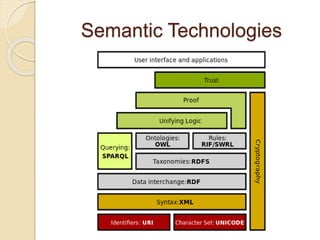
Semantic Technologies
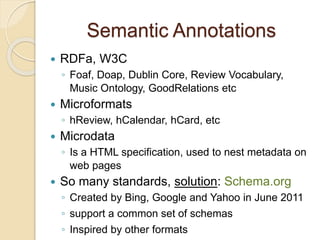
Semantic Annotations
 RDFa, W3C
◦ Foaf, Doap, Dublin Core, Review Vocabulary,
Music Ontology, GoodRelations etc
 Microformats
◦ hReview, hCalendar, hCard, etc
 Microdata
◦ Is a HTML specification, used to nest metadata on
web pages
 So many standards, solution: Schema.org
◦ Created by Bing, Google and Yahoo in June 2011
◦ support a common set of schemas
◦ Inspired by other formats
Linked Data Arrival
 Almost every major Web company has now announced
their work on a knowledge graph
 Dbpedia example
◦ open-source knowledge graph since 2006.
◦ Extract structured information from Wikipedia and make it
available on the Web.
 Linked Data
◦ Web 2.0 technologies allowed websites to be re-used from
third-parties and to repurpose data on the Web, a road to Web
3.0
 Linked Data benefits
◦ can navigate in Web of Data, complex search queries
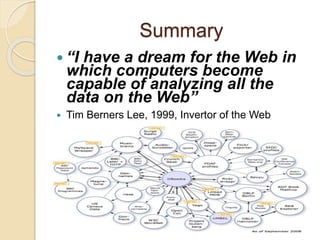
Summary
 “I have a dream for the Web in
which computers become
capable of analyzing all the
data on the Web”
 Tim Berners Lee, 1999, Invertor of the Web
Semantic Linked Data
Kouroupetroglou Praxitelis Nikolaos
Sources:
• www.w3.org
• semanticweb.org
• linkeddatatools.com
• microformats.org
• microdata wikipedia
• semantic-web-and-linked-data presentation
• tutorial-on-semantic-web-presentation
Thank you for listening

Semantic Linked Data

  • 1.
    Semantic Linked Data KouroupetroglouPraxitelis Nikolaos Postgraduate Student Department of Computer Science Aristotle University, Thessaloniki, Greece Master Studies – Web Data Mining Instructor: Vakali Athena
  • 2.
    What is about?– Origins?  Web 1.0 ◦ The Internet is a huge network of computers that uses TCP/IP to communicate, Lot of documents interlinked via the internet ◦ Users have a passive role, they just receive a page  Web 2.0 ◦ People started to interact with pages, forums, social networks, blogs etc.  Problem ◦ Web Pages are written in HTML, describing the structure and not the
  • 3.
    Tackle the Problem Semantic Web is about Things instead of today’s Web is about Documents  Solutions ◦ Top Down  ◊ Need: Information Analysis, Web scraping, natural language processing  - Expensive! Human Intervention, hard to maintain, legal issues ◦ Bottom Up  ◊ Embedding sematic annotations into the web pages
  • 4.
  • 5.
    Semantic Annotations  RDFa,W3C ◦ Foaf, Doap, Dublin Core, Review Vocabulary, Music Ontology, GoodRelations etc  Microformats ◦ hReview, hCalendar, hCard, etc  Microdata ◦ Is a HTML specification, used to nest metadata on web pages  So many standards, solution: Schema.org ◦ Created by Bing, Google and Yahoo in June 2011 ◦ support a common set of schemas ◦ Inspired by other formats
  • 6.
    Linked Data Arrival Almost every major Web company has now announced their work on a knowledge graph  Dbpedia example ◦ open-source knowledge graph since 2006. ◦ Extract structured information from Wikipedia and make it available on the Web.  Linked Data ◦ Web 2.0 technologies allowed websites to be re-used from third-parties and to repurpose data on the Web, a road to Web 3.0  Linked Data benefits ◦ can navigate in Web of Data, complex search queries
  • 7.
    Summary  “I havea dream for the Web in which computers become capable of analyzing all the data on the Web”  Tim Berners Lee, 1999, Invertor of the Web
  • 8.
    Semantic Linked Data KouroupetroglouPraxitelis Nikolaos Sources: • www.w3.org • semanticweb.org • linkeddatatools.com • microformats.org • microdata wikipedia • semantic-web-and-linked-data presentation • tutorial-on-semantic-web-presentation Thank you for listening

Editor's Notes

  • #3 A lot of information given without semantics, just interlinked web pages
  • #5 Unicode How characters are represented URI Addressing docs / objects across the web XML layer Metadata Syntactic basis (send docs across the Web) RDF layer Metadata – semantic layer RDF basic data model for facts Does not rely on XML, but has XML-based syntax RDF Schema simple ontology language (metadata vocabulary) Ontology layer More expressive languages than RDF Schema Current Web standard: OWL Logic layer enhance ontology languages further application-specific declarative knowledge Proof layer Proof generation, exchange, validation Trust layer Digital signatures recommendations, rating agencies ….
  • #6 Annotation: tag semantically your web site Commonly used Vocabularies Friend-of-a-Friend (FOAF) provides terms for describing people and their social network DOAP Description of a Project Dublin Core Defines general metadata attributes. Review Vocabulary provides terms for representing reviews. GoodRelations provides terms for describing products and business entities. Music Ontology provides terms for describing artists, albums, tracks, but also performances, arrangements, etc. Microformats Designed for humans first and machines second, microformats are a set of simple, open data formats built upon existing and widely adopted standards. Based on XML Microdata  Provides tag and tag attributes for semantic annotation, Search engines benefit greatly from direct access to this structured data because it allows search engines to understand the information on web pages and provide more relevant results to users.
  • #7 The Knowledge Graph is a knowledge base used by Google to enhance its search engine's search results with semantic-search information gathered from a wide variety of sources. Knowledge Graph display was added to Google's search engine Google Knowledge Graph Yahoo! Web of Objects Walmart Lab Social Genome Microsoft Satori Graph / Bing Snapshots Facebook Entity Graph Semantic Queries: Cities with low criminality, the next Elton John