Search Engine Marketing 101
A primer for beginners
By Andrew Ettinger
Objective
The objective of this presentation is to provide a
basic introduction to Search Engine Marketing
This document will cover the basic tenets of Search
Engine Optimization (SEO) and Paid Search.
2
Search Engine Marketing
Search Engine Marketing comprises both organic and
paid search
There are two ways to show up on a search engine
result page (SERP)
Natural- engine searches the world wide web and displays
relevant listings based on the search criteria entered by a
visitor. Also referred to as ’organic' or 'algorithmic' search
Paid– advertisers pay to display their advertising when
consumers enter a search query
Examples of Natural & Paid
4
NATURAL
SEARCH
RESULT
PAID
SEARCH
RESULT
The Golden Triangle
The top results (paid and organic) produce the
most clicks
5
ORGANIC SEARCH RESULTS
6
Organic Search Results
Search engines rank websites on how relevant they are
for each search query
To determine relevancy on a topic, relies upon a variety
of information including
Description words
Linguistic indicators (use of text)
Loading Speed
Originality
In bound links
Search Engine Optimization (SEO)
SEO encompasses a wide range of activities designed to
generate traffic to a website by utilizing the organic search
listings of a search engine
Achievement of high organic rankings to improve qualified web traffic
through the search engine listings
Traffic is exponentially larger for first page listings
SEO agencies handle a variety of tasks to improve rankings
within the natural search results:
Keyword research
Website development
Content optimization
Link development
Data Analytics
8
SEO Challenges
It is an art, not a science
The search engines are constantly refining their (already
complex) algorithms to improve results
Cat and Mouse
As “black hat” companies try to cheat the system, Google reacts and
changes the rules
Advanced HTML development is complex to learn
In bound link development is difficult and time consuming
The more people who link to your website the better your ranking, but
those must be quality links
Google disallows you to pay other websites to link to your site
9
PAID SEARCH
Paid Search
Ads are bought on a Pay Per Click (PPC) basis
The advertiser is charged only when the ad is clicked
Search responds to consumer demand
By looking for information consumers identify themselves as
interested in a subject thus becoming qualified leads
Each campaign is bespoke
What works for Client A does not work for Client B
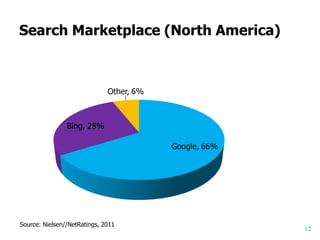
Search Marketplace (North America)
12
Source: Nielsen//NetRatings, 2011
How it works
Search Engines utilize a bidding system to sell ads
Advertisers bid on specific terms ((also called keywords)
Auction process
Every time a person enters a search query a new page is loaded and Google
holds an auction for each position on the page
Rankings are based on a combination of factors- max bid price, ad quality,
historical CTRs, competition
Ads that are clicked on more often can rise above ads with lower CTR, even if
they have lower bids
Google dominate the marketplace
The majority of Google’s traffic comes from searches on
Google.com
However traffic also comes from searches on Google owned properties
such as YouTube or affiliates like AOL
Google‟s mantra is relevance
The more relevant the ad, the more clicks it will produce, the more
money everyone will make
Google owns a number of specialty websites such as YouTube,
Blogger, Zagat, Frommers
By itself YouTube is the second largest search engine
Text Ads
Google ads have four lines of text
Title- 25 Characters max
Body- 35 Characters max
Body- 35 characters max
Visible Web address
Destination URL – the address that the ad actually links
Display URL
Google Editorial Guidelines
Google has very strict guidelines to which text ads must adhere
• Cannot use “Best”, “#1” & “Lowest” emphasizing superiority unless 3rd
party verified.
• 3rd line cannot lead into Visible URL
• No ellipses (…)
• No excessive punctuation (example: “!!” or “???”). No “!” in the headline
and only one “!” in one ad
• On destination pages, back button must return user to Google.
• Any offers stated in creative must be made explicit within 2 clicks of the
landing page.
• No excessive repetition
• No use of the word „Click‟ (such as ‘Click Here’)
Ads in the First Position Earn the
Most Clicks
Second Position Gets Fewer Clicks
Third Position even less
Fourth position
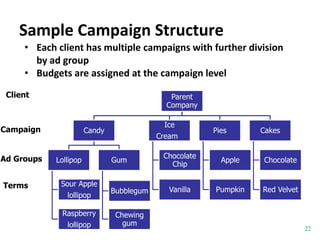
Campaign structure is key
Organize your search efforts into hierarchies to manage
the budget, bidding and workflow
Each client is divided into multiple campaigns
Each campaign is divided into ad groups
Ad groups consist of similarly themed words or phrases
Text ads are assigned to each ad group to best reflect
the tenor of the terms
Manage bidding at both the ad group and term levels
Client
Campaigns
Ad
Groups
Terms
21
Sample Campaign Structure
Parent
Company
Candy
Lollipop
Sour Apple
lollipop
Raspberry
lollipop
Gum
Bubblegum
Chewing
gum
Ice
Cream
Chocolate
Chip
Vanilla
Pies
Apple
Pumpkin
Cakes
Chocolate
Red Velvet
22
Client
Campaign
Ad Groups
Terms
• Each client has multiple campaigns with further division
by ad group
• Budgets are assigned at the campaign level
Sample Campaign Structure
Candy Co
Candy
bar
Chocolate
bar
Candy bar
Gum
Bubble gum
Chewing
gum
Lollipop
Sour Apple
Raspberry
lollipop
Licorice
Red licorice
Black
Licorice
23
Campaign
Ad Groups
Keywords
• Each ad group contains multiple keywords (terms) related to a specific topic
• If an individual ad group has a specific budget, then a separate campaign
would need to be created
How To Create Keyword Lists
Choose words based on your product, website and goals
The best performing terms are those that reflect both your website and
product
Google provides useful tools to find and evaluate keywords related to
your campaign.
Also, these tools estimate the volume of searches for each term as well
as the amount of competitive activity
Also, I highly recommend 3rd party tools like SpyFu
Campaigns start with many words but narrow the list based on
results
Let consumers decide which words are important to them
Through their actions (clicks, purchases) they decide which terms have
the most resonance
24
Google Keyword Tool
25
SpyFu
26
Keyword Matching
After advertisers select their keywords they must decide on the context on which to
bid. Since language is so dynamic, words can be used in different contexts which
affect the search query. Specificity is key because language can be vague
•Broad match is Google’s default setting. All searches for that keyword will trigger
your ad. The terms can be in any order or combination. As well, searches for other,
similar terms might prompt your ad to be shown
•Phrase match narrows the context of the search that will trigger your ad. This limits
reach by requiring the words to appear in a specific order
•Exact match further narrows the scope of searches. Now your ad will only be shown
if that exact phrase is entered. There cannot be any derivation from the order or
spellings.
•Negative match eliminates your ad when those terms are searched. Protects against
unwanted associations such as ‘Lawsuit’ or ‘is Terrible.’
27
Example of Keyword Matching
28
match type...
With this
punctuation...
To trigger your ad on... Example
broad match none
synonyms, related searches, and
other relevant variations
Candy bars
broad match modifier +keyword
close variations but not synonyms
or related searches
+Candy Bar +Chocolate
phrase match "keyword"
a phrase and close variants of
that phrase
”Candy Bars" Chocolate
exact match [keyword] an exact search of that term [Chocolate Candy Bar]
negative match -keyword
Excludes searches with the
negative term
-Vanilla
Broad
Phrase
Exact
Source: Google
1. Broad Match
This is the default option on most engines and is the most
general way of bidding on search queries
• Includes the term or phrase along with other words
– Example: Candy Bar. The ad will appear when a search query contains
Candy and Bar. These words can be in any order
• Includes plurals and relevant variations of the term
– Example: Candy Bars, Chocolate Candy Bars, Vanilla Candy Bars, etc.
Broad matches are less targeted
– Generates more clicks but yields lower CTR
Other advertisers may have bid for the same broad keyword
combinations but for products in other categories
2. Phrase Match
Phrase match is more specific than broad match
– Weeds out longer phrases that contains the keywords plus many
other words
– Searches with slight word differences are excluded
• Use quotation to signal which specific words and order to use
– Example: “Candy Bar” the ad will appear for the search chocolate
candy bar but not for chocolate bars made for candy fans
• A more precise method of keyword selection.
– Less volume but tends to produce better CTR since the search is more
related to your ad
• To ensure your ads are as targeted as possible, you should
include at least two descriptive words in the keyword
phrases.
3. Exact Match
Exact Match is the most targeted option
• You ad will appear only when the specific term in a specified
order is typed in by a person searching
– Example: [candy bar] would only appear if only those two words were
typed and only in that order.
• Use brackets to define the words
• Your ad will not show if there are other terms in the query
– Example: Your ad won't show for Vanilla Candy Bars
• You will receive less impressions but you'll likely generate
higher click through rates because users searching for the
terms may want precisely what you have to offer.
– Less Volume, Highest CTR
SEM Important Concepts
The Golden Triangle
SEO & PPC work best together
The goal is to own as much of the page as possible
Landing pages should be as specific as possible to the
search term
People will click away within a few seconds if the page does
not match the search query
Search Engine Marketing is a process, not a project
It is never finished!
32

Sem 101

  • 1.
    Search Engine Marketing101 A primer for beginners By Andrew Ettinger
  • 2.
    Objective The objective ofthis presentation is to provide a basic introduction to Search Engine Marketing This document will cover the basic tenets of Search Engine Optimization (SEO) and Paid Search. 2
  • 3.
    Search Engine Marketing SearchEngine Marketing comprises both organic and paid search There are two ways to show up on a search engine result page (SERP) Natural- engine searches the world wide web and displays relevant listings based on the search criteria entered by a visitor. Also referred to as ’organic' or 'algorithmic' search Paid– advertisers pay to display their advertising when consumers enter a search query
  • 4.
    Examples of Natural& Paid 4 NATURAL SEARCH RESULT PAID SEARCH RESULT
  • 5.
    The Golden Triangle Thetop results (paid and organic) produce the most clicks 5
  • 6.
  • 7.
    Organic Search Results Searchengines rank websites on how relevant they are for each search query To determine relevancy on a topic, relies upon a variety of information including Description words Linguistic indicators (use of text) Loading Speed Originality In bound links
  • 8.
    Search Engine Optimization(SEO) SEO encompasses a wide range of activities designed to generate traffic to a website by utilizing the organic search listings of a search engine Achievement of high organic rankings to improve qualified web traffic through the search engine listings Traffic is exponentially larger for first page listings SEO agencies handle a variety of tasks to improve rankings within the natural search results: Keyword research Website development Content optimization Link development Data Analytics 8
  • 9.
    SEO Challenges It isan art, not a science The search engines are constantly refining their (already complex) algorithms to improve results Cat and Mouse As “black hat” companies try to cheat the system, Google reacts and changes the rules Advanced HTML development is complex to learn In bound link development is difficult and time consuming The more people who link to your website the better your ranking, but those must be quality links Google disallows you to pay other websites to link to your site 9
  • 10.
  • 11.
    Paid Search Ads arebought on a Pay Per Click (PPC) basis The advertiser is charged only when the ad is clicked Search responds to consumer demand By looking for information consumers identify themselves as interested in a subject thus becoming qualified leads Each campaign is bespoke What works for Client A does not work for Client B
  • 12.
    Search Marketplace (NorthAmerica) 12 Source: Nielsen//NetRatings, 2011
  • 13.
    How it works SearchEngines utilize a bidding system to sell ads Advertisers bid on specific terms ((also called keywords) Auction process Every time a person enters a search query a new page is loaded and Google holds an auction for each position on the page Rankings are based on a combination of factors- max bid price, ad quality, historical CTRs, competition Ads that are clicked on more often can rise above ads with lower CTR, even if they have lower bids
  • 14.
    Google dominate themarketplace The majority of Google’s traffic comes from searches on Google.com However traffic also comes from searches on Google owned properties such as YouTube or affiliates like AOL Google‟s mantra is relevance The more relevant the ad, the more clicks it will produce, the more money everyone will make Google owns a number of specialty websites such as YouTube, Blogger, Zagat, Frommers By itself YouTube is the second largest search engine
  • 15.
    Text Ads Google adshave four lines of text Title- 25 Characters max Body- 35 Characters max Body- 35 characters max Visible Web address Destination URL – the address that the ad actually links Display URL
  • 16.
    Google Editorial Guidelines Googlehas very strict guidelines to which text ads must adhere • Cannot use “Best”, “#1” & “Lowest” emphasizing superiority unless 3rd party verified. • 3rd line cannot lead into Visible URL • No ellipses (…) • No excessive punctuation (example: “!!” or “???”). No “!” in the headline and only one “!” in one ad • On destination pages, back button must return user to Google. • Any offers stated in creative must be made explicit within 2 clicks of the landing page. • No excessive repetition • No use of the word „Click‟ (such as ‘Click Here’)
  • 17.
    Ads in theFirst Position Earn the Most Clicks
  • 18.
  • 19.
  • 20.
  • 21.
    Campaign structure iskey Organize your search efforts into hierarchies to manage the budget, bidding and workflow Each client is divided into multiple campaigns Each campaign is divided into ad groups Ad groups consist of similarly themed words or phrases Text ads are assigned to each ad group to best reflect the tenor of the terms Manage bidding at both the ad group and term levels Client Campaigns Ad Groups Terms 21
  • 22.
    Sample Campaign Structure Parent Company Candy Lollipop SourApple lollipop Raspberry lollipop Gum Bubblegum Chewing gum Ice Cream Chocolate Chip Vanilla Pies Apple Pumpkin Cakes Chocolate Red Velvet 22 Client Campaign Ad Groups Terms • Each client has multiple campaigns with further division by ad group • Budgets are assigned at the campaign level
  • 23.
    Sample Campaign Structure CandyCo Candy bar Chocolate bar Candy bar Gum Bubble gum Chewing gum Lollipop Sour Apple Raspberry lollipop Licorice Red licorice Black Licorice 23 Campaign Ad Groups Keywords • Each ad group contains multiple keywords (terms) related to a specific topic • If an individual ad group has a specific budget, then a separate campaign would need to be created
  • 24.
    How To CreateKeyword Lists Choose words based on your product, website and goals The best performing terms are those that reflect both your website and product Google provides useful tools to find and evaluate keywords related to your campaign. Also, these tools estimate the volume of searches for each term as well as the amount of competitive activity Also, I highly recommend 3rd party tools like SpyFu Campaigns start with many words but narrow the list based on results Let consumers decide which words are important to them Through their actions (clicks, purchases) they decide which terms have the most resonance 24
  • 25.
  • 26.
  • 27.
    Keyword Matching After advertisersselect their keywords they must decide on the context on which to bid. Since language is so dynamic, words can be used in different contexts which affect the search query. Specificity is key because language can be vague •Broad match is Google’s default setting. All searches for that keyword will trigger your ad. The terms can be in any order or combination. As well, searches for other, similar terms might prompt your ad to be shown •Phrase match narrows the context of the search that will trigger your ad. This limits reach by requiring the words to appear in a specific order •Exact match further narrows the scope of searches. Now your ad will only be shown if that exact phrase is entered. There cannot be any derivation from the order or spellings. •Negative match eliminates your ad when those terms are searched. Protects against unwanted associations such as ‘Lawsuit’ or ‘is Terrible.’ 27
  • 28.
    Example of KeywordMatching 28 match type... With this punctuation... To trigger your ad on... Example broad match none synonyms, related searches, and other relevant variations Candy bars broad match modifier +keyword close variations but not synonyms or related searches +Candy Bar +Chocolate phrase match "keyword" a phrase and close variants of that phrase ”Candy Bars" Chocolate exact match [keyword] an exact search of that term [Chocolate Candy Bar] negative match -keyword Excludes searches with the negative term -Vanilla Broad Phrase Exact Source: Google
  • 29.
    1. Broad Match Thisis the default option on most engines and is the most general way of bidding on search queries • Includes the term or phrase along with other words – Example: Candy Bar. The ad will appear when a search query contains Candy and Bar. These words can be in any order • Includes plurals and relevant variations of the term – Example: Candy Bars, Chocolate Candy Bars, Vanilla Candy Bars, etc. Broad matches are less targeted – Generates more clicks but yields lower CTR Other advertisers may have bid for the same broad keyword combinations but for products in other categories
  • 30.
    2. Phrase Match Phrasematch is more specific than broad match – Weeds out longer phrases that contains the keywords plus many other words – Searches with slight word differences are excluded • Use quotation to signal which specific words and order to use – Example: “Candy Bar” the ad will appear for the search chocolate candy bar but not for chocolate bars made for candy fans • A more precise method of keyword selection. – Less volume but tends to produce better CTR since the search is more related to your ad • To ensure your ads are as targeted as possible, you should include at least two descriptive words in the keyword phrases.
  • 31.
    3. Exact Match ExactMatch is the most targeted option • You ad will appear only when the specific term in a specified order is typed in by a person searching – Example: [candy bar] would only appear if only those two words were typed and only in that order. • Use brackets to define the words • Your ad will not show if there are other terms in the query – Example: Your ad won't show for Vanilla Candy Bars • You will receive less impressions but you'll likely generate higher click through rates because users searching for the terms may want precisely what you have to offer. – Less Volume, Highest CTR
  • 32.
    SEM Important Concepts TheGolden Triangle SEO & PPC work best together The goal is to own as much of the page as possible Landing pages should be as specific as possible to the search term People will click away within a few seconds if the page does not match the search query Search Engine Marketing is a process, not a project It is never finished! 32