SELLING PROCESS
CHAPTER 2
DPM3013 SALES MANAGEMENT
LEARNING OUTCOME
1.DEFINE PERSONAL SELLING
SELLING PROCESS
2.0Selling Process
2.1Personal Selling
2.2Steps In Selling Process
MAIN MENU
NOTES
EXERCISE
VIDEO
QUIZ
CONCLUSION
VIDEO: SELLING IS HARDWORK
SELLING PROCESS
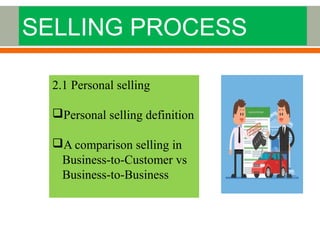
2.1 Personal selling
Personal selling definition
A comparison selling in
Business-to-Customer vs
Business-to-Business
DEFINITION SELLING PROCESS
• Personal communication between a
sales person and a potential
customer or group of customers
• The situation whereby a salesperson
personally meet the
prospect/customer.
COMPARISON SELLING
• Involves transactions between
customers and companies.
• Customers are able to
communicate with companies
using internet.
COMPARISON SELLING
A Comparison Selling In B2C vs B2B
COMPARISON SELLING
• B2B involves sales of product of one company to
another company.
• Technology used for B2B are:
a. Intranet
- Internal communication within a
company/organization
- Can only be accessed by registered users.
b. Extranet
- Communicating system for customers or
selected business partners of the company.
PROSPECTING APPROACHING
SALES
PRESENTATION&
DEMONSTRATION
HANDLING
OBJECTION
CLOSING FOLLOW-UP
STEP IN SELLING PROCESS
11
Prospecting
Sales presentation
&demonstration
Handling
objection
Closing
Follow-up
STEP IN SELLING PROCESS
Approaching
EXERCISE
VIDEO :SELLING PROCESS
PROSPECTING
• Prospecting is the lifeblood of sales
because it identifies potential
customers.
• Prospect can be defined as “a
qualified person/organization that
has potential to buy your
good/service.”
DEFINITION
PROSPECTING
Salesperson selects the right person to
discuss about the company’s
product/service
To gain the prospect’s attention and to
stimulate interests in learning more about
product.
APPROACHING
APPROACHING
APPROACHING
1 2
.
3 4
5
 SALES PRESENTATION &
DEMONSTRATION
 1.SALES PRESENTATION
SALES PERSON CUSTOMER
SALES PRESENTATION &
DEMONSTRATION
 2.DEMONSTRATION
SALES PERSON CUSTOMER DEMONSTRATION
HANDLING OBJECTION
HANDLING OBJECTION
 What objection are?
 Opposition or resistance to information or to the
salesperson’s request.
 The sales call, from introduction to close.
Major
Categorie
s of
Objection
s
Six
categories
of
objections
:
Hidden
Objection
Stalling
Objection
No-Need
Objection
Money
Objection
Product
Objection
Source
Objection
HANDLING OBJECTION
22
• Is the process of
helping people make
a decision that will
benefit them.
• Salesperson help
people make the
decision by asking
them to buy.
Closin
g
CLOSING
Maintaining contact with
customer (or prospect) in order
to evaluate the effectiveness of
the product and the satisfaction
of the customer.
FOLLOW-UP
FOLLOW-UP
 Care for the customer, take joy in work,
and find harmony in the relationship.
 Have patience in closing the sale,
kindness to all people, and moral ethics.
 Be faithful to one’s word, fair in the sale,
and self-controlled in emotions.
Quiz
Click the Quiz button to edit this object
REFERENCES
Main
Futrell, Charles M. (2005), Fundamentals Of Selling: Customer For Life Through Services, (10th
ed.)
McGraw-Hill International Edition. *
Additional
Igram, Thomas N., LaForge, Raymond W. & Avila, Ramon A. (2012). Sales Management: Analysis
and Decision Making (8th
ed.). M.E. Sharpe. (ISBN-13:9780765626400)
Marks W. Johnson, Greg W. Marshall (2010). Sales Force Management (13th
ed.) Irwin Professional
Pub. (ISBN-13:978-0073404851)
Norred, Jim (2010). Fundamentals of Selling: The Sales Track. Outskrits Press. (ISBN-13:978-
1432760687)
AUTHORS
 1. NOR AZIAH BINTI AZIZAN
 2. NORHAFIZAWATI BINTI BAKAR
Selling Process

Selling Process

Editor's Notes

  • #2 <number>
  • #3 <number>
  • #4 <number>
  • #5 <number>
  • #6 <number>
  • #7 <number>
  • #8 <number>
  • #9 <number>
  • #10 <number>
  • #11 <number>
  • #12 Clikc prospectinganimationcustome pathTiggeron clikc offreeformafter previous <number>
  • #13 <number>
  • #14 <number>
  • #15 <number>
  • #16 <number>
  • #17 <number>
  • #18 <number>
  • #19 <number>
  • #20 <number>
  • #21 <number>
  • #22 X ada sound <number>
  • #23 <number>
  • #24 <number>
  • #25 <number>
  • #26 <number>
  • #27 <number>
  • #28 <number>
  • #29 <number>
  • #30 <number>