Selling Philosophy:
1. Selling is problem solving
2. Selling is a caring activity
3. A customer is a person to be served, not a
prospect to be sold
4. Treat people as human beings, not $ signs
5. Be customer driven, not product driven
6. Long-term success depends on customers
relations
7. Selling is a ‘win-win’ activity
8. Adherence to ethics, mutual trust, and honesty
is essential
Modern Selling Philosophy
Based on trust and mutual agreement
Customer-driven
Act as if on customer’s payroll
After-sales service is key
Professionalism and integrity are essential
What buyers want from salespeople






Knowledge
Empathy
Organization
Quick turnaround
Follow-through







Solutions
Punctuality
Hard work
Energy
Honesty
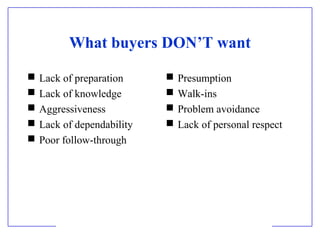
What buyers DON’T want






Lack of preparation
Lack of knowledge
Aggressiveness
Lack of dependability
Poor follow-through






Presumption
Walk-ins
Problem avoidance
Lack of personal respect
The foundation of good selling is the desire
to help people.
Professional salespeople typically view
themselves as problem solvers and selling as
problem solving.
People tend to respond better to being treated as
human beings than as dollar signs.
A salesperson is no longer a vendor out
to sell a product, but rather a consultant
out to help their customer’s business.
There is no such thing as
‘soft sell’ and ‘hard sell’,
there is only
‘smart sell’ and ‘stupid sell’.
Selling should be a friendly act. It is
something we do WITH and FOR people,
not TO them.
Forget about the sales you hope to make and
concentrate on the service you want to render.
The moment people’s attention is centered on
service to others, they become more dynamic,
more forceful and harder to resist.
How can you resist someone who is trying to
help you solve a problem? . . .
Start out each morning with the thought,
‘I want to help as many people as possible
today,’ instead of
‘I want to make as many sales as possible today
People don’t care what you know
until they know that you care.

The object of a salesperson is not to
make sales, but to make customers.
Prospecting and Pre-approach
Identify MAD Customers
 Money to Buy
 Authority to Buy
 Desire to Buy
Prospecting
The process of identifying, qualifying, and
prioritizing organizations and individuals that
have the need for and potential to purchase
the salesperson’s market offering of products
and services.

Sales
Sales
Leads
Leads

Screening
Procedures
for Qualifying
Leads

Qualified
Qualified
Prospects
Prospects
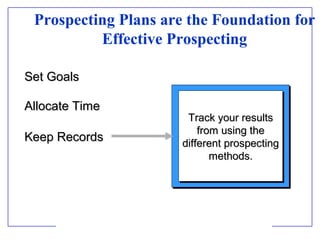
Prospecting Plans are the Foundation for
Effective Prospecting
Set Goals
Establish daily,
weekly and
monthly quotas for
acquiring new
prospects
Prospecting Plans are the Foundation for
Effective Prospecting
Set Goals
Allocate Time

Establish a regular
daily schedule for
conducting
prospecting
activities.
Prospecting Plans are the Foundation for
Effective Prospecting
Set Goals
Allocate Time
Keep Records

Track your results
from using the
different prospecting
methods.
Prospecting Plans are the Foundation
for Effective Prospecting
Set Goals
Allocate Time
Keep Records
Evaluate

What is working for
you? Compare
results and use the
methods that work
best for you.
Prospecting Plans are the Foundation
for Effective Prospecting
Set Goals
Allocate Time
Keep Records
Evaluate
Stay Positive

Develop confidence
by knowing your
products and
believing that you
offer the best
solutions.
Importance of Effective Prospecting

The better the lead generation method,
the higher the proportion of qualified
leads.
The more accurate the qualifying process,
the higher the proportion of customers per
qualified lead.
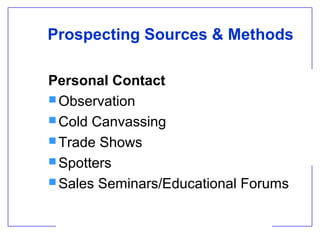
Prospecting Sources & Methods
Personal Contact
 Observation
 Cold Canvassing
 Trade Shows
 Spotters
 Sales Seminars/Educational Forums
Prospecting Sources & Methods
Internal Sources
 Company Records
 Lists and Directories
 Advertising Inquiries
 Telephone Inquiries
 Mail Inquiries
 Internet or World Wide Web
Prospecting Sources & Methods
External Sources
 Referrals
 Introductions
 Community Contacts (Centers of
Influence)
 Organizations
 Non-competing Salespeople
 Visible Accounts
Qualified Prospects . . .
 Can benefit from the sales offering
 Have the financial wherewithal to make the purchase
 Play an important role in the purchase decision process
 Are eligible to buy based on a fit within the selling
strategy

 Are reasonably accessible and willing to consider the
sales offering

 Can be added to the customer base at an acceptable
level of profitability
Personal Selling
Personal selling
Interpersonal influence process
involving a promotional
presentation conducted on a
One-to-One basis with the
buyer.
The process of:
Developing customer relationships,
Discovering customer needs,
Matching appropriate products with
these needs, and communicating
benefits.”
Evolution of Personal Selling
Peddlers selling door
to door . . . served
as intermediaries

Selling function
became more
structured

1800s
1900s
2000s
st
As we begin Post-Industrial selling and
the 21 century, War continues to develop,
Industrial
Modern
becomingRevolution
more professional and more relational
Revolution
Depression
Era

Business organizations
employed salespeople

Selling function
became more
professional
Relationship Selling

Salesperson focuses on developing a trusting
partnership in which the salesperson seeks to
provide long-term customer satisfaction by
listening, gathering information, educating, and
adding value for the customer.
Transaction- vs. Relationship Focused
Transaction-Focused

Relationship-Focused

•
•

•
•

•

•

Short term thinking
Making the sale has
priority over most
other considerations
Interaction between
buyer and seller is
competitive
Salesperson is selfinterest oriented

•

•

Long term thinking
Developing the
relationship takes priority
over getting the sale
Interaction between
buyer and seller is
collaborative.
Salesperson is customeroriented

selling n nego

  • 1.
    Selling Philosophy: 1. Sellingis problem solving 2. Selling is a caring activity 3. A customer is a person to be served, not a prospect to be sold 4. Treat people as human beings, not $ signs 5. Be customer driven, not product driven 6. Long-term success depends on customers relations 7. Selling is a ‘win-win’ activity 8. Adherence to ethics, mutual trust, and honesty is essential
  • 2.
    Modern Selling Philosophy Basedon trust and mutual agreement Customer-driven Act as if on customer’s payroll After-sales service is key Professionalism and integrity are essential
  • 3.
    What buyers wantfrom salespeople      Knowledge Empathy Organization Quick turnaround Follow-through      Solutions Punctuality Hard work Energy Honesty
  • 4.
    What buyers DON’Twant      Lack of preparation Lack of knowledge Aggressiveness Lack of dependability Poor follow-through     Presumption Walk-ins Problem avoidance Lack of personal respect
  • 5.
    The foundation ofgood selling is the desire to help people. Professional salespeople typically view themselves as problem solvers and selling as problem solving. People tend to respond better to being treated as human beings than as dollar signs.
  • 6.
    A salesperson isno longer a vendor out to sell a product, but rather a consultant out to help their customer’s business. There is no such thing as ‘soft sell’ and ‘hard sell’, there is only ‘smart sell’ and ‘stupid sell’. Selling should be a friendly act. It is something we do WITH and FOR people, not TO them.
  • 7.
    Forget about thesales you hope to make and concentrate on the service you want to render. The moment people’s attention is centered on service to others, they become more dynamic, more forceful and harder to resist. How can you resist someone who is trying to help you solve a problem? . . . Start out each morning with the thought, ‘I want to help as many people as possible today,’ instead of ‘I want to make as many sales as possible today
  • 8.
    People don’t carewhat you know until they know that you care. The object of a salesperson is not to make sales, but to make customers.
  • 9.
  • 10.
    Identify MAD Customers Money to Buy  Authority to Buy  Desire to Buy
  • 11.
    Prospecting The process ofidentifying, qualifying, and prioritizing organizations and individuals that have the need for and potential to purchase the salesperson’s market offering of products and services. Sales Sales Leads Leads Screening Procedures for Qualifying Leads Qualified Qualified Prospects Prospects
  • 12.
    Prospecting Plans arethe Foundation for Effective Prospecting Set Goals Establish daily, weekly and monthly quotas for acquiring new prospects
  • 13.
    Prospecting Plans arethe Foundation for Effective Prospecting Set Goals Allocate Time Establish a regular daily schedule for conducting prospecting activities.
  • 14.
    Prospecting Plans arethe Foundation for Effective Prospecting Set Goals Allocate Time Keep Records Track your results from using the different prospecting methods.
  • 15.
    Prospecting Plans arethe Foundation for Effective Prospecting Set Goals Allocate Time Keep Records Evaluate What is working for you? Compare results and use the methods that work best for you.
  • 16.
    Prospecting Plans arethe Foundation for Effective Prospecting Set Goals Allocate Time Keep Records Evaluate Stay Positive Develop confidence by knowing your products and believing that you offer the best solutions.
  • 17.
    Importance of EffectiveProspecting The better the lead generation method, the higher the proportion of qualified leads. The more accurate the qualifying process, the higher the proportion of customers per qualified lead.
  • 18.
    Prospecting Sources &Methods Personal Contact  Observation  Cold Canvassing  Trade Shows  Spotters  Sales Seminars/Educational Forums
  • 19.
    Prospecting Sources &Methods Internal Sources  Company Records  Lists and Directories  Advertising Inquiries  Telephone Inquiries  Mail Inquiries  Internet or World Wide Web
  • 20.
    Prospecting Sources &Methods External Sources  Referrals  Introductions  Community Contacts (Centers of Influence)  Organizations  Non-competing Salespeople  Visible Accounts
  • 21.
    Qualified Prospects .. .  Can benefit from the sales offering  Have the financial wherewithal to make the purchase  Play an important role in the purchase decision process  Are eligible to buy based on a fit within the selling strategy  Are reasonably accessible and willing to consider the sales offering  Can be added to the customer base at an acceptable level of profitability
  • 22.
  • 23.
    Personal selling Interpersonal influenceprocess involving a promotional presentation conducted on a One-to-One basis with the buyer.
  • 24.
    The process of: Developingcustomer relationships, Discovering customer needs, Matching appropriate products with these needs, and communicating benefits.”
  • 25.
    Evolution of PersonalSelling Peddlers selling door to door . . . served as intermediaries Selling function became more structured 1800s 1900s 2000s st As we begin Post-Industrial selling and the 21 century, War continues to develop, Industrial Modern becomingRevolution more professional and more relational Revolution Depression Era Business organizations employed salespeople Selling function became more professional
  • 26.
    Relationship Selling Salesperson focuseson developing a trusting partnership in which the salesperson seeks to provide long-term customer satisfaction by listening, gathering information, educating, and adding value for the customer.
  • 27.
    Transaction- vs. RelationshipFocused Transaction-Focused Relationship-Focused • • • • • • Short term thinking Making the sale has priority over most other considerations Interaction between buyer and seller is competitive Salesperson is selfinterest oriented • • Long term thinking Developing the relationship takes priority over getting the sale Interaction between buyer and seller is collaborative. Salesperson is customeroriented