Personal Selling & Sales Management Part 1 of 3
Objectives Describe roles of selling and relationship management Identify when to use personal selling Understand contributions of a salesperson Outline the steps involved in making a sale Understand ongoing nature of selling & marketing Describe major aspects of sales manager’s job Classify various forms of sales compensation Identify ethical issues facing sales personnel
Examples of Personal Selling 12 million people are engaged in personal selling in the United States Represents about 10% of the work force Telemarketing Inside selling Retail selling Field selling
Post-transaction: Reminder and reassurance Transaction: Persuasion Pre-transaction :  Create recognition and info understanding Relative Importance of Advertising and Personal Selling Advertising Personal selling Advertising Personal selling Advertising Personal selling
Characteristics of Personal Selling Flexibility Adapt to situations Engage in dialog Builds Relationships Long term Assure buyers receive appropriate services Solves customer’s problems Can not reach mass audience Expensive per contact Numerous calls needed to generate sale Labor intensive Con Pro
ORDER GETTERS Current customers New customers Types of Salespersons ORDER TAKERS Inside Order Takers (via mail, telephone, internet) Outside Field Sales SUPPORT PERSONNEL Missionary Salespersons Trade Salespersons Technical Salespersons
Personal Selling Tasks Order getting Seeking out customers Creative selling Pioneering Account management Order taking   Routine writing up orders checking invoices assuring prompt order processing Suggestive selling
Personal Selling Tasks Missionary Detailer Goodwill “ Closers” Cross-functional Account service rep
You are part of the total product
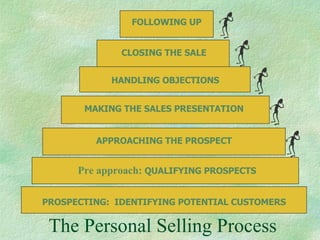
The Personal Selling Process PROSPECTING:  IDENTIFYING POTENTIAL CUSTOMERS Pre approach:   QUALIFYING PROSPECTS APPROACHING THE PROSPECT FOLLOWING UP CLOSING THE SALE HANDLING OBJECTIONS MAKING THE SALES PRESENTATION
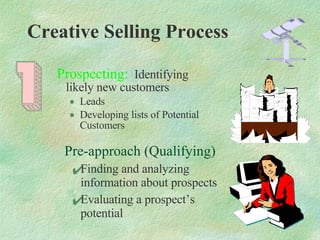
Prospecting:   Identifying likely new customers Leads Developing lists of Potential Customers Pre-approach (Qualifying) Finding and analyzing information about prospects Evaluating a prospect’s potential Creative Selling Process
Approaching The Prospect HOW DO WE MAKE THE INITIAL CONTACT & BUILD RAPPORT There is only one time to make a first impression
Making The Sales Presentation Using Persuasive communication Hold Attention Stimulate Interest Desire “Tell the product’s story” Creative Selling Process
Handling Objections Questions Reservations Understand Concern Counterarguments Acknowledge concern Clues to process Creative Selling Process
Iceberg Effect   Simple (S – R) Complex Interactions 10% is visible 90% is invisible Competition/deals Technology Consumer Preferences Personal emotions
Overcoming Objections IF HE HADN’T TOLD ME WHAT HIS OBJECTION WAS, I NEVER WOULD HAVE BEEN  ABLE TO HELP!
Closing the Sale Closing signals Trial close Asking the prospect to buy Creative Selling Process
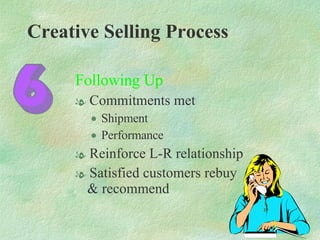
Following Up Commitments met Shipment Performance Reinforce L-R relationship Satisfied customers rebuy & recommend Creative Selling Process
 
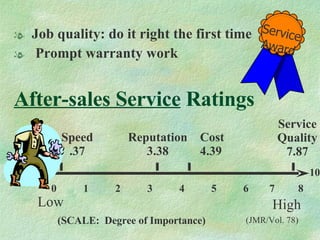
After-sales Service  Ratings Job quality: do it right the first time Prompt warranty work 0 1 2 3 4 5 6  7  8 Speed .37 Reputation 3.38 Cost 4.39 Service Quality 7.87 10 (SCALE:  Degree of Importance) (JMR/Vol. 78) Low High Service Award
A Key to Success Stay Close to Your Customer and LISTEN!

Personal Sell Pt1 3dec03

  • 1.
    Personal Selling &Sales Management Part 1 of 3
  • 2.
    Objectives Describe rolesof selling and relationship management Identify when to use personal selling Understand contributions of a salesperson Outline the steps involved in making a sale Understand ongoing nature of selling & marketing Describe major aspects of sales manager’s job Classify various forms of sales compensation Identify ethical issues facing sales personnel
  • 3.
    Examples of PersonalSelling 12 million people are engaged in personal selling in the United States Represents about 10% of the work force Telemarketing Inside selling Retail selling Field selling
  • 4.
    Post-transaction: Reminder andreassurance Transaction: Persuasion Pre-transaction : Create recognition and info understanding Relative Importance of Advertising and Personal Selling Advertising Personal selling Advertising Personal selling Advertising Personal selling
  • 5.
    Characteristics of PersonalSelling Flexibility Adapt to situations Engage in dialog Builds Relationships Long term Assure buyers receive appropriate services Solves customer’s problems Can not reach mass audience Expensive per contact Numerous calls needed to generate sale Labor intensive Con Pro
  • 6.
    ORDER GETTERS Currentcustomers New customers Types of Salespersons ORDER TAKERS Inside Order Takers (via mail, telephone, internet) Outside Field Sales SUPPORT PERSONNEL Missionary Salespersons Trade Salespersons Technical Salespersons
  • 7.
    Personal Selling TasksOrder getting Seeking out customers Creative selling Pioneering Account management Order taking Routine writing up orders checking invoices assuring prompt order processing Suggestive selling
  • 8.
    Personal Selling TasksMissionary Detailer Goodwill “ Closers” Cross-functional Account service rep
  • 9.
    You are partof the total product
  • 10.
    The Personal SellingProcess PROSPECTING: IDENTIFYING POTENTIAL CUSTOMERS Pre approach: QUALIFYING PROSPECTS APPROACHING THE PROSPECT FOLLOWING UP CLOSING THE SALE HANDLING OBJECTIONS MAKING THE SALES PRESENTATION
  • 11.
    Prospecting: Identifying likely new customers Leads Developing lists of Potential Customers Pre-approach (Qualifying) Finding and analyzing information about prospects Evaluating a prospect’s potential Creative Selling Process
  • 12.
    Approaching The ProspectHOW DO WE MAKE THE INITIAL CONTACT & BUILD RAPPORT There is only one time to make a first impression
  • 13.
    Making The SalesPresentation Using Persuasive communication Hold Attention Stimulate Interest Desire “Tell the product’s story” Creative Selling Process
  • 14.
    Handling Objections QuestionsReservations Understand Concern Counterarguments Acknowledge concern Clues to process Creative Selling Process
  • 15.
    Iceberg Effect Simple (S – R) Complex Interactions 10% is visible 90% is invisible Competition/deals Technology Consumer Preferences Personal emotions
  • 16.
    Overcoming Objections IFHE HADN’T TOLD ME WHAT HIS OBJECTION WAS, I NEVER WOULD HAVE BEEN ABLE TO HELP!
  • 17.
    Closing the SaleClosing signals Trial close Asking the prospect to buy Creative Selling Process
  • 18.
    Following Up Commitmentsmet Shipment Performance Reinforce L-R relationship Satisfied customers rebuy & recommend Creative Selling Process
  • 19.
  • 20.
    After-sales Service Ratings Job quality: do it right the first time Prompt warranty work 0 1 2 3 4 5 6 7 8 Speed .37 Reputation 3.38 Cost 4.39 Service Quality 7.87 10 (SCALE: Degree of Importance) (JMR/Vol. 78) Low High Service Award
  • 21.
    A Key toSuccess Stay Close to Your Customer and LISTEN!