Rajiv Academy For Technology And Management ,MATHURA
Personal Selling According to AMA,
“Personal Selling is an oral presentation in a conversation with one
or more prospective purchaser for the purpose of making sales”
WHAT IS PERSONAL SELLING
 In primitive days, demand preceded the supply and therefore, there was no
need to do any effort to sell one's own products.
 But as there is progress in society, production is no longer carried on, on a
small scale but on a large scale.
 Even one product is produced not by one producer but by several producers
 It results in overproduction and competition among the producers.
 The consumer is considered as the King of market.
 The producer follows different steps, one by one so as to persuade the
consumer to buy his product that will give him satisfaction.
 The steps taken by the salesman to perform his function of selling
successfully are included in selling process.
MEANING OF SELLING PROCESS
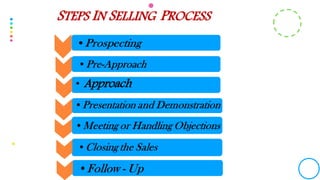
STEPS IN SELLING PROCESS
• Approach
Prospect or a potential customer is
someone who needs a product and
has an ability to buy
 Search for new markets /
customers
 Methods:
i. Referrals from existing
customers
ii. Internal company sources
iii. Sales people networking
Qualifying means the prospect is
qualified to meet necessary
standards and receive further
attention
Have the need for the product
 Can afford the product
1) PROSPECTING & QUALIFYING
 It helps in planning the whole selling efforts so that
there is no or minimum of wasted calls.
 Pre-approach is the 2nd stage of the selling process.
 The salesman is to acquire enough information about such
prospects in order to approach each one in the most effective
manner.
 Pre-approach involves developing an understanding about those prospective
buyers who have been identified and on whom the salesman proposes to call.
 This understanding may relate to buyers' needs , personality drafts and
behavior patterns which are critical to their buying decision.
 Pre - approach prepares effective background of making approach and
ascertains the best and the most effective method of approaching the prospect.
2) PRE-APPROACH
 When the salesman comes in actual contact with the prospect or
likely customer, the next stage, namely, the 'approach' is reached.
 The face-to-face contact with the prospect is termed as approach.
 Favourable first impression
 Appearance, dressing sense, attitude, opening lines, greetings with smile
 Get the attention of prospects
 Make them feel at home
3) APPROACH
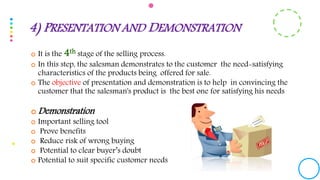
 It is the 4th stage of the selling process.
 In this step, the salesman demonstrates to the customer the need-satisfying
characteristics of the products being offered for sale.
 The objective of presentation and demonstration is to help in convincing the
customer that the salesman's product is the best one for satisfying his needs
 Demonstration
 Important selling tool
 Prove benefits
 Reduce risk of wrong buying
 Potential to clear buyer’s doubt
 Potential to suit specific customer needs
4) PRESENTATION AND DEMONSTRATION
 It is the 5th step in the selling process.
 Under this step the salesman is required to handle and over come objections
arising during or as a result of presentation and demonstration, it is just
natural for the customer to ask questions, raise objections and seek
explanation.
 It is the most difficult situation that a salesman is required to
face.
 The salesman's job is to effectively meet, handle and answer them in a
most convincing and systematic manner
5) MEETING OR HANDLING OBJECTIONS
Types of objections
i. Psychological – predetermined beliefs, preferences, decision-making, anxiety.
ii. Logical – quicker delivery, high price, quality
Methods of handling objections:
i. Asking questions
ii. Focus on benefits
iii. Denial
iv. Third – party certificate
 It is the 6th stage of the selling process.
 Closing the sale is making the customer say 'yes' to your
preparation.
 The whole object of the entire selling process is to induce the
buying decision of the prospect and thereby close the sale.
 Unless the salesman gets the prospect to agree to buy the product,
the entire efforts are wasted.
6) CLOSING THE SALES
1. Alternative choice close – Choice between two or more items
2. Minor points close – Choice on variants, Options on delivery; payment, etc.
3. Assumption close
5. Special offer – Irresistible offer to custom
CLOSING TECHNIQUES
 It is the 7th and last stage of the selling process.
 Sales personnel’s job is not over after closing the sale.
 After closing, it is important for the salesman to follow up the order booked
so as to ensure that the order is properly executed.
 Follow-up is also necessary to gather information from the customers
regarding product use, problems, if any, and the level of customer
satisfaction.
 It builds up goodwill, ensures feedback and encourages repeated purchases.
7) FOLLOW - UP
Selling process  ppt by varsha

Selling process ppt by varsha

  • 1.
    Rajiv Academy ForTechnology And Management ,MATHURA
  • 2.
    Personal Selling Accordingto AMA, “Personal Selling is an oral presentation in a conversation with one or more prospective purchaser for the purpose of making sales” WHAT IS PERSONAL SELLING
  • 3.
     In primitivedays, demand preceded the supply and therefore, there was no need to do any effort to sell one's own products.  But as there is progress in society, production is no longer carried on, on a small scale but on a large scale.  Even one product is produced not by one producer but by several producers  It results in overproduction and competition among the producers.  The consumer is considered as the King of market.  The producer follows different steps, one by one so as to persuade the consumer to buy his product that will give him satisfaction.  The steps taken by the salesman to perform his function of selling successfully are included in selling process. MEANING OF SELLING PROCESS
  • 4.
    STEPS IN SELLINGPROCESS • Approach
  • 5.
    Prospect or apotential customer is someone who needs a product and has an ability to buy  Search for new markets / customers  Methods: i. Referrals from existing customers ii. Internal company sources iii. Sales people networking Qualifying means the prospect is qualified to meet necessary standards and receive further attention Have the need for the product  Can afford the product 1) PROSPECTING & QUALIFYING  It helps in planning the whole selling efforts so that there is no or minimum of wasted calls.
  • 6.
     Pre-approach isthe 2nd stage of the selling process.  The salesman is to acquire enough information about such prospects in order to approach each one in the most effective manner.  Pre-approach involves developing an understanding about those prospective buyers who have been identified and on whom the salesman proposes to call.  This understanding may relate to buyers' needs , personality drafts and behavior patterns which are critical to their buying decision.  Pre - approach prepares effective background of making approach and ascertains the best and the most effective method of approaching the prospect. 2) PRE-APPROACH
  • 7.
     When thesalesman comes in actual contact with the prospect or likely customer, the next stage, namely, the 'approach' is reached.  The face-to-face contact with the prospect is termed as approach.  Favourable first impression  Appearance, dressing sense, attitude, opening lines, greetings with smile  Get the attention of prospects  Make them feel at home 3) APPROACH
  • 8.
     It isthe 4th stage of the selling process.  In this step, the salesman demonstrates to the customer the need-satisfying characteristics of the products being offered for sale.  The objective of presentation and demonstration is to help in convincing the customer that the salesman's product is the best one for satisfying his needs  Demonstration  Important selling tool  Prove benefits  Reduce risk of wrong buying  Potential to clear buyer’s doubt  Potential to suit specific customer needs 4) PRESENTATION AND DEMONSTRATION
  • 9.
     It isthe 5th step in the selling process.  Under this step the salesman is required to handle and over come objections arising during or as a result of presentation and demonstration, it is just natural for the customer to ask questions, raise objections and seek explanation.  It is the most difficult situation that a salesman is required to face.  The salesman's job is to effectively meet, handle and answer them in a most convincing and systematic manner 5) MEETING OR HANDLING OBJECTIONS
  • 10.
    Types of objections i.Psychological – predetermined beliefs, preferences, decision-making, anxiety. ii. Logical – quicker delivery, high price, quality Methods of handling objections: i. Asking questions ii. Focus on benefits iii. Denial iv. Third – party certificate
  • 11.
     It isthe 6th stage of the selling process.  Closing the sale is making the customer say 'yes' to your preparation.  The whole object of the entire selling process is to induce the buying decision of the prospect and thereby close the sale.  Unless the salesman gets the prospect to agree to buy the product, the entire efforts are wasted. 6) CLOSING THE SALES
  • 12.
    1. Alternative choiceclose – Choice between two or more items 2. Minor points close – Choice on variants, Options on delivery; payment, etc. 3. Assumption close 5. Special offer – Irresistible offer to custom CLOSING TECHNIQUES
  • 13.
     It isthe 7th and last stage of the selling process.  Sales personnel’s job is not over after closing the sale.  After closing, it is important for the salesman to follow up the order booked so as to ensure that the order is properly executed.  Follow-up is also necessary to gather information from the customers regarding product use, problems, if any, and the level of customer satisfaction.  It builds up goodwill, ensures feedback and encourages repeated purchases. 7) FOLLOW - UP