Self-Reinforcement
A Self-Regulating Study Skill
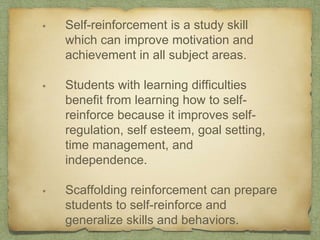
• Self-reinforcement is a study skill
which can improve motivation and
achievement in all subject areas.
• Students with learning difficulties
benefit from learning how to self-
reinforce because it improves self-
regulation, self esteem, goal setting,
time management, and
independence.
• Scaffolding reinforcement can prepare
students to self-reinforce and
generalize skills and behaviors.
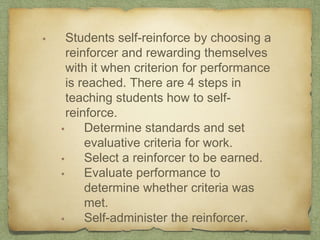
• Students self-reinforce by choosing a
reinforcer and rewarding themselves
with it when criterion for performance
is reached. There are 4 steps in
teaching students how to self-
reinforce.
• Determine standards and set
evaluative criteria for work.
• Select a reinforcer to be earned.
• Evaluate performance to
determine whether criteria was
met.
• Self-administer the reinforcer.
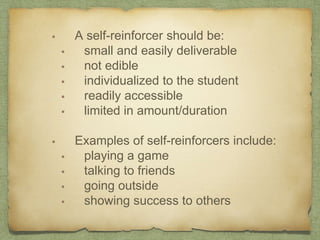
• A self-reinforcer should be:
• small and easily deliverable
• not edible
• individualized to the student
• readily accessible
• limited in amount/duration
• Examples of self-reinforcers include:
• playing a game
• talking to friends
• going outside
• showing success to others
• Self-reinforcement should be
explicitly taught, modeled, and then
scaffolded, gradually lessening
monitoring and supports.
• Initially access to the reinforcer may
need to be controlled.
• Self-reinforcement should
immediately follow self-evaluation.
• The more often a student can select
a target behavior and consistently
self-reinforce that behavior, the
more likely it will occur in the future.

Self-Reinforcement

  • 1.
  • 2.
    • Self-reinforcement isa study skill which can improve motivation and achievement in all subject areas. • Students with learning difficulties benefit from learning how to self- reinforce because it improves self- regulation, self esteem, goal setting, time management, and independence. • Scaffolding reinforcement can prepare students to self-reinforce and generalize skills and behaviors.
  • 3.
    • Students self-reinforceby choosing a reinforcer and rewarding themselves with it when criterion for performance is reached. There are 4 steps in teaching students how to self- reinforce. • Determine standards and set evaluative criteria for work. • Select a reinforcer to be earned. • Evaluate performance to determine whether criteria was met. • Self-administer the reinforcer.
  • 4.
    • A self-reinforcershould be: • small and easily deliverable • not edible • individualized to the student • readily accessible • limited in amount/duration • Examples of self-reinforcers include: • playing a game • talking to friends • going outside • showing success to others
  • 5.
    • Self-reinforcement shouldbe explicitly taught, modeled, and then scaffolded, gradually lessening monitoring and supports. • Initially access to the reinforcer may need to be controlled. • Self-reinforcement should immediately follow self-evaluation. • The more often a student can select a target behavior and consistently self-reinforce that behavior, the more likely it will occur in the future.