Unit 1: Self Portraits
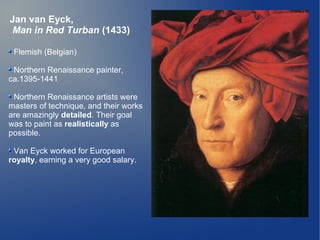
Jan van Eyck,
 Man in Red Turban (1433)

 Flemish (Belgian)

 Northern Renaissance painter,
ca.1395-1441

 Northern Renaissance artists were
masters of technique, and their works
are amazingly detailed. Their goal
was to paint as realistically as
possible.

 Van Eyck worked for European
royalty, earning a very good salary.
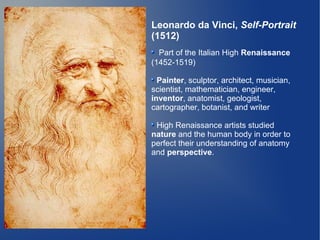
Leonardo da Vinci, Self-Portrait
(1512)
  Part of the Italian High Renaissance
(1452-1519)

  Painter, sculptor, architect, musician,
scientist, mathematician, engineer,
inventor, anatomist, geologist,
cartographer, botanist, and writer

 High Renaissance artists studied
nature and the human body in order to
perfect their understanding of anatomy
and perspective.
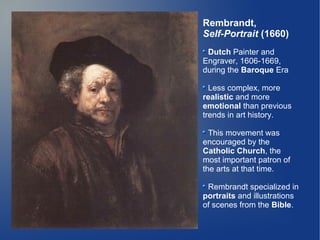
Rembrandt,
Self-Portrait (1660)
 Dutch Painter and
Engraver, 1606-1669,
during the Baroque Era

  Less complex, more
realistic and more
emotional than previous
trends in art history.

  This movement was
encouraged by the
Catholic Church, the
most important patron of
the arts at that time.

 Rembrandt specialized in
portraits and illustrations
of scenes from the Bible.
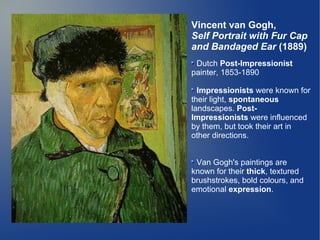
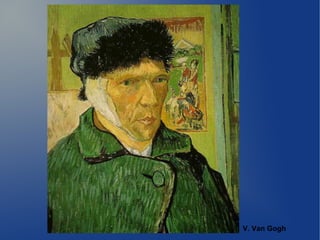
Vincent van Gogh,
Self Portrait with Fur Cap
and Bandaged Ear (1889)
 Dutch Post-Impressionist
painter, 1853-1890

  Impressionists were known for
their light, spontaneous
landscapes. Post-
Impressionists were influenced
by them, but took their art in
other directions.


 Van Gogh's paintings are
known for their thick, textured
brushstrokes, bold colours, and
emotional expression.
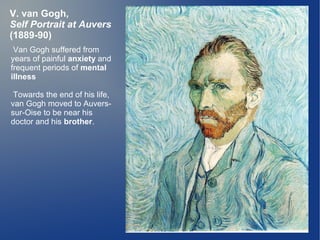
V. van Gogh,
Self Portrait at Auvers
(1889-90)
 Van Gogh suffered from
years of painful anxiety and
frequent periods of mental
illness

 Towards the end of his life,
van Gogh moved to Auvers-
sur-Oise to be near his
doctor and his brother.
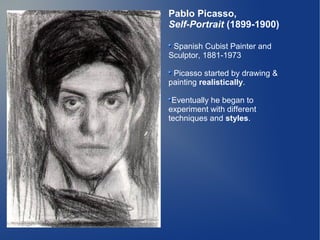
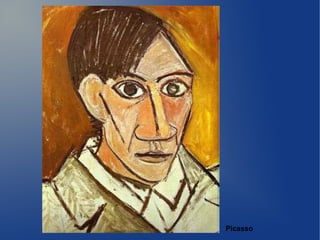
Pablo Picasso,
Self-Portrait (1899-1900)

 Spanish Cubist Painter and
Sculptor, 1881-1973

 Picasso started by drawing &
painting realistically.

 Eventually he began to
experiment with different
techniques and styles.
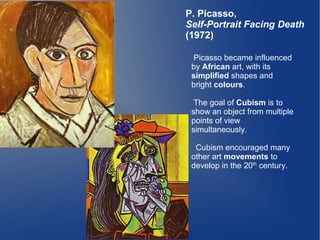
P. Picasso,
Self-Portrait Facing Death
(1972)

 Picasso became influenced
 by African art, with its
 simplified shapes and
 bright colours.

  The goal of Cubism is to
 show an object from multiple
 points of view
 simultaneously.

  Cubism encouraged many
 other art movements to
 develop in the 20th century.
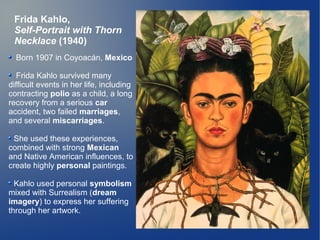
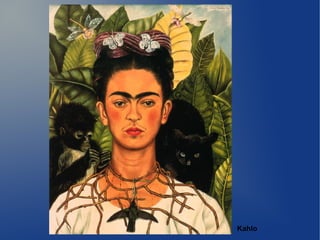
Frida Kahlo,
 Self-Portrait with Thorn
 Necklace (1940)
  Born 1907 in Coyoacán, Mexico

   Frida Kahlo survived many
difficult events in her life, including
contracting polio as a child, a long
recovery from a serious car
accident, two failed marriages,
and several miscarriages.

 She used these experiences,
combined with strong Mexican
and Native American influences, to
create highly personal paintings.

  Kahlo used personal symbolism
mixed with Surrealism (dream
imagery) to express her suffering
through her artwork.
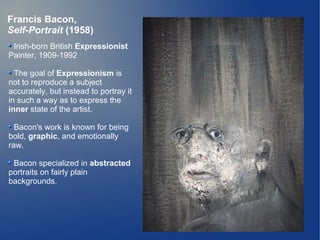
Francis Bacon,
Self-Portrait (1958)
 Irish-born British Expressionist
Painter, 1909-1992

  The goal of Expressionism is
not to reproduce a subject
accurately, but instead to portray it
in such a way as to express the
inner state of the artist.

  Bacon's work is known for being
bold, graphic, and emotionally
raw.

 Bacon specialized in abstracted
portraits on fairly plain
backgrounds.
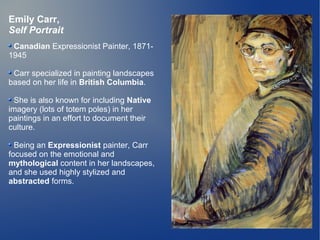
Emily Carr,
Self Portrait
 Canadian Expressionist Painter, 1871-
1945

 Carr specialized in painting landscapes
based on her life in British Columbia.

  She is also known for including Native
imagery (lots of totem poles) in her
paintings in an effort to document their
culture.

  Being an Expressionist painter, Carr
focused on the emotional and
mythological content in her landscapes,
and she used highly stylized and
abstracted forms.
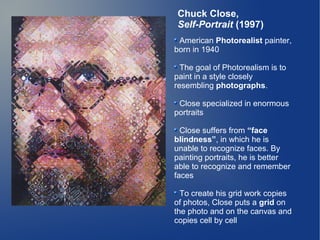
Chuck Close,
Self-Portrait (1997)
 American Photorealist painter,
born in 1940

  The goal of Photorealism is to
paint in a style closely
resembling photographs.

 Close specialized in enormous
portraits

  Close suffers from “face
blindness”, in which he is
unable to recognize faces. By
painting portraits, he is better
able to recognize and remember
faces

  To create his grid work copies
of photos, Close puts a grid on
the photo and on the canvas and
copies cell by cell
V. Van Gogh
Picasso
Kahlo

Self-Portait Art History

  • 1.
    Unit 1: SelfPortraits
  • 2.
    Jan van Eyck, Man in Red Turban (1433) Flemish (Belgian) Northern Renaissance painter, ca.1395-1441 Northern Renaissance artists were masters of technique, and their works are amazingly detailed. Their goal was to paint as realistically as possible. Van Eyck worked for European royalty, earning a very good salary.
  • 3.
    Leonardo da Vinci,Self-Portrait (1512) Part of the Italian High Renaissance (1452-1519) Painter, sculptor, architect, musician, scientist, mathematician, engineer, inventor, anatomist, geologist, cartographer, botanist, and writer High Renaissance artists studied nature and the human body in order to perfect their understanding of anatomy and perspective.
  • 4.
    Rembrandt, Self-Portrait (1660) DutchPainter and Engraver, 1606-1669, during the Baroque Era Less complex, more realistic and more emotional than previous trends in art history. This movement was encouraged by the Catholic Church, the most important patron of the arts at that time. Rembrandt specialized in portraits and illustrations of scenes from the Bible.
  • 5.
    Vincent van Gogh, SelfPortrait with Fur Cap and Bandaged Ear (1889) Dutch Post-Impressionist painter, 1853-1890 Impressionists were known for their light, spontaneous landscapes. Post- Impressionists were influenced by them, but took their art in other directions. Van Gogh's paintings are known for their thick, textured brushstrokes, bold colours, and emotional expression.
  • 6.
    V. van Gogh, SelfPortrait at Auvers (1889-90) Van Gogh suffered from years of painful anxiety and frequent periods of mental illness Towards the end of his life, van Gogh moved to Auvers- sur-Oise to be near his doctor and his brother.
  • 7.
    Pablo Picasso, Self-Portrait (1899-1900) Spanish Cubist Painter and Sculptor, 1881-1973 Picasso started by drawing & painting realistically. Eventually he began to experiment with different techniques and styles.
  • 8.
    P. Picasso, Self-Portrait FacingDeath (1972) Picasso became influenced by African art, with its simplified shapes and bright colours. The goal of Cubism is to show an object from multiple points of view simultaneously. Cubism encouraged many other art movements to develop in the 20th century.
  • 9.
    Frida Kahlo, Self-Portraitwith Thorn Necklace (1940) Born 1907 in Coyoacán, Mexico Frida Kahlo survived many difficult events in her life, including contracting polio as a child, a long recovery from a serious car accident, two failed marriages, and several miscarriages. She used these experiences, combined with strong Mexican and Native American influences, to create highly personal paintings. Kahlo used personal symbolism mixed with Surrealism (dream imagery) to express her suffering through her artwork.
  • 10.
    Francis Bacon, Self-Portrait (1958) Irish-born British Expressionist Painter, 1909-1992 The goal of Expressionism is not to reproduce a subject accurately, but instead to portray it in such a way as to express the inner state of the artist. Bacon's work is known for being bold, graphic, and emotionally raw. Bacon specialized in abstracted portraits on fairly plain backgrounds.
  • 11.
    Emily Carr, Self Portrait Canadian Expressionist Painter, 1871- 1945 Carr specialized in painting landscapes based on her life in British Columbia. She is also known for including Native imagery (lots of totem poles) in her paintings in an effort to document their culture. Being an Expressionist painter, Carr focused on the emotional and mythological content in her landscapes, and she used highly stylized and abstracted forms.
  • 12.
    Chuck Close, Self-Portrait (1997) American Photorealist painter, born in 1940 The goal of Photorealism is to paint in a style closely resembling photographs. Close specialized in enormous portraits Close suffers from “face blindness”, in which he is unable to recognize faces. By painting portraits, he is better able to recognize and remember faces To create his grid work copies of photos, Close puts a grid on the photo and on the canvas and copies cell by cell
  • 13.
  • 14.
  • 15.