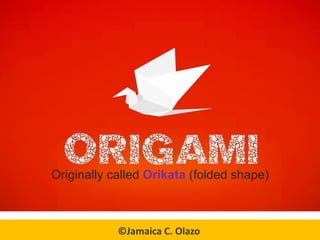
Originally called Orikata (folded shape)
©Jamaica C. Olazo
- the art of paper folding,
which is often associated
with Japanese culture.
Origami (折り紙)
"folding"
“paper"
(kami changes to gami
due to RENDAKU)
©Jamaica C. Olazo
Kerigami
- designs
which use
cuts, although
cutting is more
characteristic
of Chinese
papercrafts.
©Jamaica C. Olazo
Ts’ai Lun of China
(A.D.105)
- invented the
paper.
What origami historians believe?
Paper folding was invented after the
invention of paper.
©Jamaica C. Olazo
In China, traditional
funerals often include
the burning of folded
paper, most often
representations of gold
nuggets (yuanbao). The
practice of burning paper
representations instead
of full-scale wood or clay
replicas dates from the
Sung Dynasty (905–
1125 CE)
for religious ceremonial
purposes due to high
price of paper
©Jamaica C. Olazo
Paper Crane
-the best known origami model.
An ancient Japanese legend says that if you fold
one thousand cranes you will be granted a wish.
©Jamaica C. Olazo
ORIGAMI
Materials used:
• Paper- Normal copy
paper with weights of
70–90 g/m2
• Color- dual colored
and patterned versions
Many folders believe that no tool should be used when folding.
©Jamaica C. Olazo
Types of Origami
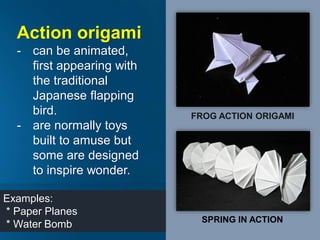
Action origami
- can be animated,
first appearing with
the traditional
Japanese flapping
bird.
- are normally toys
built to amuse but
some are designed
to inspire wonder.
FROG ACTION ORIGAMI
SPRING IN ACTION
Examples:
* Paper Planes
* Water Bomb
Wet-folding
- an origami technique
developed by Akira
Yoshizawa that
employs water to
dampen the paper
so that it can be
manipulated more
easily.
WET-FOLDED BULL
AKIRA YOSHIZAWA
Used very often by professional
folders for non-geometric
origami, such as animals.
©Jamaica C. Olazo
One of the most prominent users of the wet-folding technique
who specialized in animals, people, and mythological
creatures such as fairies. He also created origami masks.
Éric Joisel
Modular origami
- a paperfolding
technique which uses
two or more sheets of
paper to create a
larger and more
complex structure than
would be possible
using single-piece
origami techniques.
SWAN ORIGAMI
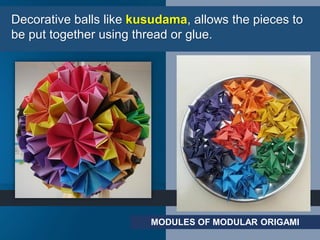
MODULES OF MODULAR ORIGAMI
Decorative balls like kusudama, allows the pieces to
be put together using thread or glue.
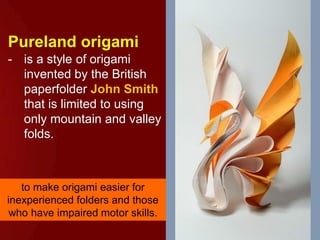
Pureland origami
- is a style of origami
invented by the British
paperfolder John Smith
that is limited to using
only mountain and valley
folds.
to make origami easier for
inexperienced folders and those
who have impaired motor skills.
Tessellation
- a collection of figures
filling a plane with no
gaps or overlaps.
- pleats are used to
connect molecules
such as twist folds
together in a repeating
fashion.
ORIGAMI TESSELATION BY
ROBERT J. LANG
What are some
mind
blowing
facts about
origami
?
The smallest origami crane in the world was made
by Naito Akirafolding plastic film
measuring 0.1 by 0.1 mm.
What are some mind blowing facts about origami?
The Samurai in
Japan gave each
other gifts known
as "noshi" that
were paper folded
with a strip of fish
and were
considered a
good luck token.
What are some mind blowing facts about origami?
MUCH LIKE GREETING CARDS
There are dozens of
entries for origami in
the Guinness Book
of World Records
including most folds,
smallest, biggest,
fastest time for folding
100 cranes, and many
more.
What are some mind blowing facts about origami?
Origami is the theme of a play in New York called
"Animals Out of Paper" in which the three main
characters all are involved in the art of paper folding.
What are some mind blowing facts about origami?
The largest number of
origami cranes was
created as part of the 50th
anniversary of the
dropping of the atom
bomb on Hiroshima. A
total of 250,000 paper
cranes were folded and
displayed in a large
memorial in the city. Each
had a person's name on it
and a short, peaceful
message. A paper crane is
a symbol for world peace.
What are some mind blowing facts about origami?
FOLDING THE PIECES
SET ARED MACAW ORIGAMI
SET BPEACOCK ORIGAMI
SET CSWAN ORIGAMI
SET DDAFFODIL ORIGAMI
SET E
Let’s get
building!

ORIGAMI PRODUCTION

  • 1.
    Originally called Orikata(folded shape) ©Jamaica C. Olazo
  • 2.
    - the artof paper folding, which is often associated with Japanese culture. Origami (折り紙) "folding" “paper" (kami changes to gami due to RENDAKU) ©Jamaica C. Olazo
  • 3.
    Kerigami - designs which use cuts,although cutting is more characteristic of Chinese papercrafts. ©Jamaica C. Olazo
  • 4.
    Ts’ai Lun ofChina (A.D.105) - invented the paper. What origami historians believe? Paper folding was invented after the invention of paper. ©Jamaica C. Olazo
  • 5.
    In China, traditional funeralsoften include the burning of folded paper, most often representations of gold nuggets (yuanbao). The practice of burning paper representations instead of full-scale wood or clay replicas dates from the Sung Dynasty (905– 1125 CE) for religious ceremonial purposes due to high price of paper ©Jamaica C. Olazo
  • 6.
    Paper Crane -the bestknown origami model.
  • 7.
    An ancient Japaneselegend says that if you fold one thousand cranes you will be granted a wish. ©Jamaica C. Olazo
  • 8.
    ORIGAMI Materials used: • Paper-Normal copy paper with weights of 70–90 g/m2 • Color- dual colored and patterned versions Many folders believe that no tool should be used when folding. ©Jamaica C. Olazo
  • 9.
  • 10.
    Action origami - canbe animated, first appearing with the traditional Japanese flapping bird. - are normally toys built to amuse but some are designed to inspire wonder. FROG ACTION ORIGAMI SPRING IN ACTION Examples: * Paper Planes * Water Bomb
  • 11.
    Wet-folding - an origamitechnique developed by Akira Yoshizawa that employs water to dampen the paper so that it can be manipulated more easily. WET-FOLDED BULL AKIRA YOSHIZAWA Used very often by professional folders for non-geometric origami, such as animals. ©Jamaica C. Olazo
  • 12.
    One of themost prominent users of the wet-folding technique who specialized in animals, people, and mythological creatures such as fairies. He also created origami masks. Éric Joisel
  • 14.
    Modular origami - apaperfolding technique which uses two or more sheets of paper to create a larger and more complex structure than would be possible using single-piece origami techniques. SWAN ORIGAMI
  • 15.
    MODULES OF MODULARORIGAMI Decorative balls like kusudama, allows the pieces to be put together using thread or glue.
  • 16.
    Pureland origami - isa style of origami invented by the British paperfolder John Smith that is limited to using only mountain and valley folds. to make origami easier for inexperienced folders and those who have impaired motor skills.
  • 17.
    Tessellation - a collectionof figures filling a plane with no gaps or overlaps. - pleats are used to connect molecules such as twist folds together in a repeating fashion. ORIGAMI TESSELATION BY ROBERT J. LANG
  • 18.
  • 19.
    The smallest origamicrane in the world was made by Naito Akirafolding plastic film measuring 0.1 by 0.1 mm. What are some mind blowing facts about origami?
  • 20.
    The Samurai in Japangave each other gifts known as "noshi" that were paper folded with a strip of fish and were considered a good luck token. What are some mind blowing facts about origami? MUCH LIKE GREETING CARDS
  • 21.
    There are dozensof entries for origami in the Guinness Book of World Records including most folds, smallest, biggest, fastest time for folding 100 cranes, and many more. What are some mind blowing facts about origami?
  • 22.
    Origami is thetheme of a play in New York called "Animals Out of Paper" in which the three main characters all are involved in the art of paper folding. What are some mind blowing facts about origami?
  • 23.
    The largest numberof origami cranes was created as part of the 50th anniversary of the dropping of the atom bomb on Hiroshima. A total of 250,000 paper cranes were folded and displayed in a large memorial in the city. Each had a person's name on it and a short, peaceful message. A paper crane is a symbol for world peace. What are some mind blowing facts about origami?
  • 24.
  • 25.
    SET ARED MACAWORIGAMI SET BPEACOCK ORIGAMI
  • 26.
    SET CSWAN ORIGAMI SETDDAFFODIL ORIGAMI
  • 27.
  • 28.