Department of civil engineering AMRIT 2023-24
SELF SUSTAINABLE BUILDING
RESEARCH PAPER
Jayesh Fasale . Shubham Gond . Amit Chudhari. Sagar Thakare
Department of civil engineering , Atma Malik institute of technology and research engineering
Of shahapur,Thane, Maharashtra
ABSTRACT:
The global pursuit of sustainable living and environmental responsibility has propelled self-sustainable building design to
the forefront of architectural and construction practices. This abstract provides a concise overview of the key concepts,
principles, and benefits associated with self-sustainable building design. Self-sustainable buildings, often referred to as
green buildings, eco-friendly buildings, or sustainable architecture, represent a holistic approach to construction that
prioritizes energy efficiency, water management, sustainable materials, and waste reduction. They are designed with the
overarching goal of reducing environmental impact, conserving resources, and promoting eco-conscious living.Key
principles guiding self-sustainable building design include energy efficiency, water management, sustainable materials,
and waste reduction. Energy efficiency strategies incorporate passive design features, renewable energy sources, and
energy-efficient systems. Water management practices encompass rainwater harvesting, greywater recycling, and low-flow
plumbing fixtures. Sustainable materials emphasize the use of recycled, locally sourced, and low-flow plumbing fixtures.
Sustainable materials emphasize the use of recycled, locally sourced, and environmentally friendly materials. Waste
reduction efforts extend to on-site recycling programs and waste-to-energy technologies.
Research in this field highlights the profound impact of self-sustainable building design on resource conservation, energy
consumption, and carbon emissions reduction. It underscores the importance of passive design features, renewable energy
integration, and water-construction methods have been shown to reduce the environmental footprint of building projects.
technologies in achieving sustainable living spaces. Furthermore, sustainable materials and construction methods have
been shown to reduce the environmental footprint of building projects. Self-sustainable buildings not only contribute to
environmental stewardship but also offer tangible benefits, including energy cost savings, improved indoor air quality, and
enhanced occupant comfort. However, the adoption of self-sustainable building practices faces challenges such as
regulatory complexities, initial construction costs, and the need for broader public awareness and acceptance
2 Department of civil engineering AMRIT 2023-24
INTRODUCTION
In an era marked by growing environmental awareness and the urgent need to combat climate change, the concept of self-
sustainable building design has emerged as a beacon of hope and innovation. With the built environment being a major
contributor to resource consumption and greenhouse gas emissions, there is an increasing demand for architectural and
construction practices that prioritize sustainability, efficiency, and environmental responsibility. Self-sustainable buildings,
often referred to as green buildings or eco-friendly buildings, represent a transformative approach to the way we conceive,
plan, and construct our living spaces. Self-sustainable building design goes beyond traditional construction practices. It
embodies a commitment to reducing environmental impact, conserving resources, and promoting eco-conscious living.
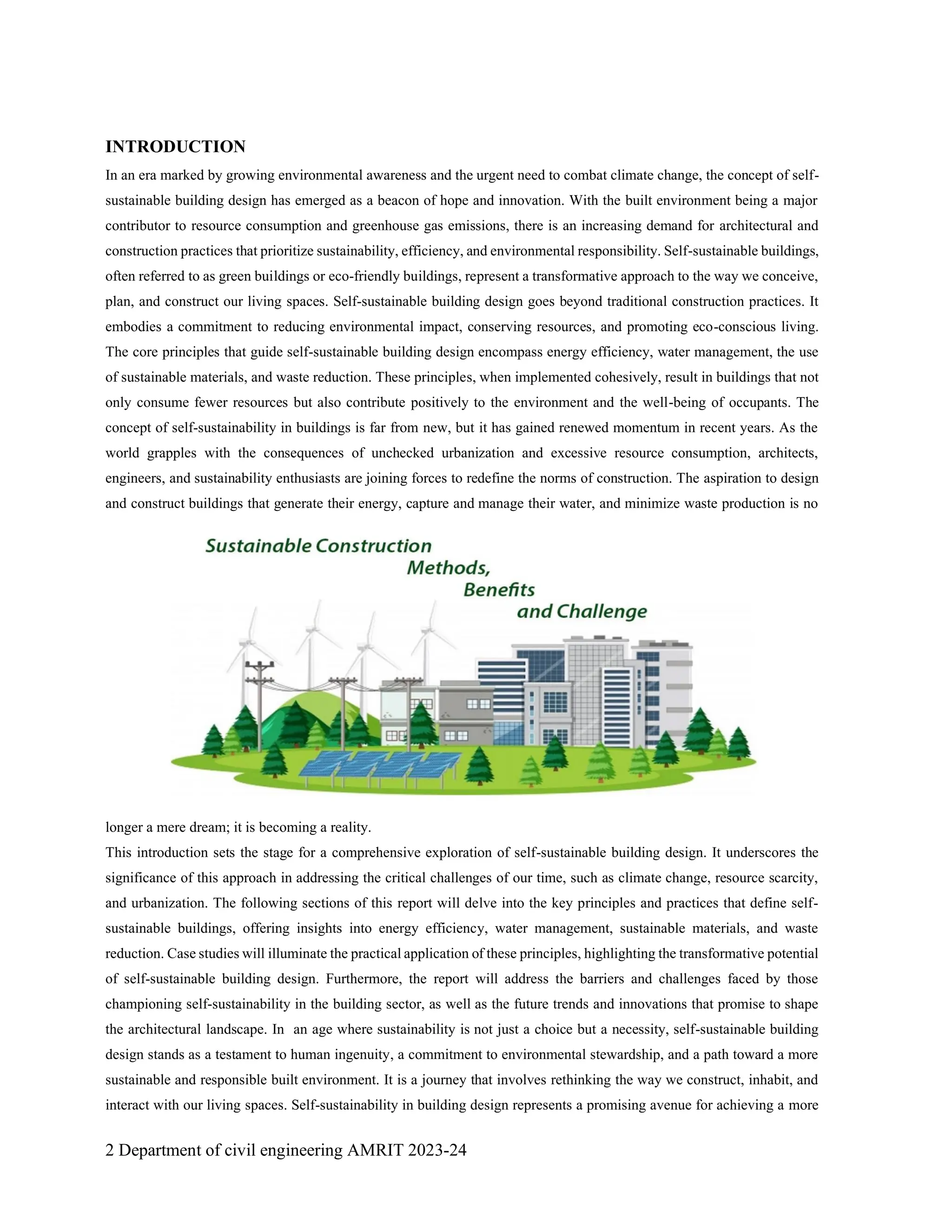
The core principles that guide self-sustainable building design encompass energy efficiency, water management, the use
of sustainable materials, and waste reduction. These principles, when implemented cohesively, result in buildings that not
only consume fewer resources but also contribute positively to the environment and the well-being of occupants. The
concept of self-sustainability in buildings is far from new, but it has gained renewed momentum in recent years. As the
world grapples with the consequences of unchecked urbanization and excessive resource consumption, architects,
engineers, and sustainability enthusiasts are joining forces to redefine the norms of construction. The aspiration to design
and construct buildings that generate their energy, capture and manage their water, and minimize waste production is no
longer a mere dream; it is becoming a reality.
This introduction sets the stage for a comprehensive exploration of self-sustainable building design. It underscores the
significance of this approach in addressing the critical challenges of our time, such as climate change, resource scarcity,
and urbanization. The following sections of this report will delve into the key principles and practices that define self-
sustainable buildings, offering insights into energy efficiency, water management, sustainable materials, and waste
reduction. Case studies will illuminate the practical application of these principles, highlighting the transformative potential
of self-sustainable building design. Furthermore, the report will address the barriers and challenges faced by those
championing self-sustainability in the building sector, as well as the future trends and innovations that promise to shape
the architectural landscape. In an age where sustainability is not just a choice but a necessity, self-sustainable building
design stands as a testament to human ingenuity, a commitment to environmental stewardship, and a path toward a more
sustainable and responsible built environment. It is a journey that involves rethinking the way we construct, inhabit, and
interact with our living spaces. Self-sustainability in building design represents a promising avenue for achieving a more
3 Department of civil engineering AMRIT 2023-24
sustainable and environmentally conscious future, and this report aims to shed light on the transformative potential of this
innovative approach.
LITERATURE REVIEW
1. Developing a Self Sustainable Building: A Case Study of an Institutional Library: This paper says that the self
sustainable building Concept drives to link energy efficiency and renewable energy generation to achieve
sustainable development. It’s difficult to achieve but Possible in case of large institutional campuses. Institute
library buildings are large public buildings, and due to its complexity in occupancy Level, they require a
continuous and uninterrupted power supply.
2. Self sustainable Building- An Energy Efficient Approach: This paper has stated that with increasing degradation
of the environment Because of increased energy consumption, environment conscious building design has become
urgent. The benefits of green design to society In general, and building owners and users in particular, are
manifold.
3. Design of self sustainable Building: This paper has stated that In this project the design of the Conventional
building by using Modular bricks and self sustainable Building by using Hollow Brick The Comparison of the
Conventional Building and SSB was completed by using the parameters such as the temperature by using
instrument infrared thermometer which was found to be 4℃ less in SSB compared to conventional building under
same condition.
4. International Journal of Applied Engineering Research ISSN 0973- 4562Volume 13, Number 1 (2018): This paper
says that the Specialty of the self sustainable building, Prana project, is that the whole building is made keeping
sustainability and green building in mind. Every aspect of the building was planned with ‘green’ approach,
showcasing the latest in HVAC technology alongside recycled materials.
4 Department of civil engineering AMRIT 2023-24
5. Case Study: India’s First sustainable Building- Indira Paryavaran Bhavan: This paper says that the case study
saysthat Indira Paryavarn Bhawan firstgovt. Building in the country to achieve the landmark of sustainable
building to reduce emissions.
Material & Method used for self sustainable building
Sustainable building design and construction involve various methods and materials that prioritize
environmental responsibility, resource efficiency, and long-term durability. Here are some key
methods and materials commonly used in sustainable building practices:
METHOD –
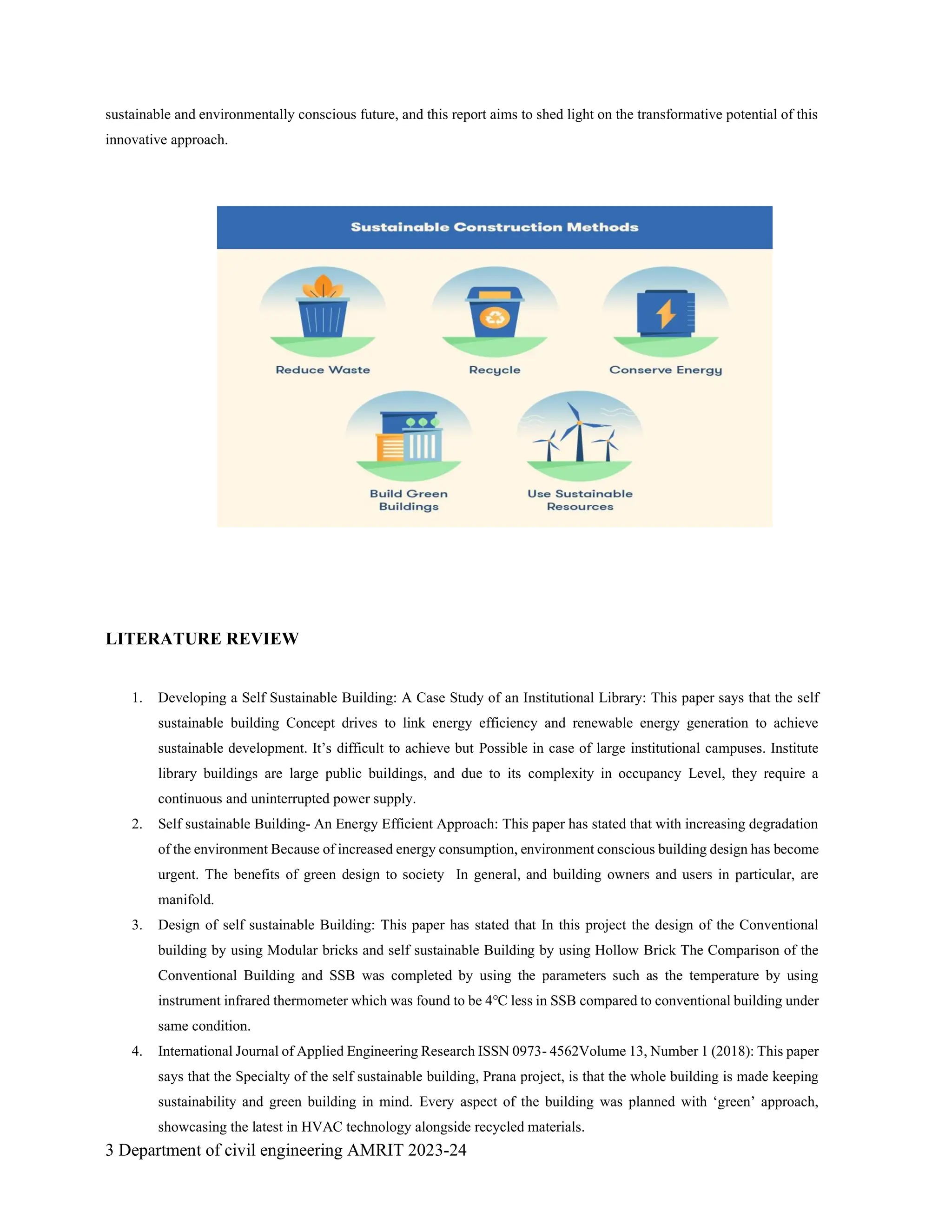
Energy Efficiency: Passive Design: Building orientation, shading, and natural ventilation are designed to reduce the need
for mechanical heating and cooling.High-Performance Insulation: Use of advanced insulation materials to minimize heat
loss and gain. Energy-Efficient Appliances: Installation of energy-efficient lighting, HVAC systems, and appliances to
reduce electricity consumption.
Renewable Energy: Solar Panels: Photovoltaic panels to generate electricity from sunlight. Wind Turbines: Capture wind
energy to produce electricity. Geothermal Systems: Use geothermal heat pumps for heating and cooling.
Water Management: Rainwater Harvesting: Collection and storage of rainwater for non-potable uses, like irrigation and
toilet flushing.
Greywater Recycling: Treatment and reuse of wastewater from sinks and showers for landscape irrigation.
Water-Efficient Fixtures: Installation of low-flow toilets, faucets, and showerheads to reduce water consumption.
Sustainable Materials:
Recycled Materials: Use of materials with recycled content, such as recycled steel, glass, and reclaimed wood.
Local Sourcing: Selection of materials produced and sourced locally to reduce transportation-related energy and emissions.
Low-VOC Paints and Finishes: Application of paints and finishes with low volatile organic compound (VOC) content to
improve indoor air quality.
Green Roofs and Living Walls:
Incorporation of green roofs with vegetation and living walls to enhance insulation, reduce urban heat island effect, and
promote biodiversity.
MATERIAL :
1) Bamboo: Bamboo is a sustainable and rapidly renewable material used for flooring, cabinetry, and even structural
elements in some cases.
2) Reclaimed Wood: wood from old buildings and structures is repurposed for flooring, furniture, and decorative
elements.
3) Energy-Efficient Windows : Windows with low U-values and high solar heat gain coefficients (SHGC) reduce
heat loss and gain.
4) Cool Roofing: Cool roofing materials reflect sunlight and absorb less heat, reducing cooling energy consumption.
5 Department of civil engineering AMRIT 2023-24
5) Recycled Metal: Recycled steel and aluminum are used for roofing and structural elements.
6) Eco-Friendly Insulation: Materials like cellulose, recycled denim, and soy-based foams offer efficient insulation
with minimal environmental impact.
7) Sustainable Concrete: High-performance concrete with a lower carbon footprint and recycled aggregate content.
CONCLUSION :
In a world facing pressing environmental challenges and the urgent need for sustainable solutions, self-sustainable building
design stands as a testament to human ingenuity, a commitment to environmental stewardship, and a pathway toward a
more sustainable and responsible future. The journey of self-sustainable building design encompasses a transformative
approach to construction, shaping structures that not only provide shelter but also exemplify environmental responsibility,
resource efficiency, and longevity.
REFERANCE :
1. Autonomous Houses (Sculptors Wiki: Autonomous Houses (archive.org))
2. Sustainable development begins at home (Sustainable development begins at home – On Line Opinion –
15/3/2002)
3. Mohammadjavad, M., Arish, Z., Airy, N., Setarch, G., Narjes, E., 2014 “Dilemma of green and pseudo green
architecture based on LEED norms in case of developing countries” International Journal of Sustainable Built
Environment (2014) 3, 235-246.
4. USGBC, 2002, U.S. Green Building Council, Building Momentum: “National Trends and Prospects for High-
Performance Green Buildings,” Prepared for the US Senate Subcommittee on Environmental and Public Works
by the US. Green Building Council, November 2002.
5. CBFEE, 1999, “Sky lighting and Retail Sales: An Investigation into the Relationship Between Daylighting and
Human Performance,” The Heschong Mahone Group, on Behalf of the California Board for Energy Efficiency
Third Party Program, 1999. 6.CGB, 2009, Center for Green Building, “Building the GREEN Garden State”, New
Jersey Municipalities magazine Vol. 86, No. 6, June 200

Self sustainable building .pdf

  • 1.
    Department of civilengineering AMRIT 2023-24 SELF SUSTAINABLE BUILDING RESEARCH PAPER Jayesh Fasale . Shubham Gond . Amit Chudhari. Sagar Thakare Department of civil engineering , Atma Malik institute of technology and research engineering Of shahapur,Thane, Maharashtra ABSTRACT: The global pursuit of sustainable living and environmental responsibility has propelled self-sustainable building design to the forefront of architectural and construction practices. This abstract provides a concise overview of the key concepts, principles, and benefits associated with self-sustainable building design. Self-sustainable buildings, often referred to as green buildings, eco-friendly buildings, or sustainable architecture, represent a holistic approach to construction that prioritizes energy efficiency, water management, sustainable materials, and waste reduction. They are designed with the overarching goal of reducing environmental impact, conserving resources, and promoting eco-conscious living.Key principles guiding self-sustainable building design include energy efficiency, water management, sustainable materials, and waste reduction. Energy efficiency strategies incorporate passive design features, renewable energy sources, and energy-efficient systems. Water management practices encompass rainwater harvesting, greywater recycling, and low-flow plumbing fixtures. Sustainable materials emphasize the use of recycled, locally sourced, and low-flow plumbing fixtures. Sustainable materials emphasize the use of recycled, locally sourced, and environmentally friendly materials. Waste reduction efforts extend to on-site recycling programs and waste-to-energy technologies. Research in this field highlights the profound impact of self-sustainable building design on resource conservation, energy consumption, and carbon emissions reduction. It underscores the importance of passive design features, renewable energy integration, and water-construction methods have been shown to reduce the environmental footprint of building projects. technologies in achieving sustainable living spaces. Furthermore, sustainable materials and construction methods have been shown to reduce the environmental footprint of building projects. Self-sustainable buildings not only contribute to environmental stewardship but also offer tangible benefits, including energy cost savings, improved indoor air quality, and enhanced occupant comfort. However, the adoption of self-sustainable building practices faces challenges such as regulatory complexities, initial construction costs, and the need for broader public awareness and acceptance
  • 2.
    2 Department ofcivil engineering AMRIT 2023-24 INTRODUCTION In an era marked by growing environmental awareness and the urgent need to combat climate change, the concept of self- sustainable building design has emerged as a beacon of hope and innovation. With the built environment being a major contributor to resource consumption and greenhouse gas emissions, there is an increasing demand for architectural and construction practices that prioritize sustainability, efficiency, and environmental responsibility. Self-sustainable buildings, often referred to as green buildings or eco-friendly buildings, represent a transformative approach to the way we conceive, plan, and construct our living spaces. Self-sustainable building design goes beyond traditional construction practices. It embodies a commitment to reducing environmental impact, conserving resources, and promoting eco-conscious living. The core principles that guide self-sustainable building design encompass energy efficiency, water management, the use of sustainable materials, and waste reduction. These principles, when implemented cohesively, result in buildings that not only consume fewer resources but also contribute positively to the environment and the well-being of occupants. The concept of self-sustainability in buildings is far from new, but it has gained renewed momentum in recent years. As the world grapples with the consequences of unchecked urbanization and excessive resource consumption, architects, engineers, and sustainability enthusiasts are joining forces to redefine the norms of construction. The aspiration to design and construct buildings that generate their energy, capture and manage their water, and minimize waste production is no longer a mere dream; it is becoming a reality. This introduction sets the stage for a comprehensive exploration of self-sustainable building design. It underscores the significance of this approach in addressing the critical challenges of our time, such as climate change, resource scarcity, and urbanization. The following sections of this report will delve into the key principles and practices that define self- sustainable buildings, offering insights into energy efficiency, water management, sustainable materials, and waste reduction. Case studies will illuminate the practical application of these principles, highlighting the transformative potential of self-sustainable building design. Furthermore, the report will address the barriers and challenges faced by those championing self-sustainability in the building sector, as well as the future trends and innovations that promise to shape the architectural landscape. In an age where sustainability is not just a choice but a necessity, self-sustainable building design stands as a testament to human ingenuity, a commitment to environmental stewardship, and a path toward a more sustainable and responsible built environment. It is a journey that involves rethinking the way we construct, inhabit, and interact with our living spaces. Self-sustainability in building design represents a promising avenue for achieving a more
  • 3.
    3 Department ofcivil engineering AMRIT 2023-24 sustainable and environmentally conscious future, and this report aims to shed light on the transformative potential of this innovative approach. LITERATURE REVIEW 1. Developing a Self Sustainable Building: A Case Study of an Institutional Library: This paper says that the self sustainable building Concept drives to link energy efficiency and renewable energy generation to achieve sustainable development. It’s difficult to achieve but Possible in case of large institutional campuses. Institute library buildings are large public buildings, and due to its complexity in occupancy Level, they require a continuous and uninterrupted power supply. 2. Self sustainable Building- An Energy Efficient Approach: This paper has stated that with increasing degradation of the environment Because of increased energy consumption, environment conscious building design has become urgent. The benefits of green design to society In general, and building owners and users in particular, are manifold. 3. Design of self sustainable Building: This paper has stated that In this project the design of the Conventional building by using Modular bricks and self sustainable Building by using Hollow Brick The Comparison of the Conventional Building and SSB was completed by using the parameters such as the temperature by using instrument infrared thermometer which was found to be 4℃ less in SSB compared to conventional building under same condition. 4. International Journal of Applied Engineering Research ISSN 0973- 4562Volume 13, Number 1 (2018): This paper says that the Specialty of the self sustainable building, Prana project, is that the whole building is made keeping sustainability and green building in mind. Every aspect of the building was planned with ‘green’ approach, showcasing the latest in HVAC technology alongside recycled materials.
  • 4.
    4 Department ofcivil engineering AMRIT 2023-24 5. Case Study: India’s First sustainable Building- Indira Paryavaran Bhavan: This paper says that the case study saysthat Indira Paryavarn Bhawan firstgovt. Building in the country to achieve the landmark of sustainable building to reduce emissions. Material & Method used for self sustainable building Sustainable building design and construction involve various methods and materials that prioritize environmental responsibility, resource efficiency, and long-term durability. Here are some key methods and materials commonly used in sustainable building practices: METHOD – Energy Efficiency: Passive Design: Building orientation, shading, and natural ventilation are designed to reduce the need for mechanical heating and cooling.High-Performance Insulation: Use of advanced insulation materials to minimize heat loss and gain. Energy-Efficient Appliances: Installation of energy-efficient lighting, HVAC systems, and appliances to reduce electricity consumption. Renewable Energy: Solar Panels: Photovoltaic panels to generate electricity from sunlight. Wind Turbines: Capture wind energy to produce electricity. Geothermal Systems: Use geothermal heat pumps for heating and cooling. Water Management: Rainwater Harvesting: Collection and storage of rainwater for non-potable uses, like irrigation and toilet flushing. Greywater Recycling: Treatment and reuse of wastewater from sinks and showers for landscape irrigation. Water-Efficient Fixtures: Installation of low-flow toilets, faucets, and showerheads to reduce water consumption. Sustainable Materials: Recycled Materials: Use of materials with recycled content, such as recycled steel, glass, and reclaimed wood. Local Sourcing: Selection of materials produced and sourced locally to reduce transportation-related energy and emissions. Low-VOC Paints and Finishes: Application of paints and finishes with low volatile organic compound (VOC) content to improve indoor air quality. Green Roofs and Living Walls: Incorporation of green roofs with vegetation and living walls to enhance insulation, reduce urban heat island effect, and promote biodiversity. MATERIAL : 1) Bamboo: Bamboo is a sustainable and rapidly renewable material used for flooring, cabinetry, and even structural elements in some cases. 2) Reclaimed Wood: wood from old buildings and structures is repurposed for flooring, furniture, and decorative elements. 3) Energy-Efficient Windows : Windows with low U-values and high solar heat gain coefficients (SHGC) reduce heat loss and gain. 4) Cool Roofing: Cool roofing materials reflect sunlight and absorb less heat, reducing cooling energy consumption.
  • 5.
    5 Department ofcivil engineering AMRIT 2023-24 5) Recycled Metal: Recycled steel and aluminum are used for roofing and structural elements. 6) Eco-Friendly Insulation: Materials like cellulose, recycled denim, and soy-based foams offer efficient insulation with minimal environmental impact. 7) Sustainable Concrete: High-performance concrete with a lower carbon footprint and recycled aggregate content. CONCLUSION : In a world facing pressing environmental challenges and the urgent need for sustainable solutions, self-sustainable building design stands as a testament to human ingenuity, a commitment to environmental stewardship, and a pathway toward a more sustainable and responsible future. The journey of self-sustainable building design encompasses a transformative approach to construction, shaping structures that not only provide shelter but also exemplify environmental responsibility, resource efficiency, and longevity. REFERANCE : 1. Autonomous Houses (Sculptors Wiki: Autonomous Houses (archive.org)) 2. Sustainable development begins at home (Sustainable development begins at home – On Line Opinion – 15/3/2002) 3. Mohammadjavad, M., Arish, Z., Airy, N., Setarch, G., Narjes, E., 2014 “Dilemma of green and pseudo green architecture based on LEED norms in case of developing countries” International Journal of Sustainable Built Environment (2014) 3, 235-246. 4. USGBC, 2002, U.S. Green Building Council, Building Momentum: “National Trends and Prospects for High- Performance Green Buildings,” Prepared for the US Senate Subcommittee on Environmental and Public Works by the US. Green Building Council, November 2002. 5. CBFEE, 1999, “Sky lighting and Retail Sales: An Investigation into the Relationship Between Daylighting and Human Performance,” The Heschong Mahone Group, on Behalf of the California Board for Energy Efficiency Third Party Program, 1999. 6.CGB, 2009, Center for Green Building, “Building the GREEN Garden State”, New Jersey Municipalities magazine Vol. 86, No. 6, June 200