Self-Directed Learning dynamics in
FutureLearn courses: towards a
framework
Inge (Ignatia) de Waard
CALRG 2015#FLANOU
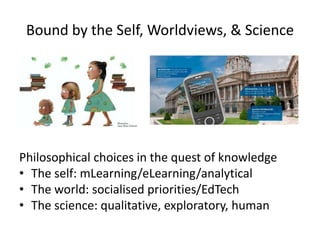
Bound by the Self, Worldviews, & Science
Philosophical choices in the quest of knowledge
• The self: mLearning/eLearning/analytical
• The world: socialised priorities/EdTech
• The science: qualitative, exploratory, human
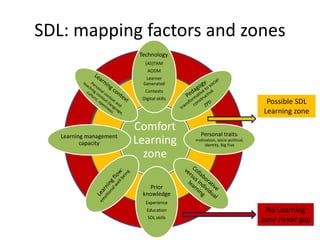
SDL: mapping factors and zones
Comfort
Learning
zone
Technology:
(AS)TAM
AODM
Learner
Generated
Contexts
Digital skills
Personal traits:
motivation, socio-political,
identity, Big Five
Prior
knowledge
Experience
Education
SDL skills
Learning management
capacity
Possible SDL
Learning zone
No Learning
zone /wide gap
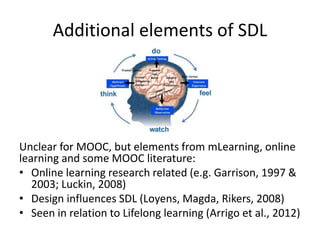
Additional elements of SDL
Unclear for MOOC, but elements from mLearning, online
learning and some MOOC literature:
• Online learning research related (e.g. Garrison, 1997 &
2003; Luckin, 2008)
• Design influences SDL (Loyens, Magda, Rikers, 2008)
• Seen in relation to Lifelong learning (Arrigo et al., 2012)
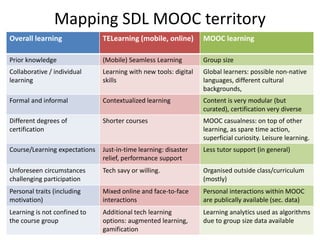
Mapping SDL MOOC territory
Overall learning TELearning (mobile, online) MOOC learning
Prior knowledge (Mobile) Seamless Learning Group size
Collaborative / individual
learning
Learning with new tools: digital
skills
Global learners: possible non-native
languages, different cultural
backgrounds,
Formal and informal Contextualized learning Content is very modular (but
curated), certification very diverse
Different degrees of
certification
Shorter courses MOOC casualness: on top of other
learning, as spare time action,
superficial curiosity. Leisure learning.
Course/Learning expectations Just-in-time learning: disaster
relief, performance support
Less tutor support (in general)
Unforeseen circumstances
challenging participation
Tech savy or willing. Organised outside class/curriculum
(mostly)
Personal traits (including
motivation)
Mixed online and face-to-face
interactions
Personal interactions within MOOC
are publically available (sec. data)
Learning is not confined to
the course group
Additional tech learning
options: augmented learning,
gamification
Learning analytics used as algorithms
due to group size data available
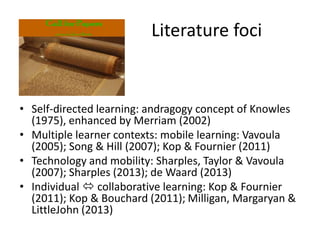
Literature foci
• Self-directed learning: andragogy concept of Knowles
(1975), enhanced by Merriam (2002)
• Multiple learner contexts: mobile learning: Vavoula
(2005); Song & Hill (2007); Kop & Fournier (2011)
• Technology and mobility: Sharples, Taylor & Vavoula
(2007); Sharples (2013); de Waard (2013)
• Individual  collaborative learning: Kop & Fournier
(2011); Kop & Bouchard (2011); Milligan, Margaryan &
LittleJohn (2013)
Research questions
• What are the learning experiences of experienced adult participants
engaging in individual and collaborative self-directed learning using
multiple devices in a FutureLearn course?
4 sub-questions:
1. What are the elements of daily life affecting the learning
experience?
2. What are the technical aspects influencing learning experiences
for learners?
3. How do the MOOC participants perceive the effect of individual or
collaborative learning on their SDL?
4. Which actions (if any) did the learners undertake to adapt their
learning?
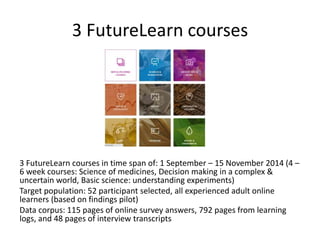
3 FutureLearn courses
3 FutureLearn courses in time span of: 1 September – 15 November 2014 (4 –
6 week courses: Science of medicines, Decision making in a complex &
uncertain world, Basic science: understanding experiments)
Target population: 52 participant selected, all experienced adult online
learners (based on findings pilot)
Data corpus: 115 pages of online survey answers, 792 pages from learning
logs, and 48 pages of interview transcripts
Grounded theory to analyse the data
Need for an exploratory, meanly qualitative methodology
• A grounded theory (GT) approach was chosen to analyse
the data (Charmaz, 2006).
• GT fits research looking for meaning as perceived by the
research subjects.
• GT permits data like learning experiences to be analysed.
• Following Charmaz allows constructing theory (rather then
only theory emergence)
Assumptions and interpretation
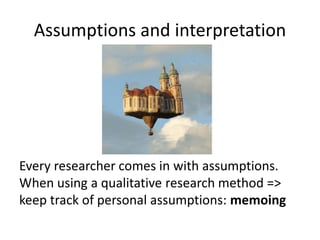
Every researcher comes in with assumptions.
When using a qualitative research method =>
keep track of personal assumptions: memoing
Method: 3 phases for collecting data
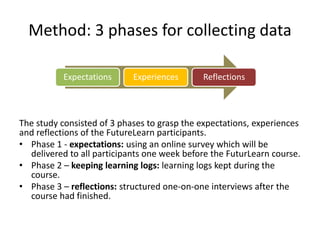
The study consisted of 3 phases to grasp the expectations, experiences
and reflections of the FutureLearn participants.
• Phase 1 - expectations: using an online survey which will be
delivered to all participants one week before the FuturLearn course.
• Phase 2 – keeping learning logs: learning logs kept during the
course.
• Phase 3 – reflections: structured one-on-one interviews after the
course had finished.
Expectations Experiences Reflections
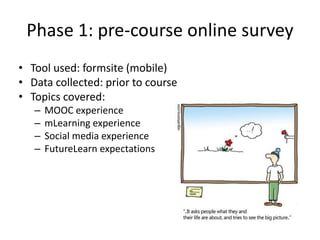
Phase 1: pre-course online survey
• Tool used: formsite (mobile)
• Data collected: prior to course
• Topics covered:
– MOOC experience
– mLearning experience
– Social media experience
– FutureLearn expectations
Phase 2: Learning Logs
Built upon Vavoula’s (2005) learning diary
templates. The templates were adapted (adding
MOOC elements: social media, collaborative
learning)
• learning log: reflects type of FutureLearn
interactions the participant engaged in, as well as
an account of the participants learning journey.
Phase 3: structured 1-on-1 interviews
Looking at the participants reflections on the course,
their devices used, their individual and collaborative
learning experiences, their overall evaluation of the
course and the strategies they adopted related to SDL.
Initial coding => four dimensions of
Bouchard framework (2009)
• Need for adaptation: tailor framework to contemporary online
learning realities
• Dimensions will need to reflect the spectrum of the FutureLearn
learning experiences
• Four dimensions: Algorithmic (cfr pedagogical), Conative (gathering
psycholoigical and social profiles), Semiotic dimension
(infrastructure, technology, materials), Economic dimension (cfr
value of knowledge)
• Each dimension groups SDL elements (in comparison to categories
emerging from data)
Four dimensions (brief examples)
Algorithmic dimension (pedagogy)
Dimensions Examples from learner data
Pacing (ref. to the timing allowed
by the learner to reach learning
goals)
I watched the videos, read other people’s
comments and posted my results a few days
early, since I am traveling overseas this week
Formulating objectives (ref. to
formulating or stating learning
objectives/goals)
I try to revive my memories related to
scientific experiments, in order to
demonstrate/practice with my son.
Finding resources (ref. to
materials, texts that allow learning
to take place)
To find things out I use dictionaries – of
science and of scientists in this case.
Reformulated/added dimensions
Finding human support in/outside
course
I spoke to the lab technician at work.
Collaborative peer learning (ref.
to peer-to-peer interactions)
Some interesting discussions and insights
from other learners especially about critiques
of Fergusons analysis.
Tutor-peer interactions. Jennifer’s [tutor] enthusiasm worked
stimulating.
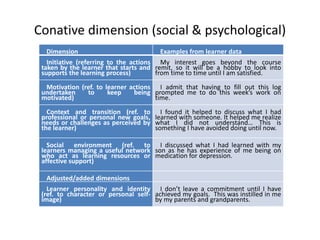
Conative dimension (social & psychological)
Dimension Examples from learner data
Initiative (referring to the actions
taken by the learner that starts and
supports the learning process)
My interest goes beyond the course
remit, so it will be a hobby to look into
from time to time until I am satisfied.
Motivation (ref. to learner actions
undertaken to keep being
motivated)
I admit that having to fill out this log
prompted me to do this week’s work on
time.
Context and transition (ref. to
professional or personal new goals,
needs or challenges as perceived by
the learner)
I found it helped to discuss what I had
learned with someone. It helped me realize
what I did not understand… This is
something I have avoided doing until now.
Social environment (ref. to
learners managing a useful network
who act as learning resources or
affective support)
I discussed what I had learned with my
son as he has experience of me being on
medication for depression.
Adjusted/added dimensions
Learner personality and identity
(ref. to character or personal self-
image)
I don’t leave a commitment until I have
achieved my goals. This was instilled in me
by my parents and grandparents.
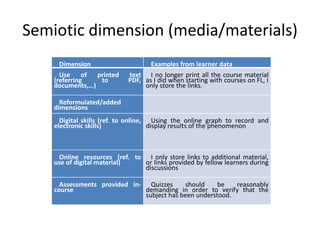
Semiotic dimension (media/materials)
Dimension Examples from learner data
Use of printed text
(referring to PDF,
documents,…)
I no longer print all the course material
as I did when starting with courses on FL, I
only store the links.
Reformulated/added
dimensions
Digital skills (ref. to online,
electronic skills)
Using the online graph to record and
display results of the phenomenon
Online resources (ref. to
use of digital material)
I only store links to additional material,
or links provided by fellow learners during
discussions
Assessments provided in-
course
Quizzes should be reasonably
demanding in order to verify that the
subject has been understood.
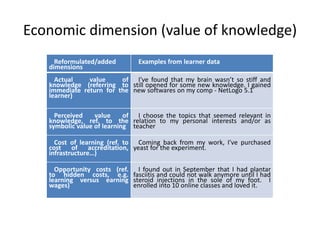
Economic dimension (value of knowledge)
Reformulated/added
dimensions
Examples from learner data
Actual value of
knowledge (referring to
immediate return for the
learner)
I've found that my brain wasn’t so stiff and
still opened for some new knowledge. I gained
new softwares on my comp - NetLogo 5.1
Perceived value of
knowledge, ref. to the
symbolic value of learning
I choose the topics that seemed relevant in
relation to my personal interests and/or as
teacher
Cost of learning (ref. to
cost of accreditation,
infrastructure…)
Coming back from my work, I’ve purchased
yeast for the experiment.
Opportunity costs (ref.
to hidden costs, e.g.
learning versus earning
wages)
I found out in September that I had plantar
fasciitis and could not walk anymore until I had
steroid injections in the sole of my foot. I
enrolled into 10 online classes and loved it.
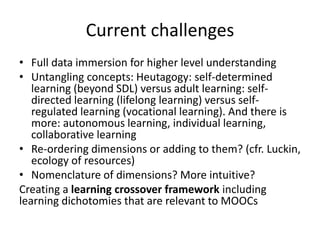
Current challenges
• Full data immersion for higher level understanding
• Untangling concepts: Heutagogy: self-determined
learning (beyond SDL) versus adult learning: self-
directed learning (lifelong learning) versus self-
regulated learning (vocational learning). And there is
more: autonomous learning, individual learning,
collaborative learning
• Re-ordering dimensions or adding to them? (cfr. Luckin,
ecology of resources)
• Nomenclature of dimensions? More intuitive?
Creating a learning crossover framework including
learning dichotomies that are relevant to MOOCs
Open science rules!
• Shared research instruments can be read here (Academia: online survey
questions, learning log templates, interview questions)
• Master thesis looking at mobile impact on MOOC can be accessed here
• A draft report with literature review and methodology on pilot study with
research instruments, can be found here (with some brief pointers on
writing a probation report).
• A paper on SDL in Trial FutureLearn courses (pilot study) can be read here.
References
• Arrigo, M., Kukulska-Hulme, A., Arnedillo-Sánchez, I., & Kismihok, G. (2012). Meta-analyses from a collaborative project in
mobile lifelong learning. British Educational Research Journal, (ahead-of-print), 1-26.
• Bouchard, P. (2009). Pedagogy without a teacher: What are the limits. International Journal of Self-Directed Learning, 6(2),
13-22.
• Garrison, D. R. (2003). Self-directed learning and distance education. In M. G. Moore & W. Anderson (Eds.), Handbook of
Distance Education (pp. 161-168). Mahwah, NJ: Lawrence Erlbaum.
• Knowles, M. S. (1975). Self-directed learning. New York: association Press.
• Merriam, S. B. (2001). Andragogy and self‐directed learning: Pillars of adult learning theory. New Directions for adult and
continuing education, 2001(89), 3-14.
• Kop, R., & Fournier, H. (2011). New dimensions to self-directed learning in an open networked learning
environment. International journal of Self-Directed Learning, 7(2).
• Loyens, S. M., Magda, J., & Rikers, R. M. (2008). Self-directed learning in problem-based learning and its relationships with
self-regulated learning.Educational Psychology Review, 20(4), 411-427.
• Luckin, R. (2008). The Learner Centric Ecology of Resources: a Framework for using Technology to Scaffold Learning.
Computers & Education 50 (2008) 449–462.
• Milrad, M., Wong, L. H., Sharples, M., Hwang, G. J., Looi, C. K., & Ogata, H. (2013). Seamless Learning: An International
Perspective on Next Generation Technology Enhanced Learning. In Z. L. Berge & L. Muilenburg (Eds). Handbook of Mobile
Learning. Routledge.
• Moustakas, C. (1994). Phenomenological research methods. Thousand Oaks, CA: Sage.
• Song, L., & Hill, J. R. (2007). A conceptual model for understanding self-directed learning in online environments. Journal of
Interactive Online Learning,6(1), 27-42.
• Vavoula, G.; O'Malley, C. & Taylor, J. (2005). A study of mobile learning as part of everyday learning. In: Attewell,
Jill and Savill-Smith, Carol (Eds). Mobile Learning Anytime Everywhere: a Book of Papers from MLEARN 2004. (pp. 211–212).
London: Learning and Skills Development Agency.
• Wong, L. H., & Looi, C. K. (2011). What seams do we remove in mobile-assisted seamless learning? A critical review of the
literature. Computers & Education, 57(4), 2364-2381.
• de Waard, Keskin, Koutropoulos (upcoming paper) Exploring future seamless learning research strands for MOOC.
Contact me: questions, networking…
23
E-mail: ingedewaard (at) gmail.com
Blog: ignatiawebs.blogspot.com
Twitter: http://twitter.com/Ignatia
Publications:
http://www.ingedewaard.net/pubconsulpres.htm
Presentations: http://www.slideshare.net/ignatia
linkedIn: http://www.linkedin.com/in/ingedewaard
And feel free to talk to me right here, right now!

Self directed learning in future learn courses using the Bouchard framework

  • 1.
    Self-Directed Learning dynamicsin FutureLearn courses: towards a framework Inge (Ignatia) de Waard CALRG 2015#FLANOU
  • 2.
    Bound by theSelf, Worldviews, & Science Philosophical choices in the quest of knowledge • The self: mLearning/eLearning/analytical • The world: socialised priorities/EdTech • The science: qualitative, exploratory, human
  • 3.
    SDL: mapping factorsand zones Comfort Learning zone Technology: (AS)TAM AODM Learner Generated Contexts Digital skills Personal traits: motivation, socio-political, identity, Big Five Prior knowledge Experience Education SDL skills Learning management capacity Possible SDL Learning zone No Learning zone /wide gap
  • 4.
    Additional elements ofSDL Unclear for MOOC, but elements from mLearning, online learning and some MOOC literature: • Online learning research related (e.g. Garrison, 1997 & 2003; Luckin, 2008) • Design influences SDL (Loyens, Magda, Rikers, 2008) • Seen in relation to Lifelong learning (Arrigo et al., 2012)
  • 5.
    Mapping SDL MOOCterritory Overall learning TELearning (mobile, online) MOOC learning Prior knowledge (Mobile) Seamless Learning Group size Collaborative / individual learning Learning with new tools: digital skills Global learners: possible non-native languages, different cultural backgrounds, Formal and informal Contextualized learning Content is very modular (but curated), certification very diverse Different degrees of certification Shorter courses MOOC casualness: on top of other learning, as spare time action, superficial curiosity. Leisure learning. Course/Learning expectations Just-in-time learning: disaster relief, performance support Less tutor support (in general) Unforeseen circumstances challenging participation Tech savy or willing. Organised outside class/curriculum (mostly) Personal traits (including motivation) Mixed online and face-to-face interactions Personal interactions within MOOC are publically available (sec. data) Learning is not confined to the course group Additional tech learning options: augmented learning, gamification Learning analytics used as algorithms due to group size data available
  • 6.
    Literature foci • Self-directedlearning: andragogy concept of Knowles (1975), enhanced by Merriam (2002) • Multiple learner contexts: mobile learning: Vavoula (2005); Song & Hill (2007); Kop & Fournier (2011) • Technology and mobility: Sharples, Taylor & Vavoula (2007); Sharples (2013); de Waard (2013) • Individual  collaborative learning: Kop & Fournier (2011); Kop & Bouchard (2011); Milligan, Margaryan & LittleJohn (2013)
  • 7.
    Research questions • Whatare the learning experiences of experienced adult participants engaging in individual and collaborative self-directed learning using multiple devices in a FutureLearn course? 4 sub-questions: 1. What are the elements of daily life affecting the learning experience? 2. What are the technical aspects influencing learning experiences for learners? 3. How do the MOOC participants perceive the effect of individual or collaborative learning on their SDL? 4. Which actions (if any) did the learners undertake to adapt their learning?
  • 8.
    3 FutureLearn courses 3FutureLearn courses in time span of: 1 September – 15 November 2014 (4 – 6 week courses: Science of medicines, Decision making in a complex & uncertain world, Basic science: understanding experiments) Target population: 52 participant selected, all experienced adult online learners (based on findings pilot) Data corpus: 115 pages of online survey answers, 792 pages from learning logs, and 48 pages of interview transcripts
  • 9.
    Grounded theory toanalyse the data Need for an exploratory, meanly qualitative methodology • A grounded theory (GT) approach was chosen to analyse the data (Charmaz, 2006). • GT fits research looking for meaning as perceived by the research subjects. • GT permits data like learning experiences to be analysed. • Following Charmaz allows constructing theory (rather then only theory emergence)
  • 10.
    Assumptions and interpretation Everyresearcher comes in with assumptions. When using a qualitative research method => keep track of personal assumptions: memoing
  • 11.
    Method: 3 phasesfor collecting data The study consisted of 3 phases to grasp the expectations, experiences and reflections of the FutureLearn participants. • Phase 1 - expectations: using an online survey which will be delivered to all participants one week before the FuturLearn course. • Phase 2 – keeping learning logs: learning logs kept during the course. • Phase 3 – reflections: structured one-on-one interviews after the course had finished. Expectations Experiences Reflections
  • 12.
    Phase 1: pre-courseonline survey • Tool used: formsite (mobile) • Data collected: prior to course • Topics covered: – MOOC experience – mLearning experience – Social media experience – FutureLearn expectations
  • 13.
    Phase 2: LearningLogs Built upon Vavoula’s (2005) learning diary templates. The templates were adapted (adding MOOC elements: social media, collaborative learning) • learning log: reflects type of FutureLearn interactions the participant engaged in, as well as an account of the participants learning journey.
  • 14.
    Phase 3: structured1-on-1 interviews Looking at the participants reflections on the course, their devices used, their individual and collaborative learning experiences, their overall evaluation of the course and the strategies they adopted related to SDL.
  • 15.
    Initial coding =>four dimensions of Bouchard framework (2009) • Need for adaptation: tailor framework to contemporary online learning realities • Dimensions will need to reflect the spectrum of the FutureLearn learning experiences • Four dimensions: Algorithmic (cfr pedagogical), Conative (gathering psycholoigical and social profiles), Semiotic dimension (infrastructure, technology, materials), Economic dimension (cfr value of knowledge) • Each dimension groups SDL elements (in comparison to categories emerging from data)
  • 16.
    Four dimensions (briefexamples) Algorithmic dimension (pedagogy) Dimensions Examples from learner data Pacing (ref. to the timing allowed by the learner to reach learning goals) I watched the videos, read other people’s comments and posted my results a few days early, since I am traveling overseas this week Formulating objectives (ref. to formulating or stating learning objectives/goals) I try to revive my memories related to scientific experiments, in order to demonstrate/practice with my son. Finding resources (ref. to materials, texts that allow learning to take place) To find things out I use dictionaries – of science and of scientists in this case. Reformulated/added dimensions Finding human support in/outside course I spoke to the lab technician at work. Collaborative peer learning (ref. to peer-to-peer interactions) Some interesting discussions and insights from other learners especially about critiques of Fergusons analysis. Tutor-peer interactions. Jennifer’s [tutor] enthusiasm worked stimulating.
  • 17.
    Conative dimension (social& psychological) Dimension Examples from learner data Initiative (referring to the actions taken by the learner that starts and supports the learning process) My interest goes beyond the course remit, so it will be a hobby to look into from time to time until I am satisfied. Motivation (ref. to learner actions undertaken to keep being motivated) I admit that having to fill out this log prompted me to do this week’s work on time. Context and transition (ref. to professional or personal new goals, needs or challenges as perceived by the learner) I found it helped to discuss what I had learned with someone. It helped me realize what I did not understand… This is something I have avoided doing until now. Social environment (ref. to learners managing a useful network who act as learning resources or affective support) I discussed what I had learned with my son as he has experience of me being on medication for depression. Adjusted/added dimensions Learner personality and identity (ref. to character or personal self- image) I don’t leave a commitment until I have achieved my goals. This was instilled in me by my parents and grandparents.
  • 18.
    Semiotic dimension (media/materials) DimensionExamples from learner data Use of printed text (referring to PDF, documents,…) I no longer print all the course material as I did when starting with courses on FL, I only store the links. Reformulated/added dimensions Digital skills (ref. to online, electronic skills) Using the online graph to record and display results of the phenomenon Online resources (ref. to use of digital material) I only store links to additional material, or links provided by fellow learners during discussions Assessments provided in- course Quizzes should be reasonably demanding in order to verify that the subject has been understood.
  • 19.
    Economic dimension (valueof knowledge) Reformulated/added dimensions Examples from learner data Actual value of knowledge (referring to immediate return for the learner) I've found that my brain wasn’t so stiff and still opened for some new knowledge. I gained new softwares on my comp - NetLogo 5.1 Perceived value of knowledge, ref. to the symbolic value of learning I choose the topics that seemed relevant in relation to my personal interests and/or as teacher Cost of learning (ref. to cost of accreditation, infrastructure…) Coming back from my work, I’ve purchased yeast for the experiment. Opportunity costs (ref. to hidden costs, e.g. learning versus earning wages) I found out in September that I had plantar fasciitis and could not walk anymore until I had steroid injections in the sole of my foot. I enrolled into 10 online classes and loved it.
  • 20.
    Current challenges • Fulldata immersion for higher level understanding • Untangling concepts: Heutagogy: self-determined learning (beyond SDL) versus adult learning: self- directed learning (lifelong learning) versus self- regulated learning (vocational learning). And there is more: autonomous learning, individual learning, collaborative learning • Re-ordering dimensions or adding to them? (cfr. Luckin, ecology of resources) • Nomenclature of dimensions? More intuitive? Creating a learning crossover framework including learning dichotomies that are relevant to MOOCs
  • 21.
    Open science rules! •Shared research instruments can be read here (Academia: online survey questions, learning log templates, interview questions) • Master thesis looking at mobile impact on MOOC can be accessed here • A draft report with literature review and methodology on pilot study with research instruments, can be found here (with some brief pointers on writing a probation report). • A paper on SDL in Trial FutureLearn courses (pilot study) can be read here.
  • 22.
    References • Arrigo, M.,Kukulska-Hulme, A., Arnedillo-Sánchez, I., & Kismihok, G. (2012). Meta-analyses from a collaborative project in mobile lifelong learning. British Educational Research Journal, (ahead-of-print), 1-26. • Bouchard, P. (2009). Pedagogy without a teacher: What are the limits. International Journal of Self-Directed Learning, 6(2), 13-22. • Garrison, D. R. (2003). Self-directed learning and distance education. In M. G. Moore & W. Anderson (Eds.), Handbook of Distance Education (pp. 161-168). Mahwah, NJ: Lawrence Erlbaum. • Knowles, M. S. (1975). Self-directed learning. New York: association Press. • Merriam, S. B. (2001). Andragogy and self‐directed learning: Pillars of adult learning theory. New Directions for adult and continuing education, 2001(89), 3-14. • Kop, R., & Fournier, H. (2011). New dimensions to self-directed learning in an open networked learning environment. International journal of Self-Directed Learning, 7(2). • Loyens, S. M., Magda, J., & Rikers, R. M. (2008). Self-directed learning in problem-based learning and its relationships with self-regulated learning.Educational Psychology Review, 20(4), 411-427. • Luckin, R. (2008). The Learner Centric Ecology of Resources: a Framework for using Technology to Scaffold Learning. Computers & Education 50 (2008) 449–462. • Milrad, M., Wong, L. H., Sharples, M., Hwang, G. J., Looi, C. K., & Ogata, H. (2013). Seamless Learning: An International Perspective on Next Generation Technology Enhanced Learning. In Z. L. Berge & L. Muilenburg (Eds). Handbook of Mobile Learning. Routledge. • Moustakas, C. (1994). Phenomenological research methods. Thousand Oaks, CA: Sage. • Song, L., & Hill, J. R. (2007). A conceptual model for understanding self-directed learning in online environments. Journal of Interactive Online Learning,6(1), 27-42. • Vavoula, G.; O'Malley, C. & Taylor, J. (2005). A study of mobile learning as part of everyday learning. In: Attewell, Jill and Savill-Smith, Carol (Eds). Mobile Learning Anytime Everywhere: a Book of Papers from MLEARN 2004. (pp. 211–212). London: Learning and Skills Development Agency. • Wong, L. H., & Looi, C. K. (2011). What seams do we remove in mobile-assisted seamless learning? A critical review of the literature. Computers & Education, 57(4), 2364-2381. • de Waard, Keskin, Koutropoulos (upcoming paper) Exploring future seamless learning research strands for MOOC.
  • 23.
    Contact me: questions,networking… 23 E-mail: ingedewaard (at) gmail.com Blog: ignatiawebs.blogspot.com Twitter: http://twitter.com/Ignatia Publications: http://www.ingedewaard.net/pubconsulpres.htm Presentations: http://www.slideshare.net/ignatia linkedIn: http://www.linkedin.com/in/ingedewaard And feel free to talk to me right here, right now!