ABRAHAM MASLOW:
HOLISTIC- DYNAMIC
THEORY
ARMAND VINCENT A. SESE, RPM, LPT
WHAT IS SOMETHING YOU
CAN'T LIVE WITHOUT?
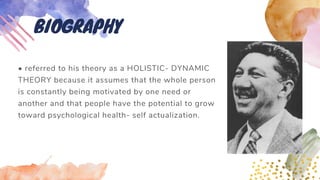
• referred to his theory as a HOLISTIC- DYNAMIC
THEORY because it assumes that the whole person
is constantly being motivated by one need or
another and that people have the potential to grow
toward psychological health- self actualization.
BIOGRAPHY
•He scored 195 in an IQ test
•“the MOST lonely and miserable childhood of any person discussed in
this book.”
• Born on April 1, 1908
• Oldest of 7 children born to Samuel Maslow and Rose Schilosky
Maslow
• As a child, Maslow’s life was filled with intense feelings of shyness,
inferiority and depression.
• He was not close to his parents.
• As a student, Maslow did well in courses that sparked his interest and
performed poorly in course he did not like.
• Fell in love with his first cousin, Bertha Goodman
• As a graduate student, he worked closely with Harry Harlow
BIOGRAPHY
• He became E.L. Thorndike's research assistant.
•Maslow, surmised that, of all people who had ever
lived, he had the best teachers.
• Died on June 8, 1970 due to heart attack.
BIOGRAPHY
• Maslow adopted a holistic approach to
motivation. That is, the whole person,
not any single part or function, is
motivated.
• Motivation is usually complex
• People are continually motivated by
one need or another
MASLOW’S VIEW OF MOTIVATION
• ALL people everywhere are
motivated by the SAME needs.
• Needs can be arranged in a
hierarchy.
MASLOW’S VIEW OF MOTIVATION
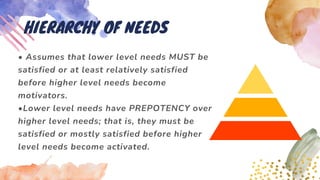
• Assumes that lower level needs MUST be
satisfied or at least relatively satisfied
before higher level needs become
motivators.
•Lower level needs have PREPOTENCY over
higher level needs; that is, they must be
satisfied or mostly satisfied before higher
level needs become activated.
HIERARCHY OF NEEDS
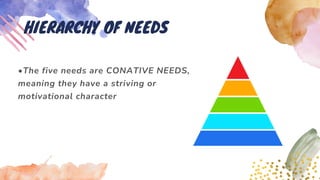
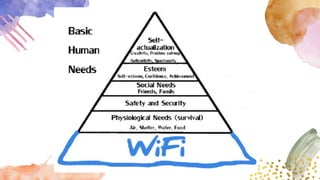
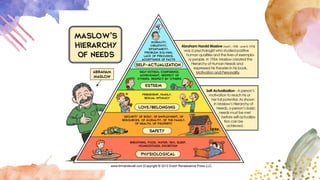
•The five needs are CONATIVE NEEDS,
meaning they have a striving or
motivational character
HIERARCHY OF NEEDS
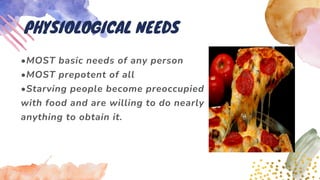
•MOST basic needs of any person
•MOST prepotent of all
•Starving people become preoccupied
with food and are willing to do nearly
anything to obtain it.
PHYSIOLOGICAL NEEDS
• How physiolgical needs differ from
other needs
a) They are the only needs that can
be completely satisfied or even overly
satisfied
b) Recuring nature
PHYSIOLOGICAL NEEDS
• physical security, stability,
dependency, protection, and freedom
from threatening forces
• Differ from physiological needs in
that they CANNOT BE OVERLY
SATISFIED.
SAFETY NEEDS
• desire for friendship, wish for a
mate and children, need to belong to
a family, a club, a neighborhood, or a
nation.
• Includes some aspect of sex and
human contact as well as the need to
both give and receive love.
LOVE AND BELONGING NEEDS
• include self-respect, confidence,
competence, and the knowledge that
others hold them in high esteem
• TWO LEVELS OF ESTEEM NEEDS
a) REPUTATION – in the eyes of
others
b) SELF- ESTEEM – own feelings of
worth and confidence
ESTEEM NEEDS
• include self- fulfillment, the
realization of all one’s potential, and a
desire to become creative in the full
sense of the word
•Self-actualizers are NOT dependent
on the satisfaction of either love or
esteem needs; they become
independent from the lower level
needs that gave them birth.
SELF- ACTUALIZATION
DO ALL PEOPLE REACH
THIS? WHY OR WHY NOT?
It is a matter of whether or not you embrace
the B- VALUES .
• People who highly respect such values as
truth, beauty, justice and the other b-values
become self-actualizing.
• B- values (BEING values) – indicators of
psychological health and are opposed to
DEFICIENCY NEEDS, which motivate non-self
actualizers
• Maslow termed b-values “METANEEDS” to
indicate that they are the ultimate level of needs.
•METAMOTIVATION – motives of self-actualizing
people
VALUES OF SELF- ACTUALIZERS
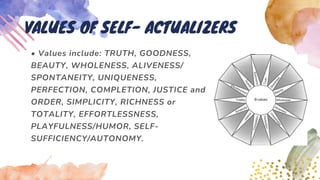
• Values include: TRUTH, GOODNESS,
BEAUTY, WHOLENESS, ALIVENESS/
SPONTANEITY, UNIQUENESS,
PERFECTION, COMPLETION, JUSTICE and
ORDER, SIMPLICITY, RICHNESS or
TOTALITY, EFFORTLESSNESS,
PLAYFULNESS/HUMOR, SELF-
SUFFICIENCY/AUTONOMY.
VALUES OF SELF- ACTUALIZERS
• Maslow hypothesized that when people's
metaneeds are not met, they experience
illness, an existential illness.
• Absence of the B-values leads to a
pathology.
• Deprivation of any of the B-values results in
METAPATHOLOGY, or the lack of a
meaningful philosophy of life.
VALUES OF SELF- ACTUALIZERS
1. Free from psychopathology
2. Had progressed through the hierarchy
of needs
3. embracing the B-values
4. full use and exploitation of talents,
capacities and potentials
CRITERIA FOR SELF- ACTUALIZATION
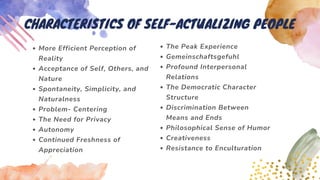
More Efficient Perception of
Reality
Acceptance of Self, Others, and
Nature
Spontaneity, Simplicity, and
Naturalness
Problem- Centering
The Need for Privacy
Autonomy
Continued Freshness of
Appreciation
CHARACTERISTICS OF SELF-ACTUALIZING PEOPLE
The Peak Experience
Gemeinschaftsgefuhl
Profound Interpersonal
Relations
The Democratic Character
Structure
Discrimination Between
Means and Ends
Philosophical Sense of Humor
Creativeness
Resistance to Enculturation
• Self-actualizing people are capable of both
giving and receiving love and are no longer
motivated by the kind of DEFICIENCY LOVE (D-
love).
•Self-actualizers are capable of B-LOVE. B-
LOVE is mutually felt and shared and are not
motivated by a deficiency or incompleteness
within the lover.
•They simply love and are loved. Their love is
never harmful. It is the kind of love that allows
lovers to be relaxed, open, and nonsecretive.
LOVE, SEX, AND SELF- ACTUALIZATION
• AESTHETIC NEEDS – the need for beauty and
aesthetically pleasing experiences
• COGNITIVE NEEDS – desire to know, to solve
mysteries, to understand, and to be curious
• NEUROTIC NEEDS- lead only to stagnation and
pathology
MASLOW IDENTIFIED 3 OTHER
CATEGORIES OF NEEDS:
• Occasionally needs are REVERSED
• Reversals, however, are usually more
apparent than real. If we understood the
unconscious motivation underlying the
behavior, we would recognize that the
needs are not reversed.
REVERSED ORDER OF NEEDS
• Maslow believed that even though all behaviors
have a cause, some behaviors are not motivated.
- conditioned reflexes, maturation, or drugs.
UNMOTIVATED BEHAVIOR
• Maslow distinguished between EXPRESSIVE BEHAVIOR
(which is often unmotivated) and COPING BEHAVIOR
(which is always motivated and aimed at satisfying a
need.
• EXPRESSIVE BEHAVIOR - frequently unconscious and
usually takes place naturally and with little effort. It has
no goals and is merely the person's mode of expression
• COPING BEHAVIOR- ordinarily conscious, effortful,
learned and determined by the external environment.
EXPRESSIVE AND COPING BEHAVIOR
•Lack of satisfaction of any of the basic needs
leads to some kind of pathology
•METAPATHOLOGY- deprivation of self-
actualization needs
– the absence of values, the lack of fulfillment,
and the loss of meaning in life
DEPRIVATION OF NEEDS
• Maslow hypothesized that some
human needs are innately
determined even though they can
be modified by learning. He called
these needs INSTINCTOID NEEDS.
INSTINCTOID NATURE OF NEEDS
• Higher needs are similar to lower ones in
that they are instinctoid.
• Higher level needs are later on the
phylogenetic and evolutionary scale.
• Higher level needs produce more happiness
and more peak experience, although
satisfaction of lower level needs may produce
a degree of pleasure.
COMPARISON OF HIGHER AND LOWER NEEDS
• Personal Orientation Inventory by
Everett L. Shostrom
• Short Index of Self-Actualization by
Alvin Jones and Rick Crandall
• Brief Index of Self-Actualization by
John Sumerlin and Charles Bundrick
MEASURING SELF-ACTUALIZATION
• According to Maslow, everyone is
born with a will toward health, a
tendency to grow toward self-
actualization, but few people reach it.
• One reason is the JONAH COMPLEX
or the fear of being one’s best
THE JONAH COMPLEX
• The aim of therapy would be for clients
to embrace the BEING VALUES.
• Psychotherapy is largely an
interpersonal process.
•Psychotherapy should be directed at the
need level currently being thwarted, in
most cases love and belongingness needs.
PSYCHOTHERAPY
•Generally Optimistic
• Moderate emphasis on both similarities
and uniqueness
• Teleological and Purposive
CONCEPT OF HUMANITY

THEOPER_ABRAHAM MASLOW HOLISTIC- DYNAMIC THEORY.pdf

  • 1.
  • 4.
    WHAT IS SOMETHINGYOU CAN'T LIVE WITHOUT?
  • 5.
    • referred tohis theory as a HOLISTIC- DYNAMIC THEORY because it assumes that the whole person is constantly being motivated by one need or another and that people have the potential to grow toward psychological health- self actualization. BIOGRAPHY
  • 6.
    •He scored 195in an IQ test •“the MOST lonely and miserable childhood of any person discussed in this book.” • Born on April 1, 1908 • Oldest of 7 children born to Samuel Maslow and Rose Schilosky Maslow • As a child, Maslow’s life was filled with intense feelings of shyness, inferiority and depression. • He was not close to his parents. • As a student, Maslow did well in courses that sparked his interest and performed poorly in course he did not like. • Fell in love with his first cousin, Bertha Goodman • As a graduate student, he worked closely with Harry Harlow BIOGRAPHY
  • 7.
    • He becameE.L. Thorndike's research assistant. •Maslow, surmised that, of all people who had ever lived, he had the best teachers. • Died on June 8, 1970 due to heart attack. BIOGRAPHY
  • 8.
    • Maslow adopteda holistic approach to motivation. That is, the whole person, not any single part or function, is motivated. • Motivation is usually complex • People are continually motivated by one need or another MASLOW’S VIEW OF MOTIVATION
  • 9.
    • ALL peopleeverywhere are motivated by the SAME needs. • Needs can be arranged in a hierarchy. MASLOW’S VIEW OF MOTIVATION
  • 10.
    • Assumes thatlower level needs MUST be satisfied or at least relatively satisfied before higher level needs become motivators. •Lower level needs have PREPOTENCY over higher level needs; that is, they must be satisfied or mostly satisfied before higher level needs become activated. HIERARCHY OF NEEDS
  • 11.
    •The five needsare CONATIVE NEEDS, meaning they have a striving or motivational character HIERARCHY OF NEEDS
  • 14.
    •MOST basic needsof any person •MOST prepotent of all •Starving people become preoccupied with food and are willing to do nearly anything to obtain it. PHYSIOLOGICAL NEEDS
  • 15.
    • How physiolgicalneeds differ from other needs a) They are the only needs that can be completely satisfied or even overly satisfied b) Recuring nature PHYSIOLOGICAL NEEDS
  • 16.
    • physical security,stability, dependency, protection, and freedom from threatening forces • Differ from physiological needs in that they CANNOT BE OVERLY SATISFIED. SAFETY NEEDS
  • 17.
    • desire forfriendship, wish for a mate and children, need to belong to a family, a club, a neighborhood, or a nation. • Includes some aspect of sex and human contact as well as the need to both give and receive love. LOVE AND BELONGING NEEDS
  • 18.
    • include self-respect,confidence, competence, and the knowledge that others hold them in high esteem • TWO LEVELS OF ESTEEM NEEDS a) REPUTATION – in the eyes of others b) SELF- ESTEEM – own feelings of worth and confidence ESTEEM NEEDS
  • 19.
    • include self-fulfillment, the realization of all one’s potential, and a desire to become creative in the full sense of the word •Self-actualizers are NOT dependent on the satisfaction of either love or esteem needs; they become independent from the lower level needs that gave them birth. SELF- ACTUALIZATION
  • 20.
    DO ALL PEOPLEREACH THIS? WHY OR WHY NOT?
  • 21.
    It is amatter of whether or not you embrace the B- VALUES . • People who highly respect such values as truth, beauty, justice and the other b-values become self-actualizing.
  • 22.
    • B- values(BEING values) – indicators of psychological health and are opposed to DEFICIENCY NEEDS, which motivate non-self actualizers • Maslow termed b-values “METANEEDS” to indicate that they are the ultimate level of needs. •METAMOTIVATION – motives of self-actualizing people VALUES OF SELF- ACTUALIZERS
  • 23.
    • Values include:TRUTH, GOODNESS, BEAUTY, WHOLENESS, ALIVENESS/ SPONTANEITY, UNIQUENESS, PERFECTION, COMPLETION, JUSTICE and ORDER, SIMPLICITY, RICHNESS or TOTALITY, EFFORTLESSNESS, PLAYFULNESS/HUMOR, SELF- SUFFICIENCY/AUTONOMY. VALUES OF SELF- ACTUALIZERS
  • 24.
    • Maslow hypothesizedthat when people's metaneeds are not met, they experience illness, an existential illness. • Absence of the B-values leads to a pathology. • Deprivation of any of the B-values results in METAPATHOLOGY, or the lack of a meaningful philosophy of life. VALUES OF SELF- ACTUALIZERS
  • 25.
    1. Free frompsychopathology 2. Had progressed through the hierarchy of needs 3. embracing the B-values 4. full use and exploitation of talents, capacities and potentials CRITERIA FOR SELF- ACTUALIZATION
  • 26.
    More Efficient Perceptionof Reality Acceptance of Self, Others, and Nature Spontaneity, Simplicity, and Naturalness Problem- Centering The Need for Privacy Autonomy Continued Freshness of Appreciation CHARACTERISTICS OF SELF-ACTUALIZING PEOPLE The Peak Experience Gemeinschaftsgefuhl Profound Interpersonal Relations The Democratic Character Structure Discrimination Between Means and Ends Philosophical Sense of Humor Creativeness Resistance to Enculturation
  • 27.
    • Self-actualizing peopleare capable of both giving and receiving love and are no longer motivated by the kind of DEFICIENCY LOVE (D- love). •Self-actualizers are capable of B-LOVE. B- LOVE is mutually felt and shared and are not motivated by a deficiency or incompleteness within the lover. •They simply love and are loved. Their love is never harmful. It is the kind of love that allows lovers to be relaxed, open, and nonsecretive. LOVE, SEX, AND SELF- ACTUALIZATION
  • 28.
    • AESTHETIC NEEDS– the need for beauty and aesthetically pleasing experiences • COGNITIVE NEEDS – desire to know, to solve mysteries, to understand, and to be curious • NEUROTIC NEEDS- lead only to stagnation and pathology MASLOW IDENTIFIED 3 OTHER CATEGORIES OF NEEDS:
  • 29.
    • Occasionally needsare REVERSED • Reversals, however, are usually more apparent than real. If we understood the unconscious motivation underlying the behavior, we would recognize that the needs are not reversed. REVERSED ORDER OF NEEDS
  • 30.
    • Maslow believedthat even though all behaviors have a cause, some behaviors are not motivated. - conditioned reflexes, maturation, or drugs. UNMOTIVATED BEHAVIOR
  • 31.
    • Maslow distinguishedbetween EXPRESSIVE BEHAVIOR (which is often unmotivated) and COPING BEHAVIOR (which is always motivated and aimed at satisfying a need. • EXPRESSIVE BEHAVIOR - frequently unconscious and usually takes place naturally and with little effort. It has no goals and is merely the person's mode of expression • COPING BEHAVIOR- ordinarily conscious, effortful, learned and determined by the external environment. EXPRESSIVE AND COPING BEHAVIOR
  • 32.
    •Lack of satisfactionof any of the basic needs leads to some kind of pathology •METAPATHOLOGY- deprivation of self- actualization needs – the absence of values, the lack of fulfillment, and the loss of meaning in life DEPRIVATION OF NEEDS
  • 33.
    • Maslow hypothesizedthat some human needs are innately determined even though they can be modified by learning. He called these needs INSTINCTOID NEEDS. INSTINCTOID NATURE OF NEEDS
  • 34.
    • Higher needsare similar to lower ones in that they are instinctoid. • Higher level needs are later on the phylogenetic and evolutionary scale. • Higher level needs produce more happiness and more peak experience, although satisfaction of lower level needs may produce a degree of pleasure. COMPARISON OF HIGHER AND LOWER NEEDS
  • 35.
    • Personal OrientationInventory by Everett L. Shostrom • Short Index of Self-Actualization by Alvin Jones and Rick Crandall • Brief Index of Self-Actualization by John Sumerlin and Charles Bundrick MEASURING SELF-ACTUALIZATION
  • 36.
    • According toMaslow, everyone is born with a will toward health, a tendency to grow toward self- actualization, but few people reach it. • One reason is the JONAH COMPLEX or the fear of being one’s best THE JONAH COMPLEX
  • 37.
    • The aimof therapy would be for clients to embrace the BEING VALUES. • Psychotherapy is largely an interpersonal process. •Psychotherapy should be directed at the need level currently being thwarted, in most cases love and belongingness needs. PSYCHOTHERAPY
  • 38.
    •Generally Optimistic • Moderateemphasis on both similarities and uniqueness • Teleological and Purposive CONCEPT OF HUMANITY