BY: PRINCE, VIKAS, TARUN AND DEEPANSH
Selection is the process
of picking individuals
who have relevant
qualifications to fill jobs
in an organization. It
consists of sequential
steps which can be vary
from job to job.
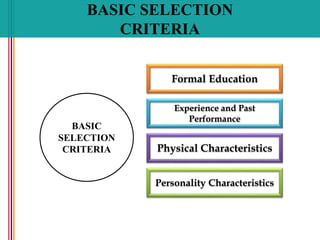
BASIC SELECTION
CRITERIA
BASIC
SELECTION
CRITERIA
Formal Education
Experience and Past
Performance
Physical Characteristics
Personality Characteristics
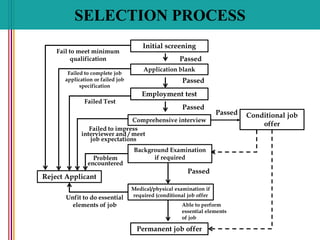
SELECTION PROCESS
Initial screening
Application blank
Medical/physical examination if
required (conditional job offer
Comprehensive interview
Employment test
Permanent job offer
Reject Applicant
Background Examination
if required
Conditional job
offer
Passed
Passed
Passed
Passed
Passed
Able to perform
essential elements
of job
Fail to meet minimum
qualification
Failed to complete job
application or failed job
specification
Failed Test
Failed to impress
interviewer and / meet
job expectations
Problem
encountered
Unfit to do essential
elements of job
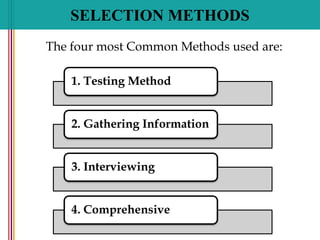
SELECTION METHODS
1. Testing Method
2. Gathering Information
3. Interviewing
4. Comprehensive
The four most Common Methods used are:
SELECTION METHODS Cont . . .
Tests measure knowledge, skill,
and ability, as well as other
characteristics, such as personality
traits.
1. TESTING
TESTING TYPES
Cognitive
Ability Test
Integrity
Test
Personality
Test
Drug Test
Physical
Ability Test
Work
Sample
Testing
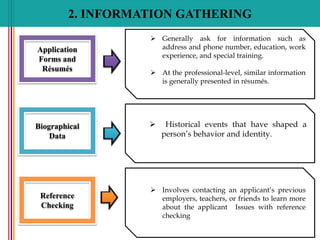
2. INFORMATION GATHERING
 Generally ask for information such as
address and phone number, education, work
experience, and special training.
 At the professional-level, similar information
is generally presented in résumés.
Application
Forms and
Résumés
 Historical events that have shaped a
person’s behavior and identity.
Biographical
Data
 Involves contacting an applicant’s previous
employers, teachers, or friends to learn more
about the applicant Issues with reference
checking
Reference
Checking
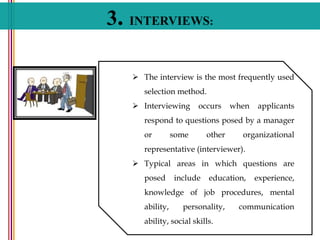
3. INTERVIEWS:
 The interview is the most frequently used
selection method.
 Interviewing occurs when applicants
respond to questions posed by a manager
or some other organizational
representative (interviewer).
 Typical areas in which questions are
posed include education, experience,
knowledge of job procedures, mental
ability, personality, communication
ability, social skills.
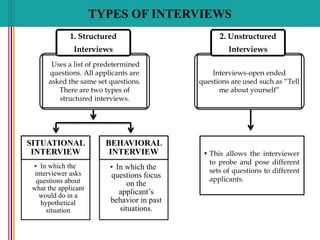
TYPES OF INTERVIEWS
SITUATIONAL
INTERVIEW
• In which the
interviewer asks
questions about
what the applicant
would do in a
hypothetical
situation
BEHAVIORAL
INTERVIEW
• In which the
questions focus
on the
applicant’s
behavior in past
situations.
Uses a list of predetermined
questions. All applicants are
asked the same set questions.
There are two types of
structured interviews.
1. Structured
Interviews
Interviews-open ended
questions are used such as “Tell
me about yourself”
2. Unstructured
Interviews
• This allows the interviewer
to probe and pose different
sets of questions to different
applicants.
4: COMPREHENSIVE
In this method candidates have to pass through a series of
steps to get selected. This method is mostly and widely
used .
The company uses a competency based
interviewing technique that looks at the
candidates abilities in terms of
strategizing, lateral thinking, problem
solving, managing the environment
Selection..ppt..

Selection..ppt..

  • 1.
    BY: PRINCE, VIKAS,TARUN AND DEEPANSH
  • 2.
    Selection is theprocess of picking individuals who have relevant qualifications to fill jobs in an organization. It consists of sequential steps which can be vary from job to job.
  • 3.
    BASIC SELECTION CRITERIA BASIC SELECTION CRITERIA Formal Education Experienceand Past Performance Physical Characteristics Personality Characteristics
  • 4.
    SELECTION PROCESS Initial screening Applicationblank Medical/physical examination if required (conditional job offer Comprehensive interview Employment test Permanent job offer Reject Applicant Background Examination if required Conditional job offer Passed Passed Passed Passed Passed Able to perform essential elements of job Fail to meet minimum qualification Failed to complete job application or failed job specification Failed Test Failed to impress interviewer and / meet job expectations Problem encountered Unfit to do essential elements of job
  • 5.
    SELECTION METHODS 1. TestingMethod 2. Gathering Information 3. Interviewing 4. Comprehensive The four most Common Methods used are:
  • 6.
    SELECTION METHODS Cont. . . Tests measure knowledge, skill, and ability, as well as other characteristics, such as personality traits. 1. TESTING TESTING TYPES Cognitive Ability Test Integrity Test Personality Test Drug Test Physical Ability Test Work Sample Testing
  • 7.
    2. INFORMATION GATHERING Generally ask for information such as address and phone number, education, work experience, and special training.  At the professional-level, similar information is generally presented in résumés. Application Forms and Résumés  Historical events that have shaped a person’s behavior and identity. Biographical Data  Involves contacting an applicant’s previous employers, teachers, or friends to learn more about the applicant Issues with reference checking Reference Checking
  • 8.
    3. INTERVIEWS:  Theinterview is the most frequently used selection method.  Interviewing occurs when applicants respond to questions posed by a manager or some other organizational representative (interviewer).  Typical areas in which questions are posed include education, experience, knowledge of job procedures, mental ability, personality, communication ability, social skills.
  • 9.
    TYPES OF INTERVIEWS SITUATIONAL INTERVIEW •In which the interviewer asks questions about what the applicant would do in a hypothetical situation BEHAVIORAL INTERVIEW • In which the questions focus on the applicant’s behavior in past situations. Uses a list of predetermined questions. All applicants are asked the same set questions. There are two types of structured interviews. 1. Structured Interviews Interviews-open ended questions are used such as “Tell me about yourself” 2. Unstructured Interviews • This allows the interviewer to probe and pose different sets of questions to different applicants.
  • 10.
    4: COMPREHENSIVE In thismethod candidates have to pass through a series of steps to get selected. This method is mostly and widely used .
  • 11.
    The company usesa competency based interviewing technique that looks at the candidates abilities in terms of strategizing, lateral thinking, problem solving, managing the environment