
Awareness in Autonomic
Systems
Applications &
Research Projects
Outline
• Proprioceptive systems
– EPiCS
• Swarm robotics
– SYMBRION
– ASCENS
– CoCoRo
• Data management
– SAPERE
– RECOGNITION
PROPRIOCEPTIVE SYSTEMS
Applications
Proprioceptive Systems
• Collect and maintain information about their
state and progress
• Enable self-awareness by reasoning about
their behavior
• Enable self-expression by effectively and
autonomously adapting their behavior to
changing conditions
EPiCS
www.epics-project.eu
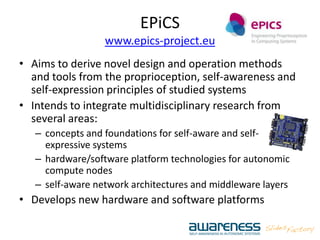
• Aims to derive novel design and operation methods
and tools from the proprioception, self-awareness and
self-expression principles of studied systems
• Intends to integrate multidisciplinary research from
several areas:
– concepts and foundations for self-aware and self-
expressive systems
– hardware/software platform technologies for autonomic
compute nodes
– self-aware network architectures and middleware layers
• Develops new hardware and software platforms
EPiCS Approach
• Integrate multidisciplinary research from several areas:
– concepts and foundations for self-aware and self-
expressive systems
– hardware/software platform technologies for autonomic
compute nodes
– self-aware network architectures and middleware layers
• Foundational and technological research validated by
the requirements of three challenging application
domains:
– heterogeneous compute clusters for financial modelling
– distributed smart cameras for person detection and
tracking
– hypermusic on an interactive mobile media system
EPiCS Videos
• How six independent mobile devices
synchronise to each other:
http://vimeo.com/67205605
• CamSim – a distributed smart camera network
simulator
http://vimeo.com/70176909
For more: http://vimeo.com/channels/epics/
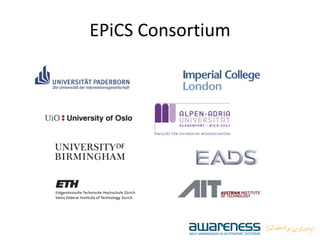
EPiCS Consortium
SWARM ROBOTICS
Applications
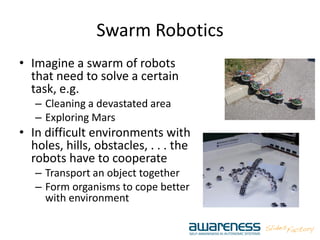
Swarm Robotics
• Imagine a swarm of robots
that need to solve a certain
task, e.g.
– Cleaning a devastated area
– Exploring Mars
• In difficult environments with
holes, hills, obstacles, . . . the
robots have to cooperate
– Transport an object together
– Form organisms to cope better
with environment
Swarm Robotics
• Robots are aware of the task they are
supposed to perform and monitor their
performance in the environment
• Robots should be able to adapt to maximize
their performance
• Adaptations take place on an individual level
as well as on a collective level:
– Individuals adjust their behavior
– Collective behavior emerges (e.g. organisms are
formed by multiple robots)
SYMBRION
www.symbrion.eu
Symbiotic Evolutionary Robot Organisms
• Hundreds of small cubic robots are built and deployed in an
environment
• Robots sense each other and the environment and are capable of
aggregating into “multi-cellular” organisms
• Aggregation and disaggregation is self-driven, depending on the
circumstances: different environments, different tasks
• Questions addressed:
– Can we build such robots and program the basic behaviors needed for
appropriate (dis)aggregation?
– Can we provide adaptive mechanisms that enable newly “born” organisms
learn to operate (sense, move, act, …)?
SYMBRION Scenario
http://www.youtube.com/watch?v=SkvpEfAPXn4
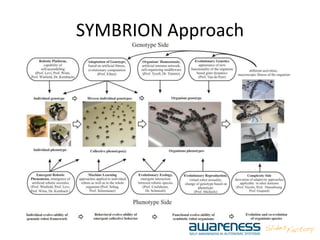
SYMBRION Approach
SYMBRION Current Results
• Different controllers have been developed for robots
• Evolutionary approaches are able to adapt the controllers
based upon fitness
• Different organisms are formed as required by the
environment
• Some initial versions of hardware have been developed and
are currently being deployed
SYMBRION Comsoritum
ASCENS
www.ascens-ist.eu
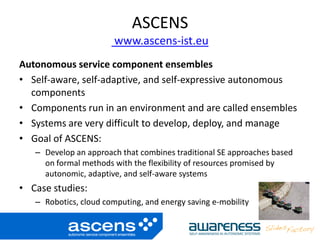
Autonomous service component ensembles
• Self-aware, self-adaptive, and self-expressive autonomous
components
• Components run in an environment and are called ensembles
• Systems are very difficult to develop, deploy, and manage
• Goal of ASCENS:
– Develop an approach that combines traditional SE approaches based
on formal methods with the flexibility of resources promised by
autonomic, adaptive, and self-aware systems
• Case studies:
– Robotics, cloud computing, and energy saving e-mobility
Ensembles
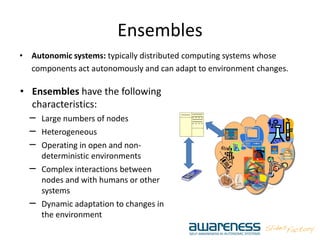
• Autonomic systems: typically distributed computing systems whose
components act autonomously and can adapt to environment changes.
• Ensembles have the following
characteristics:
– Large numbers of nodes
– Heterogeneous
– Operating in open and non-
deterministic environments
– Complex interactions between
nodes and with humans or other
systems
– Dynamic adaptation to changes in
the environment
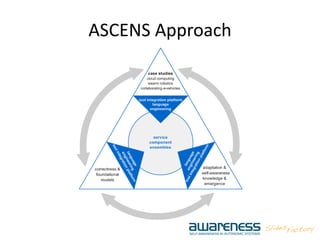
ASCENS Approach
ASCENS Consortium
CoCoRo
cocoro.uni-graz.at
Collective Cognitive Robotics
• Aims at creating an autonomous swarm of
interacting, cognitive underwater vehicles
• Tasks to be performed by the swarm:
– Ecological monitoring
– Searching
– Maintaining
– Exploring
– Harvesting resources
CoCoRo Scenario
http://www.youtube.com/watch?v=OStLml7pHZY
CoCoRo Approach
• Draw inspiration from nature to generate
behavior:
– Cognition generating algorithms:
• Social insect trophallaxis
• Social insect communication
• Slime mold
• ANN
– Collective movement:
• Bird movement
• Fish school behavior
CoCoRo Consortium
DATA MANAGEMENT
Applications
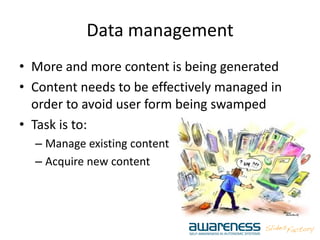
Data management
• More and more content is being generated
• Content needs to be effectively managed in
order to avoid user form being swamped
• Task is to:
– Manage existing content
– Acquire new content
SAPERE
www.sapere-project.eu
Self-aware Pervasive Service Ecosystems
• Computers for handling data and providing services are
integrated into an “ecosystem”
• System is extended with
– methods for data and situation identification
– decentralized algorithms for spatial self-organization, self-
composition, and self-management
• Thus, we obtain automated deployment and execution of
services and for the management of contextual data items
SAPERE Scenario
• Pervasive computing
– Sensor rich and always connected smart phones
– Sensor networks and information tags
– Localization and activity recognition
– Internet of things and the real‐time Web
• Innovative pervasive services arising
– Situation‐aware adaptation
– Interactive reality
– Pervasive collective intelligence and pervasive participation
• Open co‐production scenario, very dynamic, diverse
needs and diverse services, continuously evolving
SAPERE Architecture
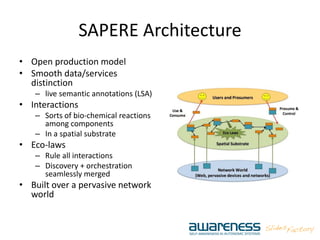
• Open production model
• Smooth data/services
distinction
– live semantic annotations (LSA)
• Interactions
– Sorts of bio‐chemical reactions
among components
– In a spatial substrate
• Eco‐laws
– Rule all interactions
– Discovery + orchestration
seamlessly merged
• Built over a pervasive network
world
SAPERE Infrastructure and applications
• Infrastructure
– A very lightweight infrastructure
– Ruling all interactions (from discovery to data exchange and
synchronization) by embedding the concept of eco‐laws
– To most extent, acting as a recommendation and planning engine
– Possibly inspired by tuple space coordination models
– Yet made it more “fluid” and suitable for a pervasive computing
continuum substrate not a network but a continuum of tuple spaces
• Applications
– The “Ecosystem of Display” as a general and impactful testbed
– To put at work and demonstrate the SAPERE findings
– Active and dynamic information sharing in urban scenarios
– Active participation of citizens to the working of the urban
infrastructure
SAPERE Consortium
RECOGNITION
www.recognition-project.eu
Relevance and Cognition for Self‐Awareness in a
Content‐Centric Internet
• Project draws inspiration from human cognitive
processes to achieve self-awareness
• Try to replicate core cognitive processes in computer
systems:
– e.g. inference, beliefs, similarity, and trust
– embed them in ICT
• Application domain: internet content
– Manage and acquire content in an effective manner by
means of self-aware computing systems
RECOGNITION Motivation
Technological Trends
• Participatory generation of content
– Prosumers, diversity, expanding edges
– Long tail, swamping, scale!
• Content in the environment
– Linkage of the physical and virtual worlds
– Embedding content and knowledge
• Acquiring knowledge through social mechanisms
– Blogging, social networking, recommendation, RSS feeds…
• How content reaches users will continue to change…
Supporting technological trends
• Intention: Paradigm to support ICT functions
– Enabling content centricity
• Better fitting of users to content and vice-versa
– Synchronize content with human activity and
needs
• Place, time, situation, relevance, context, social search
– Autonomic management
• Of content, its acquisition and resource utilization
RECOGNITION Approach
Human Awareness Behaviour
• Capture & exploit key behaviours of the most
intelligent living species
– Human capability is phenomenal in navigating
complex & diverse stimuli
– Filter & suppress information in “noisy” situations
with ambient stimuli
– Extract knowledge in presence of uncertainty
– Exercise rapid value judgment for prioritisation
– Engage a and multi‐scale social context multi learning
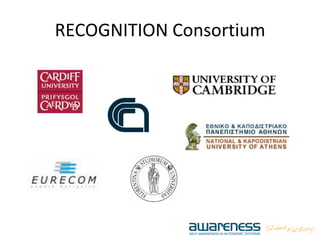
RECOGNITION Consortium
Acknowledgment
The slides in this presentation were produced
with contributions from all participants of the
Awareness Slides Factory.

Industry Training: 04 Awareness Applications

  • 1.
  • 2.
    Outline • Proprioceptive systems –EPiCS • Swarm robotics – SYMBRION – ASCENS – CoCoRo • Data management – SAPERE – RECOGNITION
  • 3.
  • 4.
    Proprioceptive Systems • Collectand maintain information about their state and progress • Enable self-awareness by reasoning about their behavior • Enable self-expression by effectively and autonomously adapting their behavior to changing conditions
  • 5.
    EPiCS www.epics-project.eu • Aims toderive novel design and operation methods and tools from the proprioception, self-awareness and self-expression principles of studied systems • Intends to integrate multidisciplinary research from several areas: – concepts and foundations for self-aware and self- expressive systems – hardware/software platform technologies for autonomic compute nodes – self-aware network architectures and middleware layers • Develops new hardware and software platforms
  • 6.
    EPiCS Approach • Integratemultidisciplinary research from several areas: – concepts and foundations for self-aware and self- expressive systems – hardware/software platform technologies for autonomic compute nodes – self-aware network architectures and middleware layers • Foundational and technological research validated by the requirements of three challenging application domains: – heterogeneous compute clusters for financial modelling – distributed smart cameras for person detection and tracking – hypermusic on an interactive mobile media system
  • 7.
    EPiCS Videos • Howsix independent mobile devices synchronise to each other: http://vimeo.com/67205605 • CamSim – a distributed smart camera network simulator http://vimeo.com/70176909 For more: http://vimeo.com/channels/epics/
  • 8.
  • 9.
  • 10.
    Swarm Robotics • Imaginea swarm of robots that need to solve a certain task, e.g. – Cleaning a devastated area – Exploring Mars • In difficult environments with holes, hills, obstacles, . . . the robots have to cooperate – Transport an object together – Form organisms to cope better with environment
  • 11.
    Swarm Robotics • Robotsare aware of the task they are supposed to perform and monitor their performance in the environment • Robots should be able to adapt to maximize their performance • Adaptations take place on an individual level as well as on a collective level: – Individuals adjust their behavior – Collective behavior emerges (e.g. organisms are formed by multiple robots)
  • 12.
    SYMBRION www.symbrion.eu Symbiotic Evolutionary RobotOrganisms • Hundreds of small cubic robots are built and deployed in an environment • Robots sense each other and the environment and are capable of aggregating into “multi-cellular” organisms • Aggregation and disaggregation is self-driven, depending on the circumstances: different environments, different tasks • Questions addressed: – Can we build such robots and program the basic behaviors needed for appropriate (dis)aggregation? – Can we provide adaptive mechanisms that enable newly “born” organisms learn to operate (sense, move, act, …)?
  • 13.
  • 14.
  • 15.
    SYMBRION Current Results •Different controllers have been developed for robots • Evolutionary approaches are able to adapt the controllers based upon fitness • Different organisms are formed as required by the environment • Some initial versions of hardware have been developed and are currently being deployed
  • 16.
  • 17.
    ASCENS www.ascens-ist.eu Autonomous service componentensembles • Self-aware, self-adaptive, and self-expressive autonomous components • Components run in an environment and are called ensembles • Systems are very difficult to develop, deploy, and manage • Goal of ASCENS: – Develop an approach that combines traditional SE approaches based on formal methods with the flexibility of resources promised by autonomic, adaptive, and self-aware systems • Case studies: – Robotics, cloud computing, and energy saving e-mobility
  • 18.
    Ensembles • Autonomic systems:typically distributed computing systems whose components act autonomously and can adapt to environment changes. • Ensembles have the following characteristics: – Large numbers of nodes – Heterogeneous – Operating in open and non- deterministic environments – Complex interactions between nodes and with humans or other systems – Dynamic adaptation to changes in the environment
  • 19.
  • 20.
  • 21.
    CoCoRo cocoro.uni-graz.at Collective Cognitive Robotics •Aims at creating an autonomous swarm of interacting, cognitive underwater vehicles • Tasks to be performed by the swarm: – Ecological monitoring – Searching – Maintaining – Exploring – Harvesting resources
  • 22.
  • 23.
    CoCoRo Approach • Drawinspiration from nature to generate behavior: – Cognition generating algorithms: • Social insect trophallaxis • Social insect communication • Slime mold • ANN – Collective movement: • Bird movement • Fish school behavior
  • 24.
  • 25.
  • 26.
    Data management • Moreand more content is being generated • Content needs to be effectively managed in order to avoid user form being swamped • Task is to: – Manage existing content – Acquire new content
  • 27.
    SAPERE www.sapere-project.eu Self-aware Pervasive ServiceEcosystems • Computers for handling data and providing services are integrated into an “ecosystem” • System is extended with – methods for data and situation identification – decentralized algorithms for spatial self-organization, self- composition, and self-management • Thus, we obtain automated deployment and execution of services and for the management of contextual data items
  • 28.
    SAPERE Scenario • Pervasivecomputing – Sensor rich and always connected smart phones – Sensor networks and information tags – Localization and activity recognition – Internet of things and the real‐time Web • Innovative pervasive services arising – Situation‐aware adaptation – Interactive reality – Pervasive collective intelligence and pervasive participation • Open co‐production scenario, very dynamic, diverse needs and diverse services, continuously evolving
  • 29.
    SAPERE Architecture • Openproduction model • Smooth data/services distinction – live semantic annotations (LSA) • Interactions – Sorts of bio‐chemical reactions among components – In a spatial substrate • Eco‐laws – Rule all interactions – Discovery + orchestration seamlessly merged • Built over a pervasive network world
  • 30.
    SAPERE Infrastructure andapplications • Infrastructure – A very lightweight infrastructure – Ruling all interactions (from discovery to data exchange and synchronization) by embedding the concept of eco‐laws – To most extent, acting as a recommendation and planning engine – Possibly inspired by tuple space coordination models – Yet made it more “fluid” and suitable for a pervasive computing continuum substrate not a network but a continuum of tuple spaces • Applications – The “Ecosystem of Display” as a general and impactful testbed – To put at work and demonstrate the SAPERE findings – Active and dynamic information sharing in urban scenarios – Active participation of citizens to the working of the urban infrastructure
  • 31.
  • 32.
    RECOGNITION www.recognition-project.eu Relevance and Cognitionfor Self‐Awareness in a Content‐Centric Internet • Project draws inspiration from human cognitive processes to achieve self-awareness • Try to replicate core cognitive processes in computer systems: – e.g. inference, beliefs, similarity, and trust – embed them in ICT • Application domain: internet content – Manage and acquire content in an effective manner by means of self-aware computing systems
  • 33.
    RECOGNITION Motivation Technological Trends •Participatory generation of content – Prosumers, diversity, expanding edges – Long tail, swamping, scale! • Content in the environment – Linkage of the physical and virtual worlds – Embedding content and knowledge • Acquiring knowledge through social mechanisms – Blogging, social networking, recommendation, RSS feeds… • How content reaches users will continue to change…
  • 34.
    Supporting technological trends •Intention: Paradigm to support ICT functions – Enabling content centricity • Better fitting of users to content and vice-versa – Synchronize content with human activity and needs • Place, time, situation, relevance, context, social search – Autonomic management • Of content, its acquisition and resource utilization
  • 35.
    RECOGNITION Approach Human AwarenessBehaviour • Capture & exploit key behaviours of the most intelligent living species – Human capability is phenomenal in navigating complex & diverse stimuli – Filter & suppress information in “noisy” situations with ambient stimuli – Extract knowledge in presence of uncertainty – Exercise rapid value judgment for prioritisation – Engage a and multi‐scale social context multi learning
  • 36.
  • 37.
    Acknowledgment The slides inthis presentation were produced with contributions from all participants of the Awareness Slides Factory.