

TREATMENT
RESISTANT
DEPRESSION
DR. RAKESH MEHTA
NGMC
INTRODUCTION
• Major Depressive Disorder (MDD)
Major depressive disorder (MDD) is characterized by at
least one discrete depressive episode lasting at least 2
weeks and involving clear-cut changes in mood, interests
and pleasure, changes in cognition and vegetative
symptoms
• The percentage of people suffering from MDD worldwide
was 4.4% in 2010.
• Across the lifespan, prevalence of MDD increases
steadily between 3 and 19 years; peaks between 20 and
64 years; decreased between 65 to 74 years.
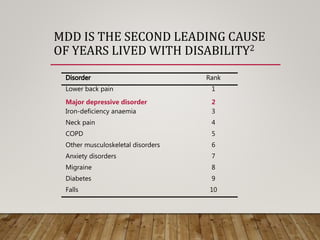
MDD IS THE SECOND LEADING CAUSE
OF YEARS LIVED WITH DISABILITY2
Rank
Lower back pain 1
Major depressive disorder 2
Iron-deficiency anaemia 3
Neck pain 4
COPD 5
Other musculoskeletal disorders 6
Anxiety disorders 7
Migraine 8
Diabetes 9
Falls 10
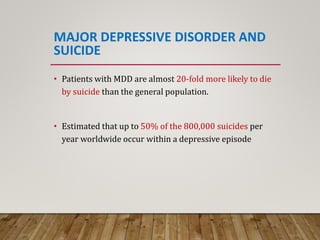
MAJOR DEPRESSIVE DISORDER AND
SUICIDE
• Patients with MDD are almost 20-fold more likely to die
by suicide than the general population.
• Estimated that up to 50% of the 800,000 suicides per
year worldwide occur within a depressive episode
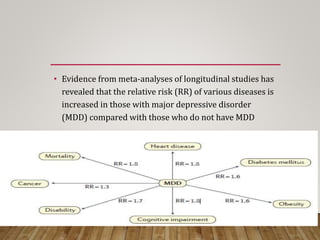
• Evidence from meta-analyses of longitudinal studies has
revealed that the relative risk (RR) of various diseases is
increased in those with major depressive disorder
(MDD) compared with those who do not have MDD
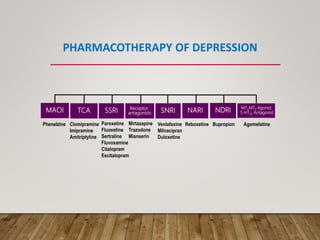
PHARMACOTHERAPY OF DEPRESSION
SNRI
Venlafaxine
Milnacipran
Duloxetine
TCA
Clomipramine
Imipramine
Amitriptyline
MAOI
Phenelzine
NARI
Reboxetine
NDRI
Bupropion
SSRI
Paroxetine
Fluoxetine
Sertraline
Fluvoxamine
Citalopram
Escitalopram
Receptor
antagonists
Mirtazapine
Trazodone
Mianserin
MT1,MT2 Agonist
5-HT2C Antagonist
Agomelatine
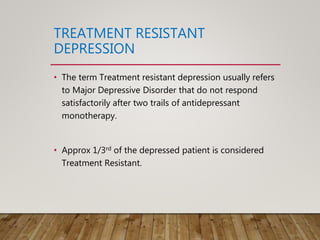
TREATMENT RESISTANT
DEPRESSION
• The term Treatment resistant depression usually refers
to Major Depressive Disorder that do not respond
satisfactorily after two trails of antidepressant
monotherapy.
• Approx 1/3rd of the depressed patient is considered
Treatment Resistant.
• Given that approx 1/3rd of depressed patient are
considered treatment resistant , this group accounts
for largest burden of disease, underscoring
importance for innovation and discovery in this area.
EVALUATION OF PATIENT
• Diagnose before you treat.
• Assess non adherence
• Cost
• Family and friends ambivalent
• Side effects : adjust dose
• Assess Co-morbidity
• OCD
• Substance use
• Anemia
• Hypothyroidism
• Psychotic Depression
• Cognitive Deficits may make patient difficult to follow
instruction
• Involve family members and care givers
• Adequate dose / duration
• Drug –Drug interaction : may interfere metabolism
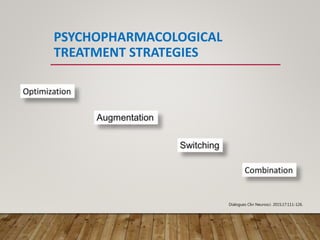
TREATMENT STRATEGIES
• SACO: Switching , Augmenting, Combining, Optimization.
• Psychotherapy.
• ECT
• Trans cranial Magnetic Stimulation
• Deep Brain Stimulation
• Vagal Nerve Stimulation
• Light Based Therapy
• Exercise
• Acupuncture
• Yoga
PSYCHOPHARMACOLOGICAL
TREATMENT STRATEGIES
Dialogues Clin Neurosci. 2015;17:111-126.
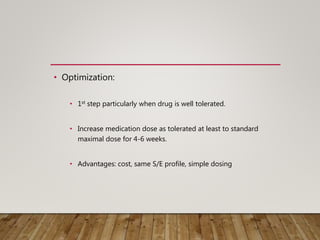
• Optimization:
• 1st step particularly when drug is well tolerated.
• Increase medication dose as tolerated at least to standard
maximal dose for 4-6 weeks.
• Advantages: cost, same S/E profile, simple dosing
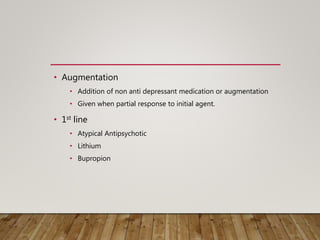
• Augmentation
• Addition of non anti depressant medication or augmentation
• Given when partial response to initial agent.
• 1st line
• Atypical Antipsychotic
• Lithium
• Bupropion
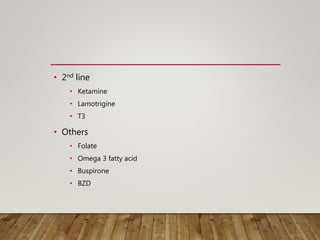
• 2nd line
• Ketamine
• Lamotrigine
• T3
• Others
• Folate
• Omega 3 fatty acid
• Buspirone
• BZD
ATYPICAL ANTIPSYCHOTICS
• Atypical Antipsychotic are the most studied class for
augmentation.
“FDA approved” Aripiprazole
Quetiapine
Olanzapine
• A study done by Berman et al found 2 fold higher
odds for reaching remission compared to placebo.
• Target dosing:
• Aripiprazole 5-10 mg/day
• Quetiapine 150-300 mg/day
• Olanzapine 5-10 mg/day
LITHIUM
• Lithium augmentation compared with
placebo had better rate (41.2% vs
14.4%) in decreasing depressive
symptoms.
• 250-1200 mg is used
• Aim for plasma level 0.4-0.8 mmol/l
THYROID AGUMENTATION
• T3 Agumentation (25-50 ug/day) is used.
• A study found by Aronson & Collegue found that
patient achieved response twice likely than placebo
• In STAR-D , T3 augmentation resulted in 25%
remission rate compared with 16% with lithium
augmentation.
• A comparison study done by trivedi et al found that T3
better tolerated and safer than lithium.
BENZODIAZEPINE
• Anxious depression, benzodiazepine are frequently used
as augmenting agents.
• One double blind placebo controlled study found benzodiazepines
augmentation was superior to antidepressant alone
• Benzodiazepines augmentation was superior to
antidepressant monotherapy for treating depressive
symptoms in first 3 weeks.
• BZD + SSRI resulted in rapid control in baseline anxiety as
well reduced SSRI induced anxiety at the beginning to
treatment and improved adherence to Antidepressant
therapy.
CELECOXIB
• Briefly, inflammation has been suggested to play a
role in pathophysiology of depression
• A meta analysis of 4 trails of celecoxib (NSAID) showed
significant antidepressant efficacy compared with
placebo.
• Modafinil
• stimulating agent has been studied as augmentation
agent for depression with fatigue with significant
improvement compared to placebo.
• 100-400 mg/day
• Omega 3 fatty acid have anti inflammatory properties has shown
some insignificant benefits.
• Folate an essential amino acid play a role in neurotransmitter
synthesis (5mg/day) may have role in antidepressant augmentation.
• Zinc
• 25mg has shown good result in one study
• Tryptophan
• 2-3g /day has long history of successful use
SWITCHING
• Following monotherapy failure the efficacy of switching
medication vs augmentation appears comparable.
• Done when
• poor tolerability
• complete non response
• Patient who fail 2 trails of one class of antidepressant
should be switched to another class on 3rd attempt
• Gradual tappering + increase of another class of
treatment reduce withdrawal side effect
COMBINATION
• 2 or more antidepressant from 2 different classes
• Drug- drug interaction should be kept in mind eg:
SSRI + MAOIS
• One metanalysis found that patients were 3 times
more likely active remission when started initially in
combination therapy.
KETAMINE
• Non-monoaminergic antidepressant
• NMDA receptor antagonist
• Subanesthetic (0.5 mg/kg over 40 min)/ (2 mg/kg
rapidly for anesthetic) has shown rapid (within 1 day),
sustained (7 days) anitidepressant efficacy.
• Decrease suicidal intention and decrease anhedonia
• Lamotrigine
• 100-400mg can be used to augment
• Scopolamine
• IV scopolamine rapidly decrease symptoms of depression.
QUETIAPINE
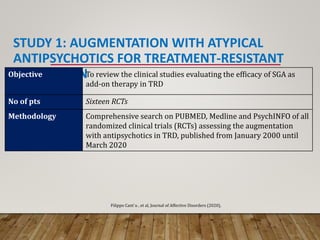
STUDY 1: AUGMENTATION WITH ATYPICAL
ANTIPSYCHOTICS FOR TREATMENT-RESISTANT
DEPRESSION
Objective To review the clinical studies evaluating the efficacy of SGA as
add-on therapy in TRD
No of pts Sixteen RCTs
Methodology Comprehensive search on PUBMED, Medline and PsychINFO of all
randomized clinical trials (RCTs) assessing the augmentation
with antipsychotics in TRD, published from January 2000 until
March 2020
Filippo Cant`u , et al, Journal of Affective Disorders (2020),
RESULTS:
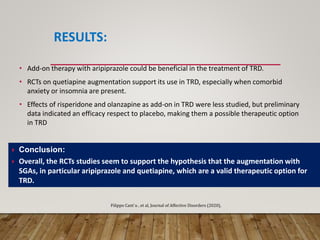
• Add-on therapy with aripiprazole could be beneficial in the treatment of TRD.
• RCTs on quetiapine augmentation support its use in TRD, especially when comorbid
anxiety or insomnia are present.
• Effects of risperidone and olanzapine as add-on in TRD were less studied, but preliminary
data indicated an efficacy respect to placebo, making them a possible therapeutic option
in TRD
 Conclusion:
 Overall, the RCTs studies seem to support the hypothesis that the augmentation with
SGAs, in particular aripiprazole and quetiapine, which are a valid therapeutic option for
TRD.
Filippo Cant`u , et al, Journal of Affective Disorders (2020),
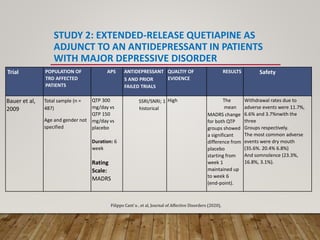
STUDY 2: EXTENDED-RELEASE QUETIAPINE AS
ADJUNCT TO AN ANTIDEPRESSANT IN PATIENTS
WITH MAJOR DEPRESSIVE DISORDER
Trial POPULATION OF
TRD AFFECTED
PATIENTS
APS ANTIDEPRESSANT
S AND PRIOR
FAILED TRIALS
QUALTIY OF
EVIDENCE
RESULTS Safety
Bauer et al,
2009
Total sample (n =
487)
Age and gender not
specified
QTP 300
mg/day vs
QTP 150
mg/day vs
placebo
Duration: 6
week
Rating
Scale:
MADRS
SSRI/SNRI; 1
historical
High The
mean
MADRS change
for both QTP
groups showed
a significant
difference from
placebo
starting from
week 1
maintained up
to week 6
(end-point).
Withdrawal rates due to
adverse events were 11.7%,
6.6% and 3.7%nwith the
three
Groups respectively.
The most common adverse
events were dry mouth
(35.6%. 20.4% 6.8%)
And somnolence (23.3%,
16.8%, 3.1%).
Filippo Cant`u , et al, Journal of Affective Disorders (2020),
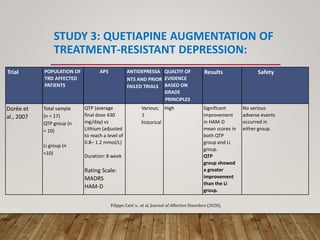
STUDY 3: QUETIAPINE AUGMENTATION OF
TREATMENT-RESISTANT DEPRESSION:
Trial POPULATION OF
TRD AFFECTED
PATIENTS
APS ANTIDEPRESSA
NTS AND PRIOR
FAILED TRIALS
QUALTIY OF
EVIDENCE
BASED ON
GRADE
PRINCIPLES
Results Safety
Dorèe et
al., 2007
Total sample
(n = 17)
QTP group (n
= 10)
Li group (n
=10)
QTP (average
final dose 430
mg/day) vs
Lithium (adjusted
to reach a level of
0.8– 1.2 mmol/L)
Duration: 8 week
Rating Scale:
MADRS
HAM-D
Various;
1
historical
High Significant
improvement
in HAM-D
mean scores in
both QTP
group and Li
group.
QTP
group showed
a greater
improvement
than the Li
group.
No serious
adverse events
occurred in
either group.
Filippo Cant`u , et al, Journal of Affective Disorders (2020),
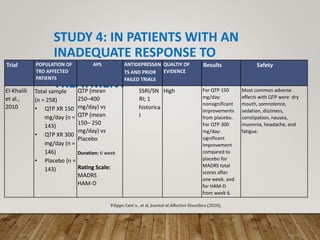
STUDY 4: IN PATIENTS WITH AN
INADEQUATE RESPONSE TO
ONGOING ANTIDEPRESSANT
TREATMENT
Trial POPULATION OF
TRD AFFECTED
PATIENTS
APS ANTIDEPRESSAN
TS AND PRIOR
FAILED TRIALS
QUALTIY OF
EVIDENCE
Results Safety
El-Khalili
et al.,
2010
Total sample
(n = 258)
• QTP XR 150
mg/day (n =
143)
• QTP XR 300
mg/day (n =
146)
• Placebo (n =
143)
QTP (mean
250–400
mg/day) vs
QTP (mean
150– 250
mg/day) vs
Placebo
Duration: 6 week
Rating Scale:
MADRS
HAM-D
SSRI/SN
RI; 1
historica
l
High For QTP 150
mg/day:
nonsignificant
improvements
from placebo.
For QTP 300
mg/day:
significant
improvement
compared to
placebo for
MADRS total
scores after
one week, and
for HAM-D
from week 6.
Most common adverse
effects with QTP were dry
mouth, somnolence,
sedation, dizziness,
constipation, nausea,
insomnia, headache, and
fatigue.
Filippo Cant`u , et al, Journal of Affective Disorders (2020),
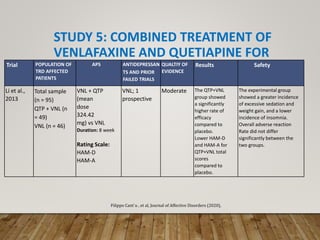
STUDY 5: COMBINED TREATMENT OF
VENLAFAXINE AND QUETIAPINE FOR
TREATMENT-RESISTANT DEPRESSION
Trial POPULATION OF
TRD AFFECTED
PATIENTS
APS ANTIDEPRESSAN
TS AND PRIOR
FAILED TRIALS
QUALTIY OF
EVIDENCE
Results Safety
Li et al.,
2013
Total sample
(n = 95)
QTP + VNL (n
= 49)
VNL (n = 46)
VNL + QTP
(mean
dose
324.42
mg) vs VNL
Duration: 8 week
Rating Scale:
HAM-D
HAM-A
VNL; 1
prospective
Moderate The QTP+VNL
group showed
a significantly
higher rate of
efficacy
compared to
placebo.
Lower HAM-D
and HAM-A for
QTP+VNL total
scores
compared to
placebo.
The experimental group
showed a greater incidence
of excessive sedation and
weight gain, and a lower
incidence of insomnia.
Overall adverse reaction
Rate did not differ
significantly between the
two groups.
Filippo Cant`u , et al, Journal of Affective Disorders (2020),
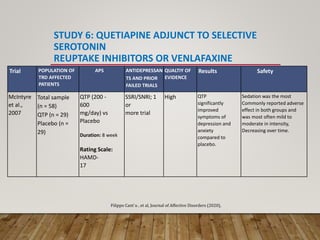
STUDY 6: QUETIAPINE ADJUNCT TO SELECTIVE
SEROTONIN
REUPTAKE INHIBITORS OR VENLAFAXINE
Trial POPULATION OF
TRD AFFECTED
PATIENTS
APS ANTIDEPRESSAN
TS AND PRIOR
FAILED TRIALS
QUALTIY OF
EVIDENCE
Results Safety
McIntyre
et al.,
2007
Total sample
(n = 58)
QTP (n = 29)
Placebo (n =
29)
QTP (200 -
600
mg/day) vs
Placebo
Duration: 8 week
Rating Scale:
HAMD-
17
SSRI/SNRI; 1
or
more trial
High QTP
significantly
improved
symptoms of
depression and
anxiety
compared to
placebo.
Sedation was the most
Commonly reported adverse
effect in both groups and
was most often mild to
moderate in intensity,
Decreasing over time.
Filippo Cant`u , et al, Journal of Affective Disorders (2020),
• Conclusion
• In setting of non –remission, it is important to re evaluate
diagnosis, adherence, co morbid condition and to consider
dose optimization, switching , augmentation as well as
combining ADs.
Thank You

Treatment approach to resistant depression

  • 1.
  • 3.
    INTRODUCTION • Major DepressiveDisorder (MDD) Major depressive disorder (MDD) is characterized by at least one discrete depressive episode lasting at least 2 weeks and involving clear-cut changes in mood, interests and pleasure, changes in cognition and vegetative symptoms
  • 4.
    • The percentageof people suffering from MDD worldwide was 4.4% in 2010. • Across the lifespan, prevalence of MDD increases steadily between 3 and 19 years; peaks between 20 and 64 years; decreased between 65 to 74 years.
  • 5.
    MDD IS THESECOND LEADING CAUSE OF YEARS LIVED WITH DISABILITY2 Rank Lower back pain 1 Major depressive disorder 2 Iron-deficiency anaemia 3 Neck pain 4 COPD 5 Other musculoskeletal disorders 6 Anxiety disorders 7 Migraine 8 Diabetes 9 Falls 10
  • 6.
    MAJOR DEPRESSIVE DISORDERAND SUICIDE • Patients with MDD are almost 20-fold more likely to die by suicide than the general population. • Estimated that up to 50% of the 800,000 suicides per year worldwide occur within a depressive episode
  • 7.
    • Evidence frommeta-analyses of longitudinal studies has revealed that the relative risk (RR) of various diseases is increased in those with major depressive disorder (MDD) compared with those who do not have MDD
  • 8.
  • 9.
    TREATMENT RESISTANT DEPRESSION • Theterm Treatment resistant depression usually refers to Major Depressive Disorder that do not respond satisfactorily after two trails of antidepressant monotherapy. • Approx 1/3rd of the depressed patient is considered Treatment Resistant.
  • 10.
    • Given thatapprox 1/3rd of depressed patient are considered treatment resistant , this group accounts for largest burden of disease, underscoring importance for innovation and discovery in this area.
  • 11.
    EVALUATION OF PATIENT •Diagnose before you treat. • Assess non adherence • Cost • Family and friends ambivalent • Side effects : adjust dose • Assess Co-morbidity • OCD • Substance use • Anemia • Hypothyroidism • Psychotic Depression
  • 12.
    • Cognitive Deficitsmay make patient difficult to follow instruction • Involve family members and care givers • Adequate dose / duration • Drug –Drug interaction : may interfere metabolism
  • 13.
    TREATMENT STRATEGIES • SACO:Switching , Augmenting, Combining, Optimization. • Psychotherapy. • ECT • Trans cranial Magnetic Stimulation • Deep Brain Stimulation • Vagal Nerve Stimulation • Light Based Therapy • Exercise • Acupuncture • Yoga
  • 14.
  • 15.
    • Optimization: • 1ststep particularly when drug is well tolerated. • Increase medication dose as tolerated at least to standard maximal dose for 4-6 weeks. • Advantages: cost, same S/E profile, simple dosing
  • 16.
    • Augmentation • Additionof non anti depressant medication or augmentation • Given when partial response to initial agent. • 1st line • Atypical Antipsychotic • Lithium • Bupropion
  • 17.
    • 2nd line •Ketamine • Lamotrigine • T3 • Others • Folate • Omega 3 fatty acid • Buspirone • BZD
  • 18.
    ATYPICAL ANTIPSYCHOTICS • AtypicalAntipsychotic are the most studied class for augmentation. “FDA approved” Aripiprazole Quetiapine Olanzapine • A study done by Berman et al found 2 fold higher odds for reaching remission compared to placebo.
  • 19.
    • Target dosing: •Aripiprazole 5-10 mg/day • Quetiapine 150-300 mg/day • Olanzapine 5-10 mg/day
  • 20.
    LITHIUM • Lithium augmentationcompared with placebo had better rate (41.2% vs 14.4%) in decreasing depressive symptoms. • 250-1200 mg is used • Aim for plasma level 0.4-0.8 mmol/l
  • 21.
    THYROID AGUMENTATION • T3Agumentation (25-50 ug/day) is used. • A study found by Aronson & Collegue found that patient achieved response twice likely than placebo • In STAR-D , T3 augmentation resulted in 25% remission rate compared with 16% with lithium augmentation. • A comparison study done by trivedi et al found that T3 better tolerated and safer than lithium.
  • 22.
    BENZODIAZEPINE • Anxious depression,benzodiazepine are frequently used as augmenting agents. • One double blind placebo controlled study found benzodiazepines augmentation was superior to antidepressant alone • Benzodiazepines augmentation was superior to antidepressant monotherapy for treating depressive symptoms in first 3 weeks. • BZD + SSRI resulted in rapid control in baseline anxiety as well reduced SSRI induced anxiety at the beginning to treatment and improved adherence to Antidepressant therapy.
  • 23.
    CELECOXIB • Briefly, inflammationhas been suggested to play a role in pathophysiology of depression • A meta analysis of 4 trails of celecoxib (NSAID) showed significant antidepressant efficacy compared with placebo.
  • 24.
    • Modafinil • stimulatingagent has been studied as augmentation agent for depression with fatigue with significant improvement compared to placebo. • 100-400 mg/day
  • 25.
    • Omega 3fatty acid have anti inflammatory properties has shown some insignificant benefits. • Folate an essential amino acid play a role in neurotransmitter synthesis (5mg/day) may have role in antidepressant augmentation. • Zinc • 25mg has shown good result in one study • Tryptophan • 2-3g /day has long history of successful use
  • 26.
    SWITCHING • Following monotherapyfailure the efficacy of switching medication vs augmentation appears comparable. • Done when • poor tolerability • complete non response • Patient who fail 2 trails of one class of antidepressant should be switched to another class on 3rd attempt • Gradual tappering + increase of another class of treatment reduce withdrawal side effect
  • 27.
    COMBINATION • 2 ormore antidepressant from 2 different classes • Drug- drug interaction should be kept in mind eg: SSRI + MAOIS • One metanalysis found that patients were 3 times more likely active remission when started initially in combination therapy.
  • 28.
    KETAMINE • Non-monoaminergic antidepressant •NMDA receptor antagonist • Subanesthetic (0.5 mg/kg over 40 min)/ (2 mg/kg rapidly for anesthetic) has shown rapid (within 1 day), sustained (7 days) anitidepressant efficacy. • Decrease suicidal intention and decrease anhedonia
  • 29.
    • Lamotrigine • 100-400mgcan be used to augment • Scopolamine • IV scopolamine rapidly decrease symptoms of depression.
  • 30.
  • 31.
    STUDY 1: AUGMENTATIONWITH ATYPICAL ANTIPSYCHOTICS FOR TREATMENT-RESISTANT DEPRESSION Objective To review the clinical studies evaluating the efficacy of SGA as add-on therapy in TRD No of pts Sixteen RCTs Methodology Comprehensive search on PUBMED, Medline and PsychINFO of all randomized clinical trials (RCTs) assessing the augmentation with antipsychotics in TRD, published from January 2000 until March 2020 Filippo Cant`u , et al, Journal of Affective Disorders (2020),
  • 32.
    RESULTS: • Add-on therapywith aripiprazole could be beneficial in the treatment of TRD. • RCTs on quetiapine augmentation support its use in TRD, especially when comorbid anxiety or insomnia are present. • Effects of risperidone and olanzapine as add-on in TRD were less studied, but preliminary data indicated an efficacy respect to placebo, making them a possible therapeutic option in TRD  Conclusion:  Overall, the RCTs studies seem to support the hypothesis that the augmentation with SGAs, in particular aripiprazole and quetiapine, which are a valid therapeutic option for TRD. Filippo Cant`u , et al, Journal of Affective Disorders (2020),
  • 33.
    STUDY 2: EXTENDED-RELEASEQUETIAPINE AS ADJUNCT TO AN ANTIDEPRESSANT IN PATIENTS WITH MAJOR DEPRESSIVE DISORDER Trial POPULATION OF TRD AFFECTED PATIENTS APS ANTIDEPRESSANT S AND PRIOR FAILED TRIALS QUALTIY OF EVIDENCE RESULTS Safety Bauer et al, 2009 Total sample (n = 487) Age and gender not specified QTP 300 mg/day vs QTP 150 mg/day vs placebo Duration: 6 week Rating Scale: MADRS SSRI/SNRI; 1 historical High The mean MADRS change for both QTP groups showed a significant difference from placebo starting from week 1 maintained up to week 6 (end-point). Withdrawal rates due to adverse events were 11.7%, 6.6% and 3.7%nwith the three Groups respectively. The most common adverse events were dry mouth (35.6%. 20.4% 6.8%) And somnolence (23.3%, 16.8%, 3.1%). Filippo Cant`u , et al, Journal of Affective Disorders (2020),
  • 34.
    STUDY 3: QUETIAPINEAUGMENTATION OF TREATMENT-RESISTANT DEPRESSION: Trial POPULATION OF TRD AFFECTED PATIENTS APS ANTIDEPRESSA NTS AND PRIOR FAILED TRIALS QUALTIY OF EVIDENCE BASED ON GRADE PRINCIPLES Results Safety Dorèe et al., 2007 Total sample (n = 17) QTP group (n = 10) Li group (n =10) QTP (average final dose 430 mg/day) vs Lithium (adjusted to reach a level of 0.8– 1.2 mmol/L) Duration: 8 week Rating Scale: MADRS HAM-D Various; 1 historical High Significant improvement in HAM-D mean scores in both QTP group and Li group. QTP group showed a greater improvement than the Li group. No serious adverse events occurred in either group. Filippo Cant`u , et al, Journal of Affective Disorders (2020),
  • 35.
    STUDY 4: INPATIENTS WITH AN INADEQUATE RESPONSE TO ONGOING ANTIDEPRESSANT TREATMENT Trial POPULATION OF TRD AFFECTED PATIENTS APS ANTIDEPRESSAN TS AND PRIOR FAILED TRIALS QUALTIY OF EVIDENCE Results Safety El-Khalili et al., 2010 Total sample (n = 258) • QTP XR 150 mg/day (n = 143) • QTP XR 300 mg/day (n = 146) • Placebo (n = 143) QTP (mean 250–400 mg/day) vs QTP (mean 150– 250 mg/day) vs Placebo Duration: 6 week Rating Scale: MADRS HAM-D SSRI/SN RI; 1 historica l High For QTP 150 mg/day: nonsignificant improvements from placebo. For QTP 300 mg/day: significant improvement compared to placebo for MADRS total scores after one week, and for HAM-D from week 6. Most common adverse effects with QTP were dry mouth, somnolence, sedation, dizziness, constipation, nausea, insomnia, headache, and fatigue. Filippo Cant`u , et al, Journal of Affective Disorders (2020),
  • 36.
    STUDY 5: COMBINEDTREATMENT OF VENLAFAXINE AND QUETIAPINE FOR TREATMENT-RESISTANT DEPRESSION Trial POPULATION OF TRD AFFECTED PATIENTS APS ANTIDEPRESSAN TS AND PRIOR FAILED TRIALS QUALTIY OF EVIDENCE Results Safety Li et al., 2013 Total sample (n = 95) QTP + VNL (n = 49) VNL (n = 46) VNL + QTP (mean dose 324.42 mg) vs VNL Duration: 8 week Rating Scale: HAM-D HAM-A VNL; 1 prospective Moderate The QTP+VNL group showed a significantly higher rate of efficacy compared to placebo. Lower HAM-D and HAM-A for QTP+VNL total scores compared to placebo. The experimental group showed a greater incidence of excessive sedation and weight gain, and a lower incidence of insomnia. Overall adverse reaction Rate did not differ significantly between the two groups. Filippo Cant`u , et al, Journal of Affective Disorders (2020),
  • 37.
    STUDY 6: QUETIAPINEADJUNCT TO SELECTIVE SEROTONIN REUPTAKE INHIBITORS OR VENLAFAXINE Trial POPULATION OF TRD AFFECTED PATIENTS APS ANTIDEPRESSAN TS AND PRIOR FAILED TRIALS QUALTIY OF EVIDENCE Results Safety McIntyre et al., 2007 Total sample (n = 58) QTP (n = 29) Placebo (n = 29) QTP (200 - 600 mg/day) vs Placebo Duration: 8 week Rating Scale: HAMD- 17 SSRI/SNRI; 1 or more trial High QTP significantly improved symptoms of depression and anxiety compared to placebo. Sedation was the most Commonly reported adverse effect in both groups and was most often mild to moderate in intensity, Decreasing over time. Filippo Cant`u , et al, Journal of Affective Disorders (2020),
  • 38.
    • Conclusion • Insetting of non –remission, it is important to re evaluate diagnosis, adherence, co morbid condition and to consider dose optimization, switching , augmentation as well as combining ADs.
  • 39.

Editor's Notes

  • #9 Older generation antidepressants MAOIs MAOIs block the metabolism of NA and 5-HT and increase levels of DA,NA, and 5-HT in brain samples. They are rarely used now due to their poor tolerability profile and risk of drug and food interactions, eg, interactions with dopaminergic agents and tyramine in chocolate, cheese etc which can result in hypertensive crisis. In rare cases, combination with serotoninergic agents or dietary tryptophan can lead to serotonin syndrome. TCAs Primarily block NA and 5-HT reuptake. They are also associated with a higher incidence of AEs than newer antidepressant agents. TCAs are associated with an increased risk of accidents, especially in the elderly (primarily accidents related to driving or falls/fractures due to postural hypotension), cardiovascular side-effects and toxicity in overdose. Second generation antidepressants In general, these have a lower incidence of cardiovascular side-effects, sedation/psychomotor impairments, minimal histaminergic anticholinergic side-effects (such as sedation, dry mouth, constipation and blurred vision) and are also safer in overdose than the TCAs. SSRIs (selective serotonin reuptake inhibitors) eg fluoxetine, fluvoxamine, paroxetine, sertraline, citalopram, es-citalopram. SSRIs are the most frequently prescribed antidepressants in Europe1 Receptor antagonists- noradrenaline and specific serotonin receptor antagonists eg mirtazapine. Mirtazapine has a mixed pharmacological profile (central 2-auto- and hetero-adrenoceptors antagonist and 5-HT2/5HT3 antagonist) . SNRI (serotonin and noradrenaline reuptake inhibitors) eg venlafaxine, milnacipran and duloxetine. NARI:(noradrenaline reuptake inhibitor) eg reboxetine NDRI: (noradrenaline and dopamine reuptake inhibitors) eg bupropion. Melatonin agonist and 5-HT2C antagonist- agomelatine. Newly licensed antidepressant (approved Nov 2008, EMEA)1. Melatonin 1 and 2 agonist and 5-HT(2C) antagonist (low affinity) 2 Demonstrated antidepressant activity in adults with major depression episodes vs. placebo in short and long-term studies (25-50mg/day)1 Different safety profile1 lack of clinically relevant weight gain low risk of sexual dysfunction vs. paroxetine3and venlafaxine4 low incidence of gastro-intestinal reaction absence of discontinuation symptoms overall incidence rates of adverse events not different from placebo References: 1. Bauer M, et al. Eur Psychiatry 2008; 23: 6673 2.EMEA/CHMP review , London, November 2008. http://www.emea.europa.eu/pdfs/human/opinion/Valdoxan_57541108en.pdf 3. Montejo A et al J Psychopharmacol. 2008 Nov 21. [Epub ahead of print] 4.Kennedy SH et al. J Clin Psychopharmacol. 2008;28(3):329-33.