Segovia city





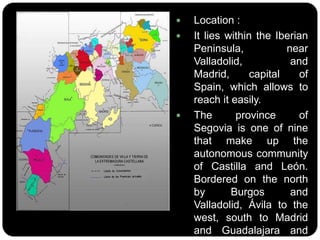
Location :
It lies within the Iberian
Peninsula,
near
Valladolid,
and
Madrid,
capital
of
Spain, which allows to
reach it easily.
The
province
of
Segovia is one of nine
that make up the
autonomous community
of Castilla and León.
Bordered on the north
by
Burgos
and
Valladolid, Ávila to the
west, south to Madrid
and Guadalajara and
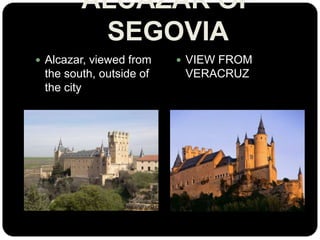
ALCAZAR OF
SEGOVIA
 Alcazar, viewed from

the south, outside of
the city

 VIEW FROM

VERACRUZ
Royal palace located on
top of a rock , is
documented for the first
time in 1122. It was one
of
the
favorite
residences of the kings
of Castile, built in the
transition
from
Romanesque
to
Gothic, and the Mudéjar
decor highlighting its
ample classroom. The
building is structured
around two courtyards
and has two towers, the
Keep and John II. It was
one of the favorite
residence
of
Isabel,
Queen of
Castile. Devastated by

TOWER OF JUAN II DE
CASTILLA
THE CATHEDRAL
It’s
the
last Gothic
cathedral built
in Spain. It is
considered the
masterpiece of
BasqueCastilian
Gothic and is
known as “The
Lady of The
Cathedrals”.

The measures of the cathedral are 33 meters
high, 50 meters wide and 105 meters long
AQUEDUCT
The Aqueduct of
Segovia is the
most
important
piece of Roman
civil engineering
in Spain and one
of
the
most
significant
and
best preserved of
those who left the
Roman
monuments
on
the
Iberian
Peninsula.
THE LOBA
CAPITOLINA


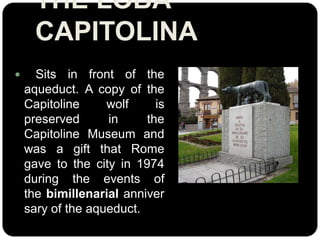
Sits in front of the
aqueduct. A copy of the
Capitoline
wolf
is
preserved
in
the
Capitoline Museum and
was a gift that Rome
gave to the city in 1974
during the events of
the bimillenarial anniver
sary of the aqueduct.
In Segovia we have a large number
of monasteries and churches:

Veracruz

San Martin
Monasterio of the Parral.

It was founded by Henry IV
and was under the
protectorate of Juan
Pacheco, Marquis of
Villena.

Convent of Discalced
Carmelites
Next to the Sanctuary of
the Fuencisla this convent
founded by St. John of the
Cross in 1558
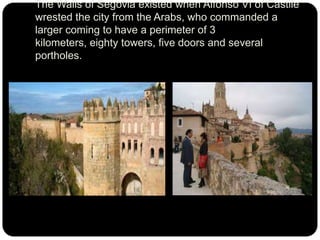
Walls of Segovia to the height of
the Garden of the Poets
The Walls of Segovia existed when Alfonso VI of Castile
wrested the city from the Arabs, who commanded a
larger coming to have a perimeter of 3
kilometers, eighty towers, five doors and several
portholes.
With respect to their inputs, in the sixteenth century
came to have a total of thirteen, distributed along its
perimeter to the rate of five doors (of which three have
been preserved)

Segovia Óscar 1 E

  • 1.
  • 2.
       Location : It lieswithin the Iberian Peninsula, near Valladolid, and Madrid, capital of Spain, which allows to reach it easily. The province of Segovia is one of nine that make up the autonomous community of Castilla and León. Bordered on the north by Burgos and Valladolid, Ávila to the west, south to Madrid and Guadalajara and
  • 3.
    ALCAZAR OF SEGOVIA  Alcazar,viewed from the south, outside of the city  VIEW FROM VERACRUZ
  • 4.
    Royal palace locatedon top of a rock , is documented for the first time in 1122. It was one of the favorite residences of the kings of Castile, built in the transition from Romanesque to Gothic, and the Mudéjar decor highlighting its ample classroom. The building is structured around two courtyards and has two towers, the Keep and John II. It was one of the favorite residence of Isabel, Queen of Castile. Devastated by TOWER OF JUAN II DE CASTILLA
  • 5.
    THE CATHEDRAL It’s the last Gothic cathedralbuilt in Spain. It is considered the masterpiece of BasqueCastilian Gothic and is known as “The Lady of The Cathedrals”. The measures of the cathedral are 33 meters high, 50 meters wide and 105 meters long
  • 6.
  • 7.
    The Aqueduct of Segoviais the most important piece of Roman civil engineering in Spain and one of the most significant and best preserved of those who left the Roman monuments on the Iberian Peninsula.
  • 8.
    THE LOBA CAPITOLINA  Sits infront of the aqueduct. A copy of the Capitoline wolf is preserved in the Capitoline Museum and was a gift that Rome gave to the city in 1974 during the events of the bimillenarial anniver sary of the aqueduct.
  • 9.
    In Segovia wehave a large number of monasteries and churches: Veracruz San Martin
  • 10.
    Monasterio of theParral. It was founded by Henry IV and was under the protectorate of Juan Pacheco, Marquis of Villena. Convent of Discalced Carmelites Next to the Sanctuary of the Fuencisla this convent founded by St. John of the Cross in 1558
  • 11.
    Walls of Segoviato the height of the Garden of the Poets
  • 12.
    The Walls ofSegovia existed when Alfonso VI of Castile wrested the city from the Arabs, who commanded a larger coming to have a perimeter of 3 kilometers, eighty towers, five doors and several portholes.
  • 13.
    With respect totheir inputs, in the sixteenth century came to have a total of thirteen, distributed along its perimeter to the rate of five doors (of which three have been preserved)