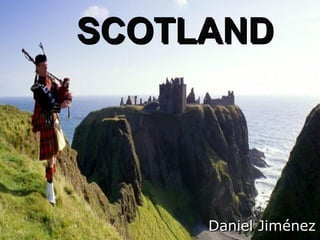
SCOTLAND

Daniel Jiménez
Geography of Scotland
The geography of Scotland is highly varied, 
from rural lowlands to barren uplands, and 
from large cities to uninhabited islands. 
Located in Northern 
Europe, Scotland comprises the northern 
one third of the island of Great Britain as 
well as 790 surrounding islands 
encompassing the major archipelagoes of 
the Shetland Islands, Orkney Islands and 
the Inner and Outer Hebrides. 
         Scotland's only land border is 
with England, which runs for 96 kilometres 
in a north easterly direction from 
the Solway Firth in the west to the North 
Sea on the east coast. Separated by 
the North Channel, the island of Ireland lies 
30 kilometres from the southwest tip of the 
Scottish mainland. Norway is located 305 
kilometres to the northeast of Scotland 
across the North Sea. The Atlantic Ocean, 
which fringes the coastline of western and 
northern Scotland and its islands, 
influences the temperate, maritime climate 
of the country.
Culzean Castle
        Culzean Castle was built in stages between 1777 
and 1792. It incorporates a large drum tower 
with a circular saloon inside (which overlooks 
the sea), a grand oval staircase and a suite of 
well-appointed apartments. In 1945, the 
Kennedy family gave the castle and its grounds 
to the National Trust for Scotland. The clifftop 
castle lies within the Culzean Castle Country 
Park and is opened to the public. Since 1987, an 
illustration of the castle has featured on the 
reverse side of five pound notes issued by 
the Royal Bank of Scotland.
        Nowadays, The castle is used for 
accommodation and wedding ceremonies.
Balmoral Castle
Balmoral Castle is a large mansion. It
became a royal residence during the
reign of Queen Victoria I. The Castle
began to be built under the orders of
William Drummond in 1390. The
castle was involved in the coronation
King Jorge IV. Balmoral is known
today for being the summer residence
of Isabel II and the Duke of
Edinburgh. The castle became a royal
residence in 1848, when it was leased
to Queen Victoria I, great-great
grandmother of the current monarch.
Both liked the residence that they
decided to buy it for 30 thousand
pounds. Prince Consort. immediately
began to work to extend the Castle
from the 15th century and adapt it to
the needs of the Queen.
fraser castle
Castle Fraser is the more elaborate plant
z-shaped Castle of Scotland and one of
the largest "Sea Castle" the Castle rises
on an open, with farmland forest, which
includes a garden and two forest paths.
There is archaeological evidence showing
the existence of a previous to the current
Castle Square Tower. Fraser Castle was
built as a family house Fraser of
Muschalls, who lived there until 1921.
Then it was sold and restored as a
shooting range. Castle Fraser has recently
been used as a filming of a movie. Today
the castle is owned by the National Trust
for Scotland, and is open to the public. It
can also be rented for weddings.
Caerlaverock Castle
Caerlaverock Castle is a moated triangular
castle first built in the 13th century. It is
located on the southern coast of Scotland,
11 kilometres south of
Dumfries. Caerlaverock was a stronghold
of the Maxwell family from the 13th
century until the 17th century when the
castle was abandoned. It was besieged by
the English during the Wars of Scottish
Independence , and underwent several
partial demolitions and reconstructions
over the 14th and 15th centuries. Although
demolished and rebuilt several times, the
castle retains the distinctive triangular plan
first laid out in the 13th century.
Today, the castle is in the care of Historic
Scotland and is a popular tourist attraction.
Loch ness
Loch Ness is an extensive and
deep freshwater lake located in the
Highlands. This Lake is part of the
series of lakes in Scotland that
were carved by glaciers during
past glaciations. Its waters have
low visibility due to the nearby
soils. It is the second largest lake
in Scotland, but due to its great
depth, it is of greater volume.
Loch Ness has a secret that has
never been descrifrado: Nessie, a
strange creature that is said that it
inhabits this deep lake. He was
never confirmed if it exists or not,
but many witnesses claiming to
have seen him support his
existence.
Music of Scotland
Scotland is internationally known for its
traditional music, which has remained vibrant
throughout the 21st Century. Scotland's national
instrument, the bagpipes, appears in many
different forms, from pipe bands and traditional
folk and ceilidh bands to solo performances,
buskers and as an accompaniment to Highland
dancing.

Although this particular form of bagpipe developed
exclusively in Scotland, it is not the only
Scottish bagpipe, and other bagpiping traditions
remain across Europe. The earliest mention of
bagpipes in Scotland dates to the 15th century
although they could have been introduced to
Scotland as early as the 6th century.
National Gallery of Scotland
The National Gallery of Scotland is the
National Gallery of art in Scotland. It is on
The Mound, in the Centre of Edinburgh, in
a neoclassical building. The National
Gallery of Scotland is home to permanent
collections of European art and also hosts
exhibitions of large-scale (Monet, the
Titian and even Gauguin) in collaboration
with its neighbour the Royal Scottish
Academy. To discover the last five
thousand years of Scottish history in
portraits, visit the Scottish National
Portrait Gallery: Robert Burns and Sean
Connery
The end

Scotland Daniel 1 E