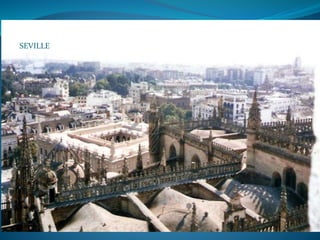
SEVILLE
The city was founded by Julio Cesar in 206 b.C. as Colonia Iulia Romula Hispalis. Its
original name was Spal, but the name of Seville cames from de arabian name Isbiliya
at the Medieval Age.
Its flag is known with de word NODO (knot in latin) ; and its coat of arms is a
representation of the king Fernando III, conqueror of the city in 1248, and the
visigothic bishops Saint Isidoro and Leandro of Seville.
Seville is the capital of Andalucia and have more than 700000 people, It has one of
the oldest universities in Spain from 1505, and was the principal trade centre with
America.
Seville is the city with the biggest historical center in Europe, with the longer list of
monuments protected of European cities. For that reason, now is World Heritage of
UNESCO.
Seville allowed the Universal Exposure in 1992 and had the first High Speed Train
(AVE) in Spain. The buildings of the Expo was converted in tecnological park
(Cartuja 93) ,university buildings and the amusement park “Isla Magica”.
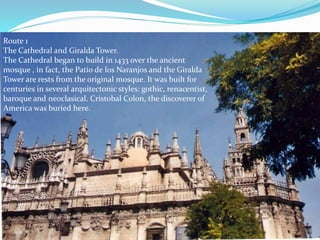
Route 1
The Cathedral and Giralda Tower.
The Cathedral began to build in 1433 over the ancient
mosque , in fact, the Patio de los Naranjos and the Giralda
Tower are rests from the original mosque. It was built for
centuries in several arquitectonic styles: gothic, renacentist,
baroque and neoclasical. Cristobal Colon, the discoverer of
America was buried here.
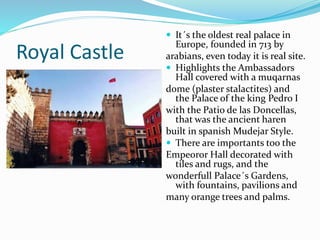
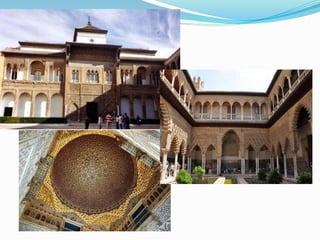
Royal Castle
 It´s the oldest real palace in
Europe, founded in 713 by
arabians, even today it is real site.
 Highlights the Ambassadors
Hall covered with a muqarnas
dome (plaster stalactites) and
the Palace of the king Pedro I
with the Patio de las Doncellas,
that was the ancient haren
built in spanish Mudejar Style.
 There are importants too the
Empeoror Hall decorated with
tiles and rugs, and the
wonderfull Palace´s Gardens,
with fountains, pavilions and
many orange trees and palms.
Route 2
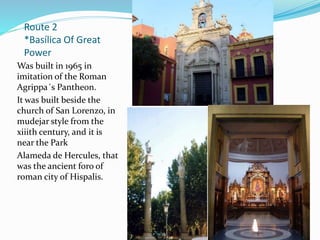
*Basílica Of Great
Power
Was built in 1965 in
imitation of the Roman
Agrippa´s Pantheon.
It was built beside the
church of San Lorenzo, in
mudejar style from the
xiiith century, and it is
near the Park
Alameda de Hercules, that
was the ancient foro of
roman city of Hispalis.
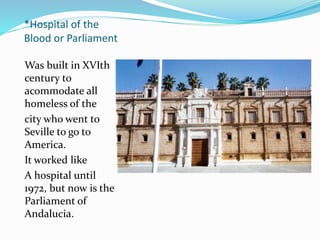
*Hospital of the
Blood or Parliament
Was built in XVIth
century to
acommodate all
homeless of the
city who went to
Seville to go to
America.
It worked like
A hospital until
1972, but now is the
Parliament of
Andalucia.
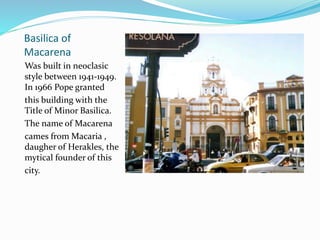
Basilica of
Macarena
Was built in neoclasic
style between 1941-1949.
In 1966 Pope granted
this building with the
Title of Minor Basilica.
The name of Macarena
cames from Macaria ,
daugher of Herakles, the
mytical founder of this
city.
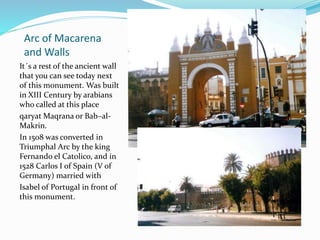
Arc of Macarena
and Walls
It´s a rest of the ancient wall
that you can see today next
of this monument. Was built
in XIII Century by arabians
who called at this place
qaryat Maqrana or Bab–al-
Makrin.
In 1508 was converted in
Triumphal Arc by the king
Fernando el Catolico, and in
1528 Carlos I of Spain (V of
Germany) married with
Isabel of Portugal in front of
this monument.
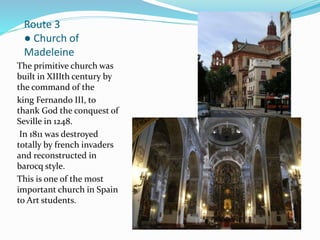
Route 3
● Church of
Madeleine
The primitive church was
built in XIIIth century by
the command of the
king Fernando III, to
thank God the conquest of
Seville in 1248.
In 1811 was destroyed
totally by french invaders
and reconstructed in
barocq style.
This is one of the most
important church in Spain
to Art students.
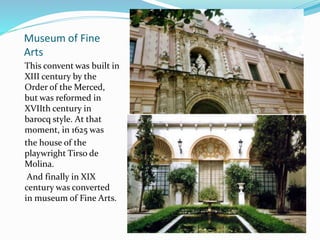
Museum of Fine
Arts
This convent was built in
XIII century by the
Order of the Merced,
but was reformed in
XVIIth century in
barocq style. At that
moment, in 1625 was
the house of the
playwright Tirso de
Molina.
And finally in XIX
century was converted
in museum of Fine Arts.
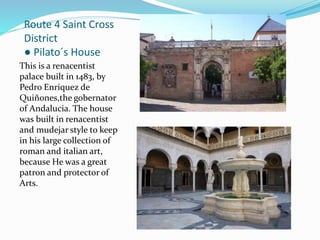
Route 4 Saint Cross
District
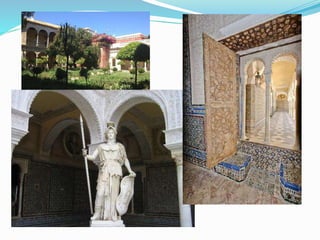
● Pilato´s House
This is a renacentist
palace built in 1483, by
Pedro Enriquez de
Quiñones,the gobernator
of Andalucia. The house
was built in renacentist
and mudejar style to keep
in his large collection of
roman and italian art,
because He was a great
patron and protector of
Arts.
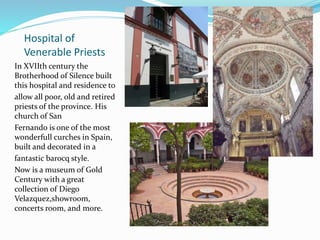
Hospital of
Venerable Priests
In XVIIth century the
Brotherhood of Silence built
this hospital and residence to
allow all poor, old and retired
priests of the province. His
church of San
Fernando is one of the most
wonderfull curches in Spain,
built and decorated in a
fantastic barocq style.
Now is a museum of Gold
Century with a great
collection of Diego
Velazquez,showroom,
concerts room, and more.
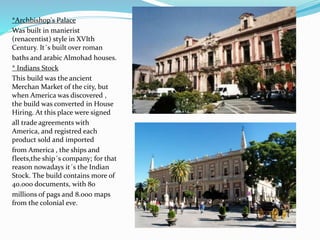
*Archbishop's Palace
Was built in manierist
(renacentist) style in XVIth
Century. It´s built over roman
baths and arabic Almohad houses.
* Indians Stock
This build was the ancient
Merchan Market of the city, but
when America was discovered ,
the build was converted in House
Hiring. At this place were signed
all trade agreements with
America, and registred each
product sold and imported
from America , the ships and
fleets,the ship´s company; for that
reason nowadays it´s the Indian
Stock. The build contains more of
40.000 documents, with 80
millions of pags and 8.000 maps
from the colonial eve.
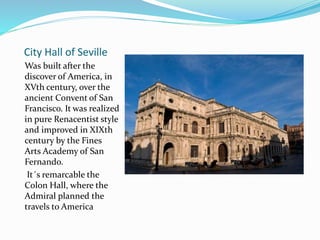
City Hall of Seville
Was built after the
discover of America, in
XVth century, over the
ancient Convent of San
Francisco. It was realized
in pure Renacentist style
and improved in XIXth
century by the Fines
Arts Academy of San
Fernando.
It´s remarcable the
Colon Hall, where the
Admiral planned the
travels to America
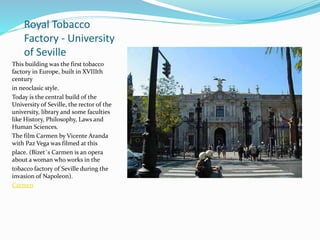
Royal Tobacco
Factory - University
of Seville
This building was the first tobacco
factory in Europe, built in XVIIIth
century
in neoclasic style.
Today is the central build of the
University of Seville, the rector of the
university, library and some faculties
like History, Philosophy, Laws and
Human Sciences.
The film Carmen by Vicente Aranda
with Paz Vega was filmed at this
place. (Bizet´s Carmen is an opera
about a woman who works in the
tobacco factory of Seville during the
invasion of Napoleon).
Carmen
Route 5 Near the
River
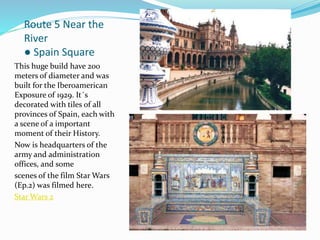
● Spain Square
This huge build have 200
meters of diameter and was
built for the Iberoamerican
Exposure of 1929. It´s
decorated with tiles of all
provinces of Spain, each with
a scene of a important
moment of their History.
Now is headquarters of the
army and administration
offices, and some
scenes of the film Star Wars
(Ep.2) was filmed here.
Star Wars 2
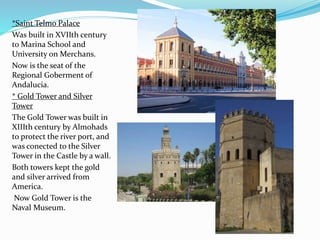
*Saint Telmo Palace
Was built in XVIIth century
to Marina School and
University on Merchans.
Now is the seat of the
Regional Goberment of
Andalucia.
* Gold Tower and Silver
Tower
The Gold Tower was built in
XIIIth century by Almohads
to protect the river port, and
was conected to the Silver
Tower in the Castle by a wall.
Both towers kept the gold
and silver arrived from
America.
Now Gold Tower is the
Naval Museum.
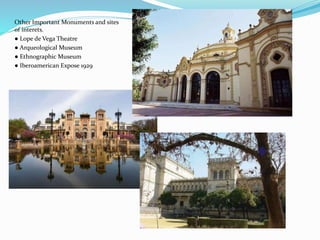
Other Important Monuments and sites
of interets.
● Lope de Vega Theatre
● Arqueological Museum
● Ethnographic Museum
● Iberoamerican Expose 1929
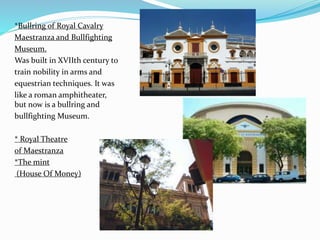
*Bullring of Royal Cavalry
Maestranza and Bullfighting
Museum.
Was built in XVIIth century to
train nobility in arms and
equestrian techniques. It was
like a roman amphitheater,
but now is a bullring and
bullfighting Museum.
* Royal Theatre
of Maestranza
*The mint
(House Of Money)

Seville

  • 1.
  • 2.
    The city wasfounded by Julio Cesar in 206 b.C. as Colonia Iulia Romula Hispalis. Its original name was Spal, but the name of Seville cames from de arabian name Isbiliya at the Medieval Age. Its flag is known with de word NODO (knot in latin) ; and its coat of arms is a representation of the king Fernando III, conqueror of the city in 1248, and the visigothic bishops Saint Isidoro and Leandro of Seville. Seville is the capital of Andalucia and have more than 700000 people, It has one of the oldest universities in Spain from 1505, and was the principal trade centre with America. Seville is the city with the biggest historical center in Europe, with the longer list of monuments protected of European cities. For that reason, now is World Heritage of UNESCO. Seville allowed the Universal Exposure in 1992 and had the first High Speed Train (AVE) in Spain. The buildings of the Expo was converted in tecnological park (Cartuja 93) ,university buildings and the amusement park “Isla Magica”.
  • 3.
    Route 1 The Cathedraland Giralda Tower. The Cathedral began to build in 1433 over the ancient mosque , in fact, the Patio de los Naranjos and the Giralda Tower are rests from the original mosque. It was built for centuries in several arquitectonic styles: gothic, renacentist, baroque and neoclasical. Cristobal Colon, the discoverer of America was buried here.
  • 4.
    Royal Castle  It´sthe oldest real palace in Europe, founded in 713 by arabians, even today it is real site.  Highlights the Ambassadors Hall covered with a muqarnas dome (plaster stalactites) and the Palace of the king Pedro I with the Patio de las Doncellas, that was the ancient haren built in spanish Mudejar Style.  There are importants too the Empeoror Hall decorated with tiles and rugs, and the wonderfull Palace´s Gardens, with fountains, pavilions and many orange trees and palms.
  • 6.
    Route 2 *Basílica OfGreat Power Was built in 1965 in imitation of the Roman Agrippa´s Pantheon. It was built beside the church of San Lorenzo, in mudejar style from the xiiith century, and it is near the Park Alameda de Hercules, that was the ancient foro of roman city of Hispalis.
  • 7.
    *Hospital of the Bloodor Parliament Was built in XVIth century to acommodate all homeless of the city who went to Seville to go to America. It worked like A hospital until 1972, but now is the Parliament of Andalucia.
  • 8.
    Basilica of Macarena Was builtin neoclasic style between 1941-1949. In 1966 Pope granted this building with the Title of Minor Basilica. The name of Macarena cames from Macaria , daugher of Herakles, the mytical founder of this city.
  • 9.
    Arc of Macarena andWalls It´s a rest of the ancient wall that you can see today next of this monument. Was built in XIII Century by arabians who called at this place qaryat Maqrana or Bab–al- Makrin. In 1508 was converted in Triumphal Arc by the king Fernando el Catolico, and in 1528 Carlos I of Spain (V of Germany) married with Isabel of Portugal in front of this monument.
  • 10.
    Route 3 ● Churchof Madeleine The primitive church was built in XIIIth century by the command of the king Fernando III, to thank God the conquest of Seville in 1248. In 1811 was destroyed totally by french invaders and reconstructed in barocq style. This is one of the most important church in Spain to Art students.
  • 11.
    Museum of Fine Arts Thisconvent was built in XIII century by the Order of the Merced, but was reformed in XVIIth century in barocq style. At that moment, in 1625 was the house of the playwright Tirso de Molina. And finally in XIX century was converted in museum of Fine Arts.
  • 12.
    Route 4 SaintCross District ● Pilato´s House This is a renacentist palace built in 1483, by Pedro Enriquez de Quiñones,the gobernator of Andalucia. The house was built in renacentist and mudejar style to keep in his large collection of roman and italian art, because He was a great patron and protector of Arts.
  • 14.
    Hospital of Venerable Priests InXVIIth century the Brotherhood of Silence built this hospital and residence to allow all poor, old and retired priests of the province. His church of San Fernando is one of the most wonderfull curches in Spain, built and decorated in a fantastic barocq style. Now is a museum of Gold Century with a great collection of Diego Velazquez,showroom, concerts room, and more.
  • 15.
    *Archbishop's Palace Was builtin manierist (renacentist) style in XVIth Century. It´s built over roman baths and arabic Almohad houses. * Indians Stock This build was the ancient Merchan Market of the city, but when America was discovered , the build was converted in House Hiring. At this place were signed all trade agreements with America, and registred each product sold and imported from America , the ships and fleets,the ship´s company; for that reason nowadays it´s the Indian Stock. The build contains more of 40.000 documents, with 80 millions of pags and 8.000 maps from the colonial eve.
  • 16.
    City Hall ofSeville Was built after the discover of America, in XVth century, over the ancient Convent of San Francisco. It was realized in pure Renacentist style and improved in XIXth century by the Fines Arts Academy of San Fernando. It´s remarcable the Colon Hall, where the Admiral planned the travels to America
  • 17.
    Royal Tobacco Factory -University of Seville This building was the first tobacco factory in Europe, built in XVIIIth century in neoclasic style. Today is the central build of the University of Seville, the rector of the university, library and some faculties like History, Philosophy, Laws and Human Sciences. The film Carmen by Vicente Aranda with Paz Vega was filmed at this place. (Bizet´s Carmen is an opera about a woman who works in the tobacco factory of Seville during the invasion of Napoleon). Carmen
  • 18.
    Route 5 Nearthe River ● Spain Square This huge build have 200 meters of diameter and was built for the Iberoamerican Exposure of 1929. It´s decorated with tiles of all provinces of Spain, each with a scene of a important moment of their History. Now is headquarters of the army and administration offices, and some scenes of the film Star Wars (Ep.2) was filmed here. Star Wars 2
  • 19.
    *Saint Telmo Palace Wasbuilt in XVIIth century to Marina School and University on Merchans. Now is the seat of the Regional Goberment of Andalucia. * Gold Tower and Silver Tower The Gold Tower was built in XIIIth century by Almohads to protect the river port, and was conected to the Silver Tower in the Castle by a wall. Both towers kept the gold and silver arrived from America. Now Gold Tower is the Naval Museum.
  • 20.
    Other Important Monumentsand sites of interets. ● Lope de Vega Theatre ● Arqueological Museum ● Ethnographic Museum ● Iberoamerican Expose 1929
  • 21.
    *Bullring of RoyalCavalry Maestranza and Bullfighting Museum. Was built in XVIIth century to train nobility in arms and equestrian techniques. It was like a roman amphitheater, but now is a bullring and bullfighting Museum. * Royal Theatre of Maestranza *The mint (House Of Money)