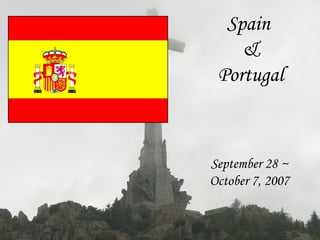
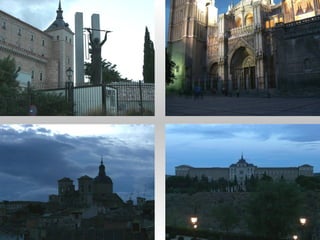
Spain
    &
 Portugal


September 28 ~
October 7, 2007
Spain
   &
Portugal


           September 28 ~
           October 7, 2007
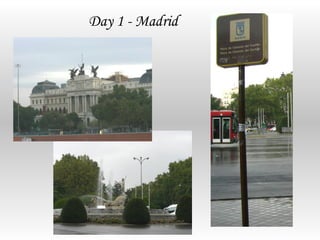
Day 1 - Madrid
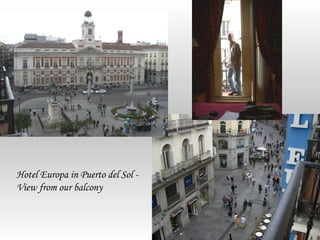
Hotel Europa in Puerto del Sol -
View from our balcony
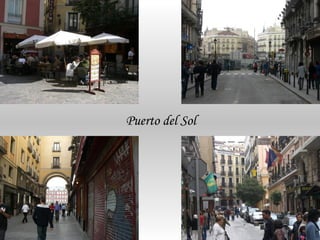
Puerto del Sol
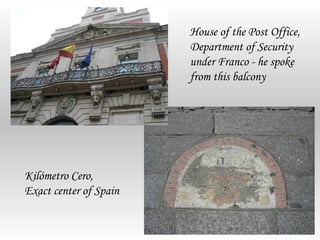
House of the Post Office,
                        Department of Security
                        under Franco - he spoke
                        from this balcony


Kilómetro Cero,
Exact center of Spain
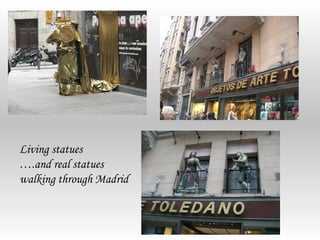
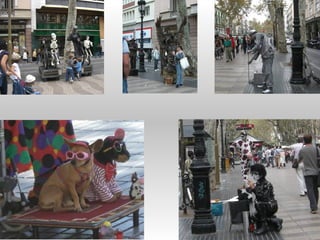
Living statues
….and real statues
walking through Madrid
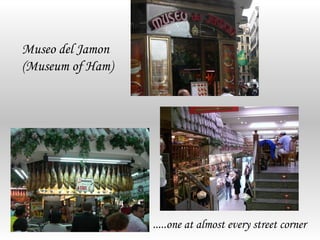
Museo del Jamon
(Museum of Ham)


                  .....one at almost every street corner
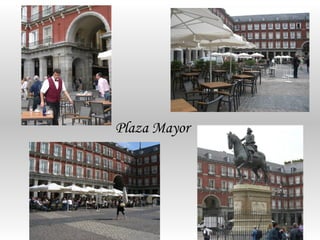
Plaza Mayor
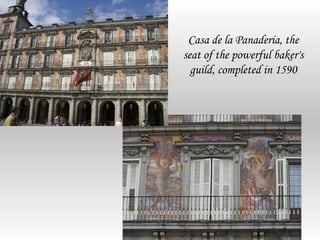
Casa de la Panaderia, the
seat of the powerful baker's
  guild, completed in 1590
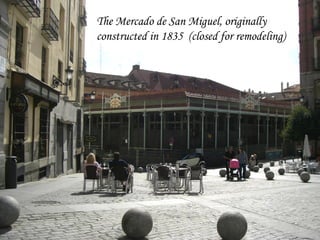
The Mercado de San Miguel, originally
constructed in 1835 (closed for remodeling)
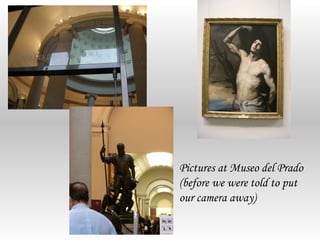
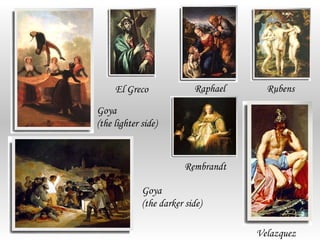
Pictures at Museo del Prado
(before we were told to put
our camera away)
El Greco              Raphael     Rubens

Goya
(the lighter side)


                         Rembrandt

             Goya
             (the darker side)

                                     Velazquez
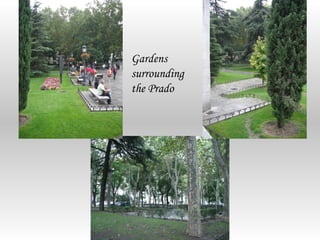
Gardens
surrounding
the Prado
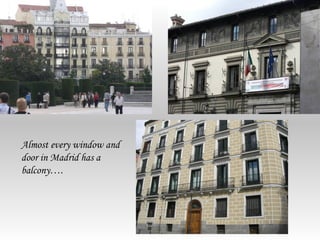
Almost every window and
door in Madrid has a
balcony….
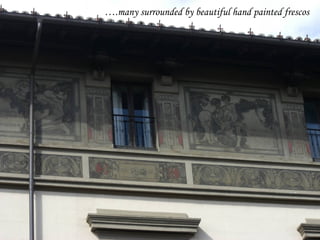
….many surrounded by beautiful hand painted frescos
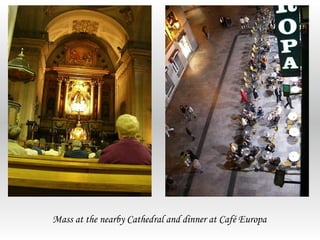
Mass at the nearby Cathedral and dinner at Café Europa
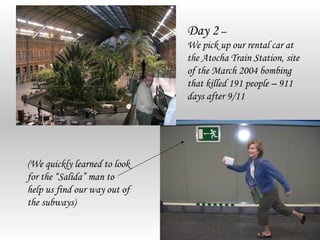
Day 2 –
                              We pick up our rental car at
                              the Atocha Train Station, site
                              of the March 2004 bombing
                              that killed 191 people – 911
                              days after 9/11


(We quickly learned to look
for the “Salida” man to
help us find our way out of
the subways)
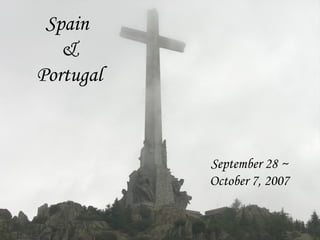
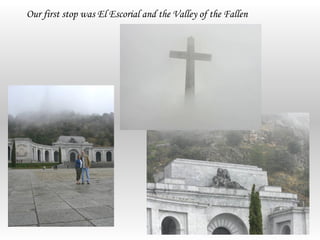
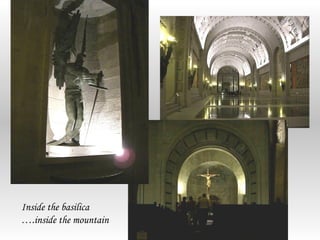
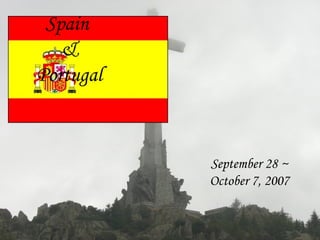
Our first stop was El Escorial and the Valley of the Fallen
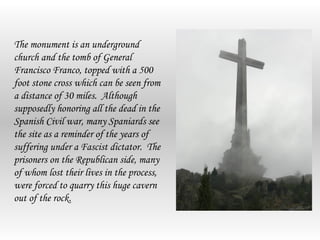
The monument is an underground
church and the tomb of General
Francisco Franco, topped with a 500
foot stone cross which can be seen from
a distance of 30 miles. Although
supposedly honoring all the dead in the
Spanish Civil war, many Spaniards see
the site as a reminder of the years of
suffering under a Fascist dictator. The
prisoners on the Republican side, many
of whom lost their lives in the process,
were forced to quarry this huge cavern
out of the rock.
Inside the basilica
….inside the mountain
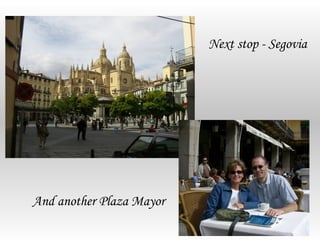
Next stop - Segovia


And another Plaza Mayor
Segovia is Spain and Castile at its best - twisting alleyways, the highest
concentration of Romanesque churches in all of Europe, pedestrian streets
where no cars are allowed, all surrounded by the city's medieval wall. On
the northwest extreme of the wall is the famous Alcázar castle where
Queen Isabel promised Columbus the financial backing he needed to
discover America. On the southeast end is the world renowned Roman
aqueduct, the longest and best preserved of its kind anywhere.
The tallest building in Segovia is still the
16th-century Cathedral, a
prominent landmark as one
approaches from any
direction.
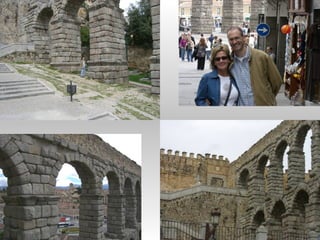
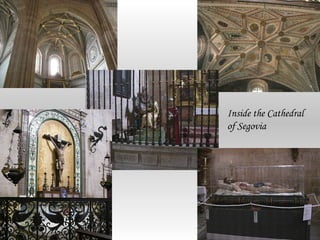
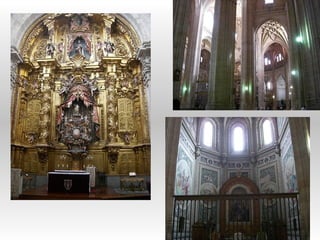
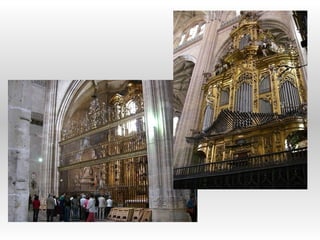
Inside the Cathedral
of Segovia
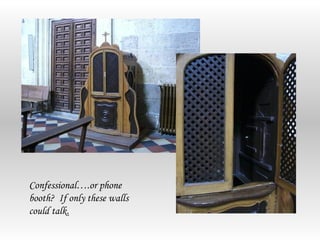
Confessional….or phone
booth? If only these walls
could talk.
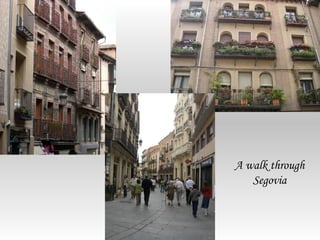
A walk through
   Segovia
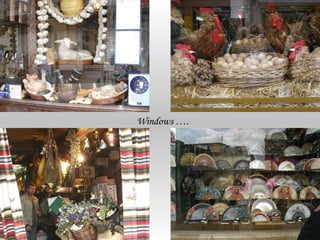
Windows ….
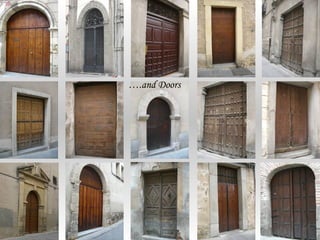
….and Doors
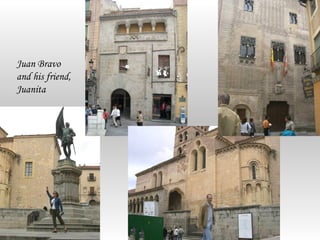
Juan Bravo
and his friend,
Juanita
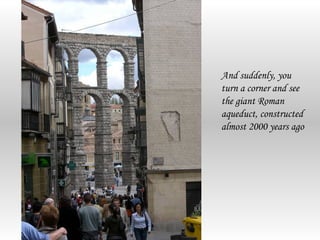
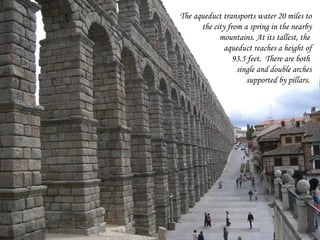
And suddenly, you
turn a corner and see
the giant Roman
aqueduct, constructed
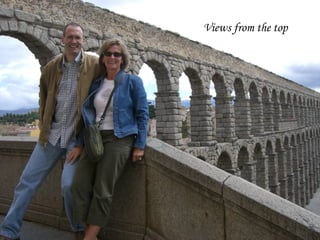
almost 2000 years ago
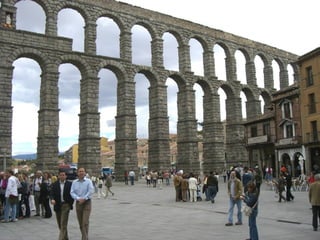
The aqueduct transports water 20 miles to
      the city from a spring in the nearby
            mountains. At its tallest, the
              aqueduct reaches a height of
                 93.5 feet. There are both
                  single and double arches
                     supported by pillars.
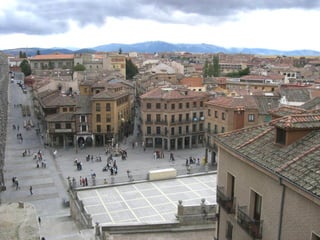
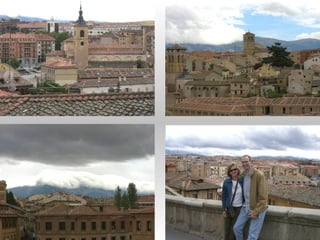
Views from the top
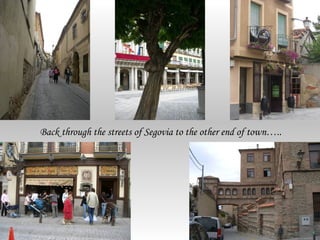
Back through the streets of Segovia to the other end of town…..
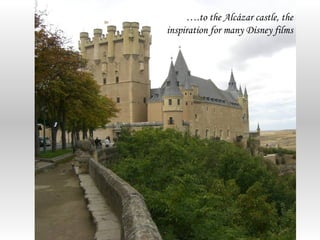
….to the Alcázar castle, the
inspiration for many Disney films
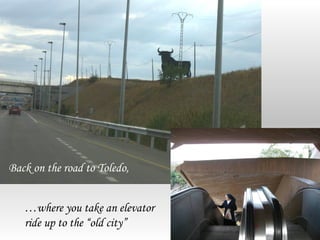
Back on the road to Toledo,


   …where you take an elevator
   ride up to the “old city”
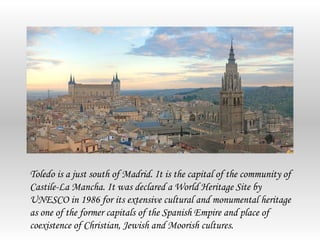
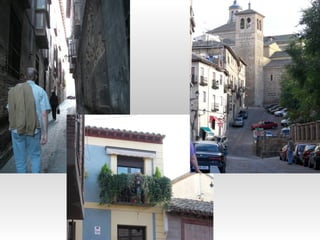
Toledo is a just south of Madrid. It is the capital of the community of
Castile-La Mancha. It was declared a World Heritage Site by
UNESCO in 1986 for its extensive cultural and monumental heritage
as one of the former capitals of the Spanish Empire and place of
coexistence of Christian, Jewish and Moorish cultures.
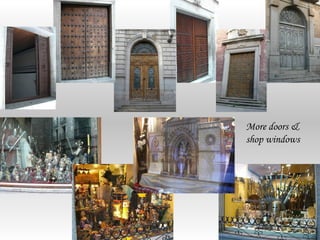
More doors &
shop windows
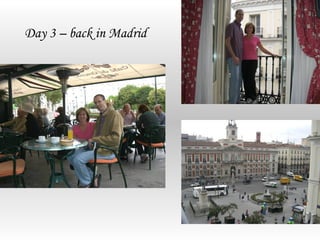
Day 3 – back in Madrid
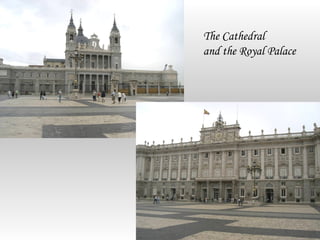
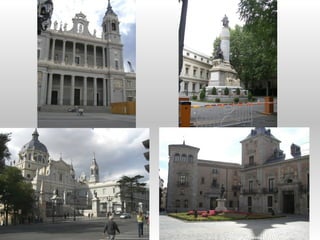
The Cathedral
and the Royal Palace
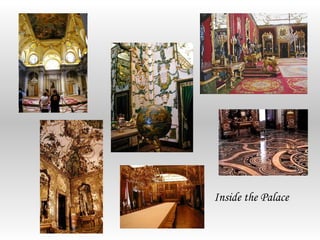
Inside the Palace
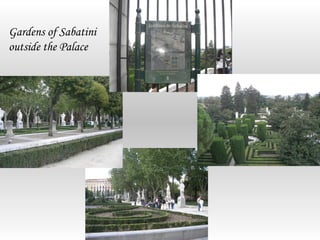
Gardens of Sabatini
outside the Palace
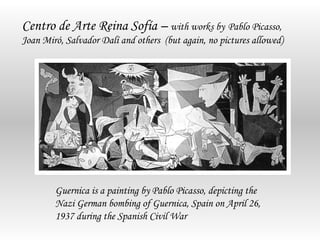
Centro de Arte Reina Sofía – with works by Pablo Picasso,
Joan Miró, Salvador Dalí and others (but again, no pictures allowed)


        Guernica is a painting by Pablo Picasso, depicting the
        Nazi German bombing of Guernica, Spain on April 26,
        1937 during the Spanish Civil War
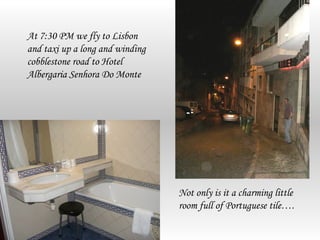
At 7:30 PM we fly to Lisbon
and taxi up a long and winding
cobblestone road to Hotel
Albergaria Senhora Do Monte


                                 Not only is it a charming little
                                 room full of Portuguese tile….
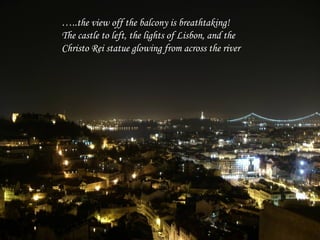
…..the view off the balcony is breathtaking!
The castle to left, the lights of Lisbon, and the
Christo Rei statue glowing from across the river
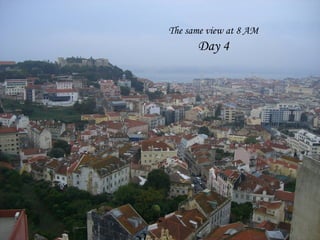
The same view at 8 AM
      Day 4
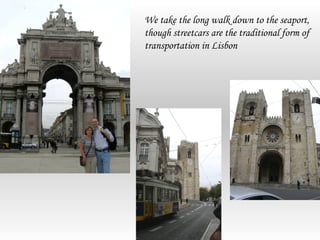
We take the long walk down to the seaport,
though streetcars are the traditional form of
transportation in Lisbon
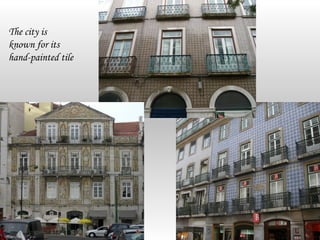
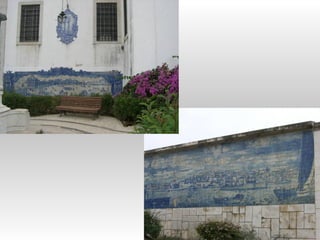
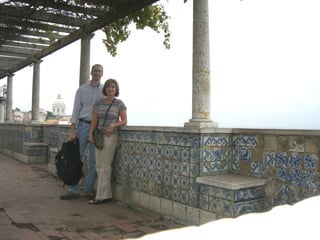
The city is
known for its
hand-painted tile
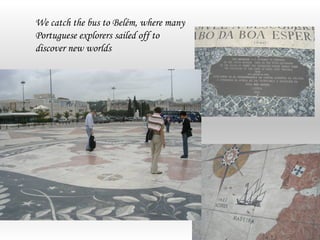
We catch the bus to Belém, where many
Portuguese explorers sailed off to
discover new worlds
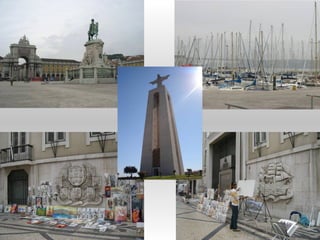
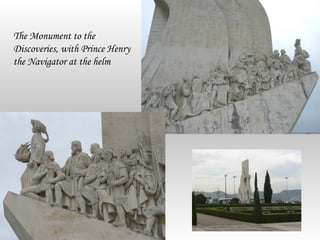
The Monument to the
Discoveries, with Prince Henry
the Navigator at the helm
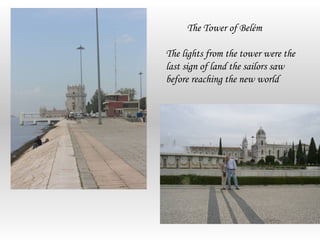
The Tower of Belém

The lights from the tower were the
last sign of land the sailors saw
before reaching the new world
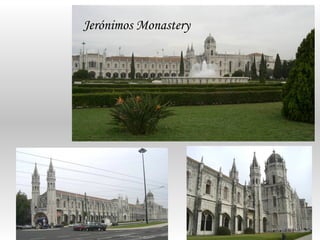
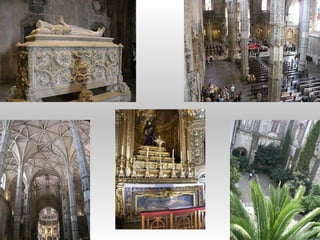
Jerónimos Monastery
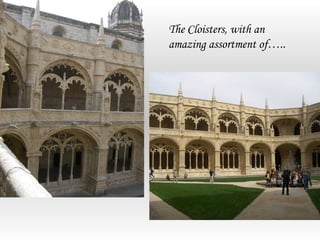
The Cloisters, with an
amazing assortment of…..
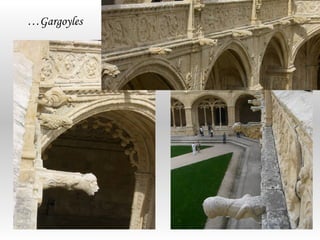
…Gargoyles
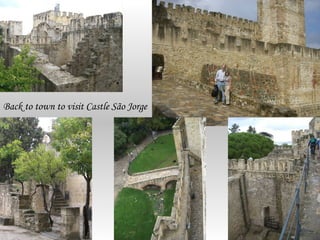
Back to town to visit Castle São Jorge
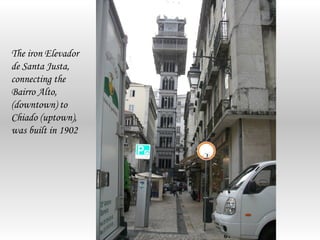
The iron Elevador
de Santa Justa,
connecting the
Bairro Alto,
(downtown) to
Chiado (uptown),
was built in 1902
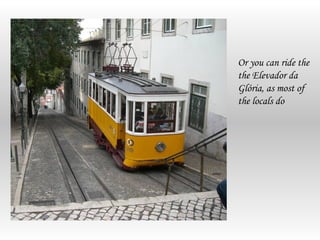
Or you can ride the
the Elevador da
Glória, as most of
the locals do
The statue of
Lisbon’s favorite
poet, Fernando
Pessoa, sitting at
his favorite café, the
famous Café A
Brasileira
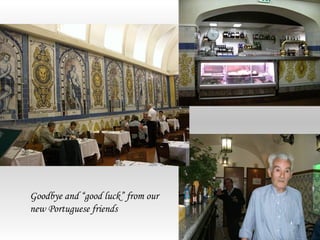
Goodbye and “good luck” from our
new Portuguese friends
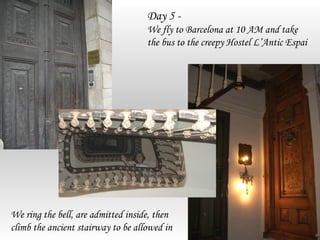
Day 5 -
                                    We fly to Barcelona at 10 AM and take
                                    the bus to the creepy Hostel L’Antic Espai


We ring the bell, are admitted inside, then
climb the ancient stairway to be allowed in
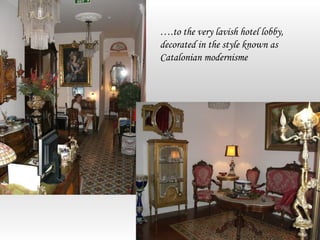
….to the very lavish hotel lobby,
decorated in the style known as
Catalonian modernisme
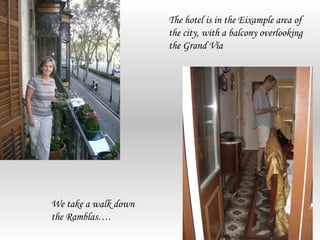
The hotel is in the Eixample area of
                      the city, with a balcony overlooking
                      the Grand Vía


We take a walk down
the Ramblas….
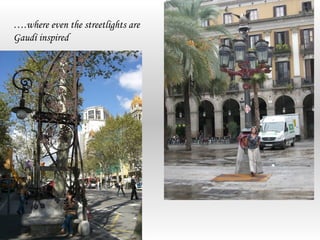
….where even the streetlights are
Gaudí inspired
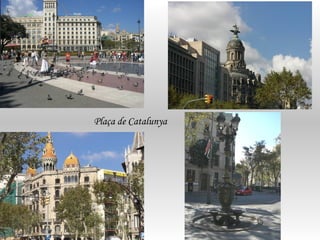
Plaça de Catalunya
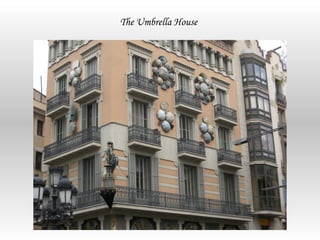
The Umbrella House
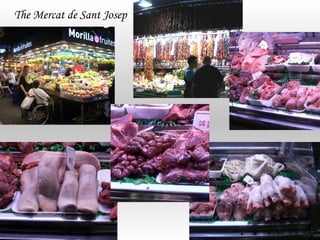
The Mercat de Sant Josep
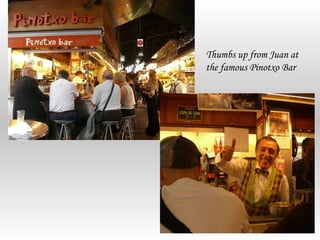
Thumbs up from Juan at
the famous Pinotxo Bar
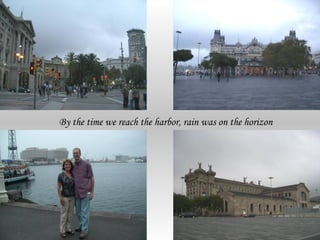
By the time we reach the harbor, rain was on the horizon
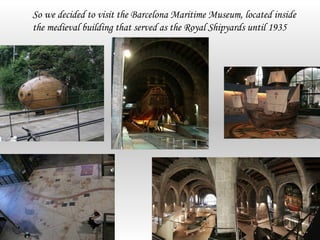
So we decided to visit the Barcelona Maritime Museum, located inside
the medieval building that served as the Royal Shipyards until 1935
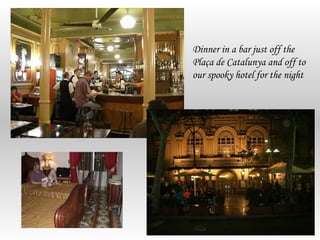
Dinner in a bar just off the
Plaça de Catalunya and off to
our spooky hotel for the night
Day 6 –
Breakfast at the
Café Zurich in
Plaça de Catalunya
At 11, we meet in Plaça Reial to go on the Fat Tire Bicycle Tour
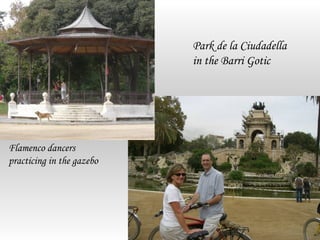
Park de la Ciudadella
                           in the Barri Gotic


Flamenco dancers
practicing in the gazebo
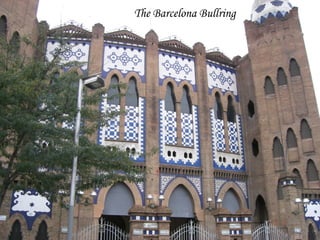
The Barcelona Bullring
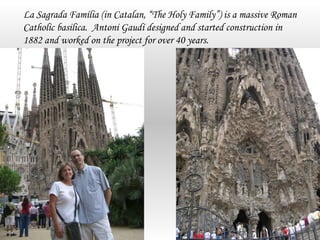
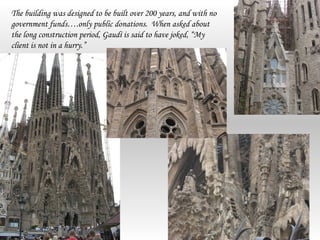
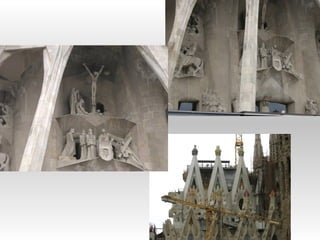
La Sagrada Família (in Catalan, “The Holy Family”) is a massive Roman
Catholic basilica. Antoni Gaudí designed and started construction in
1882 and worked on the project for over 40 years.
The building was designed to be built over 200 years, and with no
government funds….only public donations. When asked about
the long construction period, Gaudí is said to have joked, “My
client is not in a hurry.”
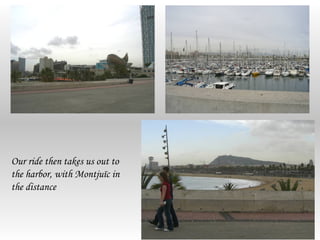
Our ride then takes us out to
the harbor, with Montjuïc in
the distance
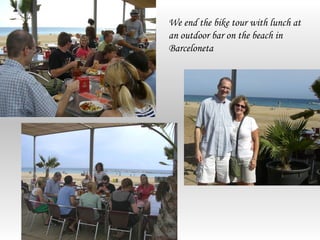
We end the bike tour with lunch at
an outdoor bar on the beach in
Barceloneta
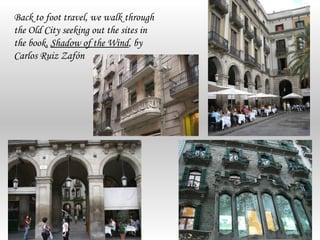
Back to foot travel, we walk through
the Old City seeking out the sites in
the book, Shadow of the Wind, by
Carlos Ruiz Zafón
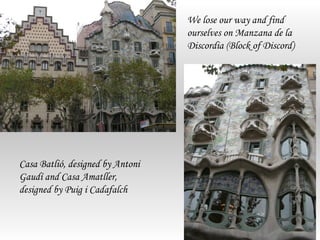
We lose our way and find
                                  ourselves on Manzana de la
                                  Discordia (Block of Discord)


Casa Batlió, designed by Antoni
Gaudí and Casa Amatller,
designed by Puig i Cadafalch
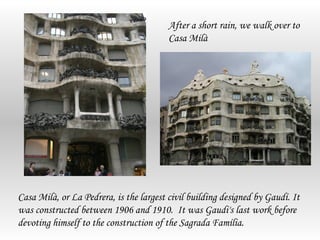
After a short rain, we walk over to
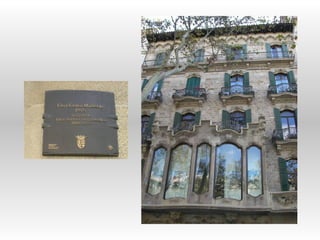
                                         Casa Milà


Casa Milà, or La Pedrera, is the largest civil building designed by Gaudí. It
was constructed between 1906 and 1910. It was Gaudi's last work before
devoting himself to the construction of the Sagrada Família.
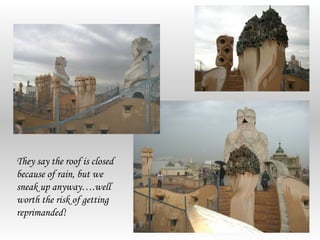
They say the roof is closed
because of rain, but we
sneak up anyway….well
worth the risk of getting
reprimanded!
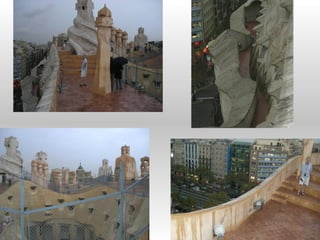
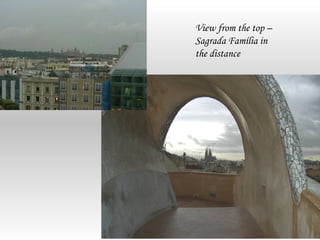
View from the top –
Sagrada Família in
the distance
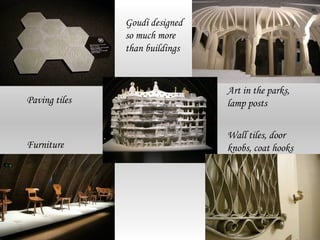
Goudí designed
               so much more
               than buildings


                                Art in the parks,
Paving tiles                    lamp posts

                                Wall tiles, door
Furniture                       knobs, coat hooks
The hanging chain sculpture….


….with its mirror image,
was the inspiration for one of
Gaudí’s buildings
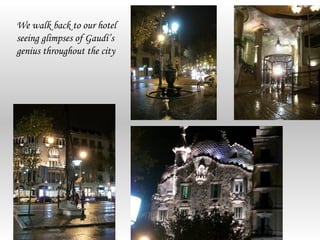
We walk back to our hotel
seeing glimpses of Gaudí’s
genius throughout the city
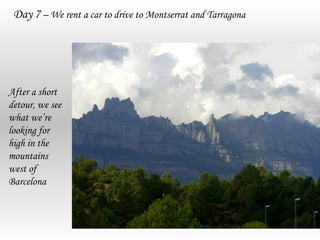
Day 7 – We rent a car to drive to Montserrat and Tarragona


After a short
detour, we see
what we’re
looking for
high in the
mountains
west of
Barcelona
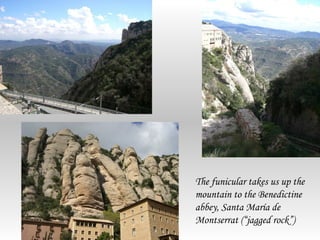
The funicular takes us up the
mountain to the Benedictine
abbey, Santa María de
Montserrat (“jagged rock”)
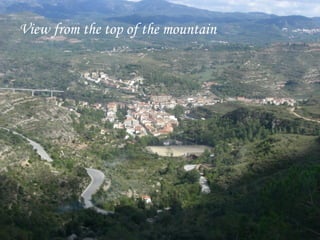
View from the top of the mountain
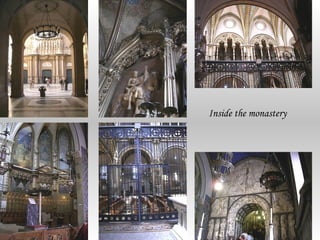
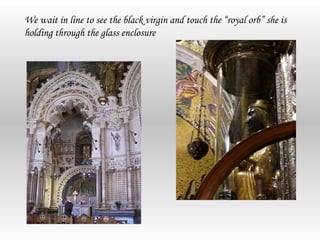
Inside the monastery
We wait in line to see the black virgin and touch the “royal orb” she is
holding through the glass enclosure
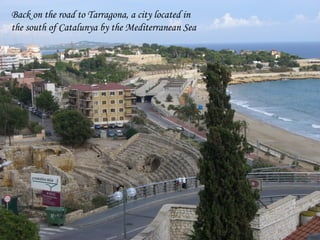
Back on the road to Tarragona, a city located in
the south of Catalunya by the Mediterranean Sea
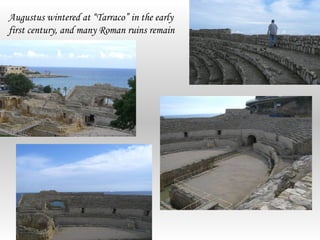
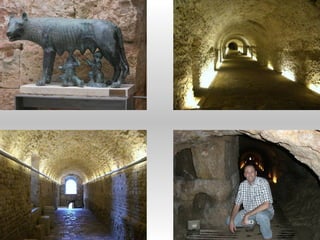
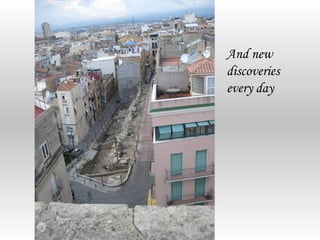
Augustus wintered at “Tarraco” in the early
first century, and many Roman ruins remain
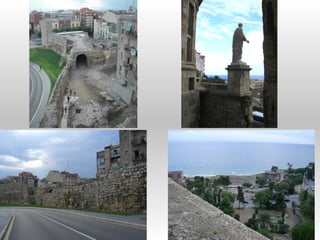
And new
discoveries
every day
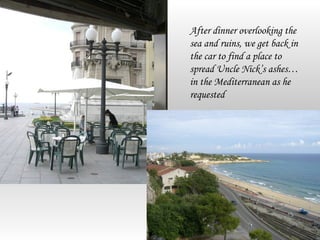
After dinner overlooking the
sea and ruins, we get back in
the car to find a place to
spread Uncle Nick’s ashes…
in the Mediterranean as he
requested
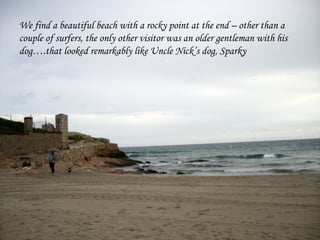
We find a beautiful beach with a rocky point at the end – other than a
couple of surfers, the only other visitor was an older gentleman with his
dog….that looked remarkably like Uncle Nick’s dog, Sparky
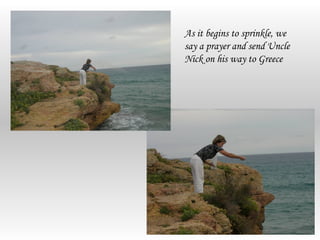
As it begins to sprinkle, we
say a prayer and send Uncle
Nick on his way to Greece
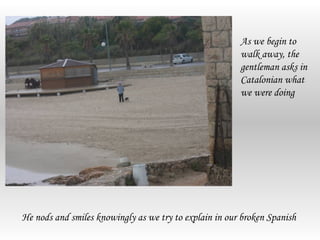
As we begin to
                                                        walk away, the
                                                        gentleman asks in
                                                        Catalonian what
                                                        we were doing


He nods and smiles knowingly as we try to explain in our broken Spanish
And as we drive back to Barcelona, the rain stops and the clouds
separate as if to open the gates of Heaven
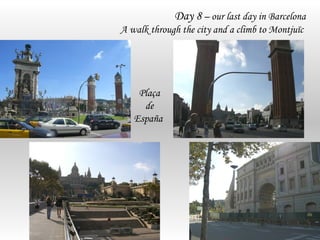
Day 8 – our last day in Barcelona
A walk through the city and a climb to Montjuïc


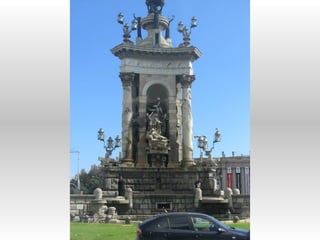
    Plaça
     de
   España
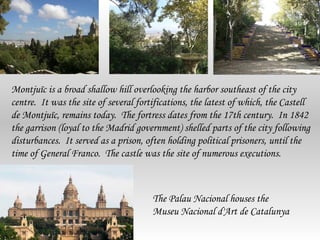
Montjuïc is a broad shallow hill overlooking the harbor southeast of the city
centre. It was the site of several fortifications, the latest of which, the Castell
de Montjuïc, remains today. The fortress dates from the 17th century. In 1842
the garrison (loyal to the Madrid government) shelled parts of the city following
disturbances. It served as a prison, often holding political prisoners, until the
time of General Franco. The castle was the site of numerous executions.


                                       The Palau Nacional houses the
                                       Museu Nacional d'Art de Catalunya
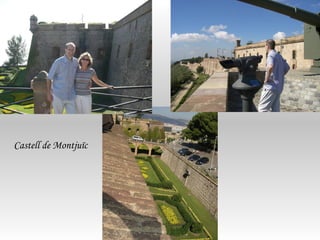
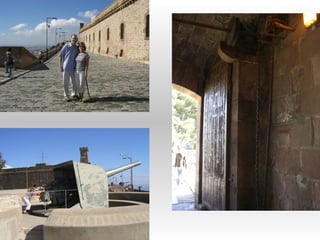
Castell de Montjuïc
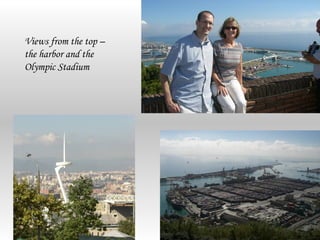
Views from the top –
the harbor and the
Olympic Stadium
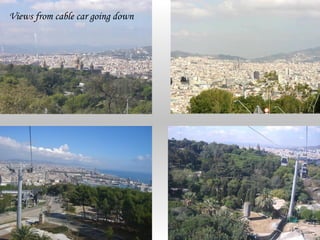
Views from cable car going down
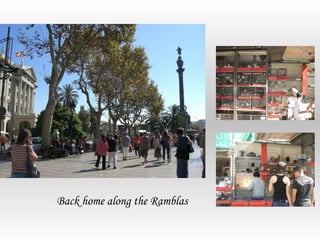
Back home along the Ramblas
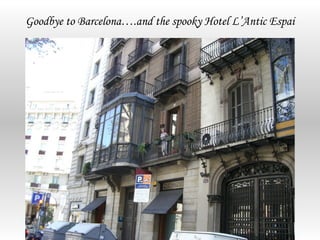
Goodbye to Barcelona….and the spooky Hotel L’Antic Espai
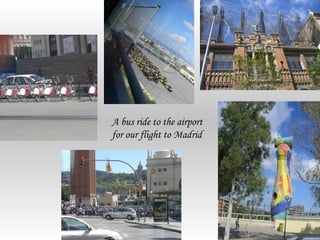
A bus ride to the airport
for our flight to Madrid
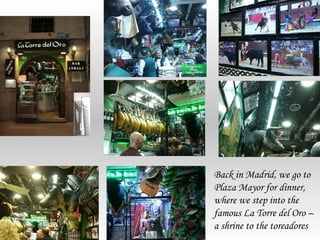
Back in Madrid, we go to
Plaza Mayor for dinner,
where we step into the
famous La Torre del Oro –
a shrine to the toreadores
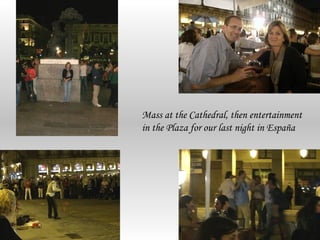
Mass at the Cathedral, then entertainment
in the Plaza for our last night in España
Spain
   &
Portugal


           September 28 ~
           October 7, 2007
Spain
    &
 Portugal


September 28 ~
October 7, 2007

Spain & portugal 9 07

  • 1.
    Spain & Portugal September 28 ~ October 7, 2007
  • 2.
    Spain & Portugal September 28 ~ October 7, 2007
  • 3.
    Day 1 -Madrid
  • 4.
    Hotel Europa inPuerto del Sol - View from our balcony
  • 5.
  • 6.
    House of thePost Office, Department of Security under Franco - he spoke from this balcony Kilómetro Cero, Exact center of Spain
  • 7.
    Living statues ….and realstatues walking through Madrid
  • 8.
    Museo del Jamon (Museumof Ham) .....one at almost every street corner
  • 9.
  • 10.
    Casa de laPanaderia, the seat of the powerful baker's guild, completed in 1590
  • 11.
    The Mercado deSan Miguel, originally constructed in 1835 (closed for remodeling)
  • 12.
    Pictures at Museodel Prado (before we were told to put our camera away)
  • 13.
    El Greco Raphael Rubens Goya (the lighter side) Rembrandt Goya (the darker side) Velazquez
  • 14.
  • 15.
    Almost every windowand door in Madrid has a balcony….
  • 16.
    ….many surrounded bybeautiful hand painted frescos
  • 17.
    Mass at thenearby Cathedral and dinner at Café Europa
  • 18.
    Day 2 – We pick up our rental car at the Atocha Train Station, site of the March 2004 bombing that killed 191 people – 911 days after 9/11 (We quickly learned to look for the “Salida” man to help us find our way out of the subways)
  • 19.
    Our first stopwas El Escorial and the Valley of the Fallen
  • 20.
    The monument isan underground church and the tomb of General Francisco Franco, topped with a 500 foot stone cross which can be seen from a distance of 30 miles. Although supposedly honoring all the dead in the Spanish Civil war, many Spaniards see the site as a reminder of the years of suffering under a Fascist dictator. The prisoners on the Republican side, many of whom lost their lives in the process, were forced to quarry this huge cavern out of the rock.
  • 21.
  • 22.
    Next stop -Segovia And another Plaza Mayor
  • 23.
    Segovia is Spainand Castile at its best - twisting alleyways, the highest concentration of Romanesque churches in all of Europe, pedestrian streets where no cars are allowed, all surrounded by the city's medieval wall. On the northwest extreme of the wall is the famous Alcázar castle where Queen Isabel promised Columbus the financial backing he needed to discover America. On the southeast end is the world renowned Roman aqueduct, the longest and best preserved of its kind anywhere. The tallest building in Segovia is still the 16th-century Cathedral, a prominent landmark as one approaches from any direction.
  • 24.
  • 27.
    Confessional….or phone booth? Ifonly these walls could talk.
  • 28.
  • 29.
  • 30.
  • 31.
    Juan Bravo and hisfriend, Juanita
  • 32.
    And suddenly, you turna corner and see the giant Roman aqueduct, constructed almost 2000 years ago
  • 35.
    The aqueduct transportswater 20 miles to the city from a spring in the nearby mountains. At its tallest, the aqueduct reaches a height of 93.5 feet. There are both single and double arches supported by pillars.
  • 37.
  • 40.
    Back through thestreets of Segovia to the other end of town…..
  • 41.
    ….to the Alcázarcastle, the inspiration for many Disney films
  • 43.
    Back on theroad to Toledo, …where you take an elevator ride up to the “old city”
  • 44.
    Toledo is ajust south of Madrid. It is the capital of the community of Castile-La Mancha. It was declared a World Heritage Site by UNESCO in 1986 for its extensive cultural and monumental heritage as one of the former capitals of the Spanish Empire and place of coexistence of Christian, Jewish and Moorish cultures.
  • 46.
  • 48.
    Day 3 –back in Madrid
  • 49.
  • 50.
  • 51.
  • 53.
    Centro de ArteReina Sofía – with works by Pablo Picasso, Joan Miró, Salvador Dalí and others (but again, no pictures allowed) Guernica is a painting by Pablo Picasso, depicting the Nazi German bombing of Guernica, Spain on April 26, 1937 during the Spanish Civil War
  • 54.
    At 7:30 PMwe fly to Lisbon and taxi up a long and winding cobblestone road to Hotel Albergaria Senhora Do Monte Not only is it a charming little room full of Portuguese tile….
  • 55.
    …..the view offthe balcony is breathtaking! The castle to left, the lights of Lisbon, and the Christo Rei statue glowing from across the river
  • 56.
    The same viewat 8 AM Day 4
  • 58.
    We take thelong walk down to the seaport, though streetcars are the traditional form of transportation in Lisbon
  • 59.
    The city is knownfor its hand-painted tile
  • 63.
    We catch thebus to Belém, where many Portuguese explorers sailed off to discover new worlds
  • 64.
    The Monument tothe Discoveries, with Prince Henry the Navigator at the helm
  • 65.
    The Tower ofBelém The lights from the tower were the last sign of land the sailors saw before reaching the new world
  • 66.
  • 68.
    The Cloisters, withan amazing assortment of…..
  • 69.
  • 70.
    Back to townto visit Castle São Jorge
  • 72.
    The iron Elevador deSanta Justa, connecting the Bairro Alto, (downtown) to Chiado (uptown), was built in 1902
  • 73.
    Or you canride the the Elevador da Glória, as most of the locals do
  • 74.
    The statue of Lisbon’sfavorite poet, Fernando Pessoa, sitting at his favorite café, the famous Café A Brasileira
  • 75.
    Goodbye and “goodluck” from our new Portuguese friends
  • 76.
    Day 5 - We fly to Barcelona at 10 AM and take the bus to the creepy Hostel L’Antic Espai We ring the bell, are admitted inside, then climb the ancient stairway to be allowed in
  • 77.
    ….to the verylavish hotel lobby, decorated in the style known as Catalonian modernisme
  • 78.
    The hotel isin the Eixample area of the city, with a balcony overlooking the Grand Vía We take a walk down the Ramblas….
  • 79.
    ….where even thestreetlights are Gaudí inspired
  • 80.
  • 82.
  • 83.
    The Mercat deSant Josep
  • 84.
    Thumbs up fromJuan at the famous Pinotxo Bar
  • 85.
    By the timewe reach the harbor, rain was on the horizon
  • 86.
    So we decidedto visit the Barcelona Maritime Museum, located inside the medieval building that served as the Royal Shipyards until 1935
  • 87.
    Dinner in abar just off the Plaça de Catalunya and off to our spooky hotel for the night
  • 88.
    Day 6 – Breakfastat the Café Zurich in Plaça de Catalunya
  • 89.
    At 11, wemeet in Plaça Reial to go on the Fat Tire Bicycle Tour
  • 91.
    Park de laCiudadella in the Barri Gotic Flamenco dancers practicing in the gazebo
  • 92.
  • 93.
    La Sagrada Família(in Catalan, “The Holy Family”) is a massive Roman Catholic basilica. Antoni Gaudí designed and started construction in 1882 and worked on the project for over 40 years.
  • 94.
    The building wasdesigned to be built over 200 years, and with no government funds….only public donations. When asked about the long construction period, Gaudí is said to have joked, “My client is not in a hurry.”
  • 96.
    Our ride thentakes us out to the harbor, with Montjuïc in the distance
  • 97.
    We end thebike tour with lunch at an outdoor bar on the beach in Barceloneta
  • 98.
    Back to foottravel, we walk through the Old City seeking out the sites in the book, Shadow of the Wind, by Carlos Ruiz Zafón
  • 99.
    We lose ourway and find ourselves on Manzana de la Discordia (Block of Discord) Casa Batlió, designed by Antoni Gaudí and Casa Amatller, designed by Puig i Cadafalch
  • 100.
    After a shortrain, we walk over to Casa Milà Casa Milà, or La Pedrera, is the largest civil building designed by Gaudí. It was constructed between 1906 and 1910. It was Gaudi's last work before devoting himself to the construction of the Sagrada Família.
  • 101.
    They say theroof is closed because of rain, but we sneak up anyway….well worth the risk of getting reprimanded!
  • 103.
    View from thetop – Sagrada Família in the distance
  • 104.
    Goudí designed so much more than buildings Art in the parks, Paving tiles lamp posts Wall tiles, door Furniture knobs, coat hooks
  • 105.
    The hanging chainsculpture…. ….with its mirror image, was the inspiration for one of Gaudí’s buildings
  • 106.
    We walk backto our hotel seeing glimpses of Gaudí’s genius throughout the city
  • 107.
    Day 7 –We rent a car to drive to Montserrat and Tarragona After a short detour, we see what we’re looking for high in the mountains west of Barcelona
  • 108.
    The funicular takesus up the mountain to the Benedictine abbey, Santa María de Montserrat (“jagged rock”)
  • 109.
    View from thetop of the mountain
  • 111.
  • 112.
    We wait inline to see the black virgin and touch the “royal orb” she is holding through the glass enclosure
  • 114.
    Back on theroad to Tarragona, a city located in the south of Catalunya by the Mediterranean Sea
  • 115.
    Augustus wintered at“Tarraco” in the early first century, and many Roman ruins remain
  • 118.
  • 120.
    After dinner overlookingthe sea and ruins, we get back in the car to find a place to spread Uncle Nick’s ashes… in the Mediterranean as he requested
  • 121.
    We find abeautiful beach with a rocky point at the end – other than a couple of surfers, the only other visitor was an older gentleman with his dog….that looked remarkably like Uncle Nick’s dog, Sparky
  • 122.
    As it beginsto sprinkle, we say a prayer and send Uncle Nick on his way to Greece
  • 123.
    As we beginto walk away, the gentleman asks in Catalonian what we were doing He nods and smiles knowingly as we try to explain in our broken Spanish
  • 124.
    And as wedrive back to Barcelona, the rain stops and the clouds separate as if to open the gates of Heaven
  • 125.
    Day 8 –our last day in Barcelona A walk through the city and a climb to Montjuïc Plaça de España
  • 127.
    Montjuïc is abroad shallow hill overlooking the harbor southeast of the city centre. It was the site of several fortifications, the latest of which, the Castell de Montjuïc, remains today. The fortress dates from the 17th century. In 1842 the garrison (loyal to the Madrid government) shelled parts of the city following disturbances. It served as a prison, often holding political prisoners, until the time of General Franco. The castle was the site of numerous executions. The Palau Nacional houses the Museu Nacional d'Art de Catalunya
  • 128.
  • 129.
    Views from thetop – the harbor and the Olympic Stadium
  • 131.
    Views from cablecar going down
  • 132.
    Back home alongthe Ramblas
  • 135.
    Goodbye to Barcelona….andthe spooky Hotel L’Antic Espai
  • 136.
    A bus rideto the airport for our flight to Madrid
  • 137.
    Back in Madrid,we go to Plaza Mayor for dinner, where we step into the famous La Torre del Oro – a shrine to the toreadores
  • 138.
    Mass at theCathedral, then entertainment in the Plaza for our last night in España
  • 139.
    Spain & Portugal September 28 ~ October 7, 2007
  • 140.
    Spain & Portugal September 28 ~ October 7, 2007