Digital animals – commercial experts
Segmenting your Prospects
& Clients for Increased Sales
Segment your markets
Sustainable, profitable growth starts with breaking markets down into segments
• Looking at broad demand promotes inside out thinking
• Looking at granular segments promotes outside in thinking
Segmentation = slicing up a marketplace differently in light of current needs (less important) &
future needs (hugely important)
Creating digestible chunks, with each chunk representing a need
Client segmentation
Objective: To segment the client base
Why is segmentation crucial to revenue generation?
1. To ensure better matching of customer needs
2. To create enhanced profits and better opportunities for growth
3. To retain more customers and prevent client attrition
4. To target specialised marketing communications to different groups
5. To gain a larger share of the market
What is segmentation?
1. The process by which you can better understand the needs of your clients and how your clients
distinguish between one offer and another.
2. Segmentation is essentially the identification of subsets of buyers within a market that share
similar needs and demonstrate similar buyer behaviour/s.
3. This insight is used to form groups of customers who share the same or similar ‘value’ criteria.
4. It allows a business to divide the market/s into different buckets according to their preferences
Premise: Clients aren’t all alike and shouldn’t be treated identically, especially when targeting
them through marketing.
Effective segmentation
Nike rose to staggering success by designing high quality running shoes for serious athletes
Expanded out into shoes for basketball, tennis & football
Then into the broad consumer marketplace
By 1984, Nike had 1/3 of the US athletic footware market
…Then along came Reebok
• Stylish shoes for the athleisure market
• Segmented to create shoes for specific markets e.g. women’s aerobics
Effective segmentation
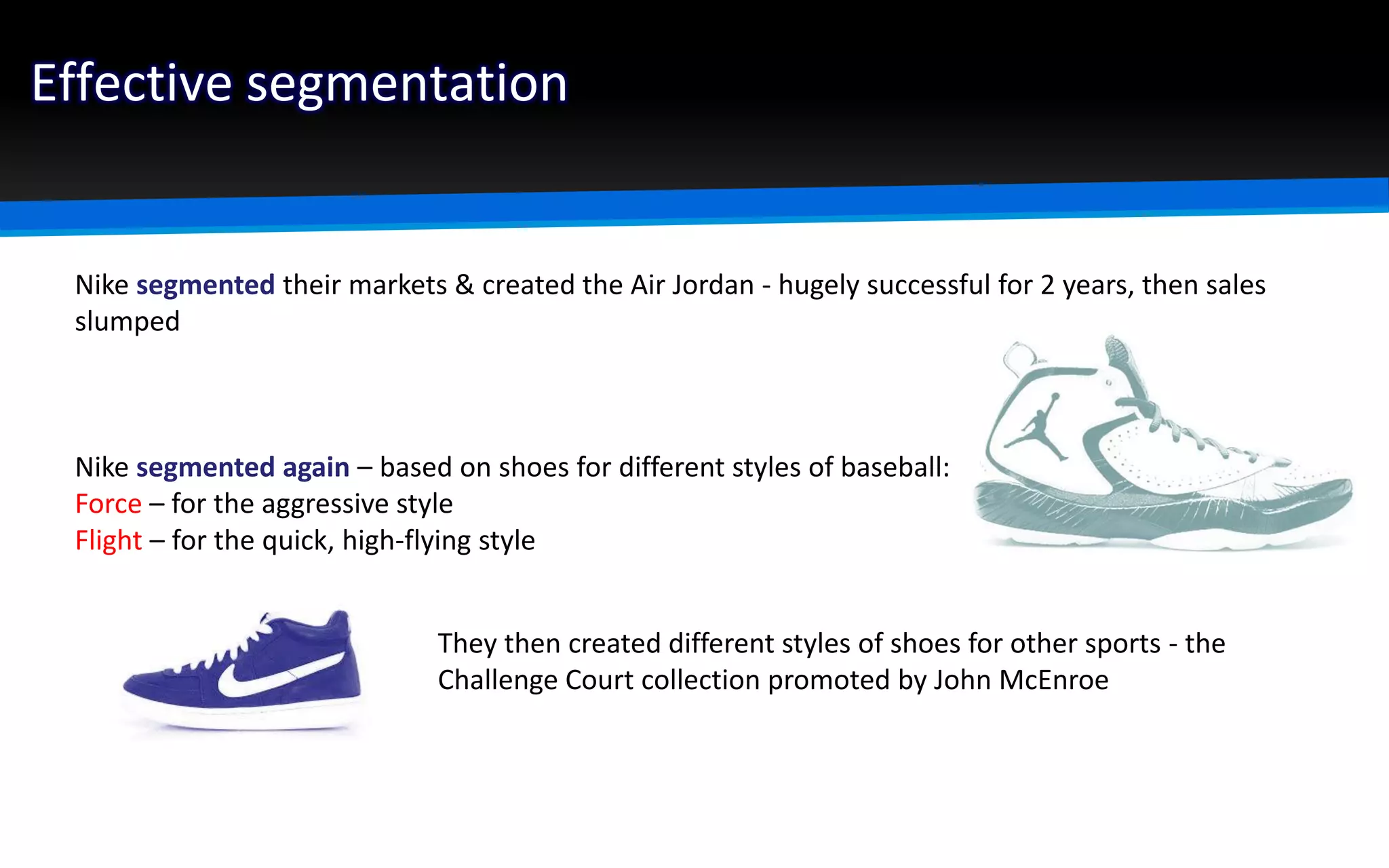
Nike segmented their markets & created the Air Jordan - hugely successful for 2 years, then sales
slumped
Nike segmented again – based on shoes for different styles of baseball:
Force – for the aggressive style
Flight – for the quick, high-flying style
They then created different styles of shoes for other sports - the
Challenge Court collection promoted by John McEnroe
Effective segmentation
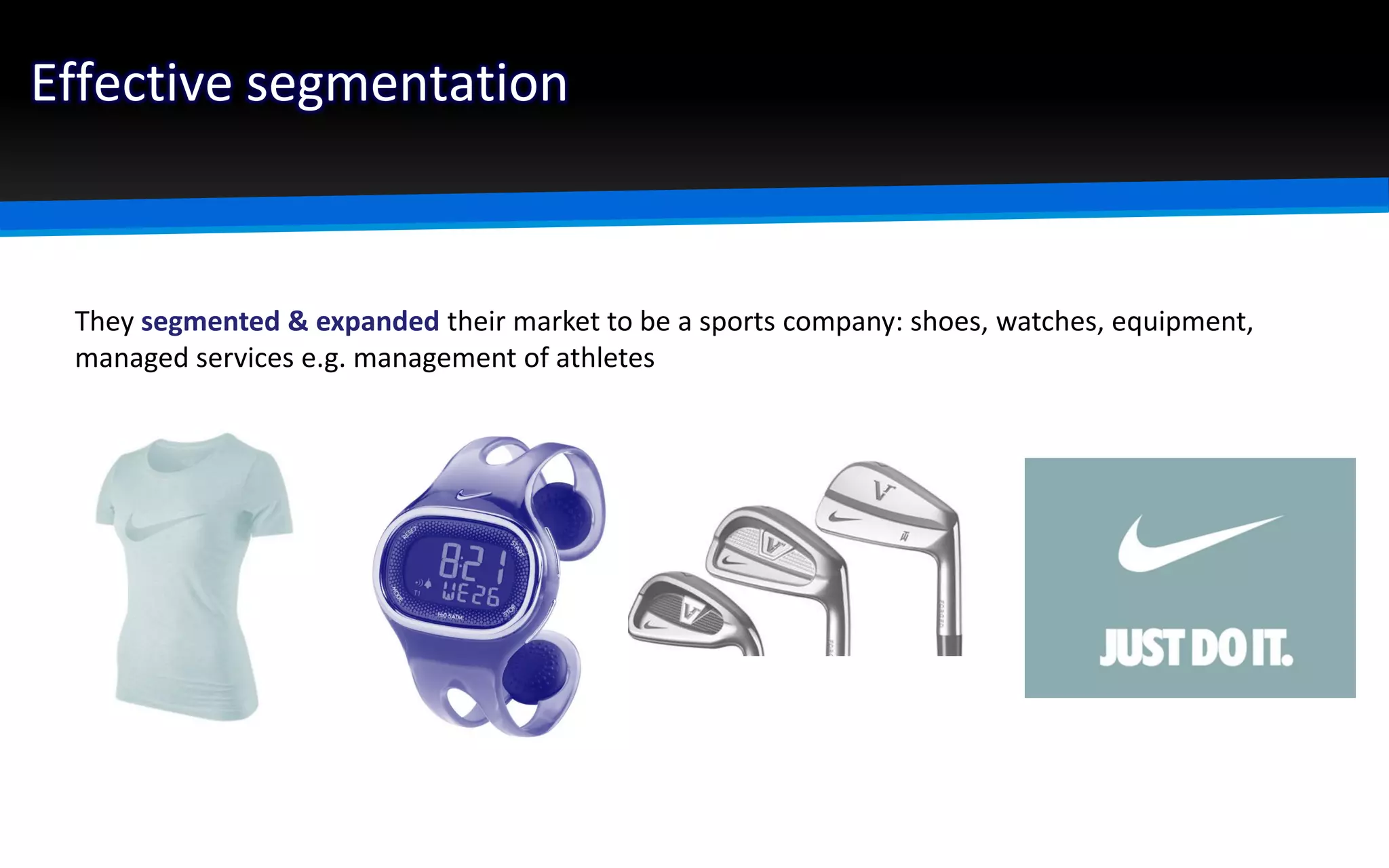
They segmented & expanded their market to be a sports company: shoes, watches, equipment,
managed services e.g. management of athletes
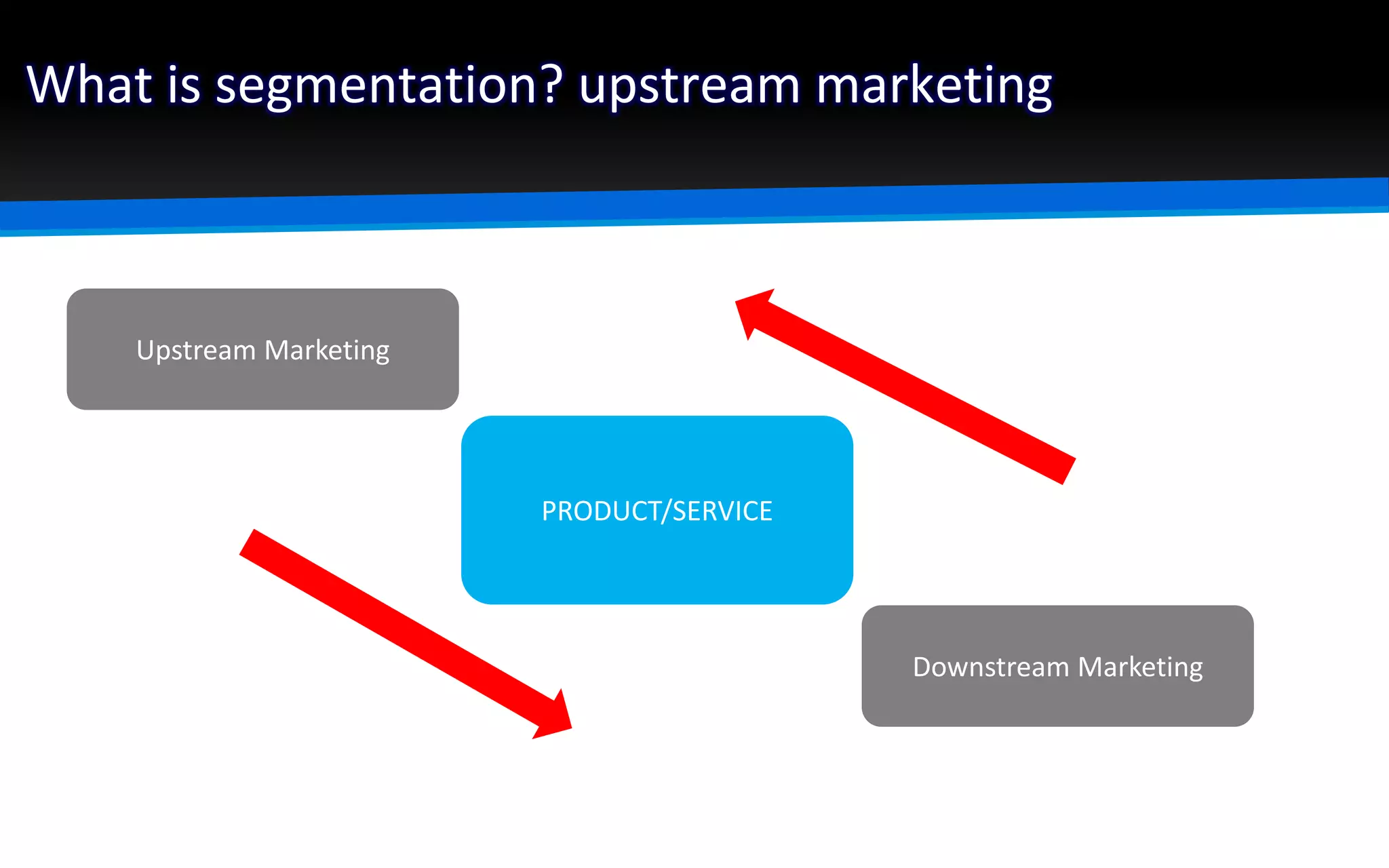
What is segmentation? upstream marketing
Upstream Marketing
Downstream Marketing
PRODUCT/SERVICE
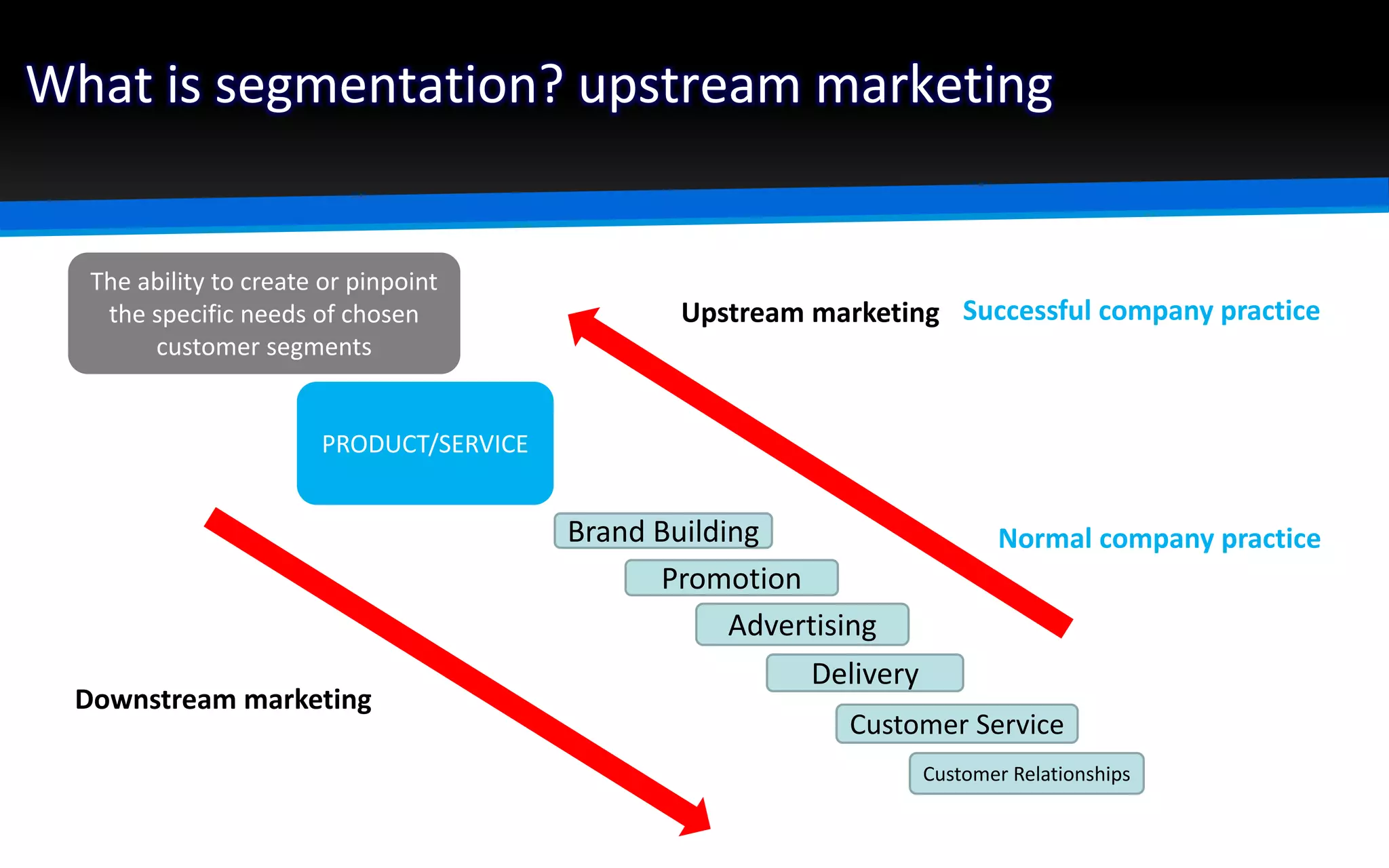
What is segmentation? upstream marketing
The ability to create or pinpoint
the specific needs of chosen
customer segments
PRODUCT/SERVICE
Brand Building
Promotion
Advertising
Delivery
Customer Service
Customer Relationships
Downstream marketing
Upstream marketing Successful company practice
Normal company practice
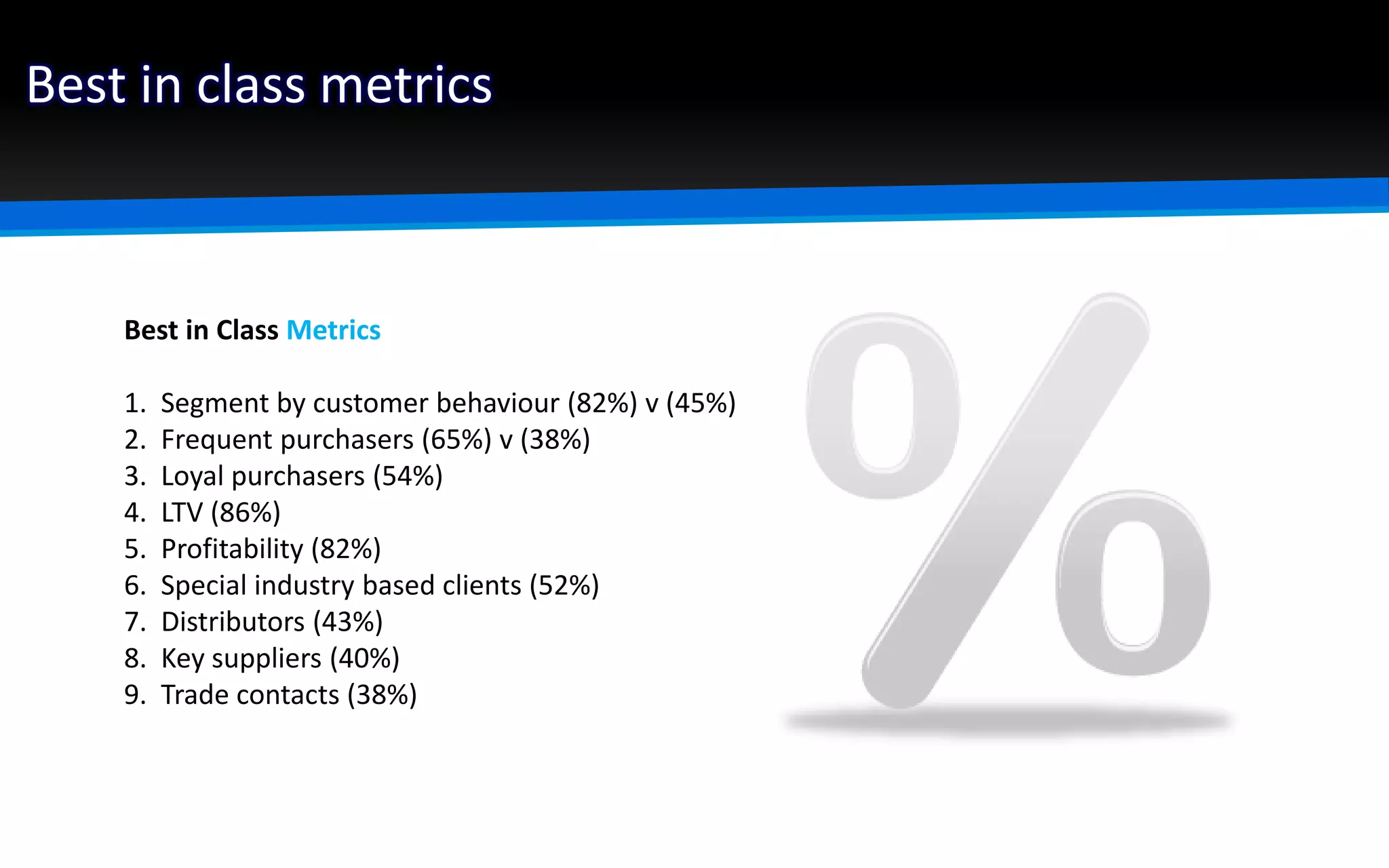
Best in class metrics
Best in Class Metrics
1. Segment by customer behaviour (82%) v (45%)
2. Frequent purchasers (65%) v (38%)
3. Loyal purchasers (54%)
4. LTV (86%)
5. Profitability (82%)
6. Special industry based clients (52%)
7. Distributors (43%)
8. Key suppliers (40%)
9. Trade contacts (38%)
Questions
Questions:
1. Which markets do you target
• Define the market and the scope of the market you are looking at (put people
in relevant buckets)
• Map the structure of the markets
2. How do you currently segment your markets?
3. What are the criteria you use?
4. Who are the decision makers?
5. What are the needs of the decision makers?
6. What are they buying from you?
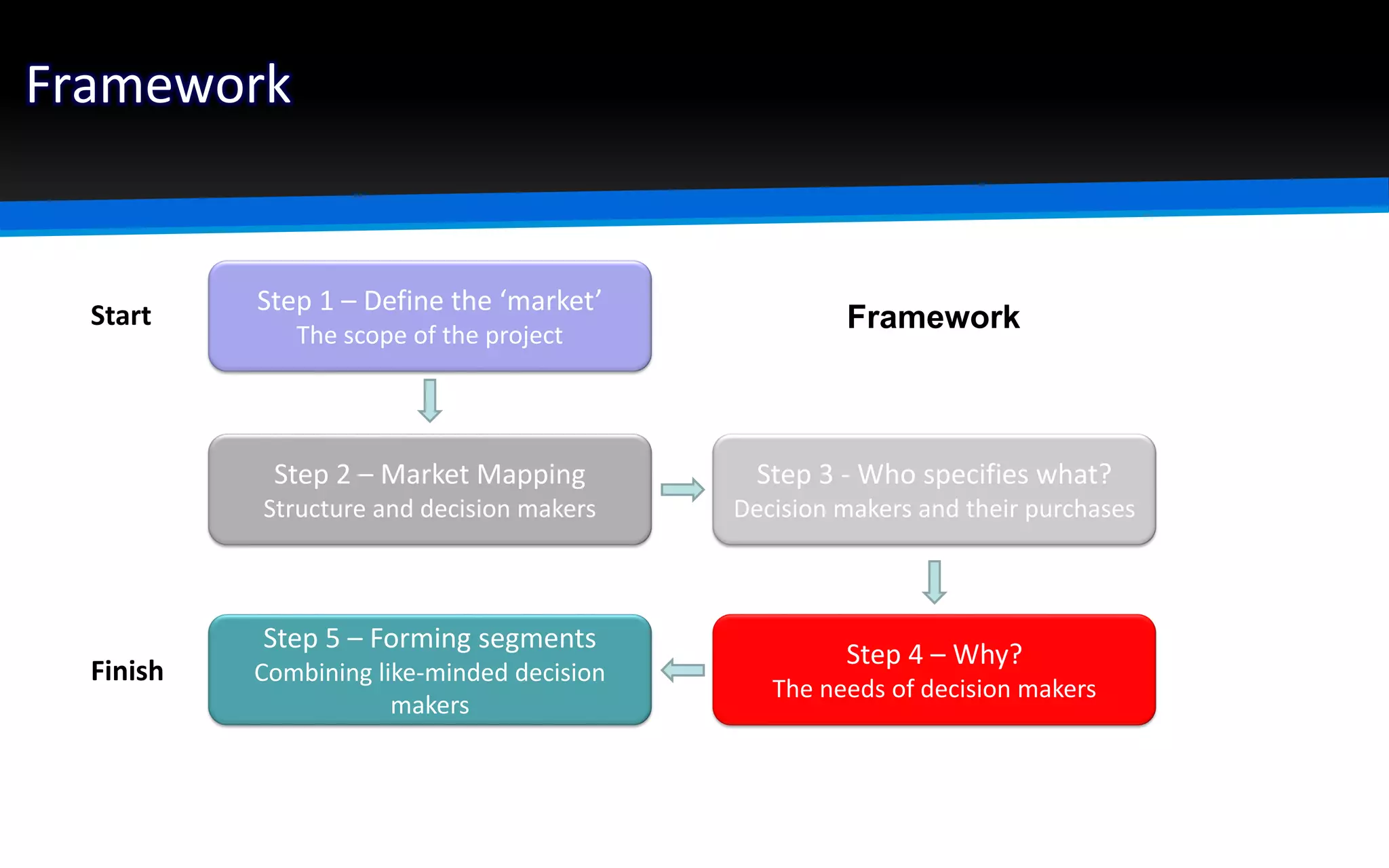
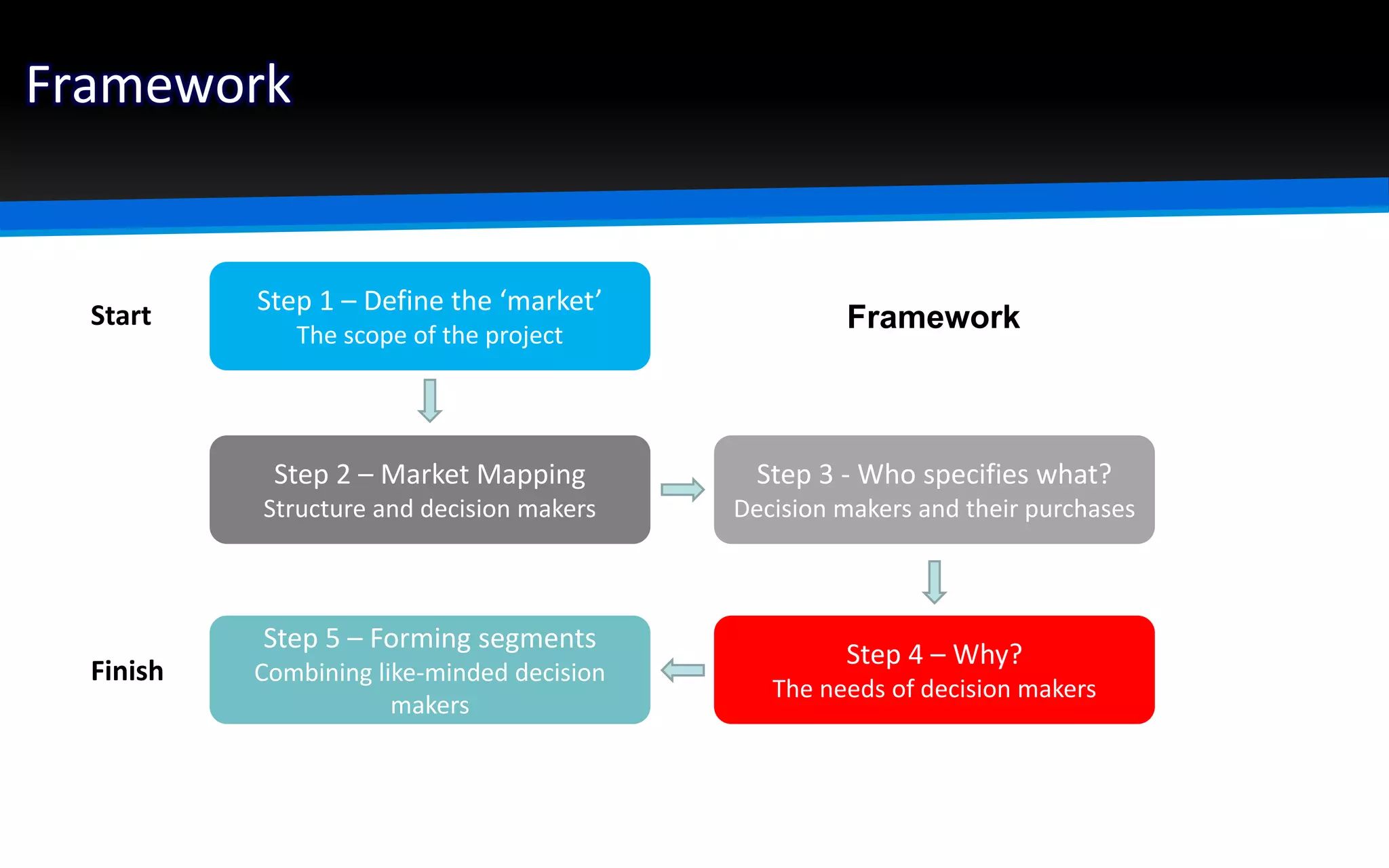
Framework
Step 1 – Define the ‘market’
The scope of the project
Step 2 – Market Mapping
Structure and decision makers
Step 3 - Who specifies what?
Decision makers and their purchases
Step 4 – Why?
The needs of decision makers
Step 5 – Forming segments
Combining like-minded decision
makers
FrameworkStart
Finish
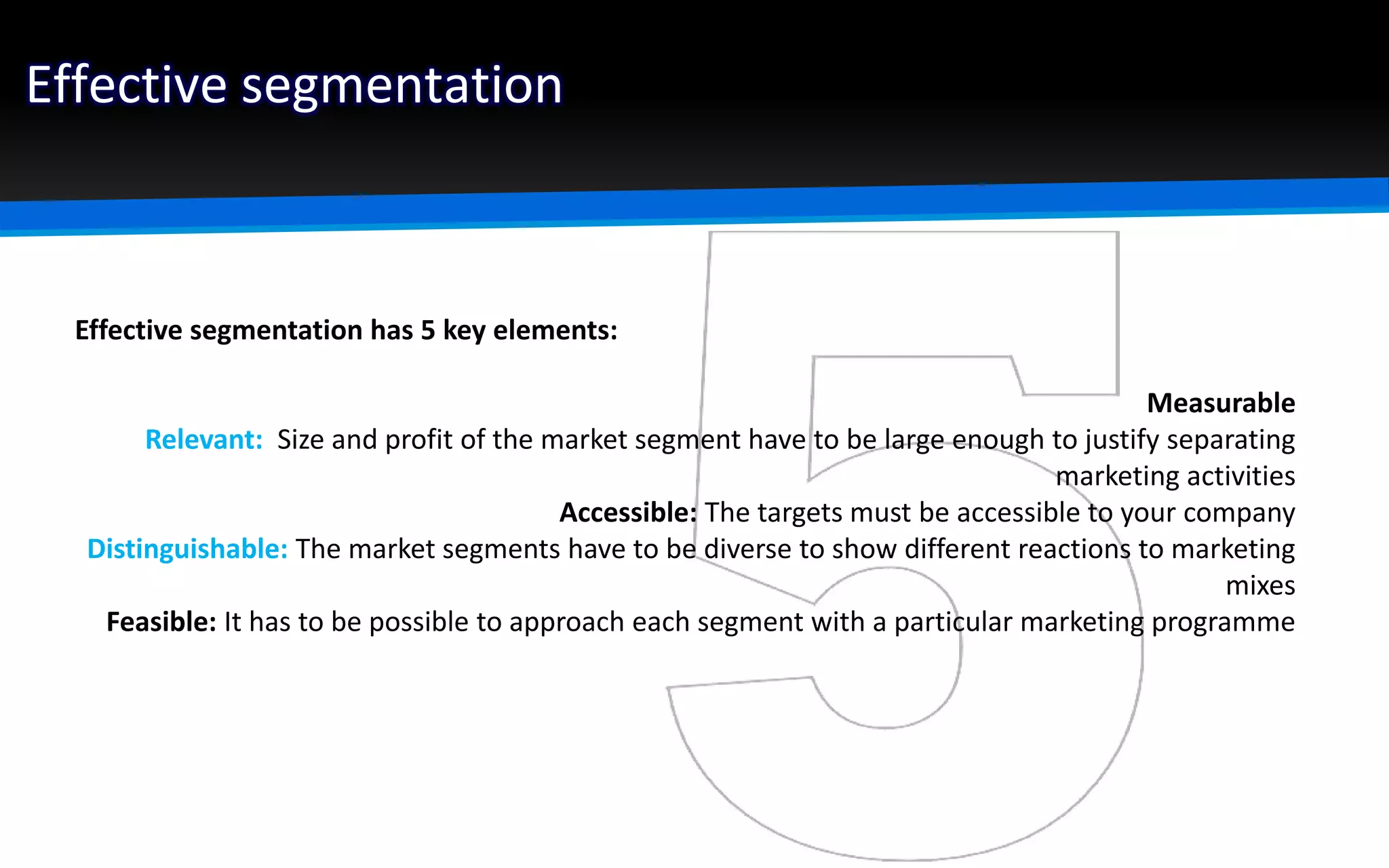
Effective segmentation
Effective segmentation has 5 key elements:
Measurable
Relevant: Size and profit of the market segment have to be large enough to justify separating
marketing activities
Accessible: The targets must be accessible to your company
Distinguishable: The market segments have to be diverse to show different reactions to marketing
mixes
Feasible: It has to be possible to approach each segment with a particular marketing programme
Segmentation: examples of consumer markets
1. Geographic
2. Demographic: age, sex, marital status, income, occupation, education, religion, nationality, ethical
group
3. Psychographic: social status, lifestyle type, personal type
4. Behaviours: intensity of product use, brand loyalty, user-behaviour, need
5. Frequency of buying: Suspects, prospects, bought once, more than once, advocate, partner
Segmentation: examples of consumer markets
6. Product specific: product attributes, benefits, wants, needs
7. Purchasing policy: organisation of purchasing function, price points
8. Value proposition
9. Customer motivation
10. Technology
11. Line extensions
12. Distribution channels
Best in class
Best in Class
1. Prioritise leads based on their propensity to
purchase (frequency of purchase)
2. Ask the question, will the prospect benefit from
the product/service we are offering?
Framework
Step 1 – Define the ‘market’
The scope of the project
Step 2 – Market Mapping
Structure and decision makers
Step 3 - Who specifies what?
Decision makers and their purchases
Step 4 – Why?
The needs of decision makers
Step 5 – Forming segments
Combining like-minded decision
makers
FrameworkStart
Finish
Create your segmentation strategy
Actions: Create your segmentation strategy
1. What is the scope of the market you are looking at? Define the market
• Establish a sample of clients which will represent the different decision-makers found
in the specified markets (referred to as ‘micro-segments’)
• The difference between them are the key features they use to discriminate between
competing offers and the importance of these features
• Define the market and the scope of the market you are looking at (put people in
relevant buckets)
• Map the structure of the markets
Create your segmentation strategy
2. Who are the decision makers, where do they sit within the company?
• Record personal details about the decision makers (including their company details if
appropriate), which can be used to identify them
• How can decision makers be grouped together?
Create your segmentation strategy
3. What are they buying or what do they want to buy? What are the needs (and other
segmentation criteria) of the decision makers?
A. Understand the real needs of clients and list the benefits they are seeking, along with the
importance of these benefits, for each micro segment
B. How do clients group together? Put people in the relevant buckets e.g. these are the
companies we are looking at, within these markets
C. Bring together those micro-segments that illustrate similar patterns of importance for the
benefits in order to form cluster
Create your segmentation strategy
D. Verify that the concluding clusters can be regarded as segments
• Is each cluster large enough to justify the development and marketing of a
specific offer?
• Is the offer required by each cluster sufficiently different from that required by
the other clusters?
• Can you identify which clients are to be found in each cluster so that you can
target them their appropriate offer?
If the answer to all three questions is ‘yes’, then the clusters can be regarded as segments
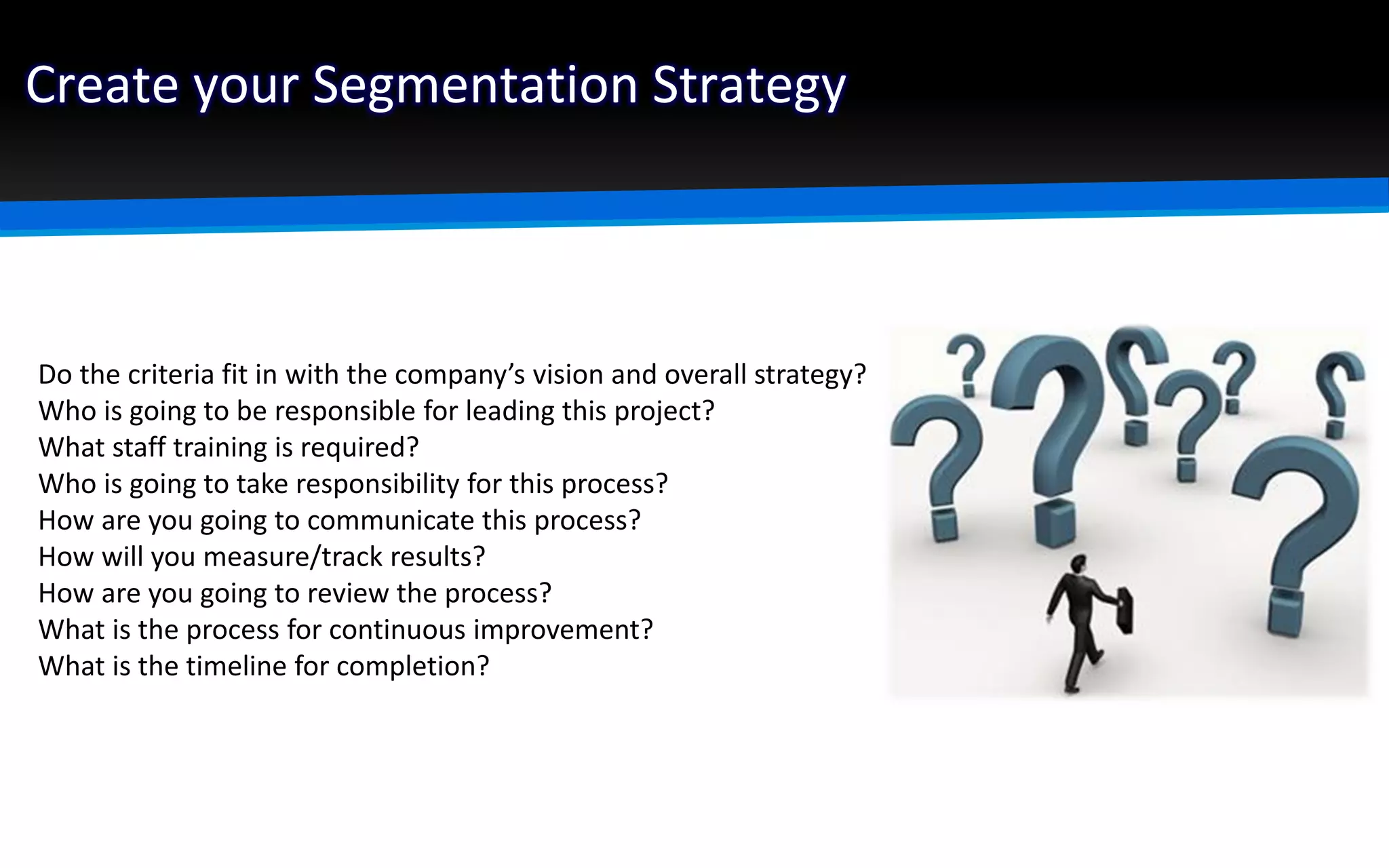
Create your Segmentation Strategy
Do the criteria fit in with the company’s vision and overall strategy?
Who is going to be responsible for leading this project?
What staff training is required?
Who is going to take responsibility for this process?
How are you going to communicate this process?
How will you measure/track results?
How are you going to review the process?
What is the process for continuous improvement?
What is the timeline for completion?
Create your segmentation strategy
Implementation Actions:
1. How do you currently target these groups? – define marketing methods. (Will
come onto this in targeting
2. How should you be targeting these groups
Database segmentation
Objective: To segment the client database according to the client base
segmentation criteria
Why is database segmentation crucial to revenue generation?
• To reflect the client segmentation criteria to enable effective, measurable and
targeted marketing using your database to maximum effect
Best in Class metrics:
• Top performers are 30% more likely to incorporate intense CRM usage into their
daily selling lives
Database segmentation
Questions re the current database:
1. What segmentation criteria do you currently use?
2. Is that reflective of the client segmentation criteria?
3. Where is the database held?
4. What CRM do you use?
5. Who updates the database?
6. How regularly is the database updated – what is the process?
7. Is the data clean?
8. Is all your data integrated into the database, or do you have separate sources?
Create your database segmentation strategy
Actions: Create the database segmentation strategy
1. What are the segmentation criteria to be used?
2. How is the data going to be updated and cleaned?
3. How are multiple sources of data going to be integrated?
4. What is the process for updating data on a regular basis?
5. What is the process to ensure the client database is used on a daily basis?
6. Who is going to be responsible for leading this process?
Create the Database Segmentation Strategy
Actions: Create the database segmentation strategy
7. What is the training that needs to be provided?
8. How are you going to communicate this process?
9. How are you going to measure/track results?
10. How are you going to review the process?
11. What is the timeline for completion of this project?
12. How are clients going to be targeted with relevant marketing offers? (see
targeting)
13. What is the process for continuous improvement?
Segmentation: always changing
Segmentation is dynamic, always evolving & always changing
t: (0)800 8600 512
e: growth@incisive-edge.com
w: www.incisive-edge.com
Want to find out more? Why not download our Buyer
Journey or Positioning presentations
Or just contact us using the details below

Segmenting prospects clients_incisive_edge

  • 1.
    Digital animals –commercial experts Segmenting your Prospects & Clients for Increased Sales
  • 2.
    Segment your markets Sustainable,profitable growth starts with breaking markets down into segments • Looking at broad demand promotes inside out thinking • Looking at granular segments promotes outside in thinking Segmentation = slicing up a marketplace differently in light of current needs (less important) & future needs (hugely important) Creating digestible chunks, with each chunk representing a need
  • 3.
    Client segmentation Objective: Tosegment the client base Why is segmentation crucial to revenue generation? 1. To ensure better matching of customer needs 2. To create enhanced profits and better opportunities for growth 3. To retain more customers and prevent client attrition 4. To target specialised marketing communications to different groups 5. To gain a larger share of the market
  • 4.
    What is segmentation? Whatis segmentation? 1. The process by which you can better understand the needs of your clients and how your clients distinguish between one offer and another. 2. Segmentation is essentially the identification of subsets of buyers within a market that share similar needs and demonstrate similar buyer behaviour/s. 3. This insight is used to form groups of customers who share the same or similar ‘value’ criteria. 4. It allows a business to divide the market/s into different buckets according to their preferences Premise: Clients aren’t all alike and shouldn’t be treated identically, especially when targeting them through marketing.
  • 5.
    Effective segmentation Nike roseto staggering success by designing high quality running shoes for serious athletes Expanded out into shoes for basketball, tennis & football Then into the broad consumer marketplace By 1984, Nike had 1/3 of the US athletic footware market …Then along came Reebok • Stylish shoes for the athleisure market • Segmented to create shoes for specific markets e.g. women’s aerobics
  • 6.
    Effective segmentation Nike segmentedtheir markets & created the Air Jordan - hugely successful for 2 years, then sales slumped Nike segmented again – based on shoes for different styles of baseball: Force – for the aggressive style Flight – for the quick, high-flying style They then created different styles of shoes for other sports - the Challenge Court collection promoted by John McEnroe
  • 7.
    Effective segmentation They segmented& expanded their market to be a sports company: shoes, watches, equipment, managed services e.g. management of athletes
  • 8.
    What is segmentation?upstream marketing Upstream Marketing Downstream Marketing PRODUCT/SERVICE
  • 9.
    What is segmentation?upstream marketing The ability to create or pinpoint the specific needs of chosen customer segments PRODUCT/SERVICE Brand Building Promotion Advertising Delivery Customer Service Customer Relationships Downstream marketing Upstream marketing Successful company practice Normal company practice
  • 10.
    Best in classmetrics Best in Class Metrics 1. Segment by customer behaviour (82%) v (45%) 2. Frequent purchasers (65%) v (38%) 3. Loyal purchasers (54%) 4. LTV (86%) 5. Profitability (82%) 6. Special industry based clients (52%) 7. Distributors (43%) 8. Key suppliers (40%) 9. Trade contacts (38%)
  • 11.
    Questions Questions: 1. Which marketsdo you target • Define the market and the scope of the market you are looking at (put people in relevant buckets) • Map the structure of the markets 2. How do you currently segment your markets? 3. What are the criteria you use? 4. Who are the decision makers? 5. What are the needs of the decision makers? 6. What are they buying from you?
  • 12.
    Framework Step 1 –Define the ‘market’ The scope of the project Step 2 – Market Mapping Structure and decision makers Step 3 - Who specifies what? Decision makers and their purchases Step 4 – Why? The needs of decision makers Step 5 – Forming segments Combining like-minded decision makers FrameworkStart Finish
  • 13.
    Effective segmentation Effective segmentationhas 5 key elements: Measurable Relevant: Size and profit of the market segment have to be large enough to justify separating marketing activities Accessible: The targets must be accessible to your company Distinguishable: The market segments have to be diverse to show different reactions to marketing mixes Feasible: It has to be possible to approach each segment with a particular marketing programme
  • 14.
    Segmentation: examples ofconsumer markets 1. Geographic 2. Demographic: age, sex, marital status, income, occupation, education, religion, nationality, ethical group 3. Psychographic: social status, lifestyle type, personal type 4. Behaviours: intensity of product use, brand loyalty, user-behaviour, need 5. Frequency of buying: Suspects, prospects, bought once, more than once, advocate, partner
  • 15.
    Segmentation: examples ofconsumer markets 6. Product specific: product attributes, benefits, wants, needs 7. Purchasing policy: organisation of purchasing function, price points 8. Value proposition 9. Customer motivation 10. Technology 11. Line extensions 12. Distribution channels
  • 16.
    Best in class Bestin Class 1. Prioritise leads based on their propensity to purchase (frequency of purchase) 2. Ask the question, will the prospect benefit from the product/service we are offering?
  • 17.
    Framework Step 1 –Define the ‘market’ The scope of the project Step 2 – Market Mapping Structure and decision makers Step 3 - Who specifies what? Decision makers and their purchases Step 4 – Why? The needs of decision makers Step 5 – Forming segments Combining like-minded decision makers FrameworkStart Finish
  • 18.
    Create your segmentationstrategy Actions: Create your segmentation strategy 1. What is the scope of the market you are looking at? Define the market • Establish a sample of clients which will represent the different decision-makers found in the specified markets (referred to as ‘micro-segments’) • The difference between them are the key features they use to discriminate between competing offers and the importance of these features • Define the market and the scope of the market you are looking at (put people in relevant buckets) • Map the structure of the markets
  • 19.
    Create your segmentationstrategy 2. Who are the decision makers, where do they sit within the company? • Record personal details about the decision makers (including their company details if appropriate), which can be used to identify them • How can decision makers be grouped together?
  • 20.
    Create your segmentationstrategy 3. What are they buying or what do they want to buy? What are the needs (and other segmentation criteria) of the decision makers? A. Understand the real needs of clients and list the benefits they are seeking, along with the importance of these benefits, for each micro segment B. How do clients group together? Put people in the relevant buckets e.g. these are the companies we are looking at, within these markets C. Bring together those micro-segments that illustrate similar patterns of importance for the benefits in order to form cluster
  • 21.
    Create your segmentationstrategy D. Verify that the concluding clusters can be regarded as segments • Is each cluster large enough to justify the development and marketing of a specific offer? • Is the offer required by each cluster sufficiently different from that required by the other clusters? • Can you identify which clients are to be found in each cluster so that you can target them their appropriate offer? If the answer to all three questions is ‘yes’, then the clusters can be regarded as segments
  • 22.
    Create your SegmentationStrategy Do the criteria fit in with the company’s vision and overall strategy? Who is going to be responsible for leading this project? What staff training is required? Who is going to take responsibility for this process? How are you going to communicate this process? How will you measure/track results? How are you going to review the process? What is the process for continuous improvement? What is the timeline for completion?
  • 23.
    Create your segmentationstrategy Implementation Actions: 1. How do you currently target these groups? – define marketing methods. (Will come onto this in targeting 2. How should you be targeting these groups
  • 24.
    Database segmentation Objective: Tosegment the client database according to the client base segmentation criteria Why is database segmentation crucial to revenue generation? • To reflect the client segmentation criteria to enable effective, measurable and targeted marketing using your database to maximum effect Best in Class metrics: • Top performers are 30% more likely to incorporate intense CRM usage into their daily selling lives
  • 25.
    Database segmentation Questions rethe current database: 1. What segmentation criteria do you currently use? 2. Is that reflective of the client segmentation criteria? 3. Where is the database held? 4. What CRM do you use? 5. Who updates the database? 6. How regularly is the database updated – what is the process? 7. Is the data clean? 8. Is all your data integrated into the database, or do you have separate sources?
  • 26.
    Create your databasesegmentation strategy Actions: Create the database segmentation strategy 1. What are the segmentation criteria to be used? 2. How is the data going to be updated and cleaned? 3. How are multiple sources of data going to be integrated? 4. What is the process for updating data on a regular basis? 5. What is the process to ensure the client database is used on a daily basis? 6. Who is going to be responsible for leading this process?
  • 27.
    Create the DatabaseSegmentation Strategy Actions: Create the database segmentation strategy 7. What is the training that needs to be provided? 8. How are you going to communicate this process? 9. How are you going to measure/track results? 10. How are you going to review the process? 11. What is the timeline for completion of this project? 12. How are clients going to be targeted with relevant marketing offers? (see targeting) 13. What is the process for continuous improvement?
  • 28.
    Segmentation: always changing Segmentationis dynamic, always evolving & always changing
  • 29.
    t: (0)800 8600512 e: growth@incisive-edge.com w: www.incisive-edge.com Want to find out more? Why not download our Buyer Journey or Positioning presentations Or just contact us using the details below