Franklin Heath Ltd28 May 2013
Security Lessons from Bletchley Park and Enigma
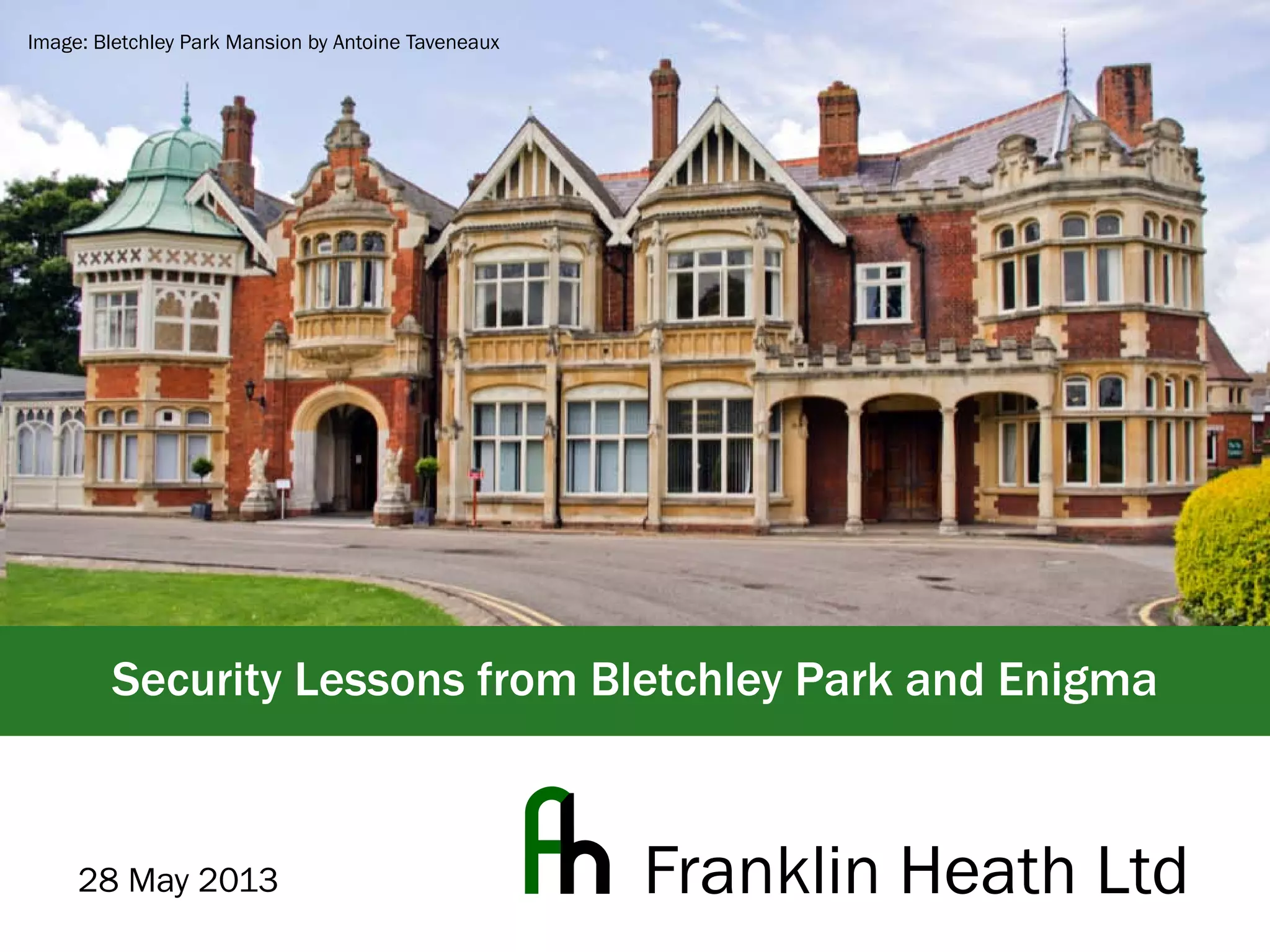
Image: Bletchley Park Mansion by Antoine Taveneaux
CC BY 3.0
Topics
 How the Enigma machine works
 How Bletchley Park exploited German mistakes
 Five lessons we can draw from this
28 May 2013 2
© Franklin Heath Ltd
CC BY 3.0
The Enigma Machine
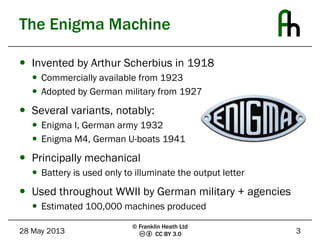
 Invented by Arthur Scherbius in 1918
 Commercially available from 1923
 Adopted by German military from 1927
 Several variants, notably:
 Enigma I, German army 1932
 Enigma M4, German U-boats 1941
 Principally mechanical
 Battery is used only to illuminate the output letter
 Used throughout WWII by German military + agencies
 Estimated 100,000 machines produced
28 May 2013 3
© Franklin Heath Ltd
CC BY 3.0
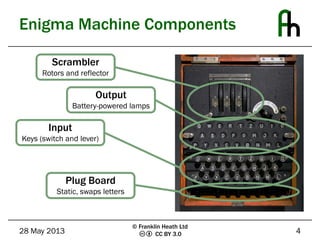
Enigma Machine Components
28 May 2013 4
© Franklin Heath Ltd
Scrambler
Rotors and reflector
Output
Battery-powered lamps
Input
Keys (switch and lever)
Plug Board
Static, swaps letters
CC BY 3.0
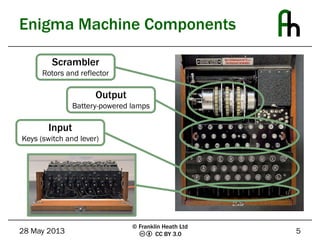
Enigma Machine Components
28 May 2013 5
© Franklin Heath Ltd
Scrambler
Rotors and reflector
Output
Battery-powered lamps
Input
Keys (switch and lever)
CC BY 3.0
Fully Functional Paper Model
28 May 2013 6
© Franklin Heath Ltd
CC BY 3.0
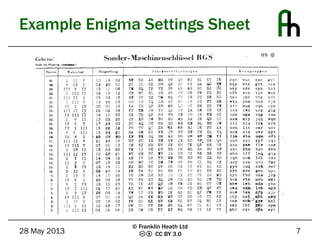
Example Enigma Settings Sheet
28 May 2013 7
© Franklin Heath Ltd
CC BY 3.0
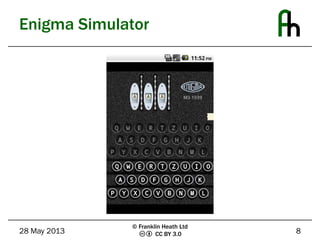
Enigma Simulator
28 May 2013 8
© Franklin Heath Ltd
CC BY 3.0
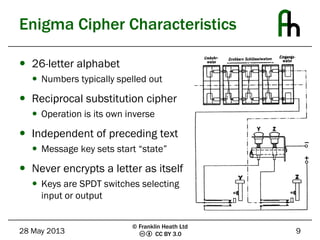
Enigma Cipher Characteristics
 26-letter alphabet
 Numbers typically spelled out
 Reciprocal substitution cipher
 Operation is its own inverse
 Independent of preceding text
 Message key sets start “state”
 Never encrypts a letter as itself
 Keys are SPDT switches selecting
input or output
28 May 2013 9
© Franklin Heath Ltd
CC BY 3.0
Enigma Machine Key Length
 4-rotor Enigma M4
 2 possible reflectors
 672 possible rotor choices
 676 possible notch positions
 532,985,208,200,576 possible combinations of plugs
 456,976 possible starting positions
 = 221,286,292,668,406,558,235,295,744 possible keys
 Log2 gives equivalent binary key length: ~88 bits
 Still export-controlled today!
 Yet it could be broken with 70-year old mechanical technology
 Key length isn’t the most important characteristic
28 May 2013 10
© Franklin Heath Ltd
CC BY 3.0
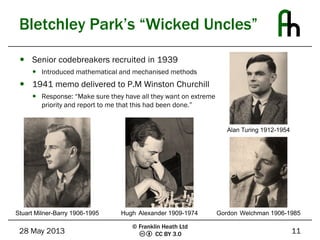
Bletchley Park’s “Wicked Uncles”
 Senior codebreakers recruited in 1939
 Introduced mathematical and mechanised methods
 1941 memo delivered to P.M Winston Churchill
 Response: “Make sure they have all they want on extreme
priority and report to me that this had been done.”
28 May 2013 11
© Franklin Heath Ltd
Alan Turing 1912-1954
Gordon Welchman 1906-1985Hugh Alexander 1909-1974Stuart Milner-Barry 1906-1995
CC BY 3.0
Types of Breaks into Enigma
 Polish Cipher Bureau, 1932 onwards
 Common start positions (mitigated 1938)
 Repeated message key (mitigated 1940)
 UK GC&CS, 1937 onwards
 “Rodding” using cribs (mitigated by plug board)
 Herivel tip, to deduce ring settings
 Cillies, to deduce message keys
 Banburismus, to identify likely rotor orders
 Bombe menus from cribs, to test rotor orders
 EINS catalogue, to deduce message keys and bigram tables
28 May 2013 12
© Franklin Heath Ltd
CC BY 3.0
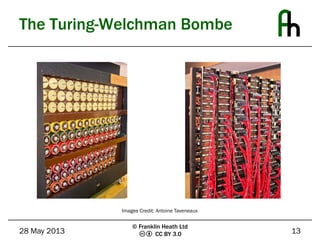
The Turing-Welchman Bombe
28 May 2013 13
© Franklin Heath Ltd
Images Credit: Antoine Taveneaux
CC BY 3.0
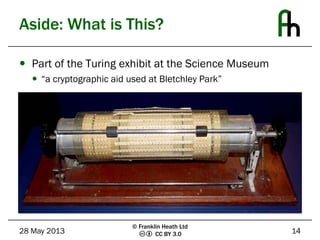
Aside: What is This?
 Part of the Turing exhibit at the Science Museum
 “a cryptographic aid used at Bletchley Park”
28 May 2013 14
© Franklin Heath Ltd
CC BY 3.0
Lesson 1:
Cryptosystems have Subtle Flaws
 Long keys do not alone make a strong cryptosystem
 Stream ciphers can have unfortunate interactions with
themselves (especially reciprocal synchronous ones)
 Attackers can take advantage of predictable plain text or even
predictable repetitions in otherwise unknown plaintext
 Best practice for modern systems seems to be to use
block ciphers like AES with chaining modes
 2001 break of WEP (“Wired Equivalent Privacy”) exploited use
of duplicate initialisation vectors with RC4 stream cipher
28 May 2013 15
© Franklin Heath Ltd
CC BY 3.0
Lesson 2:
Plan for Key Compromise
 “Pinches” provided a way into new Enigma networks
 1940 HMS Gleaner: rotors VI and VII from U-33
 1940 HMS Griffin: settings and cribs from armed trawler Polares
 1941 HMS Tartar: code books from weather ship Lauenberg
 1941 HMS Somali: rotors and code books from armed trawler Krebs
 1941 HMS Somali: code books from weather ship München
 1941 HMS Bulldog: machine and code books from U-110
 1942 HMS Petard: machine and code books from U-559
 They had emergency procedures to switch to other settings
 Modern security systems need to have “renewability” too
 for recovery from “class breaks” like the DVD CSS key breach in 1999
28 May 2013 16
© Franklin Heath Ltd
CC BY 3.0
Lesson 3:
Users Pick Poor Passwords
 Many Enigma messages were read by guessing the
message key that the operator chose (“Cillies”)
 AAA BBB, QWE ASD, BER LIN, etc.
 This was addressed later in the war by operational
procedures
 Daily settings used as a pseudo-random generator
 Cryptographic keys need more entropy than users can
supply in the form of a password
 Salts, nonces, initialisation vectors, etc.
 You can crack many unsalted MD5 passwords just with Google
28 May 2013 17
© Franklin Heath Ltd
CC BY 3.0
Lesson 4:
Pick a Good RNG and Trust It
 Don’t be tempted to interfere to make it look random
 German cipher staff had rules for not repeating rotor
order and not plugging adjacent letters
 This significantly reduced the number of possible settings that
needed to be tried on the Bombe
 Many security vulnerabilities in modern systems are
due to poor randomness
 e.g. Debian OpenSSL vulnerability in 2008
28 May 2013 18
© Franklin Heath Ltd
CC BY 3.0
Lesson 5:
Don’t Underestimate the Enemy
 German high command told Enigma was “unbreakable”
 German cryptographers knew it was theoretically
breakable, but thought no one would put in that much
effort
 Bletchley Park’s mathematical approach and production
line methods led to industrial-scale cryptanalysis
 Modern example:
 2009 breaking of GSM A5/1 using precomputed rainbow tables
 Used GPUs in a distributed collaborative project
28 May 2013 19
© Franklin Heath Ltd
CC BY 3.0
Summary
 The Enigma machine cipher is elegant, efficient and has
few significant inherent flaws
 Bletchley Park benefited greatly from weaknesses in the
key establishment procedures and from analysis of traffic
for which keys had been compromised
 Five lessons:
 Cryptosystems have subtle flaws
 Plan for key compromise
 Users pick poor passwords
 Pick a good RNG and trust it
 Don’t underestimate the enemy
28 May 2013 20
© Franklin Heath Ltd

Security Lessons from Bletchley Park and Enigma

  • 1.
    Franklin Heath Ltd28May 2013 Security Lessons from Bletchley Park and Enigma Image: Bletchley Park Mansion by Antoine Taveneaux
  • 2.
    CC BY 3.0 Topics How the Enigma machine works  How Bletchley Park exploited German mistakes  Five lessons we can draw from this 28 May 2013 2 © Franklin Heath Ltd
  • 3.
    CC BY 3.0 TheEnigma Machine  Invented by Arthur Scherbius in 1918  Commercially available from 1923  Adopted by German military from 1927  Several variants, notably:  Enigma I, German army 1932  Enigma M4, German U-boats 1941  Principally mechanical  Battery is used only to illuminate the output letter  Used throughout WWII by German military + agencies  Estimated 100,000 machines produced 28 May 2013 3 © Franklin Heath Ltd
  • 4.
    CC BY 3.0 EnigmaMachine Components 28 May 2013 4 © Franklin Heath Ltd Scrambler Rotors and reflector Output Battery-powered lamps Input Keys (switch and lever) Plug Board Static, swaps letters
  • 5.
    CC BY 3.0 EnigmaMachine Components 28 May 2013 5 © Franklin Heath Ltd Scrambler Rotors and reflector Output Battery-powered lamps Input Keys (switch and lever)
  • 6.
    CC BY 3.0 FullyFunctional Paper Model 28 May 2013 6 © Franklin Heath Ltd
  • 7.
    CC BY 3.0 ExampleEnigma Settings Sheet 28 May 2013 7 © Franklin Heath Ltd
  • 8.
    CC BY 3.0 EnigmaSimulator 28 May 2013 8 © Franklin Heath Ltd
  • 9.
    CC BY 3.0 EnigmaCipher Characteristics  26-letter alphabet  Numbers typically spelled out  Reciprocal substitution cipher  Operation is its own inverse  Independent of preceding text  Message key sets start “state”  Never encrypts a letter as itself  Keys are SPDT switches selecting input or output 28 May 2013 9 © Franklin Heath Ltd
  • 10.
    CC BY 3.0 EnigmaMachine Key Length  4-rotor Enigma M4  2 possible reflectors  672 possible rotor choices  676 possible notch positions  532,985,208,200,576 possible combinations of plugs  456,976 possible starting positions  = 221,286,292,668,406,558,235,295,744 possible keys  Log2 gives equivalent binary key length: ~88 bits  Still export-controlled today!  Yet it could be broken with 70-year old mechanical technology  Key length isn’t the most important characteristic 28 May 2013 10 © Franklin Heath Ltd
  • 11.
    CC BY 3.0 BletchleyPark’s “Wicked Uncles”  Senior codebreakers recruited in 1939  Introduced mathematical and mechanised methods  1941 memo delivered to P.M Winston Churchill  Response: “Make sure they have all they want on extreme priority and report to me that this had been done.” 28 May 2013 11 © Franklin Heath Ltd Alan Turing 1912-1954 Gordon Welchman 1906-1985Hugh Alexander 1909-1974Stuart Milner-Barry 1906-1995
  • 12.
    CC BY 3.0 Typesof Breaks into Enigma  Polish Cipher Bureau, 1932 onwards  Common start positions (mitigated 1938)  Repeated message key (mitigated 1940)  UK GC&CS, 1937 onwards  “Rodding” using cribs (mitigated by plug board)  Herivel tip, to deduce ring settings  Cillies, to deduce message keys  Banburismus, to identify likely rotor orders  Bombe menus from cribs, to test rotor orders  EINS catalogue, to deduce message keys and bigram tables 28 May 2013 12 © Franklin Heath Ltd
  • 13.
    CC BY 3.0 TheTuring-Welchman Bombe 28 May 2013 13 © Franklin Heath Ltd Images Credit: Antoine Taveneaux
  • 14.
    CC BY 3.0 Aside:What is This?  Part of the Turing exhibit at the Science Museum  “a cryptographic aid used at Bletchley Park” 28 May 2013 14 © Franklin Heath Ltd
  • 15.
    CC BY 3.0 Lesson1: Cryptosystems have Subtle Flaws  Long keys do not alone make a strong cryptosystem  Stream ciphers can have unfortunate interactions with themselves (especially reciprocal synchronous ones)  Attackers can take advantage of predictable plain text or even predictable repetitions in otherwise unknown plaintext  Best practice for modern systems seems to be to use block ciphers like AES with chaining modes  2001 break of WEP (“Wired Equivalent Privacy”) exploited use of duplicate initialisation vectors with RC4 stream cipher 28 May 2013 15 © Franklin Heath Ltd
  • 16.
    CC BY 3.0 Lesson2: Plan for Key Compromise  “Pinches” provided a way into new Enigma networks  1940 HMS Gleaner: rotors VI and VII from U-33  1940 HMS Griffin: settings and cribs from armed trawler Polares  1941 HMS Tartar: code books from weather ship Lauenberg  1941 HMS Somali: rotors and code books from armed trawler Krebs  1941 HMS Somali: code books from weather ship München  1941 HMS Bulldog: machine and code books from U-110  1942 HMS Petard: machine and code books from U-559  They had emergency procedures to switch to other settings  Modern security systems need to have “renewability” too  for recovery from “class breaks” like the DVD CSS key breach in 1999 28 May 2013 16 © Franklin Heath Ltd
  • 17.
    CC BY 3.0 Lesson3: Users Pick Poor Passwords  Many Enigma messages were read by guessing the message key that the operator chose (“Cillies”)  AAA BBB, QWE ASD, BER LIN, etc.  This was addressed later in the war by operational procedures  Daily settings used as a pseudo-random generator  Cryptographic keys need more entropy than users can supply in the form of a password  Salts, nonces, initialisation vectors, etc.  You can crack many unsalted MD5 passwords just with Google 28 May 2013 17 © Franklin Heath Ltd
  • 18.
    CC BY 3.0 Lesson4: Pick a Good RNG and Trust It  Don’t be tempted to interfere to make it look random  German cipher staff had rules for not repeating rotor order and not plugging adjacent letters  This significantly reduced the number of possible settings that needed to be tried on the Bombe  Many security vulnerabilities in modern systems are due to poor randomness  e.g. Debian OpenSSL vulnerability in 2008 28 May 2013 18 © Franklin Heath Ltd
  • 19.
    CC BY 3.0 Lesson5: Don’t Underestimate the Enemy  German high command told Enigma was “unbreakable”  German cryptographers knew it was theoretically breakable, but thought no one would put in that much effort  Bletchley Park’s mathematical approach and production line methods led to industrial-scale cryptanalysis  Modern example:  2009 breaking of GSM A5/1 using precomputed rainbow tables  Used GPUs in a distributed collaborative project 28 May 2013 19 © Franklin Heath Ltd
  • 20.
    CC BY 3.0 Summary The Enigma machine cipher is elegant, efficient and has few significant inherent flaws  Bletchley Park benefited greatly from weaknesses in the key establishment procedures and from analysis of traffic for which keys had been compromised  Five lessons:  Cryptosystems have subtle flaws  Plan for key compromise  Users pick poor passwords  Pick a good RNG and trust it  Don’t underestimate the enemy 28 May 2013 20 © Franklin Heath Ltd