A Glimpse of the History of
Cryptography
Cunsheng Ding
Department of Computer Science
HKUST, Hong Kong, CHINA
Part II: Machine Ciphers
Enigma
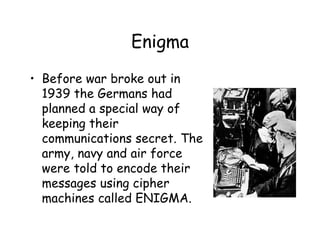
• Before war broke out in
1939 the Germans had
planned a special way of
keeping their
communications secret. The
army, navy and air force
were told to encode their
messages using cipher
machines called ENIGMA.
Enigma
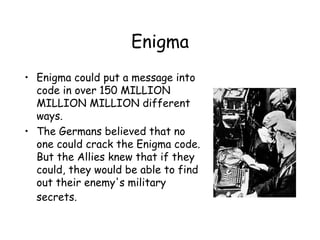
• Enigma could put a message into
code in over 150 MILLION
MILLION MILLION different
ways.
• The Germans believed that no
one could crack the Enigma code.
But the Allies knew that if they
could, they would be able to find
out their enemy's military
secrets.
Enigma
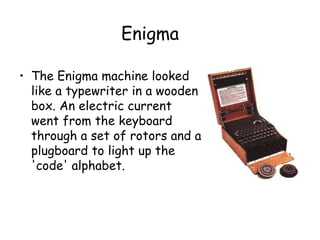
• The Enigma machine looked
like a typewriter in a wooden
box. An electric current
went from the keyboard
through a set of rotors and a
plugboard to light up the
'code' alphabet.
Enigma
• At least once a day the
Germans changed the order
of the rotors, their starting
positions and the plugboard
connections. To decipher a
message sent using Enigma,
you had to work out exactly
how all of these had been set.
Enigma
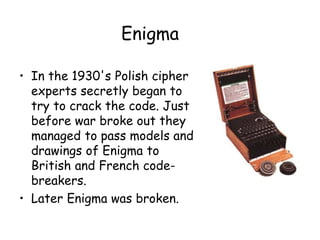
• In the 1930's Polish cipher
experts secretly began to
try to crack the code. Just
before war broke out they
managed to pass models and
drawings of Enigma to
British and French code-
breakers.
• Later Enigma was broken.
Sigaba
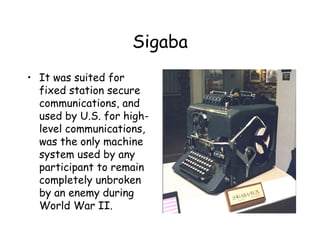
• It was suited for
fixed station secure
communications, and
used by U.S. for high-
level communications,
was the only machine
system used by any
participant to remain
completely unbroken
by an enemy during
World War II.
B-21 Machine by Boris Hagelin
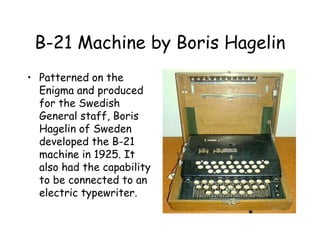
• Patterned on the
Enigma and produced
for the Swedish
General staff, Boris
Hagelin of Sweden
developed the B-21
machine in 1925. It
also had the capability
to be connected to an
electric typewriter.
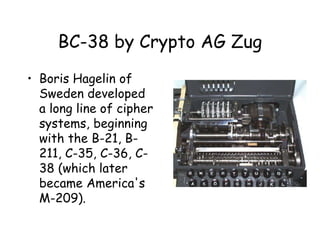
BC-38 by Crypto AG Zug
• Boris Hagelin of
Sweden developed
a long line of cipher
systems, beginning
with the B-21, B-
211, C-35, C-36, C-
38 (which later
became America's
M-209).
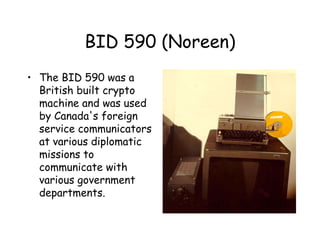
BID 590 (Noreen)
• The BID 590 was a
British built crypto
machine and was used
by Canada's foreign
service communicators
at various diplomatic
missions to
communicate with
various government
departments.
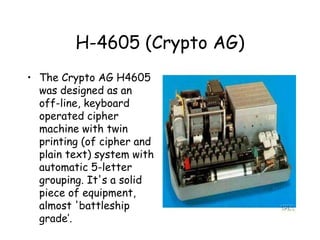
H-4605 (Crypto AG)
• The Crypto AG H4605
was designed as an
off-line, keyboard
operated cipher
machine with twin
printing (of cipher and
plain text) system with
automatic 5-letter
grouping. It's a solid
piece of equipment,
almost 'battleship
grade’.
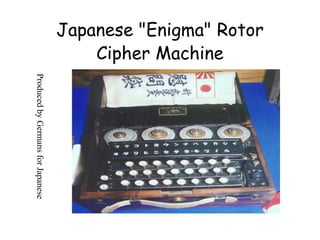
Japanese "Enigma" Rotor
Cipher Machine
Produced
by
Germans
for
Japanese
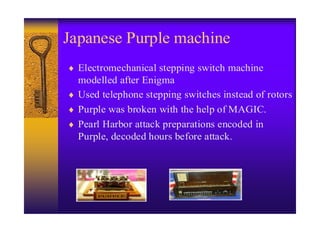
Japanese Purple machine
¨ Electromechanical stepping switch machine
modelled after Enigma
¨ Used telephone stepping switches instead of rotors
¨ Purple was broken with the help of MAGIC.
¨ Pearl Harbor attack preparations encoded in
Purple, decoded hours before attack.
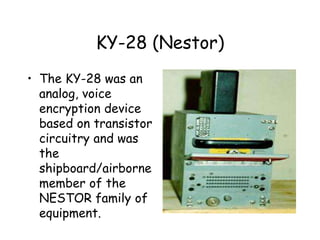
KY-28 (Nestor)
• The KY-28 was an
analog, voice
encryption device
based on transistor
circuitry and was
the
shipboard/airborne
member of the
NESTOR family of
equipment.
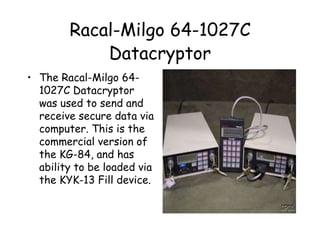
Racal-Milgo 64-1027C
Datacryptor
• The Racal-Milgo 64-
1027C Datacryptor
was used to send and
receive secure data via
computer. This is the
commercial version of
the KG-84, and has
ability to be loaded via
the KYK-13 Fill device.
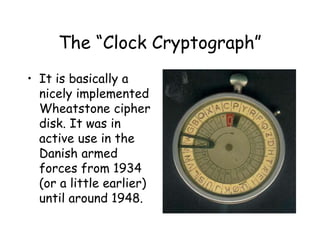
The “Clock Cryptograph”
• It is basically a
nicely implemented
Wheatstone cipher
disk. It was in
active use in the
Danish armed
forces from 1934
(or a little earlier)
until around 1948.
People in Breaking Codes
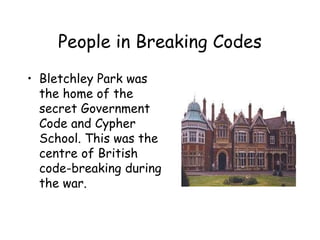
• Bletchley Park was
the home of the
secret Government
Code and Cypher
School. This was the
centre of British
code-breaking during
the war.
People in Breaking Codes
• The code-breakers in Bletchley
Park were specially chosen from
among the cleverest people in
England. Some were brilliant
mathematicians or linguists.
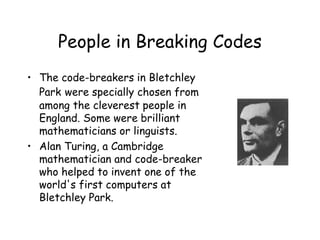
• Alan Turing, a Cambridge
mathematician and code-breaker
who helped to invent one of the
world's first computers at
Bletchley Park.
Computer and Code Breaking
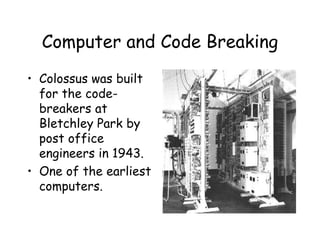
• Colossus was built
for the code-
breakers at
Bletchley Park by
post office
engineers in 1943.
• One of the earliest
computers.
Computer and Code Breaking
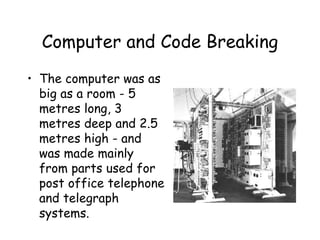
• The computer was as
big as a room - 5
metres long, 3
metres deep and 2.5
metres high - and
was made mainly
from parts used for
post office telephone
and telegraph
systems.
Computer and Code Breaking
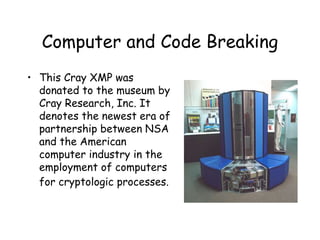
• This Cray XMP was
donated to the museum by
Cray Research, Inc. It
denotes the newest era of
partnership between NSA
and the American
computer industry in the
employment of computers
for cryptologic processes.
Cipher Machines and Software
Somulation
• http://frode.home.cern.ch/frode/crypto/

history.ppt

  • 1.
    A Glimpse ofthe History of Cryptography Cunsheng Ding Department of Computer Science HKUST, Hong Kong, CHINA
  • 2.
  • 3.
    Enigma • Before warbroke out in 1939 the Germans had planned a special way of keeping their communications secret. The army, navy and air force were told to encode their messages using cipher machines called ENIGMA.
  • 4.
    Enigma • Enigma couldput a message into code in over 150 MILLION MILLION MILLION different ways. • The Germans believed that no one could crack the Enigma code. But the Allies knew that if they could, they would be able to find out their enemy's military secrets.
  • 5.
    Enigma • The Enigmamachine looked like a typewriter in a wooden box. An electric current went from the keyboard through a set of rotors and a plugboard to light up the 'code' alphabet.
  • 6.
    Enigma • At leastonce a day the Germans changed the order of the rotors, their starting positions and the plugboard connections. To decipher a message sent using Enigma, you had to work out exactly how all of these had been set.
  • 7.
    Enigma • In the1930's Polish cipher experts secretly began to try to crack the code. Just before war broke out they managed to pass models and drawings of Enigma to British and French code- breakers. • Later Enigma was broken.
  • 8.
    Sigaba • It wassuited for fixed station secure communications, and used by U.S. for high- level communications, was the only machine system used by any participant to remain completely unbroken by an enemy during World War II.
  • 9.
    B-21 Machine byBoris Hagelin • Patterned on the Enigma and produced for the Swedish General staff, Boris Hagelin of Sweden developed the B-21 machine in 1925. It also had the capability to be connected to an electric typewriter.
  • 10.
    BC-38 by CryptoAG Zug • Boris Hagelin of Sweden developed a long line of cipher systems, beginning with the B-21, B- 211, C-35, C-36, C- 38 (which later became America's M-209).
  • 11.
    BID 590 (Noreen) •The BID 590 was a British built crypto machine and was used by Canada's foreign service communicators at various diplomatic missions to communicate with various government departments.
  • 12.
    H-4605 (Crypto AG) •The Crypto AG H4605 was designed as an off-line, keyboard operated cipher machine with twin printing (of cipher and plain text) system with automatic 5-letter grouping. It's a solid piece of equipment, almost 'battleship grade’.
  • 13.
    Japanese "Enigma" Rotor CipherMachine Produced by Germans for Japanese
  • 14.
    Japanese Purple machine ¨Electromechanical stepping switch machine modelled after Enigma ¨ Used telephone stepping switches instead of rotors ¨ Purple was broken with the help of MAGIC. ¨ Pearl Harbor attack preparations encoded in Purple, decoded hours before attack.
  • 15.
    KY-28 (Nestor) • TheKY-28 was an analog, voice encryption device based on transistor circuitry and was the shipboard/airborne member of the NESTOR family of equipment.
  • 16.
    Racal-Milgo 64-1027C Datacryptor • TheRacal-Milgo 64- 1027C Datacryptor was used to send and receive secure data via computer. This is the commercial version of the KG-84, and has ability to be loaded via the KYK-13 Fill device.
  • 17.
    The “Clock Cryptograph” •It is basically a nicely implemented Wheatstone cipher disk. It was in active use in the Danish armed forces from 1934 (or a little earlier) until around 1948.
  • 18.
    People in BreakingCodes • Bletchley Park was the home of the secret Government Code and Cypher School. This was the centre of British code-breaking during the war.
  • 19.
    People in BreakingCodes • The code-breakers in Bletchley Park were specially chosen from among the cleverest people in England. Some were brilliant mathematicians or linguists. • Alan Turing, a Cambridge mathematician and code-breaker who helped to invent one of the world's first computers at Bletchley Park.
  • 20.
    Computer and CodeBreaking • Colossus was built for the code- breakers at Bletchley Park by post office engineers in 1943. • One of the earliest computers.
  • 21.
    Computer and CodeBreaking • The computer was as big as a room - 5 metres long, 3 metres deep and 2.5 metres high - and was made mainly from parts used for post office telephone and telegraph systems.
  • 22.
    Computer and CodeBreaking • This Cray XMP was donated to the museum by Cray Research, Inc. It denotes the newest era of partnership between NSA and the American computer industry in the employment of computers for cryptologic processes.
  • 23.
    Cipher Machines andSoftware Somulation • http://frode.home.cern.ch/frode/crypto/