Security Architecture-
Security Models
Suraj singh
References: As mentioned in my previous slides, Shaun Harris CISSP books and
official ISC2 books
This Photo by Unknown Author is licensed under CC BY-ND
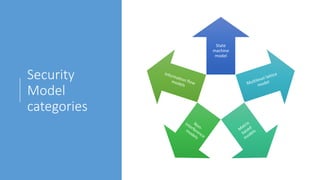
Security
Model
categories
State
machine
model
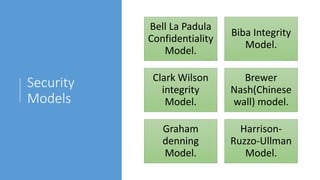
Security
Models
Bell La Padula
Confidentiality
Model.
Biba Integrity
Model.
Clark Wilson
integrity
Model.
Brewer
Nash(Chinese
wall) model.
Graham
denning
Model.
Harrison-
Ruzzo-Ullman
Model.
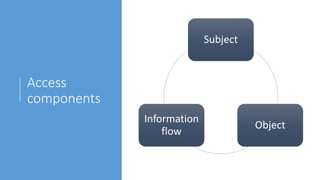
Access
components
Subject
Object
Information
flow
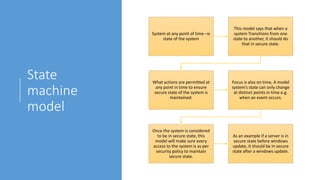
State
machine
model
System at any point of time –is
state of the system
This model says that when a
system Transitions from one
state to another, it should do
that in secure state.
What actions are permitted at
any point in time to ensure
secure state of the system is
maintained.
Focus is also on time, A model
system’s state can only change
at distinct points in time e.g.
when an event occurs.
Once the system is considered
to be in secure state, this
model will make sure every
access to the system is as per
security policy to maintain
secure state.
As an example if a server is in
secure state before windows
update, it should be in secure
state after a windows update.
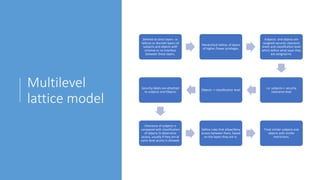
Multilevel
lattice model
Defined as strict layers or
lattices or discreet layers of
subjects and objects with
minimal or no interface
between these layers.
Hierarchical lattice, of layers
of higher /lower privileges.
Subjects and objects are
assigned security clearance
levels and classification level
which define what layer they
are assigned to.
i.e. subjects-> security
clearance level
Objects -> classification level
Security labels are attached
to subjects and Objects
Clearance of subjects is
compared with classification
of objects to determine
access, usually if they are at
same level access is allowed.
Define rules that allow/deny
access between them, based
on the layers they are in.
Treat similar subjects and
objects with similar
restrictions.
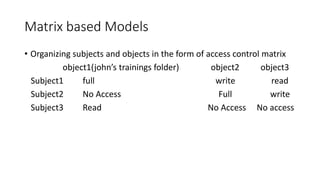
Matrix based Models
• Organizing subjects and objects in the form of access control matrix
object1(john’s trainings folder) object2 object3
Subject1 full write read
Subject2 No Access Full write
Subject3 Read No Access No access
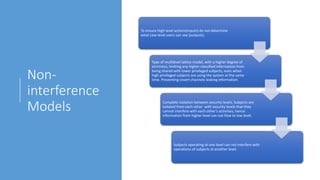
Non-
interference
Models
To ensure High level actions(inputs) do not determine
what Low-level users can see (outputs).
Type of multilevel lattice model, with a higher degree of
strictness, limiting any higher-classified information from
being shared with lower privileged subjects, even when
high privileged subjects are using the system at the same
time. Preventing covert channels leaking information.
Complete isolation between security levels. Subjects are
isolated from each other with security levels that they
cannot interfere with each other’s activities, hence
information from higher level can not flow to low level.
Subjects operating at one level can not interfere with
operations of subjects at another level.
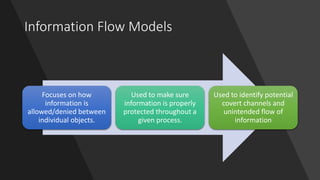
Information Flow Models
Focuses on how
information is
allowed/denied between
individual objects.
Used to make sure
information is properly
protected throughout a
given process.
Used to identify potential
covert channels and
unintended flow of
information
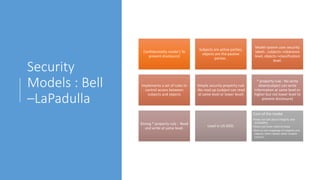
Security
Models : Bell
–LaPadulla
Confidentiality model ( To
prevent disclosure)
Subjects are active parties,
objects are the passive
parties .
Model system uses security
labels , subjects->clearance
level, objects->classification
level.
Implements a set of rules to
control access between
subjects and objects
Simple security property rule
:No read up (subject can read
at same level or lower level)
* property rule : No write
down(subject can write
information at same level or
higher but not lower level to
prevent disclosure)
Strong * property rule : Read
and write at same level.
Used in US DOD.
Cons of the model
•Does not talk about integrity and
availability.
•Does not cover need to know
•One to one mappings of subjects and
objects, that’s where other models
come in.
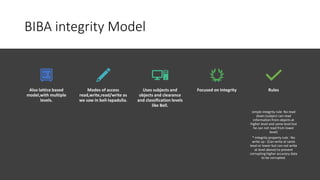
BIBA integrity Model
Also lattice based
model,with multiple
levels.
Modes of access
read,write,read/write as
we saw in bell-lapadulla.
Uses subjects and
objects and clearance
and classification levels
like Bell.
Focused on Integrity Rules
simple integrity rule: No read
down (subject can read
information from objects at
higher level and same level but
he can not read from lower
level)
* integrity property rule : No
write up : (Can write at same
level or lower but can not write
at level above) to prevent
corrupting higher accuracy data
to be corrupted.
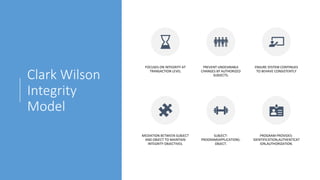
Clark Wilson
Integrity
Model
FOCUSES ON INTEGRITY AT
TRANSACTION LEVEL
PREVENT UNDESIRABLE
CHANGES BY AUTHORIZED
SUBJECTS.
ENSURE SYSTEM CONTINUES
TO BEHAVE CONSISTENTLY
MEDIATION BETWEEN SUBJECT
AND OBJECT TO MAINTAIN
INTEGRITY OBJECTIVES.
SUBJECT-
PROGRAM(APPLICATION)-
OBJECT.
PROGRAM PROVIDES-
IDENTIFICATION,AUTHENTICAT
ION,AUTHORIZATION.
Brewer Nash(Chinese wall)
Model
• Focuses on conflict of interest.
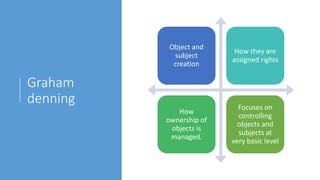
Graham
denning
Object and
subject
creation
How they are
assigned rights
How
ownership of
objects is
managed.
Focuses on
controlling
objects and
subjects at
very basic level
Harrison
ruzzo Ullman
model Similar to graham
denning.
Set of generic rights and
finite set of commands
Q and A

Security Architecture-Security Models

  • 1.
    Security Architecture- Security Models Surajsingh References: As mentioned in my previous slides, Shaun Harris CISSP books and official ISC2 books This Photo by Unknown Author is licensed under CC BY-ND
  • 2.
  • 3.
    Security Models Bell La Padula Confidentiality Model. BibaIntegrity Model. Clark Wilson integrity Model. Brewer Nash(Chinese wall) model. Graham denning Model. Harrison- Ruzzo-Ullman Model.
  • 4.
  • 5.
    State machine model System at anypoint of time –is state of the system This model says that when a system Transitions from one state to another, it should do that in secure state. What actions are permitted at any point in time to ensure secure state of the system is maintained. Focus is also on time, A model system’s state can only change at distinct points in time e.g. when an event occurs. Once the system is considered to be in secure state, this model will make sure every access to the system is as per security policy to maintain secure state. As an example if a server is in secure state before windows update, it should be in secure state after a windows update.
  • 6.
    Multilevel lattice model Defined asstrict layers or lattices or discreet layers of subjects and objects with minimal or no interface between these layers. Hierarchical lattice, of layers of higher /lower privileges. Subjects and objects are assigned security clearance levels and classification level which define what layer they are assigned to. i.e. subjects-> security clearance level Objects -> classification level Security labels are attached to subjects and Objects Clearance of subjects is compared with classification of objects to determine access, usually if they are at same level access is allowed. Define rules that allow/deny access between them, based on the layers they are in. Treat similar subjects and objects with similar restrictions.
  • 7.
    Matrix based Models •Organizing subjects and objects in the form of access control matrix object1(john’s trainings folder) object2 object3 Subject1 full write read Subject2 No Access Full write Subject3 Read No Access No access
  • 8.
    Non- interference Models To ensure Highlevel actions(inputs) do not determine what Low-level users can see (outputs). Type of multilevel lattice model, with a higher degree of strictness, limiting any higher-classified information from being shared with lower privileged subjects, even when high privileged subjects are using the system at the same time. Preventing covert channels leaking information. Complete isolation between security levels. Subjects are isolated from each other with security levels that they cannot interfere with each other’s activities, hence information from higher level can not flow to low level. Subjects operating at one level can not interfere with operations of subjects at another level.
  • 9.
    Information Flow Models Focuseson how information is allowed/denied between individual objects. Used to make sure information is properly protected throughout a given process. Used to identify potential covert channels and unintended flow of information
  • 10.
    Security Models : Bell –LaPadulla Confidentialitymodel ( To prevent disclosure) Subjects are active parties, objects are the passive parties . Model system uses security labels , subjects->clearance level, objects->classification level. Implements a set of rules to control access between subjects and objects Simple security property rule :No read up (subject can read at same level or lower level) * property rule : No write down(subject can write information at same level or higher but not lower level to prevent disclosure) Strong * property rule : Read and write at same level. Used in US DOD. Cons of the model •Does not talk about integrity and availability. •Does not cover need to know •One to one mappings of subjects and objects, that’s where other models come in.
  • 11.
    BIBA integrity Model Alsolattice based model,with multiple levels. Modes of access read,write,read/write as we saw in bell-lapadulla. Uses subjects and objects and clearance and classification levels like Bell. Focused on Integrity Rules simple integrity rule: No read down (subject can read information from objects at higher level and same level but he can not read from lower level) * integrity property rule : No write up : (Can write at same level or lower but can not write at level above) to prevent corrupting higher accuracy data to be corrupted.
  • 12.
    Clark Wilson Integrity Model FOCUSES ONINTEGRITY AT TRANSACTION LEVEL PREVENT UNDESIRABLE CHANGES BY AUTHORIZED SUBJECTS. ENSURE SYSTEM CONTINUES TO BEHAVE CONSISTENTLY MEDIATION BETWEEN SUBJECT AND OBJECT TO MAINTAIN INTEGRITY OBJECTIVES. SUBJECT- PROGRAM(APPLICATION)- OBJECT. PROGRAM PROVIDES- IDENTIFICATION,AUTHENTICAT ION,AUTHORIZATION.
  • 13.
    Brewer Nash(Chinese wall) Model •Focuses on conflict of interest.
  • 14.
    Graham denning Object and subject creation How theyare assigned rights How ownership of objects is managed. Focuses on controlling objects and subjects at very basic level
  • 15.
    Harrison ruzzo Ullman model Similarto graham denning. Set of generic rights and finite set of commands
  • 16.