Security ICT GCSE
Loss of Data Can have many consequences: Cash flow problems Failure to receive or make payments Late or non-delivery of goods Making bad business decisions Bad publicity Loss of goodwill from customers Remember data is often confidential and/or irreplaceable. For these reasons it is essential that business puts sufficient measures in place to protect its data
Threats to data Physical (ie fire) Viruses Software that  automatically  copies itself so that it can ‘infect’ other disks or programs Data Loss For example the computer could develop a problem or data could be lost through  user error . Hard disks do not have an infinite life and will eventually fail Most of these threats can be combated through regular  backups
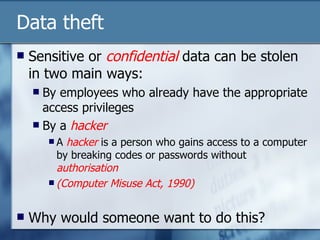
Data theft Sensitive or  confidential  data can be stolen in two main ways: By employees who already have the appropriate access privileges By a  hacker A  hacker  is a person who gains access to a computer by breaking codes or passwords without  authorisation (Computer Misuse Act, 1990) Why would someone want to do this?
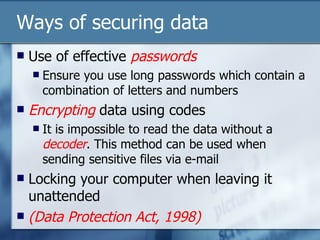
Ways of securing data Use of effective  passwords Ensure you use long passwords which contain a combination of letters and numbers Encrypting  data using codes It is impossible to read the data without a  decoder . This method can be used when sending sensitive files via e-mail Locking your computer when leaving it unattended (Data Protection Act, 1998)
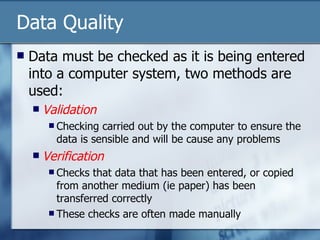
Data Quality Data must be checked as it is being entered into a computer system, two methods are used: Validation Checking carried out by the computer to ensure the data is sensible and will be cause any problems Verification Checks that data that has been entered, or copied from another medium (ie paper) has been transferred correctly  These checks are often made manually

Security

  • 1.
  • 2.
    Loss of DataCan have many consequences: Cash flow problems Failure to receive or make payments Late or non-delivery of goods Making bad business decisions Bad publicity Loss of goodwill from customers Remember data is often confidential and/or irreplaceable. For these reasons it is essential that business puts sufficient measures in place to protect its data
  • 3.
    Threats to dataPhysical (ie fire) Viruses Software that automatically copies itself so that it can ‘infect’ other disks or programs Data Loss For example the computer could develop a problem or data could be lost through user error . Hard disks do not have an infinite life and will eventually fail Most of these threats can be combated through regular backups
  • 4.
    Data theft Sensitiveor confidential data can be stolen in two main ways: By employees who already have the appropriate access privileges By a hacker A hacker is a person who gains access to a computer by breaking codes or passwords without authorisation (Computer Misuse Act, 1990) Why would someone want to do this?
  • 5.
    Ways of securingdata Use of effective passwords Ensure you use long passwords which contain a combination of letters and numbers Encrypting data using codes It is impossible to read the data without a decoder . This method can be used when sending sensitive files via e-mail Locking your computer when leaving it unattended (Data Protection Act, 1998)
  • 6.
    Data Quality Datamust be checked as it is being entered into a computer system, two methods are used: Validation Checking carried out by the computer to ensure the data is sensible and will be cause any problems Verification Checks that data that has been entered, or copied from another medium (ie paper) has been transferred correctly These checks are often made manually