Data Logging & Control ICT GCSE
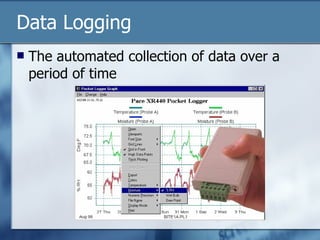
Data Logging The automated collection of data over a period of time
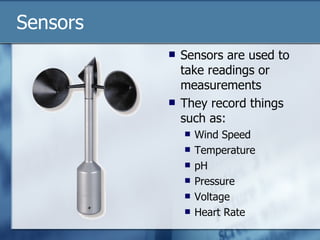
Sensors Sensors are used to take readings or measurements They record things such as: Wind Speed Temperature pH Pressure Voltage Heart Rate
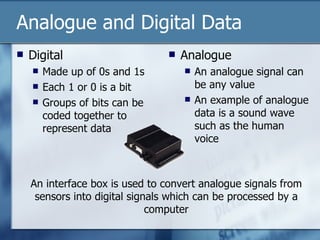
Analogue and Digital Data Digital Made up of 0s and 1s Each 1 or 0 is a bit Groups of bits can be coded together to represent data Analogue An analogue signal can be any value An example of analogue data is a sound wave such as the human voice An interface box is used to convert analogue signals from sensors into digital signals which can be processed by a computer
Example Hospitals When a patient has had a major operation or is very ill they may be put in the intensive care unit (ICU) Several sensors are used to monitor their condition: Heart Rate Oxygen levels Temperature This data is displayed as digital numbers or in the form of a graph
Other Uses Taking readings during science experiments Weather stations Recording traffic levels Recording pollution levels Central heating systems
Advantages and Disadvantages Advantages Can be used in remote or dangerous locations 24/7 Automated Often more accurate No need for a human to be present Disadvantages Equipment could break down Can be expensive The recordings will only be taken at the intervals set up, if something unexpected happens it may not be recorded
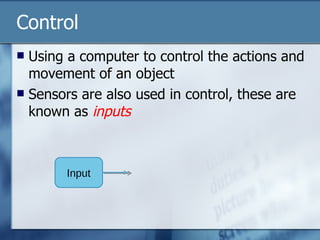
Control Using a computer to control the actions and movement of an object Sensors are also used in control, these are known as  inputs Input
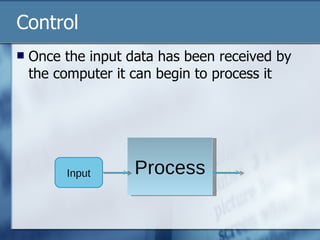
Control Once the input data has been received by the computer it can begin to process it Process Input
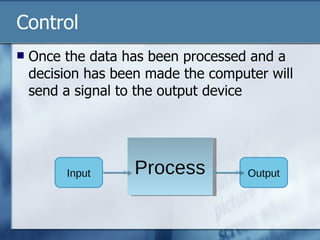
Control Once the data has been processed and a decision has been made the computer will send a signal to the output device Process Output Input
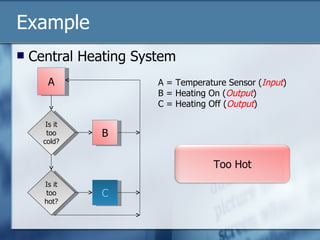
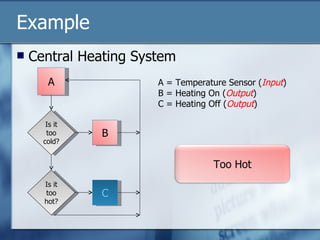
Example Central Heating System Is it too cold? B A Is it too hot? C A = Temperature Sensor ( Input ) B = Heating On ( Output ) C = Heating Off ( Output ) Too Hot
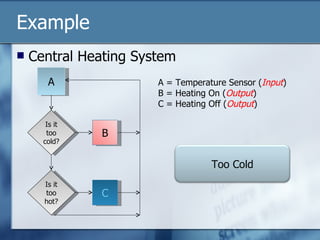
Example Central Heating System Is it too cold? B A Is it too hot? C A = Temperature Sensor ( Input ) B = Heating On ( Output ) C = Heating Off ( Output ) Too Cold
Example Central Heating System Is it too cold? B A Is it too hot? C A = Temperature Sensor ( Input ) B = Heating On ( Output ) C = Heating Off ( Output ) Too Hot
Instructions You write sequences of instructions in order to control devices, for example a robot which is designed to draw designs
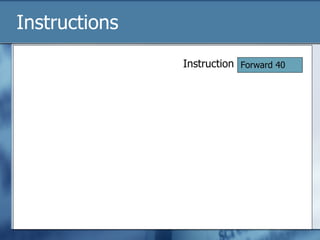
Instructions Stop Forward 40 Instruction Right 90 Forward 40 Right 90 Forward 40 Right 90 Forward 40

Data Logging And Control

  • 1.
    Data Logging &Control ICT GCSE
  • 2.
    Data Logging Theautomated collection of data over a period of time
  • 3.
    Sensors Sensors areused to take readings or measurements They record things such as: Wind Speed Temperature pH Pressure Voltage Heart Rate
  • 4.
    Analogue and DigitalData Digital Made up of 0s and 1s Each 1 or 0 is a bit Groups of bits can be coded together to represent data Analogue An analogue signal can be any value An example of analogue data is a sound wave such as the human voice An interface box is used to convert analogue signals from sensors into digital signals which can be processed by a computer
  • 5.
    Example Hospitals Whena patient has had a major operation or is very ill they may be put in the intensive care unit (ICU) Several sensors are used to monitor their condition: Heart Rate Oxygen levels Temperature This data is displayed as digital numbers or in the form of a graph
  • 6.
    Other Uses Takingreadings during science experiments Weather stations Recording traffic levels Recording pollution levels Central heating systems
  • 7.
    Advantages and DisadvantagesAdvantages Can be used in remote or dangerous locations 24/7 Automated Often more accurate No need for a human to be present Disadvantages Equipment could break down Can be expensive The recordings will only be taken at the intervals set up, if something unexpected happens it may not be recorded
  • 8.
    Control Using acomputer to control the actions and movement of an object Sensors are also used in control, these are known as inputs Input
  • 9.
    Control Once theinput data has been received by the computer it can begin to process it Process Input
  • 10.
    Control Once thedata has been processed and a decision has been made the computer will send a signal to the output device Process Output Input
  • 11.
    Example Central HeatingSystem Is it too cold? B A Is it too hot? C A = Temperature Sensor ( Input ) B = Heating On ( Output ) C = Heating Off ( Output ) Too Hot
  • 12.
    Example Central HeatingSystem Is it too cold? B A Is it too hot? C A = Temperature Sensor ( Input ) B = Heating On ( Output ) C = Heating Off ( Output ) Too Cold
  • 13.
    Example Central HeatingSystem Is it too cold? B A Is it too hot? C A = Temperature Sensor ( Input ) B = Heating On ( Output ) C = Heating Off ( Output ) Too Hot
  • 14.
    Instructions You writesequences of instructions in order to control devices, for example a robot which is designed to draw designs
  • 15.
    Instructions Stop Forward40 Instruction Right 90 Forward 40 Right 90 Forward 40 Right 90 Forward 40