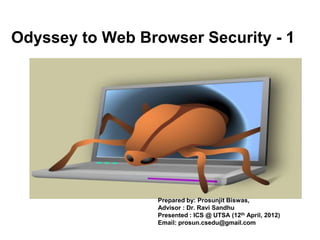
Odyssey to Web Browser Security - 1


                  Prepared by: Prosunjit Biswas,
                  Advisor : Dr. Ravi Sandhu
                  Presented : ICS @ UTSA (12th April, 2012)
                  Email: prosun.csedu@gmail.com
What is Web Browsers
               for?


• Web Browsers Retrieve, Present and
 Traverse information on Web typically
 provided by web servers.

• Web Browsers use URI/URLs to locate and
 retrieve information.
Http Request (URL) format
"protocol:" "//" host [ ":" port ] [ abs_path [
"?" query ]]

Examples:
1. http://cs.utsa.edu/index.html
2. http://utsa.summon.serialssolutions.com/search/results?
spellcheck=true&q=security
3. http://www.php.net/manual/en/reserved.variables.get.php
4. http://www.amazon.com/s/ref=nb_sb_noss/185-1213459-
6355102 ?url=search-alias%3Daps&field-keywords=iphone
Notice…


• The ‘query’ part in the URL may contain
    user provided data that is feed to the
    application.

•   And contains Payload for maximum
    possible attacks.
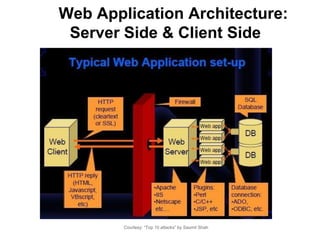
Web Application Architecture:
 Server Side & Client Side


        Courtesy: “Top 10 attacks” by Saumil Shah
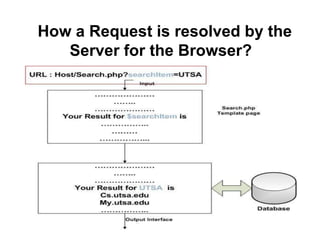
How a Request is resolved by the
   Server for the Browser?
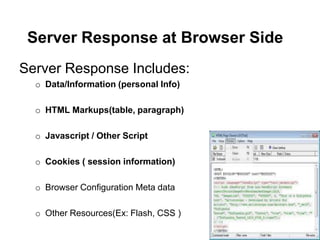
Server Response at Browser Side
Server Response Includes:
  o Data/Information (personal Info)

  o HTML Markups(table, paragraph)

  o Javascript / Other Script

  o Cookies ( session information)

  o Browser Configuration Meta data

  o Other Resources(Ex: Flash, CSS )
HTML Markup

• HTML Markups provides presentation for the
 data/content.

• In Web 2.0 data & Markup altogether build
 Document Object Model (DOM)

• DOM form a XML tree structure for easy
 retrieval of data.
Script / Javascript
• When We say Dynamic HTML( DHTML), this
  dynamicity is achieved by JavaScript at the
  Browser Side.

• JavaScript can manipulate (Insert/delete/
  Modify) any content in the browser .

• Unfortunately it is „The World's Most
  Misunderstood Programming Language’
                     -- Douglas Crockford
Where to put JavaScript in a web
               page ?
• Typically JS can be put almost all places.
• <script> JS content </script>
• <input onclick=“JS content”>
• <img src=“javascript:JS Content”>
• And others.
How Web Browsing can be
              insecure?
• Attacker Steals data [Attack User information]
• Attacker defaces a webpage [Attack markup]
• Inject / Modify JavaScript [Script Based
    attack]
•   Steal Cookie
•   Insert Meta Data on page
•   Attack other Resources [ex: Image]
Notice …


• All the mentioned attacks can be  achieved
 by injecting / modifying JavaScript on a
 honest web page.
Risk That We Do Not Care …
• A website is malicious and an user visits this
  site and get infected.
       [We can leave it to the discretion of   the
  visitor]
Risk That We Care(2) …
• A website is not intended to be malicious but
  attacker has compromised this page and let
  everyone who visit it, be compromised.
  o [ We do Care for this ]
Attacking Approach (Client-server
            Perspective)
• Attack Servers / Services [ Server side
 attack]
  o Ex. Website Defacement ,
  o SQL injection,
  o DoS Attack and others
• Attack Web Client [ Client / Browser based
 attack].
  o Ex: XSS ( Cross Site Scripting)
  o XSRF ( Cross Site Request forgery)
  o Phishing ( Social Eng.) and others
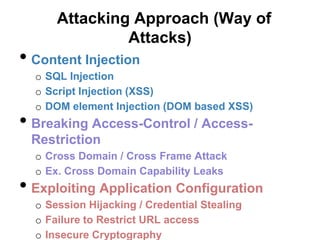
Attacking Approach (Way of
               Attacks)
• Content Injection
  o SQL Injection
  o Script Injection (XSS)
  o DOM element Injection (DOM based XSS)
• Breaking Access-Control / Access-
 Restriction
  o Cross Domain / Cross Frame Attack
  o Ex. Cross Domain Capability Leaks
• Exploiting Application Configuration
  o Session Hijacking / Credential Stealing
  o Failure to Restrict URL access
  o Insecure Cryptography
Attacking Approach (Way of
         Attacks) continuing…
• Insecure Network
  o Proxy-based attack
  o Man-in-the-middle attacks


• Web Based Malware Attack

  We are more Interested on Content Injection Attack
   because of its wide attack surface.
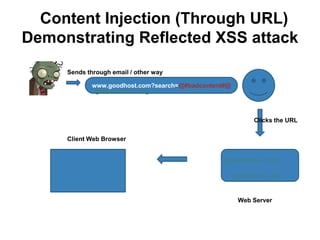
Content Injection (Through URL)
Demonstrating Reflected XSS attack
            Sends through email / other way

                    www.goodhost.com?search=@#badcontent#@
                    @#badcontent #@


                                                                   Clicks the URL

            Client Web Browser


                                                       @#badcontent #@
           @#badcontent#@
                                                             @#badcontent #@


                                                              Web Server
 User is infected with the injection attack
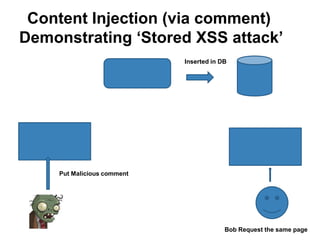
Content Injection (via comment)
Demonstrating ‘Stored XSS attack’
                                            Inserted in DB

                       @#comment!@#

                       Malicious content Comment Retrieved
                                         From database


 @#comment!@#
                                                               Clicks the URL
                                                                Clicks the URL

                                                                Request

       Put Malicious comment


                                                         Bob Request the same page
Content Injection Attack (2) (What
               content?)


• SQL ( Data Integrity & Privacy attack)
• Script / JavaScript (Privacy attack – Steal
    Cookie)
•   DOM Element ( Data Integrity - Phishing )

    We are more Interested in Script Injection
    attack (also called XSS) which is easy and
    obvious but impact is severe therefore
    critical to handle.
Why attackers prefer JavaScript
            injection?


• JavaScript can access almost all resources in
  a web page.

• JavaScript is supported by all major browsers
• JavaScript has great expressive power.
Consequence of XSS attack


• Sensitive Information theft.
  o Credential Theft ( Ex: cookies)


• Intranet Scanning
  o Scan Open ports .


• Attacking other users
  o Replay attack from compromised browser.
What are the Existing Approaches
     to Protect XSS attacks?
All the existing approaches place some kinds of
  restrictions over JavaScript uses.

• Host based Restriction
  o allow JavaScript from a White listed hosts.
  o Restrict JavaScript from Black listed hosts.


• Place holder Restriction
  o Restrict places where JavaScript can be inserted.
What are the Existing Approaches
to Protect XSS attacks …
• Transfer Restriction
  o Restrict Sensitive Resources to be send out to
    other hosts/domains.


• Content Rewrite
  o Re-write JavaScript to delete unsafe code.


• Flow Control
  o Control the flow of sensitive information in
    JavaScript (Taint Sensitive information)
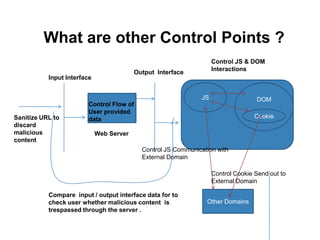
What are other Control Points ?
                                                                     Control JS & DOM
                                                                     Interactions
                                          Output Interface
           Input Interface


                                                                JS                  DOM
                         Control Flow of
                         User provided
Sanitize URL to          data                                                       Cookie
discard
malicious                    Web Server
content
                                            Control JS Communication with
                                            External Domain

                                                                     Control Cookie Send out to
                                                                     External Domain

           Compare input / output interface data for to
           check user whether malicious content is               Other Domains
           trespassed through the server .
References:
•   http://stackoverflow.com/questions/1267284/common-website-attack-
    methods-detection-and-recovery
•   http://yehg.net/lab/pr0js/papers/What%20XSS%20Can%20Do.pdf
o Thanks.

Secure webbrowsing 1

  • 1.
    Odyssey to WebBrowser Security - 1 Prepared by: Prosunjit Biswas, Advisor : Dr. Ravi Sandhu Presented : ICS @ UTSA (12th April, 2012) Email: prosun.csedu@gmail.com
  • 2.
    What is WebBrowsers for? • Web Browsers Retrieve, Present and Traverse information on Web typically provided by web servers. • Web Browsers use URI/URLs to locate and retrieve information.
  • 3.
    Http Request (URL)format "protocol:" "//" host [ ":" port ] [ abs_path [ "?" query ]] Examples: 1. http://cs.utsa.edu/index.html 2. http://utsa.summon.serialssolutions.com/search/results? spellcheck=true&q=security 3. http://www.php.net/manual/en/reserved.variables.get.php 4. http://www.amazon.com/s/ref=nb_sb_noss/185-1213459- 6355102 ?url=search-alias%3Daps&field-keywords=iphone
  • 4.
    Notice… • The ‘query’part in the URL may contain user provided data that is feed to the application. • And contains Payload for maximum possible attacks.
  • 5.
    Web Application Architecture: Server Side & Client Side Courtesy: “Top 10 attacks” by Saumil Shah
  • 6.
    How a Requestis resolved by the Server for the Browser?
  • 7.
    Server Response atBrowser Side Server Response Includes: o Data/Information (personal Info) o HTML Markups(table, paragraph) o Javascript / Other Script o Cookies ( session information) o Browser Configuration Meta data o Other Resources(Ex: Flash, CSS )
  • 8.
    HTML Markup • HTMLMarkups provides presentation for the data/content. • In Web 2.0 data & Markup altogether build Document Object Model (DOM) • DOM form a XML tree structure for easy retrieval of data.
  • 9.
    Script / Javascript •When We say Dynamic HTML( DHTML), this dynamicity is achieved by JavaScript at the Browser Side. • JavaScript can manipulate (Insert/delete/ Modify) any content in the browser . • Unfortunately it is „The World's Most Misunderstood Programming Language’ -- Douglas Crockford
  • 10.
    Where to putJavaScript in a web page ? • Typically JS can be put almost all places. • <script> JS content </script> • <input onclick=“JS content”> • <img src=“javascript:JS Content”> • And others.
  • 11.
    How Web Browsingcan be insecure? • Attacker Steals data [Attack User information] • Attacker defaces a webpage [Attack markup] • Inject / Modify JavaScript [Script Based attack] • Steal Cookie • Insert Meta Data on page • Attack other Resources [ex: Image]
  • 12.
    Notice … • Allthe mentioned attacks can be achieved by injecting / modifying JavaScript on a honest web page.
  • 13.
    Risk That WeDo Not Care … • A website is malicious and an user visits this site and get infected. [We can leave it to the discretion of the visitor]
  • 14.
    Risk That WeCare(2) … • A website is not intended to be malicious but attacker has compromised this page and let everyone who visit it, be compromised. o [ We do Care for this ]
  • 15.
    Attacking Approach (Client-server Perspective) • Attack Servers / Services [ Server side attack] o Ex. Website Defacement , o SQL injection, o DoS Attack and others • Attack Web Client [ Client / Browser based attack]. o Ex: XSS ( Cross Site Scripting) o XSRF ( Cross Site Request forgery) o Phishing ( Social Eng.) and others
  • 16.
    Attacking Approach (Wayof Attacks) • Content Injection o SQL Injection o Script Injection (XSS) o DOM element Injection (DOM based XSS) • Breaking Access-Control / Access- Restriction o Cross Domain / Cross Frame Attack o Ex. Cross Domain Capability Leaks • Exploiting Application Configuration o Session Hijacking / Credential Stealing o Failure to Restrict URL access o Insecure Cryptography
  • 17.
    Attacking Approach (Wayof Attacks) continuing… • Insecure Network o Proxy-based attack o Man-in-the-middle attacks • Web Based Malware Attack We are more Interested on Content Injection Attack because of its wide attack surface.
  • 18.
    Content Injection (ThroughURL) Demonstrating Reflected XSS attack Sends through email / other way www.goodhost.com?search=@#badcontent#@ @#badcontent #@ Clicks the URL Client Web Browser @#badcontent #@ @#badcontent#@ @#badcontent #@ Web Server User is infected with the injection attack
  • 19.
    Content Injection (viacomment) Demonstrating ‘Stored XSS attack’ Inserted in DB @#comment!@# Malicious content Comment Retrieved From database @#comment!@# Clicks the URL Clicks the URL Request Put Malicious comment Bob Request the same page
  • 20.
    Content Injection Attack(2) (What content?) • SQL ( Data Integrity & Privacy attack) • Script / JavaScript (Privacy attack – Steal Cookie) • DOM Element ( Data Integrity - Phishing ) We are more Interested in Script Injection attack (also called XSS) which is easy and obvious but impact is severe therefore critical to handle.
  • 21.
    Why attackers preferJavaScript injection? • JavaScript can access almost all resources in a web page. • JavaScript is supported by all major browsers • JavaScript has great expressive power.
  • 22.
    Consequence of XSSattack • Sensitive Information theft. o Credential Theft ( Ex: cookies) • Intranet Scanning o Scan Open ports . • Attacking other users o Replay attack from compromised browser.
  • 23.
    What are theExisting Approaches to Protect XSS attacks? All the existing approaches place some kinds of restrictions over JavaScript uses. • Host based Restriction o allow JavaScript from a White listed hosts. o Restrict JavaScript from Black listed hosts. • Place holder Restriction o Restrict places where JavaScript can be inserted.
  • 24.
    What are theExisting Approaches to Protect XSS attacks … • Transfer Restriction o Restrict Sensitive Resources to be send out to other hosts/domains. • Content Rewrite o Re-write JavaScript to delete unsafe code. • Flow Control o Control the flow of sensitive information in JavaScript (Taint Sensitive information)
  • 25.
    What are otherControl Points ? Control JS & DOM Interactions Output Interface Input Interface JS DOM Control Flow of User provided Sanitize URL to data Cookie discard malicious Web Server content Control JS Communication with External Domain Control Cookie Send out to External Domain Compare input / output interface data for to check user whether malicious content is Other Domains trespassed through the server .
  • 26.
    References: • http://stackoverflow.com/questions/1267284/common-website-attack- methods-detection-and-recovery • http://yehg.net/lab/pr0js/papers/What%20XSS%20Can%20Do.pdf
  • 27.