SECTORS OF INDIAN
ECONOMY
ECONOMY
It is the system according to which the
money, industry, and trade of a country or
region are organized.
Activities that generate some income-
economic activity.
Activities are classified into various groups
which are known as sectors.
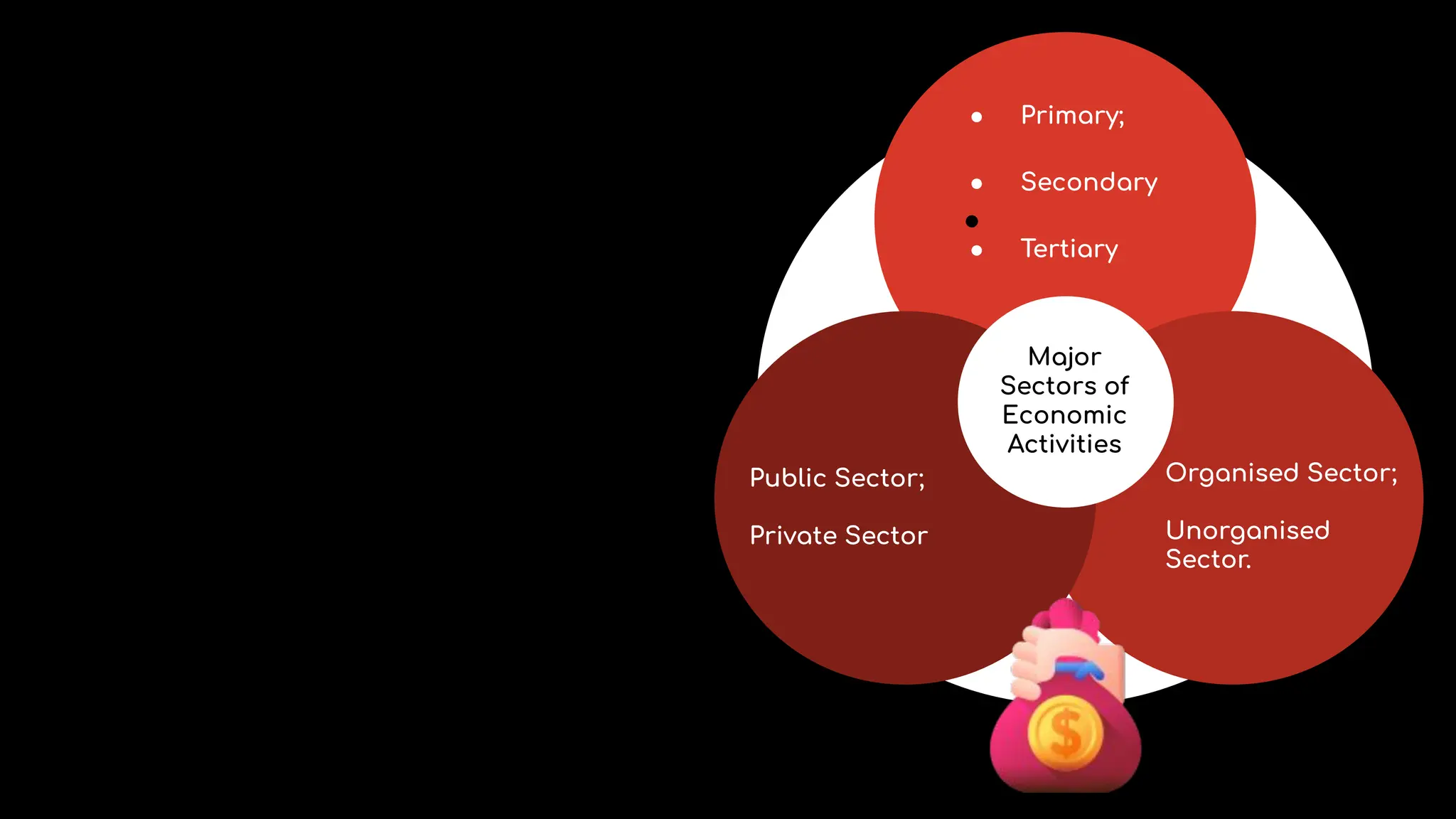
●
● Primary;
● Secondary
● Tertiary
Organised Sector;
Unorganised
Sector.
Public Sector;
Private Sector
Major
Sectors of
Economic
Activities
● Sector directly
associated with
nature.
● When we produce a
good by exploiting
natural resources, it
is an activity of the
primary sector.
● It forms the base for
all other products.
● Most of the natural
products we get are
from agriculture,
dairy, fishing,
forestry, etc.
PRIMARY SECTOR
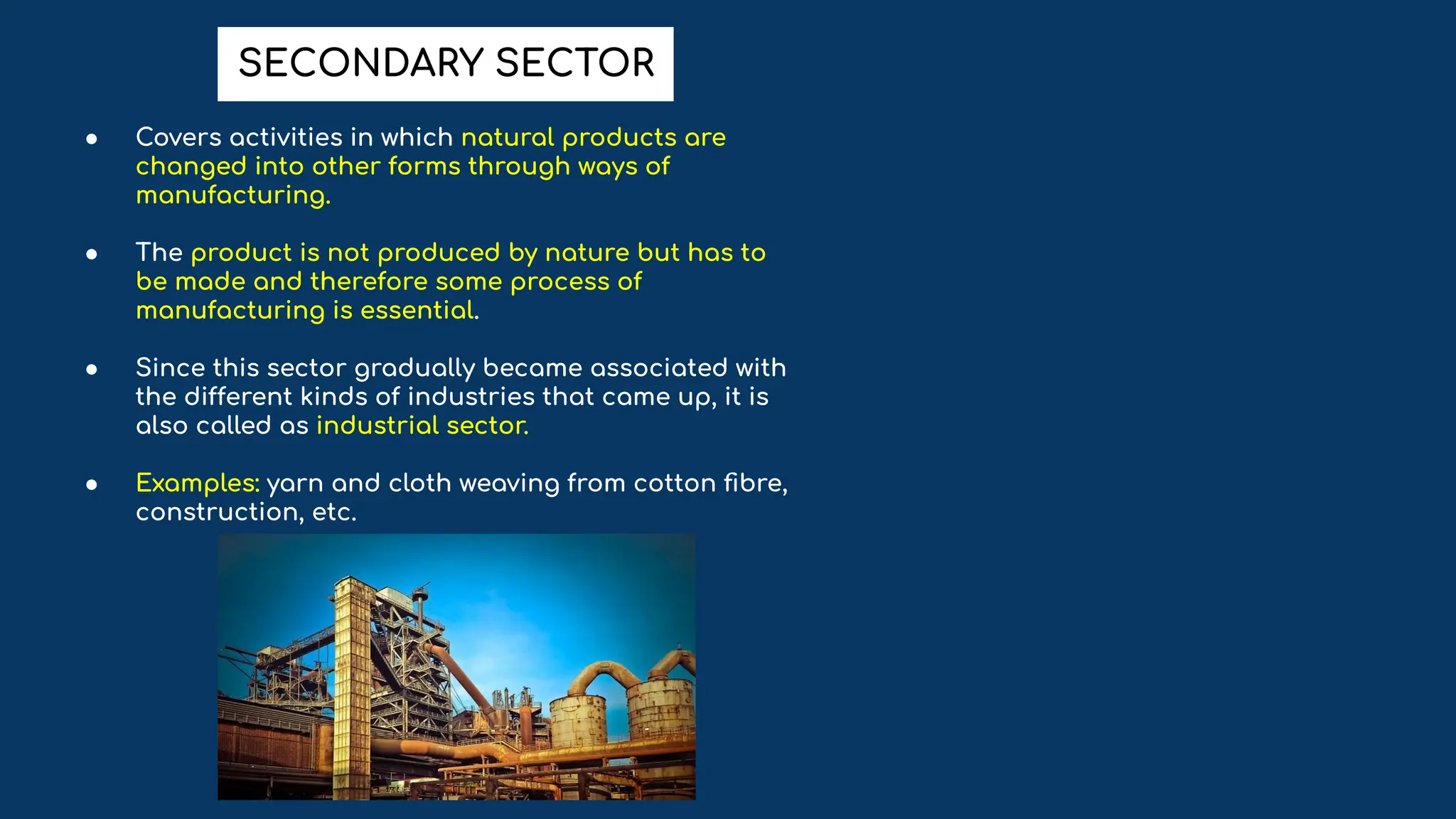
● Covers activities in which natural products are
changed into other forms through ways of
manufacturing.
● The product is not produced by nature but has to
be made and therefore some process of
manufacturing is essential.
● Since this sector gradually became associated with
the different kinds of industries that came up, it is
also called as industrial sector.
● Examples: yarn and cloth weaving from cotton fibre,
construction, etc.
SECONDARY SECTOR
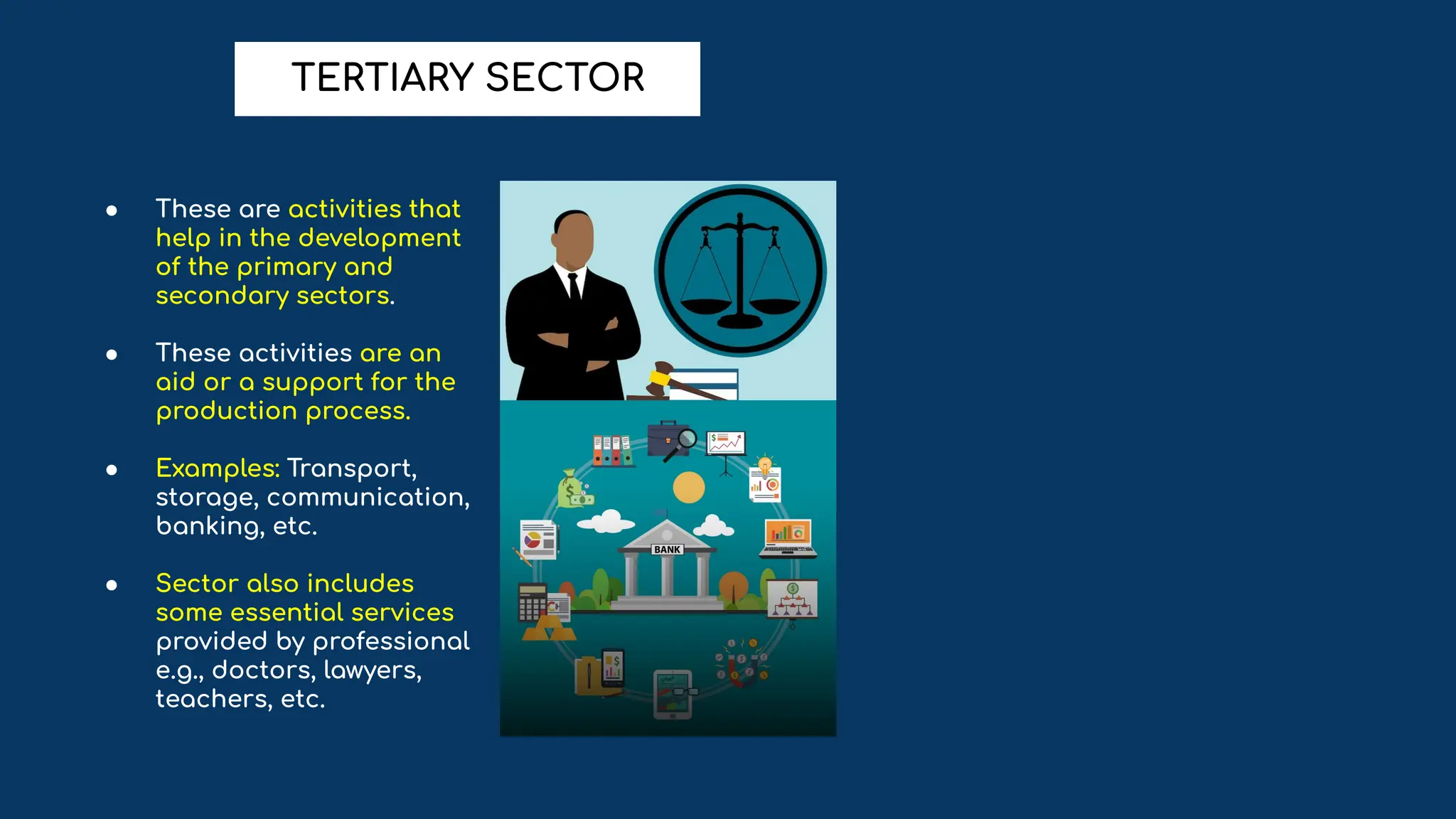
● These are activities that
help in the development
of the primary and
secondary sectors.
● These activities are an
aid or a support for the
production process.
● Examples: Transport,
storage, communication,
banking, etc.
● Sector also includes
some essential services
provided by professional
e.g., doctors, lawyers,
teachers, etc.
TERTIARY SECTOR
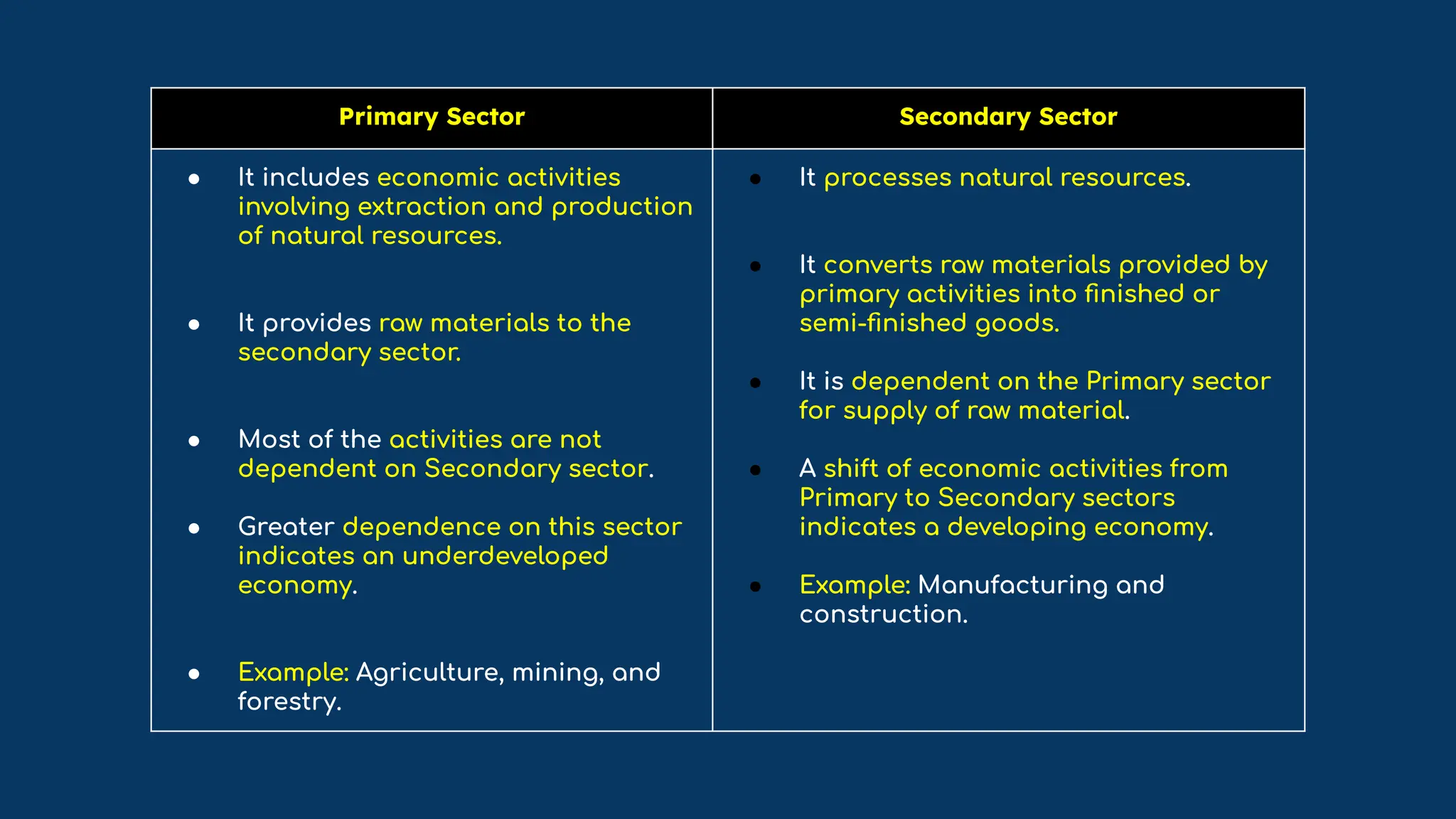
Primary Sector Secondary Sector
● It includes economic activities
involving extraction and production
of natural resources.
● It provides raw materials to the
secondary sector.
● Most of the activities are not
dependent on Secondary sector.
● Greater dependence on this sector
indicates an underdeveloped
economy.
● Example: Agriculture, mining, and
forestry.
● It processes natural resources.
● It converts raw materials provided by
primary activities into finished or
semi-finished goods.
● It is dependent on the Primary sector
for supply of raw material.
● A shift of economic activities from
Primary to Secondary sectors
indicates a developing economy.
● Example: Manufacturing and
construction.
COMPARING THE THREE
SECTORS
The various production activities in the primary,
secondary and tertiary sectors produce a very large
number of goods and services.
Also, the three sectors have a large number of people
working in them to produce these goods and services.
The next step, therefore, is to see how much goods
and services are produced and how many people
work in each sector.
In an economy there could be one or more sectors which
are dominant in terms of total production and
employment, while other sectors are relatively small in
size.
Goods & Services are of two
types:
● Final Goods & Services;
● Intermediate Goods &
Services
Raw Materials: Basic products required
to produce intermediate/ final goods.
Intermediate Products: Product used to
produce a final good or finished product.
Final/ Consumer Goods: It is a
commodity that is used by the consumer
to satisfy current wants or needs, unlike
intermediate goods which is utilized to
produce other goods.
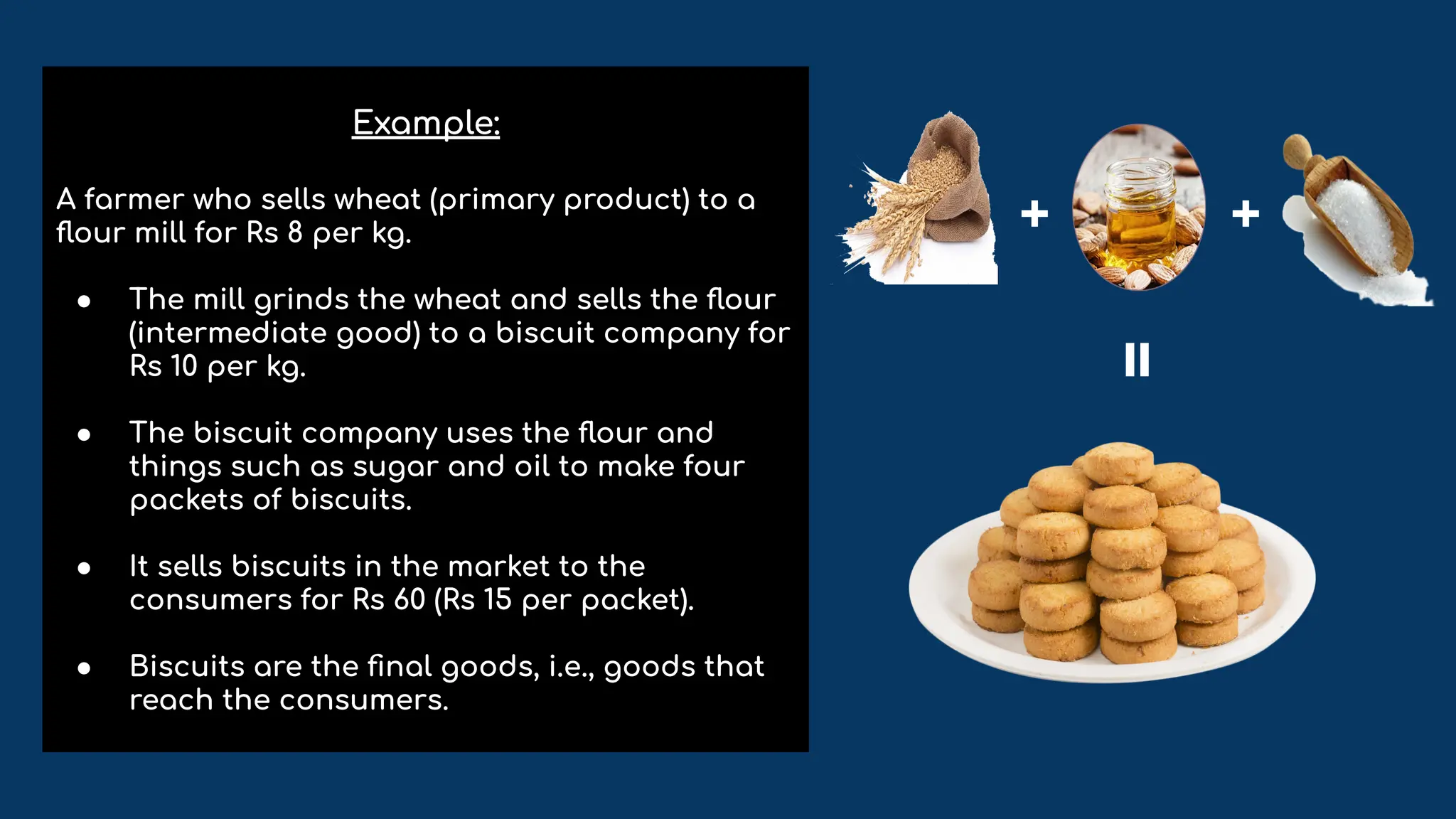
Example:
A farmer who sells wheat (primary product) to a
flour mill for Rs 8 per kg.
● The mill grinds the wheat and sells the flour
(intermediate good) to a biscuit company for
Rs 10 per kg.
● The biscuit company uses the flour and
things such as sugar and oil to make four
packets of biscuits.
● It sells biscuits in the market to the
consumers for Rs 60 (Rs 15 per packet).
● Biscuits are the final goods, i.e., goods that
reach the consumers.
+ +
=
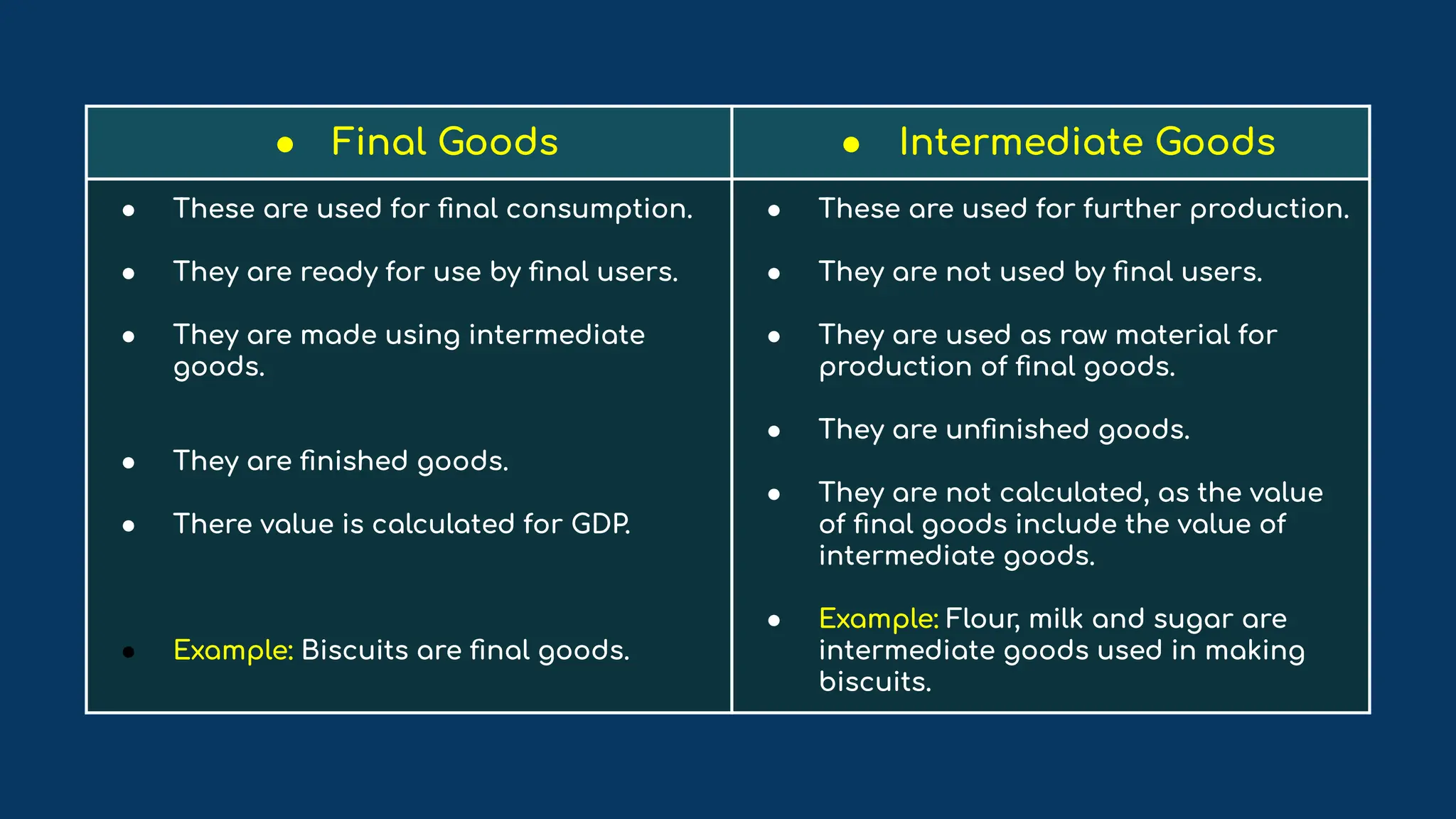
● Final Goods ● Intermediate Goods
● These are used for final consumption.
● They are ready for use by final users.
● They are made using intermediate
goods.
● They are finished goods.
● There value is calculated for GDP.
● Example: Biscuits are final goods.
● These are used for further production.
● They are not used by final users.
● They are used as raw material for
production of final goods.
● They are unfinished goods.
● They are not calculated, as the value
of final goods include the value of
intermediate goods.
● Example: Flour, milk and sugar are
intermediate goods used in making
biscuits.
GROSS DOMESTIC PRODUCT
It is the value of final goods and services produced
in each sector during a particular year. It provides
the total production of the sector for that year.
The sum of production in the three sectors is known
as Gross Domestic Product.
It is the value of all the final goods and services
produced within a country during a particular year.
GDP shows how big the economy is.
Who conducts the process of calculation
of GDP?
In India, the mammoth task of
measuring GDP is undertaken by a
central government ministry.
This Ministry, with the help of various
government departments of all the
Indian states and union territories,
collects information relating to total
volume of goods and services and
their prices and then estimates the
GDP.
HISTORICAL CHANGE IN SECTORS
PRIMARY SECTOR
Primary sector was most important sector in initial
stages of development.
As the methods of farming changed and agriculture
sector began to prosper, it produced much more food
than before.
Many people could now take up other activities. There
were increasing number of craft persons and traders.
Buying and selling activities increased many times.
Besides, there were also transporters, administrators,
army etc.
However, at this stage, most of the goods produced
were natural products from the primary sector and
most people were also employed in this sector.
SECONDARY SECTOR
With the introduction of new methods of
manufacturing, factories came up and started
expanding.
People who worked on farms now began to work in
factories in large numbers.
People began to use factory made products because
they were cheap.
Secondary sector gradually became the most
important in total production and employment.
Hence, over time, a shift had taken place. This
means that the importance of of the sectors had
changed.
TERTIARY SECTOR
In the past 100 years, there has been a further shift
from secondary sector to tertiary sector in developed
countries.
The tertiary sector has become the most important in
terms of production.
Most of the working people are employed in the tertiary
sector. This is the general pattern observed in
developed countries.
Rising Importance of the Tertiary
Sector of Production
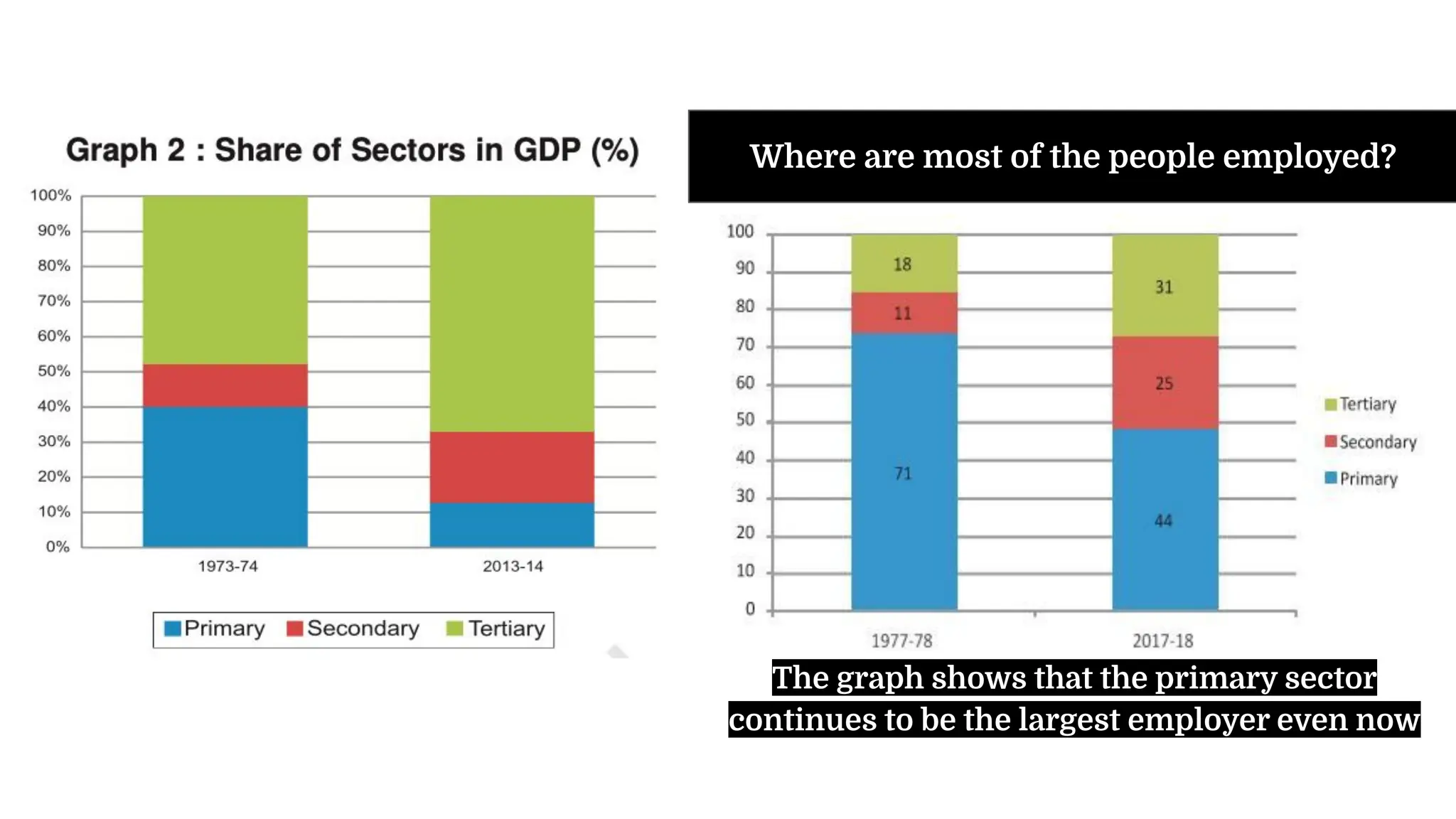
Over the 40 years
between 1973-74 and
2013-14, India has
witness growth in all
three sectors
particularly
remarkable in
Tertiary sector.
As a result, in the
year 2013-14, the
tertiary sector has
emerged as the
largest producing
sector in India
replacing the
primary sector.
In any country several services such as hospitals,
educational institutions, defence, transport, police
stations, courts, etc etc. are required. These can be
considered as basic services.
In a developing country the government has to take
responsibility for the provision of these services.
Reason 1- Increase in demand for basic services
The development of agriculture and industry leads to
the development of services such as transport, trade,
storage and the like, as we have already seen.
Greater the development of the primary and secondary
sectors, more would be the demand for such services.
Reason 2- Development of Primary & Secondary Activities
As income levels rise, certain sections of people start
demanding many more services like eating out, tourism,
shopping, private hospitals, private schools,
professional training etc.
You can see this change quite sharply in cities,
especially in big cities.
Reason 3- Increase in Income Level
Over the past decade or so, certain new services such
as those based on information and communication
technology have become important and essential.
The production of these services has been rising
rapidly.
Reason 4- Increasing Importance of Information and
Communication Technology
Which service sector is growing?
Services that employ highly skilled and educated
people.
Which service sector is not growing?
Large part of service sector that employs small
shopkeepers, repair persons, transport person.
These people barely manage to earn a living and
yet they perform these services because no
alternative opportunities for work are available to
them.
However, not all of the service sector is
growing equally.
Where are most of the people employed?
The graph shows that the primary sector
continues to be the largest employer even now
❏ It is because not enough jobs were created in
the secondary and tertiary sectors.
❏ More than half of the workers in the country
are working in the primary sector, mainly in
agriculture, producing only about one sixth
of the GDP.
❏ In contrast to this, the secondary and
tertiary sectors produce the rest of the
produce whereas they employ less about
half the people.
❏ It means that there are more people in
agriculture than is necessary
Why didn’t a similar shift out of primary sector
happen in case of employment?
Even if we move a few
people out, production will
not be affected. In other
words, workers in the
agricultural sector are
underemployed.
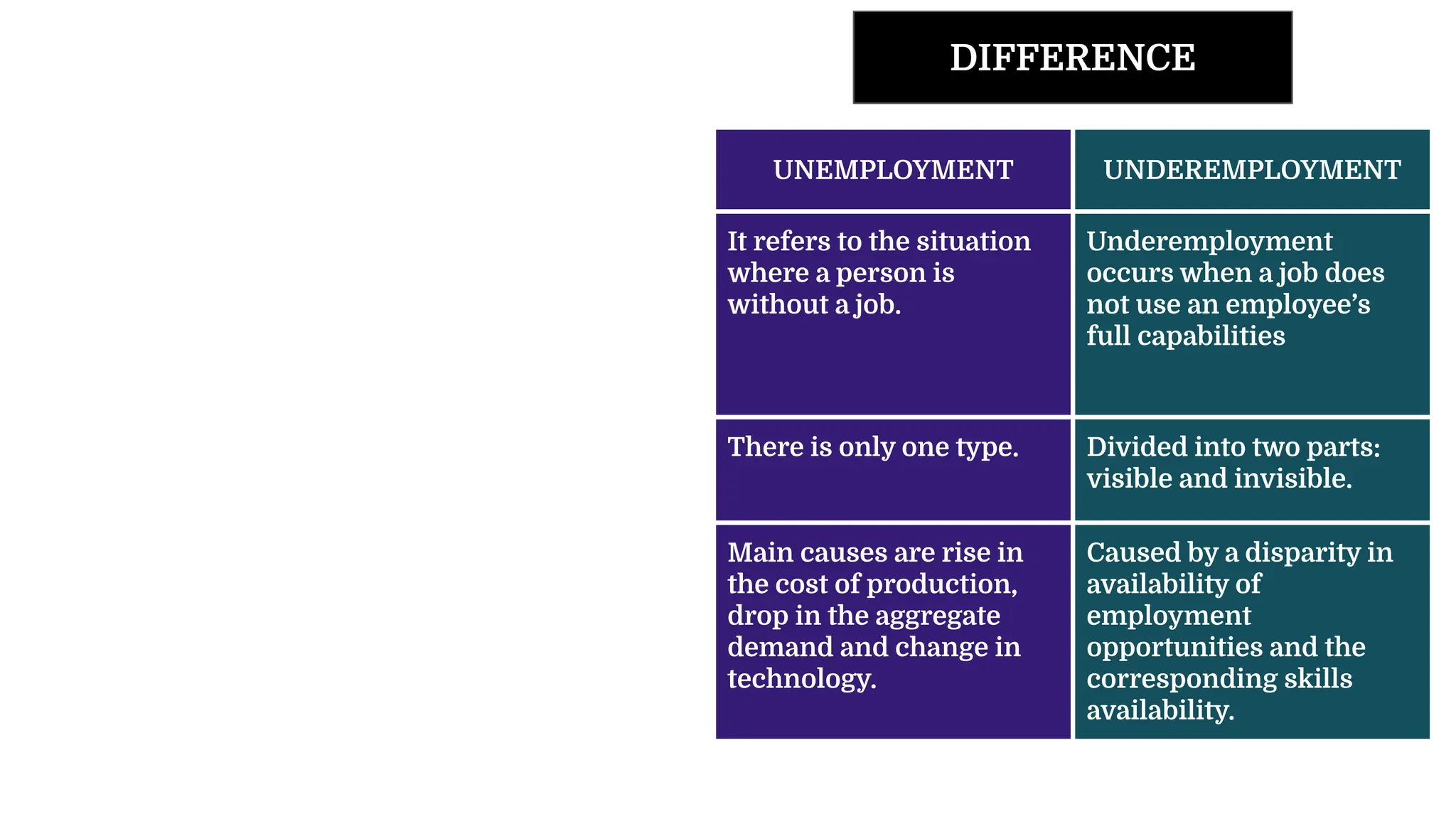
UNEMPLOYMENT UNDEREMPLOYMENT
It refers to the situation
where a person is
without a job.
Underemployment
occurs when a job does
not use an employee’s
full capabilities
There is only one type. Divided into two parts:
visible and invisible.
Main causes are rise in
the cost of production,
drop in the aggregate
demand and change in
technology.
Caused by a disparity in
availability of
employment
opportunities and the
corresponding skills
availability.
DIFFERENCE
Let’s understand the concept of Underemployment
with a case of a small farmer.
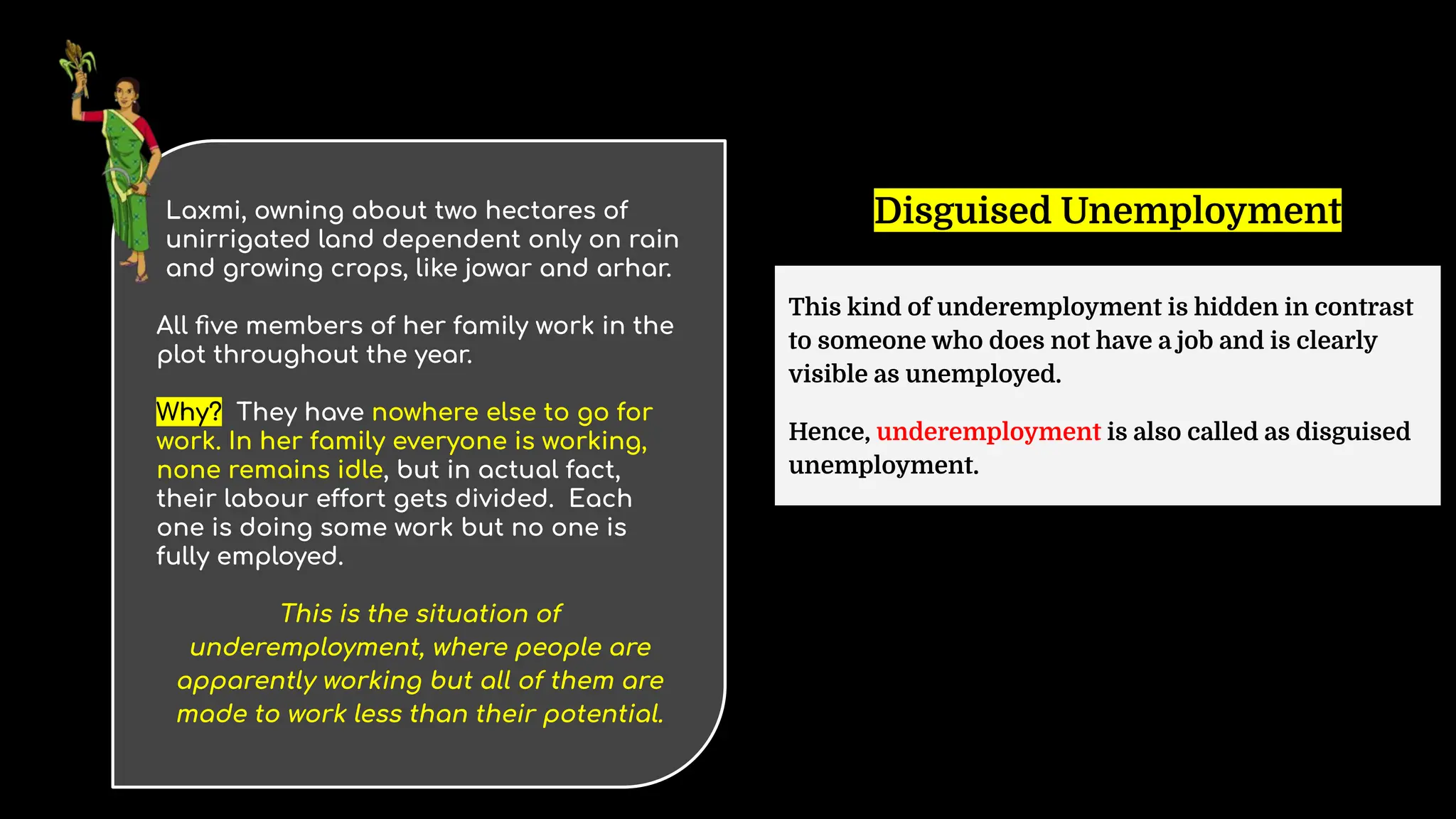
Laxmi, owning about two hectares of
unirrigated land dependent only on rain
and growing crops, like jowar and arhar.
All five members of her family work in the
plot throughout the year.
Why? They have nowhere else to go for
work. In her family everyone is working,
none remains idle, but in actual fact,
their labour effort gets divided. Each
one is doing some work but no one is
fully employed.
This is the situation of
underemployment, where people are
apparently working but all of them are
made to work less than their potential.
Disguised Unemployment
This kind of underemployment is hidden in contrast
to someone who does not have a job and is clearly
visible as unemployed.
Hence, underemployment is also called as disguised
unemployment.
DISGUISED
UNEMPLOYMENT
People appear to be
employed, but are
actually not employed.
This usually happens
among family members
engaged in agricultural
activities.
SEASONAL
UNEMPLOYMENT
It is a situation in which
people are not able to
find jobs during some
months of the year.
Because of the seasonal
character of agriculture
in India agricultural
labourers find work only
during busy seasons as
sowing, harvesting.
There are lakhs of farmers like Laxmi in
India.
This means that even if we remove a lot
of people from agricultural sector and
provide them with proper work
elsewhere, agricultural production will
not suffer.
The incomes of the people who take up
other work would increase the total
family income.
Underemployment also occurs in urban areas
Thousands of casual workers in the service sector
search for daily employment.
They are doing this work because they
do not have better opportunities.
They are employed as painters, plumbers, repair
persons and others doing odd jobs. Many of them
don’t find work everyday.
Similarly, we see other people of the service sector on
the street pushing a cart or selling something where
they may spend the whole day but earn very little.
CREATING MORE
EMPLOYMENT
Construction of dams or canals to irrigate farms can
generate a lot of employment within the agricultural
sector.
Government investing in transportation & storage of
crops, or constructing better rural roads can provide
productive employment to not just farmers but also
others such as those in services like transport or trade
Local bank should provide cheap agricultural credit to
the farmers for farming to improve their production.
Identify, promote and locate industries and services in
semi-rural areas where a large number of people may be
employed.
Opening a cold storage could give an opportunity for
farmers to store their products like potatoes and onions
and sell them when the price is good.
Emphasis on education and training centres.
In India about 60% of the population belongs
to the age group 5-29 years?
Out of this, only about 51% are attending
educational institutions.
The rest and particularly those
aged less than 18 years may
be at home many of them may
be working as child labourers.
Every state or region has potential for
increasing the income and employment for
people in that area. It could be tourism, or
regional craft industry, or new services like
IT.
Some of these would require proper
planning and support from the
government.
For example, the same study by the
Planning Commission says that if tourism
as a sector is improved, every year we can
give additional employment to more than
35 lakh people.
If these children are to attend schools, we will
require more buildings, more teachers and
other staff. NITI (National Institution for
Transforming India) Aayog Estimates that
nearly 20 lakh jobs can be created in the
education sector alone.
Recognising the need for employment generation
the Central Government in India made a law
implementing the Right to Work in about 625
districts of India.
MGNREGA, 2005
Under MGNREGA 2005, all those who are able to, and
are in need of, work in rural areas are guaranteed 100
days of employment in a year by the government.
If the government fails in its duty to provide
employment, it will give unemployment allowances to the
people.
The types of work that would in future help to increase
the production from land will be given preference under
the Act.
On the basis of the employment
conditions and rules, economic
activities are divided into:
Organised
Sector
Unorganised
Sector
Example of Kanta
Kanta works in an office. She attends her office from
9.30 a.m. to 5.30 p.m. She gets her salary regularly at
the end of every month.
In addition to the salary, she also gets provident
fund as per the rules laid down by the government.
She also gets medical and other allowances. Kanta
does not go to office on Sundays. This is a paid
holiday. When she joined work, she was given an
appointment letter stating all the terms and
conditions of work.
Works in Organised Sector
Example of Kamal
Kamal is Kanta’s neighbour. He is a daily wage
labourer in a nearby grocery shop.
He goes to the shop at 7:30 in the morning and works
till 8:00 p.m. in the evening. He gets no other
allowances apart from his wages. He is not paid for
the days he does not work.
He has therefore no leave or paid holidays. Nor was
he given any formal letter saying that he has been
employed in the shop. He can be asked to leave
anytime by his employer.
Works in Unorganised Sector
ORGANISED SECTOR
Organised sector covers those enterprises or
places of work where the terms of employment
are regular and therefore, people have assured
work.
Registered by the government and have to
follow its rules and regulations which are given
in various laws such as the Factories Act,
Minimum Wages Act, etc.
Workers in the organised sector enjoy job
security, fixed working hours, paid overtime.
They also get several other benefits from the
employers
➔ Paid leave, payment during holidays,
provident fund, gratuity etc.
➔ They are supposed to get medical
benefits and, under the laws, the
factory manager has to ensure
facilities like drinking water and a safe
working environment.
➔ When they retire, these workers get
pensions as well.
Other Benefits
Self-Employed people also fall under
Organised Sector.
Some of the people may not be
employed by anyone but may work on
their own but they too have to register
themselves with the government and
follow the rules and regulations.
UNORGANISED SECTOR
Unorganised sector is characterised by
small and scattered units which are largely
outside the control of the government.
There are rules and regulations but these
are not followed. Jobs here are low-paid
and often not regular.
There is no provision for overtime, paid
leave, holidays, leave due to sickness etc.
Employment is not secure.
➔ When there is less work, such as during
some seasons, some people may be
asked to leave.
➔ A lot also depends on the whims of the
employer.
➔ This sector includes a large number of
people who are employed on their own
doing small jobs such as selling on the
street or doing repair work.
How to protect workers in the
Unorganised Sector?
The organised sector offers jobs that are the most
sought-after.
Very slow expansion of employment opportunities in
organised sector.
It is also common to find many organised sector
enterprises in the unorganised sector.
They adopt such strategies to evade taxes and refuse
to follow laws that protect labourers.
Workers in organised sector are:
- Often exploited;
- Not paid fair wage;
- Have meagre salary
- Irregular earnings
- Jobs not secured
- No other benefits.
Reason why large number of workers are
forced to enter the unorganised sector?
Since the 1990s, it is also common to see a
large number of workers losing their jobs in
the organised sector.
These workers are forced to take up jobs in
the unorganised sector with low earnings.
Hence, besides the need for more work, there
is also a need for protection and support of
the workers in the unorganised sector.
Who are these vulnerable people
who need protection?
UNORGANIZED SECTOR
Exposed workforce in Rural Areas
Landless Agricultural Labourers
Small and Marginal Farmers
Sharecroppers and artisans
(Carpenters & Goldsmiths)
Nearly 80% of rural households in India are in small
and marginal farmer category.
Farmers can be supported by providing adequate
facility for delivery of seeds, agricultural inputs,
credit, storage and marketing outlets.
UNORGANIZED SECTOR
Exposed workforce in Urban Areas
Small-scale Industry
workers
Casual workers in
Construction, trade &
transport
Street vendors, head load
workers, garment makers,
rag pickers etc.
Small-scale industry also needs government’s support
for procuring raw material and marketing of output.
The casual workers in both rural and urban areas
need to be protected.
Majority of workers are from scheduled caste,
tribes & backward classes in unorganised sector.
Beside low wages, job insecurity, they also face
social discrimination.
Protection is therefore necessary for social &
economic development.
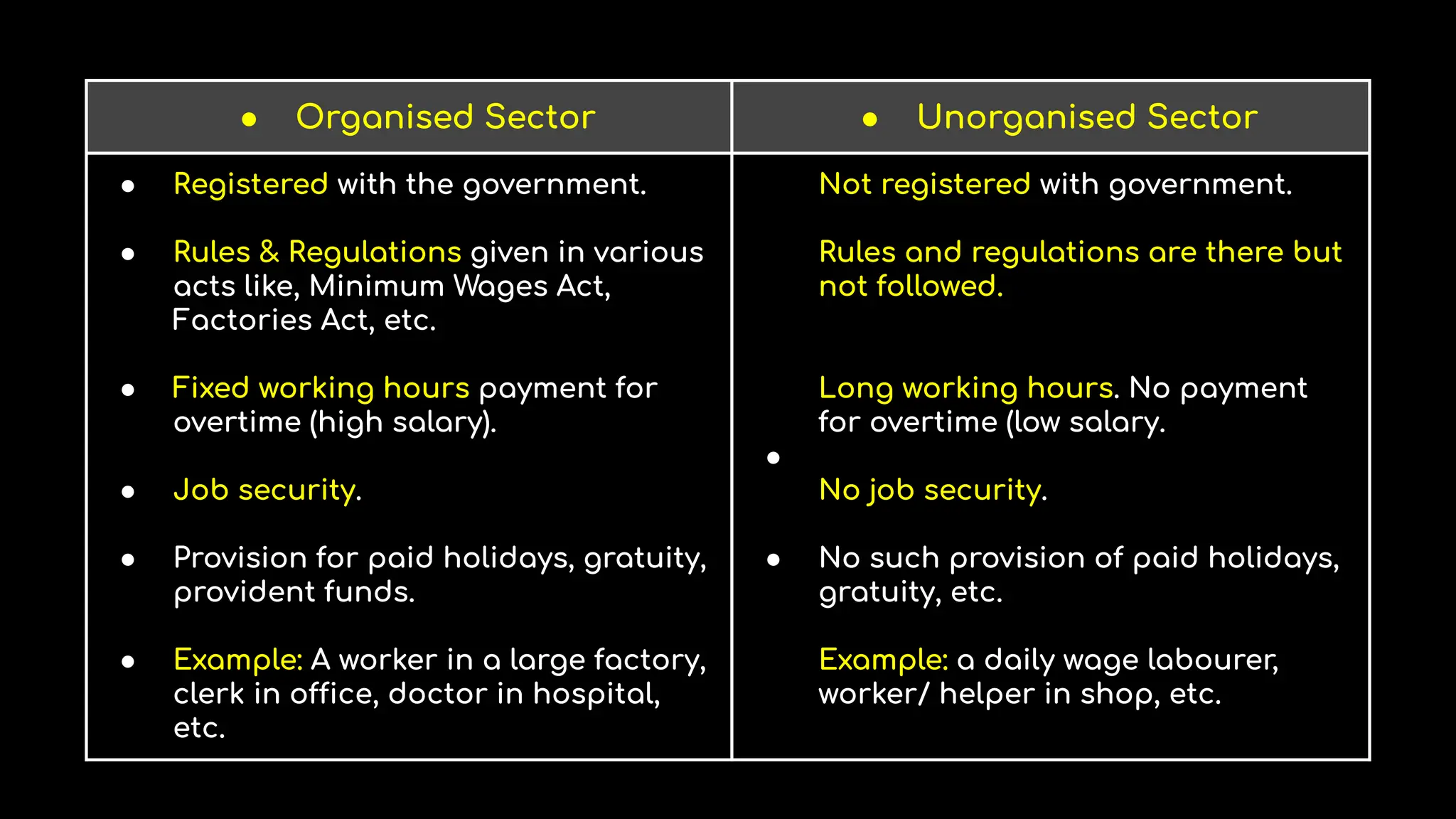
● Organised Sector ● Unorganised Sector
● Registered with the government.
● Rules & Regulations given in various
acts like, Minimum Wages Act,
Factories Act, etc.
● Fixed working hours payment for
overtime (high salary).
● Job security.
● Provision for paid holidays, gratuity,
provident funds.
● Example: A worker in a large factory,
clerk in office, doctor in hospital,
etc.
● Not registered with government.
● Rules and regulations are there but
not followed.
● Long working hours. No payment
for overtime (low salary.
●
● No job security.
● No such provision of paid holidays,
gratuity, etc.
● Example: a daily wage labourer,
worker/ helper in shop, etc.
SECTORS IN TERMS OF
OWNERSHIP
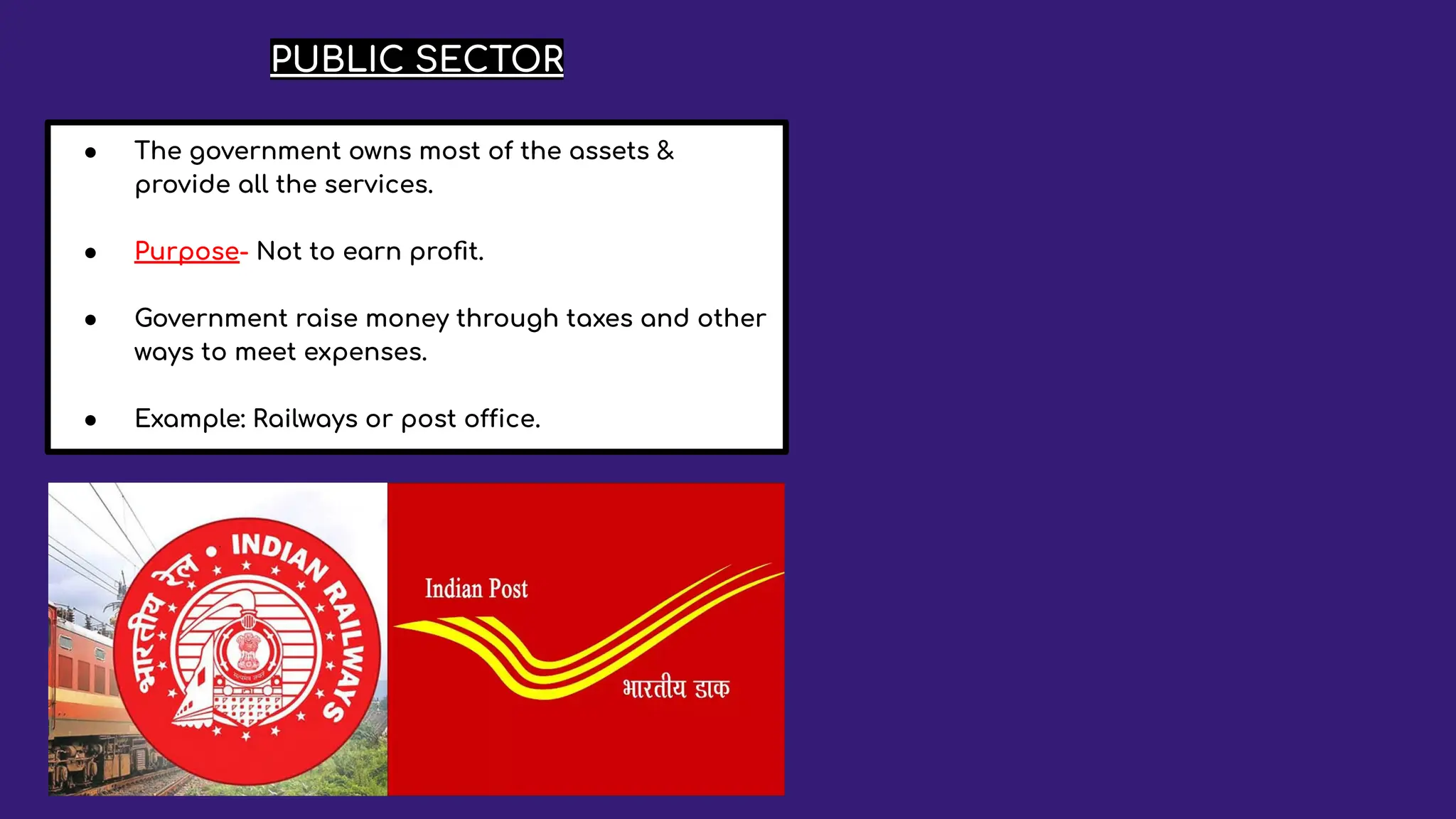
PUBLIC SECTOR
● The government owns most of the assets &
provide all the services.
● Purpose- Not to earn profit.
● Government raise money through taxes and other
ways to meet expenses.
● Example: Railways or post office.
PRIVATE SECTOR
● Ownership of assets and delivery of services is in
the hands of private individuals or companies.
● Purpose- To earn profit.
● Example: Tata Iron and Steel Company Limited
(TISCO), Reliance Industries Ltd.
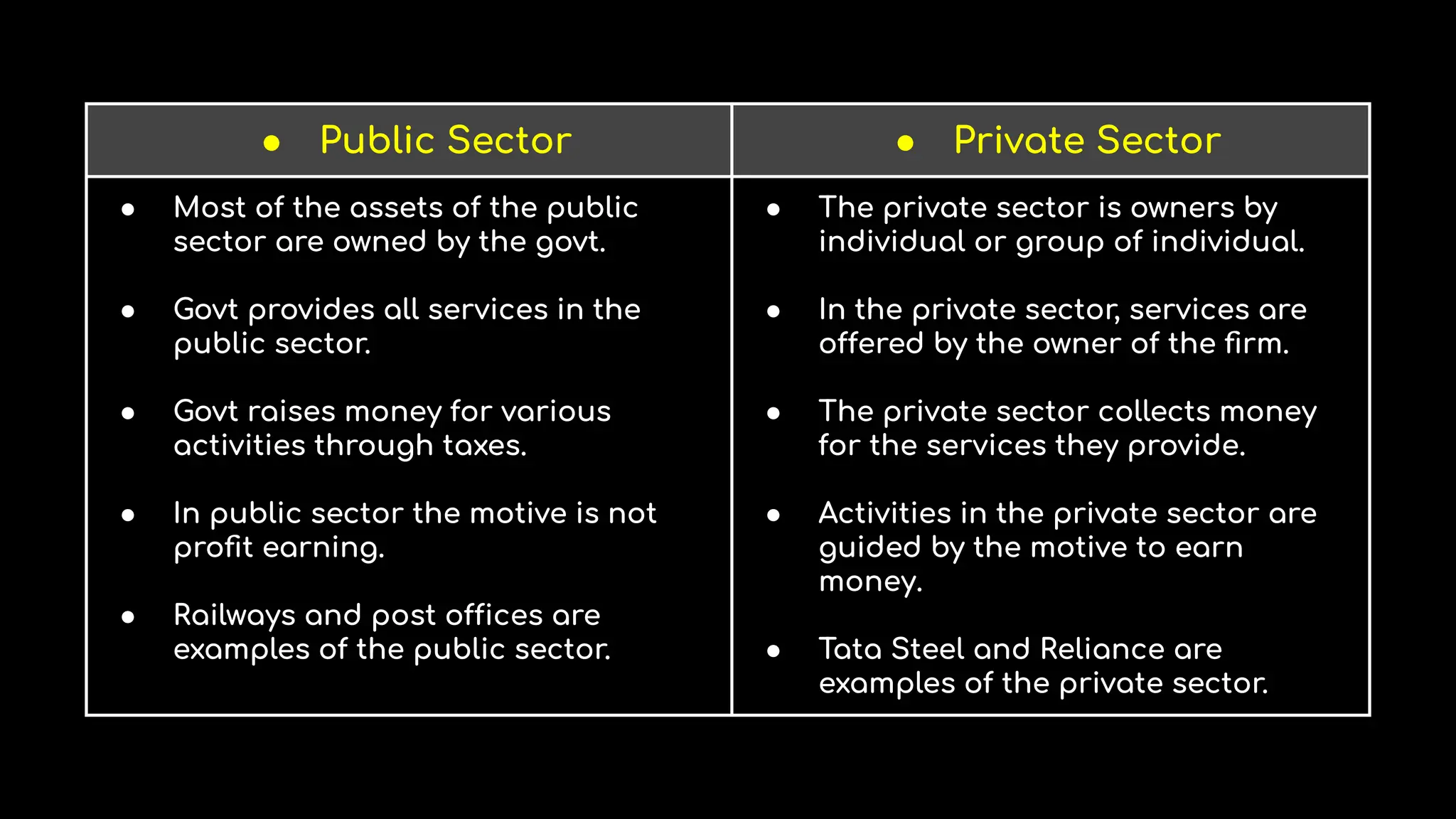
● Public Sector ● Private Sector
● Most of the assets of the public
sector are owned by the govt.
● Govt provides all services in the
public sector.
● Govt raises money for various
activities through taxes.
● In public sector the motive is not
profit earning.
● Railways and post offices are
examples of the public sector.
● The private sector is owners by
individual or group of individual.
● In the private sector, services are
offered by the owner of the firm.
● The private sector collects money
for the services they provide.
● Activities in the private sector are
guided by the motive to earn
money.
● Tata Steel and Reliance are
examples of the private sector.
Role of Government in Providing
Services
There are several things needed by the society as a
whole but which the private sector will not provide at
a reasonable cost.
Some of these need spending large sums of money,
which is beyond the capacity of private sector.
Even if private sector do provide these things they
would charge a high rate for their use.
Thus, governments have to undertake such
heavy spending and ensure that these
facilities are available for everyone.
The private sector may not continue their
production or business unless government
encourages it.
Government here steps in by producing and
supplying electricity at rates which these industries
can afford. Government has to bear part of the cost.
Developing infrastructure: Governments have to
undertake such heavy spending like construction of
roads, bridges, railways, harbours, generating
electricity, etc., and ensure that these facilities are
available for everyone.
Provides healthcare facilities and education:
Running proper schools and providing quality
education, particularly elementary education,
is the duty of the government.
Government also needs to pay attention to
aspects of human development: Availability of safe
drinking water, housing facilities for the poor and
food and nutrition. It is also the duty of the
government to take care of the poorest and most
ignored regions of the country through increased
spending in such areas.
In India’s nearly half of children are
malnourished and a quarter of
them are critically ill.
The infant mortality rate of Odisha
(40) or Madhya Pradesh (48) is
higher than some of the poorest
regions of the world.
NCERT QUESTIONS
Sugney Sectors of Indian Economy (Class 10) PPT

Sugney Sectors of Indian Economy (Class 10) PPT

  • 1.
  • 2.
    ECONOMY It is thesystem according to which the money, industry, and trade of a country or region are organized. Activities that generate some income- economic activity. Activities are classified into various groups which are known as sectors.
  • 3.
    ● ● Primary; ● Secondary ●Tertiary Organised Sector; Unorganised Sector. Public Sector; Private Sector Major Sectors of Economic Activities
  • 4.
    ● Sector directly associatedwith nature. ● When we produce a good by exploiting natural resources, it is an activity of the primary sector. ● It forms the base for all other products. ● Most of the natural products we get are from agriculture, dairy, fishing, forestry, etc. PRIMARY SECTOR
  • 5.
    ● Covers activitiesin which natural products are changed into other forms through ways of manufacturing. ● The product is not produced by nature but has to be made and therefore some process of manufacturing is essential. ● Since this sector gradually became associated with the different kinds of industries that came up, it is also called as industrial sector. ● Examples: yarn and cloth weaving from cotton fibre, construction, etc. SECONDARY SECTOR
  • 6.
    ● These areactivities that help in the development of the primary and secondary sectors. ● These activities are an aid or a support for the production process. ● Examples: Transport, storage, communication, banking, etc. ● Sector also includes some essential services provided by professional e.g., doctors, lawyers, teachers, etc. TERTIARY SECTOR
  • 7.
    Primary Sector SecondarySector ● It includes economic activities involving extraction and production of natural resources. ● It provides raw materials to the secondary sector. ● Most of the activities are not dependent on Secondary sector. ● Greater dependence on this sector indicates an underdeveloped economy. ● Example: Agriculture, mining, and forestry. ● It processes natural resources. ● It converts raw materials provided by primary activities into finished or semi-finished goods. ● It is dependent on the Primary sector for supply of raw material. ● A shift of economic activities from Primary to Secondary sectors indicates a developing economy. ● Example: Manufacturing and construction.
  • 8.
  • 9.
    The various productionactivities in the primary, secondary and tertiary sectors produce a very large number of goods and services. Also, the three sectors have a large number of people working in them to produce these goods and services. The next step, therefore, is to see how much goods and services are produced and how many people work in each sector. In an economy there could be one or more sectors which are dominant in terms of total production and employment, while other sectors are relatively small in size.
  • 10.
    Goods & Servicesare of two types: ● Final Goods & Services; ● Intermediate Goods & Services
  • 11.
    Raw Materials: Basicproducts required to produce intermediate/ final goods. Intermediate Products: Product used to produce a final good or finished product. Final/ Consumer Goods: It is a commodity that is used by the consumer to satisfy current wants or needs, unlike intermediate goods which is utilized to produce other goods.
  • 12.
    Example: A farmer whosells wheat (primary product) to a flour mill for Rs 8 per kg. ● The mill grinds the wheat and sells the flour (intermediate good) to a biscuit company for Rs 10 per kg. ● The biscuit company uses the flour and things such as sugar and oil to make four packets of biscuits. ● It sells biscuits in the market to the consumers for Rs 60 (Rs 15 per packet). ● Biscuits are the final goods, i.e., goods that reach the consumers. + + =
  • 13.
    ● Final Goods● Intermediate Goods ● These are used for final consumption. ● They are ready for use by final users. ● They are made using intermediate goods. ● They are finished goods. ● There value is calculated for GDP. ● Example: Biscuits are final goods. ● These are used for further production. ● They are not used by final users. ● They are used as raw material for production of final goods. ● They are unfinished goods. ● They are not calculated, as the value of final goods include the value of intermediate goods. ● Example: Flour, milk and sugar are intermediate goods used in making biscuits.
  • 14.
    GROSS DOMESTIC PRODUCT Itis the value of final goods and services produced in each sector during a particular year. It provides the total production of the sector for that year. The sum of production in the three sectors is known as Gross Domestic Product. It is the value of all the final goods and services produced within a country during a particular year. GDP shows how big the economy is.
  • 15.
    Who conducts theprocess of calculation of GDP? In India, the mammoth task of measuring GDP is undertaken by a central government ministry. This Ministry, with the help of various government departments of all the Indian states and union territories, collects information relating to total volume of goods and services and their prices and then estimates the GDP.
  • 16.
  • 17.
    PRIMARY SECTOR Primary sectorwas most important sector in initial stages of development. As the methods of farming changed and agriculture sector began to prosper, it produced much more food than before. Many people could now take up other activities. There were increasing number of craft persons and traders. Buying and selling activities increased many times. Besides, there were also transporters, administrators, army etc. However, at this stage, most of the goods produced were natural products from the primary sector and most people were also employed in this sector.
  • 18.
    SECONDARY SECTOR With theintroduction of new methods of manufacturing, factories came up and started expanding. People who worked on farms now began to work in factories in large numbers. People began to use factory made products because they were cheap. Secondary sector gradually became the most important in total production and employment. Hence, over time, a shift had taken place. This means that the importance of of the sectors had changed.
  • 19.
    TERTIARY SECTOR In thepast 100 years, there has been a further shift from secondary sector to tertiary sector in developed countries. The tertiary sector has become the most important in terms of production. Most of the working people are employed in the tertiary sector. This is the general pattern observed in developed countries.
  • 20.
    Rising Importance ofthe Tertiary Sector of Production Over the 40 years between 1973-74 and 2013-14, India has witness growth in all three sectors particularly remarkable in Tertiary sector. As a result, in the year 2013-14, the tertiary sector has emerged as the largest producing sector in India replacing the primary sector.
  • 21.
    In any countryseveral services such as hospitals, educational institutions, defence, transport, police stations, courts, etc etc. are required. These can be considered as basic services. In a developing country the government has to take responsibility for the provision of these services. Reason 1- Increase in demand for basic services The development of agriculture and industry leads to the development of services such as transport, trade, storage and the like, as we have already seen. Greater the development of the primary and secondary sectors, more would be the demand for such services. Reason 2- Development of Primary & Secondary Activities
  • 22.
    As income levelsrise, certain sections of people start demanding many more services like eating out, tourism, shopping, private hospitals, private schools, professional training etc. You can see this change quite sharply in cities, especially in big cities. Reason 3- Increase in Income Level Over the past decade or so, certain new services such as those based on information and communication technology have become important and essential. The production of these services has been rising rapidly. Reason 4- Increasing Importance of Information and Communication Technology
  • 23.
    Which service sectoris growing? Services that employ highly skilled and educated people. Which service sector is not growing? Large part of service sector that employs small shopkeepers, repair persons, transport person. These people barely manage to earn a living and yet they perform these services because no alternative opportunities for work are available to them. However, not all of the service sector is growing equally.
  • 24.
    Where are mostof the people employed? The graph shows that the primary sector continues to be the largest employer even now
  • 25.
    ❏ It isbecause not enough jobs were created in the secondary and tertiary sectors. ❏ More than half of the workers in the country are working in the primary sector, mainly in agriculture, producing only about one sixth of the GDP. ❏ In contrast to this, the secondary and tertiary sectors produce the rest of the produce whereas they employ less about half the people. ❏ It means that there are more people in agriculture than is necessary Why didn’t a similar shift out of primary sector happen in case of employment? Even if we move a few people out, production will not be affected. In other words, workers in the agricultural sector are underemployed.
  • 26.
    UNEMPLOYMENT UNDEREMPLOYMENT It refersto the situation where a person is without a job. Underemployment occurs when a job does not use an employee’s full capabilities There is only one type. Divided into two parts: visible and invisible. Main causes are rise in the cost of production, drop in the aggregate demand and change in technology. Caused by a disparity in availability of employment opportunities and the corresponding skills availability. DIFFERENCE
  • 27.
    Let’s understand theconcept of Underemployment with a case of a small farmer.
  • 28.
    Laxmi, owning abouttwo hectares of unirrigated land dependent only on rain and growing crops, like jowar and arhar. All five members of her family work in the plot throughout the year. Why? They have nowhere else to go for work. In her family everyone is working, none remains idle, but in actual fact, their labour effort gets divided. Each one is doing some work but no one is fully employed. This is the situation of underemployment, where people are apparently working but all of them are made to work less than their potential. Disguised Unemployment This kind of underemployment is hidden in contrast to someone who does not have a job and is clearly visible as unemployed. Hence, underemployment is also called as disguised unemployment.
  • 29.
    DISGUISED UNEMPLOYMENT People appear tobe employed, but are actually not employed. This usually happens among family members engaged in agricultural activities. SEASONAL UNEMPLOYMENT It is a situation in which people are not able to find jobs during some months of the year. Because of the seasonal character of agriculture in India agricultural labourers find work only during busy seasons as sowing, harvesting.
  • 30.
    There are lakhsof farmers like Laxmi in India. This means that even if we remove a lot of people from agricultural sector and provide them with proper work elsewhere, agricultural production will not suffer. The incomes of the people who take up other work would increase the total family income.
  • 31.
    Underemployment also occursin urban areas Thousands of casual workers in the service sector search for daily employment. They are doing this work because they do not have better opportunities. They are employed as painters, plumbers, repair persons and others doing odd jobs. Many of them don’t find work everyday. Similarly, we see other people of the service sector on the street pushing a cart or selling something where they may spend the whole day but earn very little.
  • 32.
  • 33.
    Construction of damsor canals to irrigate farms can generate a lot of employment within the agricultural sector. Government investing in transportation & storage of crops, or constructing better rural roads can provide productive employment to not just farmers but also others such as those in services like transport or trade Local bank should provide cheap agricultural credit to the farmers for farming to improve their production. Identify, promote and locate industries and services in semi-rural areas where a large number of people may be employed. Opening a cold storage could give an opportunity for farmers to store their products like potatoes and onions and sell them when the price is good. Emphasis on education and training centres.
  • 34.
    In India about60% of the population belongs to the age group 5-29 years? Out of this, only about 51% are attending educational institutions. The rest and particularly those aged less than 18 years may be at home many of them may be working as child labourers.
  • 35.
    Every state orregion has potential for increasing the income and employment for people in that area. It could be tourism, or regional craft industry, or new services like IT. Some of these would require proper planning and support from the government. For example, the same study by the Planning Commission says that if tourism as a sector is improved, every year we can give additional employment to more than 35 lakh people.
  • 36.
    If these childrenare to attend schools, we will require more buildings, more teachers and other staff. NITI (National Institution for Transforming India) Aayog Estimates that nearly 20 lakh jobs can be created in the education sector alone.
  • 37.
    Recognising the needfor employment generation the Central Government in India made a law implementing the Right to Work in about 625 districts of India.
  • 38.
    MGNREGA, 2005 Under MGNREGA2005, all those who are able to, and are in need of, work in rural areas are guaranteed 100 days of employment in a year by the government. If the government fails in its duty to provide employment, it will give unemployment allowances to the people. The types of work that would in future help to increase the production from land will be given preference under the Act.
  • 39.
    On the basisof the employment conditions and rules, economic activities are divided into: Organised Sector Unorganised Sector
  • 40.
    Example of Kanta Kantaworks in an office. She attends her office from 9.30 a.m. to 5.30 p.m. She gets her salary regularly at the end of every month. In addition to the salary, she also gets provident fund as per the rules laid down by the government. She also gets medical and other allowances. Kanta does not go to office on Sundays. This is a paid holiday. When she joined work, she was given an appointment letter stating all the terms and conditions of work. Works in Organised Sector
  • 41.
    Example of Kamal Kamalis Kanta’s neighbour. He is a daily wage labourer in a nearby grocery shop. He goes to the shop at 7:30 in the morning and works till 8:00 p.m. in the evening. He gets no other allowances apart from his wages. He is not paid for the days he does not work. He has therefore no leave or paid holidays. Nor was he given any formal letter saying that he has been employed in the shop. He can be asked to leave anytime by his employer. Works in Unorganised Sector
  • 42.
    ORGANISED SECTOR Organised sectorcovers those enterprises or places of work where the terms of employment are regular and therefore, people have assured work. Registered by the government and have to follow its rules and regulations which are given in various laws such as the Factories Act, Minimum Wages Act, etc. Workers in the organised sector enjoy job security, fixed working hours, paid overtime. They also get several other benefits from the employers ➔ Paid leave, payment during holidays, provident fund, gratuity etc. ➔ They are supposed to get medical benefits and, under the laws, the factory manager has to ensure facilities like drinking water and a safe working environment. ➔ When they retire, these workers get pensions as well. Other Benefits
  • 43.
    Self-Employed people alsofall under Organised Sector. Some of the people may not be employed by anyone but may work on their own but they too have to register themselves with the government and follow the rules and regulations.
  • 44.
    UNORGANISED SECTOR Unorganised sectoris characterised by small and scattered units which are largely outside the control of the government. There are rules and regulations but these are not followed. Jobs here are low-paid and often not regular. There is no provision for overtime, paid leave, holidays, leave due to sickness etc. Employment is not secure. ➔ When there is less work, such as during some seasons, some people may be asked to leave. ➔ A lot also depends on the whims of the employer. ➔ This sector includes a large number of people who are employed on their own doing small jobs such as selling on the street or doing repair work.
  • 46.
    How to protectworkers in the Unorganised Sector?
  • 47.
    The organised sectoroffers jobs that are the most sought-after. Very slow expansion of employment opportunities in organised sector. It is also common to find many organised sector enterprises in the unorganised sector. They adopt such strategies to evade taxes and refuse to follow laws that protect labourers. Workers in organised sector are: - Often exploited; - Not paid fair wage; - Have meagre salary - Irregular earnings - Jobs not secured - No other benefits. Reason why large number of workers are forced to enter the unorganised sector?
  • 48.
    Since the 1990s,it is also common to see a large number of workers losing their jobs in the organised sector. These workers are forced to take up jobs in the unorganised sector with low earnings. Hence, besides the need for more work, there is also a need for protection and support of the workers in the unorganised sector.
  • 49.
    Who are thesevulnerable people who need protection?
  • 50.
    UNORGANIZED SECTOR Exposed workforcein Rural Areas Landless Agricultural Labourers Small and Marginal Farmers Sharecroppers and artisans (Carpenters & Goldsmiths) Nearly 80% of rural households in India are in small and marginal farmer category. Farmers can be supported by providing adequate facility for delivery of seeds, agricultural inputs, credit, storage and marketing outlets. UNORGANIZED SECTOR Exposed workforce in Urban Areas Small-scale Industry workers Casual workers in Construction, trade & transport Street vendors, head load workers, garment makers, rag pickers etc. Small-scale industry also needs government’s support for procuring raw material and marketing of output. The casual workers in both rural and urban areas need to be protected.
  • 51.
    Majority of workersare from scheduled caste, tribes & backward classes in unorganised sector. Beside low wages, job insecurity, they also face social discrimination. Protection is therefore necessary for social & economic development.
  • 52.
    ● Organised Sector● Unorganised Sector ● Registered with the government. ● Rules & Regulations given in various acts like, Minimum Wages Act, Factories Act, etc. ● Fixed working hours payment for overtime (high salary). ● Job security. ● Provision for paid holidays, gratuity, provident funds. ● Example: A worker in a large factory, clerk in office, doctor in hospital, etc. ● Not registered with government. ● Rules and regulations are there but not followed. ● Long working hours. No payment for overtime (low salary. ● ● No job security. ● No such provision of paid holidays, gratuity, etc. ● Example: a daily wage labourer, worker/ helper in shop, etc.
  • 53.
    SECTORS IN TERMSOF OWNERSHIP
  • 54.
    PUBLIC SECTOR ● Thegovernment owns most of the assets & provide all the services. ● Purpose- Not to earn profit. ● Government raise money through taxes and other ways to meet expenses. ● Example: Railways or post office.
  • 55.
    PRIVATE SECTOR ● Ownershipof assets and delivery of services is in the hands of private individuals or companies. ● Purpose- To earn profit. ● Example: Tata Iron and Steel Company Limited (TISCO), Reliance Industries Ltd.
  • 56.
    ● Public Sector● Private Sector ● Most of the assets of the public sector are owned by the govt. ● Govt provides all services in the public sector. ● Govt raises money for various activities through taxes. ● In public sector the motive is not profit earning. ● Railways and post offices are examples of the public sector. ● The private sector is owners by individual or group of individual. ● In the private sector, services are offered by the owner of the firm. ● The private sector collects money for the services they provide. ● Activities in the private sector are guided by the motive to earn money. ● Tata Steel and Reliance are examples of the private sector.
  • 57.
    Role of Governmentin Providing Services
  • 58.
    There are severalthings needed by the society as a whole but which the private sector will not provide at a reasonable cost. Some of these need spending large sums of money, which is beyond the capacity of private sector. Even if private sector do provide these things they would charge a high rate for their use. Thus, governments have to undertake such heavy spending and ensure that these facilities are available for everyone.
  • 59.
    The private sectormay not continue their production or business unless government encourages it. Government here steps in by producing and supplying electricity at rates which these industries can afford. Government has to bear part of the cost. Developing infrastructure: Governments have to undertake such heavy spending like construction of roads, bridges, railways, harbours, generating electricity, etc., and ensure that these facilities are available for everyone.
  • 60.
    Provides healthcare facilitiesand education: Running proper schools and providing quality education, particularly elementary education, is the duty of the government. Government also needs to pay attention to aspects of human development: Availability of safe drinking water, housing facilities for the poor and food and nutrition. It is also the duty of the government to take care of the poorest and most ignored regions of the country through increased spending in such areas. In India’s nearly half of children are malnourished and a quarter of them are critically ill. The infant mortality rate of Odisha (40) or Madhya Pradesh (48) is higher than some of the poorest regions of the world.
  • 61.