LEARNING CONCEPTS
 CLASSIFICATION OF SECTORS OF INDIAN ECONOMY
 PRIMAARY, SECONDARY & TERTIARY SECTOR
 INTERDEPENDENCY OF SECTORS
 HISTORICAL CHANGES IN THE SECTORS
 GROWTH & STATUS OF DIFFERENT SECTORS
 ORGANISED & UNORGANISED SECTOR
 HOW TO CREATE JOB OPPORTUNITIES
 MGNREGA( RIGHT TO WORK)
SECTORS OF INDIAN ECONOMY
INTRODUCTION
• India is today one of the fastest growing economies of the world. The
country ranked third in terms of Purchasing Power Parity (PPP) in 2020.
The Indian economy has transformed into a vibrant, rapidly growing
consumer market, comprising over 300 million strong middle class with
increasing purchasing power. An abundant and diversified natural
resource base, sound economic, industrial and market fundamentals
and highly skilled and talented human resources, make India a
destination for business and investment opportunities with an assured
potential for attractive returns
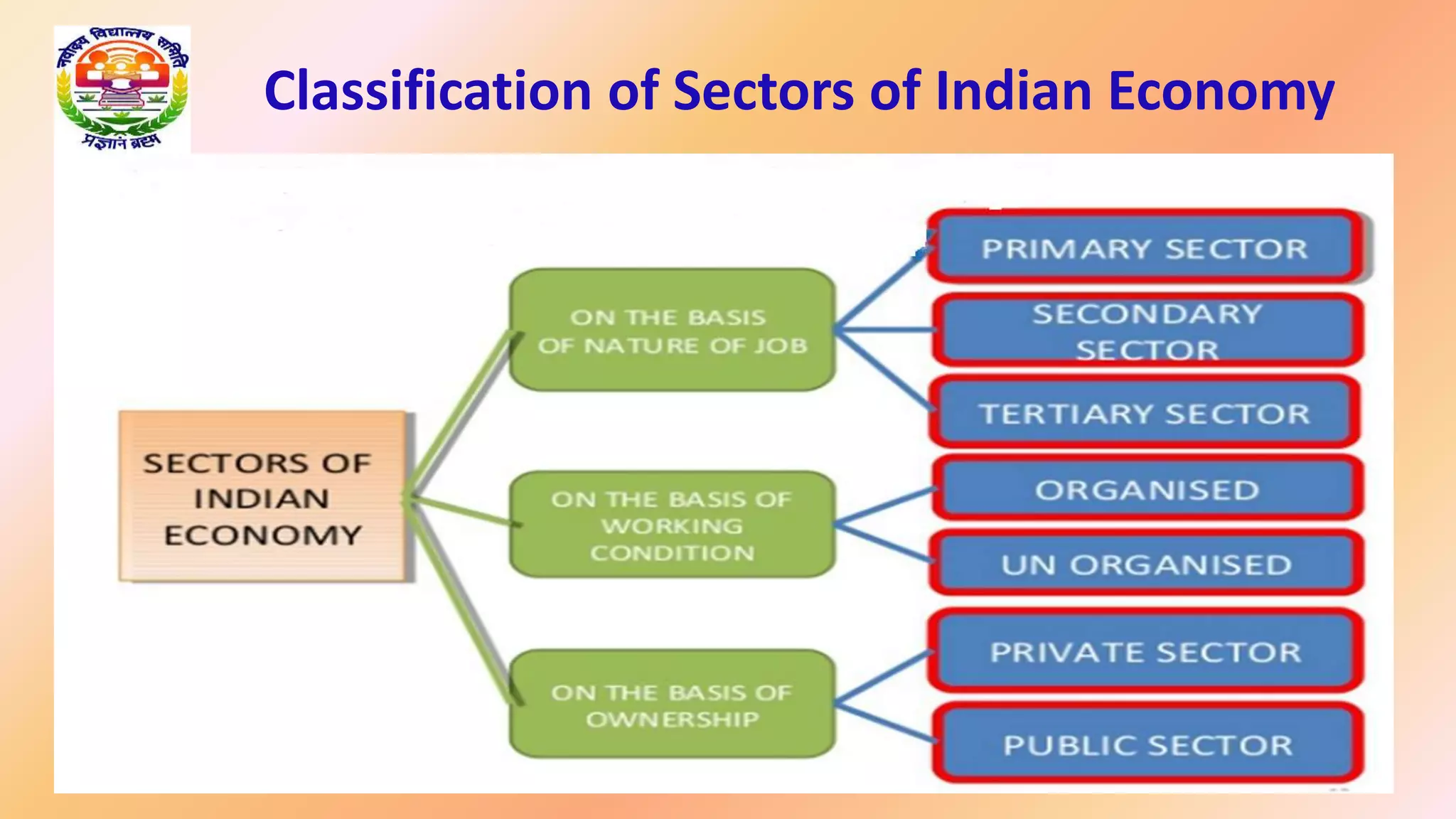
Classification of Sectors of Indian Economy
PRIMARY SECTOR
 Activities undertaken by directly
using natural resources.
 Example—Agriculture, Mining,
Fishing, Forestry, Dairy etc.
 Example—Agriculture, Mining,
Fishing, Forestry, Dairy etc.
 Since most of the natural
products we get are from
agriculture, dairy, forestry,
fishing it is also called
Agriculture and related sector.
SECONDARY SECTOR
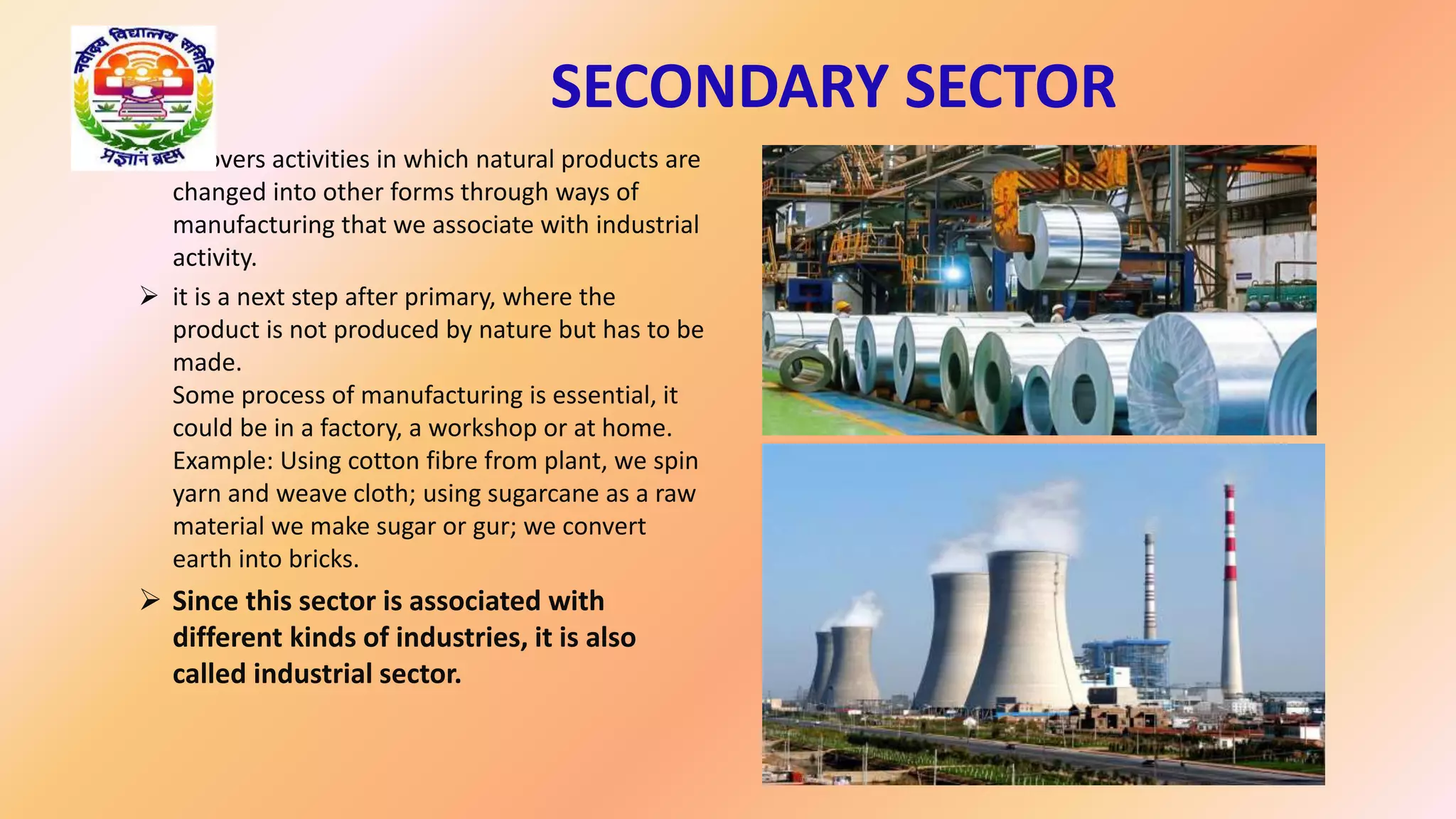
 It covers activities in which natural products are
changed into other forms through ways of
manufacturing that we associate with industrial
activity.
 it is a next step after primary, where the
product is not produced by nature but has to be
made.
Some process of manufacturing is essential, it
could be in a factory, a workshop or at home.
Example: Using cotton fibre from plant, we spin
yarn and weave cloth; using sugarcane as a raw
material we make sugar or gur; we convert
earth into bricks.
 Since this sector is associated with
different kinds of industries, it is also
called industrial sector.
TERTIARY SECTOR
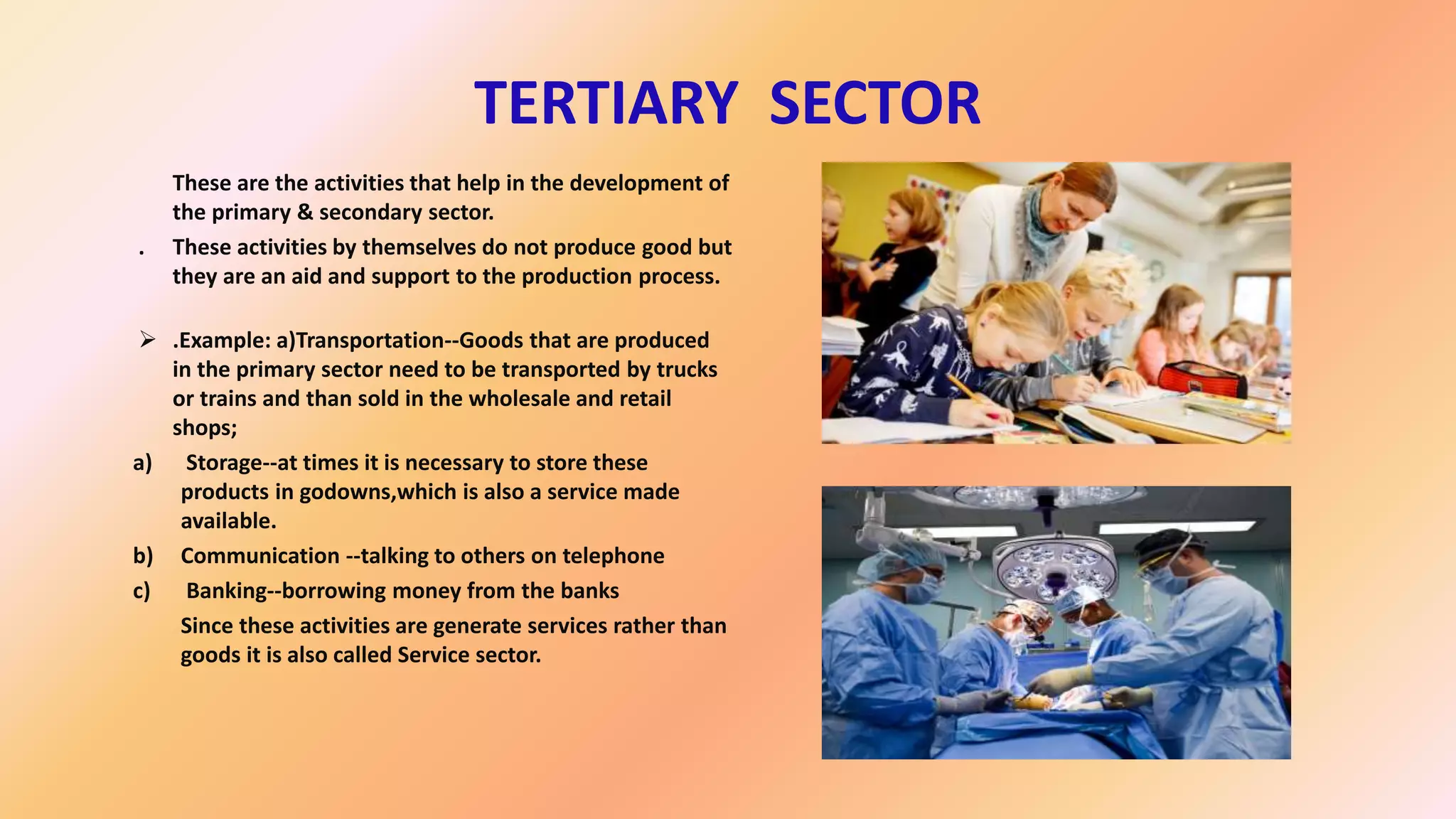
These are the activities that help in the development of
the primary & secondary sector.
. These activities by themselves do not produce good but
they are an aid and support to the production process.
 .Example: a)Transportation--Goods that are produced
in the primary sector need to be transported by trucks
or trains and than sold in the wholesale and retail
shops;
a) Storage--at times it is necessary to store these
products in godowns,which is also a service made
available.
b) Communication --talking to others on telephone
c) Banking--borrowing money from the banks
Since these activities are generate services rather than
goods it is also called Service sector.
Evolution of an Economy from Primary
Sector Based to Tertiary Sector Based
During early civilization all economic activity was in primary sector. When the food
production became surplus people’s need for other products increased. This led to
the development of secondary sector. The growth of secondary sector spread its
influence during industrial revolution in nineteenth century.
After growth of economic activity a support system was the need to facilitate the
industrial activity. Certain sectors like transport and finance play an important role
supporting the industrial activity. Moreover, more shops were needed to provide
goods in people’s neighbourhood.
Ultimately, other services like tuition, administrative support developed.
Interdependency of Sectors
To understand this interdependency, let us take an example of a cold drink.
A cold drink contains water, sugar and artificial flavour. Suppose if there is no
sugarcane production then procuring sugar will become difficult and costly for the
cold drink manufacturer. Now to transport sugarcane to sugar mills and sugar to
the cold drink plant needs the services of a transporter.
A person or system of persons is required to maintain and monitor all these
movements of goods from farm to factory to shop in different locations. That is
where role of administrative staffs comes.
Let us go back to the farmer. He also needs fertilizers and seeds which is processed
in some factory and which will be delivered to his doorstep by some means of
transportation.
To top it all at every step of these activities we require the proper monetary and
banking system. So, in a nutshell this describes how interrelated all sectors of an
economy are.
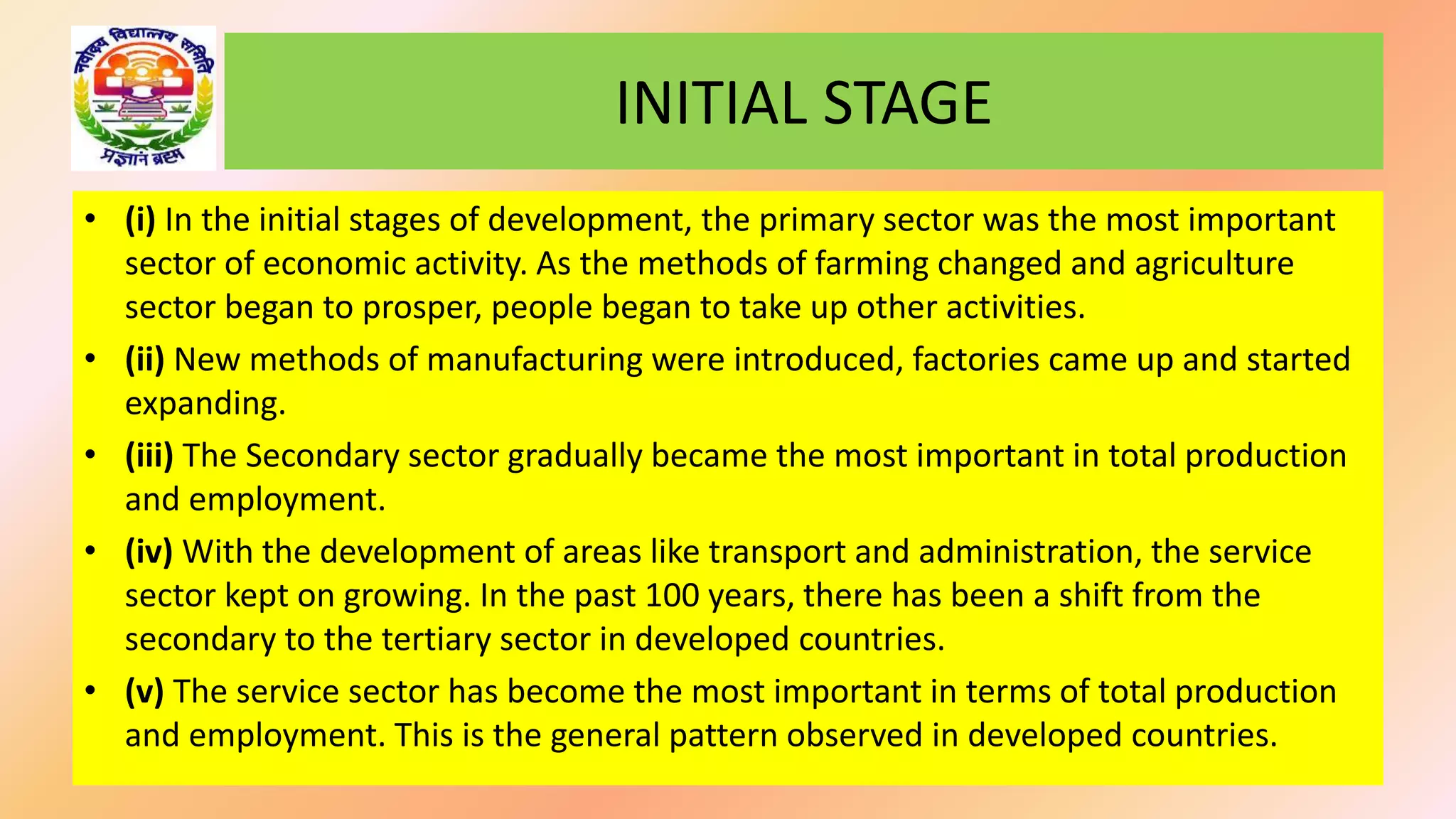
HISTORICAL CHANGE IN SECTORS
• (i) In the initial stages of development, the primary sector was the most important
sector of economic activity. As the methods of farming changed and agriculture
sector began to prosper, people began to take up other activities.
• (ii) New methods of manufacturing were introduced, factories came up and started
expanding.
• (iii) The Secondary sector gradually became the most important in total production
and employment.
• (iv) With the development of areas like transport and administration, the service
sector kept on growing. In the past 100 years, there has been a shift from the
secondary to the tertiary sector in developed countries.
• (v) The service sector has become the most important in terms of total production
and employment. This is the general pattern observed in developed countries.
INITIAL STAGE
SECOND STAGE
A. Over a long time(more than hundred years ) because new methods of
manufacturing were introduced, factories came up and started expanding.
B. People began to work in factories in large numbers, and also people started using
factory goods in large numbers as they were cheap.
C. Secondary sector gradually became the most important in total production and
employment. There was a shift and the importance of the sectors also changed.
THIRD STAGE:
In past hundred, there has been a further shift from Secondary
to Tertiary sector in the developed countries.
The service sector has become the most important in terms of
total production. Most of working people are also employed in
the service sector.
Reasons of Rising importance of tertiary
sector in production
• Over forty years between 1973 and 2013, production in the tertiary sector has increased the most,
and it has emerged as the largest producing sector in India replacing the primary sector. The
several reasons to it are:
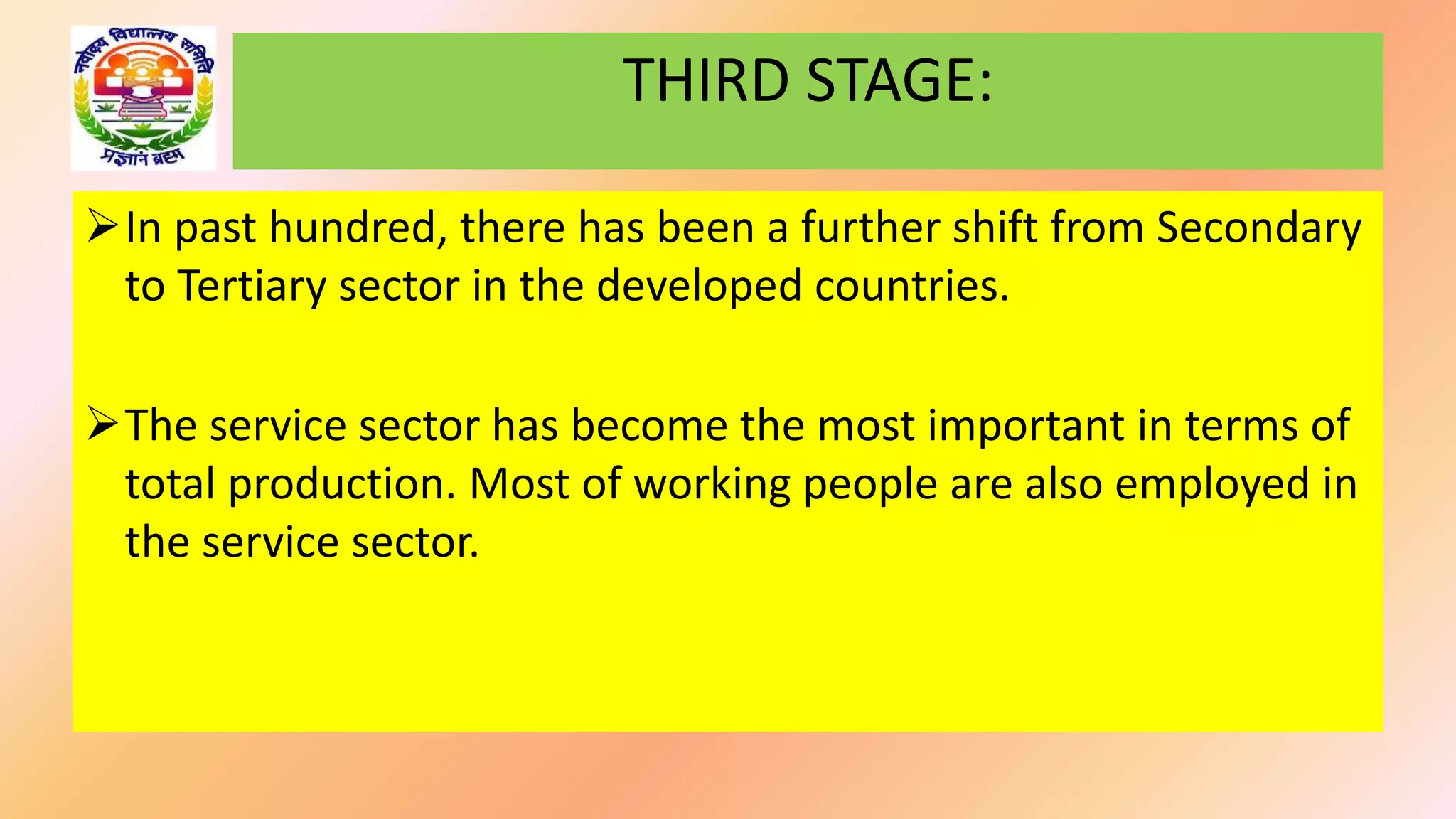
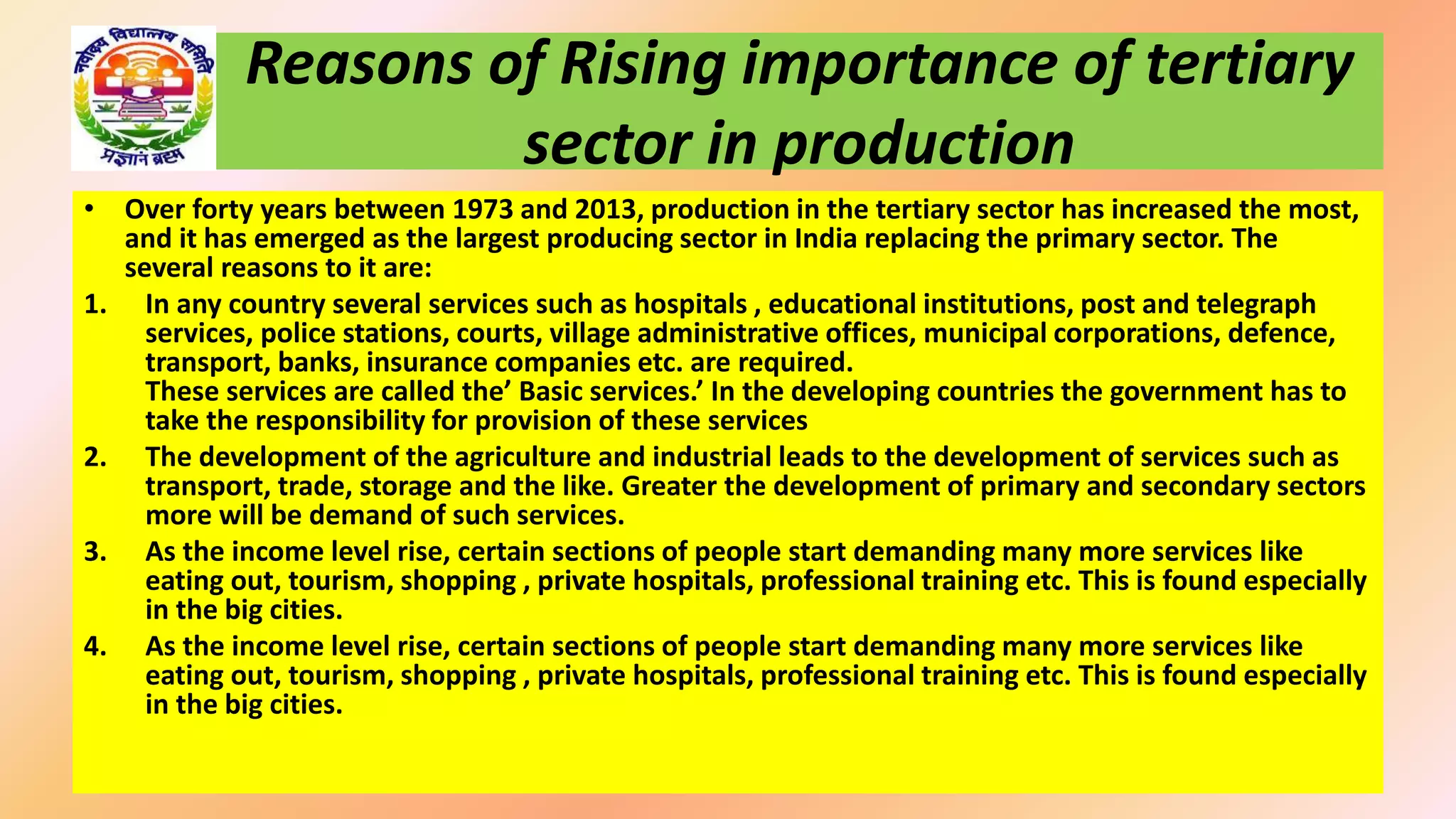
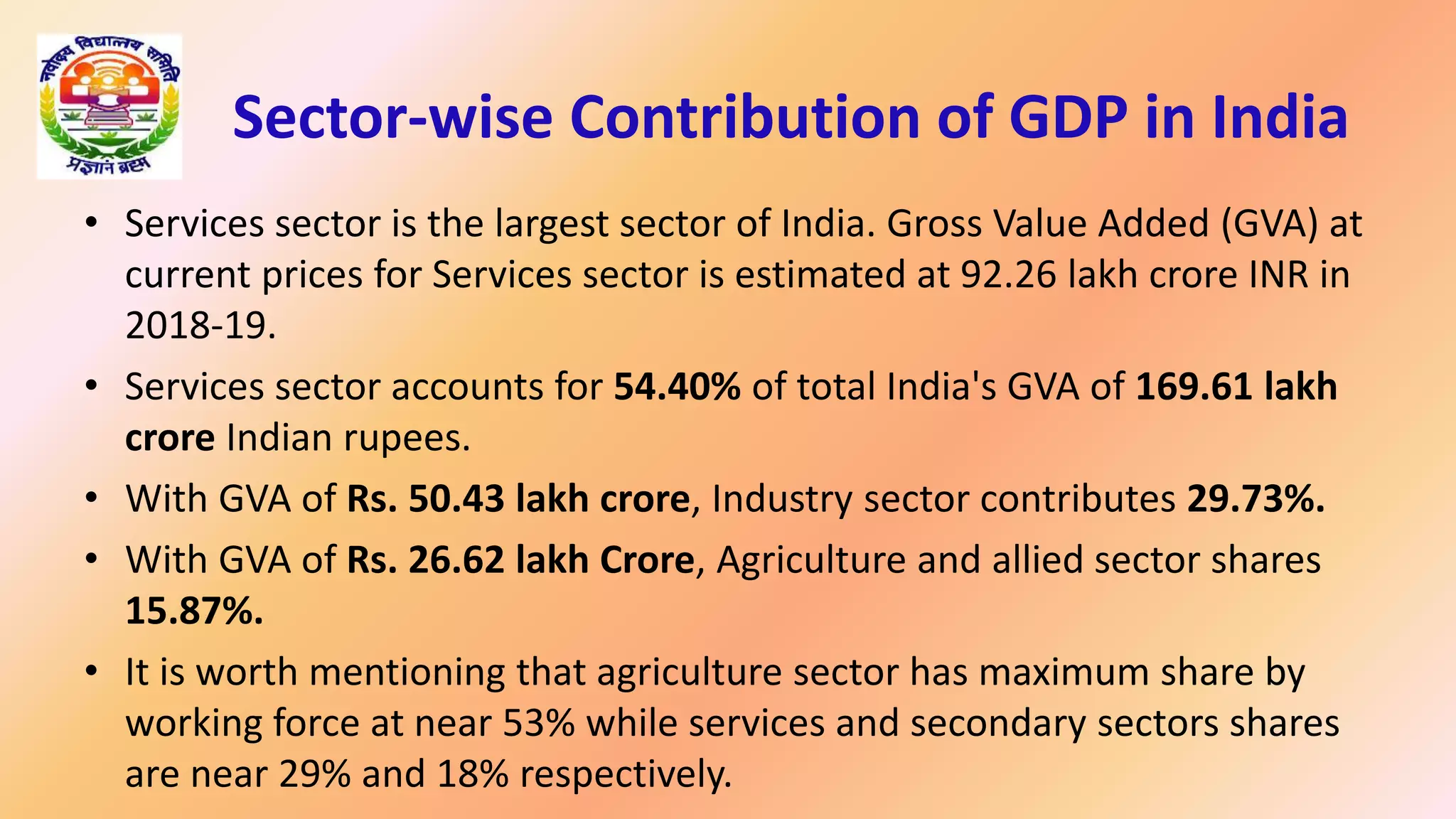
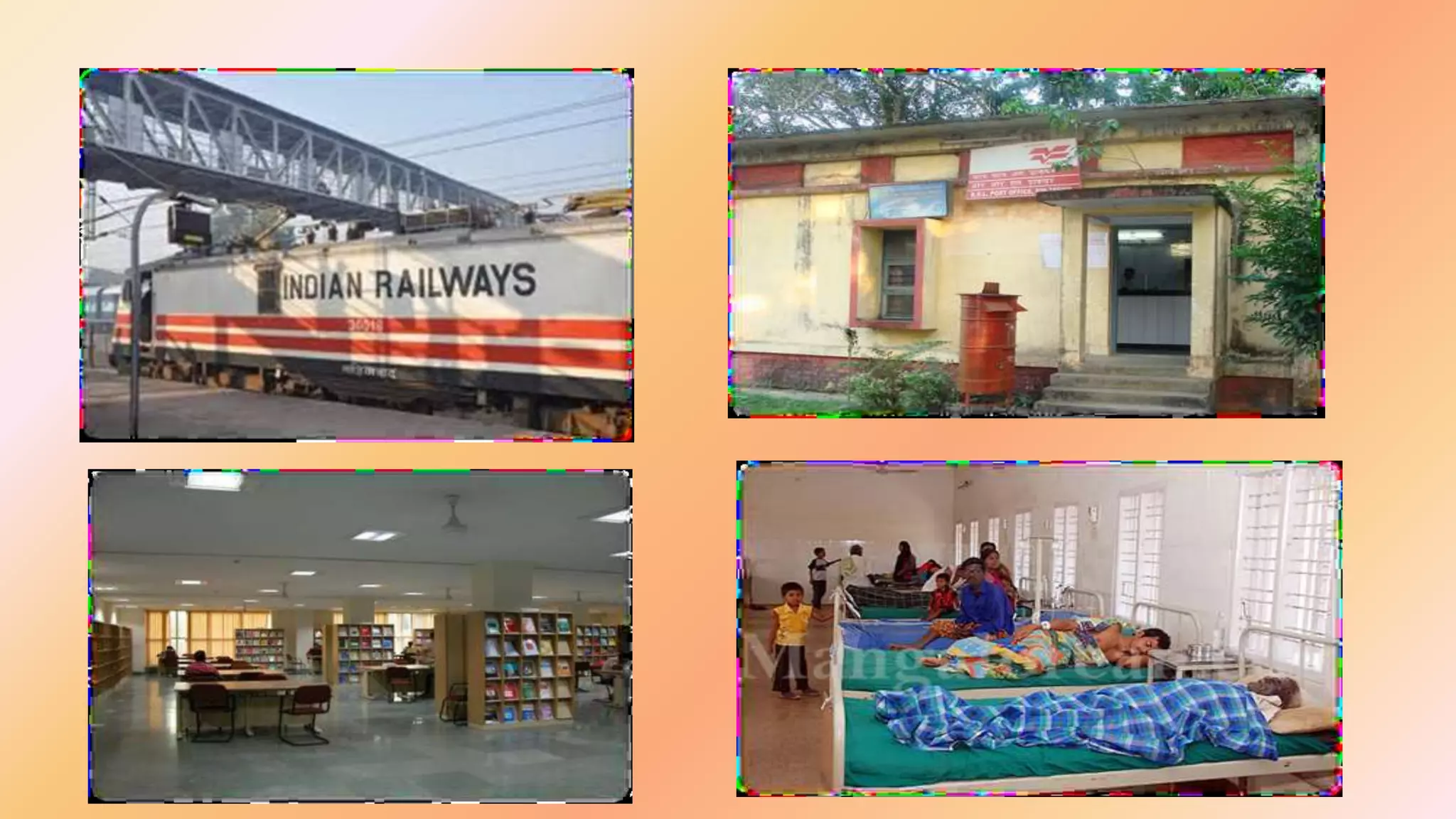
1. In any country several services such as hospitals , educational institutions, post and telegraph
services, police stations, courts, village administrative offices, municipal corporations, defence,
transport, banks, insurance companies etc. are required.
These services are called the’ Basic services.’ In the developing countries the government has to
take the responsibility for provision of these services
2. The development of the agriculture and industrial leads to the development of services such as
transport, trade, storage and the like. Greater the development of primary and secondary sectors
more will be demand of such services.
3. As the income level rise, certain sections of people start demanding many more services like
eating out, tourism, shopping , private hospitals, professional training etc. This is found especially
in the big cities.
4. As the income level rise, certain sections of people start demanding many more services like
eating out, tourism, shopping , private hospitals, professional training etc. This is found especially
in the big cities.
Growth and Status of Different Sectors in India
0%
10%
20%
30%
40%
50%
60%
70%
80%
90%
100%
1950 2000 2018
57.97
27.33
15.87
13.77
24.37
29.73
28.26
48.30
54.40
TERTIARY
SECONDARY
PRIMARY
SHARES OF DIFFERENT SECTORS IN GDP OF INDIA
(IN %)
SECTOR 1950 2000 2018
PRIMARY 57.97 27.33 15.87
SECONDARY 13.77 24.37 29.73
TERTIARY 28.26 48.3 54.40
TOTAL 100 100 100
The Share of Primary Sector in employment is always highest in comparison to other two
sectors
Share of different sectors in employment(in %)
0%
10%
20%
30%
40%
50%
60%
70%
80%
90%
100%
1973 2000 2018-19
75
60 53
10
18 29
15 22 18
TERTIARY
SECONDARY
PRIMARY
Sector-wise Contribution of GDP in India
• Services sector is the largest sector of India. Gross Value Added (GVA) at
current prices for Services sector is estimated at 92.26 lakh crore INR in
2018-19.
• Services sector accounts for 54.40% of total India's GVA of 169.61 lakh
crore Indian rupees.
• With GVA of Rs. 50.43 lakh crore, Industry sector contributes 29.73%.
• With GVA of Rs. 26.62 lakh Crore, Agriculture and allied sector shares
15.87%.
• It is worth mentioning that agriculture sector has maximum share by
working force at near 53% while services and secondary sectors shares
are near 29% and 18% respectively.
Findings
 Majority of people are still employed in agricultural activities. As agriculture
provides seasonal employment during cropping season so chances of hidden
employment are big. Moreover, as history suggests a developed nation’s
dependency shifts from primary sector towards tertiary sector in all aspects of
economic development, so it can be said that India is still way behind because
majority still depend on agriculture.
Secondary and Tertiary Sector have failed to generate enough
employment opportunities making a pressure on primary sector. Although
educated and skilled workforce do get employed in secondary and tertiary
sector but for unskilled and semi-skilled workers there is still shortage of
employment avenues.
• The sector which carries out all activity
through a system and follows the law of the
land is called organized sector.
• Moreover, labour rights are given due respect
and wages are as per the norms of the
country and those of the industry.
• Labour working organized sector get the
benefit of social security net as framed by the
Government. Certain benefits like provident
fund, leave entitlement, medical benefits and
insurance are provided to workers in the
organized sector.
• These security provisions are necessary to
provide source of sustenance in case of
disability or death of the main breadwinner
of the family. Otherwise the dependents will
face a bleak future.
Unorganised Sector
• The sector which evade most of the laws
and don’t follow the system come under
• unorganized sector. Small shopkeepers,
some small scale manufacturing units keep
• all their attention on profit making and
ignore their workers basic rights. Workers
• don’t get adequate salary and other
benefits like leave, health benefits and
insurance
• are beyond the imagination of people
working in unorganized sectors.
Public Sector
• Companies which are run and financed by the Government comprise
the public sector. After independence India was a very poor country. India
needed huge amount of money to set up manufacturing plants for basic items
like iron and steel, aluminum, fertilizers and cements. Additionally
infrastructure like roads, railways, ports and airports also require huge
investment. In those days Indian entrepreneur was not cash rich so
government had to start creating big public sector enterprises like SAIL (Steel
Authority of India Limited), ONGC(Oil & Natural Gas Commission).
Private Sector
Companies which are run and financed by private people comprise the private
sector. Companies like Hero Honda, Tata , Reliance India Ltd. Wipro, Infosys,
Hindustan Lever Ltd, ICICI bank, HDFC Bank are from private sectors.
Public Sector Vs Private Sector
BASIS PUBLIC SECTOR PRIVATE SECTOR
Definition Public Sector refers to the part of the Country’s
overall economy which is controlled by the
Government or various Government bodies.
The private Sector refers to the
part of the Country’s overall
economy which is controlled by
Individuals or Private
Companies.
Ownership Public sector companies are owned and managed
by Government/Ministries/State Govt./Govt.
Bodies
Private sector companies are
owned and managed by Private
Individuals and Private
Companies.
Primary
Purposes
Generally, Public Sector entities are driven by the
purpose of providing the basic public services to
the common public at a reasonable cost in their
respective industries by being also self-sustainable
and profitable. However, profitability is not the
primary motive.
The purpose of Companies in the
Private Sector is profit-making by
operating within the rules and
compliances of the respective
country.
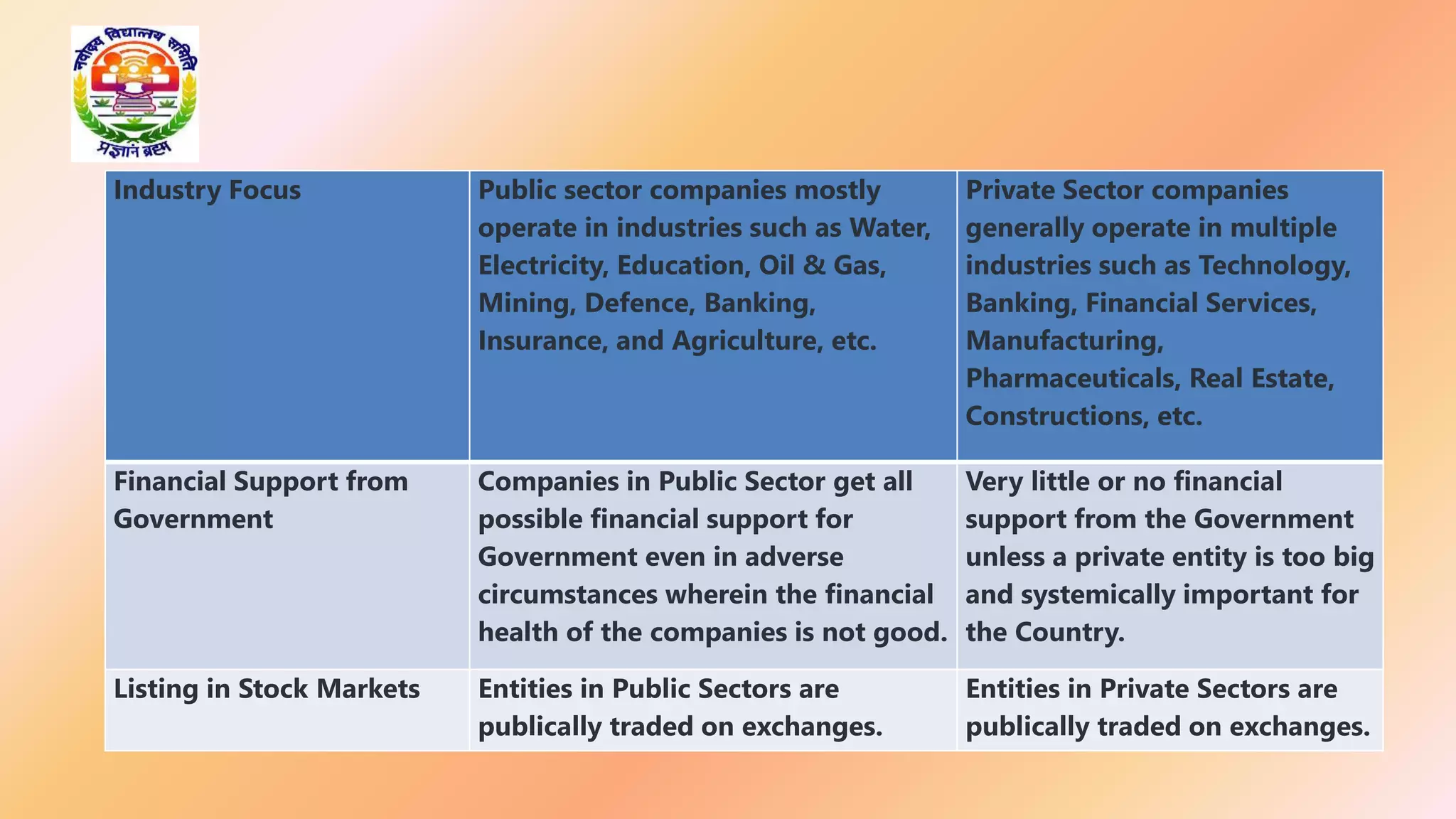
Industry Focus Public sector companies mostly
operate in industries such as Water,
Electricity, Education, Oil & Gas,
Mining, Defence, Banking,
Insurance, and Agriculture, etc.
Private Sector companies
generally operate in multiple
industries such as Technology,
Banking, Financial Services,
Manufacturing,
Pharmaceuticals, Real Estate,
Constructions, etc.
Financial Support from
Government
Companies in Public Sector get all
possible financial support for
Government even in adverse
circumstances wherein the financial
health of the companies is not good.
Very little or no financial
support from the Government
unless a private entity is too big
and systemically important for
the Country.
Listing in Stock Markets Entities in Public Sectors are
publically traded on exchanges.
Entities in Private Sectors are
publically traded on exchanges.
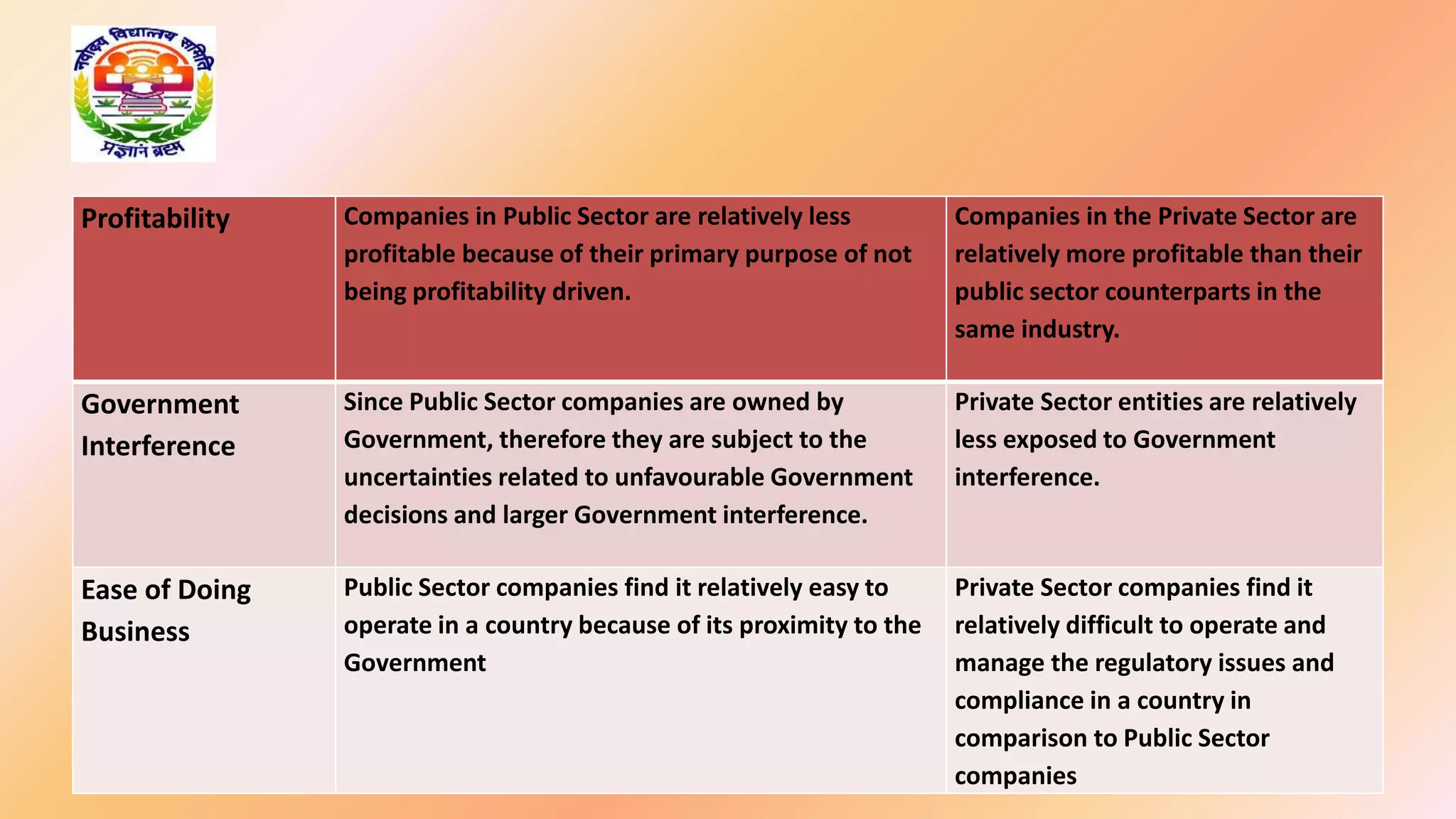
Profitability Companies in Public Sector are relatively less
profitable because of their primary purpose of not
being profitability driven.
Companies in the Private Sector are
relatively more profitable than their
public sector counterparts in the
same industry.
Government
Interference
Since Public Sector companies are owned by
Government, therefore they are subject to the
uncertainties related to unfavourable Government
decisions and larger Government interference.
Private Sector entities are relatively
less exposed to Government
interference.
Ease of Doing
Business
Public Sector companies find it relatively easy to
operate in a country because of its proximity to the
Government
Private Sector companies find it
relatively difficult to operate and
manage the regulatory issues and
compliance in a country in
comparison to Public Sector
companies
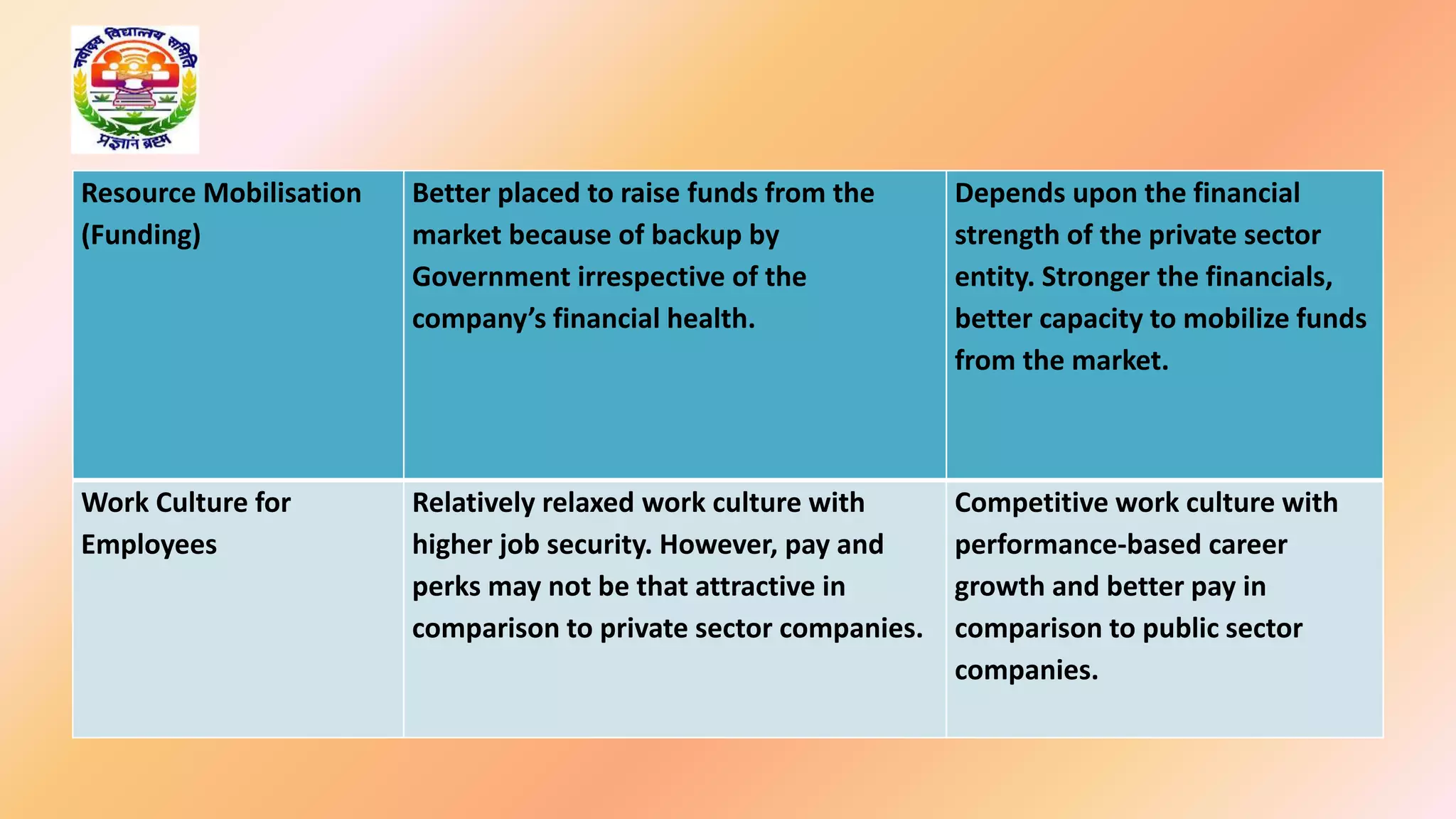
Resource Mobilisation
(Funding)
Better placed to raise funds from the
market because of backup by
Government irrespective of the
company’s financial health.
Depends upon the financial
strength of the private sector
entity. Stronger the financials,
better capacity to mobilize funds
from the market.
Work Culture for
Employees
Relatively relaxed work culture with
higher job security. However, pay and
perks may not be that attractive in
comparison to private sector companies.
Competitive work culture with
performance-based career
growth and better pay in
comparison to public sector
companies.
How to create job Opportunities in Rural Areas
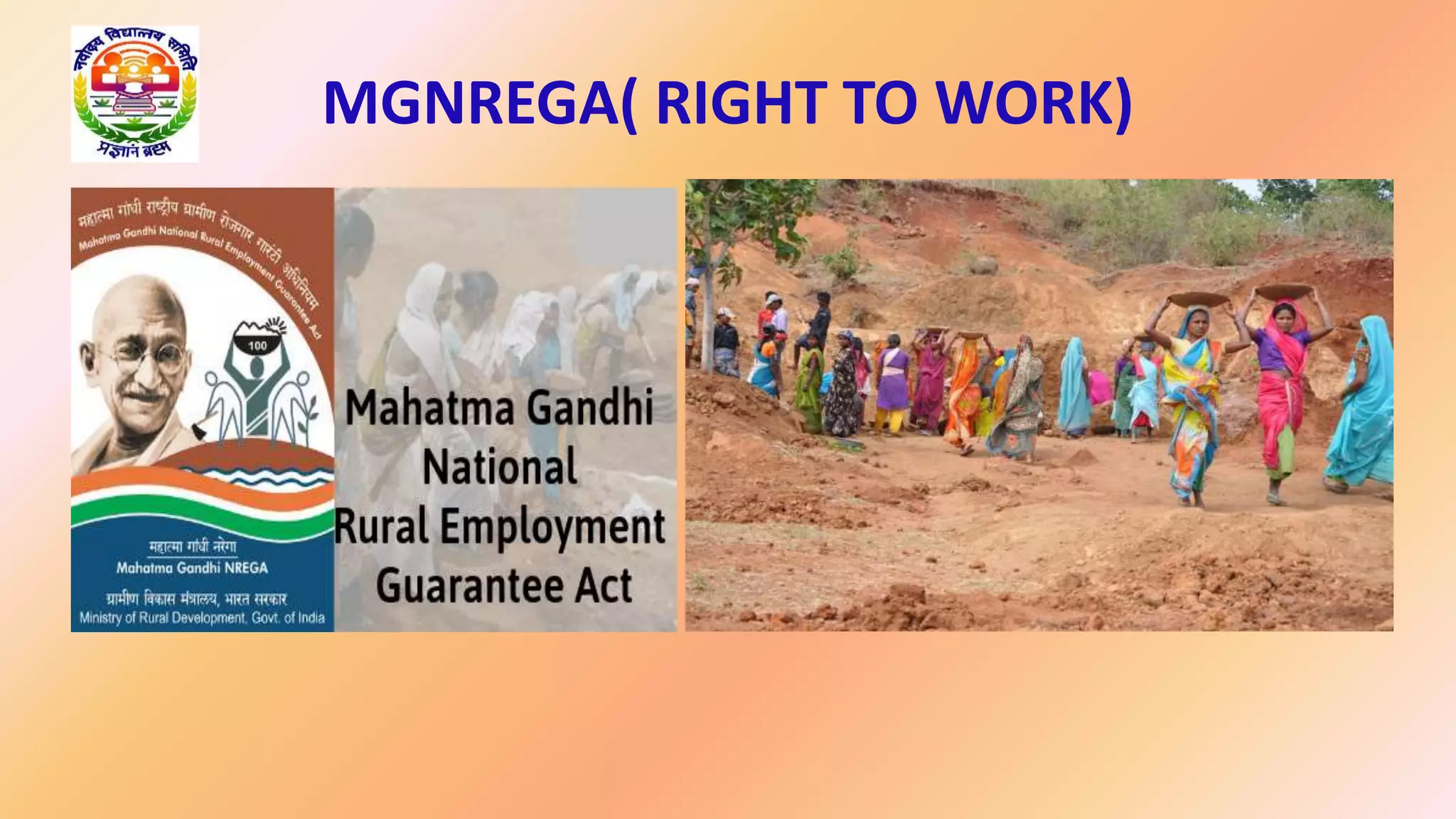
MGNREGA( RIGHT TO WORK)
• Mahatma Gandhi Employment Guarantee Act 2005 (NREGA ,
later renamed as the "Mahatma Gandhi National Rural
Employment Guarantee Act", MGNREGA), is an Indian labour
law and social security measure that aims to guarantee the
'right to work'. This act was passed in September 2005 under
the UPA government of Prime Minister Dr. Manmohan Singh.
• It aims to enhance livelihood security in rural areas by
providing at least 100 days of wage employment in a financial
year to every household whose adult members volunteer to do
unskilled manual work.
The act was first proposed in 1991 by P.V. Narasimha Rao. It was
finally accepted in the parliament and commenced
implementation in 625 districts of India. Based on this pilot
experience, NREGA was scoped up to cover all the districts of
India from 1 April 2008.The statute is hailed by the government
as "the largest and most ambitious social security and public
works programme in the world".
In its World Development Report 2014, the World Bank termed
it a "stellar example of rural development".
• The MGNREGA was initiated with the objective of "enhancing livelihood
security in rural areas by providing at least 100 days of guaranteed
wage employment in a financial year, to every household whose adult
members volunteer to do unskilled manual work".
• Another aim of MGNREGA is to create durable assets (such as roads,
canals, ponds and wells). Employment is to be provided within 5 km of
an applicant's residence, and minimum wages are to be paid. If work is
not provided within 15 days of applying, applicants are entitled to an
unemployment allowance. That is, if the government fails to provide
employment, it has to provide certain unemployment allowances to
those people. Thus, employment under MGNREGA is a legal
entitlement.
• MGNREGA is to be implemented mainly by Gram Panchayats (GPs). The
involvement of contractors is banned.
• Apart from providing economic security and creating rural assets,
NREGA can help in protecting the environment, empowering rural
women, reducing rural-urban migration and fostering social equity,
among others.
• The law provides many safeguards to promote its effective management
and implementation. The act explicitly mentions the principles and
agencies for implementation, list of allowed works, financing
pattern, monitoring and evaluation, and most importantly the detailed
measures to ensure transparency and accountability.
PREPARED BY
DR. MANOTOSH KUMAR PATI.PGT-ECONOMICS
JNV, BAGUDI, BALASORE, ODISHA
Mobile No: 8917248151

Sectors of indian economy

  • 1.
    LEARNING CONCEPTS  CLASSIFICATIONOF SECTORS OF INDIAN ECONOMY  PRIMAARY, SECONDARY & TERTIARY SECTOR  INTERDEPENDENCY OF SECTORS  HISTORICAL CHANGES IN THE SECTORS  GROWTH & STATUS OF DIFFERENT SECTORS  ORGANISED & UNORGANISED SECTOR  HOW TO CREATE JOB OPPORTUNITIES  MGNREGA( RIGHT TO WORK) SECTORS OF INDIAN ECONOMY
  • 2.
    INTRODUCTION • India istoday one of the fastest growing economies of the world. The country ranked third in terms of Purchasing Power Parity (PPP) in 2020. The Indian economy has transformed into a vibrant, rapidly growing consumer market, comprising over 300 million strong middle class with increasing purchasing power. An abundant and diversified natural resource base, sound economic, industrial and market fundamentals and highly skilled and talented human resources, make India a destination for business and investment opportunities with an assured potential for attractive returns
  • 3.
    Classification of Sectorsof Indian Economy
  • 4.
    PRIMARY SECTOR  Activitiesundertaken by directly using natural resources.  Example—Agriculture, Mining, Fishing, Forestry, Dairy etc.  Example—Agriculture, Mining, Fishing, Forestry, Dairy etc.  Since most of the natural products we get are from agriculture, dairy, forestry, fishing it is also called Agriculture and related sector.
  • 5.
    SECONDARY SECTOR  Itcovers activities in which natural products are changed into other forms through ways of manufacturing that we associate with industrial activity.  it is a next step after primary, where the product is not produced by nature but has to be made. Some process of manufacturing is essential, it could be in a factory, a workshop or at home. Example: Using cotton fibre from plant, we spin yarn and weave cloth; using sugarcane as a raw material we make sugar or gur; we convert earth into bricks.  Since this sector is associated with different kinds of industries, it is also called industrial sector.
  • 6.
    TERTIARY SECTOR These arethe activities that help in the development of the primary & secondary sector. . These activities by themselves do not produce good but they are an aid and support to the production process.  .Example: a)Transportation--Goods that are produced in the primary sector need to be transported by trucks or trains and than sold in the wholesale and retail shops; a) Storage--at times it is necessary to store these products in godowns,which is also a service made available. b) Communication --talking to others on telephone c) Banking--borrowing money from the banks Since these activities are generate services rather than goods it is also called Service sector.
  • 7.
    Evolution of anEconomy from Primary Sector Based to Tertiary Sector Based During early civilization all economic activity was in primary sector. When the food production became surplus people’s need for other products increased. This led to the development of secondary sector. The growth of secondary sector spread its influence during industrial revolution in nineteenth century. After growth of economic activity a support system was the need to facilitate the industrial activity. Certain sectors like transport and finance play an important role supporting the industrial activity. Moreover, more shops were needed to provide goods in people’s neighbourhood. Ultimately, other services like tuition, administrative support developed.
  • 8.
    Interdependency of Sectors Tounderstand this interdependency, let us take an example of a cold drink. A cold drink contains water, sugar and artificial flavour. Suppose if there is no sugarcane production then procuring sugar will become difficult and costly for the cold drink manufacturer. Now to transport sugarcane to sugar mills and sugar to the cold drink plant needs the services of a transporter. A person or system of persons is required to maintain and monitor all these movements of goods from farm to factory to shop in different locations. That is where role of administrative staffs comes. Let us go back to the farmer. He also needs fertilizers and seeds which is processed in some factory and which will be delivered to his doorstep by some means of transportation. To top it all at every step of these activities we require the proper monetary and banking system. So, in a nutshell this describes how interrelated all sectors of an economy are.
  • 9.
  • 10.
    • (i) Inthe initial stages of development, the primary sector was the most important sector of economic activity. As the methods of farming changed and agriculture sector began to prosper, people began to take up other activities. • (ii) New methods of manufacturing were introduced, factories came up and started expanding. • (iii) The Secondary sector gradually became the most important in total production and employment. • (iv) With the development of areas like transport and administration, the service sector kept on growing. In the past 100 years, there has been a shift from the secondary to the tertiary sector in developed countries. • (v) The service sector has become the most important in terms of total production and employment. This is the general pattern observed in developed countries. INITIAL STAGE
  • 11.
    SECOND STAGE A. Overa long time(more than hundred years ) because new methods of manufacturing were introduced, factories came up and started expanding. B. People began to work in factories in large numbers, and also people started using factory goods in large numbers as they were cheap. C. Secondary sector gradually became the most important in total production and employment. There was a shift and the importance of the sectors also changed.
  • 12.
    THIRD STAGE: In pasthundred, there has been a further shift from Secondary to Tertiary sector in the developed countries. The service sector has become the most important in terms of total production. Most of working people are also employed in the service sector.
  • 13.
    Reasons of Risingimportance of tertiary sector in production • Over forty years between 1973 and 2013, production in the tertiary sector has increased the most, and it has emerged as the largest producing sector in India replacing the primary sector. The several reasons to it are: 1. In any country several services such as hospitals , educational institutions, post and telegraph services, police stations, courts, village administrative offices, municipal corporations, defence, transport, banks, insurance companies etc. are required. These services are called the’ Basic services.’ In the developing countries the government has to take the responsibility for provision of these services 2. The development of the agriculture and industrial leads to the development of services such as transport, trade, storage and the like. Greater the development of primary and secondary sectors more will be demand of such services. 3. As the income level rise, certain sections of people start demanding many more services like eating out, tourism, shopping , private hospitals, professional training etc. This is found especially in the big cities. 4. As the income level rise, certain sections of people start demanding many more services like eating out, tourism, shopping , private hospitals, professional training etc. This is found especially in the big cities.
  • 14.
    Growth and Statusof Different Sectors in India 0% 10% 20% 30% 40% 50% 60% 70% 80% 90% 100% 1950 2000 2018 57.97 27.33 15.87 13.77 24.37 29.73 28.26 48.30 54.40 TERTIARY SECONDARY PRIMARY SHARES OF DIFFERENT SECTORS IN GDP OF INDIA (IN %) SECTOR 1950 2000 2018 PRIMARY 57.97 27.33 15.87 SECONDARY 13.77 24.37 29.73 TERTIARY 28.26 48.3 54.40 TOTAL 100 100 100
  • 15.
    The Share ofPrimary Sector in employment is always highest in comparison to other two sectors
  • 16.
    Share of differentsectors in employment(in %) 0% 10% 20% 30% 40% 50% 60% 70% 80% 90% 100% 1973 2000 2018-19 75 60 53 10 18 29 15 22 18 TERTIARY SECONDARY PRIMARY
  • 17.
    Sector-wise Contribution ofGDP in India • Services sector is the largest sector of India. Gross Value Added (GVA) at current prices for Services sector is estimated at 92.26 lakh crore INR in 2018-19. • Services sector accounts for 54.40% of total India's GVA of 169.61 lakh crore Indian rupees. • With GVA of Rs. 50.43 lakh crore, Industry sector contributes 29.73%. • With GVA of Rs. 26.62 lakh Crore, Agriculture and allied sector shares 15.87%. • It is worth mentioning that agriculture sector has maximum share by working force at near 53% while services and secondary sectors shares are near 29% and 18% respectively.
  • 18.
    Findings  Majority ofpeople are still employed in agricultural activities. As agriculture provides seasonal employment during cropping season so chances of hidden employment are big. Moreover, as history suggests a developed nation’s dependency shifts from primary sector towards tertiary sector in all aspects of economic development, so it can be said that India is still way behind because majority still depend on agriculture. Secondary and Tertiary Sector have failed to generate enough employment opportunities making a pressure on primary sector. Although educated and skilled workforce do get employed in secondary and tertiary sector but for unskilled and semi-skilled workers there is still shortage of employment avenues.
  • 19.
    • The sectorwhich carries out all activity through a system and follows the law of the land is called organized sector. • Moreover, labour rights are given due respect and wages are as per the norms of the country and those of the industry. • Labour working organized sector get the benefit of social security net as framed by the Government. Certain benefits like provident fund, leave entitlement, medical benefits and insurance are provided to workers in the organized sector. • These security provisions are necessary to provide source of sustenance in case of disability or death of the main breadwinner of the family. Otherwise the dependents will face a bleak future.
  • 20.
    Unorganised Sector • Thesector which evade most of the laws and don’t follow the system come under • unorganized sector. Small shopkeepers, some small scale manufacturing units keep • all their attention on profit making and ignore their workers basic rights. Workers • don’t get adequate salary and other benefits like leave, health benefits and insurance • are beyond the imagination of people working in unorganized sectors.
  • 21.
    Public Sector • Companieswhich are run and financed by the Government comprise the public sector. After independence India was a very poor country. India needed huge amount of money to set up manufacturing plants for basic items like iron and steel, aluminum, fertilizers and cements. Additionally infrastructure like roads, railways, ports and airports also require huge investment. In those days Indian entrepreneur was not cash rich so government had to start creating big public sector enterprises like SAIL (Steel Authority of India Limited), ONGC(Oil & Natural Gas Commission).
  • 23.
    Private Sector Companies whichare run and financed by private people comprise the private sector. Companies like Hero Honda, Tata , Reliance India Ltd. Wipro, Infosys, Hindustan Lever Ltd, ICICI bank, HDFC Bank are from private sectors.

  • 24.
    Public Sector VsPrivate Sector BASIS PUBLIC SECTOR PRIVATE SECTOR Definition Public Sector refers to the part of the Country’s overall economy which is controlled by the Government or various Government bodies. The private Sector refers to the part of the Country’s overall economy which is controlled by Individuals or Private Companies. Ownership Public sector companies are owned and managed by Government/Ministries/State Govt./Govt. Bodies Private sector companies are owned and managed by Private Individuals and Private Companies. Primary Purposes Generally, Public Sector entities are driven by the purpose of providing the basic public services to the common public at a reasonable cost in their respective industries by being also self-sustainable and profitable. However, profitability is not the primary motive. The purpose of Companies in the Private Sector is profit-making by operating within the rules and compliances of the respective country.
  • 25.
    Industry Focus Publicsector companies mostly operate in industries such as Water, Electricity, Education, Oil & Gas, Mining, Defence, Banking, Insurance, and Agriculture, etc. Private Sector companies generally operate in multiple industries such as Technology, Banking, Financial Services, Manufacturing, Pharmaceuticals, Real Estate, Constructions, etc. Financial Support from Government Companies in Public Sector get all possible financial support for Government even in adverse circumstances wherein the financial health of the companies is not good. Very little or no financial support from the Government unless a private entity is too big and systemically important for the Country. Listing in Stock Markets Entities in Public Sectors are publically traded on exchanges. Entities in Private Sectors are publically traded on exchanges.
  • 26.
    Profitability Companies inPublic Sector are relatively less profitable because of their primary purpose of not being profitability driven. Companies in the Private Sector are relatively more profitable than their public sector counterparts in the same industry. Government Interference Since Public Sector companies are owned by Government, therefore they are subject to the uncertainties related to unfavourable Government decisions and larger Government interference. Private Sector entities are relatively less exposed to Government interference. Ease of Doing Business Public Sector companies find it relatively easy to operate in a country because of its proximity to the Government Private Sector companies find it relatively difficult to operate and manage the regulatory issues and compliance in a country in comparison to Public Sector companies
  • 27.
    Resource Mobilisation (Funding) Better placedto raise funds from the market because of backup by Government irrespective of the company’s financial health. Depends upon the financial strength of the private sector entity. Stronger the financials, better capacity to mobilize funds from the market. Work Culture for Employees Relatively relaxed work culture with higher job security. However, pay and perks may not be that attractive in comparison to private sector companies. Competitive work culture with performance-based career growth and better pay in comparison to public sector companies.
  • 28.
    How to createjob Opportunities in Rural Areas
  • 29.
  • 30.
    • Mahatma GandhiEmployment Guarantee Act 2005 (NREGA , later renamed as the "Mahatma Gandhi National Rural Employment Guarantee Act", MGNREGA), is an Indian labour law and social security measure that aims to guarantee the 'right to work'. This act was passed in September 2005 under the UPA government of Prime Minister Dr. Manmohan Singh. • It aims to enhance livelihood security in rural areas by providing at least 100 days of wage employment in a financial year to every household whose adult members volunteer to do unskilled manual work.
  • 31.
    The act wasfirst proposed in 1991 by P.V. Narasimha Rao. It was finally accepted in the parliament and commenced implementation in 625 districts of India. Based on this pilot experience, NREGA was scoped up to cover all the districts of India from 1 April 2008.The statute is hailed by the government as "the largest and most ambitious social security and public works programme in the world". In its World Development Report 2014, the World Bank termed it a "stellar example of rural development".
  • 32.
    • The MGNREGAwas initiated with the objective of "enhancing livelihood security in rural areas by providing at least 100 days of guaranteed wage employment in a financial year, to every household whose adult members volunteer to do unskilled manual work". • Another aim of MGNREGA is to create durable assets (such as roads, canals, ponds and wells). Employment is to be provided within 5 km of an applicant's residence, and minimum wages are to be paid. If work is not provided within 15 days of applying, applicants are entitled to an unemployment allowance. That is, if the government fails to provide employment, it has to provide certain unemployment allowances to those people. Thus, employment under MGNREGA is a legal entitlement.
  • 33.
    • MGNREGA isto be implemented mainly by Gram Panchayats (GPs). The involvement of contractors is banned. • Apart from providing economic security and creating rural assets, NREGA can help in protecting the environment, empowering rural women, reducing rural-urban migration and fostering social equity, among others. • The law provides many safeguards to promote its effective management and implementation. The act explicitly mentions the principles and agencies for implementation, list of allowed works, financing pattern, monitoring and evaluation, and most importantly the detailed measures to ensure transparency and accountability.
  • 34.
    PREPARED BY DR. MANOTOSHKUMAR PATI.PGT-ECONOMICS JNV, BAGUDI, BALASORE, ODISHA Mobile No: 8917248151