Human Enablement – Education and Skill
development for Jobs in the future
A National Skill Development Model/Framework:
Draft Report by TASC, Bangalore ; Sept 2019
Preamble
Numerous studies have projected that India’s population will cross 1.5 billion
by year 2030, that we will be adding nearly a million youth every month to
the employment pool seeking jobs and that more than 40 % of our workforce
would need skill redevelopment to retain their jobs in coming decades. This is
a Himalayan challenge to the nation.
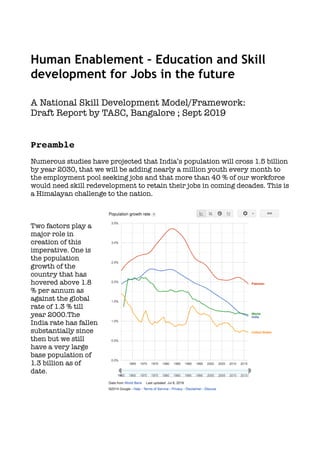
Two factors play a
major role in
creation of this
imperative. One is
the population
growth of the
country that has
hovered above 1.8
% per annum as
against the global
rate of 1.3 % till
year 2000.The
India rate has fallen
substantially since
then but we still
have a very large
base population of
1.3 billion as of
date.
The second factor arises due to the over arching nature of the force of
automation, fueled by Artificial Intelligence devices and systems, enveloping
all nations. It has gained momentum and is projected to wipe out millions of
traditional jobs hitherto performed by human workforce. A serious concern
exists that newer jobs in the AI impacted world would polarize the market
into a few high paying jobs and millions of low paying jobs thus hollowing out
the middle rungs. These changes are projected to occur within the next three
decades.
Government of India has recognized the need and urgency to revamp the
education sector and to create the ecosystem for continuous skill building, in
this context. It has embarked on new initiatives such as Skill India, Digital
India, Smart cities and Make In India. it has chosen to standardize the
curriculum, testing and admission procedures and upgrade the competencies
of many institutions.
Yet it is apparent that the results achieved are still far below the targets set
and do not instill any confidence that the nation is upto the task.
An in-depth review of these initiatives and the manner in which they have
been implemented reveal shocking lacunae. Between the studies done to
ascertain the current status ( the descriptive) and the goals set by policy
makers and the initiatives ( the prescriptive) there is no connect. Neither the
cause and effects of forces that move the current state to a desired future
state have been understood properly nor reflected in the path chosen to move
to the goals set. The studies and the Initiatives sit in silos. Worse still is the
lack of assurance that these are the best means by which the nation can
reach the goals efficiently. Measures of efficacy are conspicuously absent.
Accountability for results and the resources expended can be achieved only
when various initiatives are tied together in a logical framework , provide a
means for assessing the efficiency and effectiveness of planned programs and
monitor progress with unbiased data gathering mechanism.
Another major shortcoming is the disconnect between the demand and
supply side initiatives. Investments in improving the educational and skill
building institutions have no link to the demand side. The demand for jobs
and higher value adding ones, be it in products or services segments, will
arise only when the economy is humming, public consumption is seen to be
growing, fresh and continuous investments in plant and machinery happen
( by both public and private sectors) and equitable growth is ensured. There
are no reliable estimates and projections of nature and distribution of jobs
for the years to come.
Better demarcation is the need of the hour between the role assigned to the
public sector and the private sector. And they require different mechanisms
to spur growth.
In summary, our TASC group has identified the absence of a National Skill
Development Model/Framework as the key missing link in this scenario. The
Model needs to be quantifiable, actionable, comprehensive, envelope all
stakeholder institutions, identify all linkages, and above all provide the
logical link between the supply side and demand side initiatives.
The framework being suggested here is at best a modest attempt and a
starting effort. It needs far more thinking and development. It is our fond
belief that many would join hands with us to develop it to a state where it
merits serious consideration from the nation.
Skill Building
The debate on the mission and purpose of education, especially at the school
level, is present continuous in every society. India is no exception to this rule.
It is an agreed and well-settled vision that the school education should result
in grooming model citizens and in imparting basic life skills. There is
considerable divergence of opinion in building job skills at the school level,
however.
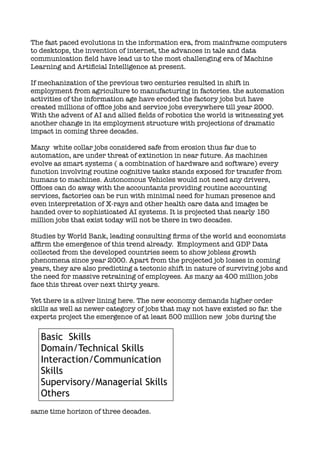
The generic job skill, irrespective of the sector in which employment is
provided can be placed in a stack of
Basic Skills need for all, Domain or Technical skills that call for specialized
knowledge, Interaction and communication Skills for primarily customer
facing roles and Supervisory or managerial skills for team leads. Jobs differ
in content and skills required and it is likely that one or more of these stacks
are needed in a given job.
While the school education upto the 10th grade lays the foundation for all the
stacks, additional training becomes a necessity in the job market. Many a
time such a skill building activity takes place on the job but the aspiration
level of the populace can be met only by imparting higher order skills at the
time of entry to the job market.
Hence the need for education beyond the school level. The Technical
institutions such as ITis and the Polytechnics provide this education for
technical roles while the three or four year college degree programs ( in
Arts, Science or Professional streams) focus on technical as well as soft skills
such as communication and supervisory.
The educational system described above, emerged as a response to the
industrial revolution and stood the test of time over two centuries until the
dawn of the Information Age. The arrival of computers about 80 years ago
has had a major impact in our belief on what needs to be taught and when.
The fast paced evolutions in the information era, from mainframe computers
to desktops, the invention of internet, the advances in tale and data
communication field have lead us to the most challenging era of Machine
Learning and Artificial Intelligence at present.
If mechanization of the previous two centuries resulted in shift in
employment from agriculture to manufacturing in factories. the automation
activities of the information age have eroded the factory jobs but have
created millions of office jobs and service jobs everywhere till year 2000.
With the advent of AI and allied fields of robotics the world is witnessing yet
another change in its employment structure with projections of dramatic
impact in coming three decades.
Many white collar jobs considered safe from erosion thus far due to
automation, are under threat of extinction in near future. As machines
evolve as smart systems ( a combination of hardware and software) every
function involving routine cognitive tasks stands exposed for transfer from
humans to machines. Autonomous Vehicles would not need any drivers,
Offices can do away with the accountants providing routine accounting
services, factories can be run with minimal need for human presence and
even interpretation of X-rays and other health care data and images be
handed over to sophisticated AI systems. It is projected that nearly 150
million jobs that exist today will not be there in two decades.
Studies by World Bank, leading consulting firms of the world and economists
affirm the emergence of this trend already. Employment and GDP Data
collected from the developed countries seem to show jobless growth
phenomena since year 2000. Apart from the projected job losses in coming
years, they are also predicting a tectonic shift in nature of surviving jobs and
the need for massive retraining of employees. As many as 400 million jobs
face this threat over next thirty years.
Yet there is a silver lining here. The new economy demands higher order
skills as well as newer category of jobs that may not have existed so far. the
experts project the emergence of at least 500 million new jobs during the
same time horizon of three decades.
Basic Skills
Domain/Technical Skills
Interaction/Communication
Skills
Supervisory/Managerial Skills
Others
The skills demanded in future can be represented as shown below in the Skill
Sets Trifurcation Model
Smart Systems of the future demand optimization of features and
functionality distributed between hardware and software and periodic
enhancement. Products and Services need to be conceived and designed to
cater to the emerging demands in the market place.
An entirely different but allied set of skills are needed to take these products
and implement them at millions of customer sites around the world. The
product functionality needs to be tweaked and tuned to local requirements
just as say a Generic Billing System would need adjustments or changes
depending on the vertical or geographic domain of the customer. Further, the
number of people needed with these skills will be a scale factor of the order of
20 and more in comparison to the design skilled personnel.
The employees at the customer firm also require additional skills to use these
products and serve their end customers.
The deployment ( of the system) calls for retraining existing employees on an
ongoing basis. Again the number of people to be retrained will be a multiple
factor of people needed for implementation.
Since most of the new jobs are expected to be created with these skill sets,
the educational sector has to be adequately geared with capacity to meet
demand. The short duration training institutes along with in-house company
training programs are likely to handle the skills retraining needs.
Mapping Demand and Supply in Skill Building
Capacity has to be built to meet rising or waning demand and aligned well to
ensure mismatches are minimized. Hence any framework for skill building
has to be developed with equal focus on the demand and supply side factors.
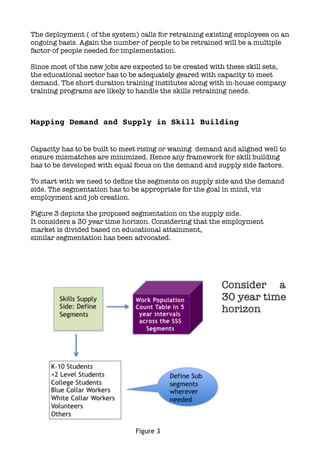
To start with we need to define the segments on supply side and the demand
side. The segmentation has to be appropriate for the goal in mind, viz
employment and job creation.
Figure 3 depicts the proposed segmentation on the supply side.
It considers a 30 year time horizon. Considering that the employment
market is divided based on educational attainment,
similar segmentation has been advocated.
it also recommends that the sub segments can be defined as per needs.
The task is to derive a Work Population Count Table in 5 year intervals across
the Supply Side Segments. It can be derived from existing census data with
projections done and reviewed by demographers and economists. We need to
consider the availability factor in each cell as the entire population in that
age group is not available. Nearly 50 % of the women choose not to enter the
job market. There would be a steady drop out from the blue and white collar
working groups due to retirement , migration and other factors.
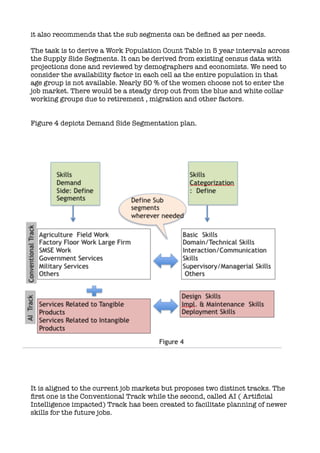
Figure 4 depicts Demand Side Segmentation plan.
It is aligned to the current job markets but proposes two distinct tracks. The
first one is the Conventional Track while the second, called AI ( Artificial
Intelligence impacted) Track has been created to facilitate planning of newer
skills for the future jobs.
The AI Track seeks to build the skill sets identified earlier through the Skill
Sets Trifurcation Model.
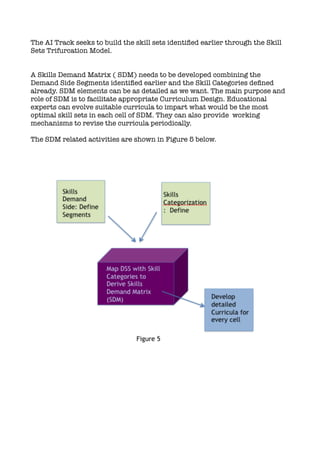
A Skills Demand Matrix ( SDM) needs to be developed combining the
Demand Side Segments identified earlier and the Skill Categories defined
already. SDM elements can be as detailed as we want. The main purpose and
role of SDM is to facilitate appropriate Curriculum Design. Educational
experts can evolve suitable curricula to impart what would be the most
optimal skill sets in each cell of SDM. They can also provide working
mechanisms to revise the curricula periodically.
The SDM related activities are shown in Figure 5 below.
The Demand side tables need to be built with the national aspirations in
mind. They have been expressed in terms of goals for desired education
levels, income levels, social equity to be achieved etc. In other words status
quo has to be changed to the desired levels of population to be engaged in
different work segments within the society. The role of technology as the job
creator and destroyer has to be duly recognized as well.
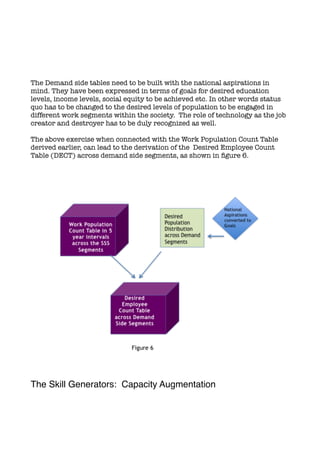
The above exercise when connected with the Work Population Count Table
derived earlier, can lead to the derivation of the Desired Employee Count
Table (DECT) across demand side segments, as shown in figure 6.
The Skill Generators: Capacity Augmentation
While Schools play the starting role of Skill Generation, many other
established institutions such as ITI, Polytechnics, Colleges and Universities
pick up the thread and continue to impart higher order skills to students.
Their main mission is to prepare the young minds to enter the job stream.
There are many other modes and means of skills generation and
augmentation of employees in their work place. Most employers take up the
responsibility to train their employees on new products and services,
processes and technologies that are of immediate relevance and use to them.
These training programs are conducted in house or through external
training institutions. Such a system works reasonably well in the organized
sector for large and mid sized firms.
Millions of micro and small sector firms in India, however, attempt this
remedial or skills rebuilding programs for their employees sparingly. The
government pitches in at this stage through multiple grants and initiatives
so that large scale unemployment is averted.
The Information Technology Sector has been a major innovator in this
regard. It has given birth to thousands of online short duration programs and
modules that facilitate self learning or guided sessions. Reputed institutions
such as IITs have embarked on major MOOC initiatives so that technology
related training can be imparted anywhere anytime by educational institutes
with limited in-house facilities or trainer resources.
They are widely adopted by the corporate sector to train, test and get their
employees certified in a cost effective manner. Such programs are a viable
means of skills upgradation for technology savvy citizens through self study
too.
Figure 7 reveals the next step of determining the SDMwise Current capacity
assessment based on existing skill generators.
Desired Employee Count Table (DECT) obtained as shown in Figure 6 can be
combined with the SDM ( Skills Demand Matrix) to yield SDMwise Required
Capacity.[Figure 8]
Continuing with the exercise, SDMwise Capacity Gap is identified. [Figure 9]
The next task calls for determining which of the SDM cell is best served by
which Skill Generator. It is apparent that the capability to deliver the
training program may exist in many Generators and a strategy has to be
developed as to which one or more of the Generators is best positioned to
provide the service to a given Demand Segment.
Based on existing reach, ability to reach to a demand segment with ease,
ability to scale quickly, ability to provide service of consistent quality and
being cost effective ,one Generator may score over others Hence evolving the
Efficacy Matrix for the Skill generators is an exercise needed to be
undertaken. EM can then be a guide to allocation of additional capacity to a
Generator optimally.
EM creation is a significant step as it can guide resource allocation decisions
that arise all the time. When new programs or initiatives are launched, it
provides a ready or quick reckoner to choose who can serve as the best
implementer. Many marginal investment decisions can be taken without
undue delays.
EM creation calls for expertise in Technology delivery mechanisms, good
understanding of market beneficiaries and their geography & other
demographic characteristics as well as cost economics.
Figure 10 shows how a Generatorwise Capacity augmentation Plan can be
developed by combining information from SDMwise Capacity Gap with the
Efficacy Matrix.
Investment in Adequate Resources
Capacity Augmentation is a resource and time consuming process. The
resources demanded would include Land, Capital, Trainers and more.
Procurement and supply of each of these resources can also be a time
consuming activity, Hence the planning process for capacity augmentation
need to recognize them explicitly.
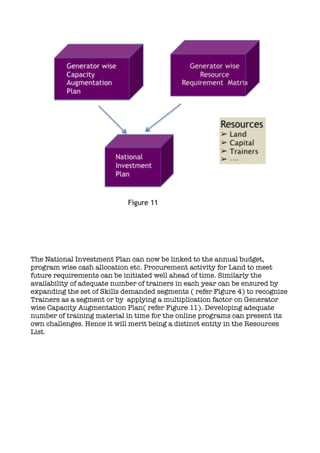
Developing a Generatorwise Resource Requirement Matrix[RRM] ( for a
given level of capacity ) is an essential step in this model building activity.
The RRM data along with the Generatorwise Capacity augmentation Plan
derived earlier, can be combined to yield the National Investment Plan as
shown in figure 11.
The National Investment Plan can now be linked to the annual budget,
program wise cash allocation etc. Procurement activity for Land to meet
future requirements can be initiated well ahead of time. Similarly the
availability of adequate number of trainers in each year can be ensured by
expanding the set of Skills demanded segments ( refer Figure 4) to recognize
Trainers as a segment or by applying a multiplication factor on Generator
wise Capacity Augmentation Plan( refer Figure 11). Developing adequate
number of training material in time for the online programs can present its
own challenges. Hence it will merit being a distinct entity in the Resources
List.
Integration with Existing Initiatives and
Embellishment
Numerous programs have been launched in last five years by GOI to meet its
specific goals. Yet, as stated in Preamble, these initiatives sit in silos, show
weak links between efforts and desired results achieved and do not have an
objective methodology to assess their efficacy. The National Skill
development Model proposed in this note offers a viable means to bring the
existing initiatives under a rational framework. It will also serve as an
evaluation platform to launch newer initiatives.
Effective Implementation of chosen programs requires setting up of new legal
entities that can be assigned responsibility and accountability. Some key
entities required are listed below.
Many Policy Reforms must accompany the efforts to build and utilize the
NSDM for its success. Many of them call for discussions with expert groups,
compilation of public views etc. It is also appropriate to acknowledge the
need for such reforms independent of our desire to build the NSDM.
for example, the list of such Policy Reform Initiatives can contain
❖ Role of Public Sector Vis Private Sector Vis Self
funded Skill Building in various life stages
❖ Education Policy: Comprehensive Review
❖ Government budgeting, funding and review
❖ Nodal and Inter Agency Formation, functioning,
Empowerment and Accountability
❖ Data and Decision ownership between Machines
and Human-beings
❖ Data Privacy and Security Needs
❖ Institutions for Data Compilation,
Ownership and Projections
❖ Institutions for Quality Assurance
and Certification
❖ Nodal Agencies for Missions/
Initiatives
❖ Independent Bodies for Validation of
Performance and Remedial Action
❖ Inter Agency Coordination
( Modalities, Framework)
Summary
Given the unprecedented changes anticipated in the job market in next three
decades due to technology and the challenges of meeting the economic and
aspirational goals of more than a billion people, India faces a mammoth task.
The programs and initiatives launched by the government over the past
decade, bear testimony to the nation’s awareness and earnest efforts to
address the issue.
Yet it has been adequately recorded that more needs to be done to skill the
youth of the nation appropriately to equip themselves to the emerging job
markets and to launch continuous retraining, reskilling programs for the
already employed, to retain their jobs.
We advocate that the need of the hour is to bring all existing initiatives into a
rational framework and to launch new ones, both being ensured to help
achieve stated goals over the next three decades. The National Skill
development Model presented here merits due consideration as a vehicle
providing the required rational framework.
It can be reviewed, embellished and developed in a six months time frame by
forming empowered study groups. It can be piloted in year 2020 and utilized
over the plan horizon with adequate mechanisms for its continuous
improvement.

a National Skill Development Model for India

  • 1.
    Human Enablement –Education and Skill development for Jobs in the future A National Skill Development Model/Framework: Draft Report by TASC, Bangalore ; Sept 2019 Preamble Numerous studies have projected that India’s population will cross 1.5 billion by year 2030, that we will be adding nearly a million youth every month to the employment pool seeking jobs and that more than 40 % of our workforce would need skill redevelopment to retain their jobs in coming decades. This is a Himalayan challenge to the nation. Two factors play a major role in creation of this imperative. One is the population growth of the country that has hovered above 1.8 % per annum as against the global rate of 1.3 % till year 2000.The India rate has fallen substantially since then but we still have a very large base population of 1.3 billion as of date.
  • 2.
    The second factorarises due to the over arching nature of the force of automation, fueled by Artificial Intelligence devices and systems, enveloping all nations. It has gained momentum and is projected to wipe out millions of traditional jobs hitherto performed by human workforce. A serious concern exists that newer jobs in the AI impacted world would polarize the market into a few high paying jobs and millions of low paying jobs thus hollowing out the middle rungs. These changes are projected to occur within the next three decades. Government of India has recognized the need and urgency to revamp the education sector and to create the ecosystem for continuous skill building, in this context. It has embarked on new initiatives such as Skill India, Digital India, Smart cities and Make In India. it has chosen to standardize the curriculum, testing and admission procedures and upgrade the competencies of many institutions. Yet it is apparent that the results achieved are still far below the targets set and do not instill any confidence that the nation is upto the task. An in-depth review of these initiatives and the manner in which they have been implemented reveal shocking lacunae. Between the studies done to ascertain the current status ( the descriptive) and the goals set by policy makers and the initiatives ( the prescriptive) there is no connect. Neither the cause and effects of forces that move the current state to a desired future state have been understood properly nor reflected in the path chosen to move to the goals set. The studies and the Initiatives sit in silos. Worse still is the lack of assurance that these are the best means by which the nation can reach the goals efficiently. Measures of efficacy are conspicuously absent. Accountability for results and the resources expended can be achieved only when various initiatives are tied together in a logical framework , provide a means for assessing the efficiency and effectiveness of planned programs and monitor progress with unbiased data gathering mechanism. Another major shortcoming is the disconnect between the demand and supply side initiatives. Investments in improving the educational and skill building institutions have no link to the demand side. The demand for jobs and higher value adding ones, be it in products or services segments, will arise only when the economy is humming, public consumption is seen to be growing, fresh and continuous investments in plant and machinery happen ( by both public and private sectors) and equitable growth is ensured. There are no reliable estimates and projections of nature and distribution of jobs for the years to come. Better demarcation is the need of the hour between the role assigned to the public sector and the private sector. And they require different mechanisms to spur growth.
  • 3.
    In summary, ourTASC group has identified the absence of a National Skill Development Model/Framework as the key missing link in this scenario. The Model needs to be quantifiable, actionable, comprehensive, envelope all stakeholder institutions, identify all linkages, and above all provide the logical link between the supply side and demand side initiatives. The framework being suggested here is at best a modest attempt and a starting effort. It needs far more thinking and development. It is our fond belief that many would join hands with us to develop it to a state where it merits serious consideration from the nation. Skill Building The debate on the mission and purpose of education, especially at the school level, is present continuous in every society. India is no exception to this rule. It is an agreed and well-settled vision that the school education should result in grooming model citizens and in imparting basic life skills. There is considerable divergence of opinion in building job skills at the school level, however. The generic job skill, irrespective of the sector in which employment is provided can be placed in a stack of Basic Skills need for all, Domain or Technical skills that call for specialized knowledge, Interaction and communication Skills for primarily customer facing roles and Supervisory or managerial skills for team leads. Jobs differ in content and skills required and it is likely that one or more of these stacks are needed in a given job. While the school education upto the 10th grade lays the foundation for all the stacks, additional training becomes a necessity in the job market. Many a time such a skill building activity takes place on the job but the aspiration level of the populace can be met only by imparting higher order skills at the time of entry to the job market. Hence the need for education beyond the school level. The Technical institutions such as ITis and the Polytechnics provide this education for technical roles while the three or four year college degree programs ( in Arts, Science or Professional streams) focus on technical as well as soft skills such as communication and supervisory. The educational system described above, emerged as a response to the industrial revolution and stood the test of time over two centuries until the dawn of the Information Age. The arrival of computers about 80 years ago has had a major impact in our belief on what needs to be taught and when.
  • 4.
    The fast pacedevolutions in the information era, from mainframe computers to desktops, the invention of internet, the advances in tale and data communication field have lead us to the most challenging era of Machine Learning and Artificial Intelligence at present. If mechanization of the previous two centuries resulted in shift in employment from agriculture to manufacturing in factories. the automation activities of the information age have eroded the factory jobs but have created millions of office jobs and service jobs everywhere till year 2000. With the advent of AI and allied fields of robotics the world is witnessing yet another change in its employment structure with projections of dramatic impact in coming three decades. Many white collar jobs considered safe from erosion thus far due to automation, are under threat of extinction in near future. As machines evolve as smart systems ( a combination of hardware and software) every function involving routine cognitive tasks stands exposed for transfer from humans to machines. Autonomous Vehicles would not need any drivers, Offices can do away with the accountants providing routine accounting services, factories can be run with minimal need for human presence and even interpretation of X-rays and other health care data and images be handed over to sophisticated AI systems. It is projected that nearly 150 million jobs that exist today will not be there in two decades. Studies by World Bank, leading consulting firms of the world and economists affirm the emergence of this trend already. Employment and GDP Data collected from the developed countries seem to show jobless growth phenomena since year 2000. Apart from the projected job losses in coming years, they are also predicting a tectonic shift in nature of surviving jobs and the need for massive retraining of employees. As many as 400 million jobs face this threat over next thirty years. Yet there is a silver lining here. The new economy demands higher order skills as well as newer category of jobs that may not have existed so far. the experts project the emergence of at least 500 million new jobs during the same time horizon of three decades. Basic Skills Domain/Technical Skills Interaction/Communication Skills Supervisory/Managerial Skills Others
  • 5.
    The skills demandedin future can be represented as shown below in the Skill Sets Trifurcation Model Smart Systems of the future demand optimization of features and functionality distributed between hardware and software and periodic enhancement. Products and Services need to be conceived and designed to cater to the emerging demands in the market place. An entirely different but allied set of skills are needed to take these products and implement them at millions of customer sites around the world. The product functionality needs to be tweaked and tuned to local requirements just as say a Generic Billing System would need adjustments or changes depending on the vertical or geographic domain of the customer. Further, the number of people needed with these skills will be a scale factor of the order of 20 and more in comparison to the design skilled personnel. The employees at the customer firm also require additional skills to use these products and serve their end customers.
  • 6.
    The deployment (of the system) calls for retraining existing employees on an ongoing basis. Again the number of people to be retrained will be a multiple factor of people needed for implementation. Since most of the new jobs are expected to be created with these skill sets, the educational sector has to be adequately geared with capacity to meet demand. The short duration training institutes along with in-house company training programs are likely to handle the skills retraining needs. Mapping Demand and Supply in Skill Building Capacity has to be built to meet rising or waning demand and aligned well to ensure mismatches are minimized. Hence any framework for skill building has to be developed with equal focus on the demand and supply side factors. To start with we need to define the segments on supply side and the demand side. The segmentation has to be appropriate for the goal in mind, viz employment and job creation. Figure 3 depicts the proposed segmentation on the supply side. It considers a 30 year time horizon. Considering that the employment market is divided based on educational attainment, similar segmentation has been advocated.
  • 7.
    it also recommendsthat the sub segments can be defined as per needs. The task is to derive a Work Population Count Table in 5 year intervals across the Supply Side Segments. It can be derived from existing census data with projections done and reviewed by demographers and economists. We need to consider the availability factor in each cell as the entire population in that age group is not available. Nearly 50 % of the women choose not to enter the job market. There would be a steady drop out from the blue and white collar working groups due to retirement , migration and other factors. Figure 4 depicts Demand Side Segmentation plan. It is aligned to the current job markets but proposes two distinct tracks. The first one is the Conventional Track while the second, called AI ( Artificial Intelligence impacted) Track has been created to facilitate planning of newer skills for the future jobs.
  • 8.
    The AI Trackseeks to build the skill sets identified earlier through the Skill Sets Trifurcation Model. A Skills Demand Matrix ( SDM) needs to be developed combining the Demand Side Segments identified earlier and the Skill Categories defined already. SDM elements can be as detailed as we want. The main purpose and role of SDM is to facilitate appropriate Curriculum Design. Educational experts can evolve suitable curricula to impart what would be the most optimal skill sets in each cell of SDM. They can also provide working mechanisms to revise the curricula periodically. The SDM related activities are shown in Figure 5 below.
  • 9.
    The Demand sidetables need to be built with the national aspirations in mind. They have been expressed in terms of goals for desired education levels, income levels, social equity to be achieved etc. In other words status quo has to be changed to the desired levels of population to be engaged in different work segments within the society. The role of technology as the job creator and destroyer has to be duly recognized as well. The above exercise when connected with the Work Population Count Table derived earlier, can lead to the derivation of the Desired Employee Count Table (DECT) across demand side segments, as shown in figure 6. The Skill Generators: Capacity Augmentation
  • 10.
    While Schools playthe starting role of Skill Generation, many other established institutions such as ITI, Polytechnics, Colleges and Universities pick up the thread and continue to impart higher order skills to students. Their main mission is to prepare the young minds to enter the job stream. There are many other modes and means of skills generation and augmentation of employees in their work place. Most employers take up the responsibility to train their employees on new products and services, processes and technologies that are of immediate relevance and use to them. These training programs are conducted in house or through external training institutions. Such a system works reasonably well in the organized sector for large and mid sized firms. Millions of micro and small sector firms in India, however, attempt this remedial or skills rebuilding programs for their employees sparingly. The government pitches in at this stage through multiple grants and initiatives so that large scale unemployment is averted. The Information Technology Sector has been a major innovator in this regard. It has given birth to thousands of online short duration programs and modules that facilitate self learning or guided sessions. Reputed institutions such as IITs have embarked on major MOOC initiatives so that technology
  • 11.
    related training canbe imparted anywhere anytime by educational institutes with limited in-house facilities or trainer resources. They are widely adopted by the corporate sector to train, test and get their employees certified in a cost effective manner. Such programs are a viable means of skills upgradation for technology savvy citizens through self study too. Figure 7 reveals the next step of determining the SDMwise Current capacity assessment based on existing skill generators. Desired Employee Count Table (DECT) obtained as shown in Figure 6 can be combined with the SDM ( Skills Demand Matrix) to yield SDMwise Required Capacity.[Figure 8]
  • 12.
    Continuing with theexercise, SDMwise Capacity Gap is identified. [Figure 9] The next task calls for determining which of the SDM cell is best served by which Skill Generator. It is apparent that the capability to deliver the training program may exist in many Generators and a strategy has to be developed as to which one or more of the Generators is best positioned to provide the service to a given Demand Segment. Based on existing reach, ability to reach to a demand segment with ease, ability to scale quickly, ability to provide service of consistent quality and being cost effective ,one Generator may score over others Hence evolving the Efficacy Matrix for the Skill generators is an exercise needed to be undertaken. EM can then be a guide to allocation of additional capacity to a Generator optimally. EM creation is a significant step as it can guide resource allocation decisions that arise all the time. When new programs or initiatives are launched, it
  • 13.
    provides a readyor quick reckoner to choose who can serve as the best implementer. Many marginal investment decisions can be taken without undue delays. EM creation calls for expertise in Technology delivery mechanisms, good understanding of market beneficiaries and their geography & other demographic characteristics as well as cost economics. Figure 10 shows how a Generatorwise Capacity augmentation Plan can be developed by combining information from SDMwise Capacity Gap with the Efficacy Matrix. Investment in Adequate Resources Capacity Augmentation is a resource and time consuming process. The resources demanded would include Land, Capital, Trainers and more. Procurement and supply of each of these resources can also be a time consuming activity, Hence the planning process for capacity augmentation need to recognize them explicitly. Developing a Generatorwise Resource Requirement Matrix[RRM] ( for a given level of capacity ) is an essential step in this model building activity. The RRM data along with the Generatorwise Capacity augmentation Plan derived earlier, can be combined to yield the National Investment Plan as shown in figure 11.
  • 14.
    The National InvestmentPlan can now be linked to the annual budget, program wise cash allocation etc. Procurement activity for Land to meet future requirements can be initiated well ahead of time. Similarly the availability of adequate number of trainers in each year can be ensured by expanding the set of Skills demanded segments ( refer Figure 4) to recognize Trainers as a segment or by applying a multiplication factor on Generator wise Capacity Augmentation Plan( refer Figure 11). Developing adequate number of training material in time for the online programs can present its own challenges. Hence it will merit being a distinct entity in the Resources List.
  • 15.
    Integration with ExistingInitiatives and Embellishment Numerous programs have been launched in last five years by GOI to meet its specific goals. Yet, as stated in Preamble, these initiatives sit in silos, show weak links between efforts and desired results achieved and do not have an objective methodology to assess their efficacy. The National Skill development Model proposed in this note offers a viable means to bring the existing initiatives under a rational framework. It will also serve as an evaluation platform to launch newer initiatives. Effective Implementation of chosen programs requires setting up of new legal entities that can be assigned responsibility and accountability. Some key entities required are listed below. Many Policy Reforms must accompany the efforts to build and utilize the NSDM for its success. Many of them call for discussions with expert groups, compilation of public views etc. It is also appropriate to acknowledge the need for such reforms independent of our desire to build the NSDM. for example, the list of such Policy Reform Initiatives can contain ❖ Role of Public Sector Vis Private Sector Vis Self funded Skill Building in various life stages ❖ Education Policy: Comprehensive Review ❖ Government budgeting, funding and review ❖ Nodal and Inter Agency Formation, functioning, Empowerment and Accountability
  • 16.
    ❖ Data andDecision ownership between Machines and Human-beings ❖ Data Privacy and Security Needs ❖ Institutions for Data Compilation, Ownership and Projections ❖ Institutions for Quality Assurance and Certification ❖ Nodal Agencies for Missions/ Initiatives ❖ Independent Bodies for Validation of Performance and Remedial Action ❖ Inter Agency Coordination ( Modalities, Framework)
  • 17.
    Summary Given the unprecedentedchanges anticipated in the job market in next three decades due to technology and the challenges of meeting the economic and aspirational goals of more than a billion people, India faces a mammoth task. The programs and initiatives launched by the government over the past decade, bear testimony to the nation’s awareness and earnest efforts to address the issue. Yet it has been adequately recorded that more needs to be done to skill the youth of the nation appropriately to equip themselves to the emerging job markets and to launch continuous retraining, reskilling programs for the already employed, to retain their jobs. We advocate that the need of the hour is to bring all existing initiatives into a rational framework and to launch new ones, both being ensured to help achieve stated goals over the next three decades. The National Skill development Model presented here merits due consideration as a vehicle providing the required rational framework. It can be reviewed, embellished and developed in a six months time frame by forming empowered study groups. It can be piloted in year 2020 and utilized over the plan horizon with adequate mechanisms for its continuous improvement.