Applying Parallel Lines to
Polygons
Section 3-4
Angles of a Triangle
Review of Major Points
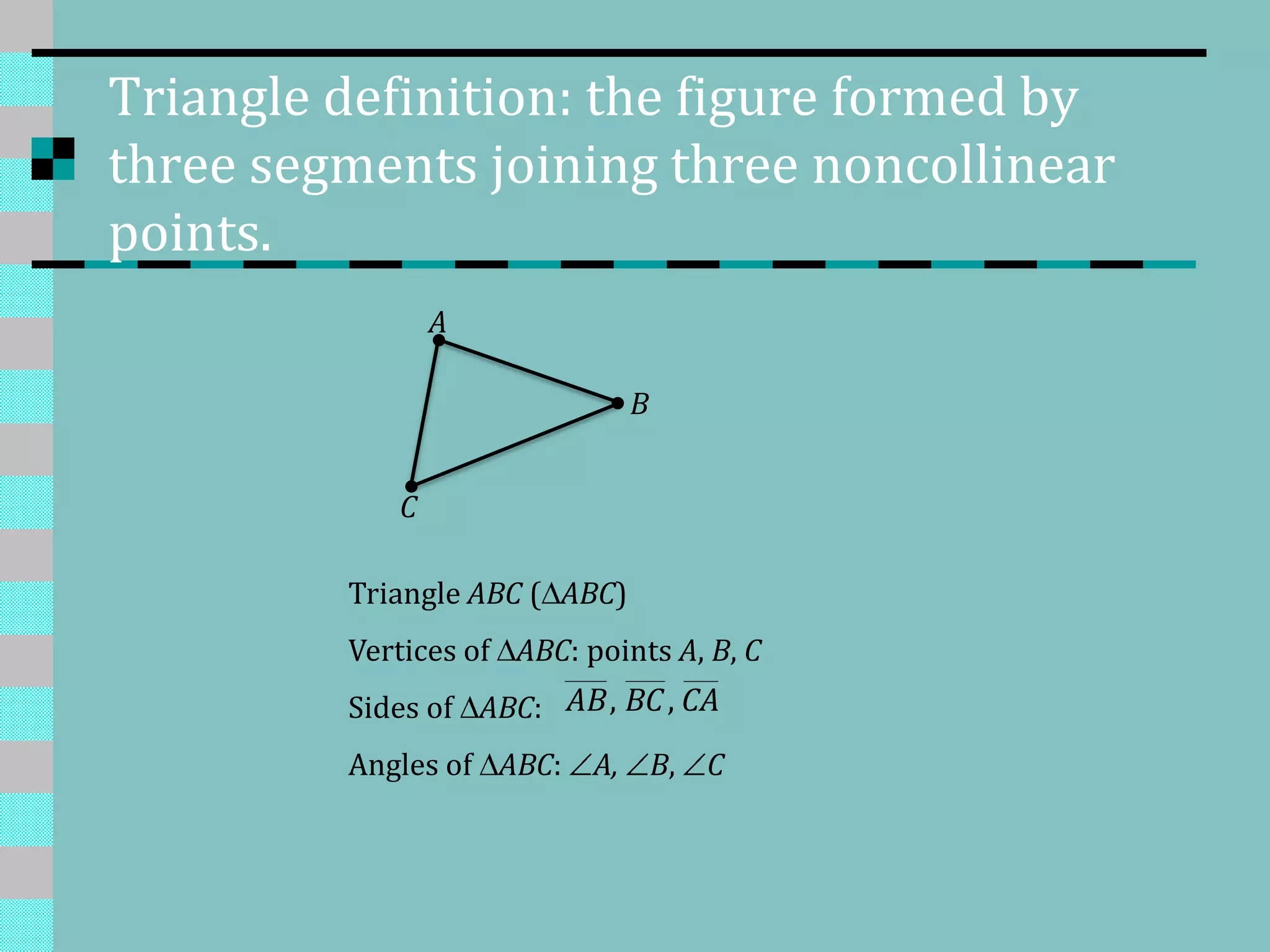
Triangle definition: the figure formed by
three segments joining three noncollinear
points.
A
B
C
Triangle ABC ( ABC)
Vertices of ABC: points A, B, C
Sides of ABC:
Angles of ABC: A, B, C
, ,AB BC CA
Classifying Triangles
By the number of
congruent sides it has.
Scalene triangle:
No sides
Isosceles triangle:
At least two sides
Equilateral triangle:
All sides
By their angles.
Acute triangle:
Three acute angles
Obtuse triangle:
One obtuse angle
Right triangle:
One right angle
Equiangular triangle:
All angles
Theorem 3-11
The sum of the measures of the angles of a triangle is 180.
Corollaries from the theorem: A statement that can be proved easily by applying a
theorem is called a corollary.
• Corollary 1
• If two angles of one triangle are congruent to two angles of another triangle, then the
third angles are congruent.
• Corollary 2
• Each angle of an equiangular triangle has measure 60.
• Corollary 3
• In a triangle, there can be at most one right angle or obtuse angle.
• Corollary 4
• The acute angles of a right triangle are complementary.
A
B
C1
2
3
4
D
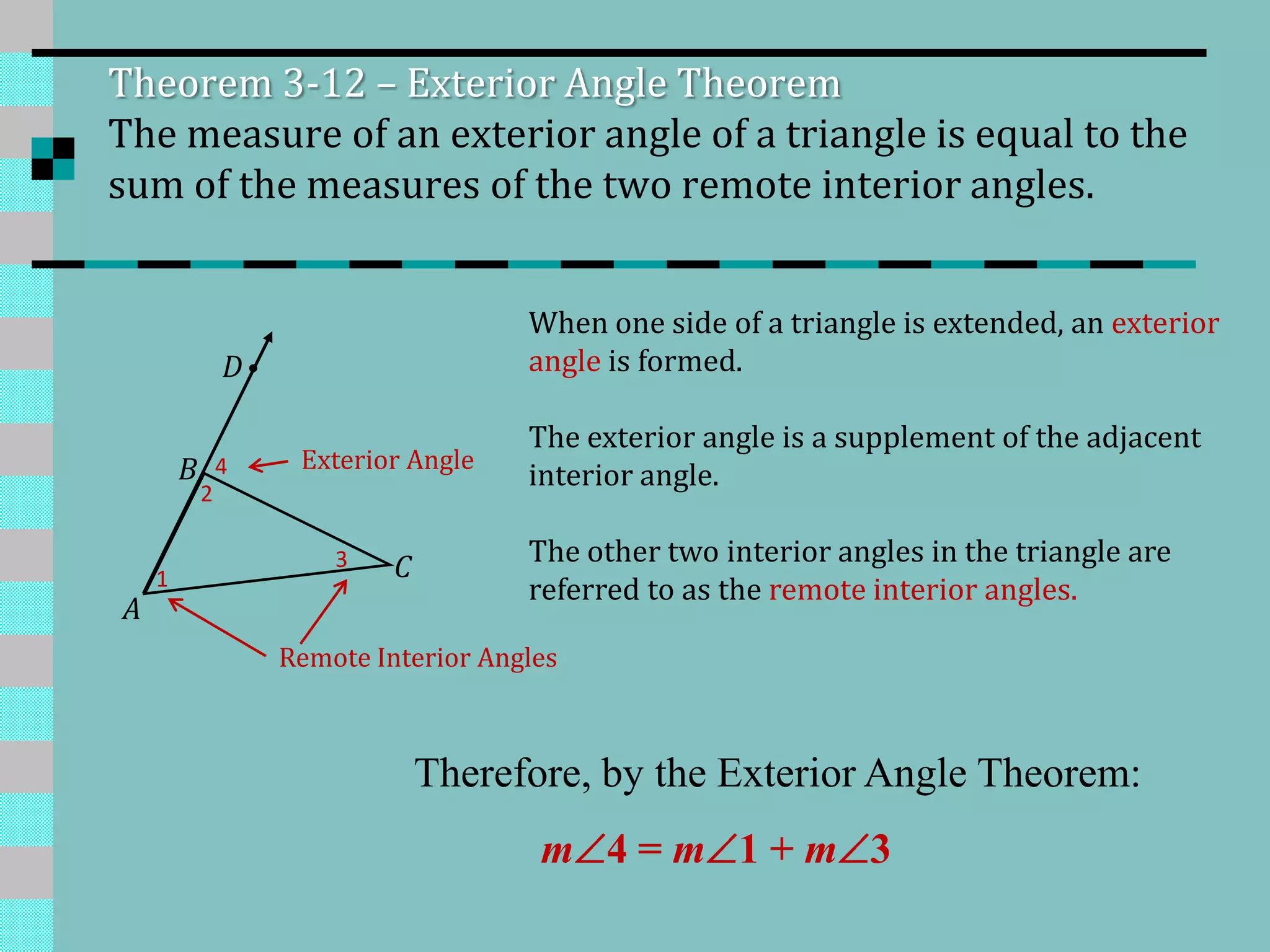
Theorem 3-12 – Exterior Angle Theorem
The measure of an exterior angle of a triangle is equal to the
sum of the measures of the two remote interior angles.
When one side of a triangle is extended, an exterior
angle is formed.
The exterior angle is a supplement of the adjacent
interior angle.
The other two interior angles in the triangle are
referred to as the remote interior angles.
Exterior Angle
Remote Interior Angles
Therefore, by the Exterior Angle Theorem:
m 4 = m 1 + m 3

Section 3 4 major points classifying triangles

  • 1.
    Applying Parallel Linesto Polygons Section 3-4 Angles of a Triangle Review of Major Points
  • 2.
    Triangle definition: thefigure formed by three segments joining three noncollinear points. A B C Triangle ABC ( ABC) Vertices of ABC: points A, B, C Sides of ABC: Angles of ABC: A, B, C , ,AB BC CA
  • 3.
    Classifying Triangles By thenumber of congruent sides it has. Scalene triangle: No sides Isosceles triangle: At least two sides Equilateral triangle: All sides By their angles. Acute triangle: Three acute angles Obtuse triangle: One obtuse angle Right triangle: One right angle Equiangular triangle: All angles
  • 4.
    Theorem 3-11 The sumof the measures of the angles of a triangle is 180. Corollaries from the theorem: A statement that can be proved easily by applying a theorem is called a corollary. • Corollary 1 • If two angles of one triangle are congruent to two angles of another triangle, then the third angles are congruent. • Corollary 2 • Each angle of an equiangular triangle has measure 60. • Corollary 3 • In a triangle, there can be at most one right angle or obtuse angle. • Corollary 4 • The acute angles of a right triangle are complementary.
  • 5.
    A B C1 2 3 4 D Theorem 3-12 –Exterior Angle Theorem The measure of an exterior angle of a triangle is equal to the sum of the measures of the two remote interior angles. When one side of a triangle is extended, an exterior angle is formed. The exterior angle is a supplement of the adjacent interior angle. The other two interior angles in the triangle are referred to as the remote interior angles. Exterior Angle Remote Interior Angles Therefore, by the Exterior Angle Theorem: m 4 = m 1 + m 3