



Chapter 10 Concept Checks Centro Escolar Solalto 9 th  Grade Biology
Concept Check 10.1
Academic Vocabulary Trait   Genetics Cross-fertilization variation of a particular inherited character  study of heredity  process by which sperm from one flower's pollen fertilizes the eggs in a flower of a different plant
Academic Vocabulary  Hybrid Monohybrid cross Allele   Homozygous   Heterozygous Dominant offspring of two different true-breeding varieties  mating of two organisms that differ in only one character   alternative form of a gene   having identical alleles for a gene   having different alleles for a gene descriptive of an allele in a heterozygous individual that appears to be the only one affecting a trait
Academic Vocabulary Recessive Punnett square Phenotype Genotype   Testcross   Dihybrid cross descriptive of an allele in a heterozygous individual that does not appear to affect a trait   diagram showing the probabilities of the possible outcomes of a genetic cross  observable traits of an organism genetic makeup of an organism; an organism's combination of alleles  mating of an individual of unknown genotype but dominant phenotype with a homozygous recessive individual  mating of two organisms that differ in two characters
Reading Questions & Answers What was the name of the Austrian monk who discovered the basic rules underlying inheritance patterns? Gregor Mendel Figure No. 1
Reading Questions & Answers Give an example of the blending hypothesis of inheritance. According to the  blending hypothesis , if a  red-flowered  plant were crossed with a  yellow-flowered  plant of the same species, the red and yellow hereditary material in the offspring would  blend  to produce  orange-flowered  plants.
Reading Questions & Answers Why was the blending hypothesis discarded? The blending hypothesis was eventually discarded because it could not explain how traits that disappear in one generation can reappear in later ones.
Reading Questions & Answers In the 19th century most biologists worked by observing and describing nature. What new approach of obtaining new biological information did Gregor Mendel use? He was one of the first biologists to apply an  experimental approach  to the study of biological inheritance.
Reading Questions & Answers Describe Gregor Mendel’s hypothesis of inheritance?   Mendel’s hypothesis states that parents pass on to their offspring separate and distinct factors  (today called genes)  that are responsible for inherited traits. Mendel stressed that these heritable factors  retain their identity generation after generation .
Concept Check 10.1 Explain how Mendel's particulate hypothesis is different from the blending hypothesis of inheritance. The  particulate hypothesis  states that parents pass on to their offspring distinct factors that retain their identities, while the blending hypothesis states that parents’ hereditary material blends in the offspring.
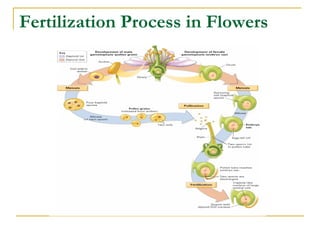
Concept Check 10.1 What is the difference between self-fertilization and cross-fertilization?  In  self-fertilization , sperm-containing pollen fertilizes an egg of the same plant. In  cross-fertilization , sperm-containing pollen from one flower fertilizes an egg of a different plant.
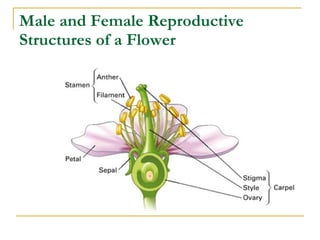
Male and Female Reproductive Structures of a Flower
Fertilization Process in Flowers
Concept Check 10.1 Describe a pattern of inheritance that the blending hypothesis fails to explain. For example, red-flower plants can produce yellow-flowered offspring.
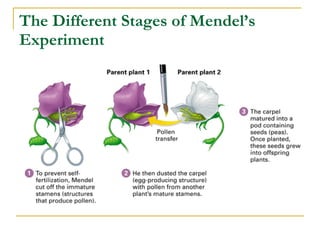
The Different Stages of Mendel’s Experiment
Reading Questions & Answers How might two brown rabbits have white offspring?  One of the brown rabbits passed on to its offspring  genes  that are responsible for the inherited trait of white hair color. This heritable factor  retained its identity  from previous generations.
Reading Questions & Answers What is an  F 1  generation? What does the  F  stand for? The  F 1   generation is the first hybrid offspring of two different true-breeding varieties.  The  F  stands for  filial , the Latin word for “ son ”.
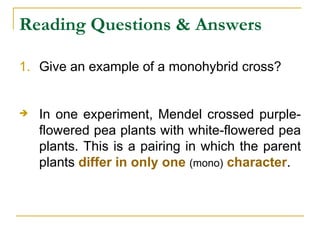
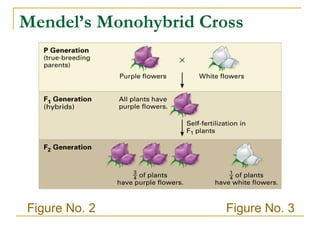
Reading Questions & Answers Give an example of a monohybrid cross? In one experiment, Mendel crossed purple-flowered pea plants with white-flowered pea plants. This is a pairing in which the parent plants  differ in only one   (mono)   character .
Mendel’s Monohybrid Cross   Figure No. 2 Figure No. 3
Reading Questions & Answers What Mendel called factors are now called _____________. genes
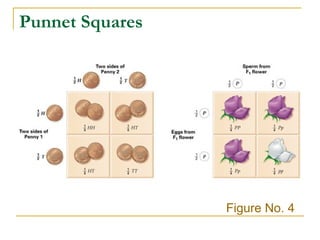
Reading Questions & Answers What are Punnett squares used for? To show all possible outcomes of a genetic cross. You can use a  Punnet square  to  predict probabilities  of particular outcomes if you know the genetic makeup of both parents.
Punnet Squares Figure No. 4
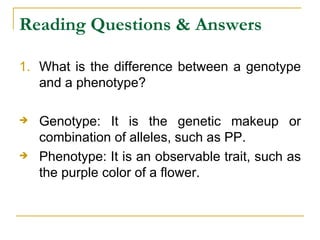
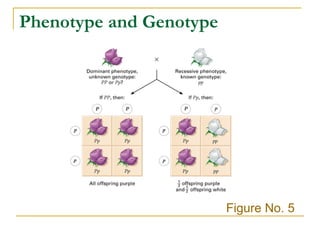
Reading Questions & Answers What is the difference between a genotype and a phenotype? Genotype: It is the genetic makeup or combination of alleles, such as PP. Phenotype: It is an observable trait, such as the purple color of a flower.
Phenotype and Genotype Figure No. 5
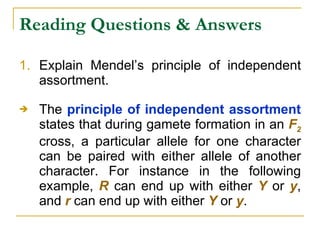
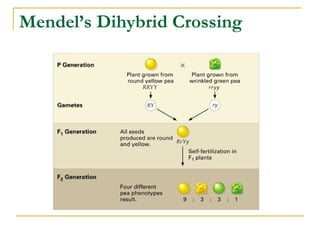
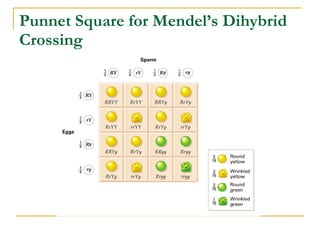
Reading Questions & Answers Explain Mendel’s principle of independent assortment. The  principle of independent assortment  states that during gamete formation in an  F 2  cross, a particular allele for one character can be paired with either allele of another character. For instance in the following example,  R  can end up with either  Y  or  y , and  r  can end up with either  Y  or  y .
Mendel’s Dihybrid Crossing
Punnet Square for Mendel’s Dihybrid Crossing
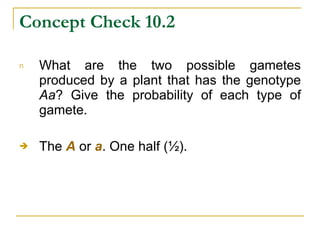
Concept Check 10.2 What are the two possible gametes produced by a plant that has the genotype  Aa ? Give the probability of each type of gamete. The  A  or  a . One half ( ½).
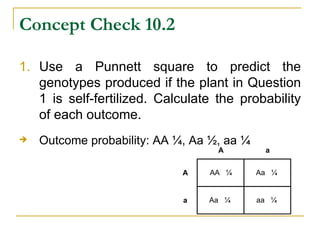
Concept Check 10.2 Use a Punnett square to predict the genotypes produced if the plant in Question 1 is self-fertilized. Calculate the probability of each outcome. Outcome probability: AA  ¼, Aa ½, aa ¼
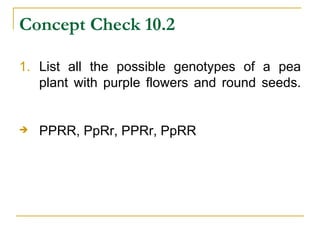
Concept Check 10.2 List all the possible genotypes of a pea plant with purple flowers and round seeds. PPRR, PpRr, PPRr, PpRR
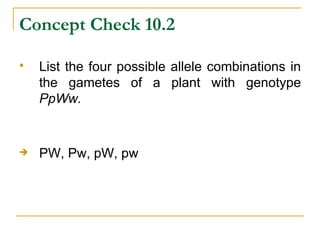
Concept Check 10.2 List the four possible allele combinations in the gametes of a plant with genotype  PpWw. PW, Pw, pW, pw
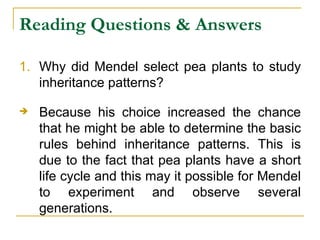
Reading Questions & Answers Why did Mendel select pea plants to study inheritance patterns? Because his choice increased the chance that he might be able to determine the basic rules behind inheritance patterns. This is due to the fact that pea plants have a short life cycle and this may it possible for Mendel to experiment and observe several generations.
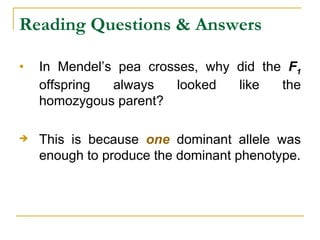
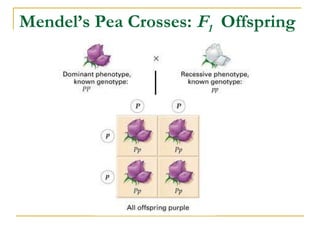
Reading Questions & Answers In Mendel’s pea crosses, why did the  F 1  offspring always looked like the homozygous parent? This is because  one  dominant allele was enough to produce the dominant phenotype.
Mendel’s Pea Crosses:  F 1   Offspring
Reading Questions & Answers Does the environment have any effect on an individual’s phenotype? If yes, give an example. Yes, it does.   An example of this is that although a tree’s  genotype  does not change throughout its lifetime, the tree’s leaves vary in size, shape, and color ( phenotype ) from year to year depending on exposure to wind and sunlight.
Growth of a Pea Plant
Thank you for your attention !

Section 10.1 (9th grade)

  • 1.
    Chapter 10 ConceptChecks Centro Escolar Solalto 9 th Grade Biology
  • 2.
  • 3.
    Academic Vocabulary Trait Genetics Cross-fertilization variation of a particular inherited character study of heredity process by which sperm from one flower's pollen fertilizes the eggs in a flower of a different plant
  • 4.
    Academic Vocabulary Hybrid Monohybrid cross Allele Homozygous Heterozygous Dominant offspring of two different true-breeding varieties mating of two organisms that differ in only one character alternative form of a gene having identical alleles for a gene having different alleles for a gene descriptive of an allele in a heterozygous individual that appears to be the only one affecting a trait
  • 5.
    Academic Vocabulary RecessivePunnett square Phenotype Genotype Testcross Dihybrid cross descriptive of an allele in a heterozygous individual that does not appear to affect a trait diagram showing the probabilities of the possible outcomes of a genetic cross observable traits of an organism genetic makeup of an organism; an organism's combination of alleles mating of an individual of unknown genotype but dominant phenotype with a homozygous recessive individual mating of two organisms that differ in two characters
  • 6.
    Reading Questions &Answers What was the name of the Austrian monk who discovered the basic rules underlying inheritance patterns? Gregor Mendel Figure No. 1
  • 7.
    Reading Questions &Answers Give an example of the blending hypothesis of inheritance. According to the blending hypothesis , if a red-flowered plant were crossed with a yellow-flowered plant of the same species, the red and yellow hereditary material in the offspring would blend to produce orange-flowered plants.
  • 8.
    Reading Questions &Answers Why was the blending hypothesis discarded? The blending hypothesis was eventually discarded because it could not explain how traits that disappear in one generation can reappear in later ones.
  • 9.
    Reading Questions &Answers In the 19th century most biologists worked by observing and describing nature. What new approach of obtaining new biological information did Gregor Mendel use? He was one of the first biologists to apply an experimental approach to the study of biological inheritance.
  • 10.
    Reading Questions &Answers Describe Gregor Mendel’s hypothesis of inheritance? Mendel’s hypothesis states that parents pass on to their offspring separate and distinct factors (today called genes) that are responsible for inherited traits. Mendel stressed that these heritable factors retain their identity generation after generation .
  • 11.
    Concept Check 10.1Explain how Mendel's particulate hypothesis is different from the blending hypothesis of inheritance. The particulate hypothesis states that parents pass on to their offspring distinct factors that retain their identities, while the blending hypothesis states that parents’ hereditary material blends in the offspring.
  • 12.
    Concept Check 10.1What is the difference between self-fertilization and cross-fertilization? In self-fertilization , sperm-containing pollen fertilizes an egg of the same plant. In cross-fertilization , sperm-containing pollen from one flower fertilizes an egg of a different plant.
  • 13.
    Male and FemaleReproductive Structures of a Flower
  • 14.
  • 15.
    Concept Check 10.1Describe a pattern of inheritance that the blending hypothesis fails to explain. For example, red-flower plants can produce yellow-flowered offspring.
  • 16.
    The Different Stagesof Mendel’s Experiment
  • 17.
    Reading Questions &Answers How might two brown rabbits have white offspring? One of the brown rabbits passed on to its offspring genes that are responsible for the inherited trait of white hair color. This heritable factor retained its identity from previous generations.
  • 18.
    Reading Questions &Answers What is an F 1 generation? What does the F stand for? The F 1 generation is the first hybrid offspring of two different true-breeding varieties. The F stands for filial , the Latin word for “ son ”.
  • 19.
    Reading Questions &Answers Give an example of a monohybrid cross? In one experiment, Mendel crossed purple-flowered pea plants with white-flowered pea plants. This is a pairing in which the parent plants differ in only one (mono) character .
  • 20.
    Mendel’s Monohybrid Cross Figure No. 2 Figure No. 3
  • 21.
    Reading Questions &Answers What Mendel called factors are now called _____________. genes
  • 22.
    Reading Questions &Answers What are Punnett squares used for? To show all possible outcomes of a genetic cross. You can use a Punnet square to predict probabilities of particular outcomes if you know the genetic makeup of both parents.
  • 23.
  • 24.
    Reading Questions &Answers What is the difference between a genotype and a phenotype? Genotype: It is the genetic makeup or combination of alleles, such as PP. Phenotype: It is an observable trait, such as the purple color of a flower.
  • 25.
  • 26.
    Reading Questions &Answers Explain Mendel’s principle of independent assortment. The principle of independent assortment states that during gamete formation in an F 2 cross, a particular allele for one character can be paired with either allele of another character. For instance in the following example, R can end up with either Y or y , and r can end up with either Y or y .
  • 27.
  • 28.
    Punnet Square forMendel’s Dihybrid Crossing
  • 29.
    Concept Check 10.2What are the two possible gametes produced by a plant that has the genotype Aa ? Give the probability of each type of gamete. The A or a . One half ( ½).
  • 30.
    Concept Check 10.2Use a Punnett square to predict the genotypes produced if the plant in Question 1 is self-fertilized. Calculate the probability of each outcome. Outcome probability: AA ¼, Aa ½, aa ¼
  • 31.
    Concept Check 10.2List all the possible genotypes of a pea plant with purple flowers and round seeds. PPRR, PpRr, PPRr, PpRR
  • 32.
    Concept Check 10.2List the four possible allele combinations in the gametes of a plant with genotype PpWw. PW, Pw, pW, pw
  • 33.
    Reading Questions &Answers Why did Mendel select pea plants to study inheritance patterns? Because his choice increased the chance that he might be able to determine the basic rules behind inheritance patterns. This is due to the fact that pea plants have a short life cycle and this may it possible for Mendel to experiment and observe several generations.
  • 34.
    Reading Questions &Answers In Mendel’s pea crosses, why did the F 1 offspring always looked like the homozygous parent? This is because one dominant allele was enough to produce the dominant phenotype.
  • 35.
  • 36.
    Reading Questions &Answers Does the environment have any effect on an individual’s phenotype? If yes, give an example. Yes, it does. An example of this is that although a tree’s genotype does not change throughout its lifetime, the tree’s leaves vary in size, shape, and color ( phenotype ) from year to year depending on exposure to wind and sunlight.
  • 37.
    Growth of aPea Plant
  • 38.
    Growth of aPea Plant
  • 39.
    Thank you foryour attention !