Jeff Keyes
Director of Product Marketing
Greater Seattle Area
Marc Hornbeek
CEO – Engineering DevOps Consulting
Author – Engineering DevOps
Value Stream
Mapping
Webinar Series
I. Current State Value Stream Mapping
II. Future State Value Stream Mapping
III. Examples of Value Stream Mapping
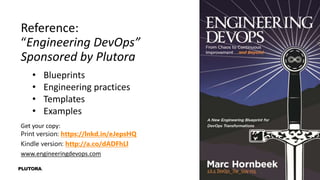
Reference:
“Engineering DevOps”
Sponsored by Plutora
Get your copy:
Print version: https://lnkd.in/eJepsHQ
Kindle version: http://a.co/dADFhLl
www.engineeringdevops.com
• Blueprints
• Engineering practices
• Templates
• Examples
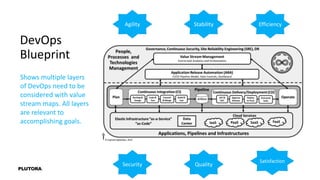
DevOps
Blueprint
Shows multiple layers
of DevOps need to be
considered with value
stream maps. All layers
are relevant to
accomplishing goals.
Agility Stability Efficiency
Security Quality
Satisfaction
What you
will learn:
• What is a future-state value stream map?
• Why is a future-state value stream map important?
• How are future-state value stream maps created?
• What is the expected result of a future-state value-stream
mapping exercise?
• Several tips on how to identify solutions that address the
most critical bottlenecks to be targeted for improvement
in a future-state value stream map.
To what extent is
your organization
using future-state
value stream maps
today?
Survey
Question #1
Don’t know.A
Just getting familiar with future-state value stream mappingB
Decided to implement future-state value stream mapping but not
yet implemented.
C
Future-state Value stream mapping is being implemented but not
yet part of our production environment.
D
Future-state Value stream mapping is part of our production
environment.
E
Decided not to use future-state value stream mapping.F
PAGE 7
This has been used in lean manufacturing and
business process engineering for years and is
useful for modelling future state of DevOps
continuous delivery pipelines and software
value streams.
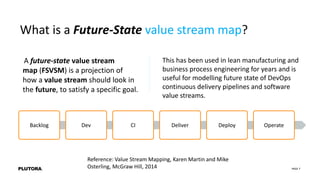
What is a Future-State value stream map?
A future-state value stream
map (FSVSM) is a projection of
how a value stream should look in
the future, to satisfy a specific goal.
Backlog Dev CI Deliver Deploy Operate
Reference: Value Stream Mapping, Karen Martin and Mike
Osterling, McGraw Hill, 2014
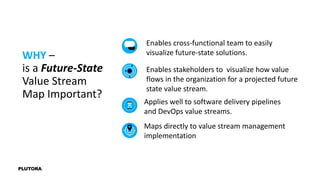
Enables stakeholders to visualize how value
flows in the organization for a projected future
state value stream.
WHY –
is a Future-State
Value Stream
Map Important?
Applies well to software delivery pipelines
and DevOps value streams.
Maps directly to value stream management
implementation
Enables cross-functional team to easily
visualize future-state solutions.
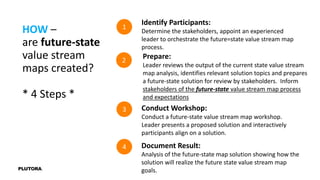
Prepare:
Leader reviews the output of the current state value stream
map analysis, identifies relevant solution topics and prepares
a future-state solution for review by stakeholders. Inform
stakeholders of the future-state value stream map process
and expectations
HOW –
are future-state
value stream
maps created?
* 4 Steps *
Conduct Workshop:
Conduct a future-state value stream map workshop.
Leader presents a proposed solution and interactively
participants align on a solution.
Document Result:
Analysis of the future-state map solution showing how the
solution will realize the future state value stream map
goals.
1
Identify Participants:
Determine the stakeholders, appoint an experienced
leader to orchestrate the future=state value stream map
process.
2
3
4
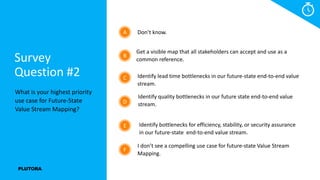
What is your highest priority
use case for Future-State
Value Stream Mapping?
Survey
Question #2
Don’t know.A
Identify lead time bottlenecks in our future-state end-to-end value
stream.
B
C
D
E
I don’t see a compelling use case for future-state Value Stream
Mapping.
F
Get a visible map that all stakeholders can accept and use as a
common reference.
Identify quality bottlenecks in our future state end-to-end value
stream.
Identify bottlenecks for efficiency, stability, or security assurance
in our future-state end-to-end value stream.
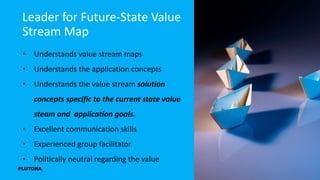
• Understands value stream maps
• Understands the application concepts
• Understands the value stream solution
concepts specific to the current state value
steam and application goals.
• Excellent communication skills
• Experienced group facilitator
• Politically neutral regarding the value
Leader for Future-State Value
Stream Map
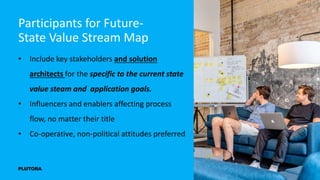
• Include key stakeholders and solution
architects for the specific to the current state
value steam and application goals.
• Influencers and enablers affecting process
flow, no matter their title
• Co-operative, non-political attitudes preferred
Participants for Future-
State Value Stream Map
Large Insurance Company
Goal:
Reduce from 45 days to 10 days the lead time from
code check-in to deployment.
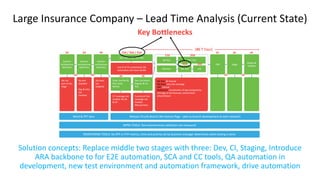
Large Insurance Company – Lead Time (Current State)
Goal: 10 days lead time check-in to deploy.
[45 ? Days]
Word & PPT docs
INFRA TOOLS: Test environments utilization not measured
MONITORING TOOLS: No RTP or PTP metrics, time and priority set by business manager determines when testing is done
Solution
Architecture
Definition
5d
QA not
part of this
stage
Solution
Architecture
Definition
4h
QA tasks
not
assigned
2d
Release (Trunk) Branch (No feature flags – plan to branch development at each release!)
Deploy &
Validate
xh
Manual
Stage
xh
Manual
CRB
xh
Manual
Solution
Architecture
Definition
2d
No test
checklist
Ops & Infra
not
involved
4d xh xh
QA / UAT / Perf Test Plan
10d / 20d / 55d
Low % of TCs automated, QA
automation test team decide
Code, DevTest &
Peer Code
Review
Dev Functional,
Regress & Int.
Test
UT coverage not
tracked. No SA
& CR
Functional Test
coverage not
tracked.
Manual tests.
xh xh
QA Test
QA Auto
Perf Test
E2E Test UAT
QA Test: all manual
QA Auto: very low coverage
UAT: manual
Bottleneck: coordination of app components,
shortage of tool licenses, environment
setup/release
15d 20d
40d 20d
Large Insurance Company – Lead Time Analysis (Current State)
Solution concepts: Replace middle two stages with three: Dev, CI, Staging, Introduce
ARA backbone to for E2E automation, SCA and CC tools, QA automation in
development, new test environment and automation framework, drive automation
Key Bottlenecks
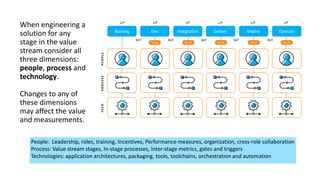
When engineering a
solution for any
stage in the value
stream consider all
three dimensions:
people, process and
technology.
Changes to any of
these dimensions
may affect the value
and measurements.
Backlog Dev Integration Deliver Deploy Operate
PEOPLEPROCESSTECH
L/P L/P L/P L/P L/P L/P
NVT NVT NVT NVT NVT
%C/A %C/A %C/A %C/A %C/A
People: Leadership, roles, training, Incentives, Performance measures, organization, cross-role collaboration
Process: Value stream stages, In-stage processes, inter-stage metrics, gates and triggers
Technologies: application architectures, packaging, tools, toolchains, orchestration and automation
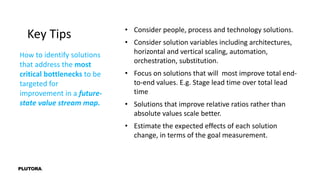
How to identify solutions
that address the most
critical bottlenecks to be
targeted for
improvement in a future-
state value stream map.
Key Tips • Consider people, process and technology solutions.
• Consider solution variables including architectures,
horizontal and vertical scaling, automation,
orchestration, substitution.
• Focus on solutions that will most improve total end-
to-end values. E.g. Stage lead time over total lead
time
• Solutions that improve relative ratios rather than
absolute values scale better.
• Estimate the expected effects of each solution
change, in terms of the goal measurement.
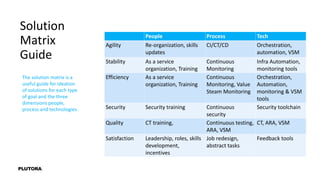
The solution matrix is a
useful guide for ideation
of solutions for each type
of goal and the three
dimensions people,
process and technologies.
Solution
Matrix
Guide
People Process Tech
Agility Re-organization, skills
updates
CI/CT/CD Orchestration,
automation, VSM
Stability As a service
organization, Training
Continuous
Monitoring
Infra Automation,
monitoring tools
Efficiency As a service
organization, Training
Continuous
Monitoring, Value
Steam Monitoring
Orchestration,
Automation,
monitoring & VSM
tools
Security Security training Continuous
security
Security toolchain
Quality CT training, Continuous testing,
ARA, VSM
CT, ARA, VSM
Satisfaction Leadership, roles, skills
development,
incentives
Job redesign,
abstract tasks
Feedback tools
PAGE 19
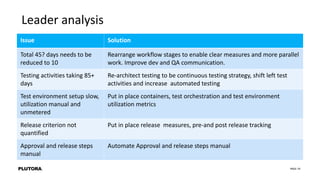
Leader analysis
Issue Solution
Total 45? days needs to be
reduced to 10
Rearrange workflow stages to enable clear measures and more parallel
work. Improve dev and QA communication.
Testing activities taking 85+
days
Re-architect testing to be continuous testing strategy, shift left test
activities and increase automated testing
Test environment setup slow,
utilization manual and
unmetered
Put in place containers, test orchestration and test environment
utilization metrics
Release criterion not
quantified
Put in place release measures, pre-and post release tracking
Approval and release steps
manual
Automate Approval and release steps manual
Large Insurance Company – Lead Time (Future State)
[10 days]
4h
Jira, Slack
Backlog
Include infra &
tests and
assignments
Dev
Feature flags, TDD,
100% UT, 100%
SCA, Create
automated smoke
& regress tests,
test environment
orchestration
CI
Trigger integration
builds from
commit, automate
smoke tests and
regression
Acceptance
Automate 85%
UAT, Performance,
& E2E system
regression, test
environment
orchestration
Delivery
Delivery & CRB:
Automate deployment tests and release criterion
Deploy:
Containers and cluster management, use APM, Green/Blue & A/B
testing
CRB Deploy
Release (Trunk) Branch (with feature flags)
INFRA TOOLS: Slack and Jira for communication flow, Application Release Automation tool, test automation/test environment orchestration and
containers tools, VRA
MONITORING TOOLS: Jira, ARA, Splunk, APT, SLIs, SLOs
10d 3d 5d 1d 1d 4h
1d 2h 2h 2h 2h 2h
Product Activity
Team alignment:
Stakeholders agree to the visualized solution.
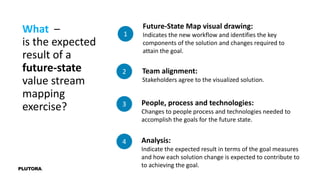
What –
is the expected
result of a
future-state
value stream
mapping
exercise? People, process and technologies:
Changes to people process and technologies needed to
accomplish the goals for the future state.
Analysis:
Indicate the expected result in terms of the goal measures
and how each solution change is expected to contribute to
to achieving the goal.
1
Future-State Map visual drawing:
Indicates the new workflow and identifies the key
components of the solution and changes required to
attain the goal.
2
3
4
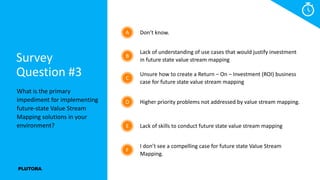
What is the primary
impediment for implementing
future-state Value Stream
Mapping solutions in your
environment?
Survey
Question #3
Don’t know.A
Lack of understanding of use cases that would justify investment
in future state value stream mapping
B
Unsure how to create a Return – On – Investment (ROI) business
case for future state value stream mapping
C
Higher priority problems not addressed by value stream mapping.D
Lack of skills to conduct future state value stream mappingE
I don’t see a compelling case for future state Value Stream
Mapping.
F
Plutora is the most complete Value Stream
Management platform
FOUNDED IN 2011
COMPANY CONFIDENTIAL – DO NOT DISTRIBUTE
PAGE 24
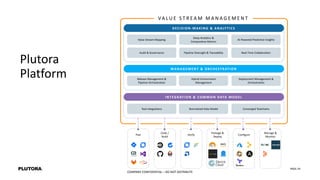
Plutora
Platform
DECISION-MAKING & ANALYTICS
MANAGEMENT & ORCHESTRATION
INTEGRATION & COMMON DATA MODEL
Value Stream Mapping
Deep Analytics &
Comparative Metrics
AI-Powered Predictive Insights
VA L U E S T R E A M M A N A G E M E N T
Plan
Code /
Build
Verify
Package &
Deploy
Configure
Manage &
Monitor
Audit & Governance Pipeline Oversight & Traceability Real-Time Collaboration
Release Management &
Pipeline Orchestration
Hybrid Environment
Management
Deployment Management &
Orchestration
Tool Integrations Normalized Data Model Converged Toolchains
COMPANY CONFIDENTIAL – DO NOT DISTRIBUTE
Jeff Keyes
Director of Product Marketing
jeff.keyes@plutora.com
Q & A
Marc Hornbeek
CEO – Engineering DevOps Consulting
Author – Engineering DevOps

Secrets of Value Stream Mapping for Future State

  • 1.
    Jeff Keyes Director ofProduct Marketing Greater Seattle Area Marc Hornbeek CEO – Engineering DevOps Consulting Author – Engineering DevOps
  • 2.
    Value Stream Mapping Webinar Series I.Current State Value Stream Mapping II. Future State Value Stream Mapping III. Examples of Value Stream Mapping
  • 3.
    Reference: “Engineering DevOps” Sponsored byPlutora Get your copy: Print version: https://lnkd.in/eJepsHQ Kindle version: http://a.co/dADFhLl www.engineeringdevops.com • Blueprints • Engineering practices • Templates • Examples
  • 4.
    DevOps Blueprint Shows multiple layers ofDevOps need to be considered with value stream maps. All layers are relevant to accomplishing goals. Agility Stability Efficiency Security Quality Satisfaction
  • 5.
    What you will learn: •What is a future-state value stream map? • Why is a future-state value stream map important? • How are future-state value stream maps created? • What is the expected result of a future-state value-stream mapping exercise? • Several tips on how to identify solutions that address the most critical bottlenecks to be targeted for improvement in a future-state value stream map.
  • 6.
    To what extentis your organization using future-state value stream maps today? Survey Question #1 Don’t know.A Just getting familiar with future-state value stream mappingB Decided to implement future-state value stream mapping but not yet implemented. C Future-state Value stream mapping is being implemented but not yet part of our production environment. D Future-state Value stream mapping is part of our production environment. E Decided not to use future-state value stream mapping.F
  • 7.
    PAGE 7 This hasbeen used in lean manufacturing and business process engineering for years and is useful for modelling future state of DevOps continuous delivery pipelines and software value streams. What is a Future-State value stream map? A future-state value stream map (FSVSM) is a projection of how a value stream should look in the future, to satisfy a specific goal. Backlog Dev CI Deliver Deploy Operate Reference: Value Stream Mapping, Karen Martin and Mike Osterling, McGraw Hill, 2014
  • 8.
    Enables stakeholders tovisualize how value flows in the organization for a projected future state value stream. WHY – is a Future-State Value Stream Map Important? Applies well to software delivery pipelines and DevOps value streams. Maps directly to value stream management implementation Enables cross-functional team to easily visualize future-state solutions.
  • 9.
    Prepare: Leader reviews theoutput of the current state value stream map analysis, identifies relevant solution topics and prepares a future-state solution for review by stakeholders. Inform stakeholders of the future-state value stream map process and expectations HOW – are future-state value stream maps created? * 4 Steps * Conduct Workshop: Conduct a future-state value stream map workshop. Leader presents a proposed solution and interactively participants align on a solution. Document Result: Analysis of the future-state map solution showing how the solution will realize the future state value stream map goals. 1 Identify Participants: Determine the stakeholders, appoint an experienced leader to orchestrate the future=state value stream map process. 2 3 4
  • 10.
    What is yourhighest priority use case for Future-State Value Stream Mapping? Survey Question #2 Don’t know.A Identify lead time bottlenecks in our future-state end-to-end value stream. B C D E I don’t see a compelling use case for future-state Value Stream Mapping. F Get a visible map that all stakeholders can accept and use as a common reference. Identify quality bottlenecks in our future state end-to-end value stream. Identify bottlenecks for efficiency, stability, or security assurance in our future-state end-to-end value stream.
  • 11.
    • Understands valuestream maps • Understands the application concepts • Understands the value stream solution concepts specific to the current state value steam and application goals. • Excellent communication skills • Experienced group facilitator • Politically neutral regarding the value Leader for Future-State Value Stream Map
  • 12.
    • Include keystakeholders and solution architects for the specific to the current state value steam and application goals. • Influencers and enablers affecting process flow, no matter their title • Co-operative, non-political attitudes preferred Participants for Future- State Value Stream Map
  • 13.
    Large Insurance Company Goal: Reducefrom 45 days to 10 days the lead time from code check-in to deployment.
  • 14.
    Large Insurance Company– Lead Time (Current State) Goal: 10 days lead time check-in to deploy. [45 ? Days] Word & PPT docs INFRA TOOLS: Test environments utilization not measured MONITORING TOOLS: No RTP or PTP metrics, time and priority set by business manager determines when testing is done Solution Architecture Definition 5d QA not part of this stage Solution Architecture Definition 4h QA tasks not assigned 2d Release (Trunk) Branch (No feature flags – plan to branch development at each release!) Deploy & Validate xh Manual Stage xh Manual CRB xh Manual Solution Architecture Definition 2d No test checklist Ops & Infra not involved 4d xh xh QA / UAT / Perf Test Plan 10d / 20d / 55d Low % of TCs automated, QA automation test team decide Code, DevTest & Peer Code Review Dev Functional, Regress & Int. Test UT coverage not tracked. No SA & CR Functional Test coverage not tracked. Manual tests. xh xh QA Test QA Auto Perf Test E2E Test UAT QA Test: all manual QA Auto: very low coverage UAT: manual Bottleneck: coordination of app components, shortage of tool licenses, environment setup/release 15d 20d 40d 20d
  • 15.
    Large Insurance Company– Lead Time Analysis (Current State) Solution concepts: Replace middle two stages with three: Dev, CI, Staging, Introduce ARA backbone to for E2E automation, SCA and CC tools, QA automation in development, new test environment and automation framework, drive automation Key Bottlenecks
  • 16.
    When engineering a solutionfor any stage in the value stream consider all three dimensions: people, process and technology. Changes to any of these dimensions may affect the value and measurements. Backlog Dev Integration Deliver Deploy Operate PEOPLEPROCESSTECH L/P L/P L/P L/P L/P L/P NVT NVT NVT NVT NVT %C/A %C/A %C/A %C/A %C/A People: Leadership, roles, training, Incentives, Performance measures, organization, cross-role collaboration Process: Value stream stages, In-stage processes, inter-stage metrics, gates and triggers Technologies: application architectures, packaging, tools, toolchains, orchestration and automation
  • 17.
    How to identifysolutions that address the most critical bottlenecks to be targeted for improvement in a future- state value stream map. Key Tips • Consider people, process and technology solutions. • Consider solution variables including architectures, horizontal and vertical scaling, automation, orchestration, substitution. • Focus on solutions that will most improve total end- to-end values. E.g. Stage lead time over total lead time • Solutions that improve relative ratios rather than absolute values scale better. • Estimate the expected effects of each solution change, in terms of the goal measurement.
  • 18.
    The solution matrixis a useful guide for ideation of solutions for each type of goal and the three dimensions people, process and technologies. Solution Matrix Guide People Process Tech Agility Re-organization, skills updates CI/CT/CD Orchestration, automation, VSM Stability As a service organization, Training Continuous Monitoring Infra Automation, monitoring tools Efficiency As a service organization, Training Continuous Monitoring, Value Steam Monitoring Orchestration, Automation, monitoring & VSM tools Security Security training Continuous security Security toolchain Quality CT training, Continuous testing, ARA, VSM CT, ARA, VSM Satisfaction Leadership, roles, skills development, incentives Job redesign, abstract tasks Feedback tools
  • 19.
    PAGE 19 Leader analysis IssueSolution Total 45? days needs to be reduced to 10 Rearrange workflow stages to enable clear measures and more parallel work. Improve dev and QA communication. Testing activities taking 85+ days Re-architect testing to be continuous testing strategy, shift left test activities and increase automated testing Test environment setup slow, utilization manual and unmetered Put in place containers, test orchestration and test environment utilization metrics Release criterion not quantified Put in place release measures, pre-and post release tracking Approval and release steps manual Automate Approval and release steps manual
  • 20.
    Large Insurance Company– Lead Time (Future State) [10 days] 4h Jira, Slack Backlog Include infra & tests and assignments Dev Feature flags, TDD, 100% UT, 100% SCA, Create automated smoke & regress tests, test environment orchestration CI Trigger integration builds from commit, automate smoke tests and regression Acceptance Automate 85% UAT, Performance, & E2E system regression, test environment orchestration Delivery Delivery & CRB: Automate deployment tests and release criterion Deploy: Containers and cluster management, use APM, Green/Blue & A/B testing CRB Deploy Release (Trunk) Branch (with feature flags) INFRA TOOLS: Slack and Jira for communication flow, Application Release Automation tool, test automation/test environment orchestration and containers tools, VRA MONITORING TOOLS: Jira, ARA, Splunk, APT, SLIs, SLOs 10d 3d 5d 1d 1d 4h 1d 2h 2h 2h 2h 2h Product Activity
  • 21.
    Team alignment: Stakeholders agreeto the visualized solution. What – is the expected result of a future-state value stream mapping exercise? People, process and technologies: Changes to people process and technologies needed to accomplish the goals for the future state. Analysis: Indicate the expected result in terms of the goal measures and how each solution change is expected to contribute to to achieving the goal. 1 Future-State Map visual drawing: Indicates the new workflow and identifies the key components of the solution and changes required to attain the goal. 2 3 4
  • 22.
    What is theprimary impediment for implementing future-state Value Stream Mapping solutions in your environment? Survey Question #3 Don’t know.A Lack of understanding of use cases that would justify investment in future state value stream mapping B Unsure how to create a Return – On – Investment (ROI) business case for future state value stream mapping C Higher priority problems not addressed by value stream mapping.D Lack of skills to conduct future state value stream mappingE I don’t see a compelling case for future state Value Stream Mapping. F
  • 23.
    Plutora is themost complete Value Stream Management platform FOUNDED IN 2011
  • 24.
    COMPANY CONFIDENTIAL –DO NOT DISTRIBUTE PAGE 24 Plutora Platform DECISION-MAKING & ANALYTICS MANAGEMENT & ORCHESTRATION INTEGRATION & COMMON DATA MODEL Value Stream Mapping Deep Analytics & Comparative Metrics AI-Powered Predictive Insights VA L U E S T R E A M M A N A G E M E N T Plan Code / Build Verify Package & Deploy Configure Manage & Monitor Audit & Governance Pipeline Oversight & Traceability Real-Time Collaboration Release Management & Pipeline Orchestration Hybrid Environment Management Deployment Management & Orchestration Tool Integrations Normalized Data Model Converged Toolchains
  • 25.
    COMPANY CONFIDENTIAL –DO NOT DISTRIBUTE Jeff Keyes Director of Product Marketing jeff.keyes@plutora.com Q & A Marc Hornbeek CEO – Engineering DevOps Consulting Author – Engineering DevOps

Editor's Notes

  • #3 New webinar series – educational
  • #4 New webinar series – educational
  • #5 How does mapping fit into a devops transformation? How does that tie into value stream management?
  • #6 Q: What are we going to learn Webinar Goals: Explain the steps of an approach to create a Value Stream Map of the current state of a value stream for your organization. Walk-through the steps showing how to create a current state value stream map including the key calculations and metrics Walk through a real current state value stream map created at a large insurance company. Walk through the results of the current state value stream map to show how those results are important for the creation of a future state value stream map.
  • #7 10 after
  • #8 Q: Whats a value stream map? Q: How does this differ from a process map? Q: What is the difference between future state / present state?
  • #9 Why is this important? Customer example? Relation to value creation Relation to DevOps Relation to value stream management
  • #10 Q: How does this work? Relation to value creation Relation to devops Relation to value stream management
  • #11 30 after
  • #12 Q: How to pick a leader?
  • #13 Q: Who needs to be involved? What kind of feedback do they offer? What preparation do they need?
  • #14 Case study Tell me about insurance company – # of dev teams, problem How did they realize they needed this process?
  • #15 Q: Colors – what do they mean Q: how did you come up with this current state? Q: What are the key problems you saw
  • #16 Q: How decide these were bottlenecks Q:
  • #17 Q: How do you identify tactics to support those improvements? Q: How to evaluate these value stream maps?
  • #18 Key tips to share
  • #19 Q: Types of solutions – explain the matrix
  • #21 Q: Proposed vs actual? Q: How to come up with timings? Q: How to measure the investment
  • #22 Relation to value creation Relation to devops Relation to value stream management
  • #23 50