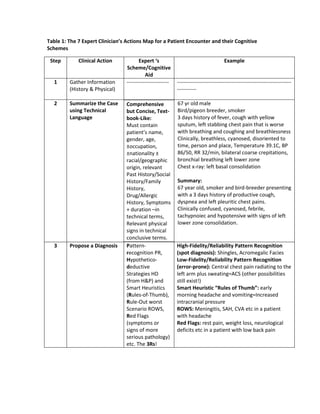
Table 1: The 7 Expert Clinician’s Actions Map for a Patient Encounter and their Cognitive
Schemes
Step

Clinical Action

1

Gather Information
(History & Physical)

2

Summarize the Case
using Technical
Language

3

Propose a Diagnosis

Expert ‘s
Scheme/Cognitive
Aid
------------------------

Comprehensive
but Concise, Textbook-Like:
Must contain
patient’s name,
gender, age,
±occupation,
±nationality ±
racial/geographic
origin, relevant
Past History/Social
History/Family
History,
Drug/Allergic
History, Symptoms
+ duration –in
technical terms,
Relevant physical
signs in technical
conclusive terms.
Patternrecognition PR,
Hypotheticodeductive
Strategies HD
(from H&P) and
Smart Heuristics
(Rules-of-Thumb),
Rule-Out worst
Scenario ROWS,
Red Flags
(symptoms or
signs of more
serious pathology)
etc. The 3Rs!

Example

--------------------------------------------------------------------------67 yr old male
Bird/pigeon breeder, smoker
3 days history of fever, cough with yellow
sputum, left stabbing chest pain that is worse
with breathing and coughing and breathlessness
Clinically, breathless, cyanosed, disoriented to
time, person and place, Temperature 39.1C, BP
86/50, RR 32/min, bilateral coarse crepitations,
bronchial breathing left lower zone
Chest x-ray: left basal consolidation
Summary:
67 year old, smoker and bird-breeder presenting
with a 3 days history of productive cough,
dyspnea and left pleuritic chest pains.
Clinically confused, cyanosed, febrile,
tachypnoiec and hypotensive with signs of left
lower zone consolidation.

High-Fidelity/Reliability Pattern Recognition
(spot diagnosis): Shingles, Acromegalic Facies
Low-Fidelity/Reliability Pattern Recognition
(error-prone): Central chest pain radiating to the
left arm plus sweating=ACS (other possibilities
still exist!)
Smart Heuristic “Rules of Thumb”: early
morning headache and vomiting=Increased
intracranial pressure
ROWS: Meningitis, SAH, CVA etc in a patient
with headache
Red Flags: rest pain, weight loss, neurological
deficits etc in a patient with low back pain
4

Differential
Diagnosis

Differential
Diagnosis
Cognitive Aids:
Anatomical,
Physiological,
Pathological

Anatomical: Swellings, Pain, Amenorrhea
Physiological: Shock, Thrombosis, Hyponatremia
Pathological: Traumatic, Infective,
Inflammatory/auto-immune,
Vascular/degenerative, Neoplastic/paraneoplastic, Metabolic/endocrine, Druginduced/poisoning, Deficiency diseases,
Psychogenic and Idiopathic/cryptogenic.

5

Order Tests
(Rationally)

Frugal(simple and
applicable)
Heuristics
Probability
Assessment,
Order tests: Test
Sensitivity,
Specificity and
Likelihood Ratios

Pre-test Probability:
1. Strong Risk factor for the condition
2. No alternative Diagnosis
High (2 YES) or Intermediate (1 YES 1 NO) or Low
(2 NO)
SpIn: highly specific tests are useful for ruling-in
the diagnosis when positive ( use for high and
intermediate probabilities)
SnOut: highly sensitive tests are useful for
ruling-out the diagnosis when negative ( use for
low probabilities)

6

Confirm &
Comprehensively
give a Diagnostic
Label

Bed-side Diagnosis: CAP
Etiology: Chlamydia psittaci
Severity: CURB-65= 4

7

Therapeutic
Interventions

8

Prepare for
Discharge

Guideline-friendly
Bed-side
Diagnosis,
Etiology, Severity
(BESD)
Contextual,
Patient-centered
Therapeutic
Cognitive Aid: Site
of Care,
Symptomatic,
Supportive,
Specific and
Specialty Referral
(5S).
Assess Response
to Treatment
(Subjective &
Objective), Criteria
for Discharge,
Timing of Followup (ACT)

Site of Care: Ward, CCU, ICU etc
Symptomatic: Analgesia, Anti-emetic, Antipyretic etc
Supportive: Oxygen, IV fluids, Bicarbonate etc
Specific: Antibiotic, Thrombolytic, Cytotoxic etc
Specialty Referral: Cardiology, Surgery,
Gynecology, Physiotherapy etc

Assess Response to Treatment : Subjective &
Objective
Criteria for Discharge: Clinical, Laboratory,
Radiologic, Social etc
Timing of Follow-up : Clinic Appointment for
disease and drug monitoring
Box 1: Summarizing the History and Physical Examination
Comprehensive but Concise, Text-book-Like:
Must contain patient’s name, gender, age, ±occupation, ±nationality ± racial/geographic origin,
relevant Past History/Social History/Family History, Drug/Allergic History, Symptoms + duration
–in technical terms, Relevant physical signs in technical conclusive terms.

Table 2: Differential Diagnosis Cognitive Aids
Anatomical Differential
Diagnosis
Pain Syndromes: e.g. central
chest pain may be categorized
as arising from the heart,
aorta, esophagus, chest wall
etc
Swellings: e.g. a neck swelling
differential diagnosis will
include the thyroid, lymph
nodes, vascular, skin etc

Physiological Differential
Diagnosis
Shock: this may be
hypovolemic, distributive,
obstructive or cardiogenic

Etio-pathological Differential
Diagnosis
Congenital or Hereditary

Thrombosis: This may be
related to a vessel wall
pathology, blood constituents
or flow rate.

Acquired:
1. Traumatic
2. Infective: viral, bacterial
etc
3. Inflammatory/autoimmune
4. Vascular/degenerative
5. Neoplastic/paraneoplastic
6. Metabolic/endocrine
7. Drug-induced/ poisoning
8. Deficiency diseases
9. Psychogenic
10. Idiopathic/cryptogenic
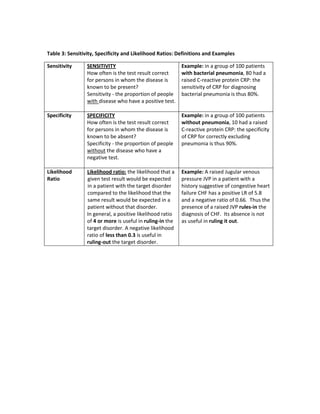
Table 3: Sensitivity, Specificity and Likelihood Ratios: Definitions and Examples
Sensitivity

SENSITIVITY
How often is the test result correct
for persons in whom the disease is
known to be present?
Sensitivity - the proportion of people
with disease who have a positive test.

Example: in a group of 100 patients
with bacterial pneumonia, 80 had a
raised C-reactive protein CRP: the
sensitivity of CRP for diagnosing
bacterial pneumonia is thus 80%.

Specificity

SPECIFICITY
How often is the test result correct
for persons in whom the disease is
known to be absent?
Specificity - the proportion of people
without the disease who have a
negative test.

Example: in a group of 100 patients
without pneumonia, 10 had a raised
C-reactive protein CRP: the specificity
of CRP for correctly excluding
pneumonia is thus 90%.

Likelihood
Ratio

Likelihood ratio: the likelihood that a
given test result would be expected
in a patient with the target disorder
compared to the likelihood that the
same result would be expected in a
patient without that disorder.
In general, a positive likelihood ratio
of 4 or more is useful in ruling-in the
target disorder. A negative likelihood
ratio of less than 0.3 is useful in
ruling-out the target disorder.

Example: A raised Jugular venous
pressure JVP in a patient with a
history suggestive of congestive heart
failure CHF has a positive LR of 5.8
and a negative ratio of 0.66. Thus the
presence of a raised JVP rules-in the
diagnosis of CHF. Its absence is not
as useful in ruling it out.

Secrets of Expert Clinicians: Schemes/Cognitive Aids for Decision Making

  • 1.
    Table 1: The7 Expert Clinician’s Actions Map for a Patient Encounter and their Cognitive Schemes Step Clinical Action 1 Gather Information (History & Physical) 2 Summarize the Case using Technical Language 3 Propose a Diagnosis Expert ‘s Scheme/Cognitive Aid ------------------------ Comprehensive but Concise, Textbook-Like: Must contain patient’s name, gender, age, ±occupation, ±nationality ± racial/geographic origin, relevant Past History/Social History/Family History, Drug/Allergic History, Symptoms + duration –in technical terms, Relevant physical signs in technical conclusive terms. Patternrecognition PR, Hypotheticodeductive Strategies HD (from H&P) and Smart Heuristics (Rules-of-Thumb), Rule-Out worst Scenario ROWS, Red Flags (symptoms or signs of more serious pathology) etc. The 3Rs! Example --------------------------------------------------------------------------67 yr old male Bird/pigeon breeder, smoker 3 days history of fever, cough with yellow sputum, left stabbing chest pain that is worse with breathing and coughing and breathlessness Clinically, breathless, cyanosed, disoriented to time, person and place, Temperature 39.1C, BP 86/50, RR 32/min, bilateral coarse crepitations, bronchial breathing left lower zone Chest x-ray: left basal consolidation Summary: 67 year old, smoker and bird-breeder presenting with a 3 days history of productive cough, dyspnea and left pleuritic chest pains. Clinically confused, cyanosed, febrile, tachypnoiec and hypotensive with signs of left lower zone consolidation. High-Fidelity/Reliability Pattern Recognition (spot diagnosis): Shingles, Acromegalic Facies Low-Fidelity/Reliability Pattern Recognition (error-prone): Central chest pain radiating to the left arm plus sweating=ACS (other possibilities still exist!) Smart Heuristic “Rules of Thumb”: early morning headache and vomiting=Increased intracranial pressure ROWS: Meningitis, SAH, CVA etc in a patient with headache Red Flags: rest pain, weight loss, neurological deficits etc in a patient with low back pain
  • 2.
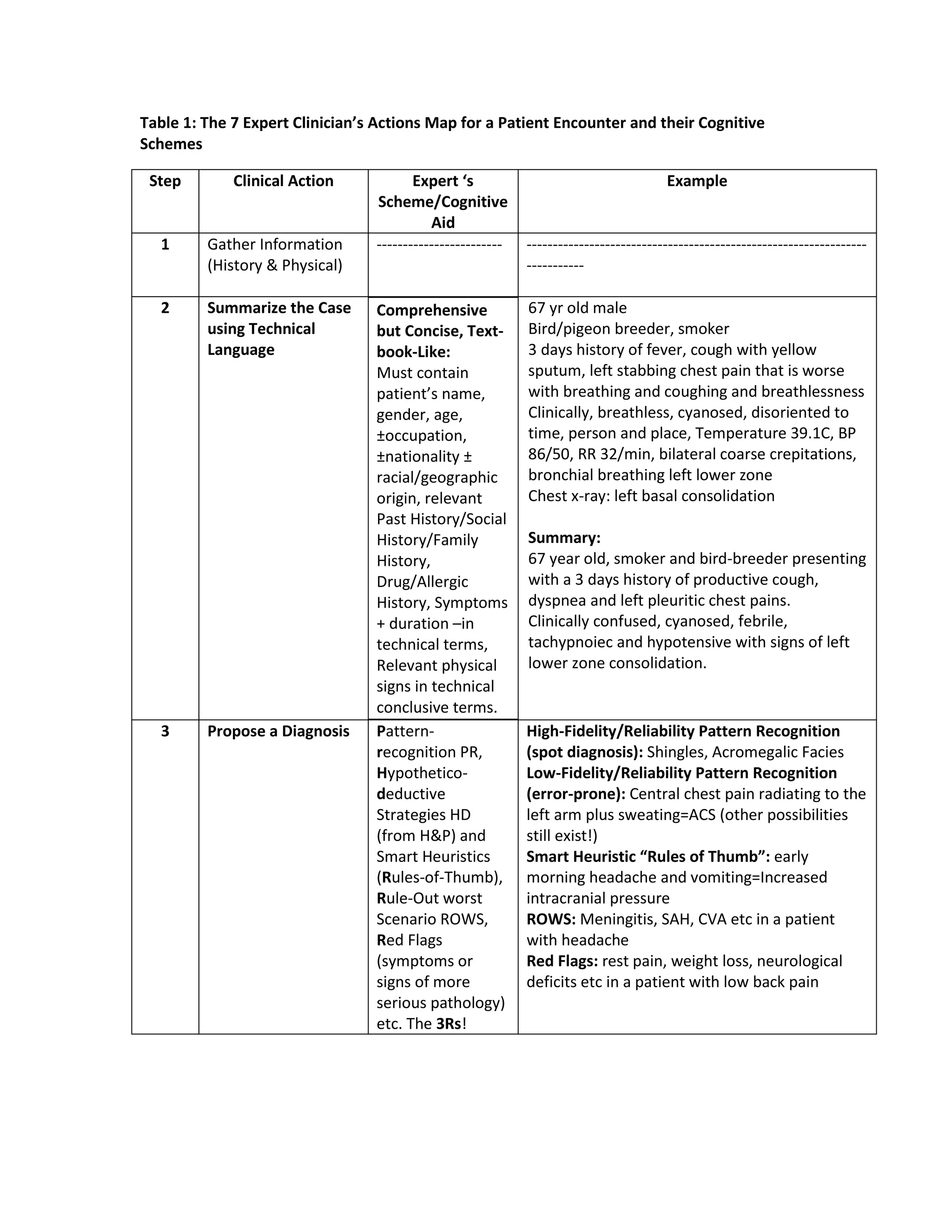
    4 Differential Diagnosis Differential Diagnosis Cognitive Aids: Anatomical, Physiological, Pathological Anatomical: Swellings,Pain, Amenorrhea Physiological: Shock, Thrombosis, Hyponatremia Pathological: Traumatic, Infective, Inflammatory/auto-immune, Vascular/degenerative, Neoplastic/paraneoplastic, Metabolic/endocrine, Druginduced/poisoning, Deficiency diseases, Psychogenic and Idiopathic/cryptogenic. 5 Order Tests (Rationally) Frugal(simple and applicable) Heuristics Probability Assessment, Order tests: Test Sensitivity, Specificity and Likelihood Ratios Pre-test Probability: 1. Strong Risk factor for the condition 2. No alternative Diagnosis High (2 YES) or Intermediate (1 YES 1 NO) or Low (2 NO) SpIn: highly specific tests are useful for ruling-in the diagnosis when positive ( use for high and intermediate probabilities) SnOut: highly sensitive tests are useful for ruling-out the diagnosis when negative ( use for low probabilities) 6 Confirm & Comprehensively give a Diagnostic Label Bed-side Diagnosis: CAP Etiology: Chlamydia psittaci Severity: CURB-65= 4 7 Therapeutic Interventions 8 Prepare for Discharge Guideline-friendly Bed-side Diagnosis, Etiology, Severity (BESD) Contextual, Patient-centered Therapeutic Cognitive Aid: Site of Care, Symptomatic, Supportive, Specific and Specialty Referral (5S). Assess Response to Treatment (Subjective & Objective), Criteria for Discharge, Timing of Followup (ACT) Site of Care: Ward, CCU, ICU etc Symptomatic: Analgesia, Anti-emetic, Antipyretic etc Supportive: Oxygen, IV fluids, Bicarbonate etc Specific: Antibiotic, Thrombolytic, Cytotoxic etc Specialty Referral: Cardiology, Surgery, Gynecology, Physiotherapy etc Assess Response to Treatment : Subjective & Objective Criteria for Discharge: Clinical, Laboratory, Radiologic, Social etc Timing of Follow-up : Clinic Appointment for disease and drug monitoring
  • 3.
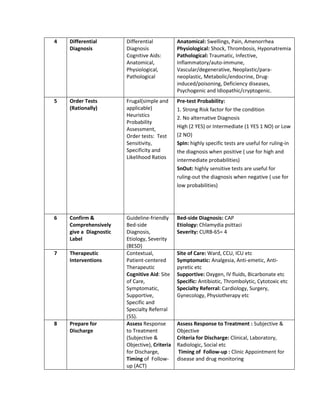
    Box 1: Summarizingthe History and Physical Examination Comprehensive but Concise, Text-book-Like: Must contain patient’s name, gender, age, ±occupation, ±nationality ± racial/geographic origin, relevant Past History/Social History/Family History, Drug/Allergic History, Symptoms + duration –in technical terms, Relevant physical signs in technical conclusive terms. Table 2: Differential Diagnosis Cognitive Aids Anatomical Differential Diagnosis Pain Syndromes: e.g. central chest pain may be categorized as arising from the heart, aorta, esophagus, chest wall etc Swellings: e.g. a neck swelling differential diagnosis will include the thyroid, lymph nodes, vascular, skin etc Physiological Differential Diagnosis Shock: this may be hypovolemic, distributive, obstructive or cardiogenic Etio-pathological Differential Diagnosis Congenital or Hereditary Thrombosis: This may be related to a vessel wall pathology, blood constituents or flow rate. Acquired: 1. Traumatic 2. Infective: viral, bacterial etc 3. Inflammatory/autoimmune 4. Vascular/degenerative 5. Neoplastic/paraneoplastic 6. Metabolic/endocrine 7. Drug-induced/ poisoning 8. Deficiency diseases 9. Psychogenic 10. Idiopathic/cryptogenic
  • 4.
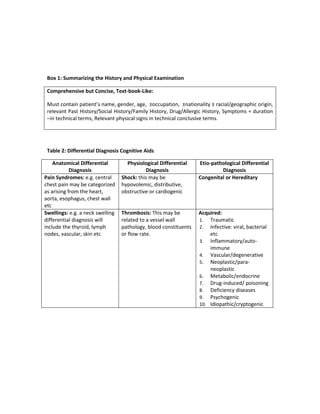
    Table 3: Sensitivity,Specificity and Likelihood Ratios: Definitions and Examples Sensitivity SENSITIVITY How often is the test result correct for persons in whom the disease is known to be present? Sensitivity - the proportion of people with disease who have a positive test. Example: in a group of 100 patients with bacterial pneumonia, 80 had a raised C-reactive protein CRP: the sensitivity of CRP for diagnosing bacterial pneumonia is thus 80%. Specificity SPECIFICITY How often is the test result correct for persons in whom the disease is known to be absent? Specificity - the proportion of people without the disease who have a negative test. Example: in a group of 100 patients without pneumonia, 10 had a raised C-reactive protein CRP: the specificity of CRP for correctly excluding pneumonia is thus 90%. Likelihood Ratio Likelihood ratio: the likelihood that a given test result would be expected in a patient with the target disorder compared to the likelihood that the same result would be expected in a patient without that disorder. In general, a positive likelihood ratio of 4 or more is useful in ruling-in the target disorder. A negative likelihood ratio of less than 0.3 is useful in ruling-out the target disorder. Example: A raised Jugular venous pressure JVP in a patient with a history suggestive of congestive heart failure CHF has a positive LR of 5.8 and a negative ratio of 0.66. Thus the presence of a raised JVP rules-in the diagnosis of CHF. Its absence is not as useful in ruling it out.