
CASE CONTROL STUDY
Submitted by :- Baldev Singh
INTRODUCTION
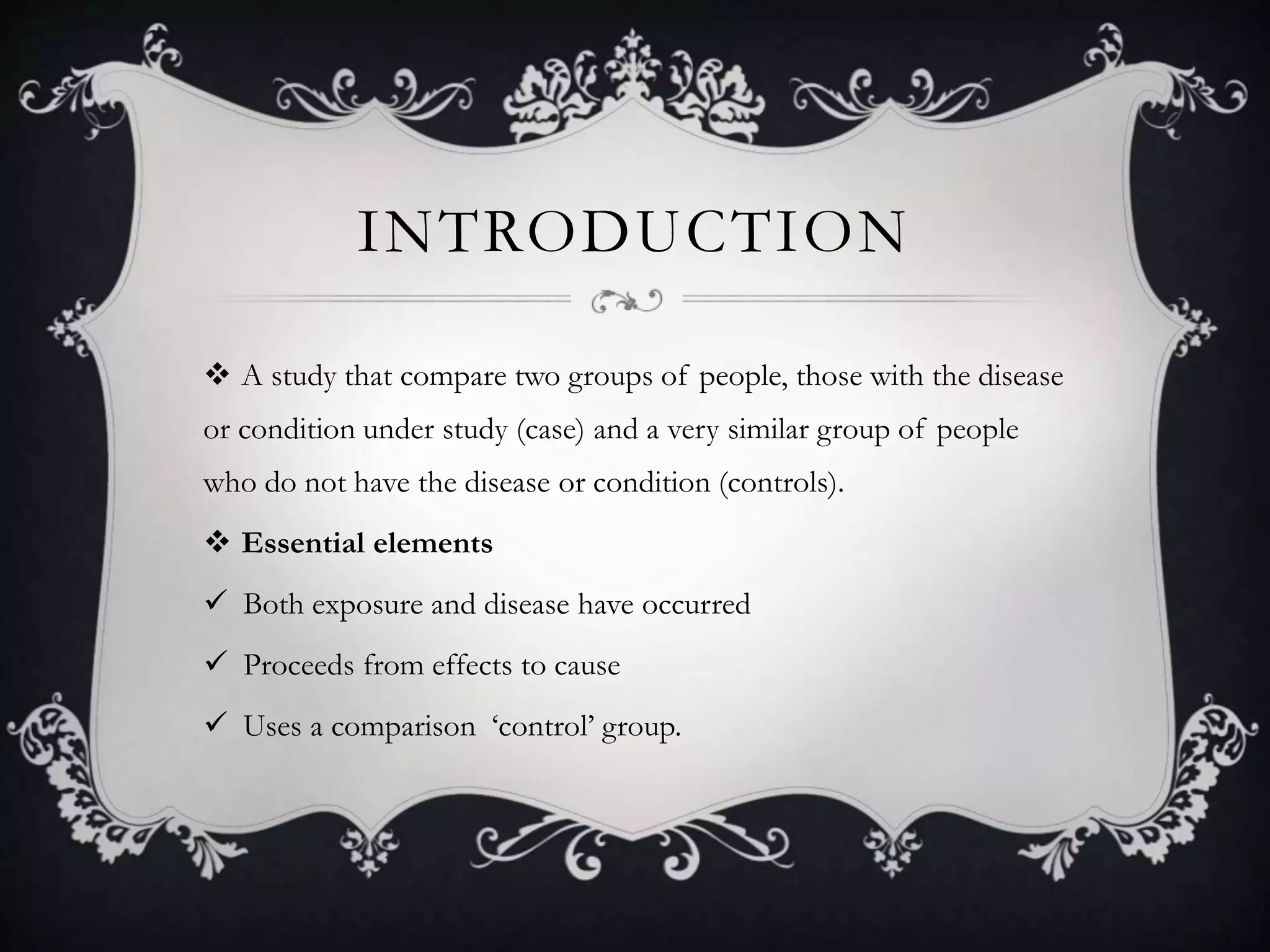
 A study that compare two groups of people, those with the disease
or condition under study (case) and a very similar group of people
who do not have the disease or condition (controls).
 Essential elements
 Both exposure and disease have occurred
 Proceeds from effects to cause
 Uses a comparison ‘control’ group.
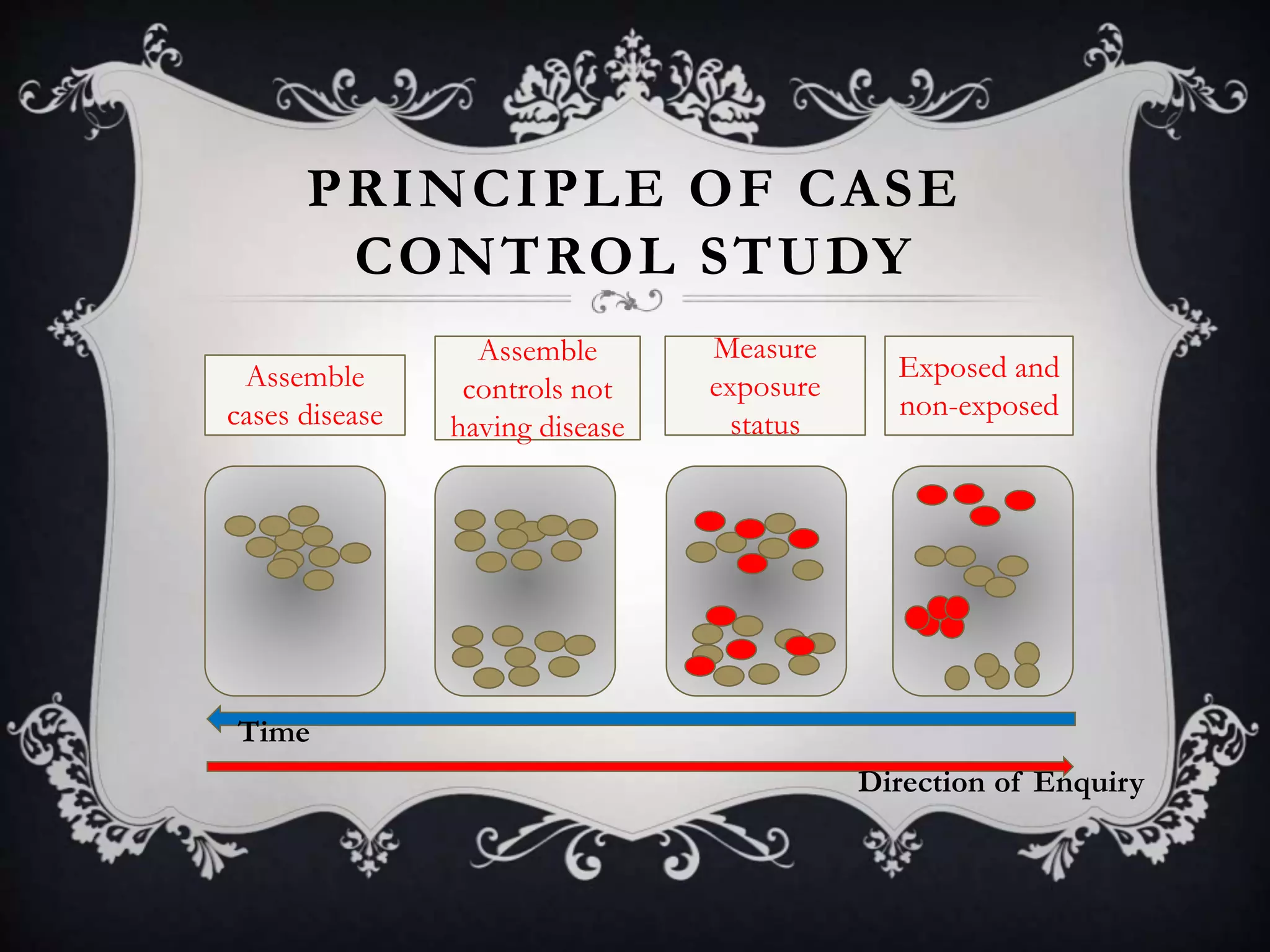
PRINCIPLE OF CASE
CONTROL STUDY
Assemble
cases disease
Assemble
controls not
having disease
Measure
exposure
status
Exposed and
non-exposed
Time
Direction of Enquiry
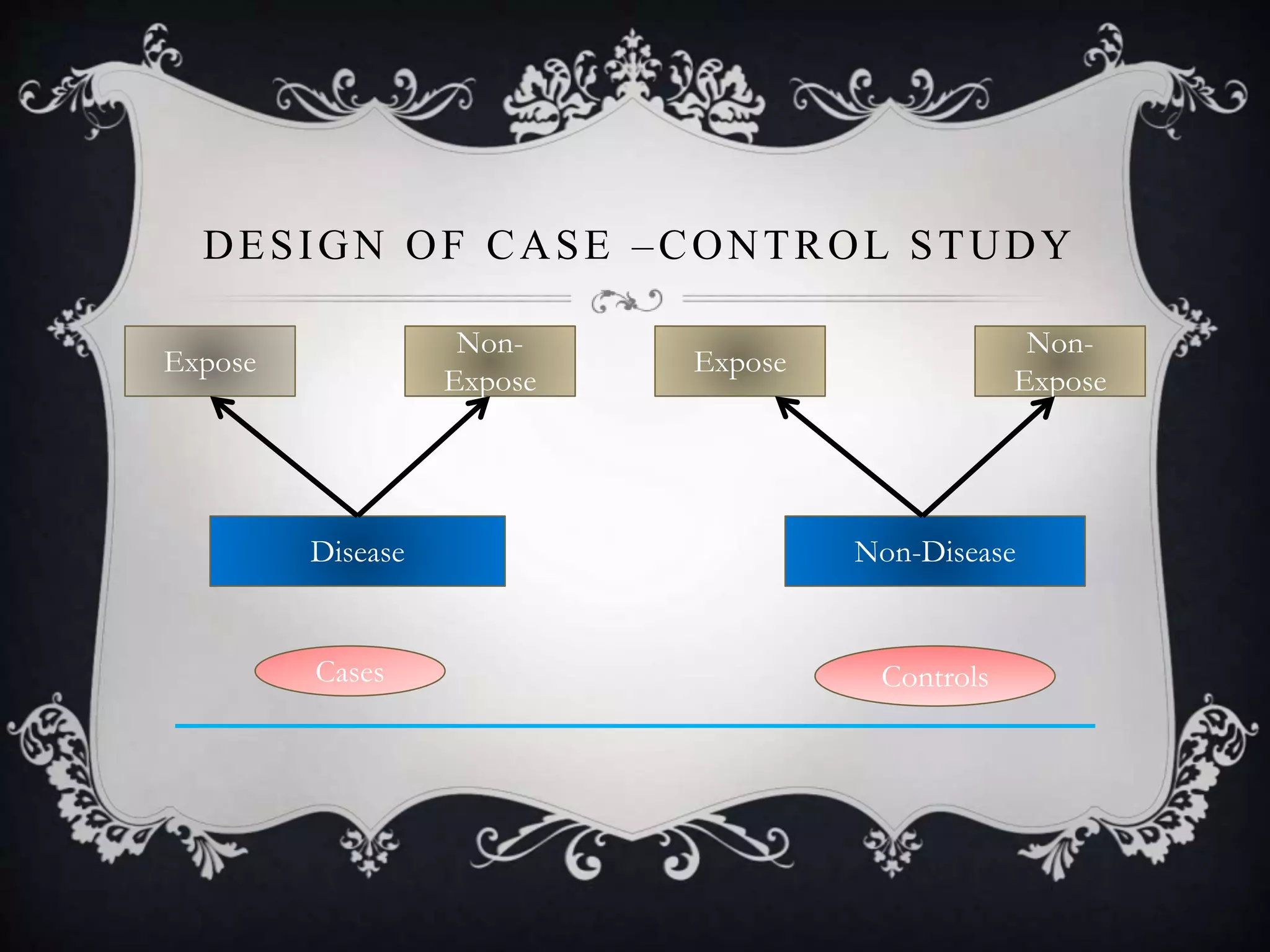
DESIGN OF CASE –CONTROL STUDY
Expose
Non-
Expose
Disease Non-Disease
Expose
Non-
Expose
Cases Controls
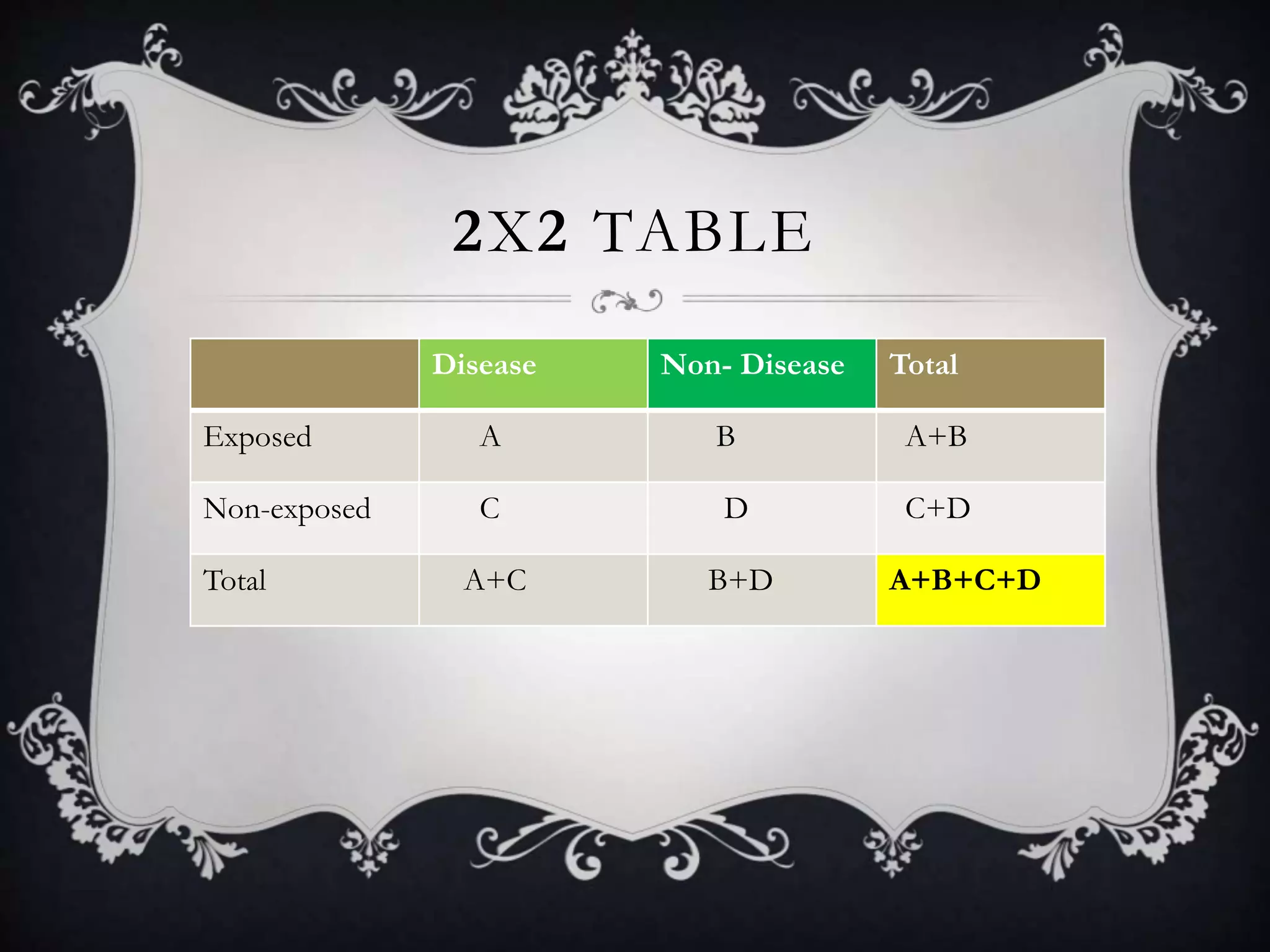
2X2 TABLE
Disease Non- Disease Total
Exposed A B A+B
Non-exposed C D C+D
Total A+C B+D A+B+C+D
STEPS IN CASE CONTROL
 Selecting of cases and controls.
 Matching.
 Measurement of exposure.
 Analysis and interpretation.
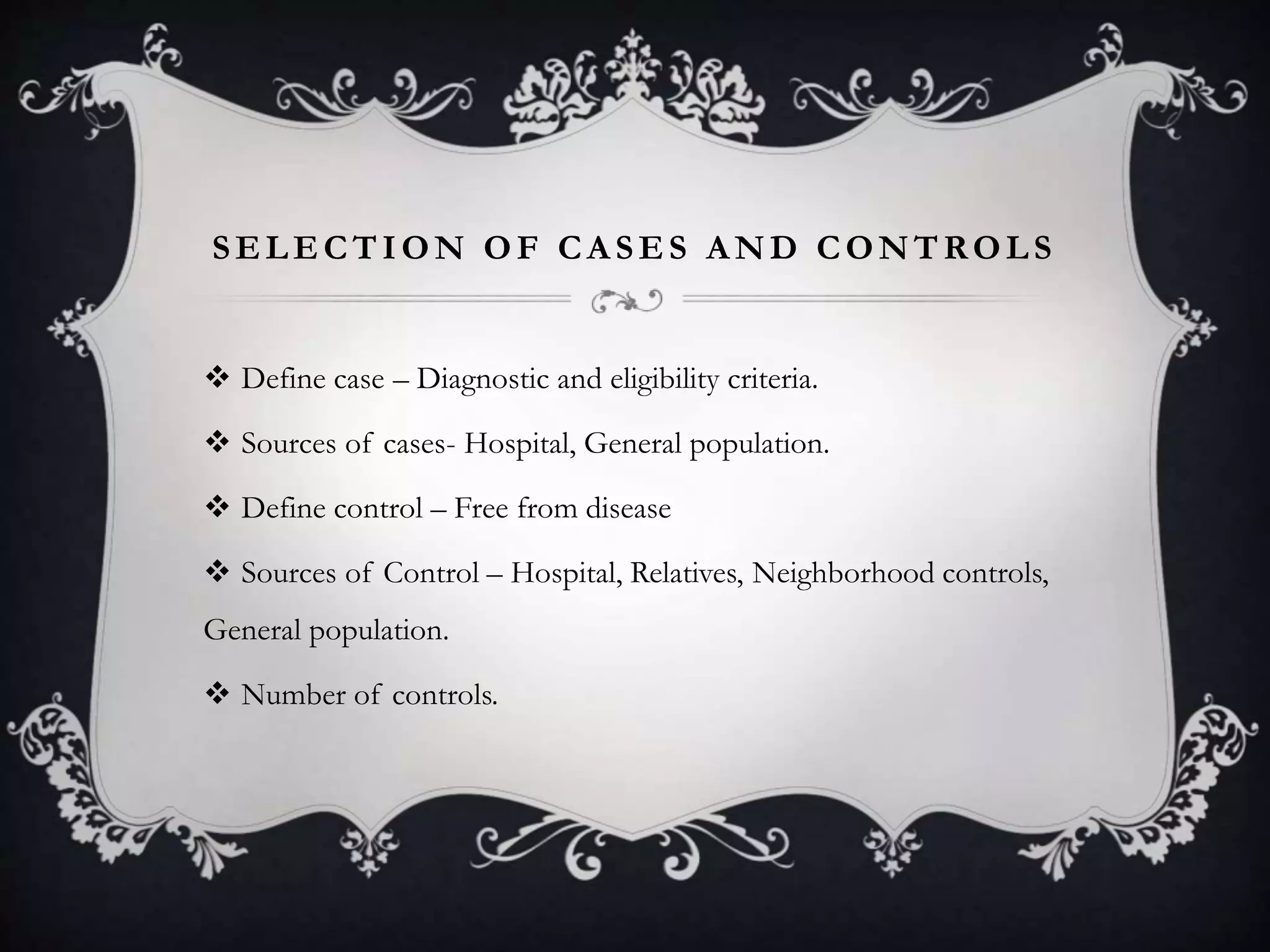
SELECTION OF CASES AND CONTROLS
 Define case – Diagnostic and eligibility criteria.
 Sources of cases- Hospital, General population.
 Define control – Free from disease
 Sources of Control – Hospital, Relatives, Neighborhood controls,
General population.
 Number of controls.
MATCHING
 Ensure comparability between cases and controls
 A confounding factor is defined as one which is associated both
with exposure and disease, and is distributed unequally in study and
control groups.
 Suspected etiological factor should not be matched
 Types of matching : Pair, Frequency
MEASURE THE EXPOSURE
 Define exposure-
 Measure in precisely the same manner both for cases and controls
ANALYSIS
 Exposure rate among cases and controls
 Odds Ratio – AD/BC (also called cross product ratio)
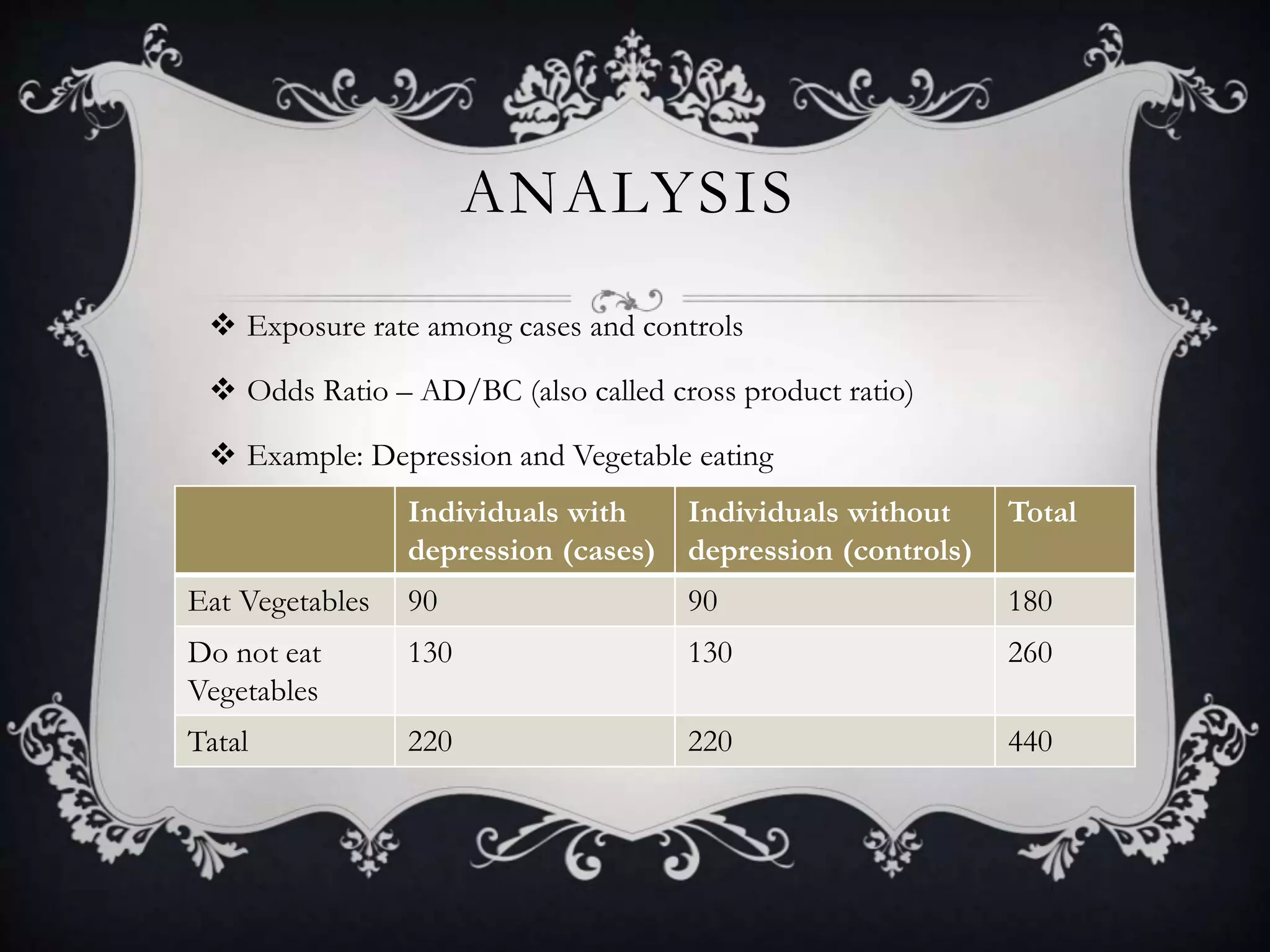
 Example: Depression and Vegetable eating
Individuals with
depression (cases)
Individuals without
depression (controls)
Total
Eat Vegetables 90 90 180
Do not eat
Vegetables
130 130 260
Tatal 220 220 440
ANALYSIS..
 Odds of exposure among cases : A/C = 90/130 = 0.6923
 Odds of exposure among controls : B/D = 90/130 = 0.6923
 Odds Ratio = 0.6923/0.6923 =1.0
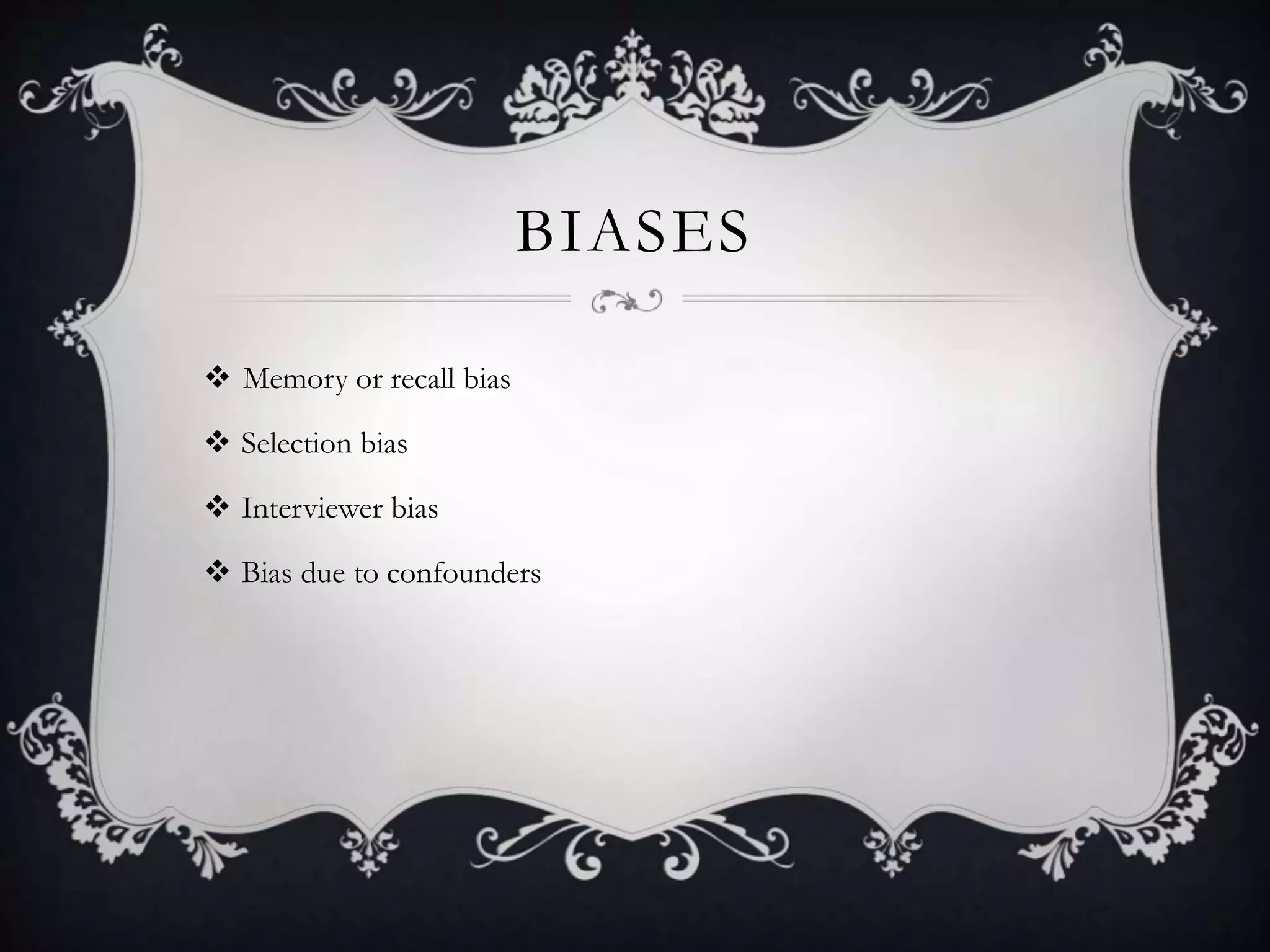
BIASES
 Memory or recall bias
 Selection bias
 Interviewer bias
 Bias due to confounders
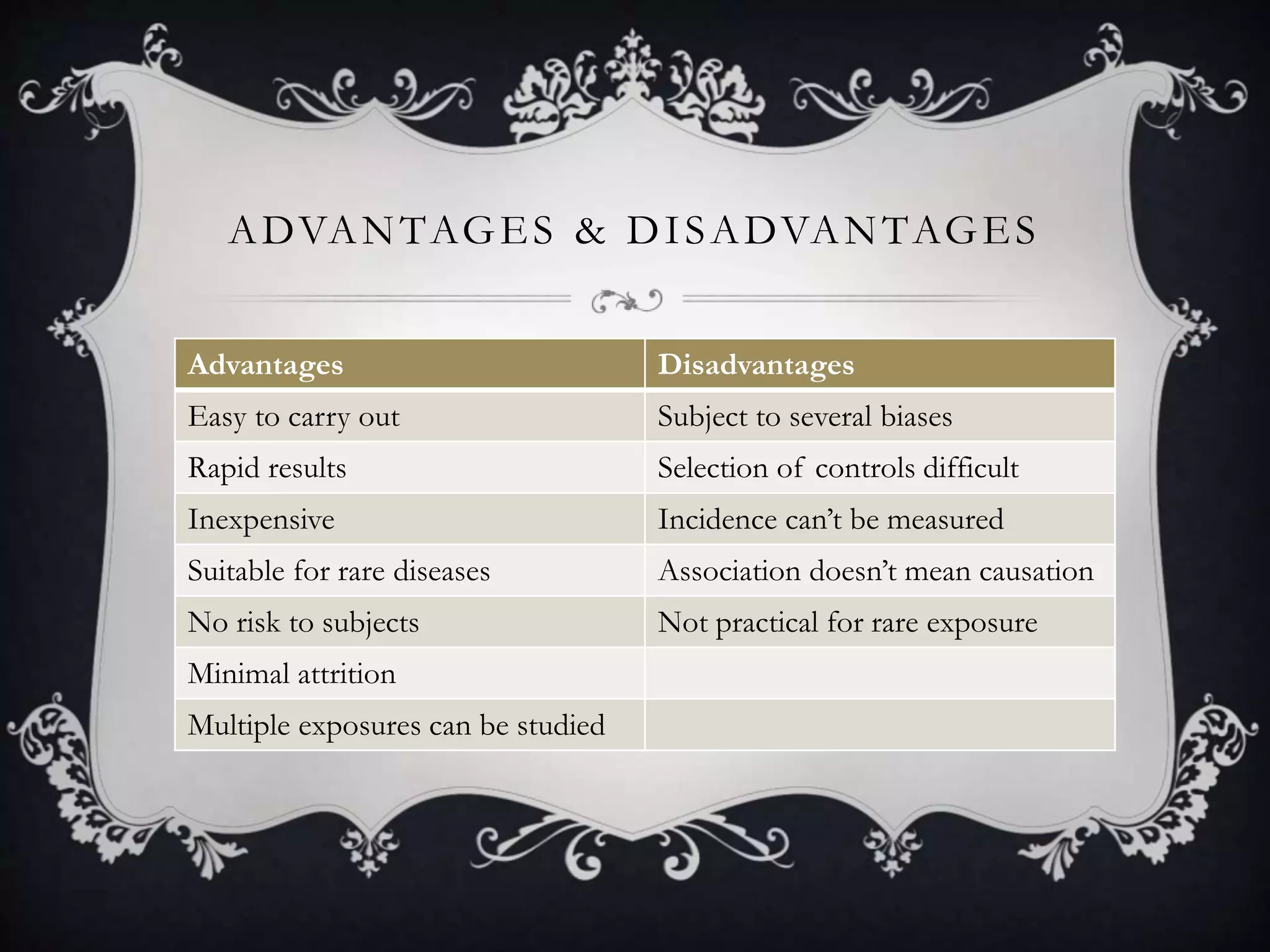
ADVANTAGES & DISADVANTAGES
Advantages Disadvantages
Easy to carry out Subject to several biases
Rapid results Selection of controls difficult
Inexpensive Incidence can’t be measured
Suitable for rare diseases Association doesn’t mean causation
No risk to subjects Not practical for rare exposure
Minimal attrition
Multiple exposures can be studied
ARTICLE REVIEW
A Case-Control Study of
Drinking Habits Past and Present
Authors
Helen Rodgers, MRCP; Philip D. Aitken, FRACP; Joyce M. French, BSc;
Richard H. Curless, MRCP; David Bates, FRCP; Oliver F.W. James, FRCP
INTRODUCTION OF THE STUDY
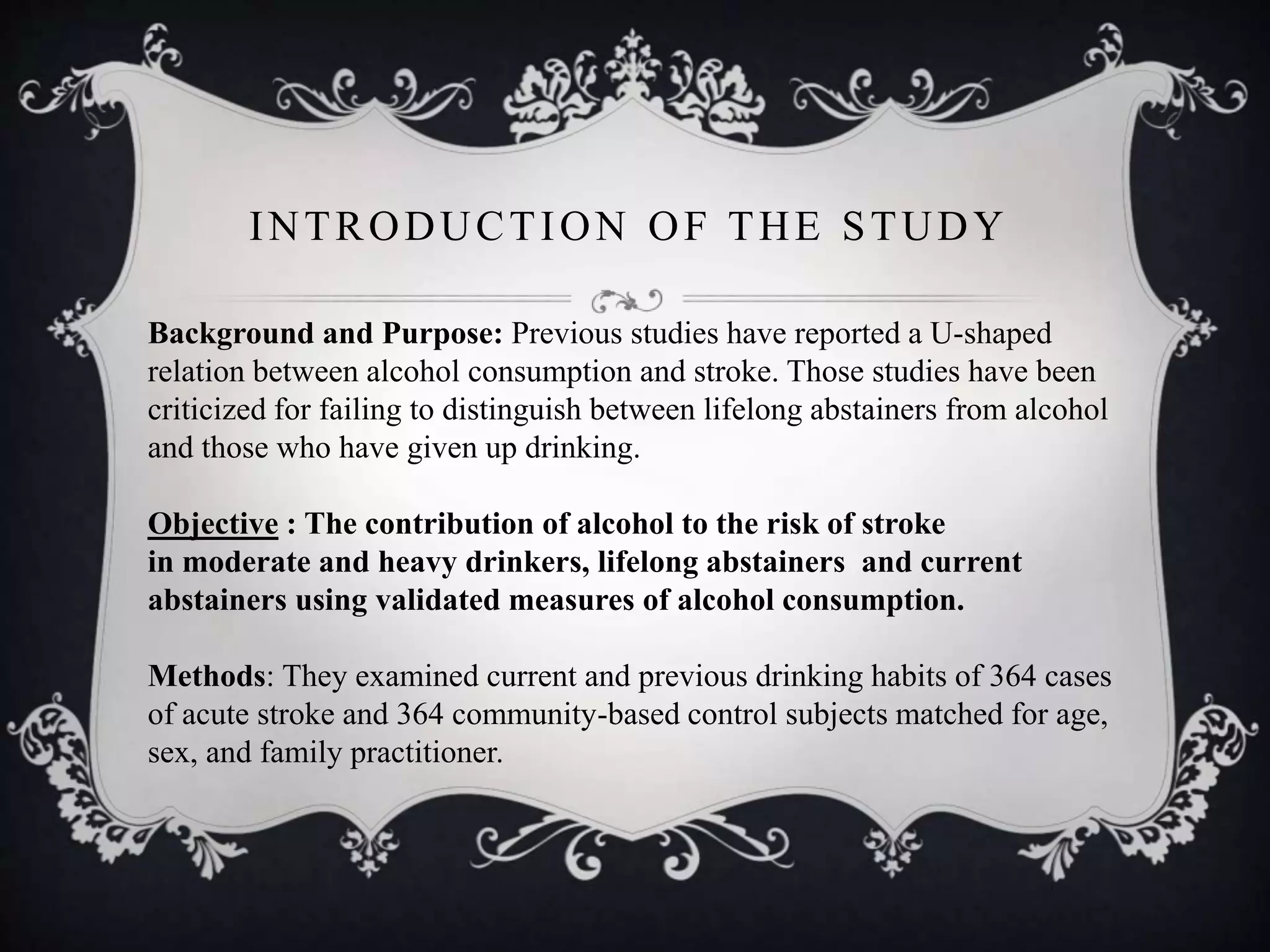
Background and Purpose: Previous studies have reported a U-shaped
relation between alcohol consumption and stroke. Those studies have been
criticized for failing to distinguish between lifelong abstainers from alcohol
and those who have given up drinking.
Objective : The contribution of alcohol to the risk of stroke
in moderate and heavy drinkers, lifelong abstainers and current
abstainers using validated measures of alcohol consumption.
Methods: They examined current and previous drinking habits of 364 cases
of acute stroke and 364 community-based control subjects matched for age,
sex, and family practitioner.
INTRODUCTION OF THE STUDY
Results: Stroke patients were more likely to have been lifelong
abstainers from alcohol than were the control subjects. The odds
ratio (OR) of lifelong abstainers versus those who had ever drunk
regularly was 2.36 (95% confidence interval [CI], 1.67 to 3.37). No
relation was found between stroke and current nondrinkers. Current
male heavy drinkers also had an increased risk of stroke (OR, 2.88;
95% CI, 1.08 to 2.31).
Conclusions:……………….
SUMMARY
CRITIQUES
 Positive :
I. This study shows the well established relationship between alcohol
consumption and strokes.
II. The study show not only the relationship between alcohol
consumption & strokes, but also show the relation with other disease
like hypertension, cerebral infarction etc.
 Negatives :
I. Cases of the study is only from the hospital record, while controls are
taken from community.
II. Study does not described clearly about the hypertension and cerebral
infarction.
CONCLUSION & REFRENCE
 Conclusion
Lifelong abstention from alcohol is associated with an increased
risk of stroke. Moderate alcohol consumption may protect against
cerebrovascular disease.
Case control study (Review of an Article)

Case control study (Review of an Article)

  • 1.
    CASE CONTROL STUDY Submittedby :- Baldev Singh
  • 2.
    INTRODUCTION  A studythat compare two groups of people, those with the disease or condition under study (case) and a very similar group of people who do not have the disease or condition (controls).  Essential elements  Both exposure and disease have occurred  Proceeds from effects to cause  Uses a comparison ‘control’ group.
  • 3.
    PRINCIPLE OF CASE CONTROLSTUDY Assemble cases disease Assemble controls not having disease Measure exposure status Exposed and non-exposed Time Direction of Enquiry
  • 4.
    DESIGN OF CASE–CONTROL STUDY Expose Non- Expose Disease Non-Disease Expose Non- Expose Cases Controls
  • 5.
    2X2 TABLE Disease Non-Disease Total Exposed A B A+B Non-exposed C D C+D Total A+C B+D A+B+C+D
  • 6.
    STEPS IN CASECONTROL  Selecting of cases and controls.  Matching.  Measurement of exposure.  Analysis and interpretation.
  • 7.
    SELECTION OF CASESAND CONTROLS  Define case – Diagnostic and eligibility criteria.  Sources of cases- Hospital, General population.  Define control – Free from disease  Sources of Control – Hospital, Relatives, Neighborhood controls, General population.  Number of controls.
  • 8.
    MATCHING  Ensure comparabilitybetween cases and controls  A confounding factor is defined as one which is associated both with exposure and disease, and is distributed unequally in study and control groups.  Suspected etiological factor should not be matched  Types of matching : Pair, Frequency
  • 9.
    MEASURE THE EXPOSURE Define exposure-  Measure in precisely the same manner both for cases and controls
  • 10.
    ANALYSIS  Exposure rateamong cases and controls  Odds Ratio – AD/BC (also called cross product ratio)  Example: Depression and Vegetable eating Individuals with depression (cases) Individuals without depression (controls) Total Eat Vegetables 90 90 180 Do not eat Vegetables 130 130 260 Tatal 220 220 440
  • 11.
    ANALYSIS..  Odds ofexposure among cases : A/C = 90/130 = 0.6923  Odds of exposure among controls : B/D = 90/130 = 0.6923  Odds Ratio = 0.6923/0.6923 =1.0
  • 12.
    BIASES  Memory orrecall bias  Selection bias  Interviewer bias  Bias due to confounders
  • 13.
    ADVANTAGES & DISADVANTAGES AdvantagesDisadvantages Easy to carry out Subject to several biases Rapid results Selection of controls difficult Inexpensive Incidence can’t be measured Suitable for rare diseases Association doesn’t mean causation No risk to subjects Not practical for rare exposure Minimal attrition Multiple exposures can be studied
  • 14.
    ARTICLE REVIEW A Case-ControlStudy of Drinking Habits Past and Present Authors Helen Rodgers, MRCP; Philip D. Aitken, FRACP; Joyce M. French, BSc; Richard H. Curless, MRCP; David Bates, FRCP; Oliver F.W. James, FRCP
  • 15.
    INTRODUCTION OF THESTUDY Background and Purpose: Previous studies have reported a U-shaped relation between alcohol consumption and stroke. Those studies have been criticized for failing to distinguish between lifelong abstainers from alcohol and those who have given up drinking. Objective : The contribution of alcohol to the risk of stroke in moderate and heavy drinkers, lifelong abstainers and current abstainers using validated measures of alcohol consumption. Methods: They examined current and previous drinking habits of 364 cases of acute stroke and 364 community-based control subjects matched for age, sex, and family practitioner.
  • 16.
    INTRODUCTION OF THESTUDY Results: Stroke patients were more likely to have been lifelong abstainers from alcohol than were the control subjects. The odds ratio (OR) of lifelong abstainers versus those who had ever drunk regularly was 2.36 (95% confidence interval [CI], 1.67 to 3.37). No relation was found between stroke and current nondrinkers. Current male heavy drinkers also had an increased risk of stroke (OR, 2.88; 95% CI, 1.08 to 2.31). Conclusions:……………….
  • 17.
  • 18.
    CRITIQUES  Positive : I.This study shows the well established relationship between alcohol consumption and strokes. II. The study show not only the relationship between alcohol consumption & strokes, but also show the relation with other disease like hypertension, cerebral infarction etc.  Negatives : I. Cases of the study is only from the hospital record, while controls are taken from community. II. Study does not described clearly about the hypertension and cerebral infarction.
  • 19.
    CONCLUSION & REFRENCE Conclusion Lifelong abstention from alcohol is associated with an increased risk of stroke. Moderate alcohol consumption may protect against cerebrovascular disease.

Editor's Notes

  • #10 Exposure- the condition of being subjected to something's, which may have harmful effect.