SECOND QUARTER
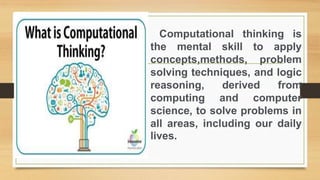
Computational thinking is
the mental skill to apply
concepts,methods, problem
solving techniques, and logic
reasoning, derived from
computing and computer
science, to solve problems in
all areas, including our daily
lives.
Important terms in computational
thinking :
Computing is the process of using computer
technology to complete a given goal-oriented task.
Computer science is the study of computation,
automation, and information.
 Programming is the practice of developing a set of
instructions that a computer can understand and execute, as
well as debugging, organizing, and applying that code to
appropriate problem-solving contexts.
• Computational thinking skills- are the cognitive
processes necessary to engage with computational
tools to solve problems. These skills are the
foundation to engage in any computational problem
solving and should be integrated into early learning
opportunities .
• Computational thinking practices - combine multiple
computational skills to solve an applied problem.
Students in the older grades (4-12) may use these
practices to develop artifacts such as a computer
program, data visualization, or computational model.
• Inclusive pedagogies - are strategies for
engaging all learners in computing, connecting
applications to students’ interests and
experiences, and providing opportunities to
acknowledge, and combat biases and
stereotypes within the computing field.
Computational thinking requires:
•exploring and analyzing problems
thoroughly in order to fully understand
them
•using precise and detailed language to
outline both problems and solutions
•applying clear reasoning at every stage of
the process
Pattern Recognition Process
Example
Conditions for loops:
• While the user gets their
password wrong, allow them to
input it or
• For three attempts let the user
input their password and that
question there would be has a
user answered it three times or
• Do until we do something until
the condition is met allow the
user to enter their password until
they answer the correct password
.
Pseudocode is an artificial and informal language that
helps programmers develop algorithms. Pseudocode
is a "text-based" detail (algorithmic) design tool.
JAVA PROGRAMMING
Java is a widely used object-oriented
programming language and software
platform that runs on billions of devices, including
notebook computers, mobile devices, gaming
consoles, medical devices and many others. The
rules and syntax of Java are based on the C and
C++ languages
Second-Quarter-Grade-8.pptx

Second-Quarter-Grade-8.pptx

  • 1.
  • 3.
    Computational thinking is themental skill to apply concepts,methods, problem solving techniques, and logic reasoning, derived from computing and computer science, to solve problems in all areas, including our daily lives.
  • 4.
    Important terms incomputational thinking : Computing is the process of using computer technology to complete a given goal-oriented task. Computer science is the study of computation, automation, and information.  Programming is the practice of developing a set of instructions that a computer can understand and execute, as well as debugging, organizing, and applying that code to appropriate problem-solving contexts.
  • 5.
    • Computational thinkingskills- are the cognitive processes necessary to engage with computational tools to solve problems. These skills are the foundation to engage in any computational problem solving and should be integrated into early learning opportunities . • Computational thinking practices - combine multiple computational skills to solve an applied problem. Students in the older grades (4-12) may use these practices to develop artifacts such as a computer program, data visualization, or computational model.
  • 6.
    • Inclusive pedagogies- are strategies for engaging all learners in computing, connecting applications to students’ interests and experiences, and providing opportunities to acknowledge, and combat biases and stereotypes within the computing field.
  • 7.
    Computational thinking requires: •exploringand analyzing problems thoroughly in order to fully understand them •using precise and detailed language to outline both problems and solutions •applying clear reasoning at every stage of the process
  • 18.
  • 19.
  • 27.
    Conditions for loops: •While the user gets their password wrong, allow them to input it or • For three attempts let the user input their password and that question there would be has a user answered it three times or • Do until we do something until the condition is met allow the user to enter their password until they answer the correct password .
  • 29.
    Pseudocode is anartificial and informal language that helps programmers develop algorithms. Pseudocode is a "text-based" detail (algorithmic) design tool.
  • 31.
    JAVA PROGRAMMING Java isa widely used object-oriented programming language and software platform that runs on billions of devices, including notebook computers, mobile devices, gaming consoles, medical devices and many others. The rules and syntax of Java are based on the C and C++ languages