CBB Spring Rotationwith Steven KleinsteinConserved Residues ofan Antibody’s V RegionDaniel Gadala-Maria7 June 2010
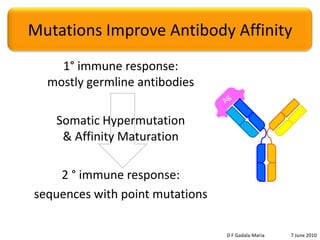
	1° immune response:mostly germline antibodies	Somatic Hypermutation& Affinity Maturation2 ° immune response:	sequences with point mutationsAgAgMutations improve antibody affinityD F Gadala-Maria	7 June 2010
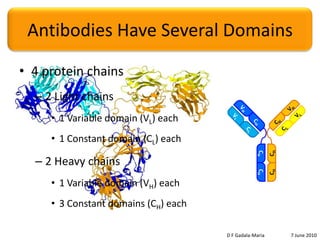
Antibodies have several domains4 protein chains2 Light chains1 Variable domain (VL) each1 Constant domain (CL) each2 Heavy chains1 Variable domain (VH) each3 Constant domains (CH) eachVHVHVLVLCHCHCLCLCHCHCHCHD F Gadala-Maria	7 June 2010
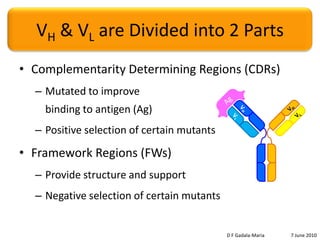
VH & VL are divided into 2 partsComplementarityDetermining Regions (CDRs)Mutated to improvebinding to antigen (Ag)Positive selection of certain mutantsFramework Regions (FWs)Provide structure and supportFraction of mutations are not tolerableAgVHVHVLVLD F Gadala-Maria	7 June 2010
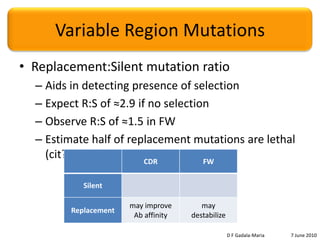
Estimate that ½ of replacement mutations are lethal in FWShlomchik et al (1989)1, using two methods:Use replacement:silent mutation ratioExpect R:S of ≈2.9 if no selectionObserve R:S of 155/107 ≈ 1.45 in FWEstimate ≈ ½ R Mutations lethal in FWCategorize and count replacement mutations79 positions categorized as into:21 invariant, 27 conservative, 31 non-conservativeEstimate of 0.48 R Mutations lethal in FW1Shlomchik M,Litwin S, and Weigert M. (1989) The influence of somatic mutation on clonal expansion. Prog. Immunol. 7:415-423.D F Gadala-Maria	7 June 2010
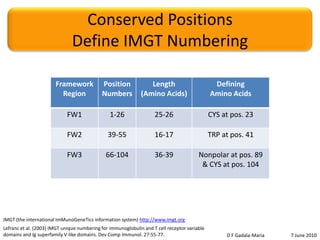
Could just line them up and count, if we had a good alignment…Many more sequences available!IMGT (the international ImMunoGeneTics information system) http://www.imgt.orgLefrancet al. (2003) IMGT unique numbering for immunoglobulin and T cell receptor variable domains and Igsuperfamily V-like domains. Dev Comp Immunol. 27:55-77.D F Gadala-Maria	7 June 2010
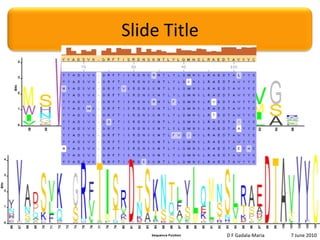
FWs 2 & 3 show much conservationD F Gadala-Maria	7 June 2010
Can we categorize positions?20/ 56 = 0.357136/ 56D F Gadala-Maria	7 June 2010
Loose ends & future directionsCould use more sequences (readily available),especiallynon-functional (not so common)Correct bad alignments for FW1Looked at just V, but could do V(D)J Other methods for assessing % lethalPlot conserved positions onto crystal structureD F Gadala-Maria	7 June 2010
Thank you for listening!Special thanks to:Steve KleinsteinMohamed UdumanChris BolenUri HershbergD F Gadala-Maria	7 June 2010

Antibody Structure

  • 1.
    CBB Spring RotationwithSteven KleinsteinConserved Residues ofan Antibody’s V RegionDaniel Gadala-Maria7 June 2010
  • 2.
    1° immune response:mostlygermline antibodies Somatic Hypermutation& Affinity Maturation2 ° immune response: sequences with point mutationsAgAgMutations improve antibody affinityD F Gadala-Maria 7 June 2010
  • 3.
    Antibodies have severaldomains4 protein chains2 Light chains1 Variable domain (VL) each1 Constant domain (CL) each2 Heavy chains1 Variable domain (VH) each3 Constant domains (CH) eachVHVHVLVLCHCHCLCLCHCHCHCHD F Gadala-Maria 7 June 2010
  • 4.
    VH & VLare divided into 2 partsComplementarityDetermining Regions (CDRs)Mutated to improvebinding to antigen (Ag)Positive selection of certain mutantsFramework Regions (FWs)Provide structure and supportFraction of mutations are not tolerableAgVHVHVLVLD F Gadala-Maria 7 June 2010
  • 5.
    Estimate that ½of replacement mutations are lethal in FWShlomchik et al (1989)1, using two methods:Use replacement:silent mutation ratioExpect R:S of ≈2.9 if no selectionObserve R:S of 155/107 ≈ 1.45 in FWEstimate ≈ ½ R Mutations lethal in FWCategorize and count replacement mutations79 positions categorized as into:21 invariant, 27 conservative, 31 non-conservativeEstimate of 0.48 R Mutations lethal in FW1Shlomchik M,Litwin S, and Weigert M. (1989) The influence of somatic mutation on clonal expansion. Prog. Immunol. 7:415-423.D F Gadala-Maria 7 June 2010
  • 6.
    Could just linethem up and count, if we had a good alignment…Many more sequences available!IMGT (the international ImMunoGeneTics information system) http://www.imgt.orgLefrancet al. (2003) IMGT unique numbering for immunoglobulin and T cell receptor variable domains and Igsuperfamily V-like domains. Dev Comp Immunol. 27:55-77.D F Gadala-Maria 7 June 2010
  • 7.
    FWs 2 &3 show much conservationD F Gadala-Maria 7 June 2010
  • 8.
    Can we categorizepositions?20/ 56 = 0.357136/ 56D F Gadala-Maria 7 June 2010
  • 9.
    Loose ends &future directionsCould use more sequences (readily available),especiallynon-functional (not so common)Correct bad alignments for FW1Looked at just V, but could do V(D)J Other methods for assessing % lethalPlot conserved positions onto crystal structureD F Gadala-Maria 7 June 2010
  • 10.
    Thank you forlistening!Special thanks to:Steve KleinsteinMohamed UdumanChris BolenUri HershbergD F Gadala-Maria 7 June 2010

Editor's Notes

  • #2 Lethal FR mutations hinder detecting selection
  • #3 Likely to re-encounted the same antigens.These mutated sequences help provide an efficient secondary response.
  • #5 Variable regions areN-terminus of each chainCDR mutations may improve Ab affinity,FW mutations may destabilizeNon-tolerated fraction important b/c reduced presence of R mutations might look like selection (in terms of Ab binding ability)
  • #6 The CDRs are predisposed to mutation while the FWs are not.Codon bias.R:S sequences numbered on the order of dozensWhy don’t we just take the 50%? X number of sequences (small number), etc. Now we have Y sequences…etc
  • #7 Talk a little about where the data came from.Next move onto numbering
  • #8 Log2(20) ~ 4.32Lead in to dividing into two groups: conserved and not…
  • #9 Log2(20) ~ 4.32Lead into non-functional (expect conservation to not matter, good control)
  • #10 variable (V), diversity (D) and joining (J) segmentsCould analyze which of the 9 reachable-in-one-mutation amino acids are found