International Business
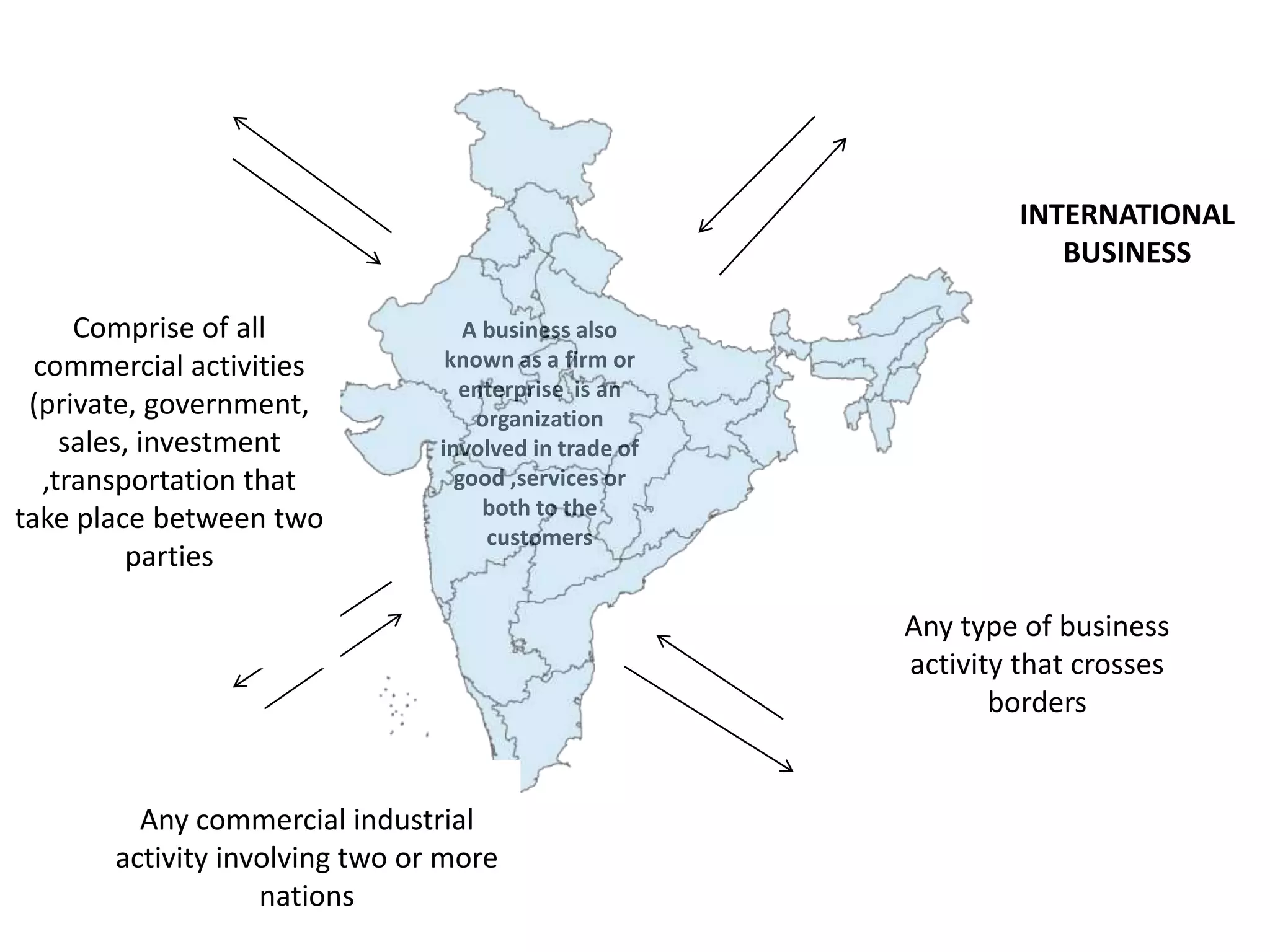
A business also
known as a firm or
enterprise is an
organization
involved in trade of
good ,services or
both to the
customers
Comprise of all
commercial activities
(private, government,
sales, investment
,transportation that
take place between two
parties
Any type of business
activity that crosses
borders
Any commercial industrial
activity involving two or more
nations
INTERNATIONAL
BUSINESS
Examples Perfume(UK
Shoe
(Canada)
marketed
by another
BeverageIT company
Dress
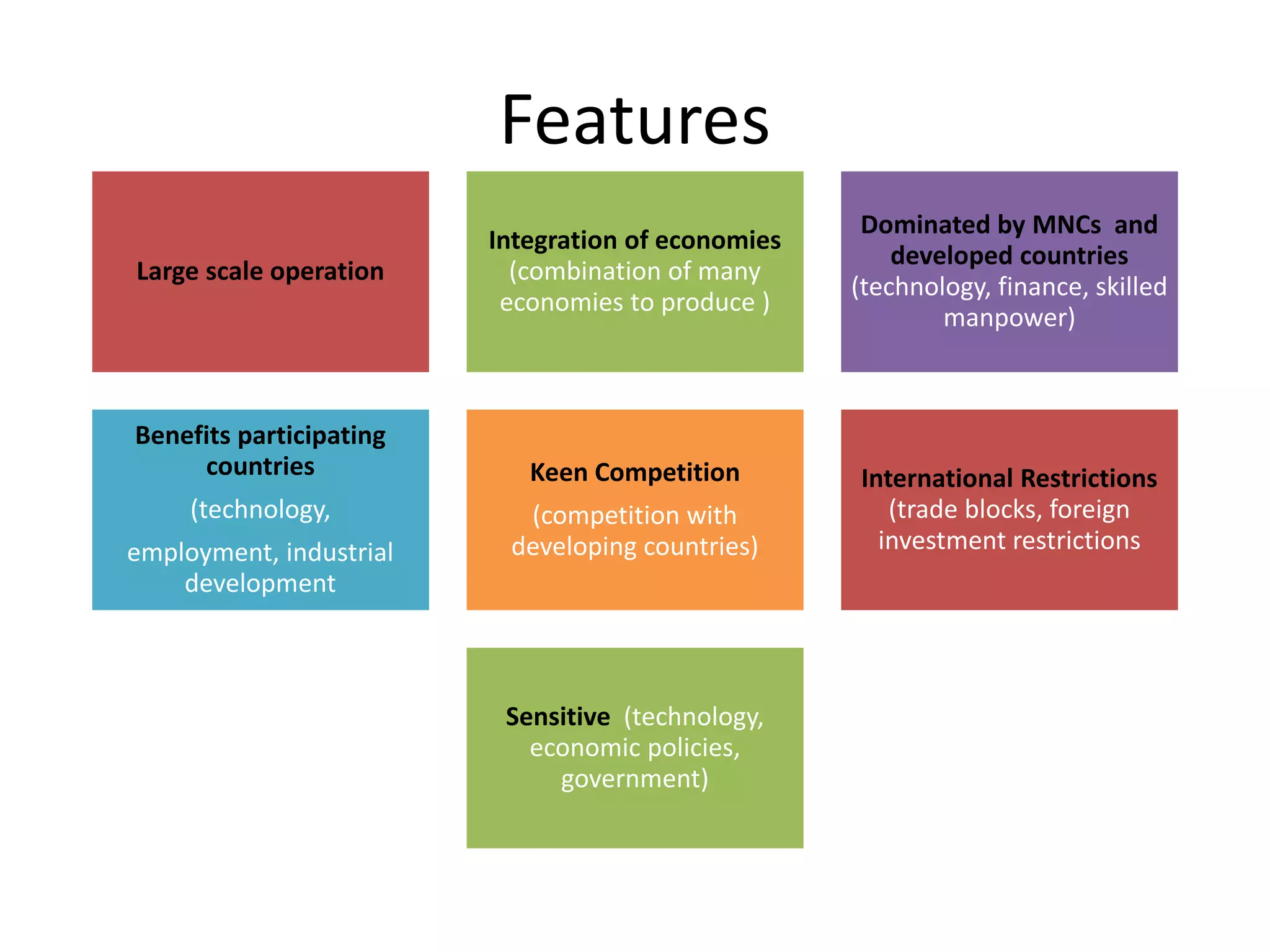
Features
Large scale operation
Integration of economies
(combination of many
economies to produce )
Dominated by MNCs and
developed countries
(technology, finance, skilled
manpower)
Benefits participating
countries
(technology,
employment, industrial
development
Keen Competition
(competition with
developing countries)
International Restrictions
(trade blocks, foreign
investment restrictions
Sensitive (technology,
economic policies,
government)
Process of internationalization
Domestic
Company
International
Company
Multinational
Company
Global
Company
Transnational
Company
Multinational
Corporation
DOMESTIC COMPANY
-operation within national
boundaries
-focuses on domestic
customers, suppliers,
opportunities
INTERNATIONAL COMPANY
-just importers and exporters
-No investment abroad
-Focus is mainly on domestic
country
MULTINATIONAL COMPANY
-finds out extension
strategy will not work
(Toyota-Japan/US)
-have investment in other
countries
-Formulate strategies for
each market
GLOBAL COMPANY
-Philps- MNC
(Japanese companies –
global strategy- satisfy
world market
-have investment in
other countries
-produce in one country
and market globally or
produce globally and
market domestically
Dr.Reddys Lab
TRANSNATIONAL COMPANY
-They produce,operate,invest across the globe
Have investment in foreign companies
-have central corporate facility but decision
making ,R&D etc to individual market
International business approaches
Ethnocentric
Polycentric
Regiocentric
Geocentric
Same as International
company
Same as MNC/McD
Considers regional
environment for
policy/strategy
formulation
Entire world is a single
country for company
Each subsidary works
like independent country
Goals of International business
Achieve high rate of
profits
Apple-$730
million(foreign)$620(dom
estic)-2007
Expanding beyond the
demand of domestic country
Toyota(Japan)
Severe competition in home
country
Limited home market
(low population/low
purchasing power
Japan-US/Europe
ITC-Europe due to (India)
Political stability
(continuation of same
policies )
Technology and competent
human force
Europe-Indian
companies(BPO)
High cost of transportation
Compared to domestic
countries(locate manufacturing
units in domestic)
Mobil,caterpiller
Nearness to raw materials
US,Europe-Saudi
Arabia(availability of petrol
Availability of cheap
manpower
Locating business in India
Liberalization and Globalization
Increase market share
Ball corporation(can
manufacturer-continental can
company(europe)-increased
global market share
Achieve high rate of economic
development
Tarrifs and Quotas
(protect domestic countries)
Japan/US- competion-
Us-imposed T&Q on import of
Japanese automobiles
Best is FDI
Theories of International Trade
• Mercantilism
• Absolute advantage (Classical)
• Comparative advantage
• Factor Proportions Trade
• International Product Cycle
• New Trade Theory
• National competitive advantage
Mercantilism: mid-16th century
• A nation’s wealth depends on accumulated
treasure
– Gold and silver are the currency of
trade
• Theory says you should have a trade surplus.
– Maximize export through subsidies.
– Minimize imports through tariffs and quotas
Benefitted colonial powers and caused
discontent in colonies- India /British
Defining mercantilism …
“… trade theory holding that nations should
accumulate financial wealth, usually in the form
of gold (forget things like living standards or
human development) by encouraging exports
and discouraging imports”
• Flaws: Restrictions, impaired growth, decay of
gold standards reduces validity of theory
• It is views trade as a zero sum game which
means a gain for one country results in a loss by
another
Theory of Absolute cost Advantage
• Adam Smith: Wealth of Nations (1776) argued:
– Capability of one country to produce more of a
product with the same amount of input than
another country
– A country should produce only goods where it is
most efficient(Cost less than other countries),
and trade for those goods where it is not efficient
– Based on the principle of division of labour
– E.g INDIA
• Trade between countries is, therefore, beneficial
• Assumes there is an absolute balance among
nations
• Advantage may be in skilled labor in certain
products ,economies of scale would reduce
cost per unit , or it may be natural advantage
due to climate, natural resources(Indian
climate (mangoes, cashews);U.s(Wheat) or
may be acquired advantage through
technology and skill development
Assumptions
• Trade is between two countries
• Only two commodities are traded
• Free trade exists between countries
• The only element of cost of production is
labour
Assume if they trade with each other
Output per one day of labour
Japan India
PENS 20 60
AUDIO TAPE RECORDERS 6 2
• Suppose Japanese agree to exchange 4 tape recorders for
40 pens
• To produce 40 pens ----Japan takes 2 days
• To produce 4 tape recorders----Japan takes 0.67 day(4/6)
Now India,
To produce 40 pens---India takes 0.67 day
To produce 4 tape recorder-----India takes 2 days
So what is the advantage
India= (2-0.67)= 1.33 day same for japan
So here they save labour, which can be used for other
purposes
0 10 20 30 40 50
1
2
3
4
5
6
60
No of pens
Nooftaperecorders
• … destroys the mercantilist idea since there
are gains to be had by both countries party to
an exchange
• … questions the objective of national
governments to acquire wealth through
restrictive trade policies
• … measures a nation’s wealth by the living
standards of its people

International business

  • 1.
  • 2.
    A business also knownas a firm or enterprise is an organization involved in trade of good ,services or both to the customers Comprise of all commercial activities (private, government, sales, investment ,transportation that take place between two parties Any type of business activity that crosses borders Any commercial industrial activity involving two or more nations INTERNATIONAL BUSINESS
  • 3.
  • 4.
    Features Large scale operation Integrationof economies (combination of many economies to produce ) Dominated by MNCs and developed countries (technology, finance, skilled manpower) Benefits participating countries (technology, employment, industrial development Keen Competition (competition with developing countries) International Restrictions (trade blocks, foreign investment restrictions Sensitive (technology, economic policies, government)
  • 5.
  • 6.
    DOMESTIC COMPANY -operation withinnational boundaries -focuses on domestic customers, suppliers, opportunities INTERNATIONAL COMPANY -just importers and exporters -No investment abroad -Focus is mainly on domestic country MULTINATIONAL COMPANY -finds out extension strategy will not work (Toyota-Japan/US) -have investment in other countries -Formulate strategies for each market GLOBAL COMPANY -Philps- MNC (Japanese companies – global strategy- satisfy world market -have investment in other countries -produce in one country and market globally or produce globally and market domestically Dr.Reddys Lab TRANSNATIONAL COMPANY -They produce,operate,invest across the globe Have investment in foreign companies -have central corporate facility but decision making ,R&D etc to individual market
  • 7.
    International business approaches Ethnocentric Polycentric Regiocentric Geocentric Sameas International company Same as MNC/McD Considers regional environment for policy/strategy formulation Entire world is a single country for company Each subsidary works like independent country
  • 8.
    Goals of Internationalbusiness Achieve high rate of profits Apple-$730 million(foreign)$620(dom estic)-2007 Expanding beyond the demand of domestic country Toyota(Japan) Severe competition in home country Limited home market (low population/low purchasing power Japan-US/Europe ITC-Europe due to (India) Political stability (continuation of same policies ) Technology and competent human force Europe-Indian companies(BPO)
  • 9.
    High cost oftransportation Compared to domestic countries(locate manufacturing units in domestic) Mobil,caterpiller Nearness to raw materials US,Europe-Saudi Arabia(availability of petrol Availability of cheap manpower Locating business in India Liberalization and Globalization Increase market share Ball corporation(can manufacturer-continental can company(europe)-increased global market share Achieve high rate of economic development Tarrifs and Quotas (protect domestic countries) Japan/US- competion- Us-imposed T&Q on import of Japanese automobiles Best is FDI
  • 10.
    Theories of InternationalTrade • Mercantilism • Absolute advantage (Classical) • Comparative advantage • Factor Proportions Trade • International Product Cycle • New Trade Theory • National competitive advantage
  • 11.
    Mercantilism: mid-16th century •A nation’s wealth depends on accumulated treasure – Gold and silver are the currency of trade • Theory says you should have a trade surplus. – Maximize export through subsidies. – Minimize imports through tariffs and quotas Benefitted colonial powers and caused discontent in colonies- India /British
  • 12.
    Defining mercantilism … “…trade theory holding that nations should accumulate financial wealth, usually in the form of gold (forget things like living standards or human development) by encouraging exports and discouraging imports” • Flaws: Restrictions, impaired growth, decay of gold standards reduces validity of theory • It is views trade as a zero sum game which means a gain for one country results in a loss by another
  • 13.
    Theory of Absolutecost Advantage • Adam Smith: Wealth of Nations (1776) argued: – Capability of one country to produce more of a product with the same amount of input than another country – A country should produce only goods where it is most efficient(Cost less than other countries), and trade for those goods where it is not efficient – Based on the principle of division of labour – E.g INDIA • Trade between countries is, therefore, beneficial • Assumes there is an absolute balance among nations
  • 14.
    • Advantage maybe in skilled labor in certain products ,economies of scale would reduce cost per unit , or it may be natural advantage due to climate, natural resources(Indian climate (mangoes, cashews);U.s(Wheat) or may be acquired advantage through technology and skill development
  • 16.
    Assumptions • Trade isbetween two countries • Only two commodities are traded • Free trade exists between countries • The only element of cost of production is labour
  • 17.
    Assume if theytrade with each other Output per one day of labour Japan India PENS 20 60 AUDIO TAPE RECORDERS 6 2
  • 18.
    • Suppose Japaneseagree to exchange 4 tape recorders for 40 pens • To produce 40 pens ----Japan takes 2 days • To produce 4 tape recorders----Japan takes 0.67 day(4/6) Now India, To produce 40 pens---India takes 0.67 day To produce 4 tape recorder-----India takes 2 days So what is the advantage India= (2-0.67)= 1.33 day same for japan So here they save labour, which can be used for other purposes
  • 19.
    0 10 2030 40 50 1 2 3 4 5 6 60 No of pens Nooftaperecorders
  • 20.
    • … destroysthe mercantilist idea since there are gains to be had by both countries party to an exchange • … questions the objective of national governments to acquire wealth through restrictive trade policies • … measures a nation’s wealth by the living standards of its people