Training and Development
Introduction
• Once employee has been recruited and
selected, the next step involved in the HRM
process is to transform them to meet the
future requirements of the organisation. Such
Transformation of employees is done by
means of training and development.
Training
• Training is the process of teaching the new and
/or present employees the basic skills they need
to effectively perform their jobs
• Training is the art of increasing the knowledge
and skill of an employee for doing his/her job
• Training refers to the teaching and learning
activities carried on for the primary purpose of
helping members of an organisation to acquire
and also to apply the required knowledge, skill
and attitudes to perform their jobs effectively.
Definitions
• Training is the act of increasing the knowledge
and skill of an employee for doing a particular
job- Edwin B . Flippo
• Training is any process by which the attitudes ,
skills and abilities of employees to perform
specific jobs are improved –Michael J. Jucious.
• Training allows the employee to be better
equipped to do his present job or to mould him
to fit for a higher job involving higher
responsibilities.
• Training is a learning experience that seeks a
relatively permanent change in an individual that
will improve his/her ability to perform his job.
• Training bridges the gap between what the
employee has and what the job demands.
Need for Training
• The need for training is recognized to be
essential not only in business organizations
but also in academic institutions , professional
bodies and government departments.
E.g. attending one orientation and two refresher
course has been made compulsory for
University/college teachers with an objective
to improve knowledge and skill for improving
their teaching performance.
Training is needed because:
a. The ever widening gap between planning, implementation and
completion of projects
b. Technological change necessitating acquisition of new knowledge, ability
and skills
c. Increasing qualitative demand for mangers and workmen
d. Increasing uncertainties and complexities in the total environment
necessitating flexible d adaptive responses from organisations
e. Need for both individual and organisations to grow at a rapid pace
f. To meet challenges posed by the global competition
g. To harness the human potential and give expression to their creative
urges
h. To enable employees to move from one job to another
i. To bridge the gap between what employees has in terms of knowledge
and skill and what his/ her job actually demands
Areas of Training
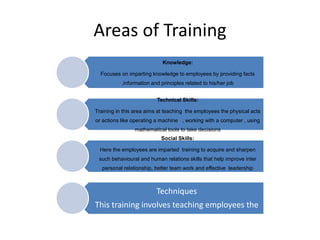
Knowledge:
Focuses on imparting knowledge to employees by providing facts
,information and principles related to his/her job
Technical Skills:
Training in this area aims at teaching the employees the physical acts
or actions like operating a machine , working with a computer , using
mathematical tools to take decisions
Social Skills:
Here the employees are imparted training to acquire and sharpen
such behavioural and human relations skills that help improve inter
personal relationship, better team work and effective leadership
Techniques
This training involves teaching employees the

Training and development

  • 1.
  • 2.
    Introduction • Once employeehas been recruited and selected, the next step involved in the HRM process is to transform them to meet the future requirements of the organisation. Such Transformation of employees is done by means of training and development.
  • 3.
    Training • Training isthe process of teaching the new and /or present employees the basic skills they need to effectively perform their jobs • Training is the art of increasing the knowledge and skill of an employee for doing his/her job • Training refers to the teaching and learning activities carried on for the primary purpose of helping members of an organisation to acquire and also to apply the required knowledge, skill and attitudes to perform their jobs effectively.
  • 4.
    Definitions • Training isthe act of increasing the knowledge and skill of an employee for doing a particular job- Edwin B . Flippo • Training is any process by which the attitudes , skills and abilities of employees to perform specific jobs are improved –Michael J. Jucious.
  • 5.
    • Training allowsthe employee to be better equipped to do his present job or to mould him to fit for a higher job involving higher responsibilities. • Training is a learning experience that seeks a relatively permanent change in an individual that will improve his/her ability to perform his job. • Training bridges the gap between what the employee has and what the job demands.
  • 6.
    Need for Training •The need for training is recognized to be essential not only in business organizations but also in academic institutions , professional bodies and government departments. E.g. attending one orientation and two refresher course has been made compulsory for University/college teachers with an objective to improve knowledge and skill for improving their teaching performance.
  • 7.
    Training is neededbecause: a. The ever widening gap between planning, implementation and completion of projects b. Technological change necessitating acquisition of new knowledge, ability and skills c. Increasing qualitative demand for mangers and workmen d. Increasing uncertainties and complexities in the total environment necessitating flexible d adaptive responses from organisations e. Need for both individual and organisations to grow at a rapid pace f. To meet challenges posed by the global competition g. To harness the human potential and give expression to their creative urges h. To enable employees to move from one job to another i. To bridge the gap between what employees has in terms of knowledge and skill and what his/ her job actually demands
  • 8.
    Areas of Training Knowledge: Focuseson imparting knowledge to employees by providing facts ,information and principles related to his/her job Technical Skills: Training in this area aims at teaching the employees the physical acts or actions like operating a machine , working with a computer , using mathematical tools to take decisions Social Skills: Here the employees are imparted training to acquire and sharpen such behavioural and human relations skills that help improve inter personal relationship, better team work and effective leadership Techniques This training involves teaching employees the