Economic
Importance of
Algae
Dr.M.JEEVITHA
Assistant professor of Botany,
Pope’s College (Autonomous)
The following points highlight the economic importance of
algae. They are:-
 Algae Constitute the Link of Food Chain
 Algae is Useful in Fish Culture
 Algae is Used for Recreational Purposes
 Algae is Useful in Sewage Treatment Plants
 Algae and Limestone Formation
 Algae is Used in Space Research and Other Fundamental Studies
 Algae is Used as Food
 Algae is Used as Fodder
 Algae is Used as Fertilizers
 Algae is Used as Medicine
 Industrial Utilization of Algae
1. Algae Constitute the Link of Food Chain
 Both fresh and salt waters contain an enormous variety of algae
which constitute the fundamental or primary link of many
diverse food chains.
 Algae synthesize organic food stuffs, just as do the plants of the
land.
 As the flesh of the land is dependent upon the activities of the
green leaf, so the fish and other aquatic forms of animal life are
dependent, directly or indirectly, upon algae, and fish in turn
are important item in the daily diet of larger sea animals and
man.
2. Algae is Useful in Fish Culture
 That algae are fruitfully utilized in fish culture can
very well be indicated from the successful culture
of the Siamese fish, Tilapia mossambica which is
voracious feeder of filamentous algae.
 This particular fish has been successfully
introduced in different parts of India.
 A culture of Scenedesmus is often exclusively used
as a daily dose of fish meal for the culture T.
mossambica.
Siamese fish
Tilapia mossambica
Scenedesmus
3. Algae is Used for Recreational Purposes
 Certain selected algae are grown in
recreational areas like—lakes and streams
along with fish.
4. Algae is Useful in Sewage Treatment Plants
 Species of Chlamydomonas, Scene-
desmus, Chlorella and Euglena are
used in sewage treatment plants
for providing through
photosynthesis the oxygen
necessary for rapid decomposition
of the sewage by bacteria.
Chlamydomonas Scenedesmus
Chlorella Euglena
5. Algae and Limestone Formation
 Many species of algae withdraw calcium
from water, both fresh and salt, and
deposit it, in the form of calcium
carbonate, in their cell walls or gelatinous
sheaths.
 The most significant forms in this category
are the blue-greens and reds, but certain
green algae and flagellates are also
concerned.
 The algae are not only important in the
present age in the formation of calcareous
deposits, both in the seas and fresh waters,
but also they have played a significant part
in the production of beds of limestone
rocks, which may be 1000 feet thick.
Calcareous Algae
6. Algae is Used in Space Research and Other
Fundamental Studies:
 In recent years Chlorella is being used in space
research.
 Chlorella has been found very suitable for
keeping the air in space vehicles pure on long
interplanetary flights.
 The stale air in which the carbon dioxide has been
concentrated is fed into a flood-lit container
containing a mixture of water and nutrient
chemicals and Chlorella.
 The alga restores oxygen into the space vehicle
by its photosynthesis.
 Again species of Chlorella, Chlamydomonas, and
Acetabularia are used as tools for solving
fundamental biochemical and genetical problems.
Chlamydomonas
Chlorella
Acetabularia
Algae is Used as Food
 Large number of algae have entered into
the diets of human beings from ancient
times.
 The earliest records are those of the
Chinese, who mentioned such food plants as
Laminaria and Gracilaria in their ‘materia
medica’ several thousand years ago.
 The ancient inhabitants of Japan ate
Porphyra as a healthful supplement to their
rice diet. Its use became widespread, not
only in Japan, but in China in course of
time.
 Kombu, a Japanese food is prepared from
stipes of species of Laminaria.
Laminaria
Gracilaria
Porphyra
 The most diversified dietary use of seaweeds was
developed by the Polynesians and reached its peak in
Hawaii, where during the nineteenth century at least 75
species were separately named and used regularly as
food in that island world.
 The Hawaiians called them ‘limu’ and considered them a
necessary staple of their daily diet.
 Man, thus obtains carbohydrates, vitamins (algae are
especially rich in vitamins A and E, and they contain
some C and D), and inorganic substances, e.g., iodine
(goiter is unknown among the people who eat
seaweeds), not to mention the benefits of the mild
laxative action of the ingested algae.
 Witsch (1959) stated that vitamin B value of young
cultures of Chlorella equals that of lemon juice.
 In Japan, powdered Chlorella ellipsoidea has been used
successfully mixing with green tea.
Chlorella ellipsoidea
8. Algae is Used as Fodder
 Some kinds of algae, such as Rhodymenia
palmata and Alaria esculenta, are
favourable food of goats, cows, and sheep,
and in Scotland and Ireland the stock
actively hunt the shores at low tide for
particular algae, especially the former.
 The high mineral and vitamin G content of
kelp meal has made possible its use in
various poultry and other animal rations.
Rhodymenia palmata
Alaria esculenta
9. Algae is Used as Fertilizers
 The value of seaweeds in fertilizing the soil was discovered early in the
history of agriculture in coastal Asia, and by the ancient colonizers of the
coasts and islands of North-Western Europe.
 Not only the chemical fertilization, but also the water-holding capacity of
fragments of the algae in the soil proved effective.
 These provided valuable small reservoirs of water in close contact with the
roots of the cultivated plants.
 Furthermore, the bulky organic substances decay slowly in the soil and form
humus.
 Again yield of paddy is increased substantially when paddy field is inoculated
with nitrogen fixing blue-green algae.
 Some of them are: Tolypothrix tenius, Aulosira fertilissima, Anabaena oryzae,
Anabaenopsis arnoldii, Calothrix confervicola, Nostoc commune, and
Cylindrospermum bengalense.
Tolypothrix tenius Anabaena oryzae Anabaenopsis arnoldii
Calothrix confervicola Nostoc commune
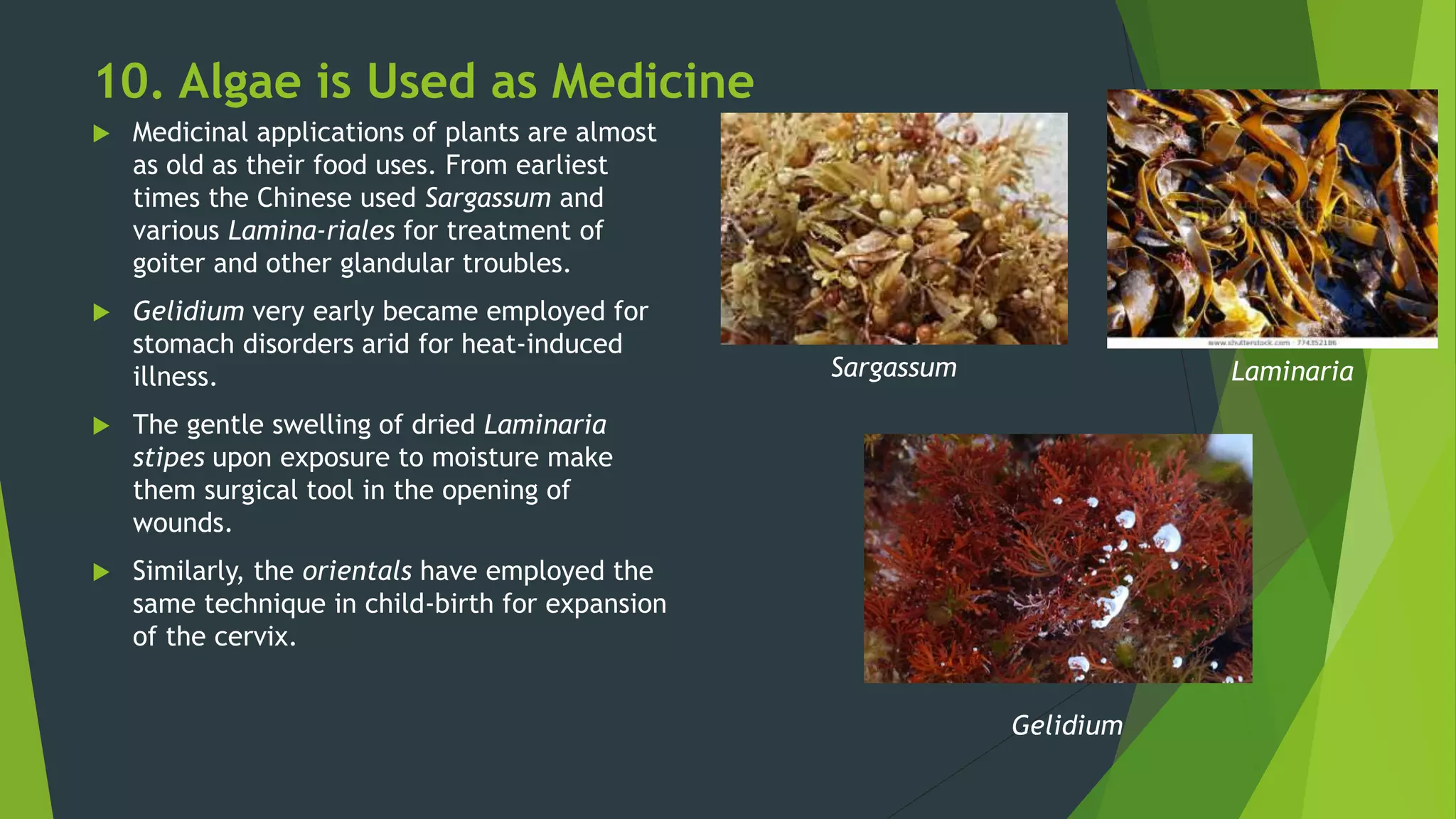
10. Algae is Used as Medicine
 Medicinal applications of plants are almost
as old as their food uses. From earliest
times the Chinese used Sargassum and
various Lamina-riales for treatment of
goiter and other glandular troubles.
 Gelidium very early became employed for
stomach disorders arid for heat-induced
illness.
 The gentle swelling of dried Laminaria
stipes upon exposure to moisture make
them surgical tool in the opening of
wounds.
 Similarly, the orientals have employed the
same technique in child-birth for expansion
of the cervix.
Sargassum
Gelidium
Laminaria
 The name ‘agar-agar’ is of Malay origin and. means
‘jelly’.
 This jelly was obtained by boiling up seaweeds and
cooling the resulting liquid.
 Agar early became useful for stomach disorders and
as a laxative, and was once employed as a dietetic.
 The most significant date in the utilization of
agarphytes was 1881, when Robert Koch proved the
value of agar in the cultivation of bacteria.
 Chlorella is used for the preparation of antibiotic
Chlorellin
11. Industrial Utilization of Algae
(i) Kelp Industry:
 Industrial utilization of seaweeds in Europe had
its principal early development in the
production of ‘kelp’, a name that originally
referred to the ash, rich in soda and potash,
derived from burning marine plants.
(ii) Algin Industry:
 Algin is the general term designating the
hydrophilic, or water-loving derivatives of
alginic acid. The most commonly known algin is
sodium alginate, but other commercially
important compounds are the potassium,
ammonium, calcium, and propylene glycol
alginates, as well as alginic acid itself.
 Algin occurs generally throughout the brown algae (Laminaria,
Macrocystis, Sargassum and Fucus) as a cell wall constituent.
It has remarkable water-absorbing qualities that make it
useful in numerous industries in which a thickening,
suspending, stabilizing, emulsifying, gel-forming, or film-form-
ing colloid is required.
 Thus, algin provides ice cream with a smooth texture by pre-
venting the formation of ice crystals. In automobile polishes it
suspends the abrasive; in paints, the pigments; also in
pharmaceuticals, the drugs and antibiotics. As a stabilizing
agent it serves in the processing of rubber latex .and in the
printing of textiles. As an emulsifier it is widely used in such
products as water-based paints, French dressings, and
cosmetics.
 The algin industry has become so important to such a wide
variety of industries that extensive survey of kelp-bed ecology
is an effort to guard against loss of this important resource.
Harvesting methods are now carefully regulated, and a huge
amount of money is being spent on kelp-bed research
throughout the world.
Macrocystis
Fucus
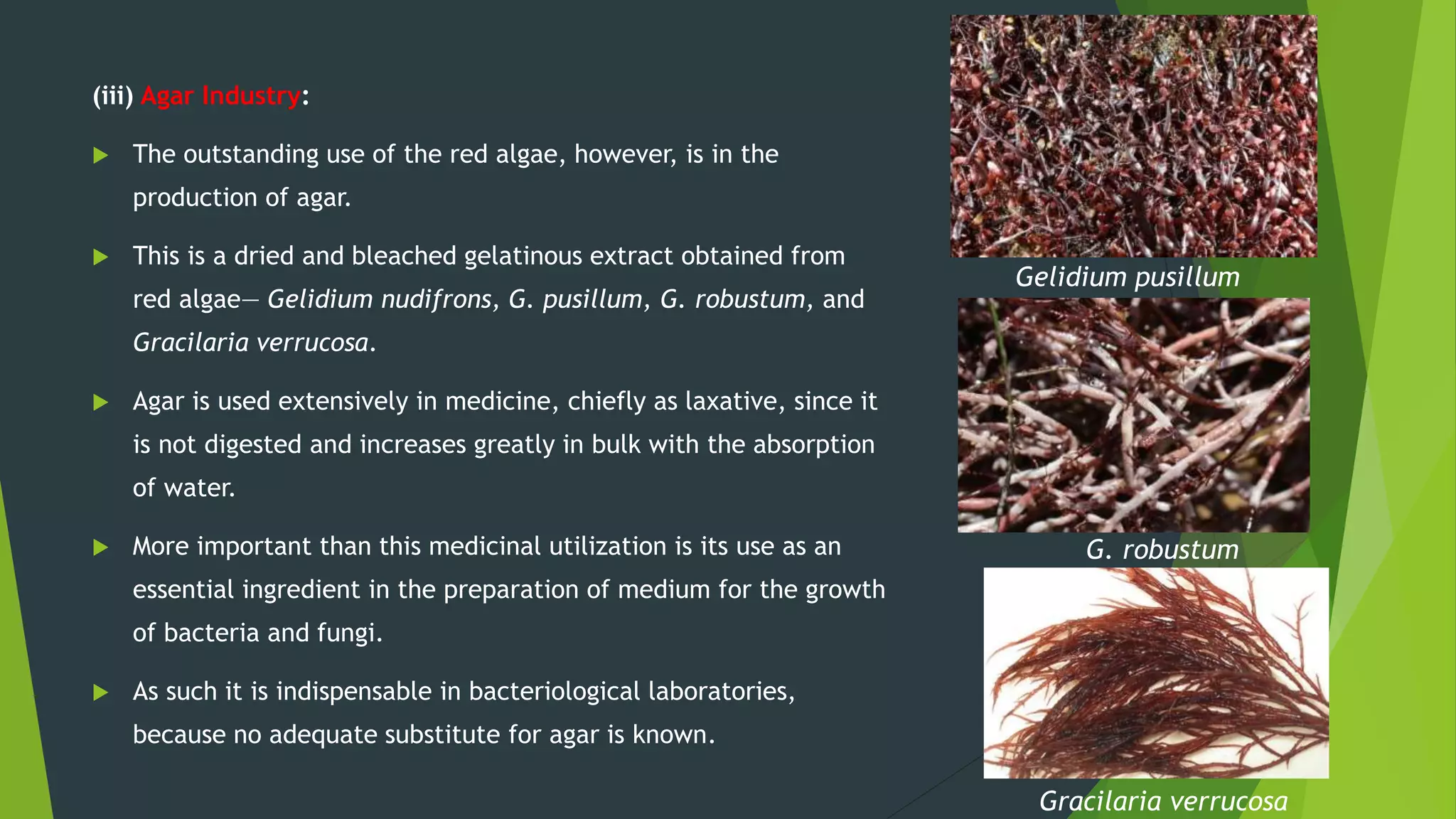
(iii) Agar Industry:
 The outstanding use of the red algae, however, is in the
production of agar.
 This is a dried and bleached gelatinous extract obtained from
red algae— Gelidium nudifrons, G. pusillum, G. robustum, and
Gracilaria verrucosa.
 Agar is used extensively in medicine, chiefly as laxative, since it
is not digested and increases greatly in bulk with the absorption
of water.
 More important than this medicinal utilization is its use as an
essential ingredient in the preparation of medium for the growth
of bacteria and fungi.
 As such it is indispensable in bacteriological laboratories,
because no adequate substitute for agar is known.
Gelidium pusillum
G. robustum
Gracilaria verrucosa
 Agar serves widely as a substitute for gelatin, as an anti-drying agent in breads
and pastry, in improving the slicing quality of cheese, in the preparation of rapid-
setting jellies and desserts, and in the manufacture of frozen dairy products.
 The use of agar in meat and fish canning has greatly expanded, and hundreds of
tons are utilized annually.
 Early industrial uses of agar in the Orient included sizing fabric, water-proofing
paper and cloth, and making rice paper more durable.
 Modern industry has refined and expanded these uses to meet new needs in the
manufacturing of such items as photographic film, shoe polish, dental impression
molds, shaving soaps, and hand lotions.
 In the tanning industry agar imparts a gloss and stiffness to finished leather.
 In the manufacture of electric lamps, a lubricant of graphite and agar is used in
drawing the hot tungsten wire.
(iv) Diatomaceous Earth Industry:
 Most species of Diatoms are marine, and when these minute plants die, they fall to
the sea bottom and, because of their siliceous nature, the cell walls are preserved
indefinitely.
 Great deposits of this material, known as diatomaceous earth, are found in many
parts of the world.
 It makes an excellent filtering agent, which is widely used to remove colouring
matters from products as diverse as petrol and sugar.
 As a poor conductor of heat it is used in soundproofing.
 It is used in the manufacture of paints and varnishes, of phonograph records, and as a
filler for battery boxes.
 Because of its hardness, it is used as an abrasive in scouring and polishing powders.
Thank You

Economic Importance of Algae.pptx

  • 1.
  • 2.
    The following pointshighlight the economic importance of algae. They are:-  Algae Constitute the Link of Food Chain  Algae is Useful in Fish Culture  Algae is Used for Recreational Purposes  Algae is Useful in Sewage Treatment Plants  Algae and Limestone Formation  Algae is Used in Space Research and Other Fundamental Studies  Algae is Used as Food  Algae is Used as Fodder  Algae is Used as Fertilizers  Algae is Used as Medicine  Industrial Utilization of Algae
  • 3.
    1. Algae Constitutethe Link of Food Chain  Both fresh and salt waters contain an enormous variety of algae which constitute the fundamental or primary link of many diverse food chains.  Algae synthesize organic food stuffs, just as do the plants of the land.  As the flesh of the land is dependent upon the activities of the green leaf, so the fish and other aquatic forms of animal life are dependent, directly or indirectly, upon algae, and fish in turn are important item in the daily diet of larger sea animals and man.
  • 4.
    2. Algae isUseful in Fish Culture  That algae are fruitfully utilized in fish culture can very well be indicated from the successful culture of the Siamese fish, Tilapia mossambica which is voracious feeder of filamentous algae.  This particular fish has been successfully introduced in different parts of India.  A culture of Scenedesmus is often exclusively used as a daily dose of fish meal for the culture T. mossambica. Siamese fish Tilapia mossambica Scenedesmus
  • 5.
    3. Algae isUsed for Recreational Purposes  Certain selected algae are grown in recreational areas like—lakes and streams along with fish.
  • 6.
    4. Algae isUseful in Sewage Treatment Plants  Species of Chlamydomonas, Scene- desmus, Chlorella and Euglena are used in sewage treatment plants for providing through photosynthesis the oxygen necessary for rapid decomposition of the sewage by bacteria. Chlamydomonas Scenedesmus Chlorella Euglena
  • 7.
    5. Algae andLimestone Formation  Many species of algae withdraw calcium from water, both fresh and salt, and deposit it, in the form of calcium carbonate, in their cell walls or gelatinous sheaths.  The most significant forms in this category are the blue-greens and reds, but certain green algae and flagellates are also concerned.  The algae are not only important in the present age in the formation of calcareous deposits, both in the seas and fresh waters, but also they have played a significant part in the production of beds of limestone rocks, which may be 1000 feet thick. Calcareous Algae
  • 8.
    6. Algae isUsed in Space Research and Other Fundamental Studies:  In recent years Chlorella is being used in space research.  Chlorella has been found very suitable for keeping the air in space vehicles pure on long interplanetary flights.  The stale air in which the carbon dioxide has been concentrated is fed into a flood-lit container containing a mixture of water and nutrient chemicals and Chlorella.  The alga restores oxygen into the space vehicle by its photosynthesis.  Again species of Chlorella, Chlamydomonas, and Acetabularia are used as tools for solving fundamental biochemical and genetical problems. Chlamydomonas Chlorella Acetabularia
  • 9.
    Algae is Usedas Food  Large number of algae have entered into the diets of human beings from ancient times.  The earliest records are those of the Chinese, who mentioned such food plants as Laminaria and Gracilaria in their ‘materia medica’ several thousand years ago.  The ancient inhabitants of Japan ate Porphyra as a healthful supplement to their rice diet. Its use became widespread, not only in Japan, but in China in course of time.  Kombu, a Japanese food is prepared from stipes of species of Laminaria. Laminaria Gracilaria Porphyra
  • 10.
     The mostdiversified dietary use of seaweeds was developed by the Polynesians and reached its peak in Hawaii, where during the nineteenth century at least 75 species were separately named and used regularly as food in that island world.  The Hawaiians called them ‘limu’ and considered them a necessary staple of their daily diet.  Man, thus obtains carbohydrates, vitamins (algae are especially rich in vitamins A and E, and they contain some C and D), and inorganic substances, e.g., iodine (goiter is unknown among the people who eat seaweeds), not to mention the benefits of the mild laxative action of the ingested algae.  Witsch (1959) stated that vitamin B value of young cultures of Chlorella equals that of lemon juice.  In Japan, powdered Chlorella ellipsoidea has been used successfully mixing with green tea. Chlorella ellipsoidea
  • 11.
    8. Algae isUsed as Fodder  Some kinds of algae, such as Rhodymenia palmata and Alaria esculenta, are favourable food of goats, cows, and sheep, and in Scotland and Ireland the stock actively hunt the shores at low tide for particular algae, especially the former.  The high mineral and vitamin G content of kelp meal has made possible its use in various poultry and other animal rations. Rhodymenia palmata Alaria esculenta
  • 12.
    9. Algae isUsed as Fertilizers  The value of seaweeds in fertilizing the soil was discovered early in the history of agriculture in coastal Asia, and by the ancient colonizers of the coasts and islands of North-Western Europe.  Not only the chemical fertilization, but also the water-holding capacity of fragments of the algae in the soil proved effective.  These provided valuable small reservoirs of water in close contact with the roots of the cultivated plants.  Furthermore, the bulky organic substances decay slowly in the soil and form humus.  Again yield of paddy is increased substantially when paddy field is inoculated with nitrogen fixing blue-green algae.  Some of them are: Tolypothrix tenius, Aulosira fertilissima, Anabaena oryzae, Anabaenopsis arnoldii, Calothrix confervicola, Nostoc commune, and Cylindrospermum bengalense.
  • 13.
    Tolypothrix tenius Anabaenaoryzae Anabaenopsis arnoldii Calothrix confervicola Nostoc commune
  • 14.
    10. Algae isUsed as Medicine  Medicinal applications of plants are almost as old as their food uses. From earliest times the Chinese used Sargassum and various Lamina-riales for treatment of goiter and other glandular troubles.  Gelidium very early became employed for stomach disorders arid for heat-induced illness.  The gentle swelling of dried Laminaria stipes upon exposure to moisture make them surgical tool in the opening of wounds.  Similarly, the orientals have employed the same technique in child-birth for expansion of the cervix. Sargassum Gelidium Laminaria
  • 15.
     The name‘agar-agar’ is of Malay origin and. means ‘jelly’.  This jelly was obtained by boiling up seaweeds and cooling the resulting liquid.  Agar early became useful for stomach disorders and as a laxative, and was once employed as a dietetic.  The most significant date in the utilization of agarphytes was 1881, when Robert Koch proved the value of agar in the cultivation of bacteria.  Chlorella is used for the preparation of antibiotic Chlorellin
  • 16.
    11. Industrial Utilizationof Algae (i) Kelp Industry:  Industrial utilization of seaweeds in Europe had its principal early development in the production of ‘kelp’, a name that originally referred to the ash, rich in soda and potash, derived from burning marine plants. (ii) Algin Industry:  Algin is the general term designating the hydrophilic, or water-loving derivatives of alginic acid. The most commonly known algin is sodium alginate, but other commercially important compounds are the potassium, ammonium, calcium, and propylene glycol alginates, as well as alginic acid itself.
  • 17.
     Algin occursgenerally throughout the brown algae (Laminaria, Macrocystis, Sargassum and Fucus) as a cell wall constituent. It has remarkable water-absorbing qualities that make it useful in numerous industries in which a thickening, suspending, stabilizing, emulsifying, gel-forming, or film-form- ing colloid is required.  Thus, algin provides ice cream with a smooth texture by pre- venting the formation of ice crystals. In automobile polishes it suspends the abrasive; in paints, the pigments; also in pharmaceuticals, the drugs and antibiotics. As a stabilizing agent it serves in the processing of rubber latex .and in the printing of textiles. As an emulsifier it is widely used in such products as water-based paints, French dressings, and cosmetics.  The algin industry has become so important to such a wide variety of industries that extensive survey of kelp-bed ecology is an effort to guard against loss of this important resource. Harvesting methods are now carefully regulated, and a huge amount of money is being spent on kelp-bed research throughout the world. Macrocystis Fucus
  • 18.
    (iii) Agar Industry: The outstanding use of the red algae, however, is in the production of agar.  This is a dried and bleached gelatinous extract obtained from red algae— Gelidium nudifrons, G. pusillum, G. robustum, and Gracilaria verrucosa.  Agar is used extensively in medicine, chiefly as laxative, since it is not digested and increases greatly in bulk with the absorption of water.  More important than this medicinal utilization is its use as an essential ingredient in the preparation of medium for the growth of bacteria and fungi.  As such it is indispensable in bacteriological laboratories, because no adequate substitute for agar is known. Gelidium pusillum G. robustum Gracilaria verrucosa
  • 19.
     Agar serveswidely as a substitute for gelatin, as an anti-drying agent in breads and pastry, in improving the slicing quality of cheese, in the preparation of rapid- setting jellies and desserts, and in the manufacture of frozen dairy products.  The use of agar in meat and fish canning has greatly expanded, and hundreds of tons are utilized annually.  Early industrial uses of agar in the Orient included sizing fabric, water-proofing paper and cloth, and making rice paper more durable.  Modern industry has refined and expanded these uses to meet new needs in the manufacturing of such items as photographic film, shoe polish, dental impression molds, shaving soaps, and hand lotions.  In the tanning industry agar imparts a gloss and stiffness to finished leather.  In the manufacture of electric lamps, a lubricant of graphite and agar is used in drawing the hot tungsten wire.
  • 20.
    (iv) Diatomaceous EarthIndustry:  Most species of Diatoms are marine, and when these minute plants die, they fall to the sea bottom and, because of their siliceous nature, the cell walls are preserved indefinitely.  Great deposits of this material, known as diatomaceous earth, are found in many parts of the world.  It makes an excellent filtering agent, which is widely used to remove colouring matters from products as diverse as petrol and sugar.  As a poor conductor of heat it is used in soundproofing.  It is used in the manufacture of paints and varnishes, of phonograph records, and as a filler for battery boxes.  Because of its hardness, it is used as an abrasive in scouring and polishing powders.
  • 21.