EPITOME
1.

• Introduction

2.

• Global distribution of toxins

3.

• Finfish poisoning

4.

• Shellfish poisoning

5.

• Other factors associate with seafood poisoning

6.

• New and emerging toxins

7.

• Detection methods of seafood poisoning

8.

• Symptoms of seafood poisoning

9.

• Hygienic errors for seafood poisoning

10.

• Prevention, control and monitoring

11.

• Long term consequences of seafood poisoning

12.

• Future perspectives

13.

• Sri Lankan situation of seafood poisoning

14.

• Discussion

Seafood Poisoning

W.A.Dulanjali M. Wijethilake
A group of acute illnesses due to ingestion
of contaminated finfish, bivalve mollusks
and snails may result allergy, toxemia from
foods, those inherently poisonous or those
contaminated
by
poisons.
Seafood
containing poisons formed by bacteria or
food borne infections. ( Source - medicaldictionary)

Seafood Poisoning

W.A.Dulanjali M. Wijethilake
 Seafood products are important both nutritionally and
economically
 About 16% of all animal protein
 Seafood Vs. other food
 Toxic microscopic algae
 Indigenous factors

 Accumulate through food chain

Seafood Poisoning

W.A.Dulanjali M. Wijethilake
 The toxins can produce various
Neurological and gastrointestinal illness

 Consumers are exposed to seafood poisoning
while travelling abroad
 Mainly fish and shellfish
 Main issue is poisonous seafood shows no
visible signs of contamination
 Diagnosis may be complicated due to ..
Seafood Poisoning

W.A.Dulanjali M. Wijethilake
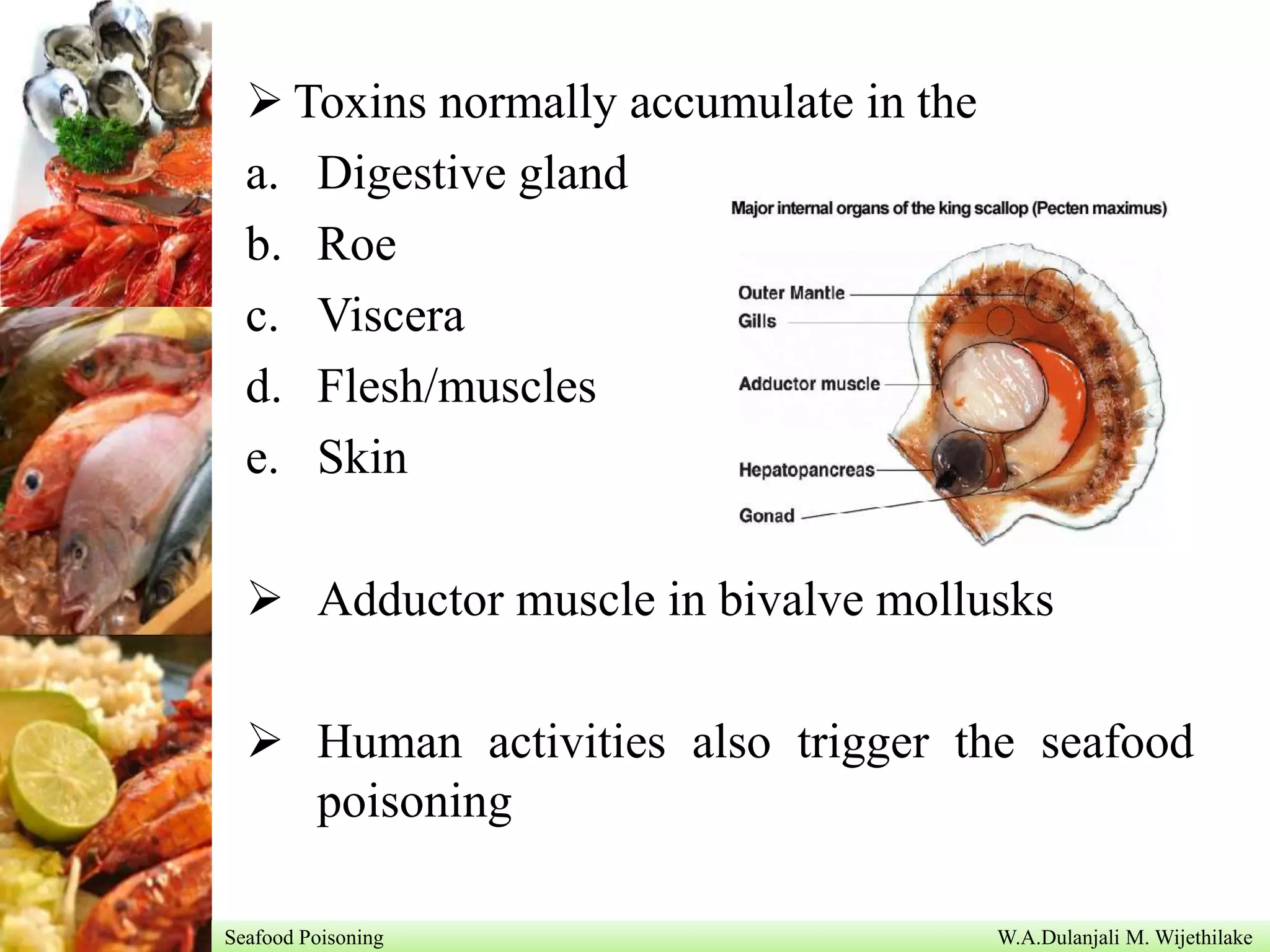
 Toxins normally accumulate in the
a. Digestive gland
b. Roe
c. Viscera
d. Flesh/muscles
e. Skin
 Adductor muscle in bivalve mollusks
 Human activities also trigger the seafood
poisoning
Seafood Poisoning

W.A.Dulanjali M. Wijethilake
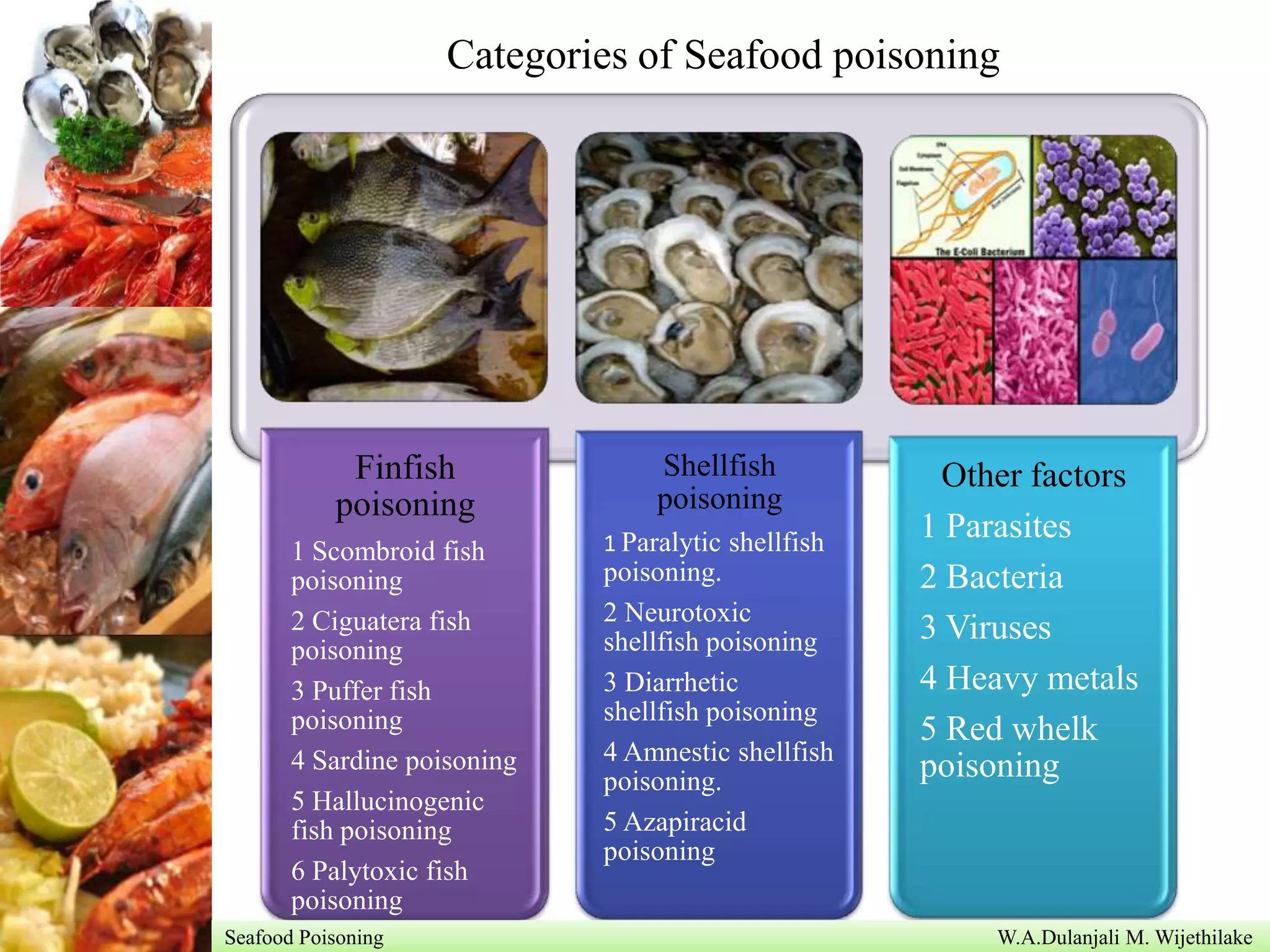
Categories of Seafood poisoning

Finfish
poisoning

Shellfish
poisoning

1 Scombroid fish
poisoning
2 Ciguatera fish
poisoning
3 Puffer fish
poisoning
4 Sardine poisoning
5 Hallucinogenic
fish poisoning
6 Palytoxic fish
poisoning

1 Paralytic shellfish

Seafood Poisoning

poisoning.
2 Neurotoxic
shellfish poisoning
3 Diarrhetic
shellfish poisoning
4 Amnestic shellfish
poisoning.
5 Azapiracid
poisoning

Other factors
1 Parasites
2 Bacteria
3 Viruses
4 Heavy metals
5 Red whelk
poisoning

W.A.Dulanjali M. Wijethilake
Syndrome
Amnesic shellfish poisoning
(ASP)

Azaspiracid shellfish poisoning
(AZP)

Ciguatera fish poisoning
(CFP)

Seafood Poisoning

Affected Areas
U.S. west coast including Alaska
Atlantic Canada
Georges Bank
Chile
Australia
New Zealand
United Kingdom
England
Scotland
Ireland
France
Spain
Morocco
Norway
Hawaii
Gulf of Mexico
Puerto Rico
Caribbean
Australia
Many Pacific islands
W.A.Dulanjali M. Wijethilake
Diarrhetic shellfish poisoning
(DSP)

Neurotoxic shellfish poisoning
(NSP)
Paralytic shellfish poisoning
(PSP)

Swimmer's itch
Dermatitis

Seafood Poisoning

Europe
Japan
Atlantic Canada
South Africa
Chile
Thailand
New Zealand
Australia
U.S. Gulf coast
New Zealand

U.S. west coast including Alaska
New England coastal states
Canada
Chile
Brazil
Europe
South Africa
Asia
Australia
New Zealand
Australia
Florida
worldwide throughout the tropics and
subtropics
W.A.Dulanjali M. Wijethilake
Figure 1 : Global distribution of PSP,NSP,DSP and ASP
Seafood Poisoning

W.A.Dulanjali M. Wijethilake
Figure 2 : Global distribution of CFP and AZP
Seafood Poisoning

W.A.Dulanjali M. Wijethilake
1. Scombroid fish poisoning (SFP)
 Most common cause
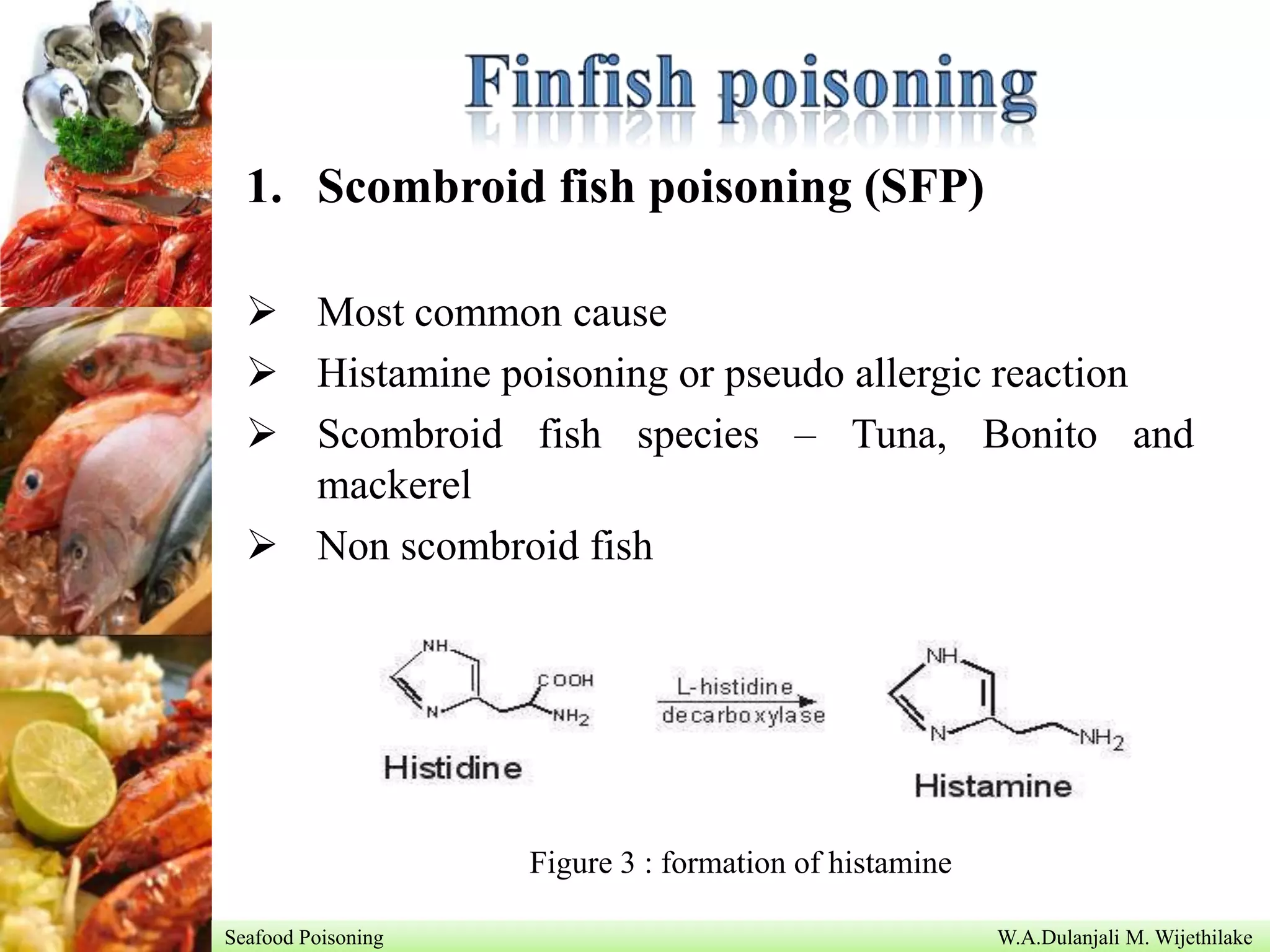
 Histamine poisoning or pseudo allergic reaction
 Scombroid fish species – Tuna, Bonito and
mackerel
 Non scombroid fish

Figure 3 : formation of histamine
Seafood Poisoning

W.A.Dulanjali M. Wijethilake
 Histidine decarboxylase enzyme producing
bacteria
a.
b.
c.
d.

E.coli
Klebsiella pneumonias
Hafnia alvei
Morganella morganii

 Biogenic amines also play major role
 Recommended Histamin levels
I. 5mg/100g = safe
II. 10-20/100g = maximum level
III. >50mg/100g = unsafe
Seafood Poisoning

W.A.Dulanjali M. Wijethilake
2. Ciguatera fish poisoning (CFP)
 Coral reef and inshore habitat fish species
Eg – Barracuda, Amberjack, King mackerel, Groupers, Snappers
 Toxin – Ciguatoxin (CTX) and Maitotoxin (MTX)
 Agent – Gambierdiscus toxicus and benthic dinoflagellates
 Mechanism

Figure 4 : Structure of Ciguatoxin
Seafood Poisoning

W.A.Dulanjali M. Wijethilake
Figure 5 : Food chain accumulation of dinoflagellates

 CFP does not affect the appearance, odour and taste

Seafood Poisoning

W.A.Dulanjali M. Wijethilake
3. Puffer fish poisoning
 Fishes include blowfish, globe fish, blue
ringed octopus, gobies, starfish, horseshoe
crab eggs
 Toxin – Tetrodotoxin
 Mechanism

 Toxin concentrated in various parts

Seafood Poisoning

W.A.Dulanjali M. Wijethilake
4. Sardine poisoning
 Rare and very poorly reported one
 Fish species include sardines, herrings and
anchovies

 Toxin - unknown
 But …

Seafood Poisoning

W.A.Dulanjali M. Wijethilake
5. Hallucinogenic fish poisoning
 Ichthyoallyeinotoxism

 Rare
 Fish species include Siganus spinus
 Exact toxin - unknown
 Similarities with CFP
Figure 5 : Siganus spinus

Seafood Poisoning

W.A.Dulanjali M. Wijethilake
6. Palytoxic fish poisoning
 Grazing animals on Palythoa sp.
 Toxin – Palytoxin

 Neurotoxic
 Similarities with CFP

Seafood Poisoning

Figure 6 : Palythoa sp.

W.A.Dulanjali M. Wijethilake
1. Paralytic shellfish poisoning (PSP)
 Most common and widespread shellfish poisoning
 Toxin – Saxitoxin (STX)
 Agent –Alexandrium sp., Gymnodinium catenatum
and Pyrodinium spp.
 Mechanism

Figure 7 : Structure of saxitoxin
Seafood Poisoning

W.A.Dulanjali M. Wijethilake
2. Neurotoxic shellfish poisoning (NSP)
 Known since centuries
 Toxin – Brevetoxins
 Agent – Gymnodinium breve, Karenia brevis ,
Karenia brevisulcatum
 Mechanism

Figure 8 : Structure of brevetoxin
Seafood Poisoning

W.A.Dulanjali M. Wijethilake
3. Diarrhetic shellfish poisoning (DSP)
 Mild poisoning

 Toxin – Okadaic acid and derivative
 Agent – Dinophysis sp., Prorocentrum sp.
 Filter feeding bivalves
 Mechanism

Figure 9 : Structure of Okadaic acid
Seafood Poisoning

W.A.Dulanjali M. Wijethilake
4. Amnestic shellfish poisoning
 One of the potentially serious poisoning

 Toxin – Domoic acid
 Agent - Pseudonitzchia sp.
 Mechanism
 20µg DA/g – Safety limit

Figure 10 : Structure of Domoic acid
Seafood Poisoning

W.A.Dulanjali M. Wijethilake
5. Azaspiracid poisoning
 More recently discovered poisoning

 Toxin – Azaspiraicd 1
 Agent - Protoperidinium crassipes

Figure 11 : Structure of Azaspiracid 1
Seafood Poisoning

W.A.Dulanjali M. Wijethilake
1. Parasites in seafood
a.
b.
c.
d.

Anisakis simplex
Diphyllobothrium sp.
Paragonimus sp.
Opisthocris sp.

Figure 12 : Anisakis simplex (Leff) and Diphyllobothrium sp. (Right)
Seafood Poisoning

W.A.Dulanjali M. Wijethilake
 Protozoans
a.
b.
c.
d.

Cryptosporidium parvum
Entamoeba histolytica
Giardia lamblia
Cyclospora sp.

Figure 13 : protozoans in fish species
Seafood Poisoning

W.A.Dulanjali M. Wijethilake
2. Bacteria in seafood
a.
b.
c.
d.
e.
f.

E.coli
Staphylococcus aureus
Salmonella sp.
Vibrio cholerae
Vibrio parahaemolyticus
Listeria monocytogenes

Figure 14 : Bacteria in fish species
Seafood Poisoning

W.A.Dulanjali M. Wijethilake
3. Viruses in seafood
a. Hepatitis A virus
b. Norovirus

4. Heavy metals in sea food

5. Red whelk poisoning

Seafood Poisoning

W.A.Dulanjali M. Wijethilake
 The occurrence of seafood toxins seems to be
increasing and new potential food poisoning
hazard

1.
2.
3.
4.

Azaspiracid
Cyanobacteria toxins
Pfiesteria toxin
Other compounds – Gymnodinine and procentrolide

Seafood Poisoning

W.A.Dulanjali M. Wijethilake
 Mouse bioassays for
 Limitations of specificity and accuracy
 Due to ethical reasons

 Alternatives
a. Cell culture assays
b. ELISA s
c. HPLC – ASP detection , Tetradotoxin
d. CE-MS
e. LC-MS
Seafood Poisoning

W.A.Dulanjali M. Wijethilake
f. Ion exchange chromatography – Histamin
g. Capillary zone electrophoresis – Histamin
h. High voltage electrophoresis - Tetramine

Figure 15 : Ion exchange chromatography machine
Seafood Poisoning

W.A.Dulanjali M. Wijethilake
Syndrome

Symptoms

Scombroid poisoning

Breathing problems (in severe cases)
Extremely red skin on face and body
Flushing
Hives and itching
Nausea
Vomiting

Ciguatera fish poisoning

Abdominal cramps
Diarrhea (severe and watery)
Nausea
Vomiting

Tetradotoxin fish poisoning

Paresthesia of the lips and tongue
Hypersalivation
Sweating
Headache
Weakness
lethargy

Seafood Poisoning

W.A.Dulanjali M. Wijethilake
Paralytic shellfish poisoning

Numbness or tingling in mouth.
This sensation may spread down to
arms and legs.
become very dizzy, have a
headache
in some cases, arms and legs may
become temporarily paralyzed

Neurotoxic shellfish poisoning

The symptoms are very similar to
Ciguatera poisoning

Amnestic shellfish poisoning

With nausea, vomiting, and
diarrhea,
followed by short-term memory
loss, as well as other less frequent
neurologic symptoms.

Seafood Poisoning

W.A.Dulanjali M. Wijethilake
Fish hygiene relates to “All conditions and
measures necessary to ensure the safety and
suitability at all stages of the fish handling".
These hygienic measures
 aim at preventing or reducing
contamination and microbial growth.

Seafood Poisoning

fish

W.A.Dulanjali M. Wijethilake
 Aspects related to the hygienic design of
facilities during
• On-board,
• Transportation
• Processing and distribution
• Personnel hygiene
• Cleaning and sanitation

Seafood Poisoning

W.A.Dulanjali M. Wijethilake
Faults doing by fishermen
Situation

Errors

Fish in hold

Fish kept in melted water
Loosening ice with harbour water
No sorting by species or catching
date

Unloading

Unload straight on to pier by hand
Pier is highly contaminated due to..
Pier is used for auctioning and
packing

Washing

Use contaminated harbour water
Washing water not change
frequently

Reloading

Inappropriate vehicles
Icing not done correctly
Cross contamination

Seafood Poisoning

W.A.Dulanjali M. Wijethilake
Transportation

Many different types of
transportation
•Refrigerated truks
•Unrefrigerated trucks
•Three wheelers
•Motorbikes
•bicycles

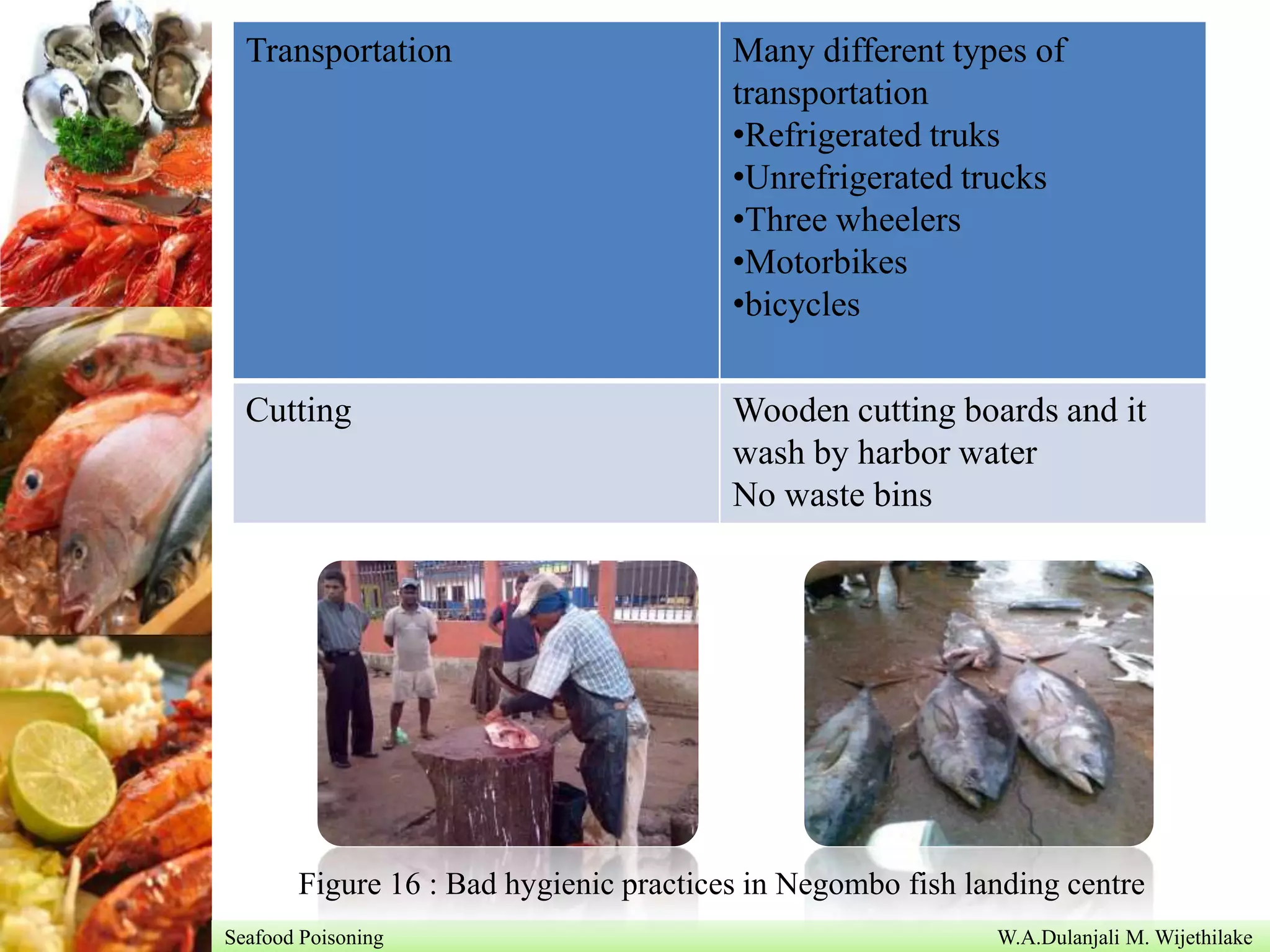
Cutting

Wooden cutting boards and it
wash by harbor water
No waste bins

Figure 16 : Bad hygienic practices in Negombo fish landing centre
Seafood Poisoning

W.A.Dulanjali M. Wijethilake
 No seafood should be collected or consumed during or for
several days after a bloom (red or green tide)

 No seafood should ever be eaten uncooked and only freshly
caught fish should be purchased
 Keep seafood on ice or refrigerated at less than 4 C to
prevent spoilage
 Keep fresh tuna, mackerel, grouper, and mahi mahi
refrigerated to prevent formation of histamine

 In the case of shrimp removing head immediately
 When catch big fishes degut first and the keep in ice
Seafood Poisoning

W.A.Dulanjali M. Wijethilake
 Freezing, drying, salting, canning and chilling may
reduced the spoilage
 Do not use bulbs when selling fish
 care should be taken when eating shellfish, and special
caution exercised with very large predatory tropical
fish
 the seafood has been cooked should be discarded, and
the viscera of any fish should not be consumed
 Proper hygienic practices

Seafood Poisoning

W.A.Dulanjali M. Wijethilake
Figure 17 : Posters exhibited in NARA – IPHT devision

Seafood Poisoning

W.A.Dulanjali M. Wijethilake
• Toxins can influence ecosystems from
both the top-down (i.e., affecting
predators and influencing grazing) and

Ecosystem

Seafood Poisoning

• from the bottom-up (i.e., affecting
plankton and benthic communities).
• Long-term effects of biotoxins on the
health of aquatic animals include
increased susceptibility to disease,
immunosuppression,
abnormal
development, and the induction of
tumors.

W.A.Dulanjali M. Wijethilake
Wildlife

Seafood Poisoning

• Fish kills, bird kills, manatees and
whales
• Sea lion mortalities - linked to the ASP
toxin passed through the food web.
• Humpback whales - associated with
domoic acid poisoning.

W.A.Dulanjali M. Wijethilake
Socioeconomic

Seafood Poisoning

• Public health impacts account for the
largest economic impacts, followed by
commercial fisheries and tourism.

W.A.Dulanjali M. Wijethilake
 Occurrence of toxins which threaten valuable
seafood resources seem to be increasing in
frequency,
intensity
and
geographic
distribution
 Overall, there are needs to develop and
validate diagnostic methods for illness,
remedial treatments, and antidotes where
appropriate.

Seafood Poisoning

W.A.Dulanjali M. Wijethilake
 Urgent need to undertake appropriate risk
assessments for marine toxins which take into
account all relevant factors

 More research is required to gain a better
understanding of the factors that determine
seafood toxicity, and to develop processes by
which intoxicated seafood can be detoxified

Seafood Poisoning

W.A.Dulanjali M. Wijethilake
 New legislation will have important
economic implications for national and
international trade

 Improved detection methods are also
urgently required to replace mouse bioassays

Seafood Poisoning

W.A.Dulanjali M. Wijethilake
 There are global distribution of seafood
poisoning cases.
 There are life threatening finfish and
shellfish poisoning in world
 Not only microalgae but also other factors
are cause for seafood poisoning

Seafood Poisoning

W.A.Dulanjali M. Wijethilake
 Occurrence of toxins which threaten valuable
seafood resources seem to be increasing in
frequency,
intensity
and
geographic
distribution
 Most seafood poisoning types are neurotoxic
and affect to CNS or Peripheral NS.

 Behind the seafood poisoning main issue is
improper hygienic practices of fishermen
 Thus long term consequences occur to
ecosystem, wild life and socioeconomic.
Seafood Poisoning

W.A.Dulanjali M. Wijethilake
 Harmful algae from
http://www.whoi.edu/redtide/page.do?pid=15315
 Jorge, R. R. (2007). Ciguatera1. 3-4.
 Mclauchlin, J., Little, C. (2007). Hobb’s Food poisoning and food
hyegiene, 7th edition. 219-222.
 Roberts, D., Greenwood, M. (2003). Practical food Microbiology,
3rd edition. 228-229.
 Science for environmental policy. Low toxic heavy metal risk for
the average Spanish consumer of sea food.
 Whittle, K., Gallacher, S. (2000). Marine toxins. Journal of British
medical bulletin, 236-253.
Seafood Poisoning

W.A.Dulanjali M. Wijethilake
Seafood Poisoning

W.A.Dulanjali M. Wijethilake

Seafood poisoning by Dulanjali M. Wijethilake

  • 3.
    EPITOME 1. • Introduction 2. • Globaldistribution of toxins 3. • Finfish poisoning 4. • Shellfish poisoning 5. • Other factors associate with seafood poisoning 6. • New and emerging toxins 7. • Detection methods of seafood poisoning 8. • Symptoms of seafood poisoning 9. • Hygienic errors for seafood poisoning 10. • Prevention, control and monitoring 11. • Long term consequences of seafood poisoning 12. • Future perspectives 13. • Sri Lankan situation of seafood poisoning 14. • Discussion Seafood Poisoning W.A.Dulanjali M. Wijethilake
  • 4.
    A group ofacute illnesses due to ingestion of contaminated finfish, bivalve mollusks and snails may result allergy, toxemia from foods, those inherently poisonous or those contaminated by poisons. Seafood containing poisons formed by bacteria or food borne infections. ( Source - medicaldictionary) Seafood Poisoning W.A.Dulanjali M. Wijethilake
  • 5.
     Seafood productsare important both nutritionally and economically  About 16% of all animal protein  Seafood Vs. other food  Toxic microscopic algae  Indigenous factors  Accumulate through food chain Seafood Poisoning W.A.Dulanjali M. Wijethilake
  • 6.
     The toxinscan produce various Neurological and gastrointestinal illness  Consumers are exposed to seafood poisoning while travelling abroad  Mainly fish and shellfish  Main issue is poisonous seafood shows no visible signs of contamination  Diagnosis may be complicated due to .. Seafood Poisoning W.A.Dulanjali M. Wijethilake
  • 7.
     Toxins normallyaccumulate in the a. Digestive gland b. Roe c. Viscera d. Flesh/muscles e. Skin  Adductor muscle in bivalve mollusks  Human activities also trigger the seafood poisoning Seafood Poisoning W.A.Dulanjali M. Wijethilake
  • 8.
    Categories of Seafoodpoisoning Finfish poisoning Shellfish poisoning 1 Scombroid fish poisoning 2 Ciguatera fish poisoning 3 Puffer fish poisoning 4 Sardine poisoning 5 Hallucinogenic fish poisoning 6 Palytoxic fish poisoning 1 Paralytic shellfish Seafood Poisoning poisoning. 2 Neurotoxic shellfish poisoning 3 Diarrhetic shellfish poisoning 4 Amnestic shellfish poisoning. 5 Azapiracid poisoning Other factors 1 Parasites 2 Bacteria 3 Viruses 4 Heavy metals 5 Red whelk poisoning W.A.Dulanjali M. Wijethilake
  • 9.
    Syndrome Amnesic shellfish poisoning (ASP) Azaspiracidshellfish poisoning (AZP) Ciguatera fish poisoning (CFP) Seafood Poisoning Affected Areas U.S. west coast including Alaska Atlantic Canada Georges Bank Chile Australia New Zealand United Kingdom England Scotland Ireland France Spain Morocco Norway Hawaii Gulf of Mexico Puerto Rico Caribbean Australia Many Pacific islands W.A.Dulanjali M. Wijethilake
  • 10.
    Diarrhetic shellfish poisoning (DSP) Neurotoxicshellfish poisoning (NSP) Paralytic shellfish poisoning (PSP) Swimmer's itch Dermatitis Seafood Poisoning Europe Japan Atlantic Canada South Africa Chile Thailand New Zealand Australia U.S. Gulf coast New Zealand U.S. west coast including Alaska New England coastal states Canada Chile Brazil Europe South Africa Asia Australia New Zealand Australia Florida worldwide throughout the tropics and subtropics W.A.Dulanjali M. Wijethilake
  • 11.
    Figure 1 :Global distribution of PSP,NSP,DSP and ASP Seafood Poisoning W.A.Dulanjali M. Wijethilake
  • 12.
    Figure 2 :Global distribution of CFP and AZP Seafood Poisoning W.A.Dulanjali M. Wijethilake
  • 13.
    1. Scombroid fishpoisoning (SFP)  Most common cause  Histamine poisoning or pseudo allergic reaction  Scombroid fish species – Tuna, Bonito and mackerel  Non scombroid fish Figure 3 : formation of histamine Seafood Poisoning W.A.Dulanjali M. Wijethilake
  • 14.
     Histidine decarboxylaseenzyme producing bacteria a. b. c. d. E.coli Klebsiella pneumonias Hafnia alvei Morganella morganii  Biogenic amines also play major role  Recommended Histamin levels I. 5mg/100g = safe II. 10-20/100g = maximum level III. >50mg/100g = unsafe Seafood Poisoning W.A.Dulanjali M. Wijethilake
  • 15.
    2. Ciguatera fishpoisoning (CFP)  Coral reef and inshore habitat fish species Eg – Barracuda, Amberjack, King mackerel, Groupers, Snappers  Toxin – Ciguatoxin (CTX) and Maitotoxin (MTX)  Agent – Gambierdiscus toxicus and benthic dinoflagellates  Mechanism Figure 4 : Structure of Ciguatoxin Seafood Poisoning W.A.Dulanjali M. Wijethilake
  • 16.
    Figure 5 :Food chain accumulation of dinoflagellates  CFP does not affect the appearance, odour and taste Seafood Poisoning W.A.Dulanjali M. Wijethilake
  • 17.
    3. Puffer fishpoisoning  Fishes include blowfish, globe fish, blue ringed octopus, gobies, starfish, horseshoe crab eggs  Toxin – Tetrodotoxin  Mechanism  Toxin concentrated in various parts Seafood Poisoning W.A.Dulanjali M. Wijethilake
  • 18.
    4. Sardine poisoning Rare and very poorly reported one  Fish species include sardines, herrings and anchovies  Toxin - unknown  But … Seafood Poisoning W.A.Dulanjali M. Wijethilake
  • 19.
    5. Hallucinogenic fishpoisoning  Ichthyoallyeinotoxism  Rare  Fish species include Siganus spinus  Exact toxin - unknown  Similarities with CFP Figure 5 : Siganus spinus Seafood Poisoning W.A.Dulanjali M. Wijethilake
  • 20.
    6. Palytoxic fishpoisoning  Grazing animals on Palythoa sp.  Toxin – Palytoxin  Neurotoxic  Similarities with CFP Seafood Poisoning Figure 6 : Palythoa sp. W.A.Dulanjali M. Wijethilake
  • 21.
    1. Paralytic shellfishpoisoning (PSP)  Most common and widespread shellfish poisoning  Toxin – Saxitoxin (STX)  Agent –Alexandrium sp., Gymnodinium catenatum and Pyrodinium spp.  Mechanism Figure 7 : Structure of saxitoxin Seafood Poisoning W.A.Dulanjali M. Wijethilake
  • 22.
    2. Neurotoxic shellfishpoisoning (NSP)  Known since centuries  Toxin – Brevetoxins  Agent – Gymnodinium breve, Karenia brevis , Karenia brevisulcatum  Mechanism Figure 8 : Structure of brevetoxin Seafood Poisoning W.A.Dulanjali M. Wijethilake
  • 23.
    3. Diarrhetic shellfishpoisoning (DSP)  Mild poisoning  Toxin – Okadaic acid and derivative  Agent – Dinophysis sp., Prorocentrum sp.  Filter feeding bivalves  Mechanism Figure 9 : Structure of Okadaic acid Seafood Poisoning W.A.Dulanjali M. Wijethilake
  • 24.
    4. Amnestic shellfishpoisoning  One of the potentially serious poisoning  Toxin – Domoic acid  Agent - Pseudonitzchia sp.  Mechanism  20µg DA/g – Safety limit Figure 10 : Structure of Domoic acid Seafood Poisoning W.A.Dulanjali M. Wijethilake
  • 25.
    5. Azaspiracid poisoning More recently discovered poisoning  Toxin – Azaspiraicd 1  Agent - Protoperidinium crassipes Figure 11 : Structure of Azaspiracid 1 Seafood Poisoning W.A.Dulanjali M. Wijethilake
  • 26.
    1. Parasites inseafood a. b. c. d. Anisakis simplex Diphyllobothrium sp. Paragonimus sp. Opisthocris sp. Figure 12 : Anisakis simplex (Leff) and Diphyllobothrium sp. (Right) Seafood Poisoning W.A.Dulanjali M. Wijethilake
  • 27.
     Protozoans a. b. c. d. Cryptosporidium parvum Entamoebahistolytica Giardia lamblia Cyclospora sp. Figure 13 : protozoans in fish species Seafood Poisoning W.A.Dulanjali M. Wijethilake
  • 28.
    2. Bacteria inseafood a. b. c. d. e. f. E.coli Staphylococcus aureus Salmonella sp. Vibrio cholerae Vibrio parahaemolyticus Listeria monocytogenes Figure 14 : Bacteria in fish species Seafood Poisoning W.A.Dulanjali M. Wijethilake
  • 29.
    3. Viruses inseafood a. Hepatitis A virus b. Norovirus 4. Heavy metals in sea food 5. Red whelk poisoning Seafood Poisoning W.A.Dulanjali M. Wijethilake
  • 30.
     The occurrenceof seafood toxins seems to be increasing and new potential food poisoning hazard 1. 2. 3. 4. Azaspiracid Cyanobacteria toxins Pfiesteria toxin Other compounds – Gymnodinine and procentrolide Seafood Poisoning W.A.Dulanjali M. Wijethilake
  • 31.
     Mouse bioassaysfor  Limitations of specificity and accuracy  Due to ethical reasons  Alternatives a. Cell culture assays b. ELISA s c. HPLC – ASP detection , Tetradotoxin d. CE-MS e. LC-MS Seafood Poisoning W.A.Dulanjali M. Wijethilake
  • 32.
    f. Ion exchangechromatography – Histamin g. Capillary zone electrophoresis – Histamin h. High voltage electrophoresis - Tetramine Figure 15 : Ion exchange chromatography machine Seafood Poisoning W.A.Dulanjali M. Wijethilake
  • 33.
    Syndrome Symptoms Scombroid poisoning Breathing problems(in severe cases) Extremely red skin on face and body Flushing Hives and itching Nausea Vomiting Ciguatera fish poisoning Abdominal cramps Diarrhea (severe and watery) Nausea Vomiting Tetradotoxin fish poisoning Paresthesia of the lips and tongue Hypersalivation Sweating Headache Weakness lethargy Seafood Poisoning W.A.Dulanjali M. Wijethilake
  • 34.
    Paralytic shellfish poisoning Numbnessor tingling in mouth. This sensation may spread down to arms and legs. become very dizzy, have a headache in some cases, arms and legs may become temporarily paralyzed Neurotoxic shellfish poisoning The symptoms are very similar to Ciguatera poisoning Amnestic shellfish poisoning With nausea, vomiting, and diarrhea, followed by short-term memory loss, as well as other less frequent neurologic symptoms. Seafood Poisoning W.A.Dulanjali M. Wijethilake
  • 35.
    Fish hygiene relatesto “All conditions and measures necessary to ensure the safety and suitability at all stages of the fish handling". These hygienic measures  aim at preventing or reducing contamination and microbial growth. Seafood Poisoning fish W.A.Dulanjali M. Wijethilake
  • 36.
     Aspects relatedto the hygienic design of facilities during • On-board, • Transportation • Processing and distribution • Personnel hygiene • Cleaning and sanitation Seafood Poisoning W.A.Dulanjali M. Wijethilake
  • 37.
    Faults doing byfishermen Situation Errors Fish in hold Fish kept in melted water Loosening ice with harbour water No sorting by species or catching date Unloading Unload straight on to pier by hand Pier is highly contaminated due to.. Pier is used for auctioning and packing Washing Use contaminated harbour water Washing water not change frequently Reloading Inappropriate vehicles Icing not done correctly Cross contamination Seafood Poisoning W.A.Dulanjali M. Wijethilake
  • 38.
    Transportation Many different typesof transportation •Refrigerated truks •Unrefrigerated trucks •Three wheelers •Motorbikes •bicycles Cutting Wooden cutting boards and it wash by harbor water No waste bins Figure 16 : Bad hygienic practices in Negombo fish landing centre Seafood Poisoning W.A.Dulanjali M. Wijethilake
  • 39.
     No seafoodshould be collected or consumed during or for several days after a bloom (red or green tide)  No seafood should ever be eaten uncooked and only freshly caught fish should be purchased  Keep seafood on ice or refrigerated at less than 4 C to prevent spoilage  Keep fresh tuna, mackerel, grouper, and mahi mahi refrigerated to prevent formation of histamine  In the case of shrimp removing head immediately  When catch big fishes degut first and the keep in ice Seafood Poisoning W.A.Dulanjali M. Wijethilake
  • 40.
     Freezing, drying,salting, canning and chilling may reduced the spoilage  Do not use bulbs when selling fish  care should be taken when eating shellfish, and special caution exercised with very large predatory tropical fish  the seafood has been cooked should be discarded, and the viscera of any fish should not be consumed  Proper hygienic practices Seafood Poisoning W.A.Dulanjali M. Wijethilake
  • 41.
    Figure 17 :Posters exhibited in NARA – IPHT devision Seafood Poisoning W.A.Dulanjali M. Wijethilake
  • 42.
    • Toxins caninfluence ecosystems from both the top-down (i.e., affecting predators and influencing grazing) and Ecosystem Seafood Poisoning • from the bottom-up (i.e., affecting plankton and benthic communities). • Long-term effects of biotoxins on the health of aquatic animals include increased susceptibility to disease, immunosuppression, abnormal development, and the induction of tumors. W.A.Dulanjali M. Wijethilake
  • 43.
    Wildlife Seafood Poisoning • Fishkills, bird kills, manatees and whales • Sea lion mortalities - linked to the ASP toxin passed through the food web. • Humpback whales - associated with domoic acid poisoning. W.A.Dulanjali M. Wijethilake
  • 44.
    Socioeconomic Seafood Poisoning • Publichealth impacts account for the largest economic impacts, followed by commercial fisheries and tourism. W.A.Dulanjali M. Wijethilake
  • 45.
     Occurrence oftoxins which threaten valuable seafood resources seem to be increasing in frequency, intensity and geographic distribution  Overall, there are needs to develop and validate diagnostic methods for illness, remedial treatments, and antidotes where appropriate. Seafood Poisoning W.A.Dulanjali M. Wijethilake
  • 46.
     Urgent needto undertake appropriate risk assessments for marine toxins which take into account all relevant factors  More research is required to gain a better understanding of the factors that determine seafood toxicity, and to develop processes by which intoxicated seafood can be detoxified Seafood Poisoning W.A.Dulanjali M. Wijethilake
  • 47.
     New legislationwill have important economic implications for national and international trade  Improved detection methods are also urgently required to replace mouse bioassays Seafood Poisoning W.A.Dulanjali M. Wijethilake
  • 48.
     There areglobal distribution of seafood poisoning cases.  There are life threatening finfish and shellfish poisoning in world  Not only microalgae but also other factors are cause for seafood poisoning Seafood Poisoning W.A.Dulanjali M. Wijethilake
  • 49.
     Occurrence oftoxins which threaten valuable seafood resources seem to be increasing in frequency, intensity and geographic distribution  Most seafood poisoning types are neurotoxic and affect to CNS or Peripheral NS.  Behind the seafood poisoning main issue is improper hygienic practices of fishermen  Thus long term consequences occur to ecosystem, wild life and socioeconomic. Seafood Poisoning W.A.Dulanjali M. Wijethilake
  • 50.
     Harmful algaefrom http://www.whoi.edu/redtide/page.do?pid=15315  Jorge, R. R. (2007). Ciguatera1. 3-4.  Mclauchlin, J., Little, C. (2007). Hobb’s Food poisoning and food hyegiene, 7th edition. 219-222.  Roberts, D., Greenwood, M. (2003). Practical food Microbiology, 3rd edition. 228-229.  Science for environmental policy. Low toxic heavy metal risk for the average Spanish consumer of sea food.  Whittle, K., Gallacher, S. (2000). Marine toxins. Journal of British medical bulletin, 236-253. Seafood Poisoning W.A.Dulanjali M. Wijethilake
  • 51.