Humanitarian Assistance, Social
Services during Disaster Situations &
DSWD National Response Plan
Presented by:
ERIC R. ROSILLO, LPT, MCDRM
National Cadre on Crisis & Disaster Risk Management
DILG-PPSC MCDRM Class KADASIG, 2019-6876
Local DRRM Officer III
Scope of Presentation
•United Nations Office for the Coordination of
Humanitarian Affairs (UN OCHA)
•International & Local Coordination Mechanism
& Cluster Approach During Disaster Relief
•DSWD National Response Action Plan
Objectives
•Participants will be able to know the
Coordination mechanism in doing humanitarian
efforts;
•Participants will be able to work effectively with
their local counterpart in giving social services
and relief assistance;
•Participants will be able to learn the DSWD
National Response Plan according to their
respective agencies.
Video Clip of Humanitarian Principle
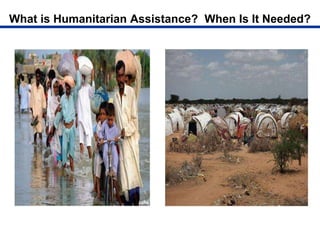
What is Humanitarian Assistance? When Is It Needed?
Objectives of Humanitarian Assistance
To save lives, alleviate suffering, and minimize the
economic costs of conflict, disasters and displacement.
Humanitarian assistance is provided on the basis of
need according to principles of universality, impartiality
and human dignity.
Source: UN OCHA
UN OCHA is part of the United Nations Secretariat
responsible for bringing together humanitarian actors to
ensure a coherent response to emergencies & disasters.
OCHA also ensures there is a framework within which each
actor can contribute to the overall response effort.
The State of the Displaced (as of end 2010)
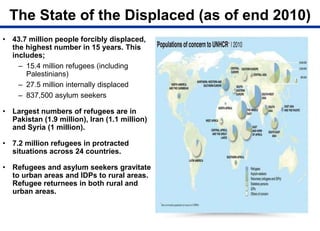
• 43.7 million people forcibly displaced,
the highest number in 15 years. This
includes;
– 15.4 million refugees (including
Palestinians)
– 27.5 million internally displaced
– 837,500 asylum seekers
• Largest numbers of refugees are in
Pakistan (1.9 million), Iran (1.1 million)
and Syria (1 million).
• 7.2 million refugees in protracted
situations across 24 countries.
• Refugees and asylum seekers gravitate
to urban areas and IDPs to rural areas.
Refugee returnees in both rural and
urban areas.
UN OCHA Data Displaced Individuals as of
2020
More than 82 million people
worldwide are forcibly
displaced due to conflict and
natural disasters.
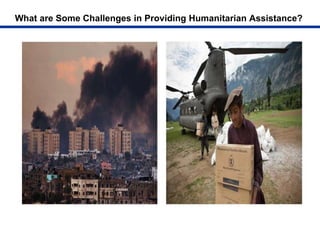
What are Some Challenges in Providing Humanitarian Assistance?
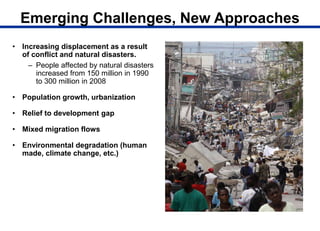
Emerging Challenges, New Approaches
• Increasing displacement as a result
of conflict and natural disasters.
– People affected by natural disasters
increased from 150 million in 1990
to 300 million in 2008
• Population growth, urbanization
• Relief to development gap
• Mixed migration flows
• Environmental degradation (human
made, climate change, etc.)
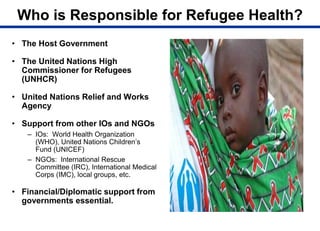
Who is Responsible for Refugee Health?
• The Host Government
• The United Nations High
Commissioner for Refugees
(UNHCR)
• United Nations Relief and Works
Agency
• Support from other IOs and NGOs
– IOs: World Health Organization
(WHO), United Nations Children’s
Fund (UNICEF)
– NGOs: International Rescue
Committee (IRC), International Medical
Corps (IMC), local groups, etc.
• Financial/Diplomatic support from
governments essential.
Who is Responsible for the Health of IDPs?
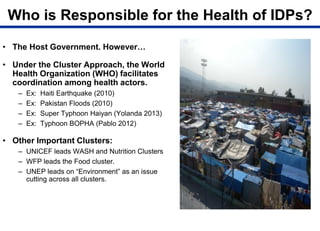
• The Host Government. However…
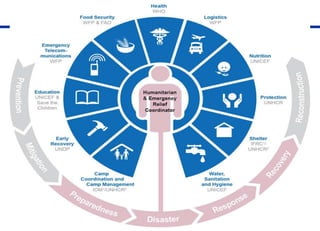
• Under the Cluster Approach, the World
Health Organization (WHO) facilitates
coordination among health actors.
– Ex: Haiti Earthquake (2010)
– Ex: Pakistan Floods (2010)
– Ex: Super Typhoon Haiyan (Yolanda 2013)
– Ex: Typhoon BOPHA (Pablo 2012)
• Other Important Clusters:
– UNICEF leads WASH and Nutrition Clusters
– WFP leads the Food cluster.
– UNEP leads on “Environment” as an issue
cutting across all clusters.
Best Practices in Refugee Health
• Health services for refugees are
accessible to the host community.
• Health services are provided at a level
comparable to that of the host country.
• Health services meet minimum
standards, as laid out in the Sphere
Handbook and UNHCR Guidelines.
• Programs build the capacity of refugees
to plan, carry out and monitor health
programs.
• Programs take into account age, gender,
and diversity (Sex Disaggregated Data).
Environmental Issue # One: Land
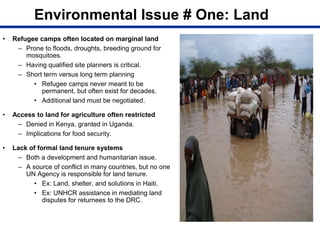
• Refugee camps often located on marginal land
– Prone to floods, droughts, breeding ground for
mosquitoes.
– Having qualified site planners is critical.
– Short term versus long term planning
• Refugee camps never meant to be
permanent, but often exist for decades.
• Additional land must be negotiated.
• Access to land for agriculture often restricted
– Denied in Kenya, granted in Uganda.
– Implications for food security.
• Lack of formal land tenure systems
– Both a development and humanitarian issue.
– A source of conflict in many countries, but no one
UN Agency is responsible for land tenure.
• Ex: Land, shelter, and solutions in Haiti.
• Ex: UNHCR assistance in mediating land
disputes for returnees to the DRC.
Environmental Issue # Two: Water
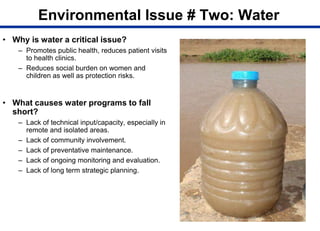
• Why is water a critical issue?
– Promotes public health, reduces patient visits
to health clinics.
– Reduces social burden on women and
children as well as protection risks.
• What causes water programs to fall
short?
– Lack of technical input/capacity, especially in
remote and isolated areas.
– Lack of community involvement.
– Lack of preventative maintenance.
– Lack of ongoing monitoring and evaluation.
– Lack of long term strategic planning.
Water (Cont.)
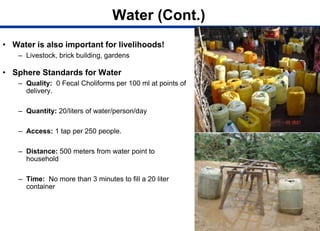
• Water is also important for livelihoods!
– Livestock, brick building, gardens
• Sphere Standards for Water
– Quality: 0 Fecal Choliforms per 100 ml at points of
delivery.
– Quantity: 20/liters of water/person/day
– Access: 1 tap per 250 people.
– Distance: 500 meters from water point to
household
– Time: No more than 3 minutes to fill a 20 liter
container
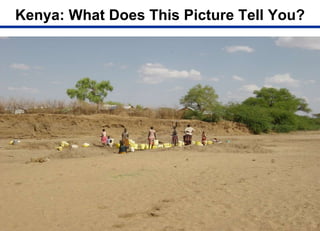
Kenya: What Does This Picture Tell You?
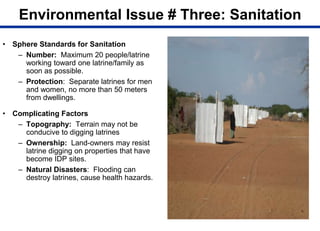
Environmental Issue # Three: Sanitation
• Sphere Standards for Sanitation
– Number: Maximum 20 people/latrine
working toward one latrine/family as
soon as possible.
– Protection: Separate latrines for men
and women, no more than 50 meters
from dwellings.
• Complicating Factors
– Topography: Terrain may not be
conducive to digging latrines
– Ownership: Land-owners may resist
latrine digging on properties that have
become IDP sites.
– Natural Disasters: Flooding can
destroy latrines, cause health hazards.
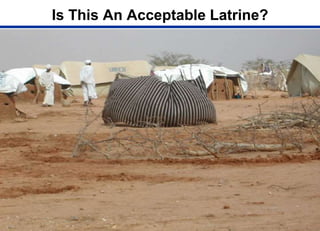
Is This An Acceptable Latrine?
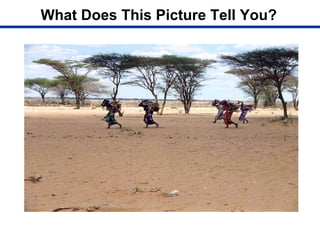
What Does This Picture Tell You?
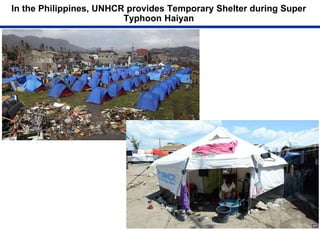
In the Philippines, UNHCR provides Temporary Shelter during Super
Typhoon Haiyan
DSWD
Disaster Response
Management
Operations
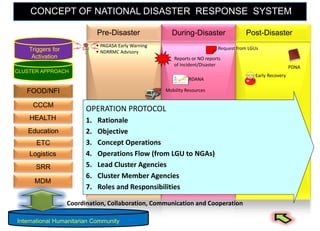
NATIONAL DISASTER
RESPONSE PLAN (NDRP)
Pre-Disaster During-Disaster Post-Disaster
Triggers for
Activation
CONCEPT OF NATIONAL DISASTER RESPONSE SYSTEM
FOOD/NFI
CCCM
Education
ETC
MDM
CLUSTER APPROACH
OPERATION PROTOCOL
1. Rationale
2. Objective
3. Concept Operations
4. Operations Flow (from LGU to NGAs)
5. Lead Cluster Agencies
6. Cluster Member Agencies
7. Roles and Responsibilities
Reports or NO reports
of Incident/Disaster
Request from LGUs
 PAGASA Early Warning
 NDRRMC Advisory
RDANA
PDNA
Mobility Resources
Early Recovery
International Humanitarian Community
Coordination, Collaboration, Communication and Cooperation
HEALTH
Logistics
SRR
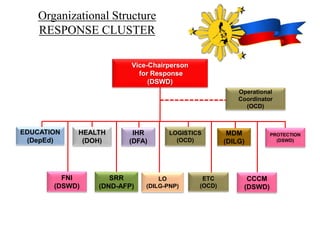
Organizational Structure
RESPONSE CLUSTER
Vice-Chairperson
for Response
(DSWD)
LOGISTICS
(OCD)
FNI
(DSWD)
MDM
(DILG)
SRR
(DND-AFP)
EDUCATION
(DepEd)
HEALTH
(DOH)
IHR
(DFA)
LO
(DILG-PNP)
Operational
Coordinator
(OCD)
ETC
(OCD)
CCCM
(DSWD)
PROTECTION
(DSWD)
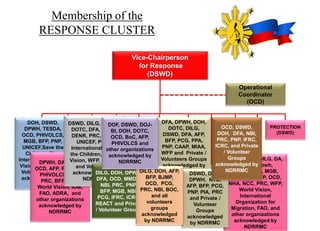
Membership of the
RESPONSE CLUSTER
LOGISTICS
(OCD)
FNI
(DSWD)
MDM
(DILG)
SRR
(DND-AFP)
EDUCATION
(DepEd)
HEALTH
(DOH)
IHR
(DFA)
LAO
(DILG-PNP)
ETC
(OCD)
CCCM
(DSWD)
PROTECTION
(DSWD)
DOH, DSWD,
DPWH, TESDA,
OCD, PHIVOLCS,
MGB, BFP, PNP,
UNICEF,Save the
Children, Plan
International, World
Vision, Private and
Volunteer Groups
acknowledged by
NDRRMC
DOH-HEMS, DILG, DA,
DepED, dpwh,
PHILVOLCS, MGB,
PCG, BFP, AFP, OCD,
NHA, NCC, PRC, WFP,
World Vision,
International
Organization for
Migration, FAO, and
other organizations
acknowledged by
NDRRMC
DPWH, DA, DOH,
OCD, AFP, PNP, BFP,
PHIVOLCS, NFA,
PRC, BFP, WFP,
World Vision, IOM,
FAO, ADRA, and
other organizations
acknowledged by
NDRRMC
DSWD, DILG, DepED,
DOTC, DFA, DOST,
DENR, PRC, WHO,
UNICEF, PLAN
International, Save
the Children, World
Vision, WFP, Private
and Volunteers
acknowledged by
NDRRMC
DFA, DPWH, DOH,
DOTC, DILG,
DSWD, DFA, AFP,
BFP, PCG, PPA,
PNP, CAAP, MIAA,
WFP and Private /
Volunteers Groups
acknowledged by
NDRRMC
DSWD, DOH,
DPWH, NTC,
AFP, BFP, PCG,
PNP, PIA, PRC
and Private /
Volunteer
Groups
acknowledged
by NDRRMC
DILG, DOH, DPWH,
DFA, OCD, MMDA,
NBI, PRC, PNP,
BFP, MGB, NBI,
PCG, IFRC, ICRC,
REACT and Private
/ Volunteer Groups
OCD, DSWD,
DOH, DFA, NBI,
PRC, PNP, IFRC,
ICRC, and Private
/ Volunteer
Groups
acknowledged by
NDRRMC
Vice-Chairperson
for Response
(DSWD)
Operational
Coordinator
(OCD)
DILG, DOH, AFP,
BFP, BJMP,
OCD, PCG,
PRC, NBI, BOC,
and all
volunteers
groups
acknowledged
by NDRRMC
DOF, DSWD, DOJ-
BI, DOH, DOTC,
OCD, BoC, AFP,
PHIVOLCS and
other organizations
acknowledged by
NDRRMC
NDRRMC
HCT, NGO,
INGO, ICSO,
CSO, other
organizations
acknowledged
by NDRRMC
ACTION:
NDRRMC recommends
for the following actions:
 Response Cluster
activation;
 Declaration of
National State of
Calamity; and
 Call for International
Humanitarian
Assistance.
LEAD, RESPONSE
CLUSTER and NIMT
ACTION:
Lead, Response Cluster
and NIMT:
 Coordinates with the
affected LGUs for
appropriate deployment
and conduct of RDANA
operations;
 Submit reports to
NDRRMC; and
 Provides needs of
affected LGUs
ACTION:
Response Clusters and NIMT:
• Acted on REPORTS from the
affected LGUs through the Crisis
Managers (Region, Province,
City/Municipal);
• Deployed RDT at the affected
areas to conduct RDANA; and
• Conduct consequence
management operations
Emergency
Operations Center
(EOC) at LGUs
ACTION:
Without Report
ASSUMPTION:
EOC INSTALLED
by the Rapid
Response Team will
function with
members of the
National Response
Cluster & NIMT with
or without LCEs of
the affected LGUs.
Incident
Command
Posts at LGUs
NATIONAL
IMT
OpCens of
Warning
Agencies
PAGASA
PHIVOLCS
MGB
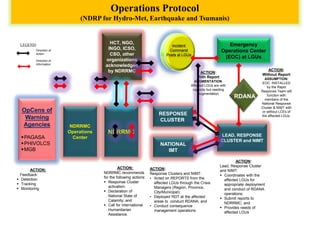
Operations Protocol
(NDRP for Hydro-Met, Earthquake and Tsumanis)
ACTION:
With Report
AUGMENTATION:
Affected LGUs are with
capacity but needing
augmentation
LEGEND:
Direction of
action
Direction of
Information
RESPONSE
CLUSTER
RDANA
ACTION:
Feedback:
 Detection
 Tracking
 Monitoring
NDRRMC
Operations
Center
Alert
Level
ALPHA
LDRRMC
Alert
Level
BRAVO
PDRRMC
Alert Level
CHARLIE
RDRRMC
Alert Level
DELTA
NDRRMC
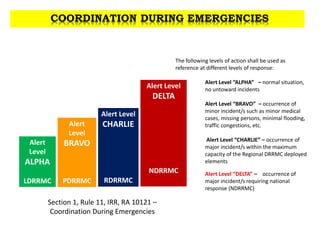
COORDINATION DURING EMERGENCIES
The following levels of action shall be used as
reference at different levels of response:
Alert Level “ALPHA” – normal situation,
no untoward incidents
Alert Level “BRAVO” – occurrence of
minor incident/s such as minor medical
cases, missing persons, minimal flooding,
traffic congestions, etc.
Alert Level “CHARLIE” – occurrence of
major incident/s within the maximum
capacity of the Regional DRRMC deployed
elements
Alert Level “DELTA” – occurrence of
major incident/s requiring national
response (NDRRMC)
Section 1, Rule 11, IRR, RA 10121 –
Coordination During Emergencies
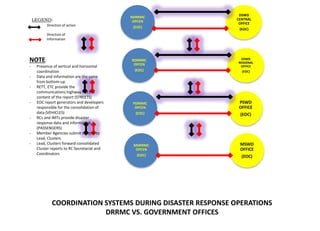
COORDINATION SYSTEMS DURING DISASTER RESPONSE OPERATIONS
DRRMC VS. GOVERNMENT OFFICES
NDRRMC
OPCEN
(EOC)
DSWD
CENTRAL
OFFICE
(EOC)
RDRRMC
OPCEN
(EOC)
DSWD
REGIONAL
OFFICE
(EOC)
LEGEND:
Direction of action
Direction of
Information
PDRRMC
OPCEN
(EOC)
PSWD
OFFICE
(EOC)
MDRRMC
OPCEN
(EOC)
MSWD
OFFICE
(EOC)
NOTE:
- Presence of vertical and horizontal
coordination
- Data and Information are the same
from bottom-up
- RETT, ETC provide the
communications highway not the
content of the report (STREETS)
- EOC report generators and developers
responsible for the consolidation of
data (VEHICLES)
- RCs and IMTs provide disaster
response data and information
(PASSENGERS)
- Member Agencies submit reports to
Lead, Clusters
- Lead, Clusters forward consolidated
Cluster reports to RC Secretariat and
Coordinators
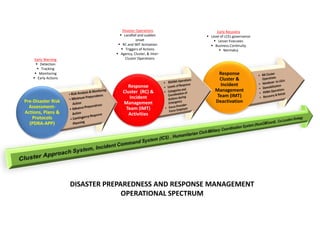
Response
Cluster &
Incident
Management
Team (IMT)
Deactivation
Response
Cluster (RC) &
Incident
Management
Team (IMT)
Activities
Pre-Disaster Risk
Assessment-
Actions, Plans &
Protocols
(PDRA-APP)
Early Warning
 Detection
 Tracking
 Monitoring
 Early Actions
Disaster Operations
 Landfall and sudden
onset
 RC and IMT Activation
 Triggers of Actions
 Agency, Cluster, & Inter-
Cluster Operations
Early Recovery
 Level of LCEs governance
 Lesser Evacuees
 Business Continuity
 Normalcy
DISASTER PREPAREDNESS AND RESPONSE MANAGEMENT
OPERATIONAL SPECTRUM
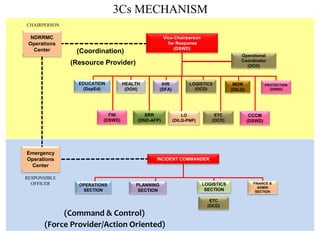
3Cs MECHANISM
Vice-Chairperson
for Response
(DSWD)
LOGISTICS
(OCD)
FNI
(DSWD)
MDM
(DILG)
SRR
(DND-AFP)
EDUCATION
(DepEd)
HEALTH
(DOH)
IHR
(DFA)
LO
(DILG-PNP)
Operational
Coordinator
(OCD)
ETC
(OCD)
CCCM
(DSWD)
PROTECTION
(DSWD)
Emergency
Operations
Center
NDRRMC
Operations
Center
INCIDENT COMMANDER
LOGISTICS
SECTION
OPERATIONS
SECTION
PLANNING
SECTION
FINANCE &
ADMIN
SECTION
(Resource Provider)
(Command & Control)
CHAIRPERSON
RESPONSIBLE
OFFICER
ETC
(OCD)
(Coordination)
(Force Provider/Action Oriented)
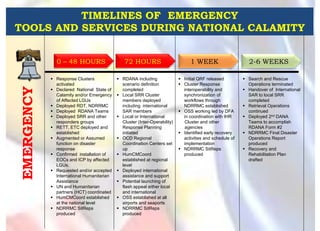
TIMELINES OF EMERGENCY
TOOLS AND SERVICES DURING NATIONAL CALAMITY
0 – 48 HOURS
 Response Clusters
activated
 Declared National State of
Calamity and/or Emergency
of Affected LGUs
 Deployed RDT, NDRRMC
 Deployed RDANA Teams
 Deployed SRR and other
responders groups
 RETT, ETC deployed and
established
 Augmented or Assumed
function on disaster
response
 Confirmed installation of
EOCs and ICP by affected
LGUs.
 Requested and/or accepted
International Humanitarian
Assistance
 UN and Humanitarian
partners (HCT) coordinated
 HumCMCoord established
at the national level
 NDRRMC SitReps
produced
EMERGENCY
72 HOURS
 RDANA including
scenario definition
completed
 Local SRR Cluster
members deployed
including international
SAR members
 Local or International
Cluster (Inter-Operability)
Response Planning
initiated
 OCD Regional
Coordination Centers set
up
 HumCMCoord
established at regional
level
 Deployed international
assistance and support
 Potential launching of
flash appeal either local
and international
 OSS established at all
airports and seaports
 NDRRMC SitReps
produced
1 WEEK
 Initial QRF released
 Cluster Response
interoperability and
synchronization of
workflows through
NDRRMC established
 OSS working led by DFA
in coordination with IHR
Cluster and other
agencies
 Identified early recovery
activities and schedule of
implementation
 NDRRMC SitReps
produced
2-6 WEEKS
 Search and Rescue
Operations terminated
 Handover of International
SAR to local SRR
completed
 Retrieval Operations
continued
 Deployed 2nd DANA
Teams to accomplish
RDANA Form #2
 NDRRMC Final Disaster
Operations Report
produced
 Recovery and
Rehabilitation Plan
drafted
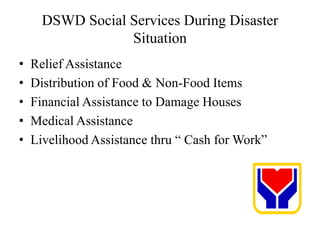
DSWD Social Services During Disaster
Situation
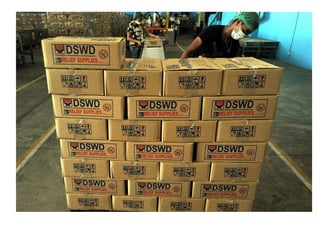
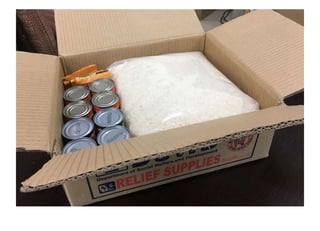
• Relief Assistance
• Distribution of Food & Non-Food Items
• Financial Assistance to Damage Houses
• Medical Assistance
• Livelihood Assistance thru “ Cash for Work”
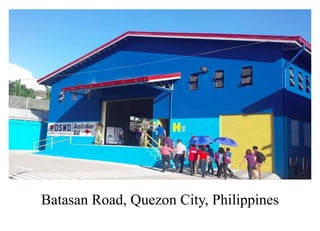
Batasan Road, Quezon City, Philippines
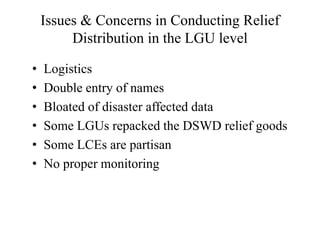
Issues & Concerns in Conducting Relief
Distribution in the LGU level
• Logistics
• Double entry of names
• Bloated of disaster affected data
• Some LGUs repacked the DSWD relief goods
• Some LCEs are partisan
• No proper monitoring
Humanitarian Assitance & Social Services.ppt

Humanitarian Assitance & Social Services.ppt

  • 1.
    Humanitarian Assistance, Social Servicesduring Disaster Situations & DSWD National Response Plan Presented by: ERIC R. ROSILLO, LPT, MCDRM National Cadre on Crisis & Disaster Risk Management DILG-PPSC MCDRM Class KADASIG, 2019-6876 Local DRRM Officer III
  • 2.
    Scope of Presentation •UnitedNations Office for the Coordination of Humanitarian Affairs (UN OCHA) •International & Local Coordination Mechanism & Cluster Approach During Disaster Relief •DSWD National Response Action Plan
  • 3.
    Objectives •Participants will beable to know the Coordination mechanism in doing humanitarian efforts; •Participants will be able to work effectively with their local counterpart in giving social services and relief assistance; •Participants will be able to learn the DSWD National Response Plan according to their respective agencies.
  • 4.
    Video Clip ofHumanitarian Principle
  • 5.
    What is HumanitarianAssistance? When Is It Needed?
  • 6.
    Objectives of HumanitarianAssistance To save lives, alleviate suffering, and minimize the economic costs of conflict, disasters and displacement. Humanitarian assistance is provided on the basis of need according to principles of universality, impartiality and human dignity. Source: UN OCHA
  • 7.
    UN OCHA ispart of the United Nations Secretariat responsible for bringing together humanitarian actors to ensure a coherent response to emergencies & disasters. OCHA also ensures there is a framework within which each actor can contribute to the overall response effort.
  • 9.
    The State ofthe Displaced (as of end 2010) • 43.7 million people forcibly displaced, the highest number in 15 years. This includes; – 15.4 million refugees (including Palestinians) – 27.5 million internally displaced – 837,500 asylum seekers • Largest numbers of refugees are in Pakistan (1.9 million), Iran (1.1 million) and Syria (1 million). • 7.2 million refugees in protracted situations across 24 countries. • Refugees and asylum seekers gravitate to urban areas and IDPs to rural areas. Refugee returnees in both rural and urban areas.
  • 10.
    UN OCHA DataDisplaced Individuals as of 2020 More than 82 million people worldwide are forcibly displaced due to conflict and natural disasters.
  • 11.
    What are SomeChallenges in Providing Humanitarian Assistance?
  • 12.
    Emerging Challenges, NewApproaches • Increasing displacement as a result of conflict and natural disasters. – People affected by natural disasters increased from 150 million in 1990 to 300 million in 2008 • Population growth, urbanization • Relief to development gap • Mixed migration flows • Environmental degradation (human made, climate change, etc.)
  • 13.
    Who is Responsiblefor Refugee Health? • The Host Government • The United Nations High Commissioner for Refugees (UNHCR) • United Nations Relief and Works Agency • Support from other IOs and NGOs – IOs: World Health Organization (WHO), United Nations Children’s Fund (UNICEF) – NGOs: International Rescue Committee (IRC), International Medical Corps (IMC), local groups, etc. • Financial/Diplomatic support from governments essential.
  • 14.
    Who is Responsiblefor the Health of IDPs? • The Host Government. However… • Under the Cluster Approach, the World Health Organization (WHO) facilitates coordination among health actors. – Ex: Haiti Earthquake (2010) – Ex: Pakistan Floods (2010) – Ex: Super Typhoon Haiyan (Yolanda 2013) – Ex: Typhoon BOPHA (Pablo 2012) • Other Important Clusters: – UNICEF leads WASH and Nutrition Clusters – WFP leads the Food cluster. – UNEP leads on “Environment” as an issue cutting across all clusters.
  • 15.
    Best Practices inRefugee Health • Health services for refugees are accessible to the host community. • Health services are provided at a level comparable to that of the host country. • Health services meet minimum standards, as laid out in the Sphere Handbook and UNHCR Guidelines. • Programs build the capacity of refugees to plan, carry out and monitor health programs. • Programs take into account age, gender, and diversity (Sex Disaggregated Data).
  • 16.
    Environmental Issue #One: Land • Refugee camps often located on marginal land – Prone to floods, droughts, breeding ground for mosquitoes. – Having qualified site planners is critical. – Short term versus long term planning • Refugee camps never meant to be permanent, but often exist for decades. • Additional land must be negotiated. • Access to land for agriculture often restricted – Denied in Kenya, granted in Uganda. – Implications for food security. • Lack of formal land tenure systems – Both a development and humanitarian issue. – A source of conflict in many countries, but no one UN Agency is responsible for land tenure. • Ex: Land, shelter, and solutions in Haiti. • Ex: UNHCR assistance in mediating land disputes for returnees to the DRC.
  • 17.
    Environmental Issue #Two: Water • Why is water a critical issue? – Promotes public health, reduces patient visits to health clinics. – Reduces social burden on women and children as well as protection risks. • What causes water programs to fall short? – Lack of technical input/capacity, especially in remote and isolated areas. – Lack of community involvement. – Lack of preventative maintenance. – Lack of ongoing monitoring and evaluation. – Lack of long term strategic planning.
  • 18.
    Water (Cont.) • Wateris also important for livelihoods! – Livestock, brick building, gardens • Sphere Standards for Water – Quality: 0 Fecal Choliforms per 100 ml at points of delivery. – Quantity: 20/liters of water/person/day – Access: 1 tap per 250 people. – Distance: 500 meters from water point to household – Time: No more than 3 minutes to fill a 20 liter container
  • 19.
    Kenya: What DoesThis Picture Tell You?
  • 20.
    Environmental Issue #Three: Sanitation • Sphere Standards for Sanitation – Number: Maximum 20 people/latrine working toward one latrine/family as soon as possible. – Protection: Separate latrines for men and women, no more than 50 meters from dwellings. • Complicating Factors – Topography: Terrain may not be conducive to digging latrines – Ownership: Land-owners may resist latrine digging on properties that have become IDP sites. – Natural Disasters: Flooding can destroy latrines, cause health hazards.
  • 21.
    Is This AnAcceptable Latrine?
  • 22.
    What Does ThisPicture Tell You?
  • 23.
    In the Philippines,UNHCR provides Temporary Shelter during Super Typhoon Haiyan
  • 24.
  • 25.
  • 26.
    Pre-Disaster During-Disaster Post-Disaster Triggersfor Activation CONCEPT OF NATIONAL DISASTER RESPONSE SYSTEM FOOD/NFI CCCM Education ETC MDM CLUSTER APPROACH OPERATION PROTOCOL 1. Rationale 2. Objective 3. Concept Operations 4. Operations Flow (from LGU to NGAs) 5. Lead Cluster Agencies 6. Cluster Member Agencies 7. Roles and Responsibilities Reports or NO reports of Incident/Disaster Request from LGUs  PAGASA Early Warning  NDRRMC Advisory RDANA PDNA Mobility Resources Early Recovery International Humanitarian Community Coordination, Collaboration, Communication and Cooperation HEALTH Logistics SRR
  • 27.
    Organizational Structure RESPONSE CLUSTER Vice-Chairperson forResponse (DSWD) LOGISTICS (OCD) FNI (DSWD) MDM (DILG) SRR (DND-AFP) EDUCATION (DepEd) HEALTH (DOH) IHR (DFA) LO (DILG-PNP) Operational Coordinator (OCD) ETC (OCD) CCCM (DSWD) PROTECTION (DSWD)
  • 28.
    Membership of the RESPONSECLUSTER LOGISTICS (OCD) FNI (DSWD) MDM (DILG) SRR (DND-AFP) EDUCATION (DepEd) HEALTH (DOH) IHR (DFA) LAO (DILG-PNP) ETC (OCD) CCCM (DSWD) PROTECTION (DSWD) DOH, DSWD, DPWH, TESDA, OCD, PHIVOLCS, MGB, BFP, PNP, UNICEF,Save the Children, Plan International, World Vision, Private and Volunteer Groups acknowledged by NDRRMC DOH-HEMS, DILG, DA, DepED, dpwh, PHILVOLCS, MGB, PCG, BFP, AFP, OCD, NHA, NCC, PRC, WFP, World Vision, International Organization for Migration, FAO, and other organizations acknowledged by NDRRMC DPWH, DA, DOH, OCD, AFP, PNP, BFP, PHIVOLCS, NFA, PRC, BFP, WFP, World Vision, IOM, FAO, ADRA, and other organizations acknowledged by NDRRMC DSWD, DILG, DepED, DOTC, DFA, DOST, DENR, PRC, WHO, UNICEF, PLAN International, Save the Children, World Vision, WFP, Private and Volunteers acknowledged by NDRRMC DFA, DPWH, DOH, DOTC, DILG, DSWD, DFA, AFP, BFP, PCG, PPA, PNP, CAAP, MIAA, WFP and Private / Volunteers Groups acknowledged by NDRRMC DSWD, DOH, DPWH, NTC, AFP, BFP, PCG, PNP, PIA, PRC and Private / Volunteer Groups acknowledged by NDRRMC DILG, DOH, DPWH, DFA, OCD, MMDA, NBI, PRC, PNP, BFP, MGB, NBI, PCG, IFRC, ICRC, REACT and Private / Volunteer Groups OCD, DSWD, DOH, DFA, NBI, PRC, PNP, IFRC, ICRC, and Private / Volunteer Groups acknowledged by NDRRMC Vice-Chairperson for Response (DSWD) Operational Coordinator (OCD) DILG, DOH, AFP, BFP, BJMP, OCD, PCG, PRC, NBI, BOC, and all volunteers groups acknowledged by NDRRMC DOF, DSWD, DOJ- BI, DOH, DOTC, OCD, BoC, AFP, PHIVOLCS and other organizations acknowledged by NDRRMC
  • 29.
    NDRRMC HCT, NGO, INGO, ICSO, CSO,other organizations acknowledged by NDRRMC ACTION: NDRRMC recommends for the following actions:  Response Cluster activation;  Declaration of National State of Calamity; and  Call for International Humanitarian Assistance. LEAD, RESPONSE CLUSTER and NIMT ACTION: Lead, Response Cluster and NIMT:  Coordinates with the affected LGUs for appropriate deployment and conduct of RDANA operations;  Submit reports to NDRRMC; and  Provides needs of affected LGUs ACTION: Response Clusters and NIMT: • Acted on REPORTS from the affected LGUs through the Crisis Managers (Region, Province, City/Municipal); • Deployed RDT at the affected areas to conduct RDANA; and • Conduct consequence management operations Emergency Operations Center (EOC) at LGUs ACTION: Without Report ASSUMPTION: EOC INSTALLED by the Rapid Response Team will function with members of the National Response Cluster & NIMT with or without LCEs of the affected LGUs. Incident Command Posts at LGUs NATIONAL IMT OpCens of Warning Agencies PAGASA PHIVOLCS MGB Operations Protocol (NDRP for Hydro-Met, Earthquake and Tsumanis) ACTION: With Report AUGMENTATION: Affected LGUs are with capacity but needing augmentation LEGEND: Direction of action Direction of Information RESPONSE CLUSTER RDANA ACTION: Feedback:  Detection  Tracking  Monitoring NDRRMC Operations Center
  • 30.
    Alert Level ALPHA LDRRMC Alert Level BRAVO PDRRMC Alert Level CHARLIE RDRRMC Alert Level DELTA NDRRMC COORDINATIONDURING EMERGENCIES The following levels of action shall be used as reference at different levels of response: Alert Level “ALPHA” – normal situation, no untoward incidents Alert Level “BRAVO” – occurrence of minor incident/s such as minor medical cases, missing persons, minimal flooding, traffic congestions, etc. Alert Level “CHARLIE” – occurrence of major incident/s within the maximum capacity of the Regional DRRMC deployed elements Alert Level “DELTA” – occurrence of major incident/s requiring national response (NDRRMC) Section 1, Rule 11, IRR, RA 10121 – Coordination During Emergencies
  • 31.
    COORDINATION SYSTEMS DURINGDISASTER RESPONSE OPERATIONS DRRMC VS. GOVERNMENT OFFICES NDRRMC OPCEN (EOC) DSWD CENTRAL OFFICE (EOC) RDRRMC OPCEN (EOC) DSWD REGIONAL OFFICE (EOC) LEGEND: Direction of action Direction of Information PDRRMC OPCEN (EOC) PSWD OFFICE (EOC) MDRRMC OPCEN (EOC) MSWD OFFICE (EOC) NOTE: - Presence of vertical and horizontal coordination - Data and Information are the same from bottom-up - RETT, ETC provide the communications highway not the content of the report (STREETS) - EOC report generators and developers responsible for the consolidation of data (VEHICLES) - RCs and IMTs provide disaster response data and information (PASSENGERS) - Member Agencies submit reports to Lead, Clusters - Lead, Clusters forward consolidated Cluster reports to RC Secretariat and Coordinators
  • 32.
    Response Cluster & Incident Management Team (IMT) Deactivation Response Cluster(RC) & Incident Management Team (IMT) Activities Pre-Disaster Risk Assessment- Actions, Plans & Protocols (PDRA-APP) Early Warning  Detection  Tracking  Monitoring  Early Actions Disaster Operations  Landfall and sudden onset  RC and IMT Activation  Triggers of Actions  Agency, Cluster, & Inter- Cluster Operations Early Recovery  Level of LCEs governance  Lesser Evacuees  Business Continuity  Normalcy DISASTER PREPAREDNESS AND RESPONSE MANAGEMENT OPERATIONAL SPECTRUM
  • 33.
    3Cs MECHANISM Vice-Chairperson for Response (DSWD) LOGISTICS (OCD) FNI (DSWD) MDM (DILG) SRR (DND-AFP) EDUCATION (DepEd) HEALTH (DOH) IHR (DFA) LO (DILG-PNP) Operational Coordinator (OCD) ETC (OCD) CCCM (DSWD) PROTECTION (DSWD) Emergency Operations Center NDRRMC Operations Center INCIDENTCOMMANDER LOGISTICS SECTION OPERATIONS SECTION PLANNING SECTION FINANCE & ADMIN SECTION (Resource Provider) (Command & Control) CHAIRPERSON RESPONSIBLE OFFICER ETC (OCD) (Coordination) (Force Provider/Action Oriented)
  • 34.
    TIMELINES OF EMERGENCY TOOLSAND SERVICES DURING NATIONAL CALAMITY 0 – 48 HOURS  Response Clusters activated  Declared National State of Calamity and/or Emergency of Affected LGUs  Deployed RDT, NDRRMC  Deployed RDANA Teams  Deployed SRR and other responders groups  RETT, ETC deployed and established  Augmented or Assumed function on disaster response  Confirmed installation of EOCs and ICP by affected LGUs.  Requested and/or accepted International Humanitarian Assistance  UN and Humanitarian partners (HCT) coordinated  HumCMCoord established at the national level  NDRRMC SitReps produced EMERGENCY 72 HOURS  RDANA including scenario definition completed  Local SRR Cluster members deployed including international SAR members  Local or International Cluster (Inter-Operability) Response Planning initiated  OCD Regional Coordination Centers set up  HumCMCoord established at regional level  Deployed international assistance and support  Potential launching of flash appeal either local and international  OSS established at all airports and seaports  NDRRMC SitReps produced 1 WEEK  Initial QRF released  Cluster Response interoperability and synchronization of workflows through NDRRMC established  OSS working led by DFA in coordination with IHR Cluster and other agencies  Identified early recovery activities and schedule of implementation  NDRRMC SitReps produced 2-6 WEEKS  Search and Rescue Operations terminated  Handover of International SAR to local SRR completed  Retrieval Operations continued  Deployed 2nd DANA Teams to accomplish RDANA Form #2  NDRRMC Final Disaster Operations Report produced  Recovery and Rehabilitation Plan drafted
  • 35.
    DSWD Social ServicesDuring Disaster Situation • Relief Assistance • Distribution of Food & Non-Food Items • Financial Assistance to Damage Houses • Medical Assistance • Livelihood Assistance thru “ Cash for Work”
  • 37.
    Batasan Road, QuezonCity, Philippines
  • 40.
    Issues & Concernsin Conducting Relief Distribution in the LGU level • Logistics • Double entry of names • Bloated of disaster affected data • Some LGUs repacked the DSWD relief goods • Some LCEs are partisan • No proper monitoring

Editor's Notes

  • #26 Appropriate Greetings …
  • #28 Today, there are 12 Response Clusters headed by the Vice-Chairperson for Response, the Department of Social Welfare and Development (DSWD). The OCD acts as the operational coordinator of this Clusters. The organizational structure is as shown: Education Cluster Lead Agency is the DepEd; Health is DOH; International Humanitarian Relations (IHR) is DFA; Logistics is OCD; Management of the Dead and Missing (MDM) is DILG; Protection is DSWD; Food and Non-Food is DSWD; Search, Rescue and Retrieval (SRR) is DND-AFP; Law and Order (LO) is DILG-PNP; Emergency Telecommunications is OCD; and Camp Coordination and Camp Management (CCCM) is DSWD.
  • #29 The following are the members of each Cluster…
  • #30 The slide will show us the operations protocol of the Philippine Cluster Approach System… (please refer to the workflow as shown in the slide) Note to the presenter: RDANA will shall also be institutionalized at the LGU level and will be basis for the actions to be taken by the national government for ‘augmentation’ and ‘assumption’ scenarios. But for both scenarios, emphasis should be noted that the consent of the lgu concerned will be sought.
  • #34 Today, there are 12 Response Clusters headed by the Vice-Chairperson for Response, the Department of Social Welfare and Development (DSWD). The OCD acts as the operational coordinator of this Clusters. The organizational structure is as shown: Education Cluster Lead Agency is the DepEd; Health is DOH; International Humanitarian Relations (IHR) is DFA; Logistics is OCD; Management of the Dead and Missing (MDM) is DILG; Protection is DSWD; Food and Non-Food is DSWD; Search, Rescue and Retrieval (SRR) is DND-AFP; Law and Order (LO) is DILG-PNP; Emergency Telecommunications is OCD; and Camp Coordination and Camp Management (CCCM) is DSWD.
  • #35 As a quick guide for the Cluster Leads and Members, they are provided with this Timelines of Emergency Tools and Services …