Cinematography Basics
The Shot
The shot is the most basic building block of cinematography.
A shot is one continuous capture of a span of action by a motion picture
camera.
A finished film is made up of a series of these shots, of varying length, that
ultimately tell the story.
Composition
Film celluloid is composed of frames, still images that together make up
the entirety of a film.
Composition is the arrangement of people, objects and setting within the
frame of an image.
How those people, objects and setting are arranged with in the border of
the image can bring balance or imbalance, reveal or hide information,
indicate power or weakness, all without a word of dialog, an edit or even a
character on the screen.
Basic Camera Composition -
Shots and Angles in
Filmmaking
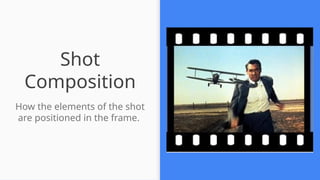
Shot
Composition
How the elements of the shot
are positioned in the frame.
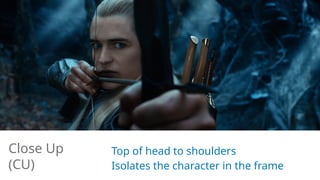
Top of head to shoulders
Isolates the character in the frame
Close Up
(CU)
Anything closer than a Close Up
Extreme
Close Up
(ECU)
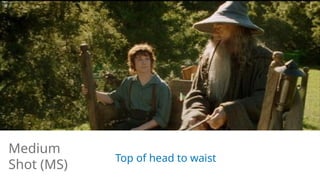
Top of head to waist
Medium
Shot (MS)
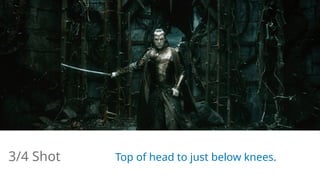
3/4 Shot Top of head to just below knees.
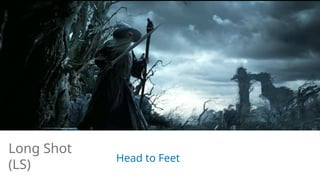
Head to Feet
Long Shot
(LS)
Character becomes almost lost in the
scene.
Extreme Long
Shot (ELS)
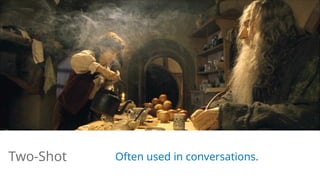
Often used in conversations.
Two-Shot
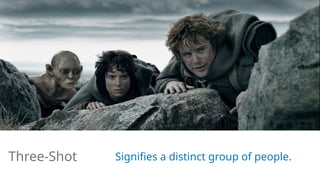
Signifies a distinct group of people.
Three-Shot
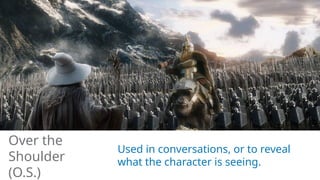
Used in conversations, or to reveal
what the character is seeing.
Over the
Shoulder
(O.S.)
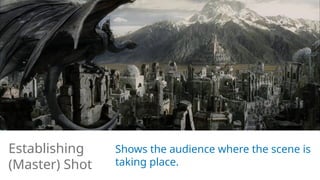
Shows the audience where the scene is
taking place.
Establishing
(Master) Shot
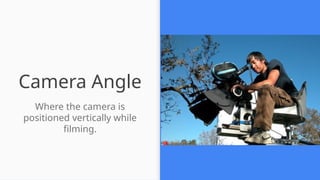
Camera Angle
Where the camera is
positioned vertically while
filming.
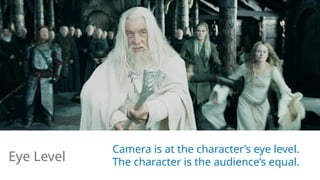
Camera is at the character’s eye level.
The character is the audience’s equal.
Eye Level
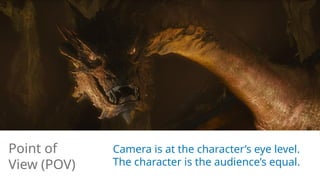
Camera is at the character’s eye level.
The character is the audience’s equal.
Point of
View (POV)
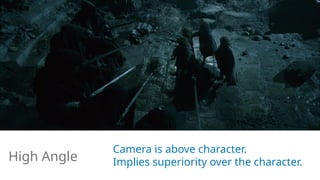
Camera is above character.
Implies superiority over the character.
High Angle
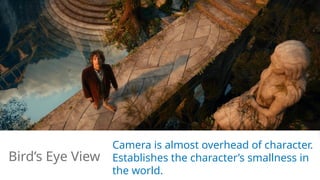
Camera is almost overhead of character.
Establishes the character’s smallness in
the world.
Bird’s Eye View
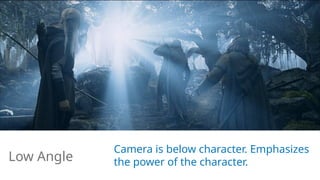
Camera is below character. Emphasizes
the power of the character.
Low Angle
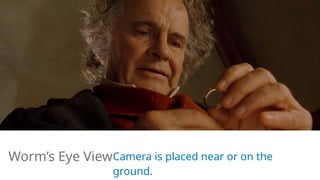
Camera is placed near or on the
ground.
Worm’s Eye View
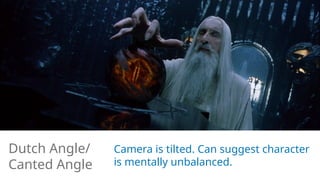
Camera is tilted. Can suggest character
is mentally unbalanced.
Dutch Angle/
Canted Angle
Moving Shot - place camera on a moving
object
Pan - horizontal camera movement
Tilt - vertical camera movement
Zoom - electronically moving the camera
closer or further to the subject
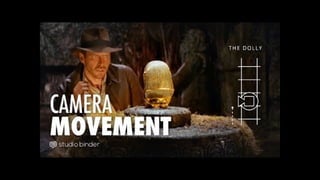
Dolly - physically moving the camera
forward or backward
Tracking - physically moving the camera
left or right
Crane/Boom - mounting the camera on a
weighted arm that moves it up and/or
down
Steadicam - special equipment that keeps
camera steady during handheld shots
Camera
Movement
Camera Movement is the real
or perceived movement of the
camera through space.
15 Compositional Theories
of
Cinematography
“I can't think how anyone can become a director without
learning the craft of cinematography.” – Nicolas Roeg
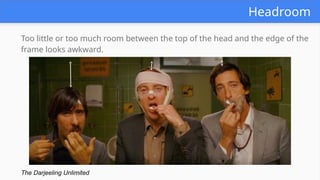
Headroom
Too little or too much room between the top of the head and the edge of the
frame looks awkward.
The Darjeeling Unlimited
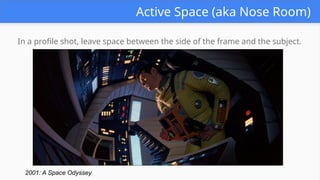
Active Space (aka Nose Room)
In a profile shot, leave space between the side of the frame and the subject.
2001: A Space Odyssey
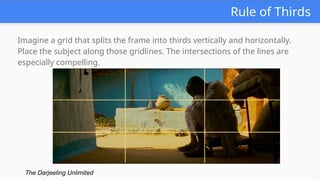
Rule of Thirds
Imagine a grid that splits the frame into thirds vertically and horizontally.
Place the subject along those gridlines. The intersections of the lines are
especially compelling.
The Darjeeling Unlimited
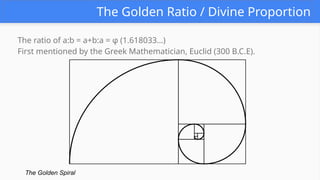
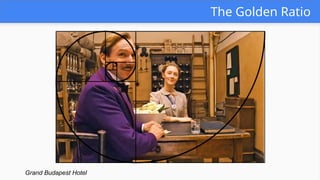
The Golden Ratio / Divine Proportion
The ratio of a:b = a+b:a = φ (1.618033…)
First mentioned by the Greek Mathematician, Euclid (300 B.C.E).
The Golden Spiral
The Golden Ratio
Grand Budapest Hotel
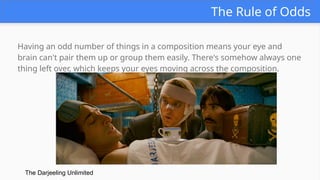
The Rule of Odds
Having an odd number of things in a composition means your eye and
brain can't pair them up or group them easily. There's somehow always one
thing left over, which keeps your eyes moving across the composition.
The Darjeeling Unlimited
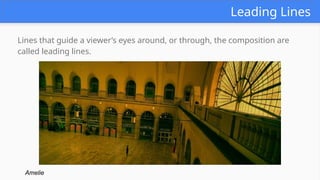
Leading Lines
Lines that guide a viewer’s eyes around, or through, the composition are
called leading lines.
Amelie
Strong Diagonal
A form of a leading line that can transform a boring composition into a
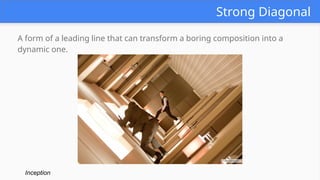
dynamic one.
Inception
Lines of Sight
Lines of sight are created when the subject is looking at something within
the frame. This causes the viewer to follow the line of sight to the object
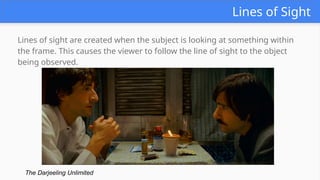
being observed.
The Darjeeling Unlimited
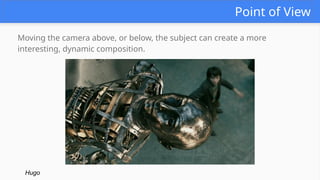
Point of View
Moving the camera above, or below, the subject can create a more
interesting, dynamic composition.
Hugo
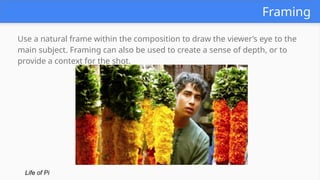
Framing
Use a natural frame within the composition to draw the viewer’s eye to the
main subject. Framing can also be used to create a sense of depth, or to
provide a context for the shot.
Life of Pi
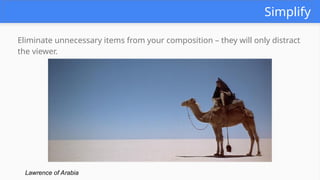
Simplify
Eliminate unnecessary items from your composition – they will only distract
the viewer.
Lawrence of Arabia
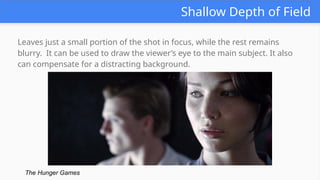
Shallow Depth of Field
Leaves just a small portion of the shot in focus, while the rest remains
blurry. It can be used to draw the viewer’s eye to the main subject. It also
can compensate for a distracting background.
The Hunger Games
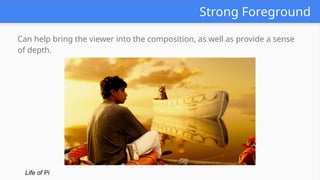
Strong Foreground
Can help bring the viewer into the composition, as well as provide a sense
of depth.
Life of Pi
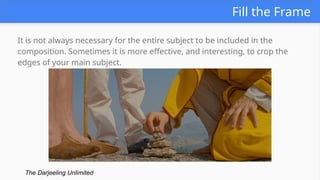
Fill the Frame
It is not always necessary for the entire subject to be included in the
composition. Sometimes it is more effective, and interesting, to crop the
edges of your main subject.
The Darjeeling Unlimited
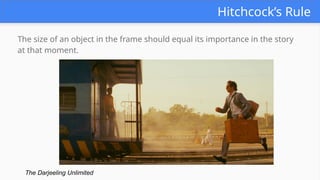
Hitchcock’s Rule
The size of an object in the frame should equal its importance in the story
at that moment.
The Darjeeling Unlimited https://vimeo.com/145332674
“I like movies where you can come back and re-
watch them and admire the cinematography 25
years later.”
– Rob Zombie
References & Resources
Moving Pictures by Russell Sharman is licensed under a
Creative Commons Attribution-NonCommercial-ShareAlike 4.0 Internation
al License
, except where otherwise noted.
FILM APPRECIATION by Dr. Yelizaveta Moss and Dr. Candice Wilson is
licensed under a Creative Commons Attribution 4.0 International License.

Camera Composition & Movement - Film Production

  • 1.
  • 2.
    The Shot The shotis the most basic building block of cinematography. A shot is one continuous capture of a span of action by a motion picture camera. A finished film is made up of a series of these shots, of varying length, that ultimately tell the story.
  • 3.
    Composition Film celluloid iscomposed of frames, still images that together make up the entirety of a film. Composition is the arrangement of people, objects and setting within the frame of an image. How those people, objects and setting are arranged with in the border of the image can bring balance or imbalance, reveal or hide information, indicate power or weakness, all without a word of dialog, an edit or even a character on the screen.
  • 4.
    Basic Camera Composition- Shots and Angles in Filmmaking
  • 5.
    Shot Composition How the elementsof the shot are positioned in the frame.
  • 6.
    Top of headto shoulders Isolates the character in the frame Close Up (CU)
  • 7.
    Anything closer thana Close Up Extreme Close Up (ECU)
  • 8.
    Top of headto waist Medium Shot (MS)
  • 9.
    3/4 Shot Topof head to just below knees.
  • 10.
  • 11.
    Character becomes almostlost in the scene. Extreme Long Shot (ELS)
  • 12.
    Often used inconversations. Two-Shot
  • 13.
    Signifies a distinctgroup of people. Three-Shot
  • 14.
    Used in conversations,or to reveal what the character is seeing. Over the Shoulder (O.S.)
  • 15.
    Shows the audiencewhere the scene is taking place. Establishing (Master) Shot
  • 16.
    Camera Angle Where thecamera is positioned vertically while filming.
  • 17.
    Camera is atthe character’s eye level. The character is the audience’s equal. Eye Level
  • 18.
    Camera is atthe character’s eye level. The character is the audience’s equal. Point of View (POV)
  • 19.
    Camera is abovecharacter. Implies superiority over the character. High Angle
  • 20.
    Camera is almostoverhead of character. Establishes the character’s smallness in the world. Bird’s Eye View
  • 21.
    Camera is belowcharacter. Emphasizes the power of the character. Low Angle
  • 22.
    Camera is placednear or on the ground. Worm’s Eye View
  • 23.
    Camera is tilted.Can suggest character is mentally unbalanced. Dutch Angle/ Canted Angle
  • 25.
    Moving Shot -place camera on a moving object Pan - horizontal camera movement Tilt - vertical camera movement Zoom - electronically moving the camera closer or further to the subject Dolly - physically moving the camera forward or backward Tracking - physically moving the camera left or right Crane/Boom - mounting the camera on a weighted arm that moves it up and/or down Steadicam - special equipment that keeps camera steady during handheld shots Camera Movement Camera Movement is the real or perceived movement of the camera through space.
  • 27.
    15 Compositional Theories of Cinematography “Ican't think how anyone can become a director without learning the craft of cinematography.” – Nicolas Roeg
  • 28.
    Headroom Too little ortoo much room between the top of the head and the edge of the frame looks awkward. The Darjeeling Unlimited
  • 29.
    Active Space (akaNose Room) In a profile shot, leave space between the side of the frame and the subject. 2001: A Space Odyssey
  • 30.
    Rule of Thirds Imaginea grid that splits the frame into thirds vertically and horizontally. Place the subject along those gridlines. The intersections of the lines are especially compelling. The Darjeeling Unlimited
  • 31.
    The Golden Ratio/ Divine Proportion The ratio of a:b = a+b:a = φ (1.618033…) First mentioned by the Greek Mathematician, Euclid (300 B.C.E). The Golden Spiral
  • 32.
    The Golden Ratio GrandBudapest Hotel
  • 34.
    The Rule ofOdds Having an odd number of things in a composition means your eye and brain can't pair them up or group them easily. There's somehow always one thing left over, which keeps your eyes moving across the composition. The Darjeeling Unlimited
  • 35.
    Leading Lines Lines thatguide a viewer’s eyes around, or through, the composition are called leading lines. Amelie
  • 36.
    Strong Diagonal A formof a leading line that can transform a boring composition into a dynamic one. Inception
  • 37.
    Lines of Sight Linesof sight are created when the subject is looking at something within the frame. This causes the viewer to follow the line of sight to the object being observed. The Darjeeling Unlimited
  • 38.
    Point of View Movingthe camera above, or below, the subject can create a more interesting, dynamic composition. Hugo
  • 39.
    Framing Use a naturalframe within the composition to draw the viewer’s eye to the main subject. Framing can also be used to create a sense of depth, or to provide a context for the shot. Life of Pi
  • 40.
    Simplify Eliminate unnecessary itemsfrom your composition – they will only distract the viewer. Lawrence of Arabia
  • 41.
    Shallow Depth ofField Leaves just a small portion of the shot in focus, while the rest remains blurry. It can be used to draw the viewer’s eye to the main subject. It also can compensate for a distracting background. The Hunger Games
  • 42.
    Strong Foreground Can helpbring the viewer into the composition, as well as provide a sense of depth. Life of Pi
  • 43.
    Fill the Frame Itis not always necessary for the entire subject to be included in the composition. Sometimes it is more effective, and interesting, to crop the edges of your main subject. The Darjeeling Unlimited
  • 44.
    Hitchcock’s Rule The sizeof an object in the frame should equal its importance in the story at that moment. The Darjeeling Unlimited https://vimeo.com/145332674
  • 45.
    “I like movieswhere you can come back and re- watch them and admire the cinematography 25 years later.” – Rob Zombie
  • 46.
    References & Resources MovingPictures by Russell Sharman is licensed under a Creative Commons Attribution-NonCommercial-ShareAlike 4.0 Internation al License , except where otherwise noted. FILM APPRECIATION by Dr. Yelizaveta Moss and Dr. Candice Wilson is licensed under a Creative Commons Attribution 4.0 International License.